Home Blog Page 957

Bitcoin’s Short-Term Holder Whales Sitting On Increasing Unrealized Losses – What’s Going On?

0

Trusted Editorial content, reviewed by leading industry experts and seasoned editors. Ad Disclosure

Bitcoin is still hampered by the ongoing volatility across the cryptocurrency market, keeping its price below the $70,000 level for the past few days. With BTC’s price steadily trending downwards, whale short-term holders are starting to feel the heat, as their unrealized losses sharply increase.

Unrealized Losses Climb For Bitcoin’s STH Whales

After a prolonged period of downside price performance, Bitcoin’s unrealized losses are spiking. A recent report from Darkfost, a market expert and author of the CryptoQuant platform, has linked this sharp increase in unrealized losses to whale short-term holders. On-chain data shows that the level of unrealized losses held by these new whales is rising to increasingly concerning levels, hinting at mounting stress among some of the market’s largest and most influential participants. 

As Bitcoin tries to regain its upward momentum, these high-value wallets, which are frequently more sensitive to recent price changes, are currently sitting on substantial paper losses. At present, Darkfost has highlighted that the losses of these investors who entered the market within the past six months are valued at roughly $26 billion.

Bitcoin
Source: Chart form Darkfost on X

Zooming in on the chart, this figure ranks among the most significant levels seen this year. The peak was recorded on February 6th, which coincided with the BTC’s price drop below the $60,000 level, expanding unrealized losses during the period to approximately $32 billion. 

Darkfost noted that whales that joined the market later in the cycle are currently suffering the consequences of the current downward trend of the Bitcoin price. Although these investors holding positions at a loss is not necessarily constructive, it can erode confidence and bolster behavioral instability. 

Such a trend has the potential to trigger emotionally driven decisions in periods of renewed market volatility. Given the mounting pressure beneath the surface, short-term whale behavior may have a significant impact on Bitcoin’s next significant move.

No Real Rally for BTC In Sight Yet

Key Bitcoin on-chain signals are revealing a conflicting signal about the current market cycle. In a post on the social media platform X, CW, a data analyst and crypto investor, the BTC On-chain Activity Strength Signal metric is showing that a real rally has not progressed in this cycle.

Short-lived increases have been triggered by speculative momentum, but there are still no underlying structural clues that usually indicate a real long-term rally. According to the expert, everything that has occurred so far, from the massive rally to an all-time high to the sharp pullback, is a preparation for an upcoming rally, which is expected to kick off soon. 

CW has compared this impending massive upward move to the powerful rally experienced in the 2017 cycle. This time, the rally could be bigger due to the fact that whale accumulation is at an all-time high, adding that the real rally that is about to begin will be enormous.

Bitcoin
BTC trading at $65,759 on the 1D chart | Source: BTCUSDT on Tradingview.com

Featured image from Pixabay, chart from Tradingview.com

Editorial Process for bitcoinist is centered on delivering thoroughly researched, accurate, and unbiased content. We uphold strict sourcing standards, and each page undergoes diligent review by our team of top technology experts and seasoned editors. This process ensures the integrity, relevance, and value of our content for our readers.


Elliptic flags Russia-linked crypto exchanges over sanctions exposure risks

0

Several Russian-linked crypto exchanges continue to allow transactions linked to sanctioned entities, according to a report published Friday by blockchain analytics firm Elliptic.

The report outlines how certain platforms enable users to convert rubles into cryptocurrencies, transfer funds across borders outside traditional banking channels, and cash out through overseas brokers or exchanges. Elliptic said these transaction pathways can reduce reliance on the conventional financial system and complicate sanctions enforcement.

Last month, a separate Elliptic report revealed that while Tether’s USDT has become a key asset for Russia to evade Western sanctions imposed after the Ukraine invasion in 2022, transactions with the ruble-pegged stablecoin A7A5 surpassed $100 billion. Since Russia’s full-scale Ukraine invasion, Western governments imposed sanctions targeting energy, finance and strategic goods. The EU froze roughly $250 billion of Russian assets and the U.K., nearly $35 billion.

Elliptic’s report follows another one by TRM Labs last week that showed illicit entities received $141 billion in stablecoins in 2025, the highest in five years, and more than half of which was linked to the ruble-pegged A7A5 token, whose Russian executives dispute claims that their operations are illegal. Sanctions-related activity accounted for 86% of illicit crypto flows, TRM’s report said, with bad actors mostly relying on stablecoin platforms.

Among the exchanges highlighted in Elliptic’s report is Bitpapa, a UAE-registered peer-to-peer platform primarily serving Russian users. The U.S. Treasury’s Office of Foreign Assets Control (OFAC) sanctioned Bitpapa in March 2024.

Elliptic estimated that roughly 9.7% of the exchange’s outgoing crypto flows were sent to sanctioned entities, including about 5% to the Russia-linked exchange Garantex. The firm also alleges that Bitpapa rotates wallet addresses in a manner designed to hinder transaction tracing.

The report also named ABCeX, which operates from Moscow’s Federation Tower, and said it has processed at least $11 billion in crypto transactions, including flows to sanctioned exchanges such as Garantex and Aifory Pro.

Other exchanges cited include Rapira, which Elliptic says processed more than $72 million in transactions with sanctioned exchange Grinex, and Aifory Pro, a service offering cash-to-crypto transactions in Moscow, Dubai and Türkiye.

The findings highlight the ongoing role of crypto infrastructure in cross-border financial activity linked to sanctioned actors, even as regulators increase scrutiny of the sector.

Beneath the Surface: Why Bitcoin’s Recovery Still Lacks Structural Confirmation

0

Bitcoin is trading at $66,304 at 8:45 a.m. EST on Feb. 23, 2026, carving out a consolidation range after a violent macro unwind. The market is stabilizing, but the broader structure remains technically fragile unless key resistance levels are reclaimed with conviction. Bitcoin Chart Outlook Bitcoin‘s daily chart on Monday morning reflects a clear macro […]

FCA Chief Nikhil Rathi Confirms Regulatory Shift Away From New Rules in Candid Podcast Interview

0

Financial Conduct Authority (FCA) Chief Executive Nikhil Rathi has signalled a fundamental shift in the regulator’s approach. Speaking as the inaugural guest on the newly launched Fairer Finance podcast, Rathi confirmed the FCA is moving away from writing new rules in favour of using the existing Consumer Duty and supervisory tools to address market failures.

In what has been described as a “remarkably candid interview,” Rathi acknowledged that “not every problem is going to be solved quickly by doing big interventions, more rules, bans, guidance”.

He elaborated: “I think that there’s a whole range of influences that are informing our willingness to write lots of new rules…. we’re moving to an outcomes-based approach, and that will mean less rules in the future because we think the Consumer Duty will do a lot of the work for us”.

Treasury pressure and transparency

During the interview, Rathi offered a frank admission regarding political pressure, specifically concerning the FCA’s use of Voluntary Requirements (VREQs). VREQs allow the regulator to secure operational changes from firms without making public announcements or taking formal enforcement action.

“The Treasury, I think, weren’t pretty secret about their view that they weren’t a big fan of transparency, about our actions when it came to firms,” Rathi revealed. “They were very persuaded by some of the lobbying they received on that topic. Nonetheless, we are stepping up the way in which we communicate through our enforcement watch”.

Stepping back from “distributional questions”

The interview also highlighted a repositioning by the FCA regarding cross-subsidies and distributional fairness in products like credit cards and premium finance. Rathi suggested these issues are “not within our mandate to decide on,” placing the responsibility firmly with the Government and the Treasury.

When challenged about business models where financially vulnerable customers essentially subsidise better-off consumers (such as those getting 0% credit cards or paying insurance premiums upfront), Rathi responded: “What is not within our mandate to decide on is some of the distributional questions that you’re pointing towards. …there can be some areas of our work which intersect with social policy. And the issue that certain products may be more expensive for certain parts of society is not going to be directly something a regulator deals with. It becomes something that becomes a matter for government”.

James Daley, managing director of the consumer group Fairer Finance, expressed concern over the FCA’s changing stance.

“This was a remarkably candid interview, and credit to Nikhil for being so open about the pressures the FCA is under and the trade-offs they’re making,” Daley said. However, he added: “We are of course disappointed to see confirmation that the FCA is stepping back from tackling problems with new regulation. While the Consumer Duty provides a useful framework for the FCA to tackle poor conduct on a firm-by-firm basis, there are a number of wider market failures that won’t be addressed without new rules or much clearer guidance”.

Daley also pointed to the broader political climate, noting: “The FCA is under pressure from the Treasury to prioritise growth and to deal with market failure and misconduct through supervisory conversations behind closed doors. As Dame Meg Hillier pointed out last week, the Chancellor has had only one meeting with a consumer group since taking office – compared to dozens of meetings with banks, insurers and asset managers. And it’s clear that this emphasis from Treasury is also following through to the way its regulator acts”.

Other key takeaways from the interview:
  • Motor Finance Redress Scheme: Rathi confirmed the final scheme will differ from the initial consultation following industry lobbying, though he insisted the FCA will act “forcefully” where the law has been broken. Final rules are expected later this month.
  • Mortgage Rules: Acknowledging the risks of loosened mortgage lending rules, Rathi noted they have made an average of £30,000 more available for mortgages, leading to a “huge increase in first-time buyers last year”. However, he admitted this could lead to “a modest amount of additional distress if interest rates rise significantly”.
  • Targeted Support: A new initiative for pensions and investments will launch in April 2026. “We’ll see how it all works,” Rathi said, noting that the FCA will observe provider engagement before deciding on future directions.
  • Enforcement and Financial Crime: The FCA reported 40 enforcement outcomes in 2024 (up from 30 in 2023), with six Consumer Duty cases currently underway. Additionally, 84% of crypto firms applying for money laundering registration were rejected.

The full interview is available on the Fairer Finance podcast.

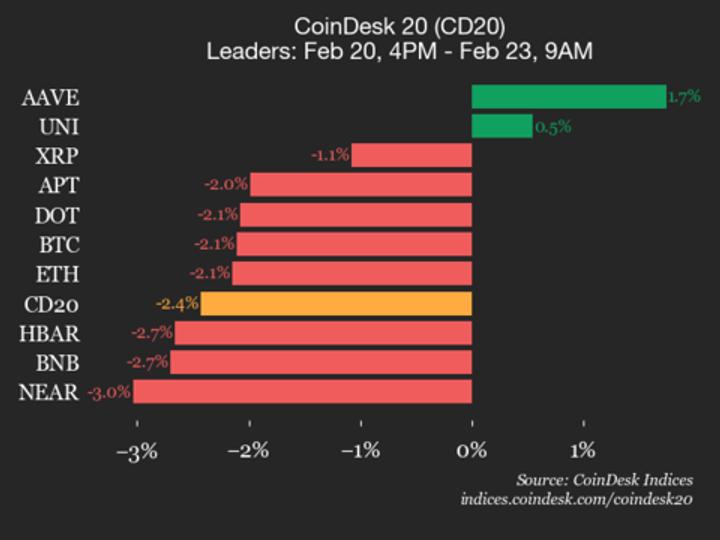
AAVE gains 1.7% while index trades lower over weekend

0

CoinDesk Indices presents its daily market update, highlighting the performance of leaders and laggards in the CoinDesk 20 Index.

The CoinDesk 20 is currently trading at 1917.67, down 2.4% (-47.79) since 4 p.m. ET on Friday.

Two of the 20 assets are trading higher.

Leaders: AAVE (+1.7%) and UNI (+0.5%).

Laggards: SUI (-4.8%) and SOL (-4.8%).

The CoinDesk 20 is a broad-based index traded on multiple platforms in several regions globally.

Standard Chartered Reaffirms $2T Stablecoin Call, Trims T-Bill View

0

Standard Chartered analysts stuck to their forecast that the stablecoin market will reach $2 trillion by late 2028, despite lowering expectations for short-term US Treasury bill demand.

Stablecoins like Tether’s USDt (USDT) and Circle’s USDC (USDC) are expected to push T-bill demand to $2.2 trillion by 2028, Standard Chartered analyst Geoffrey Kendrick and US rates strategist John Davies said in a Monday report shared with Cointelegraph.

Despite the US dollar stablecoin market cap stalling at around $300 billion in recent months amid a broader crypto downturn, the analysts remain bullish following the passage of the US GENIUS Act in 2025.

Source: Standard Chartered

“We see these issues as cyclical rather than structural, and we continue to expect stablecoin market cap to reach $2 trillion by end-2028,” Standard Chartered’s report said.

Stablecoins may drive Treasury to issue more bills despite lowered demand

According to Standard Chartered, stablecoins are now expected to generate an additional $0.8-$1 trillion in fresh T-bill demand for use as reserves by late 2028, a hefty reduction from the $1.6 trillion projected in April 2025, despite the passage of the GENIUS Act.

Related: SEC allows broker-dealers to take 2% ‘haircut’ on stablecoins

Standard Chartered analysts still expect that the US Treasury may use this potential excess demand as justification to issue more T-bills. They cited Treasury Secretary Scott Bessent’s statements in early February in which he suggested the GENIUS Act could be “an important feature of financing the US government.”

Source: Subjective Views

The Treasury’s quarterly refunding announcement on the same day also cited “growing demand for Treasury bills from the private sector,” the analysts noted, adding:

“Stablecoin-related demand, in conjunction with the Fed’s recent decision to commence RMPs [reserve management purchases] and replace its maturing MBS [mortgage-backed securities] with T-bills, could arguably cause T-bills to become overly scarce.”

In addition to forecasting stablecoins to reach $2 trillion by the end of 2028, Standard Chartered previously expected Bitcoin (BTC) to hit $500,000 over the same period.

Amid ongoing uncertainty in crypto markets, the bank’s analysts have recently lowered their BTC price target for 2026 from $150,000 to $100,000, projecting the cryptocurrency could fall as low as $50,000 before a potential recovery.

Magazine: Is China hoarding gold so yuan becomes global reserve instead of USD?