Home Blog Page 946

Basware Launches New Agentic AI Capabilities to Transform Intelligent Finance

0

Basware, a global leader in Invoice Lifecycle Management (ILM), has unveiled new AI agents in its ILM platform to transform invoice processing and make accounts payable even more autonomous. The launch makes the future of intelligent finance a reality, today. 

“The immediate future of finance involves near-perfect, touchless invoice processing,” said Jason Kurtz, CEO, Basware. “The future involves Agentic Finance, where AI entities transact on behalf of the enterprise to drive faster, smarter decisions and real business outcomes. This is the future we are creating at Basware and preparing our customers for today. We are on a journey to get our customers to 100% automated, 100% compliant, and 100% protected invoice processing.” 

The two new agents will manage invoice disputes and payment queries, as well as help AP clerks solve processing questions in real time, driving forward autonomous accounts payable. 

The Dawn of Agentic Finance  

And the time has never been better. Pressure is mounting on finance to figure out how to use AI to drive efficiencies and savings across the business and deliver ROI. According to a global survey conducted by FT Longitude on behalf of Basware, 61% of 200 finance leaders across the US, UK, France and Germany polled say their organizations have rolled out AI agents largely as an experiment, simply to see what the technology could do. And one in four admit they still don’t fully understand what an AI agent looks like in practice. But the time for experimenting with AI is done. The C-Suite wants results. 

With Basware, finance leaders can leverage an intelligent platform embedded with AI to drive a modern process for managing the invoice process from end-end that delivers immediate ROI and long-term efficiency and growth.

From Automation to Autonomy 

In November, Basware launched InvoiceAI, an advanced solution delivered on its Invoice Lifecycle Management Platform that leverages generative AI, AI agents, natural language processing and deep learning to enhance the invoicing process from ingestion to reconciliation, and introduced two new AI agents. Designed to supercharge the skills of AP teams, the agents don’t replace humans. Instead, they act as digital teammates, supporting execution of key tasks so that their human peers can focus on strategic activities: 

·      AP Business Agent – Offers contextual, real-time guidance on actions and next best steps to take when handling invoices to streamline and remove friction from the process. 

·      AP Data Agent – Allows users to query invoice data using natural language questions such as “Show me all invoices awaiting approval in Germany,” or “Which suppliers gave us early payment discounts this month?,” and delivers instant answers to drive optimal actions. 

“When AI agents handle the repetitive questions to business users, AP teams are freed up to ask strategic questions that lead to real impact,” said Kurtz. “That’s how you move from processing transactions to driving strategy.”

Trusted by Design

It sounds great in theory, but finance teams will only delegate work to AI if they feel that they stay in control of what AI is allowed to do, that every AI action is auditable and explainable, and that there is a single, governed execution path for AI/agent actions, not lots of disconnected bots.  

Recognizing this, Basware’s approach to Agentic AI is built on trust by design. “Autonomy without trust is just risk,” Kurtz said. “Our platform is uniquely designed to ensure that every AI decision is explainable, auditable, and governed through the same controls finance teams already rely on. That’s how we help our customers safely delegate more to AI while staying 100% compliant and 100% protected.”  

With Basware, every AI agent action flows through a single, governed execution path within the Invoice Lifecycle Management Platform, enforced by a central policy engine and a series of autonomy gates. These gates apply each customer’s business rules, compliance requirements, and risk thresholds before any action is taken. The result is that AI can take on more of the work, while finance teams retain full visibility, control, and a complete audit trail for every autonomous decision.  

And more AI innovation from Basware is on the way, with future agents that will go beyond surfacing insights and help prioritize actions, automate resolutions, and connect the dots across systems to support faster, smarter decision-making at scale. Among the agents planned for release:  

·       Supplier Agent – Will support managing invoice disputes and payments queries. Agent will automatically call supplier and explain dispute, summarize call and next steps, and thereby achieve quicker resolutions. 

·       AP Pro Agent – Will use generative AI to help AP clerks solve processing questions in real time through simple, natural-language queries, reducing delays and manual effort. 

Billerud, which creates paper and packaging materials, was an early adopter of  Basware’s InvoiceAI and is already seeing the benefits the solution can deliver. 

“Since day one, we’ve perceived the desired values from the project,” commented Jesper Persson, Business Developer at Billerud. “The quality of invoices has improved considerably, and the AI continues to evolve and improve with each passing day. The efficiency gains we achieved translated directly into tangible cost savings, paving the way for a rapid return on investment within just a few months,” he said. 

Crossing the AI-Delegation Chasm 

Basware will continue to invest in AI innovation across its Invoice Lifecycle Management platform and deliver new capabilities that leverage the latest advancements to help its customers cross the AI delegation chasm and unlock the real value of the technology for their business. The capabilities will be rolled out throughout 2026. 

“At Basware, AI is not a buzzword or a bonus feature. It is an integral part of our business, and we will continue to apply and use it intelligently, securely, and ethically to enable our customers to drive cost efficiencies, enhance operations and sharpen their competitive edge,” Kurtz said. 

To learn more about Basware’s Intelligent Lifecycle Management Platform and the value it is creating for finance organizations around the world, click here. 
Why Michael Saylor thinks bitcoin is mirroring Apple’s legendary ‘valley of despair’

0

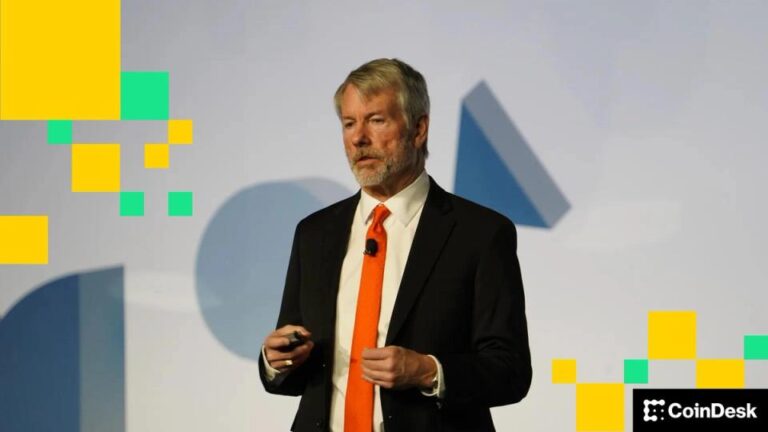
Michael Saylor wants bitcoin holders to think about Apple (AAPL).

Not Apple today, but Apple in 2013, when the stock had fallen 45% from its peak and was trading at a price-to-earnings ratio below 10, priced like a tired cash cow with no future. The iPhone was already indispensable to more than a billion people, yet the market remained unconvinced. It took seven years, along with the backing of Carl Icahn and Warren Buffett, before Apple fully recovered its prior valuation.

This is the comparison favored by Michael Saylor, founder of Strategy (MSTR), by far the largest public holder of bitcoin .

“There really is no example of a successful technology investment where you did not have to weather the 45% drawdown and go through that valley of despair,” Saylor said on Natalie Brunell’s Coin Stories podcast.

“Ours is currently taking 137 days so far. But it might take two years, it might take three years. If it took seven years, congratulations. It’s just like Apple.”

Bitcoin has dropped roughly 45% from its all time high near $125,000, mirroring the scale of Apple’s 2012 to 2013 decline. The downturn has already left scars. On Feb. 5 alone, when bitcoin fell from $70,000 to $60,000 in a single session, the network recorded $3.2 billion in entity adjusted realized losses, according to Glassnode. That surpassed the Terra Luna collapse as the largest single day loss event in bitcoin’s history.

Saylor attributed the more muted cycle in part to structural changes. The migration of derivatives activity from offshore venues to regulated U.S. markets, he said, is dampening volatility in both directions, compressing what might once have been an 80% drawdown into a 40% to 50% decline.

Traditional banks still refuse to extend meaningful credit against bitcoin holdings. That forces some investors into shadow banking or rehypothecation structures, which can create artificial selling pressure during periods of stress.

From quantum FUD to Epstein FUD

Saylor was similarly dismissive when asked about the risks posed by quantum computing, describing it as the latest in a long line of existential narratives, from block size wars to energy consumption to Chinese mining dominance, that generate attention but ultimately fail to derail the network.

He argued that quantum computing is not a near-term threat and is more than a decade away from posing a practical risk in all likelihood. By the time it becomes relevant, he expects government, financial, consumer, and defense systems to have transitioned to post quantum cryptography. Bitcoin’s software will evolve as well, he noted, with nodes, exchanges, and hardware providers upgrading through broad global consensus if necessary.

Any credible quantum breakthrough, he said, would require coordinated upgrades across every digital system worldwide, not just bitcoin. In that context, he framed both the quantum narrative and renewed attention around the Jeffrey Epstein files, which have been used by critics to target certain Bitcoin Core developers, as shifting forms of fear, uncertainty, and doubt (FUD).

“It’s a non-issue,” Saylor said. “I guess they were getting tired of the quantum FUD and they moved on to the Epstein FUD.”

BTC price teeters near $63,000 as pippin’s rally shows speculative froth remains: Crypto Daybook Americas

0

By Omkar Godbole (All times ET unless indicated otherwise)

While bitcoin and other major tokens remain under pressure, an AI-generated memecoin on the Solana blockchain is shining.

Pippin (PIPPIN), which started as a ChatGPT-generated unicorn image and evolved into an autonomous AI agent that interacts on social media platforms, has surged 135% over the past four weeks, rising 10% in 24 hours alone.

The rally in the token created by Yohei Nakajima, an innovator and thought leader in AI venture capital, appears to be driven by speculation, according to market intelligence platform LunarCrush.​

“Pippin’s price action is currently driven by strong speculative interest and rapid market cap growth, but concerns about manipulation and ‘crime’ suggest that the current price may be influenced by artificial pumps rather than organic demand, creating a volatile environment,” it said.​

Several social media accounts have alleged that the rally involves money laundering, raising reputational risk for the digital asset ecosystem.

Whatever the case, PIPPIN’s performance is evidence of lingering speculative froth in the market despite bitcoin dropping almost 50% since October. This suggests potential for more pain ahead.

As Bloomberg’s Mike McGlone said, “A Bitcoin bottom may require a further cleansing of millions of cryptos tracking nothing and a recovery in stock market volatility.”

Bitcoin dipped below $63,000 during Asian hours and has since stabilized near $63,200. Still, it’s down about 4% over 24 hours with ether (ETH), solana (SOL), XRP and the CoinDesk 20 Index falling at least as much.

U.S. tariffs and fears of AI-driven disruptions to global growth and jobs are keeping risk assets under pressure.

According to CryptoQuant, steady institutional demand is lacking, as evidenced by the persistently negative Coinbase Premium Index, which measures the bitcoin price premium on Coinbase relative to Binance.

Observers continue to highlight $60,000 as the key level.

“If we lose $60k, violent cascading liquidations ensue and you can kiss any recovery goodbye, at least until the next halving approaches. You’ll probably see a bunch of treasury companies for both BTC and ETH blow up, along with MSTR dropping below $100 if we lose $60k,” Vinny Lingham, serial entrepreneur and technology investor, said.

“I expect a 2022-type blowup if we do lose $60k,” Lingham said.​

In traditional markets, the yen weakened 1% against the U.S. dollar on reports the Japanese prime minister is taking a tough stance against the Bank of Japan’s plans to increase interest rates. The yen and bitcoin have developed an uncanny positive relationship in recent months. Stay alert!

Read more: For analysis of today’s activity in altcoins and derivatives, see Crypto Markets Today

What to Watch

For a more comprehensive list of events this week, see CoinDesk’s “Crypto Week Ahead”.

  • Crypto
  • Macro
    • Feb. 24, 8:15 a.m.: U.S. ADP employment change weekly (Prev. 10.25K)
    • Feb. 24, 9 a.m.: S&P Case-Shiller home price YoY (Prev. 1.4%)
    • Feb. 24, 10:00 a.m.: U.S. CB consumer confidence est. 86 (Prev. 84.5)
    • Feb. 24, 1:00 p.m.: U.S. money supply for January (M2) (Prev. $22.4T)
  • Earnings (Estimates based on FactSet data)
    • Feb. 24: Cipher Mining (CIFR), pre-market, $0.03

Token Events

For a more comprehensive list of events this week, see CoinDesk’s “Crypto Week Ahead”.

  • Governance votes & calls
    • Feb. 24: KAST to host an X Spaces session on the launch of the Pengu Card.
    • GMX DAO is voting to neutralize CEX supply overhang by restructuring liquidity, setting a temporary $5 buy-wall, and pausing staking rewards until the token price reaches $90. Voting ends Feb. 24.
  • Unlocks
  • Token Launches
    • Feb. 24: WAR (WAR) to be listed on Kraken.

Conferences

For a more comprehensive list of events this week, see CoinDesk’s “Crypto Week Ahead”.

Market Movements

  • BTC is down 2.05% from 4 p.m. ET Monday at $63,257.26 (24hrs: -4.54%)
  • ETH is down 1.95% at $1,826.78 (24hrs: -4.92%)
  • CoinDesk 20 is down 1.95% at 1,826.19 (24hrs: -4.53%)
  • Ether CESR Composite Staking Rate is up 5 bps at 2.81%
  • BTC funding rate is at -0.0032% (-3.5489% annualized) on Binance
  • DXY is up 0.1% at 97.81
  • Gold futures are down 0.69% at $5,189.50
  • Silver futures are up 1.32% at $87.71
  • Nikkei 225 closed up 0.87% at 57,321.09
  • Hang Seng closed down 1.82% at 26,590.32
  • FTSE is down 0.25% at 10,657.66
  • Euro Stoxx 50 is down 0.13% at 6,106.15
  • DJIA closed on Monday down 1.66% at 48,804.06
  • S&P 500 closed down 1.04% at 6,837.75
  • Nasdaq Composite closed down 1.13% at 22,627.27
  • S&P/TSX Composite closed down 0.12% at 33,776.50
  • S&P 40 Latin America closed down 1.48% at 3,743.45
  • U.S. 10-Year Treasury rate is up 0.8 bps at 4.035%
  • E-mini S&P 500 futures are up 0.22% at 6,866.75
  • E-mini Nasdaq-100 futures are up 0.33% at 24,843.50
  • E-mini Dow Jones Industrial Average Index futures are up 0.15% at 48,922.00

Bitcoin Stats

  • BTC Dominance: 58.35% (-0.51%)
  • Ether-bitcoin ratio: 0.02881 (0.32%)
  • Hashrate (seven-day moving average): 1,014 EH/s
  • Hashprice (spot): $27.70
  • Total fees: 2.6 BTC / $170,446
  • CME Futures Open Interest: 113,640 BTC
  • BTC priced in gold: 12.2 oz.
  • BTC vs gold market cap: 4.23%

Technical Analysis

Ether's daily chart in candlestick format. (TradingView)

Ether is under pressure, sliding toward key support levels. (TradingView)

  • The chart shows ether’s daily price swings in candlestick format.
  • Ether is facing renewed selling pressure and could soon retest the recent low of $1,781.
  • Should buyers fail to defend that, the focus would shift to $1,385, the low registered in April last year. This level marked the end of the downtrend at the time.

Crypto Equities

  • Coinbase Global (COIN): closed on Monday at $160.24 (-6.48%), -1.49% at $157.85 in pre-market
  • Circle Internet (CRCL): closed at $61.17 (-2.94%), -1.05% at $60.53
  • Galaxy Digital (GLXY): closed at $20.34 (-4.06%), -1.52% at $20.03
  • Bullish (BLSH): closed at $30.63 (-3.59%), -1.40% at $30.20
  • MARA Holdings (MARA): closed at $7.88 (-1.13%), -1.90% at $7.73
  • Riot Platforms (RIOT): closed at $15.65 (-0.19%), -1.47% at $15.42
  • Core Scientific (CORZ): closed at $16.89 (-2.37%), -0.47% at $16.81
  • CleanSpark (CLSK): closed at $9.82 (+1.76%), -1.93% at $9.63
  • CoinShares Valkyrie Bitcoin Miners ETF (WGMI): closed at $39.76 (+2.36%), -0.58% at $39.53
  • Exodus Movement (EXOD): closed at $9.55 (-3.14%)

Crypto Treasury Companies

  • Strategy (MSTR): closed at $123.71 (-5.60%), -1.06% at $122.40
  • Strive (ASST): closed at $7.36 (-9.69%), +0.27% at $7.38
  • SharpLink Gaming (SBET): closed at $6.49 (-3.42%), -1.23% at $6.41
  • Upexi (UPXI): closed at $0.56 (-8.58%)
  • Lite Strategy (LITS): closed at $1.07 (-3.60%)

ETF Flows

Spot BTC ETFs

  • Daily net flows: -$203.8 million
  • Cumulative net flows: $53.79 billion
  • Total BTC holdings ~1.26 million

Spot ETH ETFs

  • Daily net flows: -$49.5 million
  • Cumulative net flows: $11.51 billion
  • Total ETH holdings ~5.66 million

Source: Farside Investors

While You Were Sleeping

Over 400,000 BTC bought between $60k and $70k during BTC’s latest downturn

0

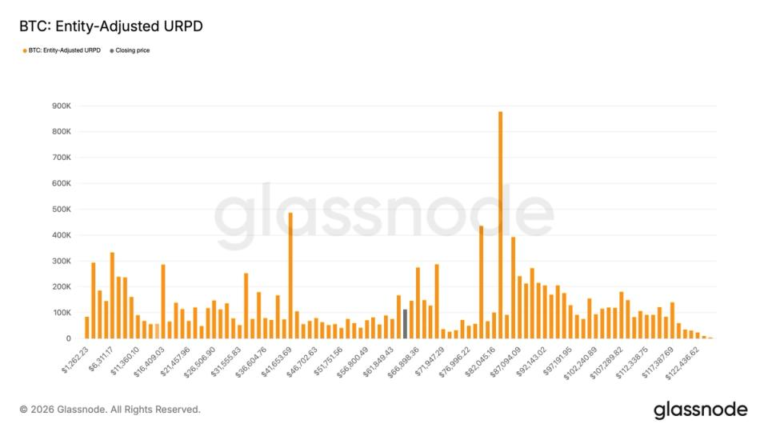
More than 400,000 BTC have been accumulated between $60,000 and $70,000 during bitcoin’s latest downturn, underscoring aggressive dip buying as the market retraced sharply, according to Glassnode data.

Supply in the $60,000 to $70,000 band has risen from roughly 997,000 BTC on Jan. 1 to about 1.43 million BTC today, an increase of approximately 429,000 BTC, or 43%, according to Glassnode data. More than 8% of the non exchange circulating supply now has a cost basis within this range, forming a dense cluster of ownership.

BTC’s price has fallen from around $88,000 on Jan. 1 to $63,000, part of a broader correction that has seen bitcoin drop around 50% from its October all time high of $126,000.

The analysis is based on Glassnode’s Unspent Transaction Output Realized Price Distribution (URPD) metric, which groups existing bitcoin supply by the price at which each coin last moved on chain. The entity adjusted version clusters addresses controlled by the same owner, excludes internal transfers, and removes exchange balances, offering a clearer view of genuine investor cost basis.

CoinDesk has previously described the $70,000 to $80,000 zone as an “air pocket”, a region where bitcoin has historically traded very little. During this recent downturn, it took just five days, from Jan. 31 to Feb. 5, for bitcoin to fall from $80,000 to $70,000, highlighting how quickly price can move through thinly transacted areas before finding heavier supply concentration below.

NPTN by LMS Joins Bank of England Synchronisation Lab to Tackle Remortgage Friction

0

LMS, a UK conveyancing services provider, is participating in the Bank of England‘s Synchrorisation Lab through its NPTN network. The initiative is examining how synchronised settlement could support a more efficient and secure remortgage process for lenders and other transaction stakeholders.

Despite broader digitisation across financial services, property transactions remain heavily reliant on manual processes. Currently, there is often poor alignment between payment finality, legal completion, and charge registration. For lenders, these timing gaps create significant settlement risk, operational friction, and avoidable completion delays.

The Bank of England’s Synchronisation Lab is exploring whether synchronising the movement of money and assets using central bank money could address these structural challenges at their root.

Testing synchronised settlements

Nick Chadbourne, CEO of LMS

Working in eight-week testing cycles, NPTN will trial a synchronised remortgage process within the Lab’s simulated Real-Time Gross Settlement (RTGS) environment.

This testing will involve splitting payments into ‘earmark’ and ‘settle’ stages via the RTGS system, while ensuring alignment with wider industry processes such as priority search, advance notice, and charge registration.

LMS currently operates at the heart of the home buying ecosystem, connecting over 4,000 law firms and more than 45 lenders, and successfully managing around 450,000 transactions each year. Through NPTN, LMS is bringing together payments infrastructure, digital identity, and legal processes to reduce risk across the entire conveyancing journey.

Nick Chadbourne, CEO of LMS, commented: “We’ve already used the NPTN sandbox to work collaboratively with 15 lenders to test use cases that improve the journey. Through the Synchronisation Lab, we can deepen that collaboration by ensuring synchronisation cuts settlement risk and streamlines completion, giving lenders greater certainty, while also aligning with the requirements of our law firm partners as we explore the future of the home buying and selling process for all key stakeholders.”

Replacing manual checks

The work within the Lab builds upon existing NPTN initiatives designed to modernise the sector. These include reusable digital ID, qualified electronic signatures, and using Open Banking for Source of Funds checks. The latter is currently in testing to replace the manual checks that are still used in over 80 per cent of property transactions.

An anonymous participating lender highlighted the potential industry impact, stating: “Synchronised settlement has the potential to materially reduce settlement risk and speed up completion. The Lab gives lenders confidence these improvements can be achieved in practice.”

Bitcoin Dips Under $63K as Market Enters Full Capitulation Phase

0

Panic selling by short-term holders, combined with the RSI near record lows, suggests that BTC could be transitioning into a full capitulation regime.

Bitcoin (BTC) sellers resumed their activity on Tuesday as the BTC price dropped 4% in 24 hours to an intraday low of $62,700.

Analysts said that Bitcoin has entered an “excess loss-realization” phase, with the relative strength index (RSI) suggesting that a price bottom may be forming. 

Key takeaways:

  • Bitcoin holders continued capitulating, pushing the BTC price below $63,000 on Tuesday. 

  • Bitcoin’s weekly RSI is nearing record lows, signaling a potential bottom.

BTC/USD hourly chart. Source: Cointelegraph/TradingView

Bitcoin holders continue capitulating

The Short-Term Holder SOPR (STH-SOPR), which measures whether short-term holders are selling at a profit or a loss, dropped below 1 after US President Donald Trump announced a new 15% global tariff on Saturday.

Related: Negative Bitcoin funding rate may signal short squeeze above $70K

Currently at 0.95, the metric shows “renewed short-term loss realization,” CryptoQuant analyst XWIN Research Japan said in a Quicktake post on Monday, adding:

“The primary sellers are short-term holders reacting to uncertainty, rather than long-term investors distributing structurally.”

Bitcoin: Short-term holder SOPR. Source: CryptoQuant

When analyzing the volume of coins spent at a loss, the seven-day estimated moving average (EMA) of Bitcoin’s short-term holder net realized losses had cooled to $500 million per day, after rising as high as $1.24 billion per day on Feb. 6. 

Glassnode said: 

“While the intensity has cooled, the broader regime still signals a market under pressure, with participants in the base formation phase continuing to capitulate.”

Bitcoin entity adjusted STH Net realized profit/loss. Source: Glassnode

The 90-day simple moving average (SMA) of Bitcoin’s realized profit/loss ratio has “now fallen below 1, confirming a full transition into an excess loss-realization regime,” Glassnode said.

Bitcoin: Realized profit/loss ratio. Source: Glassnode

Bitcoin’s “most oversold” RSI could be a bottom

Bitcoin’s weekly relative strength index, which measures the speed and change of price movements, reached its “most oversold” score of 25.71 on Tuesday.

These levels were last seen on July 22, a few months before the BTC price bottomed at $15,500 and then embarked on a bull run.

BTC/USD weekly RSI. Source: Cointelegraph/TradingView

In all previous capitulation events when the RSI hit such extreme levels, short-term weakness was common, but a long-term recovery followed every time.

Bitcoin’s weekly RSI is the “most oversold it has ever been, currently at 25.6, which is lower than the previous record low level back after 3AC/Luna crash,” crypto analyst Nic Puckrin said in an X post on Tuesday, adding:

 “More downside is likely, but a bottom could be coming soon.”

As Cointelegraph reported, Bitcoin’s fear and greed index is at historic lows while the number of bulls predicting new all-time highs is declining, which may be healthy market indicators for a macro bottom.