Terraform Labs is suing quantitative trading firm Jane Street for its role in the collapse of the Terra ecosystem.
Terraform Labs’ estate has filed a lawsuit against quantitative trading firm Jane Street, alleging that the firm abused insider knowledge to profit from Terra and that it inadvertently contributed to the downfall of the ecosystem.
“In this case, however, Jane Street Capital and its traders exploited the public’s participation in crypto markets and contributed to the collapse of Terraform’s cryptocurrency ecosystem. They did so by misappropriating confidential information and manipulating market prices,” the suit reads.
The filing is heavily redacted, but focuses on a move related to the UST Curve 3pool. Per Snyder, Terraform withdrew $150 million of UST from the pool, a move that “was not publicly announced,” to deploy it to 4pool in the coming week.
Nine minutes later, Jane Street allegedly made its “first and only sale of UST in that pool,” selling $85 million of UST in a single transaction.
Snyder says that the swap directly led to a steep selloff in UST that resulted in Terra’s subsequent death spiral, and accuses Jane Street of using its connections with Terraform Labs to “maximize its own profits and avoid losses suffered by other investors who did not have this confidential information.”
Following the UST depeg, LUNA, now LUNC, plummeted from a $29 billion market capitalization to nearly zero in a matter of days, after reaching as high as $41 billion in April 2022.
LUNC Chart – CoinGecko
In December, Terra founder Do Kwon was sentenced to 15 years in prison, a sentence that exceeded the Department of Justice’s 12-year target, after Kwon pleaded guilty to fraud charges in August 2025.
Jane Street is one of the largest quantitative firms in traditional finance and crypto, with more than $650 billion in assets under management (AUM).
The European Securities and Markets Authority (ESMA), the financial markets regulator and supervisor in the European Union, issued a notice to remind entities to assess investment vehicles providing leverage exposure to cryptocurrencies.
In a Tuesday notice, ESMA said that derivatives products, including those marketed as “perpetual futures or perpetual contracts” tied to cryptocurrencies like Bitcoin (BTC) or Ether (ETH), likely fell within the scope of intervention measures applied to contracts for differences, or CFDs. The EU Authority warned companies to “take appropriate steps to identify, prevent, or manage conflicts of interest that may arise from the offering of these products.”
“Where these derivatives meet the definition of a CFD, they are subject to the applicable product intervention requirements, including leverage limits, a mandatory risk warning, a margin close-out and negative balance protection, and the prohibition of monetary and non-monetary benefits,” said ESMA.
Source: ESMA
The EU agency, which tracks compliance with the region’s Markets in Crypto Assets (MiCA) framework, was established in 2011 as part of oversight into investor protection in financial markets. ESMA has issued similar warnings to entities tied to digital assets, including a January publication targeting financial influencers potentially promoting “volatile cryptocurrencies.”
Related: Telegram CEO faces Russia probe over allegations of terrorism facilitation
Bill Hughes, senior counsel and director of global regulatory matters at Consensys, responded to the ESMA notice on X:
“[T]he statement clearly broadcasts that European authorities are closely watching the leveraged crypto-derivatives space. Rebranding a product as a ‘perpetual future’ will not insulate it from CFD restrictions if its characteristics match the definition […] Firms offering leveraged derivatives to retail clients in the EU must revisit their product analysis, distribution strategies, and governance frameworks — or EU regulators will do it for them.”
Although not specifically targeting EU markets under MiCA, cryptocurrency exchange Kraken announced on Tuesday that it had listed “perpetual futures tracking tokenized versions” of “major equity indices, gold-backed ETFs, and leading public companies.”
The products will be available to residents of more than 110 countries outside the US. However, a Kraken spokesperson told Cointelegraph that the product is “not available to EU clients at launch.”
Magazine: Is China hoarding gold so yuan becomes global reserve instead of USD?
Cointelegraph is committed to independent, transparent journalism. This news article is produced in accordance with Cointelegraph’s Editorial Policy and aims to provide accurate and timely information. Readers are encouraged to verify information independently. Read our Editorial Policy https://cointelegraph.com/editorial-policy
Michael Saylor, one of Bitcoin’s most influential advocates and the leading voice behind corporate Bitcoin adoption, has been officially confirmed as a speaker at Bitcoin 2026, returning to the world’s largest Bitcoin conference to share his latest insights on monetary transformation, institutional adoption, and the long-term future of sound money.
As the co-founder and executive chairman of Strategy, Saylor has played a central role in reshaping how corporations think about Bitcoin, pioneering the use of BTC as a treasury reserve asset and influencing boardrooms, investors, and policymakers around the world. His past appearances at Bitcoin conferences have consistently been among the most anticipated sessions, drawing packed audiences and generating global media attention.
WE’RE EXCITED TO ANNOUNCE MICHAEL SAYLOR AS A BITCOIN 2026 SPEAKER 🚀
Bitcoin 2026 Returns to Las Vegas Bigger Than Ever
Bitcoin 2026 will take place April 27–29 at The Venetian, Las Vegas, and is expected to be the largest Bitcoin conference in history.
Focused on the future of money, Bitcoin 2026 will bring together Bitcoin builders, investors, miners, policymakers, technologists, and newcomers from around the world. The event will feature a wide range of pass types, including general admission passes designed specifically for those new to Bitcoin, alongside premium passes for professionals, enterprises, and institutions.
With multiple stages, immersive experiences, technical workshops, and headline keynotes, Bitcoin 2026 is designed to serve both first-time attendees and long-time Bitcoiners shaping the next era of global adoption.
Past Bitcoin Conferences in the U.S.
Bitcoin’s flagship conference has scaled dramatically over the past five years:
2021 – Miami: 11,000 attendees
2022 – Miami: 26,000 attendees
2023 – Miami: 15,000 attendees
2024 – Nashville: 22,000 attendees
2025 – Las Vegas: 35,000 attendees
Bitcoin 2026 is expected to surpass all previous records projecting more than 40,000 attendees.
🎟️ Get Your Bitcoin 2026 Pass
Bitcoin Magazine readers can save 10% on Bitcoin 2026 tickets for a limited time.
Stay at The official hotel of Bitcoin 2026, The Venetian, and get a guaranteed low rate plus 15% off your pass. Be in the middle of where the fun is all happening, and where the networking never ends.
Bring your whole team to Bitcoin 2026 and get 20% off your entire order for a limited time.
📍 Location: The Venetian, Las Vegas 📅 Dates: April 27–29, 2026
With tens of thousands of attendees expected and major speakers like Michael Saylor already confirmed, now is the time to lock in your ticket.
Buy Bitcoin 2026 Tickets — Save 10%
Why Attend Bitcoin 2026?
Bitcoin 2026 is the definitive gathering for anyone serious about the future of money. With 500+ speakers, multiple world-class stages, and programming spanning Bitcoin fundamentals, open-source development, enterprise adoption, mining, energy, AI, policy, and culture, the conference brings every corner of the Bitcoin ecosystem together under one roof.
From headline keynotes on the Nakamoto Stage to deep technical sessions for builders, institutional strategy discussions for enterprises, and beginner-friendly Bitcoin 101 education, Bitcoin 2026 is designed for everyone—from first-time attendees to the leaders shaping Bitcoin’s global adoption.
Whether you’re looking to learn, build, invest, network, or influence, Bitcoin 2026 is where Bitcoin’s next chapter is written.
Bitcoin 2026 Pass Types: Something for Everyone
Bitcoin 2026 offers a range of pass options designed to meet the needs of newcomers, professionals, enterprises, and high-net-worth Bitcoiners alike.
🎟️ Bitcoin 2026 General Admission Pass
Ideal for newcomers and those looking to experience the heart of the conference.
Limited access on Days 2 & 3
Entry to Main Stage
Access to Genesis Stage
Full access to the Expo Hall
🎟️ Bitcoin 2026 Pro Pass
Designed for professionals, operators, and serious Bitcoin participants.
Includes all General Admission features, plus:
Full 3-day access, including Pro Day
Entry to the Pro Pass Reception
Access to Enterprise Hall, Enterprise Stage, and Networking Lounge
Conference App networking features
Access to the Bitcoin For Corporations Symposium
Entry to Compute Village and Energy Stage
Complimentary lunch, coffee, tea, and snacks
Dedicated registration and check-in
Reserved seating at Main Stage
🐋 Bitcoin 2026 Whale Pass
The all-inclusive, premium Bitcoin 2026 experience.
Includes all Pro Pass features, plus:
Reserved seating at Main Stage
All-inclusive gourmet food and beverages
Entry to Whale Night and Whale Reception
Access to all official after-parties
Networking app access to connect with other Whales
Premium access to The Deep — an exclusive networking lounge with intimate speaker sessions
This is the most immersive way to experience Bitcoin 2026.
🎉 Bitcoin 2026 After Hours Pass
Your ticket to the night.
Most deals are done with a drink in your hand. Get exclusive access to 3 official Bitcoin 2026 after-parties across Las Vegas — each with a 2-hour open bar — where the real conversations happen and the best connections are made.
Access to 3 official Bitcoin 2026 after-parties
2-hour open bar at each event
Evening events across Las Vegas, April 27–29
Network with Bitcoiners, builders, and industry leaders after hours
More headline speaker announcements are coming soon.
Artificial intelligence firm Anthropic has accused three AI firms of illicitly using its large language model Claude to improve their own models in a technique known as a “distillation” attack.
In a blog post on Sunday, Anthropic said that it had identified these “attacks” by DeepSeek, Moonshot, and MiniMax, which involve training a less capable model on the outputs of a stronger one.
Anthropic accused the trio of generating “over 16 million exchanges” combined with the firm’s Claude AI across “approximately 24,000 fraudulent accounts.”
“Distillation is a widely used and legitimate training method. For example, frontier AI labs routinely distill their own models to create smaller, cheaper versions for their customers,” Anthropic wrote, adding:
“But distillation can also be used for illicit purposes: competitors can use it to acquire powerful capabilities from other labs in a fraction of the time, and at a fraction of the cost, that it would take to develop them independently.”
Anthropic said that the attacks focused on scraping Claude for a wide range of purposes, including agentic reasoning, coding and data analysis, rubric-based grading tasks, and computer vision.
“Each campaign targeted Claude’s most differentiated capabilities: agentic reasoning, tool use, and coding,” the multi-billion-dollar AI firm said.
Source: Anthropic
Anthropic says it was able to identify the trio via an “IP address correlation, request metadata, infrastructure indicators, and in some cases corroboration from industry partners who observed the same actors and behaviors on their platforms.”
DeepSeek, Moonshot, and Minimax are all AI companies based in China. All three have estimated valuations in the multi-billion dollar range, with DeepSeek being the most widely internationally recognized out of the three.
Beyond the intellectual property implications, Anthropic argued that distillation campaigns from foreign competitors present genuine geopolitical risks.
“Foreign labs that distill American models can then feed these unprotected capabilities into military, intelligence, and surveillance systems—enabling authoritarian governments to deploy frontier AI for offensive cyber operations, disinformation campaigns, and mass surveillance,” the firm said.
Moving forward, Anthropic said it would protect itself by enhancing detection systems to help spot dubious traffic, sharing threat intelligence, and tightening access controls, among other things.
Related: Citrini’s AI doom report sees software, payment stocks tumble
The firm also called for more collaboration from domestic industry participants and lawmakers to help stop foreign AI companies from attacking US firms.
“No company can solve this alone. As we noted above, distillation attacks at this scale require a coordinated response across the AI industry, cloud providers, and policymakers. We are publishing this to make the evidence available to everyone with a stake in the outcome.”
Magazine: Crypto loves Clawdbot/Moltbot, Uber ratings for AI agents: AI Eye
Cointelegraph is committed to independent, transparent journalism. This news article is produced in accordance with Cointelegraph’s Editorial Policy and aims to provide accurate and timely information. Readers are encouraged to verify information independently. Read our Editorial Policy https://cointelegraph.com/editorial-policy
Milo, a financial technology company and early mover in the crypto lending space, has surpassed $100million in originated crypto mortgages, marking a significant milestone for the emerging digital asset–backed home loan market.
The milestone represents significant growth in the adoption of digital asset-based financing among high-net-worth individuals and institutional investors. The $100million figure includes the company’s largest single transaction to date—a $12million crypto mortgage.
Stability and AI-enhanced underwriting
Josip Rupena, CEO and founder of Milo
Despite the historical volatility of digital assets, Milo reports a perfect track record of zero margin calls across its entire mortgage portfolio. The company currently offers competitive interest rates that average around 7 per cent.
According to the firm, this stability is achieved through AI-enhanced underwriting, servicing, and real-time collateral monitoring. These technological tools allow Milo to assess risk more precisely and move faster than traditional lenders, which is a critical advantage in the fast-moving cryptocurrency market.
Josip Rupena, CEO and founder of Milo, commented on the firm’s growth: “Crossing $100million in originations demonstrates the maturity and stability of our lending infrastructure. We’ve moved beyond proving the concept. Now we’re proving the execution.”
He added: “We’re seeing demand across both high net-worth individuals and institutions who recognize crypto as legitimate collateral. Clients are buying homes with their Bitcoin and others are cashing out home equity to buy more Bitcoin.”
How the crypto mortgage works
The product allows clients to pledge Bitcoin or Ethereum as collateral to finance real estate. By doing so, borrowers can diversify into property while retaining their exposure to potential cryptocurrency appreciation.
Key features of the offering include:
Up to 100 per cent financing on home purchases.
Loan amounts available up to $25million.
The elimination of the need for a cash down payment.
The avoidance of costly taxable events that would normally occur when selling crypto to buy a house.
For clients who prioritise maximum control over their assets, Milo provides a “self-custody” crypto mortgage option, enabling borrowers to maintain possession of their Bitcoin while still qualifying for the financing. For the traditional crypto mortgage, client assets are safeguarded by industry-leading custodians Coinbase and BitGo. The company itself operates as a SOC 2 audited licensed lender subject to stringent regulatory oversight.
Adam Back, CEO of Blockstream and an early Bitcoin pioneer, praised the model: “Milo’s product is a game changer in Bitcoin lending and unlocks real world use cases for so many bitcoiners. While Bitcoin continues to appreciate, buyers are able to build equity in real estate and don’t have to sell their long term conviction, Bitcoin.”
Beyond its flagship mortgage offering, Milo has also seen explosive growth in its broader crypto loan product. The company’s loan book quadrupled over the course of 2025. With industry-leading rates starting at 8.25 per cent, clients have leveraged these flexible loans for a variety of purposes, including purchasing additional Bitcoin, acquiring land, funding home improvements, and making business investments.
Trusted Editorial content, reviewed by leading industry experts and seasoned editors. Ad Disclosure
Performance among meme coins has been abysmal over the past few months, and the likes of Shiba Inu have suffered especially during this time. Currently sitting at over 92% lower than its all-time high levels from 2021, all hope seems to be lost for the meme coins as more than 60% of all holders have plunged into losses. However, even amid this disturbing trend, expectations still remain that the Shiba Inu price could see a reversal and move upward again.
Shiba Inu Could Hit New All-Time Highs?
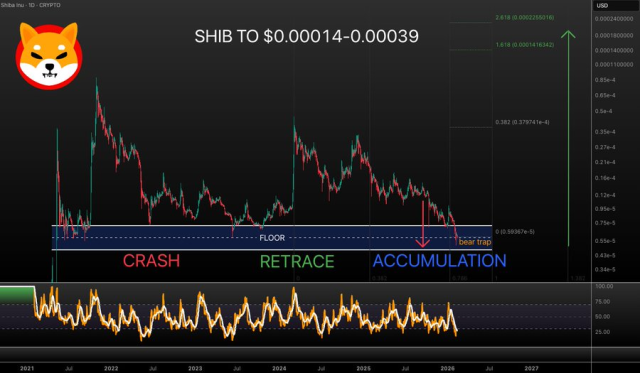
In an analysis shared earlier this month, crypto analyst Shib Spain highlights the possibility of the Shiba Inu price seeing a major price increase. This comes as the meme coin has entered what looks to be an accumulation phase, after coming out of a retracement period.
With the current downtrend, the analyst expects that the Shiba Inu price is setting up a bear trap, tricking traders into thinking the price will continue to fall and then doing the reverse. If this happens, then the analyst is expecting the meme coin’s price to rise 22x from the bottom of the bear trap, sitting around $0.0000045.
A 2,200% increase from here would put the price well above its all-time high of $0.00008, setting it on a course to new peaks. Shib Spain’s chart puts the top somewhere around $0.00018, essentially double its current peak levels.
Source: X
SHIB Still On Track To Recover
In the shorter term, the CoinCodex algorithm has also predicted a possible increase in the Shiba Inu price. The 1-3 month predictions show a tendency for a reversal, although the scale of this reversal seems to be severely limited in how high it could go.
Source: CoinCodex
Even with the Shiba Inu Fear & Greed Index reading in the Extreme Fear territory, the algorithm predicts that Shiba Inu will see a 14.26% increase in the next three months, putting it well above $0.000007. Despite this, sentiment remains incredibly bearish, and volatility is still tethering on the high side at 8.89%, the website shows.
SHIB struggles to recover from crash | Source: SHIBUSDT on Tradingview.com
Featured image from Dall.E, chart from TradingView.com
Editorial Process for bitcoinist is centered on delivering thoroughly researched, accurate, and unbiased content. We uphold strict sourcing standards, and each page undergoes diligent review by our team of top technology experts and seasoned editors. This process ensures the integrity, relevance, and value of our content for our readers.
Coinbase linked Yahoo Finance tickers directly to its exchange, enabling trading of crypto assets or tokenized stocks.
Kraken launched tokenized equity perpetual futures for non-U.S. clients, offering up to 20x leverage.
Binance has begun offering tokenized assets via Ondo Finance through its Binance Alpha platform.
Coinbase, Binance, and Kraken all announced tokenized products on Tuesday as the trend takes hold among crypto exchanges amid a depressed market and capital rotation into more structured products.
Coinbase has teamed up with Yahoo Finance to link crypto tickers and equities on the news site directly to the San Francisco-based crypto exchange, where users can trade them, either the digital asset or a tokenized stock.
The companies said in a joint press release that it’s the first step to integrating Coinbase data more deeply into Yahoo Finance.
Tokenized real-world assets have continued to grow even as the broader crypto market slides, a divergence that analysts say points to capital rotating into more durable structures rather than exiting the sector altogether.
“This partnership addresses a clear shift in investor behavior toward considering digital assets alongside traditional investments,” George Leimer, general manager of Yahoo Finance, said in a statement.
Tokenization refers to the process of representing real-world assets—such as stocks, bonds, real estate, or money market funds—as digital tokens on a blockchain.
These tokens function as on-chain records of ownership, allowing assets to be transferred, traded, or used in decentralized finance applications with the speed and programmability of crypto networks.
The total value of real-world assets using the blockchain as a distribution layer is up nearly 300% year over year, from $6.3 billion on February 25, 2025, to $25 billion, RWA data shows.
Coinbase said Tuesday the integration adds further legitimacy to digital assets.
“Our Everything Exchange vision is about removing artificial boundaries between asset classes and building for the next generation of markets,” the company said in its own press release.
On the same day, Kraken launched regulated tokenized equity perpetual futures contracts using the xStocks framework.
The new perpetual futures contracts will give eligible non-U.S. clients around-the-clock access to tokenized assets with up to 20x leverage on the Kraken and Kraken Pro platforms.
“Regulated tokenized equities as perpetual futures represent a new chapter for global capital markets,” Mark Greenberg, Kraken’s Global Head of Consumer, said in a press release shared with Decrypt. “One where equities, indices, and commodities trade with the same speed, accessibility, and flexibility as crypto via tokenization, delivering a more robust risk management experience.”
Meanwhile, Binance, the largest crypto exchange by volume, has started offering its own tokenized assets through Ondo Finance.
Those assets will be available through Binance Alpha, a curated ecosystem that the exchange uses for early-stage assets as a precursor to a full exchange listing.
The exchange said the tokens grant exposure to the underlying assets, but “they do not grant all shareholder rights, such as voting rights.”
Daily Debrief Newsletter
Start every day with the top news stories right now, plus original features, a podcast, videos and more.
A new report from BestBroker highlights ETH ETF assets shrinking since the start of the year.
U.S. spot Ethereum ETFs are recording major outflows as demand weakens across the crypto market, according to a new report from BestBrokers.
ETH ETF holdings dropped from more than 6.1 million ETH in late January to about 5.8 million by Feb. 23. Total assets in those funds also fell from $18.6 billion to about $11.9 billion. The data also shows that the market is highly concentrated, with BlackRock holding about 57% of all ETH in U.S. ETFs – well ahead of Grayscale and Fidelity.
Ether (ETH) has fallen sharply, down about 35% over the past month and nearly 40% over the past three months. Currently, the world’s second-largest cryptocurrency by market capitalization is trading at around $1,850, per CoinGecko.
ETH Holdings by ETF Issuer
The findings highlight how quickly sentiment toward crypto has soured over the past few months. It also shows how investors continue to pull money from riskier assets amid rising volatility.
Bitcoin Findings
On the Bitcoin side, the report said spot Bitcoin ETFs have also had a weaker start to 2026 after steady inflows in 2024 and 2025. BestBrokers estimates more than $4 billion in net outflows since the start of the year, with total ETF holdings slipping to 1.26 million BTC as of Feb. 23 – the first mid-quarter decline since launch.
BlackRock’s iShares Bitcoin Trust (IBIT) led the pullback, posting outflows of 19,300 BTC in February, while Grayscale and Fidelity also recorded outflows.
BestBrokers’ report said the divergence suggests institutions are treating Bitcoin as longer-term exposure, while Ethereum funds are more sensitive to market sentiment.
ETH futures liquidations reached $224 million after a 9% price drop, while the network’s onchain activity fell to a 12-month low.
ETH’s high correlation with Bitcoin and massive outflows from exchange-traded funds suggest further downside risk for Ether price.
Ether (ETH) plunged to $1,800 on Tuesday, wiping out $224 million in leveraged bullish positions over 48 hours. This 14% price slide over the last 10 days has left top traders defensive. Options and futures data, sluggish onchain activity, and steady outflows from Ether spot exchange-traded funds (ETFs) all point to a shaky floor at $1,800.
ETH options put-to-call volume premium at Deribit. Source: laevitas.ch
After demand for put (sell) and call (buy) options stayed fairly balanced from Monday through Saturday, things shifted quickly on Tuesday. The ETH put-to-call volume premium jumped to 2.2x, showing a sudden scramble for downside protection. While some might have sold puts to bet on a price bounce, the broader market seems to be bracing for more volatility.
ETH 30-day options delta skew (put-call) at Deribit. Source: laevitas.ch
The options delta skew (put-call) sat at 18% on Tuesday, meaning puts were trading at a clear premium. This lopsided demand shows that hedging is the priority right now. There is a real lack of confidence here, even with ETH sitting 63% below its all-time high. A lot of this frustration comes down to some pretty weak onchain numbers.
The total value locked (TVL) on Ethereum has slipped to $51 billion, which is the lowest level seen since May 2025. With fewer deposits hitting decentralized applications (DApps), network fees have taken a hit to $13.7 million over the last 30 days. That is a far cry from the $33 million average seen in late 2025. Traders are worried that ETH demand for data processing won’t return anytime soon.
Even though it was expected, the recent $7 million in ETH sales linked to Ethereum co-founder Vitalik Buterin haven’t helped the mood. The Ethereum co-founder earmarked ETH 16,384 of his personal holdings in January as donations to fund privacy-focused technologies, open source hardware and secure, verifiable software systems. Still, the optics of the move added another layer of bearish pressure to an already shaky week.
Outflows from Ether ETFs have only made things worse for investor sentiment. Usually, this kind of movement means institutional players are losing interest.
Related: Longest Ether dip since 2022 ignored by whales–What’s next for ETH?
US-listed Ether ETFs’ daily net flows, USD. Source: Farside Investors
The US-listed Ether ETFs have seen $405 million in net outflows since Feb. 11, which has pushed total assets under management down to $12.4 billion. This shift happened right as gold prices climbed above $5,150. In fact, gold ETFs pulled in $822 million in the week ending Feb. 20, according to gold.org.
Ether’s weak onchain and derivatives data is not a guaranteed death sentence. However, the fact that whales and market makers seem to be bracing for more downside definitely fuels the bearish mood. Ether’s price is also stuck to Bitcoin (BTC) right now as the assets’ 20-day correlation has stayed above 95% for the last three weeks.
The ETH drop to $1,800 has created a bit of a loop, where traders are still guessing at what is really driving this crypto bear market. That uncertainty is forcing traders to sell at a loss, and the situation may not change while professional traders display fear. Until those derivatives metrics stabilize, the odds of ETH sliding further are still on the table.
This article does not contain investment advice or recommendations. Every investment and trading move involves risk, and readers should conduct their own research when making a decision. While we strive to provide accurate and timely information, Cointelegraph does not guarantee the accuracy, completeness, or reliability of any information in this article. This article may contain forward-looking statements that are subject to risks and uncertainties. Cointelegraph will not be liable for any loss or damage arising from your reliance on this information.
Burst (formerly Float), the healthcare payments platform that helps retailers and wellness brands unlock billions in untapped FSA and HSA spending, today announced it has raised $3 million in total funding, including a $2.1 million seed round led by Pear VC with participation from XX. The capital will accelerate product development and fuel partnerships with retailers, e-commerce brands, and plan administrators looking to capture more health spending.
Burst’s platform has already demonstrated strong traction with wellness brands and retail partners, driving up to 30% higher customer basket size and up to 42% increase in retention rates. The company is on a mission to make it effortless for shoppers to use their pre-tax healthcare dollars on eligible purchases while keeping checkout simple.
“We can help activate more of your customers to look like your best segment,” said Anthony Rangel, co-founder and CEO at Burst. “HSA and FSA cardholders are already retailers’ most loyal customers, returning often and spending more when they do. We eliminate the friction and empower consumers to use their pre-tax health benefits at your storefront.”
Unlike traditional FSA/HSA payment solutions that require new payment methods or checkout modifications, Burst works entirely post-purchase. Retailers keep their existing payment stack, checkout flows, and tooling. Shoppers pay as they normally would with Apple Pay, credit cards, or loyalty rewards. After purchase, Burst identifies HSA/FSA-eligible items, notifies customers of their savings opportunity, and files reimbursement claims automatically with their plan administrator.
The platform integrates through a simple Shopify app or API and works across every sales channel, including e-commerce, in-store POS systems, telehealth platforms, and subscription services. For subscriptions, Burst supports Letter of Medical Necessity (LMN) issuance and helps enable automatic recurring reimbursements, turning one-time purchases into long-term customers.
“Every attempt we’ve seen to unlock HSA and FSA spend requires merchants to change how they sell and customers to change how they buy,” said Ajay Kamat, Partner at Pear VC. “Burst flips that model by fitting into existing systems—turning reimbursement into an asset for retailers and making it effortless for customers to use their HSA and FSA funds. That’s what makes the platform scalable and gives it the potential to reshape how health spending actually flows.”
Industry data shows account holders collectively forfeit approximately $4.5 billion in FSA funds annually, with nearly half losing an average of $422 each due to complexity and missed deadlines. For pharmacies, grocery stores, and wellness brands selling eligible products like OTC medicine, supplements, fitness equipment, and wellness teas, Burst eliminates these barriers while staying fully compliant with IRS guidelines and major third-party administrators.
“The FSA and HSA world has been historically fragmented and purposefully difficult to navigate,” said Shubhi Jain, co-founder & Chief Product Officer at Burst. “We’re building the abstraction layer that makes these accounts actually work for people, becoming the center of their health and wellness spending without them having to think about it.”
Burst handles compliance and eligibility determination at the SKU level, aligned with IRS 213(d) requirements. The platform facilitates clinician-issued Letters of Medical Necessity and automatically files claims with major TPAs. Merchants get paid immediately through their normal payment stack, while customers benefit from automated claim filing and faster reimbursements—turning what was once a weeks-long manual process into an instant, seamless experience.