Home Blog Page 936

Bitcoin Is Flat Out Better Than Gold, Cathie Wood Says

0

Trusted Editorial content, reviewed by leading industry experts and seasoned editors. Ad Disclosure

Ark Invest has been putting real money where its mouth is. In a single day — February 12 — the firm snapped up shares across three separate companies tied to the crypto space.

According to trading disclosures, Ark purchased 212,314 shares of Bitmine worth roughly $4.2 million, 74,323 shares of Bullish valued at about $2.4 million, and 174,767 shares of Robinhood totaling nearly $12.4 million.

These weren’t small, cautious moves. They were deliberate bets made during a stretch when Bitcoin has been losing ground.

Image: FXEmpire

The Numbers Tell An Uncomfortable Truth

Bitcoin is down 26% so far this year. Gold, by comparison, has climbed 19% over the same period. At the time of writing, Bitcoin was changing hands at $63,200 while gold traded at around $3,180 per troy ounce.

Those figures don’t exactly support the case for dumping the old safe haven in favor of the new one — at least not right now. The gap between what Cathie Wood believes and what the market is actually doing has never been more visible.

Wood isn’t backing down. In a recent Bloomberg interview, the Ark Invest founder called Bitcoin “hands down” better than gold — a strong claim for an asset that has spent most of this year sliding.

Her argument isn’t built on this month’s price chart. It’s built on where she thinks money is headed over the next decade. Reports say she views Bitcoin as a hedge that works in both inflationary and deflationary conditions, a flexibility she believes gold cannot match in the same way.

Younger Money Is Moving Differently

Part of Wood’s conviction rests on who is doing the buying — and who isn’t. Institutional exposure to Bitcoin is still being built out, she noted, while younger investors are increasingly choosing digital assets over physical bullion.

BTCUSD trading at $63,634 on the 24-hour chart: TradingView

Gold’s buyer base is mature and well established. Bitcoin’s is still forming. That distinction matters to Wood because it suggests the bulk of Bitcoin’s demand hasn’t arrived yet. Early adoption, in her reading, means there’s still a long runway ahead.

Ark’s portfolio reflects that view. Bullish has climbed to the ninth-largest holding in the firm’s ARKF fund, carrying a 3.4% weighting valued at close to $30 million.

Ark also holds positions in Block, Circle, and Coinbase — a collection of bets that together paint a picture of a firm fully committed to the idea that crypto-linked companies will be worth far more in the years ahead.

A Long Game In A Short-Term Market

The tension Wood is navigating is real. Gold is winning 2025 so far. Bitcoin is not. But Ark’s buying activity suggests the firm sees that gap not as a reason to pull back, but as a window.

Reports note that Wood and her team remain focused on adoption curves and structural shifts rather than quarterly returns.

Featured image from Kanchanara on Unsplash, chart from TradingView

Editorial Process for bitcoinist is centered on delivering thoroughly researched, accurate, and unbiased content. We uphold strict sourcing standards, and each page undergoes diligent review by our team of top technology experts and seasoned editors. This process ensures the integrity, relevance, and value of our content for our readers.


Coinbase Launches Stock And ETF Trading For All US Users

0

Coinbase has opened stock and exchange-traded fund trading to all U.S. customers, expanding beyond digital assets as it pushes to become what it calls an “everything exchange.”

The rollout allows users to buy and sell U.S.-listed stocks and ETFs on the same platform they use for crypto. Trading runs 24 hours a day, five days a week, with zero commission on eligible securities. 

Customers can fund trades with U.S. dollars or the USDC stablecoin and purchase fractional shares starting at $1.

The move builds on a limited equities launch in December and follows the debut of predictions market earlier this month. Together, the products reflect a broader strategy to bring multiple asset classes under one account and interface.

Coinbase is partnering with Yahoo Finance as part of the expansion, the company said. The financial news platform will add a “Trade [asset] on Coinbase” button to stock and crypto pages, allowing users to move from research to execution. 

Yahoo Finance will also integrate real-time data from Coinbase into its market pages. The companies did not disclose financial terms of the agreement.

To power the equities infrastructure, the company is working with Apex Fintech Solutions for clearing, custody and execution services. The integration enables users to access U.S. equity markets within the Coinbase app while relying on Apex for back-end brokerage functions.

The launch places the exchange in more direct competition with retail brokerages such as Robinhood, which has expanded its crypto offerings in recent years. By adding stocks and ETFs, Coinbase is moving onto Robinhood’s core turf as both firms compete for retail traders seeking exposure to digital assets and traditional markets in one account.

Coinbase’s ($COIN) recent stock performance

The expansion also carries implications for Coinbase’s own stock performance. Shares of Coinbase Global Inc., which trade under the ticker COIN, have often moved in tandem with the price of bitcoin, reflecting the company’s dependence on crypto trading revenue. 

A broader product mix tied to equities and other financial instruments could help loosen that relationship and position the company more like a diversified technology platform rather than a pure-play crypto exchange.

Both COIN and Robinhood’s HOOD shares have fallen about 35% this year amid weakness in digital asset markets. By contrast, trading activity in equities has provided a steadier revenue base for some platforms during periods of lower crypto volatility.

Over the past two weeks, Coinbase has faced sharp stock volatility as crypto markets swung between selloffs and brief relief rallies. Analysts trimmed price targets amid weaker trading activity, though shares rebounded strongly during short-term bitcoin surges. 

CEO Brian Armstrong also recently publicly defended the integrity of spot Bitcoin ETFs, rejecting claims that the products are backed by “paper bitcoin” and emphasizing Coinbase’s custodial role. 

Coinbase said more than 8,000 stocks and ETFs are available at launch, with plans to expand 24/5 trading to additional securities in the coming months. The company also signaled interest in offering tokenized stocks in the future, which would allow equities to move across blockchain networks and potentially trade around the clock. Any such products would be subject to regulatory approval.

The equities push comes as Coinbase reported a fourth-quarter net loss of $667 million, with transaction revenue down quarter over quarter. Subscription and services revenue also declined. 

The addition of stock and ETF trading represents an effort to diversify income streams and attract users who want a single venue for managing crypto and traditional investments.

Apple Federal Credit Union Partners with Quavo to Modernize Dispute Operations and Elevate Member Experience

0

WHY THIS MATTERS:
Dispute management is one of the most operationally intensive and compliance-sensitive areas in retail banking. As fraud volumes rise and regulatory scrutiny tightens, financial institutions are under pressure to resolve claims faster without increasing headcount or risk exposure. By adopting Quavo’s AI-driven QFD® platform, Apple FCU is aiming to automate the full disputes lifecycle — from intake through recovery — reducing manual intervention while improving auditability and compliance.

For credit unions in particular, operational efficiency must balance with member experience. Features such as real-time claim tracking and mobile self-service reflect a wider shift toward digital-first service expectations. Automating dispute workflows doesn’t just reduce back-office strain; it directly impacts member trust, especially during fraud events where speed and transparency matter most.

Quavo, Inc. (“Quavo”), the proven AI disputes technology partner and leading strategic advisor for financial institutions, has announced a new partnership with Apple Federal Credit Union (Apple FCU) to transform its dispute management operations. Through this collaboration, Apple FCU will implement Quavo’s award-winning QFD® platform to enhance efficiency, accelerate claim resolutions, and deliver a frictionless experience for members.

Built exclusively for financial institutions and technology companies, QFD® is the only AI platform capable of automating the disputes process from intake, through recovery and resolution. Trained on more than 20 million real-world cases, the platform allows Apple FCU to reduce manual workloads for staff, speed up fraud and dispute resolution times, and ensure regulatory compliance, all while scaling operations as the credit union grows.

Key member benefits include:

  • A streamlined self-service portal accessible via online and mobile banking
  • Real-time claim visibility and status updates
  • Faster, fairer dispute outcomes
  • Reduced dependency on call centers and branches

“Apple FCU shares our vision for creating smarter, more member-centric dispute processes,” said Joseph McLean, CEO and Co-Founder at Quavo. “Together, we’re replacing outdated workflows with intelligent automation that meets members where they are – online, mobile, and ready for faster results.”

This partnership reflects Apple FCU’s ongoing investment in innovative technology that meets modern member expectations and sets a new standard for operational excellence in dispute resolution.

FF NEWS TAKE:
AI in banking is increasingly moving from experimentation to high-impact operational use cases — and disputes is a natural fit. With models trained on millions of historical cases, platforms like QFD® promise both scale and consistency, two things legacy workflows struggle to deliver.

The real differentiator will be measurable outcomes: faster resolution times, lower operational costs and stronger compliance posture. If Apple FCU sees meaningful gains, this could accelerate broader adoption of AI-led dispute automation across the credit union sector.

MSTR tops list of most heavily shorted stocks, but don’t assume pure bearishness

0

The market for Bitcoin-holder Strategy (MSTR) shares is among the most “heavily shorted,” a market slang term for dominance of bearish plays, according to FactSet and Goldman Sachs data. Yet the positioning may not reflect investor bias toward a continued price crash, per some observers.

According to the report released last week, bearish short bets on Strategy (MSTR) equaled 14% of its market capitalization of $34 billion at the time, making it the most shorted stock by that measure. Cryptocurrency exchange Coinbase (COIN) ranked fourth at 11% of its market cap. The report tracked positioning in stocks with market capitalization of over $25 billion.

This comes as Strategy is sitting on roughly a $7 billion unrealized loss on its bitcoin holdings. That figure, however, has no impact on the stock in the near term. Strategy began adding BTC to its balance sheet in 2020 and has since gobbled up 717,722 BTC, worth $47 billion. As of writing, its market cap stood closer at $42 billion, despite the stock falling 20% year-to-date.

One explanation for the elevated short interest offered by analysts is the basis trade – a strategy that seeks to profit from the price difference between two related markets. In this context, traders may bought bitcoin spot ETFs, like BlackRock’s IBIT, while simultaneously shorting the MSTR stock. to profit from a narrowing of MSTR’s premium to its BTC holdings narrows, plus any funding from paired futures if layered on, while staying market neutral.

“I suspect a lot of this short interest is still MSTR / BTC basis trade. Jane Street, in particular, has recently acquired a conspicuously large IBIT position,” Brian Brookshire, specialist in bitcoin treasury companies, said.

According to recent 13F filings, Jane Street purchased more than 7 million shares of BlackRock’s iShares Bitcoin Trust. It also held a large position in MSTR.

If Brookshire’s instincts hold, Jane Street’s purchases of IBIT could be a part of the carry/basis trade, paired with short positions in MSTR.

So far this year, that trade would have not worked. The MSTR-to-IBIT ratio is up about 12%, meaning MSTR has outperformed IBIT on the downside. MSTR is down 20% year to date, while IBIT has fallen 27%.

Highest short interest outstanding as a percentage of market cap (Goldman Sachs)

Odds Of Crypto Market Structure Bill Passing This Year Fall To 40% On Polymarket

0

Trusted Editorial content, reviewed by leading industry experts and seasoned editors. Ad Disclosure

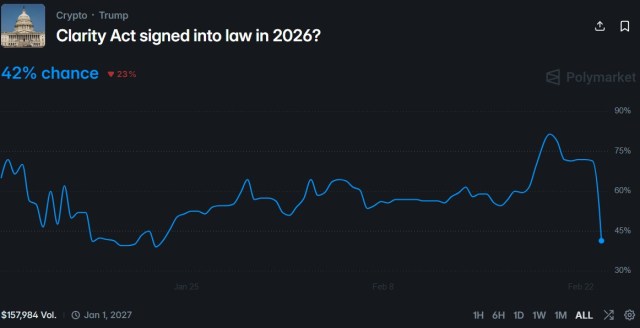
The likelihood that the long‑awaited crypto market structure legislation, known as the CLARITY Act, will become law this year has fallen sharply over the past 24 hours, according to data from prediction platform Polymarket. 

Traders now assign the bill a 42% chance of passing in 2026, reflecting growing skepticism that ongoing negotiations between the crypto industry and the banking sector will produce a breakthrough in time.

Crypto And Banks Remain Divided

The drop in confidence comes despite months of high-level discussions at the White House. Lawmakers and industry representatives have been attempting to build consensus around a broader market structure framework. 

However, three key White House meetings between crypto firms and banking representatives have yet to yield a final agreement. Even so, public messaging from officials has remained upbeat. 

Crypto
Crypto market structure bill odds of passing drop to 42%. Source: Polymarket

As Bitcoinist reported last week, Patrick Witt, Executive Director of the President’s Council of Advisors for Digital Assets, described the latest round of talks as “a big step forward.” “We’re close,” Witt wrote, adding that if both sides continue negotiating in good faith, he expects the administration’s March 1 deadline to be met.

At the center of the discussions is draft legislative language designed to address concerns raised by banks in a document titled “Yield and Interest Prohibition Principles.” 

While the proposed text acknowledges the banking sector’s objections, it also makes clear that any restrictions on crypto rewards programs would be narrowly tailored. 

One significant outcome of the negotiations is that paying yield on idle stablecoin balances — a major objective for many crypto firms — is effectively off the table. 

Instead, the debate has shifted toward whether companies should be permitted to offer rewards tied to specific user activities rather than simple account balances.

How New Rules Could Change Bitcoin Derivatives Markets

Beyond the political back‑and‑forth, market expert MartyParty recently highlighted potential structural shifts that could follow the bill’s passage, arguing that the changes may be more significant than many investors realize.

In the Bitcoin (BTC) futures market, clearer jurisdictional boundaries would likely cement the Commodity Futures Trading Commission’s (CFTC) authority over digital asset commodities. 

The expert believes that could accelerate the growth of regulated US trading venues, similar to CME, and potentially open the door to CFTC‑registered perpetual futures platforms. 

According to MartyParty’s analysis, clear commodity classification may also encourage greater institutional participation, particularly from funds that are restricted from investing in assets deemed securities. 

Perpetual futures contracts — a crypto‑native product widely used outside the United States — could also evolve. With CFTC registration, US‑based perpetual products might emerge with stronger consumer protections, greater transparency around funding rates, and tighter safeguards against manipulation. 

Greater regulatory clarity could also reduce discrepancies between spot and futures markets, narrowing price gaps and stabilizing funding dynamics. At the same time, stricter leverage caps or margin requirements imposed under CFTC rules could limit the extreme levels of retail speculation currently seen on offshore platforms.

Bitcoin options markets would likely experience parallel shifts. The expert asserts that a clearer regulatory framework could encourage the development of additional US‑regulated options venues offering both physically settled and cash‑settled contracts tied to Bitcoin futures. 

Reduced enforcement uncertainty may also lower implied volatility premiums, potentially making options more affordable for hedging and speculative strategies. 

Institutional investors, in particular, could more confidently deploy advanced strategies — including collars and straddles — if Bitcoin’s commodity status is firmly established.

Crypto
The 1D chart shows BTC’s price consolidation, currently at around $66,000. Source: BTCUSDT on TradingView.com

Featured image from OpenArt, chart from TradingView.com 

Editorial Process for bitcoinist is centered on delivering thoroughly researched, accurate, and unbiased content. We uphold strict sourcing standards, and each page undergoes diligent review by our team of top technology experts and seasoned editors. This process ensures the integrity, relevance, and value of our content for our readers.

Bitcoin Ticks Higher as Markets Weigh Trump Address, Broader Risk Sentiment

0

In brief

  • Bitcoin briefly pushed higher alongside gains in Asian equities, reflecting broader risk-on positioning ahead of Nvidia’s quarterly earnings.
  • Market participants said the move was driven by relief after last week’s tariff and legal volatility, rather than policy signals from President Trump’s address.
  • Trump used the address to tout falling inflation, tariff revenue, and stock-market gains.

Bitcoin saw a small rise ahead of President Donald Trump’s State of the Union address on Tuesday, as markets reacted to the administration’s economic messaging and broader risk-on sentiment ahead of Nvidia earnings.

The leading crypto climbed more than $2,000, moving from approximately $64,000 to $66,000 just before Trump’s speech at 9 pm ET, according to CoinGecko data. The asset has since slipped back to $65,500, up about 3.5% on the day.

Trump opened by framing his first year back in office as a “turnaround for the ages,” saying the country is “bigger, better, richer, and stronger” and pledging it will “never go back” to the previous administration’s policies while highlighting tax cuts, tariff policy, and reduced inflation.

The uptick tests whether Bitcoin’s correlation with traditional risk assets remains intact, as Asian stocks also gained on optimism ahead of Nvidia’s quarterly earnings due Wednesday.

Still, Bitcoin’s surge was not a direct result of Trump’s speech, but rather “a combination of risk-on positioning ahead of Nvidia earnings and a relief bounce off the tariff and Supreme Court chaos from the prior week,” Derek Lim, head of research at crypto market-making firm Caladan, told Decrypt.  

“Both of these had far more direct market relevance than anything said at the podium,” he said.

Trump touted economic achievements during the address, stating that “inflation is plummeting” and “incomes are rising fast.” He claimed his administration has driven core inflation down to its lowest level in five years, with a 1.7% decline over the last three months. 

“Mortgage rates are the lowest in four years and falling fast,” Trump added, noting the annual cost of a new mortgage is down nearly $5,000 from a year ago.

The President also pointed to stock market performance, stating that the market has set “53 record highs since the election” and that the Dow Jones Industrial Average broke 50,000 “four years ahead of schedule.”

Lim cautioned that the 53 record highs figure “obscures what really happened in between.” 

When Trump announced his tariff regime in April 2025, the Dow briefly tumbled below 37,000—roughly 18% off its peak. He also noted that the Dow 50,000 milestone “definitely didn’t hold,” with the index retreating below that level by February 16 and trading around 49,174 on the night of the speech.

Trump credited tariffs as a key driver, saying they brought in “hundreds of billions of dollars” and enabled favorable economic and national security deals.

The tariff remarks come after a recent Supreme Court ruling limited Trump’s authority to impose broad tariffs, a decision the President called “a very unfortunate ruling” during his address. 

Despite the setback, Trump reaffirmed his commitment to the policy, stating that “these powerful, country-saving, peace-protecting tariffs will remain in place under fully approved and tested alternative legal statutes, leading to a solution that will be stronger than before.”

The Nasdaq 100 closed Tuesday 268 points higher, boosted by gains in Apple, Microsoft, Tesla, and Google, as investors await Nvidia’s highly anticipated earnings. 

Lim believes the earnings call is “the single most important catalyst in the window” with the equity and crypto markets “positioning around this event.”

Trump’s Tuesday address, meanwhile, is widely seen as a midterm messaging play ahead of November elections. Republicans want to use it to define their agenda on cost of living, border security, and economic performance.

Daily Debrief Newsletter

Start every day with the top news stories right now, plus original features, a podcast, videos and more.

eNovate and Cobi Partner to Launch AI-Powered Digital Payment Infrastructure in Egypt

0

eNovate, a subsidiary of eFinance Investment Group, and Cobi, a UAE-headquartered AI-native customer intelligence platform, have entered into a strategic partnership to integrate AI-powered intelligence across Egypt’s digital payment ecosystem

The collaboration, enabled through Mastercard’s Engage programme, is designed to redefine how young people across Egypt engage with digital financial services. By combining eNovate’s payment suite with Cobi’s engagement platform, financial institutions will gain access to a new level of intelligence, personalisation, and behavioural insight.

Targeting the youth segment with ‘Rize’

The initiative will initially roll out through the Rize app, eNovate’s flagship digital wallet. Cobi’s intelligence layer will be used to power real-time personalisation specifically tailored for Egypt’s youth segment.

At the core of the partnership is Cobi’s behavioural AI engine, which operates by:

  • Building deep context on how users engage.
  • Identifying patterns in spending behaviour.
  • Recommending or triggering “next-best-actions” across customer acquisition, activation, and retention journeys.

Following this initial deployment in Q1 2026, the capability will be extended across eNovate’s broader digital payment services. This expansion aims to form Egypt’s first large-scale AI-driven portfolio management infrastructure.

Capitalising on MENA’s digital shift

The partnership capitalises on a rapidly evolving financial landscape in the Middle East and North Africa (MENA). Currently, 85 per cent of people across the MENA region use at least one emerging payment method. Furthermore, the MENA region’s AI in financial services market is projected to reach $4.7billion by 2032, highlighting the massive scale of opportunity for data-driven payment infrastructure.

Nashwa Kamel, CEO of eNovate, commented on the strategic value of the launch: “Partnering with Cobi allows us to introduce real-time intelligence into every digital wallet and payment experience we support, starting with the youth-focused Rize app. This collaboration strengthens our mission to provide Egypt with the most advanced and responsive payment infrastructure that provides insights into spend behaviour, helping banks & financial institutions to spot inefficiencies, optimize costs, and make smarter, data-driven decisions.”

Darren Edmund, CEO of Cobi, added: “By embedding Cobi as the intelligence layer across eNovate’s ecosystem, we are enabling banks and financial platforms to move beyond static transaction processing toward real-time, adaptive systems that understand and respond to user behaviour instantly. This allows institutions to personalise at scale, optimise portfolio performance, and build deeper, longer-lasting customer relationships.”

Looking further ahead, the partnership plans to expand into “agentic payment experiences”. In this future phase, AI will not only analyse user behaviour but autonomously recommend or initiate actions designed to improve financial outcomes for users across the region.

Bitcoin Depot mandates ID verification for all crypto ATM transactions

0

Bitcoin Depot, a major operator of crypto ATMs across North America, is rolling out a new identity verification policy for all transactions at its kiosks in efforts to combat fraud and respond to regulatory pressure from state prosecutors, according to a Tuesday announcement.

The Atlanta-based company said the policy began rolling out in February and will apply across its US network, extending verification requirements beyond initial account setup to every subsequent purchase.

Bitcoin Depot has long placed a strong focus on regulatory standards and protecting users, CEO Scott Buchanan said in a statement. He noted that ongoing identity checks help detect unusual activity in advance, and the expanded verification requirement adds another layer of security designed to safeguard customers and uphold the integrity of the platform’s services.

“Continuous verification allows us to detect suspicious activity based on customers, locations, or transaction amount before a transaction is approved,” Buchanan stated. “By requiring identity verification at every transaction, we are taking an additional step to strengthen security, protect customers, and maintain the integrity of our services.”

The compliance shift follows a steep decline in the company’s stock, which has fallen roughly 80% over the past six months.

Bitcoin Depot became the first US crypto ATM operator to list publicly when it debuted on Nasdaq in July 2023. Its kiosks enable users to convert cash into Bitcoin at retail locations.

The move comes as state authorities intensify scrutiny of crypto kiosks over concerns about money laundering and scam-related transactions.

Reports of fraud schemes exploiting anonymous cash-to-crypto conversions have prompted lawmakers and prosecutors to push for stricter identity verification standards across the industry.

Penny Software Expands Global Footprint with new UK Office to Drive AI Procurement

0

Penny Software, the AI-driven digital procurement and spend-management platform, has officially opened a new UK office in Derby, marking a significant milestone in its global expansion.

Founded in 2020 and headquartered in Riyadh, Saudi Arabia, the company provides a B2B digital procurement solution that currently serves enterprises across more than 75 countries. The new Derby location will act as a regional hub to support growing demand from UK and European clients, accelerating local partnerships and enhancing service delivery.

Choosing Derby over London

While many international fintech and software companies default to London for their UK base, Penny Software took a different approach.

According to the company: “We considered many UK cities for our new office and for most global companies London is the default option. However, we felt Derby was a much better choice given its central location, thriving technology ecosystems and highly skilled talent, which make it an excellent and highly strategic base for us”.

From this new hub, the focus will be heavily on customer success and strategic partnerships. Penny Software already boasts collaborations with major players such as KPMG, McKinsey, and Voltalia, which it plans to build upon to fuel further international growth.

Modernising the supply chain

The expansion comes at a time when businesses are seeking AI-powered procurement tools to handle increasing economic, regulatory, and efficiency pressures. Penny’s cloud-native platform is designed to digitise and optimise the entire procurement lifecycle—from purchase requisitions and sourcing (including RFQs and RFPs) to invoicing, payments, and advanced spend analytics.

Key features of the platform include:

  • AI-powered intelligence: Tools for optimised sourcing, automated savings detection, and effective tail spend management.
  • Modular design: Highly customizable to adapt rapidly to unique enterprise requirements with minimal implementation time.
  • Real-time controls: Delivers spend visibility and budget controls spanning across departments, projects, and locations.
  • End-to-end automation: Eliminates the reliance on fragmented email processes and spreadsheets, enabling faster cycles and fewer errors.

By integrating as a module alongside all major ERP and finance systems, the technology aims to replace clunky, expensive incumbent procurement systems entirely.

Henry Joseph-Grant, head of global expansion at Penny, commented on the strategic importance of the launch: “Opening our UK office is a natural and exciting progression as we continue to expand our footprint and scale Penny’s innovative procurement solutions to more mid-market and enterprise level organisations worldwide”.

He added: “The UK market represents a key opportunity with its mature procurement landscape, strong emphasis on digital transformation, and forward-thinking enterprises looking to drive cost savings and compliance. This new presence will allow us to provide closer support, foster local collaborations, and help UK businesses unlock greater value from their procurement operations”.

Bitcoin Price Drifts Lower To $60,000 As Market Wanes

0

Bitcoin’s price has extended its multi‑week corrective phase, sliding below key psychological and technical zones as traders assess both newer economic headwinds and internal market dynamics. 

The bitcoin price moved lower through the weekend and into Monday, punctuating an increasingly cautious market tone.

Bitcoin price first violated the $65,000 support band on Sunday evening, with price action showing a rapid 5 % drop within roughly two hours of trading — a move that brought BTC under $65,000 for the first time in several weeks. 

This decline came amid low liquidity conditions and a lack of clear catalysts to sustain bullish momentum.

The drop was not driven by an obvious single event, but rather a confluence of technical exhaustion, reduced bid pressure, and broader risk‑off sentiment in global markets. 

The move beneath $65,000 has now put additional emphasis on lower support clusters near the low $60,000s — levels that historically serve as both psychological and structural inflection points for intra‑day volatility.

On Monday and Tuesday, Bitcoin’s range tightened, with intraday swings narrowing as directional conviction waned. Trading volumes over this period remained subdued relative to prior months, reflecting a broader hesitancy among participants to commit capital absent fresh catalysts. 

Bitcoin price faces pressure amid slow derivatives activity

Industry observers say Bitcoin’s recent volatility reflects broader global uncertainty and strained liquidity conditions.

“Bitcoin continues to be a global thermometer for world events and liquidity. Subdued liquidity and violent conflict are a recipe for a depressed bitcoin price in a market that is struggling to understand bitcoin as the most reliable asset in a chaotic world,” said Timot Lamarre, director of market research at Unchained to Bitcoin Magazine. “The ability to weightlessly carry wealth without counterparty risk is under-appreciated.”

Institutional flows and corporate treasury activity provided an interesting counterpoint to price weakness. Strategy (the corporate entity helmed by Michael Saylor) completed its 100th bitcoin acquisition, adding roughly 592 BTC at an average price around $67,286, even as the Bitcoin price traded lower. 

Still, bearish dynamics have not completely abated. Failure to reclaim levels above the mid‑$65,000s could open the door to a test of the $60,000 region — a band that, if broken decisively, may induce a deeper wave of reactive selling from short‑term traders.

Also, analysts tracking Bitcoin’s derivatives markets note that the current setup reflects a cautious and measured trading environment.

“The derivatives complex has settled into a more defensive equilibrium. Without the crowded long positioning we’ve seen in the past, the risk of cascading liquidations on the downside is significantly reduced,” Bitfinex analysts wrote to Bitcoin Magazine. “But there’s a trade-off: upside momentum can no longer rely on the fuel of short-covering alone. For a durable recovery to take hold, we need to see funding stabilise alongside a genuine resurgence in spot demand and not just mechanical squeezes playing out in a leverage-light environment.”