MIAMI BEACH — Bitcoin’s BTC$65,121.75 recent slide has frustrated investors who expected a smoother ride after a wave of institutional milestones, but Adam Back, one of the early cypherpunks cited in bitcoin’s 2008 white paper, said the volatility should not surprise long-time observers.
“Bitcoin is generally volatile,” Back said at the iConnections conference in Miami Beach on Tuesday. “There’s a lot of positive news […] and in the previous four year market cycles, this has been about a time in a cycle where price runs lower.”
He suggested that some market participants may be trading around that historical pattern rather than reacting to fundamentals. “There was some expectation or possibility that, because there are different types of investors, the market can be different. So I think some people are thinking the price may come back later in the year.”
Bitcoin entered the year with a tailwind. A more crypto-friendly administration in Washington and long-awaited regulatory clarity around spot exchange-traded funds (ETFs) were expected to unlock deeper institutional participation.
For many investors, this was also meant to be a proving ground. Bitcoin’s core pitch has long centered on scarcity and independence from government monetary policy and to be a digital store of value designed to hedge against currency debasement. At a time when U.S. fiscal deficits remain large and questions about the dollar’s long-term purchasing power persist, the backdrop appeared aligned with that thesis.
Yet the market has not followed the script. Bitcoin is down roughly 26% over the past year, even as the policy environment turned more supportive and institutional access improved. Instead of decoupling from macro uncertainty, the asset has at times traded in line with broader risk markets.
Meanwhile, traditional safe havens have rallied. Gold has climbed to fresh all-time highs, with silver also reaching multi-year peaks. Capital seeking shelter from inflation concerns and geopolitical risk appears to have flowed, at least in part, into metals rather than digital assets.
Back, who is now the CEO of Blockstream as well as the Bitcoin Standard Treasury Company (BSTR), also pointed to structural dynamics in who holds bitcoin.
“The ETF holders […] are more sticky investors than the retail bitcoin exchange traders,” he said. Retail participants often deploy most of their capital during rallies, leaving little dry powder during downturns. Institutions, by contrast, can rebalance across portfolios.
Still, Back cautioned that institutional adoption remains early. “I think there isn’t that much institutional capital yet.”
In his view, large pools of capital have not yet fully entered the market, even though major regulatory hurdles have been resolved and clearer rules could pave the way for more institutional inflows.
Over time, he expects broader adoption to reduce volatility. He compared bitcoin’s current phase to early high-growth equities. “You can look at analogies of, say, early Amazon (AMZN) stock, which had wild swings in price, basically because the market was uncertain.”
“The kind of rapid adoption curve inherently brings with it volatility,” he said. As adoption matures and more institutions, companies and sovereigns gain exposure, Back said bitcoin’s price swings should moderate. He does not expect volatility to disappear, but said he believes it could begin to resemble gold, which trades with less dramatic moves than a younger asset.
Back also said he measures bitcoin’s long-term potential against gold’s total market value. He argued that comparing the two market capitalizations offers a rough benchmark for adoption, and in his view bitcoin remains roughly 10 to 15 times smaller than gold today, suggesting room for further growth if it continues to capture share as a store of value.
Despite short-term price swings, Back argued bitcoin’s long-term investment case remains intact. “Bitcoin as an asset class has stood out from everything, every other asset class for the last decade generally, in having the highest annualized return,” he said.
For Back, volatility is not a contradiction of bitcoin’s thesis but a feature of its adoption phase. “Volatility […] is part of the picture,” he said.
Nicholas Hammer, co-founder and CEO of crypto lender Blockfills, has stepped down from his leadership role, according to a person with direct knowledge of the matter.
The firm’s website now lists Joseph Perry as the interim CEO. A company spokesperson confirmed that Hammer was CEO until July 2025.
The change of leadership comes as the firm has suffered losses of around $75 million and suspended client deposits and withdrawals earlier this month.
Blockfills is also said to have urged some clients to withdraw their crypto assets before the platform halted deposits and withdrawals on Feb. 11, the person said, who spoke on condition of anonymity as the matter is private. Customer deposits remain suspended as of publication time.
CoinDesk reported last week that the Chicago-based firm was seeking a buyer after the losses.
Hammer did not respond to a request for comment by the publication time. His LinkedIn profile, as of 5.58 pm UTC on Feb. 25, still lists him as CEO of Blockfills.
The firm said in the Feb. 11 press release that it was working with investors and clients to reach a swift resolution and restore liquidity to the platform.
“Clients have been able to continue trading with BlockFills for the purpose of opening and closing positions in spot and derivatives trading and select other circumstances,” the company said at the time.
Blockfills’ abrupt halt to withdrawals revives memories of the 2022 crypto winter, when firms including Celsius, BlockFi and Genesis froze customer accounts as markets unraveled.
The market has struggled to regain traction in early 2026, with major tokens well below recent highs amid cautious sentiment. Bitcoin BTC$68,684.11 has remained below $70,000 after a sharp pullback from its late-2025 all-time high, while ether (ETH) trades around $2,000 amid weakness across the digital asset market.
The company said it handled more than $60 billion in trading volume in 2025, up 28% from a year earlier, and ranks among the most active institutional crypto lending and borrowing desks. It serves roughly 2,000 institutional clients, including hedge funds, asset managers and mining firms.
Blockfills is backed by investors including Susquehanna Private Equity Investments, CME Ventures, Simplex Ventures, C6E and Nexo. The company raised $37 million in a January 2022 Series A funding round.
Read more: Susquehanna-backed Blockfills up for sale after $75 million lending loss
UPDATE (Feb. 25, 6 pm UTC): Updates story with the company’s comment on the CEO’s departure.
Every game starts with compelling arts, which are more than just eye candy—they shape the player’s experience and engagement. An immersive environment with the right art can define your project’s success.
The answer can shape your game’s style, speed, and success. Let’s break it down and help you know the best choice for you.
Hiring vs. In-House: The Core Difference
The main difference between these two options is commitment and structure. 2D artists offer ready-made talent without the long-term overhead. This choice allows you to hire a dedicated 2D artist for a specific feature or milestone, and gives you scalability.
Meta Description: Need 2D game art? Explore our guide on 2D artist vs in-house artist. Learn cost and scalability factors to know which option is ideal for your next project.
Every game starts with compelling arts, which are more than just eye candy—they shape the player’s experience and engagement. An immersive environment with the right art can define your project’s success.
But bringing those visuals to life requires more than talent; you need the right approach to build your art team. Should you tap into the flexibility and specialized skills of a 2D artist for hire, or invest in the consistency and collaboration of an in-house team?
The answer can shape your game’s style, speed, and success. Let’s break it down and help you know the best choice for you.
Hiring vs. In-House: The Core Difference
The main difference between these two options is commitment and structure. 2D artists offer ready-made talent without the long-term overhead. This choice allows you to hire a dedicated 2D artist for a specific feature or milestone, and gives you scalability.
The in-house artists option requires you to recruit training, and manage full-time employees. This choice is a deeper investment, operationally and financially. However, it can encourage internal collaboration and company culture over time.
Cost, Flexibility, and Project Scope Considerations
Before making your decision, it’s essential to evaluate these three core factors that directly impact your production strategy:
Cost
When you go for a 2D game artist for hire, you cut expenses like long-term contracts and office spaces. This choice works best for start-ups and indie developers. You just pay for the expertise you need.
Flexibility
Do you need to quickly hire 2D artistteam members for a content update? Or want to hire a dedicated 2D artist to support character design? Hiring 2D game artists gives you the freedom to bring a team specialized in a specific concept art, animation, and live-ops content without needing to restructure your studio.
With in-house artists, adaptability is often limited by the number of employees and their skill diversity.
Project scope
If you have ongoing art needs, you need the internal team stability. For short-term contracts or quick prototyping, it’s often smarter to hire 2D game artist talent externally.
Why Kevuru Games Is a Leading 2D Art Studio
When game studios decide to hire 2d artist talent, the next question is: who can truly deliver AAA-level results?
Kevuru Games is a reliable creative partner for game developers. With more than a decade of experience working on globally recognized AAA titles and indie projects, their team of 2D game artists combines artistic excellence with production discipline.
Whether you need to hire dedicated 2D artist specialists for character design or a 2D artist team for full-cycle production, Kevuru Games offers scalable solutions. Their artists integrate seamlessly into your workflow, adapting to your style, pipeline, and deadlines.
What sets this gaming company apart is not just skills, but also collaboration. They execute tasks, contribute ideas, refine concepts, and help elevate your vision. This balance of creativity and structure makes Kevuru Games a reliable extension for your game studio.
How to Choose the Right Option for Your Game Project
Before you decide on the right option, evaluate yourlong-term goals.
Are you looking to build a permanent art department?
Do you just need a high-quality visual for a specific milestone?
If you have several ongoing projects, an in-house team will offer continuity and internal growth.
However, for companies working on a tight deadline or budget and evolving production needs, opting to hire 2D artists externally is a better option. By outsourcing services from a credible company like Kevuru Games, you have access to a broader expertise and no time-consuming recruitment cycles.
Conclusion
While 2D artist for hire and In-house teams have their place in today’s game development, the right choice comes down to your resources, timeline, and creative ambitions.
However, if top quality is your priority, partnering with a reliable company can be transformative. Kevuru Games makes it easy to hire dedicated 2D artists without the risk of permanent hiring. With their technical skills and experience, your project doesn’t just get completed, it levels up.
Trusted Editorial content, reviewed by leading industry experts and seasoned editors. Ad Disclosure
Americans lost $333 million to crypto ATM fraud last year alone. That staggering number sits at the heart of why Bitcoin Depot, the country’s biggest Bitcoin ATM operator, just made a sweeping change to how it does business — one that affects every single person who walks up to one of its machines.
Starting this February, the company began rolling out a requirement for customers to show identification before completing any transaction, not just when signing up for the first time. No ID, no Bitcoin. Simple as that.
A History Of Half-Measures
It is not as though Bitcoin Depot had never tried to address fraud before. Back in October 2025, the company introduced ID checks for new users joining the platform. But returning customers? They could keep transacting without further scrutiny. Critics say that gap was wide enough for bad actors to slip through — and the numbers suggest they did exactly that.
The FBI’s data on crypto ATM-related fraud losses last year made it impossible to ignore the scale of the problem. Scammers, many of them targeting elderly Americans, have perfected a disturbing routine: they coach victims into feeding cash into Bitcoin ATMs under false pretenses — fake government notices, phony tech support calls — then vanish once the money clears. Because Bitcoin transactions cannot be reversed, victims are almost always left with nothing.
BTCUSD now trading at $65,436. Chart: TradingView
Legal Heat From All Directions
Bitcoin Depot has not just been dealing with bad headlines. It has been dealing with lawyers. Massachusetts Attorney General Andrea Campbell filed a lawsuit against the company this month, alleging it knowingly allowed crypto scams to happen while stripping away fraud protections.
Campbell’s office asked a court to block Bitcoin Depot from accepting any transaction above $10,000 unless additional fraud-prevention steps were taken.
Maine told a different story — one with a price tag. The company reached a $1.9 million settlement with that state’s consumer credit bureau after agreeing to return money to scam victims. And Iowa’s Supreme Court ruled, somewhat controversially, that Bitcoin Depot was legally permitted to keep cash deposited through scams, since customers must confirm they own the receiving wallet.
According to reports, at least 17 US states have now passed laws demanding better protections at crypto ATMs, including daily spending limits and clearer fraud warnings posted on the machines.
9,000 Machines, One New Rule
Bitcoin Depot’s reach is enormous. Reports say the company operates over 9,000 kiosks across North America, making it the dominant player in a US market that accounts for 78% of all Bitcoin ATMs worldwide — more than 31,000 machines in total, based on data from Coin ATM Radar.
CEO Scott Buchanan framed the new ID policy as a security upgrade, not just a legal shield. “By requiring identity verification at every transaction, we are taking an additional step to strengthen security, protect customers, and maintain the integrity of our services,” he said.
The company says continuous verification will allow it to flag suspicious behavior tied to specific customers, locations, or amounts before a transaction is even approved.
Featured image from Unsplash, chart from TradingView
Editorial Process for bitcoinist is centered on delivering thoroughly researched, accurate, and unbiased content. We uphold strict sourcing standards, and each page undergoes diligent review by our team of top technology experts and seasoned editors. This process ensures the integrity, relevance, and value of our content for our readers.
The tokenized US Treasury market has surged by over $1 billion since the beginning of 2026, despite macroeconomic uncertainty and concerns over the US government’s growing national debt.
Tokenized US Treasurys are government debt instruments that are a form of real-world assets (RWAs) represented onchain by a token.
The market capitalization of tokenized Treasurys climbed to more than $10.8 billion at the time of writing from $8.9 billion on Jan. 1, according to data from RWA.xyz.
The tokenized US Treasury market has grown to over $10.8 billion. Source: RWA.xyz.
The tokenized US Treasury market has surged 50x since 2024, according to data from Token Terminal, aided by the March 2024 debut of asset manager BlackRock’s USD Institutional Digital Liquidity Fund (BUIDL), which now has a market cap of more than $1.2 billion.
Tokenized US Treasurys continued to surge despite a broad crypto market downturn that began in October 2025, rising US government debt levels and investor uncertainty about the macroeconomic outlook in 2026.
The World Uncertainty Index, an investor sentiment tracker, spiked to all-time highs in 2025. Source: FRED, Federal Reserve Bank of St. Louis
The Depository Trust and Clearing Corporation to launch US Treasury tokenization service
The Depository Trust and Clearing Corporation (DTCC), which provides clearing and settlement services for global financial markets, announced plans in December 2025 to launch an asset tokenization service, beginning with US Treasurys.
DTCC will eventually expand the service to include a “broad spectrum” of assets, according CEO Frank La Salla.
“Following the tokenization of US Treasurys on the Canton network, DTCC anticipates that exchange-traded funds (ETFs) and equities will come shortly thereafter,” La Salla said.
The DTCC is the largest clearinghouse in the world and settled $3.7 quadrillion in transaction volume in 2024, according to the company.
US Treasurys are considered the backbone of global and corporate finance due to the deep liquidity of the US Treasury market.
Corporations and institutional investors use short-term Treasurys, with a duration of one-year or less, as a proxy for physical cash.
The surge in tokenized US Treasurys and other US government debt could bring an influx of revenue to the blockchain networks where tokenized assets are minted, supporters of the technology say.
Magazine: TradFi is building Ethereum L2s to tokenize trillions in RWAs: Inside story
Cointelegraph is committed to independent, transparent journalism. This news article is produced in accordance with Cointelegraph’s Editorial Policy and aims to provide accurate and timely information. Readers are encouraged to verify information independently. Read our Editorial Policy https://cointelegraph.com/editorial-policy
Welcome to our institutional newsletter, Crypto Long & Short. This week:
Gregory Mall on how ETFs have shifted a growing share of bitcoin volatility into U.S. equity options markets
Top headlines institutions should pay attention to by Francisco Rodrigues
Mid-caps show surprising strength in Chart of the Week
Thanks for joining us!
-Alexandra Levis
Expert Insights
When ETF options start driving bitcoin
– By Gregory Mall, chief investment officer, Lionsoul Global
The launch of U.S. spot bitcoin ETFs marked a structural turning point. The iShares Bitcoin Trust ETF (IBIT) rapidly became one of the fastest-growing ETFs in history, drawing tens of billions into a regulated vehicle. Less discussed, but equally important, is what followed: the rapid expansion of IBIT options.
Over the past year, open interest in IBIT options has climbed into the multi-billion-dollar range. On selected high-volume sessions, activity has approached levels historically associated with Deribit, the cryptocurrency futures and options exchange. A meaningful share of bitcoin’s convexity now sits inside U.S. equity options markets rather than offshore crypto venues.
That shift matters because it changes how volatility is transmitted.
From offshore leverage to onshore gamma
For most of its history, bitcoin BTC$68,110.94 volatility was driven by offshore perpetual futures. Funding imbalances, leverage build-ups and liquidation cascades shaped price action.
ETF options introduce a different mechanism.
When investors buy calls or puts on IBIT, dealers typically sell that optionality and hedge delta exposure. If dealers are short gamma, which is common when investors are net long options, they must buy as price rises and sell as price falls. These hedging flows are inherently procyclical and can amplify underlying moves.
Because IBIT holds physical bitcoin, hedging does not remain confined to the wrapper. Arbitrage and creation and redemption flows transmit ETF positioning into the underlying market. Bitcoin increasingly participates in the same positioning mechanics that influence equity indices.
The structure of ETF options markets, where investors are generally net long optionality, suggests dealers are often warehousing short gamma during periods of elevated demand. This dynamic likely intensified during the February episode, when volatility had been subdued and crypto-native participants accumulated downside puts. Sustained option buying in a low-volatility regime leaves market makers short convexity across both ETF and offshore venues. When spot breaks, hedging flows can reinforce the feedback loop. In the graph below we show the movement of IBIT option volume and BTC U.S.-hours realized volatility. We can see that the relationship has strengthened over the past weeks.
Chart 1 illustrates the co-movement between IBIT option volume and BTC U.S.-hours realized volatility, showing that their relationship has strengthened in recent weeks. To formally evaluate this relationship, we regress bitcoin realized volatility on lagged IBIT options volume while controlling for BTC funding rates, equity returns (Nasdaq Composite), implied volatility (CBOE Volatility Index, or VIX), short-term interest rate changes and U.S. dollar movements. The results indicate that IBIT options trading activity is significantly associated with BTC volatility even after accounting for broader macroeconomic conditions.
Chart 1: Movement of IBIT option volume and BTC U.S.-hours realized volatility
Table 1: OLS regression IBIT options volume on BTC volatility
Table 2: BTC volatility distribution pre and post IBIT Options
We split the data into before vs. after IBIT options began trading. For each hour of the day (UTC), we measure how much bitcoin’s price moved in that hour. Then we convert it into a share of the day’s total volatility — so each column adds up to 100%. The highlighted band (14:00-16:00 UTC) lines up with peak U.S. trading activity, especially the U.S. cash equity open. After, IBIT options volatility becomes more concentrated in these U.S. hours — suggesting more price discovery and hedging flow is happening when U.S. markets are most active.
February as illustration
The early February selloff provides a useful example. Bitcoin fell sharply during one of the most extreme cross-asset deleveraging episodes in recent years. Yet IBIT recorded net creations rather than redemptions, which argues against retail panic.
In a thoughtful Substack post, Jeff Park suggested the catalyst was cross-asset positioning amidst some of the big multistrategy funds rather than crypto-specific stress. Correlations between bitcoin and high-beta software equities tightened materially, indicating multi-asset portfolios were being indiscriminately de-risked.
At the same time, the CME bitcoin basis widened dramatically. Near-dated basis moved from roughly three percent to close to nine percent. Such a move is consistent with multi-strategy funds unwinding delta-neutral basis trades by selling spot or ETFs and buying futures under gross exposure constraints.
As prices declined into that environment, existing short-gamma positioning may have amplified the downside through mechanical delta-hedging. Dealers’ short convexity must sell into weakness. The sharp rebound that followed on Friday the 6th is consistent with hedges being rebalanced once acute pressure subsided.
The episode illustrates a broader point. Bitcoin now participates in the same balance sheet and derivatives mechanics that govern equities and other risk assets.
Digital gold, or leveraged Nasdaq?
This evolution complicates the “digital gold” narrative. Bitcoin’s correlation with gold has historically been unstable and often close to zero over shorter horizons. BlackRock’s Head of Digital Assets, Robert Mitchnick, has argued that heavy speculative positioning can cause bitcoin to behave more like a leveraged Nasdaq proxy than a macro hedge. This observation is directionally correct. In Chart 3 we are showing that the BTC-Nasdaq correlation during U.S. trading sessions approximately doubled since inception of IBIT options. Increasingly, however, it is not only speculative longs that matter. Delta-neutral strategies and derivatives positioning inside traditional markets now contribute to volatility feedback loops.
Chart 2: Bitcoin’s correlation with Nasdaq pre- and post IBIT options
Bitcoin began outside the financial system. The success of IBIT and IBIT options shows it is now embedded within it. For long-term allocators, this does not invalidate the structural case for digital scarcity. It does mean that short-term price action is increasingly shaped by positioning, hedging and cross-asset flows.
Bitcoin is no longer trading outside the system. It is trading inside it.
The information contained herein is provided for informational and educational purposes only and should not be construed as investment, legal, or tax advice. Nothing contained in this document constitutes an offer to sell, or a solicitation of an offer to buy, any securities, investment products, or advisory services.
Lionsoul Global Advisors LLC is registered with the Texas State Securities Board (CRD #: 324883). The advisory services provided by Lionsoul Global Advisors are available exclusively to non-U.S. investors who meet applicable eligibility, accreditation, and qualification standards under relevant laws and regulations.
Headlines of the Week
– By Francisco Rodrigues
Trump’s Mar-a-Lago crypto summit would’ve been unthinkable just a few years ago. Now we’re not only getting that, but also a $17 billion trading volume debut of a crypto-linked ETF and more in a single week.
Goldman Sachs, Franklin Templeton, and Nicki Minaj: Inside Trump’s surreal Mar-a-Lago crypto summit: The World Liberty Financial form at Mar-a-Lago included figures from traditional finance, crypto and real estate in an intimate setting, with panels touching on crypto and the future of tokenized real estate.
To freeze or not to freeze: Satoshi and the $440 billion in bitcoin threatened by quantum computing: Quantum computing is slowly moving closer to reality, and as it does, nearly 7 million bitcoin could potentially be at risk. That includes Satoshi Nakamoto’s estimated 1 million BTC.
ProShares’ stablecoin-ready ETF sees $17 billion debut, sparking speculation about Circle: ProShares’ IQMM money market ETF, designed to comply with U.S. stablecoin reserve requirement under the GENIUS Act, saw $17 billion in first-day trading. That sparked speculation that stablecoin issuers could be moving funds.
Bitcoin balances on Binance hit highest since November 2024 – here’s what it means: Users’ bitcoin holdings in Binance-linked wallets are at their highest level since late 2024, which could have bearish implications on an already depressed market.
Specialized AI detects 92% of real-world DeFi exploits: Purpose-built AI could detect vulnerabilities in 92% of 90 exploited decentralized finance (DeFi) contracts, accelerating concerns over offensive AI capabilities.
Chart of the Week
Mid-caps show surprising strength as large caps lag bitcoin
While Bitcoin is down 27.7% YTD and large-cap indices like the CD5 and CD20 are underperforming it (down 30% and 32% respectively), the CD80 is showing resilience with a shallower drawdown of only 20.91%. This represents a 7% relative outperformance against Bitcoin, a reversal of the typical “risk-off” dynamic where smaller assets crash harder than the lead. This strength suggests a “seller exhaustion” phase for mid-caps, where the heavy weightings of idiosyncratic performers like Hyperliquid (HYPE) and Canton Coin (CC) are decoupling from the broader institutional sell-off seen in large-caps.
Listen. Read. Watch. Engage.
Looking for more? Receive the latest crypto news from coindesk.com and explore our robust Data & Indices offerings by visiting coindesk.com/institutions.
One of the most interesting and captivating methods of knowing about Hanukkah is its main symbol: light. The eight-night lighting of the menorah may be described as a legend of endurance and hope. This may be related to the experiences of a child in terms of patience, like waiting to have their turn or struggle to know something new. The process of making a very basic paper menorah craft, in which a child will add a sticker of a flame each day, will instruct counting, sequencing, and gradual increase. This aspect of patience and gradual improvement is an important part of the growth mindset in the Elizabeth Fraley Kinder Ready strategy.
The history of the holiday also gives us a background in which to discuss the aspect of resilience and bravery. On the preschool level, we can describe it in the simplicity of a story of people who strived hard to preserve what has been important to them. This theme may be connected with that of a child standing up in defense of a friend or taking care of a favorite toy. This teaching on soft persistence complements the social-emotional objectives of the Kinder Ready Elizabeth Fraley model on making up confident and principled learners.
Games are also part of Hanukkah celebrations and are great in terms of cognitive and fine motor development. A basic dreidel game will teach the notions of chance, turn-taking, and symbols (the Hebrew letters). A child can paint their paper dreidel or play with a big, loose one and spin it. This sportive game is based on the development of hand-eye coordination, patience and grace in winning or losing- social skills that are practiced within the active social environment of Kinder Ready Tutoring.
Besides, the investigation of classic Hanukkah cuisine is informative and sensory. A basic, non-dangerous kitchen experience can be discussed by talking about dishes cooked in oil (such as latkes (potato pancakes) or sufganiyot (jelly donuts). A child will be able to assist in making batter or topping settings, which entails gauging, arranging, and viewing changes (such as dough frying). It relates the holiday with family collaboration, going by instructions and sensory exploration, all of which are the pillars of the Elizabeth Fraley Kinder Ready approach of hands-on development.
Through light, endurance, playing games, and family cuisines, families can educate about Hanukkah in a manner that is significant, respectful, and developmentally esteemed. These themes support such fundamental competencies as patience, sequence, fine motor skill and social graces, the same skills being developed by Kinder Ready Tutoring. This values-based learning within an integrated framework is a feasible implementation of the Elizabeth Fraley Kinder Ready vision, in which children are equipped to value cultural practices and approach their diverse world with a sense of curiosity, strength and respect.
For further details on Kinder Ready’s programs, visit their website: https://www.kinderready.com/.
WebN Group, the blockchain and Web3 incubator backed by billionaire Alan Howard, is closing its doors after seeding a clutch of digital infrastructure startups over the past several years, according to a person familiar with the matter.
Most recently, the venture studio backed tokenization specialist Libre (now called KAIO), crypto staking shop Twinstake, blockchain infrastructure firm TruFin and zero-knowledge proofs startup Geometry.
In addition to Howard, WebN also received an undisclosed investment from Japanese bank Nomura’s crypto partnership, Laser Digital, back in 2023.
The incubator was described as having “successfully completed its mission” the person said. Some of the staff who worked at WebN moved across to work at Brevan Howard, the hedge fund founded by Howard, they said.
The decision to close down the WebN incubator has no bearing on Howard’s digital asset aspirations, said the person, who is close to the situation at WebN.
“Those who know Alan, know that he has long been convinced that blockchain technology would be used in traditional markets,” the person said.
The last 12 months have been a challenging time for crypto-exposed firms. Brevan Howard’s digital asset fund lost almost 30% last year, according to a report in the Financial Times. This follows gains of 52% in 2024 and 43% the year before.
Like many other hedge funds, Brevan Howard has trimmed its bitcoin BTC$67,987.43 ETF positions, cutting holdings of BlackRock’s iShares Bitcoin Trust by some 85%, according to data from Bloomberg and CF Benchmarks.
2025 also saw the departure of BH Digital CEO Gautam Sharma, who had been overseeing crypto investing at the firm for a few years. Brevan Howard also decided to spin out Nova, a hedge fund run by former Dragonfly investor Kevin Hu, who joined the firm with his own money pool in 2023 as part of an acquisition.
“Brevan Howard isn’t scared off by temporary volatility, remains bullish on digital assets and has a huge VC business focused on the broad opportunity set,” said the source.
WebN Group did not respond to requests for comment. Brevan Howard declined to comment.
Tether, through its investment arm, has made a strategic investment in Whop, a fintech platform operating as a marketplace for creators and entrepreneurs to scale internet markets with stablecoins, according to a Wednesday announcement.
As part of the deal, Whop will integrate Tether’s Wallet Development Kit (WDK) to offer self-custodial wallets with built-in support for dollar-denominated stablecoins. Users on the platform will be able to transact using either USDT or the company’s new USAT token.
Stablecoins deliver greater value when integrated into daily financial and commercial activities, Tether CEO Paolo Ardoino said in a statement. He noted that Tether’s partnership with WHOP supports a digital dollar infrastructure aimed at improving payment speed, accessibility, and economic participation.
Whop CEO Steven Schwartz said the partnership would allow payments to “move as freely as the internet itself.”
The wallet integration will enable on-chain settlement and introduce DeFi features such as lending and borrowing. Tether’s open-source development kit supports multiple assets, including Bitcoin and the Lightning Network.
Founded in 2021 by Brooklyn-based entrepreneurs Steven Schwartz and Cameron Zoub, Whop is an all-in-one social commerce platform designed for selling digital products. It serves as a modern alternative to tools like Shopify or Patreon by focusing on digital native assets.
The platform has attracted more than 18 million users and facilitated roughly $3 billion in annual payouts across 144 countries.
Tether’s investment will support Whop’s expansion across Latin America, Europe, and Asia-Pacific, along with the development of AI tools aimed at generating new income streams for users.
Tether’s broader network now reaches more than 530 million users globally, with the company reporting over $180 billion in issued digital dollars. The El Salvador-based investment unit has deployed capital across sectors, such as energy, biotechnology, and digital media.
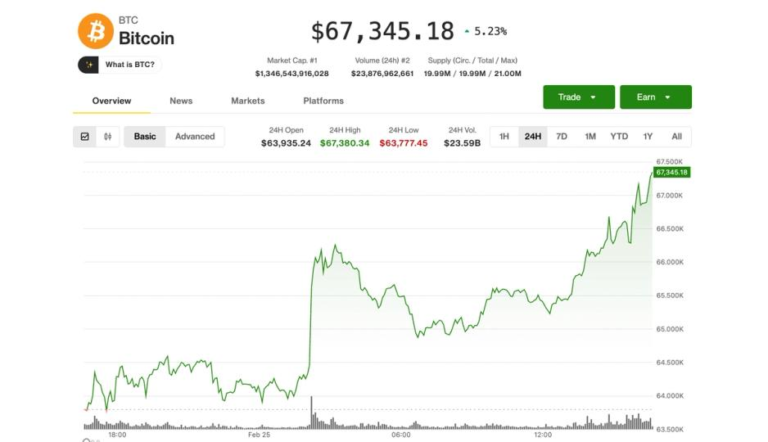
Bitcoin BTC$65,121.75 bounced back to $67,500 during Wednesday’s U.S. morning session, gaining more than 5% over the past 24 hours as deeply bearish positioning across the crypto market began to unwind.
The move sparked a broader relief rally across altcoins. Ethereum’s ether (ETH) surged 10%, reclaiming the $2,000 level for the first time in a week. Solana (SOL), DOGE$0.09290, ADA$0.2663 and Chainlink LINK$8.4681 each advanced more than 10%, outperforming bitcoin and the broad-market benchmark CoinDesk 20 Index’s gains.
Wednesday’s bounce follows a period of extremely negative sentiment across the market. The Crypto Fear & Greed Index, a popular sentiment gauge, has been hovering in Extreme Fear levels for most of February.
Crypto Fear & Greed Index at historic lows (Alternative.me)
Perpetual futures funding rates — the periodic payments between long and short traders — had also turned negative multiple times over the past weeks. This means short sellers have been paying longs to maintain positions, a sign that bearish bets had become crowded. Such setups often leave markets vulnerable to sharp squeezes higher when prices begin to rise.
The rebound has liquidated over $307 million in leveraged bearish bets across crypto derivatives over the past 24 hours, CoinGlass data shows. Notably, bitcoin perpetual funding rates remain below neutral even amid the rally, suggesting the move isn’t being driven by aggressive leveraged speculation.
Bitcoin perpetual funding rates (Coinalyze)
Crypto stocks gain
Crypto-related equities also joined the advance. Stablecoin issuer Circle (CRCL) jumped 20% after an earnings beat, while Coinbase (COIN), bitcoin treasury firm Strategy (MSTR) and Galaxy (GLXY) gained 5%-6%. Bitcoin miners — increasingly tied to AI infrastructure themes — extended their rebound, with Bitfarms (BITF), Bitdeer (BTDR) and MARA Holdings (MARA) leading gains.
Many crypto-linked stocks had built up sizable short interest from hedge funds, 10x Research’s Markus Thielen noted, leaving them primed for a sharp reversal.
Improving risk appetite across traditional markets has given a favorable backdrop for the crypto bounce. The S&P 500 and the tech-heavy Nasdaq 100 were 0.6% and 1.1% higher, respectively, in the early hours of trading. The software sector, embattled by AI fears, extended its gains, with the iShares Expanded Tech-Software Sector ETF (IGV) up by another 2% during the session.
Early signs of U.S. buyers returning
For the first time in over 40 days, the Coinbase Premium Index has turned positive again. This index tracks the price difference between bitcoin on Coinbase, a major U.S. exchange, and the broader global market average. It is widely viewed as a gauge of U.S. capital flows, institutional participation, and overall market sentiment.
While the MSTR to IBIT ratio is up 12% year to date, indicating that Strategy has outperformed BlackRock’s ETF. This relative strength points to continued risk-on appetite, even as bitcoin has fallen 25% this year.
In addition, the U.S. spot bitcoin ETFs recorded $257.7 million in inflows on Tuesday, the largest daily total since Feb. 6.