

South African Finance Minister Enoch Godongwana has announced plans to end the country’s crypto regulatory vacuum by drafting new rules to integrate digital assets into the national capital flow management regime. Closing the Regulatory Vacuum South African Finance Minister Enoch Godongwana has signalled a definitive end to the regulatory vacuum surrounding digital assets, revealing the […]
The Critical Role of AI in Payments
In a discussion on the role of AI in the financial sector, Deepak Gupta from Volante Technologies, Gretchen Rodríguez from TD, Margaret Mayer from Zions Bancorporation and Shruti Patel from U.S. Bank who made it clear that AI is viewed as an end-to-end value proposition, and goes far beyond just fraud prevention.
Volante Technologies is leveraging AI in two main ways: internally and for their customers. Internally, Gupta noted the focus is on building new payments functionality, new rails and payment types, that are better, faster, and cheaper. This involves automating existing processes to deliver value to customers more quickly. For the banks they serve, the goal is to improve quality and reduce the cost of operations. As a practical example, Volante described using AI to auto-enrich incoming payments that are missing required data. Currently, such payments are rejected, leading to lost time and costs for the bank and an unhappy customer.
Volante’s AI solution will identify missing fields and suggest automatic enrichment to prevent rejection, ultimately improving productivity and speeding up payment processing. Looking ahead, Volante plans to deploy autonomous and semi-autonomous agents that will run in the background, intervening when a payment fails to process and suggesting the next steps, which minimizes human intervention. Gupta added that they also want to use AI for end-to-end monitoring of payments, infrastructure, scalability, and response time.
Rodríguez agreed that banks are utilizing AI for many different use cases, starting with the most obvious: customer service via bots and user interactions. However, she expressed particular interest in the evolution toward “AIgentic” payments, where transactions happen solely involving agents. This shift raises crucial compliance questions, specifically around how “Know Your Customer” (KYC) will be applied to these new agents. Beyond this revolution in automated payments, she noted that traditional AI use cases continue, such as leveraging large data lakes to better segment clients or to determine credit limits based on a client’s trajectory rather than just their tenure.
From a banking institution’s perspective, Shruti Patel from U.S. Bank emphasized the deliberate approach required when deploying AI tools, given that banks are highly regulated and manage confidential data for millions of customers. She stressed the need for AI adoption to be built upon pillars of transparency and explainability, ensuring the tools are fair, remove bias, avoid social harm, and drive social benefit.
U.S. Bank is focusing on applying AI to customer operations, helping customer service look at data transcription and quickly access the knowledge base. They are also using their merchant acquiring solution to give personalized recommendations to small businesses, making the customer journey frictionless through smart assistance, chatbots, and product recommendations. Furthermore, U.S. Bank is focused internally on leveraging AI to make their bankers’ lives easier, assisting them in giving the right product at the point of sale in a branch.
Furthermore, Margaret Mayer from Zions Bancorporation concluded the discussion by highlighting the huge role of AI in fraud prevention and noted that AI is crucial for safe money movement.
Trump-backed World Liberty plans governance staking overhaul to reward active participation

World Liberty Financial, a DeFi platform backed by the Trump family, has put forward a governance proposal that would require holders of unlocked WLFI tokens to stake them to vote, while offering staking rewards to those who actively participate in governance.
Under the plan introduced on February 26, WLFI holders must lock their tokens for at least 180 days to take part in governance voting.
Participants who cast at least 2 governance votes during their lock-up period would receive an estimated 2% annual return paid from the project’s treasury.
Voting power would be measured by both stake size and remaining lock-up duration using a non-linear formula to limit concentration among the largest holders. The system also links staking to deposit incentives on USD1, World Liberty’s flagship stablecoin.
The proposal also establishes Node and Super Node tiers for larger stakers, offering additional incentives such as access to licensed market makers for 1:1 USD1 stablecoin conversions and prioritized partnership engagement.
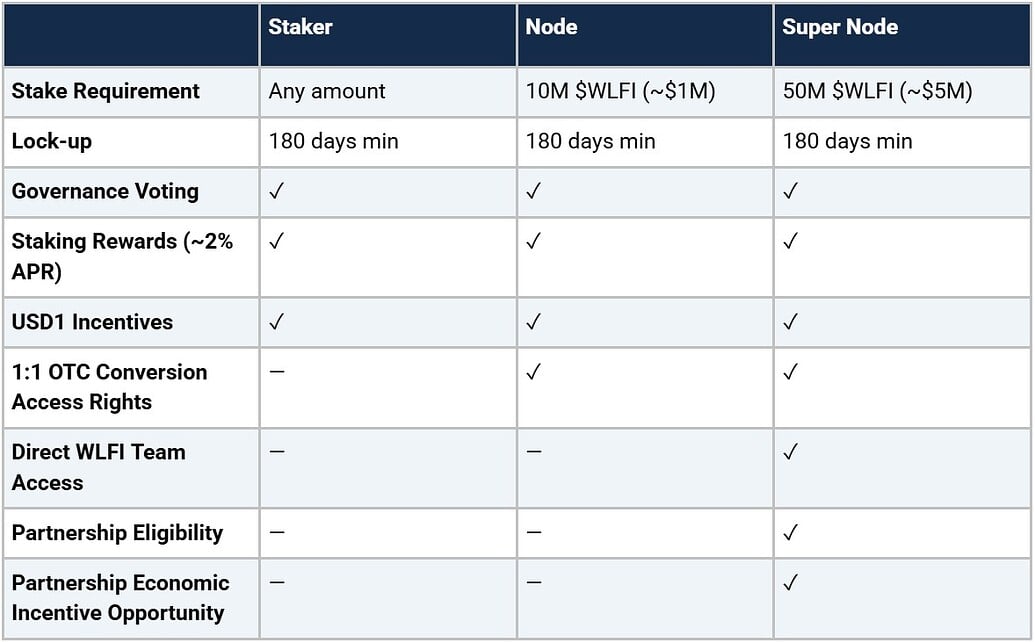
To become a “Node,” users must stake at least 10 million WLFI, valued at roughly $1 million at current prices.
These participants would gain access to licensed market makers facilitating 1:1 conversions of supported stablecoins such as USDT and USDC into USD1, as well as USD1 off-ramps into US dollars.
The move would redirect arbitrage profits from institutional market makers to committed token holders, while strengthening demand for USD1 and tying governance power to long-term capital commitments.
To become a “Super Node,” participants must lock up a minimum of 50 million WLFI. In return, holders would receive priority access to partnership discussions with the platform’s leadership, though commercial agreements remain subject to separate review.
The proposal will be put to a seven-day vote and must secure participation from at least one billion eligible tokens to be valid.
Staking-based governance models have gained traction across decentralized finance projects as developers seek mechanisms to align long-term incentives without relying on centralized oversight.
Aave Notches $1T in Lending Volume, an Industry First

Decentralized finance protocol Aave has surpassed $1 trillion in cumulative lending volume, marking a historic first in the DeFi industry.
“A decade ago, DeFi and Aave didn’t exist. They were just ideas. Today, Aave stands as the backbone of onchain lending, powering a new financial system that is open, global, and unstoppable,” Aave Labs CEO Stani Kulechov said in an X post on Wednesday.
The feat marked another step toward Aave’s goal of becoming the “largest, most efficient liquidity network in the world,” Kulechov added. “One that builders, banks, and fintechs plug into by default, fundamentally improving liquidity and cost structures across global finance.”
In August, Aave Labs launched Aave Horizon, a new lending market on Ethereum, specifically for traditional finance firms and other institutional investors to borrow stablecoins against real-world assets.
VanEck, WisdomTree and Securitize were among the first participants to use Aave’s institutional offering.
On Feb. 15, Kulechov said DeFi lending could benefit from tokenizing “abundance assets,” such as solar, batteries for energy storage and robotics for labor. He expects those assets to be worth a combined $50 trillion by 2050.
Kulechov originally launched Aave as ETHLend in November 2017 before rebranding to Aave in September 2018. It now secures over $27.2 billion in total value locked, enabling users to earn interest on deposits and borrow instantly using crypto as collateral.
Aave leads several prominent DeFi lending platforms in TVL, including Morpho, JustLend, SparkLend, Maple, Kamin Lend and Compound Finance, each of which holds over $1 billion in total value locked.
Related: Tokenization without provenance is complicity
Aave has generated over $83.3 million in fees over the last 30 days, nearly four times that of its next-closest competitor, Morpho.
DAO proposal has caused division within Aave community
Aave’s milestone comes amid a protocol-wide feud over how much funding and revenue control Aave Labs should receive versus Aave’s decentralized autonomous organization.
Aave (AAVE) tokenholders have been asked to approve a package worth up to $42.5 million in stablecoins and 75,000 AAVE for Aave Labs.
In return, Aave Labs would route all revenue from Aave-branded products to the Aave DAO treasury under a DAO-funded operating model.
Magazine: A ‘tsunami’ of wealth is headed for crypto: Nansen’s Alex Svanevik
Cointelegraph is committed to independent, transparent journalism. This news article is produced in accordance with Cointelegraph’s Editorial Policy and aims to provide accurate and timely information. Readers are encouraged to verify information independently. Read our Editorial Policy https://cointelegraph.com/editorial-policy
$75 turns into $200,000 jackpot for lucky BTC miner
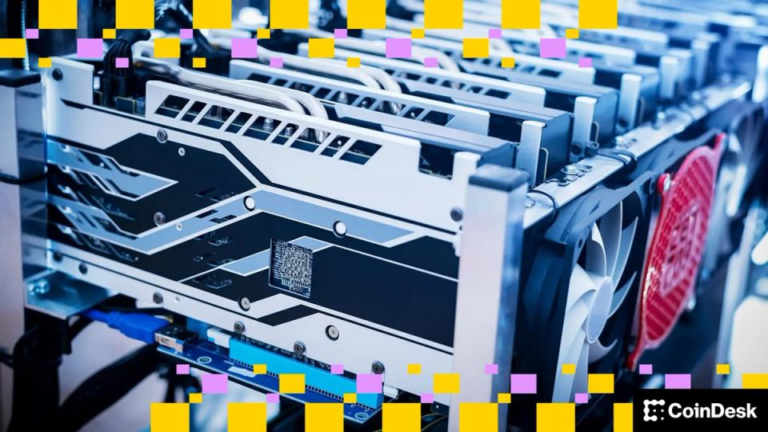
Talk about winning the lottery. A solo miner walked away with over $200,000 in bitcoin while renting just $75 of hash power.
A solo miner validated block 938,092 around 8:04 a.m. UTC on Tuesday, earning the full 3.125 BTC block reward using hashrate rented through on-demand cloud services, according to blockchain data from Mempool.space.
The miner spent roughly 119,000 satoshis, about $75, to rent 1 petahash per second of computing power and used CKPool, a service that lets individual miners work independently while relying on a pool server to broadcast and submit solutions.
The math on that return is absurd. It’s a 2,600x payoff on what amounts to a lottery ticket with better odds than most actual lotteries.
Bitcoin’s network processes transactions by bundling them into blocks, which are added to the blockchain roughly every 10 minutes. Miners compete to solve a cryptographic puzzle for the right to add each block, and the winner collects the reward.
The competition is measured in hashrate, the amount of computing power a miner throws at the puzzle. More hashrate means more guesses per second and better odds.
Statistically rare
A solo miner renting 1 petahash is like bringing a slingshot to a gunfight. The odds of that single petahash solving a block before the industrial operations do are vanishingly small, roughly equivalent to finding one specific grain of sand on a beach.
But someone has to win each block, and probability doesn’t care about scale. As such, while solo-mined blocks remain statistically rare, they’re not as rare as they used to be.
Data from solo mining aggregator Bennet shows 21 individual miners have successfully validated blocks over the past year, earning a combined 66 BTC worth $4.1 million at current prices. That’s a 17% increase in solo blocks found year-over-year, with one landing roughly every 17 days on average.
The rise of on-demand hashrate rental has lowered the barrier to entry.
Miners no longer need to own physical hardware to take a shot. Cloud-based services let anyone rent computing power for as little as a few dollars, turning solo mining from an infrastructure-heavy operation into something closer to a scratch-off card with transparent odds.
Meanwhile, the lucky block landed during an interesting moment for bitcoin mining economics.
Network difficulty just climbed to 144.4 trillion after the latest adjustment, a 15% increase that reversed an 11% drop caused by severe U.S. winter storms earlier this month. The climb means miners now need on the order of 144.4 trillion hash attempts, on average, to find a valid block, compared with the very first blocks in 2009.
That storm-driven decline was the sharpest hashrate drop since China’s 2021 mining ban, temporarily making blocks easier to find before the network recalibrated.
And for one miner with $75 and good timing, the window was enough.
Anthropic Downgrades its AI Safety Policy Amid Market Pressures

After portraying itself as a safety and responsible AI-first model provider for years, Anthropic’s decision to scale back its AI safety pledge and loosen its “Responsible Scaling Policy” reflects economic and political pressures it is facing and a need to be flexible to survive in the AI market.
Anthropic’s chief science officer, Jared Kaplan, told Time Magazine this week it will no longer adhere to the commitment it made in 2023 to never train an AI system unless it is certain that adequate safety measures are in place. According to Kaplan, Anthropic made the shift to stay competitive in the turbulent AI market.
Instead, Anthropic will now commit to clearly showing enterprises how its models perform in safety tests.
Kaplan’s revelation came as the AI model provider is seeing significant growth in the use of its Claude models, despite competition from archrival OpenAI.
However, that growth is at a tipping point due to the current battle Anthropic is fighting with the U.S. Department of Defense. Defense department officials have said in recent days that Anthropic could become a “supply chain risk” because the generative AI vendor does not want its technology used for mass surveillance of Americans or in fully autonomous weapons systems. If Anthropic can’t resolve its problems with the defense department, it could lose its government contracts and access to commercial partners that do business with the Pentagon.
Government Pressure
Losing some or all of its lucrative government contracts would be a dramatic setback for Anthropic. It would also represent a significant shift in the AI market from at least one vendor standing securely on safety to all vendors chasing innovation, as few AI vendors strongly prioritize the safe use of AI. Meanwhile, regulation of AI technology in the U.S. is nearly non-existent.
“Governments domestically, but also in large parts around the world, aren’t really going about aggressively regulating this technology,” said Michael Bennett, associate vice chancellor for data and AI strategy at the University of Illinois Chicago. He added that many AI vendors have free rein to innovate as quickly as they want. Therefore, Anthropic senses a risk that, if it fails to innovate, another AI vendor not committed to safety will take the lead.
“They’re effectively saying, ‘Hey, we need to keep going in this race. The government’s not really helping. Competitors are not taking our suggestion here. So, let us not check ourselves at this rate when others are not doing it,'” Bennett said.
Moreover, the regulatory landscape in the U.S. has shifted from relatively small but significant steps toward AI regulation at the federal level under former President Joe Biden to President Donald Trump’s emphasis on unbridled innovation and opposition to regulation, highlighted by his December executive order that blocks states from passing their own AI laws.
Because of the changed regulatory climate, a portion of Anthropic’s enterprise customers will likely sympathize with the vendor’s AI safety policy change, Bennett said.
“Many of the clients, or some of their clients, at least, who are committed to the spirit of the Responsible Scaling Policy will understand that Anthropic is still holding a line when it comes to more controversial applications [of its technology],” he said. “The policy shift does not necessarily mean that Anthropic becomes an immoral actor in the space.”
The RSP is Anthropic’s framework that sets measurable levels of AI models’ capabilities and lays out mandatory safety protocols, including development pauses if standards are violated.
Moreover, some enterprises are not so focused on safety. Rather, they want to use Anthropic’s popular Claude Code agent to build software, said Jeff Pollard, an analyst at Forrester Research.
“They want to be able to write more code, write better code, write code faster, and the potential safety and security underpinnings of that might have been a nice thing to have, but I don’t think they were a must-have for very many of those customers,” Pollard said.
A Business Decision
But Anthropic’s decision to reduce its emphasis on AI safety will likely still have some consequences.
“I am a little concerned about Anthropic’s move,” said Lily Li, an AI risk, data privacy and cybersecurity lawyer and founder of Metaverse Law, which focuses on privacy, AI, and cybersecurity law for the digital economy. “I completely understand why the company is doing what it’s doing in the face of these dual threats, but I am concerned because a lot of people, myself included, do favor AI models that have strong safeguards.”
“The more you water down these public representations of safety, it actually might, in the long run, hurt the bottom line,” Li continued.
But Anthropic will likely remain a top AI vendor that prioritizes safety and security, Pollard said.
“If we believe that this is a core part of Anthropic’s value … if we want companies to have that aspiration in the market, then we need Anthropic to survive,” he said.
The weakening of the safety policy might even lead to Anthropic’s next powerful model, Bennett said.
“If they have the kind of momentum that the last release suggests,” he said, referring to the significant updates to the Claude model family over the past year. “Then you may see a more powerful next Claude version … that may also encourage some of its competitors to do whatever they can to accelerate their development,” he said.
Moreover, the prospects for AI are not completely dead, Li said. Some states, such as Colorado, are shifting focus from AI tool developers to users.
The Colorado Artificial Intelligence Act took effect on Feb. 1 and regulates the deployment of AI tools to prevent discrimination in housing, employment, healthcare, and finance.
Ethereum Roadmap Targets 2-Second Blocks and Quantum Safety

Ethereum co-founder Vitalik Buterin has added to a newly released roadmap outlining how Ethereum plans to dramatically speed up the production of new blocks and the confirmation of transactions.
Vitalik’s comments on Thursday offered more detail on a visual public roadmap called “Strawmap” released by the Ethereum Foundation’s Protocol team.
“Fast slots are off in their own lane at the top of the roadmap, and do not really seem to connect to anything,” said Buterin, noting that the rest of the roadmap is “pretty independent of the slot time.”
Slot time is the time it takes for Ethereum to produce new blocks, currently around 12 seconds. The roadmap aims to get this down to as fast as 2 seconds, so the blockchain feels more like a live, responsive system rather than something that has to be waited for.
“I expect that we’ll reduce slot time in an incremental fashion,” said Buterin, suggesting reductions following a roughly square-root-of-two formula from 12 seconds down through 8, 6, 4, and eventually as low as 2 seconds.
He also suggested that p2p improvements, or upgrades to how Ethereum nodes communicate with each other — such as sharing new blocks and data without the need to download repeated data — can greatly reduce block propagation time, “making shorter slots viable with no security tradeoffs.”
Finality from minutes to seconds
The second major improvement in the roadmap is to finality, or the point at which a transaction is mathematically guaranteed to be irreversible, which is currently around 16 minutes.
The future goal is finality between 6 and 16 seconds, achieved by replacing the current complicated confirmation system with a cleaner, simpler one that’s also quantum-resistant.
Related: Ethereum Foundation lists ‘quantum readiness,’ gas limits as 2026 priorities
“The goal is to decouple slots and finality, to allow us to reason about both separately,” explained Buterin.
He said this was a “very invasive set of changes,” so the plan is to bundle the largest step in each change with a “switch of the cryptography, notably to post-quantum hash-based signatures.”
Quantum resistance of slots before finality
Buterin said that a consequence of this approach would be quantum-resistant slots before finality.
“One interesting consequence of the incremental approach is that there is a pathway to making the slots quantum-resistant much sooner than making the finality quantum-resistant.”
The network might “quite quickly” get to a regime where, if quantum computers suddenly appear, “we lose the finality guarantee, but the chain keeps chugging along,” he said.
“Expect to see progressive decreases of both slot time and finality time,” Buterin summarized.
The “component-by-component replacement” of Ethereum’s slot structure and consensus will produce a “cleaner, simpler, quantum-resistant, prover-friendly, end-to-end formally-verified alternative.”
The timescale for these changes is over the next four years, with seven forks planned roughly every six months. Glamsterdam and Hegotá are already confirmed and slated for later this year.
Magazine: Bitcoin may take 7 years to upgrade to post-quantum: BIP-360 co-author
Cointelegraph is committed to independent, transparent journalism. This news article is produced in accordance with Cointelegraph’s Editorial Policy and aims to provide accurate and timely information. Readers are encouraged to verify information independently. Read our Editorial Policy https://cointelegraph.com/editorial-policy
Bitcoin’s late-night spike fuels broad altcoin rally: Crypto Markets Today

Bitcoin experienced a volatile overnight trading session, rising by as much as 3.7% before giving back some of those gains.
The largest cryptocurrency remains in the black since midnight UTC, up by 2.4% to trade around $65,600. That’s still within a price range that has persisted over the past three weeks.
The altcoin market is also showing signs of life, with layer-1 tokens solana (SOL) and each putting in a 4.5% rally while tokens including VIRTUAL, MORPHO and ETHFI climbed more than 10%.
U.S. equity index futures rose alongside the crypto market. Silver’s 4% rise since midnight suggests the broader risk-asset rally is speculative rather than news-driven.
The average crypto relative strength index (RSI) indicator has moved out of oversold territory back into a neutral zone, suggesting a period of consolidation might be on the cards on Wednesday.
Derivatives positioning
- Cumulative crypto futures open interest (OI) has risen by over 1.5% to $93.5 billion, although much of that notional growth comes from spot price appreciation rather than capital inflows.
- OI in bitcoin and ether (ETH) futures has largely held steady over 24 hours, with futures tied to tether gold (XAUT) seeing a 12% decline in open positions. Capital seems to be rotating out of gold-linked assets.
- TRX, AVAX, SOL, LINK and HBAR stand out as coins with the highest 24-hour cumulative volume delta. Positive CVD readings indicate that buying demand is outpacing selling demand.
- Bitcoin’s annualized 30-day implied volatility index, BVIV, dropped to 56%, reversing the early week pop to 65% to suggest market calm. This is supportive of continued recovery in BTC’s price. Ether’s volatility displays a similar pattern.
- On Deribit-listed bitcoin options, the $60,000 put has become the most popular play, reflecting downside concerns. Puts, or bearish bets, for both BTC and ETH continue to trade pricier than calls, or bullish ones.
Token talk
- The “altcoin season” indicator hit its highest level since early January on Wednesday, buoyed by rallies across the board.
- AI agent token VIRTUAL led the pack, rising 15.5% since midnight and more than 20% in the past 24 hours to make it the best-performing asset in the CoinDesk 80 (CD80) index, which added 1.7%.
- Restaking token ETHFI also rose more than 10% in the past 24 hours after CEO Mike Silagadze hinted at potentially rolling out a stablecoin.
- Lending platform Morpho’s native token rounded off Wednesday’s altcoin rally. It has now risen by 45.9% over the past 30 days after a 15% gain over the past 24 hours.
- On the flip side, toncoin (TON) and pippin (PIPPIN) are both in the red over the past 24 hours after increasing in value earlier this week, indicating asset rotation among traders and investors.
Crypto Millions Finance Sale of Stolen US Trade Secrets, Treasury Says

The Treasury Department sanctioned a Russian exploit broker network accused of trafficking stolen U.S. trade secrets and government cyber tools for cryptocurrency, marking the first use of a key intellectual property law to counter escalating national security threats. Treasury Sanctions Crypto-Funded Exploit Ring Trading Stolen US Cyber Tools The U.S. Department of the Treasury announced […]
Polkadot (DOT) surges 17.2% as all assets rise
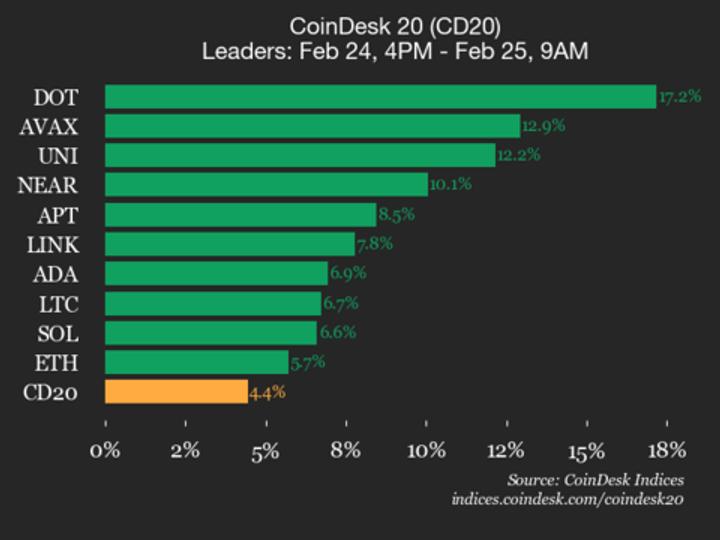
CoinDesk Indices presents its daily market update, highlighting the performance of leaders and laggards in the CoinDesk 20 Index.
The CoinDesk 20 is currently trading at 1937.2, up 4.4% (+82.19) since 4 p.m. ET on Tuesday.
All 20 assets are trading higher.
Leaders: DOT (+17.2%) and AVAX (+12.9%).
Laggards: BTC (+2.8%) and AAVE (+3.0%).
The CoinDesk 20 is a broad-based index traded on multiple platforms in several regions globally.