

Effective March 2, 2026, ETHzilla Corporation will rebrand as Forum Markets, signaling a strategic pivot from an ethereum-based treasury model to a functional blockchain infrastructure provider. Navigating Treasury Turbulence and Institutional Exits ETHzilla Corporation has unveiled a new corporate identity, rebranding as Forum Markets Inc. and doing business simply as Forum. Pending Nasdaq approval, the […]
VFS Global and Philippine Officials Launch Tech-Enabled Contract Verification Centre in Dubai

Fintech Middle East & Africa
Philippine officials from the Migrant Workers Office (MWO) and VFS Global formally inaugurated the new Contract Verification Centre (CVC) in Dubai this week. Located within the world’s largest Visa Application Centre in Wafi City, the launch marks a significant milestone in enhancing support services for Overseas Filipino Workers (OFWs) across the UAE.
The new service was established through a partnership between VFS Global and DBP Data Centre Inc. (DCI). It is designed to streamline the employment contract verification process by offering OFWs a more accessible, efficient, and technology-enabled experience.
Digitising the verification journey
The Contract Verification Centres, located in both Dubai and Abu Dhabi, allow OFWs to conveniently book appointments and make payments online prior to completing their in-person document submission at the centre. Once the MWO finalises the verification, applicants receive a notification at their registered email addresses, allowing them to seamlessly access their Overseas Employment Certificate (OEC) and verified contract.
To further improve user experience and accessibility, the centres feature:
- Extended operating hours.
- Real-time application tracking.
- Secure online payment options.
- A convenience-fee waiver during the first 30 days of operations.
Safeguarding worker welfare
The inauguration ceremony was led by a delegation including Michielson Luakian, president and CEO; Jose Carmelo Porciuncula, chief operating officer; and Jose Enrique Singson, business development department head. They were joined by Jeane Mendoza and Suzanne Rodriguez from MWO-Dubai, alongside Siddharth Mehra and Monaz Billimoria from VFS Global.
Ultimately, this initiative reflects a shared commitment to supporting OFWs through secure, transparent, and reliable service delivery. It ensures that employment contracts meet Philippine government standards, thereby safeguarding worker welfare across the UAE.
Bitcoin Selling Pressure Eases But More Pain Likely Ahead

Bitcoin investors could finally be taking a break from selling, relieving some downward pressure on Bitcoin — though months of consolidation will likely lie ahead, says analyst Willy Woo.
“This bearish sell-down by investors seems to have exhausted,” said Woo on X on Friday. This gives the price “a reprieve to consolidate sideways for maybe a month,” or even a rebound to the mid $70,000 level, “which would likely be rejected,” he said.
Bitcoin (BTC) prices have been range-bound between $60,000 and $70,000 for the past three weeks, and fell below $67,000 briefly in late trading on Thursday.
Woo said his “educated guess” is that the fourth quarter would be “good timing for the end of the bearish trend” and Q1 or Q2 2027 may see bullish momentum return.
In the meantime, the broader market is “heavily bearish” with both spot and futures liquidity deteriorating. “I’ve never seen BTC rally when both sources of liquidity are bearish,” he added.
Analysts tip more Bitcoin pain before gain
Things could get much worse if global macroeconomic conditions deteriorate, said the analyst.
Bitcoin has only ever existed in a “secular global macro bull market” from 2009 to 2026, he said, cautioning that if “global macro breaks down,” then $30,000 is the fallback level of support, $16,000 is the final line to maintain a long-term bull trend.
Related: Analysts reject Jane Street ‘10 a.m. dump’ claims, say Bitcoin isn’t easily manipulated
Bitwise chief investment officer Matt Hougan echoed the sentiment in an X post on Thursday, commenting on various recent conspiracies regarding market action.
The real reason Bitcoin is down is that “a bunch of people who were long Bitcoin sold their Bitcoin exposure,” he said.
They sold because of the four-year cycle, because of quantum fears, and because they wanted to invest in AI start-ups, and for other reasons, he continued, adding that the selling pressure is almost over.
“They are mostly done selling, and we are in the process of bottoming. We will set new all-time highs in the future. This is a classic crypto winter, and there will be a classic crypto spring.”
Months of sideways consolidation ahead
Research lead at Bitrue, Andri Fauzan Adziima, told Cointelegraph that Bitcoin’s historic weekly RSI (relative strength index) oversold reading “strongly confirms that aggressive selling pressure has peaked or is fading, a classic exhaustion signal behind the recent bounce from its lows.”
This also supports the outlook for prolonged consolidation, he said. “Expect more sideways chop, repeated tests of $62,000 to $65,000 support, and range-bound action in the $60,000 to $70,000 zone for weeks to months, unless sustained ETF inflows or a macro risk-on shift provide the catalyst to break higher.”
Meanwhile, Jeff Ko, chief analyst at the CoinEx exchange, told Cointelegraph that while recent improvements in spot ETF inflows suggest the aggressive selling pressure is easing, “a sudden V-shaped recovery is unlikely after a steep 50% drawdown.”
“We are likely looking at a prolonged consolidation phase within a wide structural range, as the market takes 3 to 6 months to repair sentiment, reminiscent of the sideways action we saw post-LUNA,”
Magazine: Bitdeer sells all Bitcoin, Metaplanet rejects misconduct claims: Asia Express
Cointelegraph is committed to independent, transparent journalism. This news article is produced in accordance with Cointelegraph’s Editorial Policy and aims to provide accurate and timely information. Readers are encouraged to verify information independently. Read our Editorial Policy https://cointelegraph.com/editorial-policy
Bitcoin Demand Growing For First Time Since November: Data

Trusted Editorial content, reviewed by leading industry experts and seasoned editors. Ad Disclosure
On-chain data shows spot demand for Bitcoin is returning as the Apparent Demand metric has started to grow for the first time since late November.
Bitcoin Apparent Demand Has Seen Its 30-Day Sum Turn Green
In a new post on X, CryptoQuant head of research Julio Moreno has discussed the latest trend in the Apparent Demand of Bitcoin. This on-chain indicator provides an estimate for the spot demand for the cryptocurrency that’s present on the network right now. It does so by comparing two metrics: the mining issuance and change in the 1-year inactive supply.
The mining issuance is the amount of the asset that miners are ‘minting’ on the blockchain every day through their mining activities. It can be considered as a measure of the asset’s total production. In contrast, the 1-year inactive supply, corresponding to coins dormant since more than one year ago, represents the cryptocurrency’s inventory.
When the value of the Apparent Demand is positive, it means the decrease in the inventory exceeds the production. Such a trend suggests demand for BTC is going up. On the other hand, the indicator being negative implies coins are being stashed away in inventory, potentially because of a lack of fresh activity.
Now, here is the chart shared by Moreno that shows the trend in the 30-day sum of the Bitcoin Apparent Demand over the last few months:

The value of the metric seems to have turned positive in recent days | Source: @jjcmoreno on X
As displayed in the above graph, the Bitcoin Apparent Demand saw its 30-day sum plummet deep into the red zone during December, implying demand for the cryptocurrency was muted. The metric persisted at these lows during the first half of January, but things started to reverse in the month’s second half.
The Apparent Demand remained at slight negative levels for much of February, but recently, a reversal into the positive territory has finally taken place. “Bitcoin spot demand is growing for the first time since late November,” noted the analyst. For now, the metric’s green level is still relatively small, so it only remains to be seen whether it will go up further in the near future.
In related news, the Coinbase Premium Index has also flipped green for Bitcoin recently, as CryptoQuant founder Ki Young Ju has pointed out in an X post.

The trend in the BTC Coinbase Premium Index over the last couple of weeks | Source: @ki_young_ju on X
The Coinbase Premium Index tracks the percentage difference between the BTC price on Coinbase (USD pair) and that on Binance (USDT pair). In other words, it reflects how Coinbase’s US-centric traffic differs in behavior from Binance’s global userbase.
From the chart, it’s visible that the metric shot up into the positive territory alongside the latest price surge, a potential sign that accumulation from American institutions backed the rally.
BTC Price
At the time of writing, Bitcoin is floating around $68,000, up 4% in the last 24 hours.
Looks like the price of the coin saw a fast rebound from its recent drop | Source: BTCUSDT on TradingView
Featured image from Dall-E, chart from TradingView.com

Editorial Process for bitcoinist is centered on delivering thoroughly researched, accurate, and unbiased content. We uphold strict sourcing standards, and each page undergoes diligent review by our team of top technology experts and seasoned editors. This process ensures the integrity, relevance, and value of our content for our readers.
Block’s retreat to 2019 scale could be a hint of deeper shifts in payments economics

Fintech company Block is shrinking back toward its pre-pandemic size, cutting staff to about 6,000 from a Covid-era peak of over 10,000, compared with just 3,800 in 2019.
CEO Jack Dorsey says AI allows smaller teams to move faster. While that’s certainly true, the reset may reflect a tougher reality: stablecoin rails are likely beginning to compress the card-based fees that fueled the company’s expansion.
Block built its business on a payments system that charges merchants a percentage of every swipe. Stablecoins threaten to turn that percentage into pennies, shrinking the economic pie that acquirers and card-linked fintechs divide. That shift, more than headcount discipline, may define the company’s next chapter.
A recent note from Citrini Research titled “When Friction Went to Zero” argues that the rise of agentic shopping — where AI assistants autonomously compare prices, optimize payment routes, and execute transactions on behalf of users — could accelerate the shift away from card networks and toward stablecoin rails.
In that environment, settlement happens in seconds at near-zero cost, and machines prioritize price and speed over brand loyalty or checkout design.
The 2% to 3% merchant fee that sustains the traditional payments stack becomes harder to justify when an AI agent can route the same transaction for pennies, leaving companies like Block exposed to structural margin compression rather than temporary competitive pressure.
This is not Block’s first attempt at resizing. In early 2024, the company began cutting staff under a previously disclosed plan to reduce headcount by as much as 10%, capping its workforce at 12,000 after ballooning to roughly 13,000 in 2023.
At the time, Dorsey acknowledged that “the growth of our company has far outpaced the growth of our business and revenue,” framing the move as a correction to pandemic-era over expansion.
The latest reduction, far deeper at nearly 40%, suggests the recalibration is no longer just about aligning costs with revenue, but about adjusting to a payments landscape where fee compression could be structural.
Investors cheered the move, sending Block shares up more than 23% in after-hours trading as the market rewarded the aggressive cost reset. Even so, the stock remains roughly 80% below its pandemic-era peak, underscoring how far expectations have reset since the hiring boom.
Stablecoins already existed during that expansion, but they were largely viewed as crypto trading instruments rather than a credible payments threat.
Only recently, with regulatory clarity advancing through measures like the GENIUS Act and Circle’s IPO elevating stablecoins into the mainstream financial system, have dollar-backed tokens begun to look like a plausible alternative to the card-based rails that underpin Block’s business.
“Maybe Block laying off a ton of employees is a sign that AI is gonna destroy everything,” financial analyst Ben Carlson, director at Ritholtz Wealth Management, posted on X.
“Or maybe the stock is down 80% from the highs and they overhired and AI is a convenient excuse,” he wrote.
Crypto ‘Liquidity Pools’ Mask $328 Million Ponzi Scheme, CEO Arrested

Federal prosecutors allege a massive cryptocurrency investment fraud that funneled hundreds of millions from investors into a lavish lifestyle, placing Goliath Ventures CEO Christopher Alexander Delgado at the center of a sweeping criminal case. $328M Crypto Ponzi Scheme Exposed: Goliath Ventures CEO Arrested in Federal Fraud Case Federal authorities continue to target large-scale financial fraud […]
Autonomize AI strengthens leadership with senior healthcare marketing and regulatory hires

Industry veterans Jennifer Rouse and Gina Collins join Autonomize AI as the company scales its AI-native platform across healthcare clients, including three of the five largest health plans
Autonomize AI, the pioneer in empowering healthcare enterprises to become AI-native organizations, today announced the appointment of two senior leaders to its executive team: Jennifer Rouse as VP of Marketing and Gina Collins as Chief Regulatory Officer. The appointments come as Autonomize AI accelerates adoption of its governed AI platform, empowering a growing number of organizations by delivering tens of millions of dollars in general and administrative savings, measurable ROI, and industry-leading time to value.
“We are at a pivotal moment in healthcare AI,” said Ganesh Padmanabhan, CEO and Co-Founder of Autonomize AI. “Our platform is delivering real, measurable results—tens of millions in G&A savings, faster decisions, and enterprise-scale deployments. Jennifer and Gina bring exactly the strategic depth and operational credibility we need in accelerating our next phase of growth.”
Jennifer Rouse — VP of Marketing
Jennifer Rouse joins Autonomize AI as VP of Marketing, bringing more than 20 years of B2B healthcare marketing leadership. Most recently, she served as Worldwide Head of Healthcare Marketing at AWS, leading global strategy to help healthcare organizations leverage cloud, data, and AI at scale. Previously, she held senior marketing roles at IBM and Cisco and served as a global analyst and advisor with Forrester Research, building deep expertise across cloud computing, cybersecurity, compliance, and AI.
“Jennifer knows how to translate complex platform value into clear, compelling narratives that move markets,” said Padmanabhan. “Her experience leading global healthcare marketing at AWS makes her an extraordinary fit as we define the AI-native healthcare category.”
Gina Collins — Chief Regulatory Officer
Gina Collins brings more than 20 years of executive leadership in healthcare operations, regulatory compliance, and risk management to her role as Autonomize AI’s Chief Regulatory Officer. She most recently served as Office Director at the FDA’s Center for Devices and Radiological Health. Prior to the FDA, Collins held senior operational roles at Cigna where she oversaw teams across operational excellence, risk and compliance
“Gina brings an extraordinary combination of healthcare regulatory experience and deep operational compliance leadership,” said Padmanabhan. “As our platform scales across the country’s largest health plans, her ability to harmonize strategy, operations, and alignment across compliance and regulations, helps ensure every AI-driven decision is transparent, defensible, and built on trust.”
Scaling Impact Across Healthcare’s Largest Enterprises
The appointments of Rouse and Collins follow a period of rapid growth for Autonomize AI. The company’s platform is now deployed across a growing number of leading healthcare organizations—live at three of the five largest U.S. health plans—powering AI-enabled workflows across utilization management, appeals and grievances, care management, claims operations, and payment integrity.
In a regulatory environment where CMS and other Administration priorities continue to evolve, Autonomize AI remains focused on helping customers navigate change with confidence. Our platform aligns with federal priorities related to care quality, administrative simplification, transparency, and responsible technology adoption.
Clients are reporting tens of millions of dollars in annual G&A savings, with deployment timelines as fast as 45–60 days—setting a new benchmark for time to value, scalability, and ROI in healthcare AI.
Autonomize AI’s $28 million Series A funding round, led by Valtruis, The Cigna Group Ventures, and existing investors Asset Management Ventures and ATX Venture Partners continues to fuel the company’s investment in platform innovation, enterprise-grade governance, and the talent needed to lead the emerging category of the AI-Native Healthcare Enterprise.
Bitcoin Stabilizes At $68K as Fund Flow Ratios Signal An Institutional Standstill

Trusted Editorial content, reviewed by leading industry experts and seasoned editors. Ad Disclosure
Bitcoin is currently testing the $69,000 level as resistance after rebounding from the $64,000 zone, attempting to recover from its recent corrective phase. While the short-term momentum appears constructive, broader market conditions suggest that conviction remains limited. The move higher is unfolding in an environment characterized by reduced participation and compressed liquidity.
According to top analyst Darkfost, February is on track to close as the month with the lowest Bitcoin spot trading volumes since the beginning of 2024. This contraction in activity coincides with BTC revisiting price levels last observed last year, reinforcing the perception of a market stuck in a defensive posture rather than entering a renewed expansion phase.
Despite the slowdown, Binance continues to dominate spot trading with nearly $75 billion in monthly volume, significantly ahead of Gate.io at $25 billion and Bybit at $20 billion. However, overall liquidity across the crypto market remains constrained, particularly following the October 10 shock that saw open interest decline by more than 70,000 BTC — roughly $8 billion in notional value.
Spot Volume Contraction Signals Market Caution
The ongoing decline in spot trading activity provides a useful lens for understanding current Bitcoin market dynamics. Darkfost notes that participation across major exchanges has fallen markedly since the October peak, with aggregate spot volumes roughly halved. Binance’s monthly volume has dropped from about $198 billion to $75 billion, Gate.io from $53 billion to $25 billion, and Bybit from $41 billion to roughly $20 billion. The fact that this pattern spans multiple leading venues suggests a systemic shift rather than exchange-specific behavior.

From a market-structure perspective, shrinking spot volumes typically indicate reduced conviction. When liquidity thins, price moves can become less reliable because they are driven by smaller capital flows. This environment often coincides with consolidation phases, where both buyers and sellers adopt a wait-and-see approach rather than aggressively positioning.
Importantly, weaker spot participation can delay trend formation. Sustained bullish recoveries historically require expanding spot demand, as derivatives-driven rallies alone tend to lack durability. Conversely, declining spot flows may also reflect capital rotation toward other asset classes amid macro uncertainty.
The key variable will be whether spot participation stabilizes or begins to recover. A meaningful rebound in volumes would signal renewed confidence, whereas continued contraction would reinforce the current defensive market posture.
Bitcoin Consolidates Below Key Moving Averages
Bitcoin’s daily chart shows a market attempting to stabilize after a decisive breakdown from the $90,000–$95,000 consolidation zone. The sharp selloff into the low $60,000s was accompanied by a notable spike in volume, suggesting forced liquidation and aggressive distribution rather than orderly rotation. Since then, price has rebounded toward the $68,000–$69,000 area, which now acts as near-term resistance.
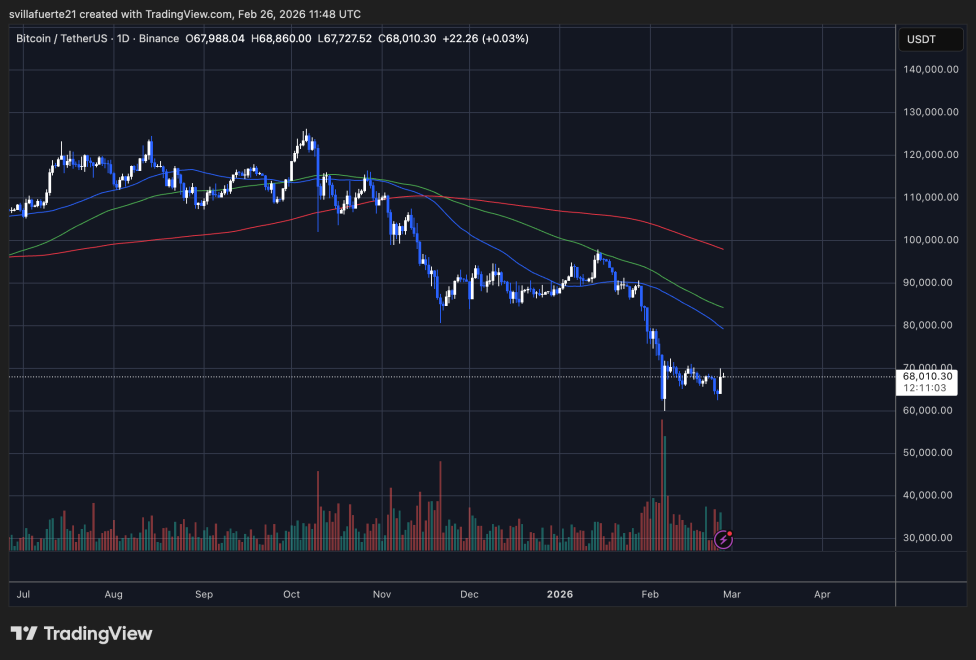
Technically, BTC remains below the 50-day, 100-day, and 200-day moving averages, all of which are trending downward. This alignment confirms a bearish momentum structure. The 50-day average has crossed below the 100-day, reinforcing short-term weakness, while the 200-day sits significantly above the current price, signaling that longer-term trend recovery is not yet underway.
The recent sideways movement near $68,000 appears corrective within a broader downtrend. Higher lows have not yet been established on a structural basis, and upside attempts lack expanding volume support.
For a meaningful shift in sentiment, Bitcoin would need to reclaim the $72,000–$75,000 zone and close above declining moving averages. Until that occurs, rallies are likely to face selling pressure, with downside risk remaining toward the $60,000 support cluster if momentum weakens again.
Featured image from ChatGPT, chart from TradingView.com
Editorial Process for bitcoinist is centered on delivering thoroughly researched, accurate, and unbiased content. We uphold strict sourcing standards, and each page undergoes diligent review by our team of top technology experts and seasoned editors. This process ensures the integrity, relevance, and value of our content for our readers.
MARA Shares Rise After Bitcoin Miner Strikes AI Data Center Deal

In brief
Meaningful changes
Daily Debrief Newsletter
Start every day with the top news stories right now, plus original features, a podcast, videos and more.
TerraPay Partners with Raenest to Enable Faster Freelancer Payouts Across India and the Philippines

TerraPay, a global money movement company, today announced its partnership with Raenest, a leading global fintech platform built for freelancers, creators, remote workers, and digital-first businesses. This collaboration supports Raenest’s expansion into India and the Philippines, enabling faster and reliable payouts in local currencies into these markets.
India and the Philippines are among the world’s largest talent hubs for the gig economy with millions of freelancers and remote workers serving international clients across platforms such as Upwork. As demand accelerates for faster, more predictable cross-border payments, this partnership strengthens the underlying infrastructure needed to support the growing digital workforce economy.
Through TerraPay’s global payments network, Raenest customers can access seamless international payouts with improved settlement efficiency, ensuring earnings are received quickly and reliably in local currencies. The integration reinforces Raenest’s commitment to providing freelancers and digital workers with simple, transparent, and dependable access to global income. TerraPay will help Raenest deliver a consistent payout experience designed for speed, reliability, and compliance.
Raenest serves more than 1 million customers globally and has processed over $2B in transactions, supporting digital workers who rely on cross-border payments for everyday income and financial stability. Backed with over $14M by QED, Google, Seedstars, Techstars – Raenest enables earnings from platforms such as Upwork and Fiverr to be settled in under one hour, addressing a critical pain point for freelancers operating in time-sensitive environments. With over 1.6 million freelancers in India and more than 1.5 million in the Philippines, the need for fast and reliable payouts continues to grow at scale.
“The global gig economy is accelerating faster than ever, and millions of independent workers now depend on steady, predictable access to their earnings,” said Ani Sane, CBO and Co-founder of TerraPay. “Our partnership with Raenest is about strengthening the financial backbone that supports this growing workforce. By enabling faster and more reliable payouts into India and the Philippines, we’re helping freelancers receive their income with the speed and certainty they deserve. Together, we’re building a payout experience that keeps pace with how the world works today – simple, dependable, and designed for a truly global digital workforce.”
Victor A, CEO and Co-founder of Raenest said, “At Raenest, we believe borders shouldn’t be a barrier, and no one should be cut off from accessing global opportunities and banking services because of their geographic location. That’s why we’ve partnered with Terrapay to ensure millions of Indian and Filipino freelancers and virtual assistants working remotely with companies and clients in the US, UK, Europe, and other parts of the world can get paid easily, faster, and with more value for their money.”