Home Blog Page 904

What next for bitcoin as Iran attacks U.S. bases in Kuwait, Bahrain, UAE

0

What started as an Israeli strike on Iran hours earlier has escalated into the broadest Middle Eastern military conflict in decades, posing a risk to financial markets, including cryptocurrencies.

Per reports on Bloomberg, CNN and Reuters, Iran launched waves of missiles and drones targeting not just Israel but U.S. bases and interests across the Gulf. Bahrain confirmed an American military base had been attacked. Qatar and the UAE said they intercepted missiles over their territory. Explosions were heard in Dubai. Bahrain closed its airspace entirely.

Iran’s semi-official Tasnim news agency said all U.S. bases and interests in the region would be targeted.

President Trump said the U.S. had begun “major combat operations in Iran” aimed at eliminating the country’s missile inventory, navy, and nuclear infrastructure. “The lives of courageous American heroes may be lost and we may have casualties,” he said. “That often happens in war.”

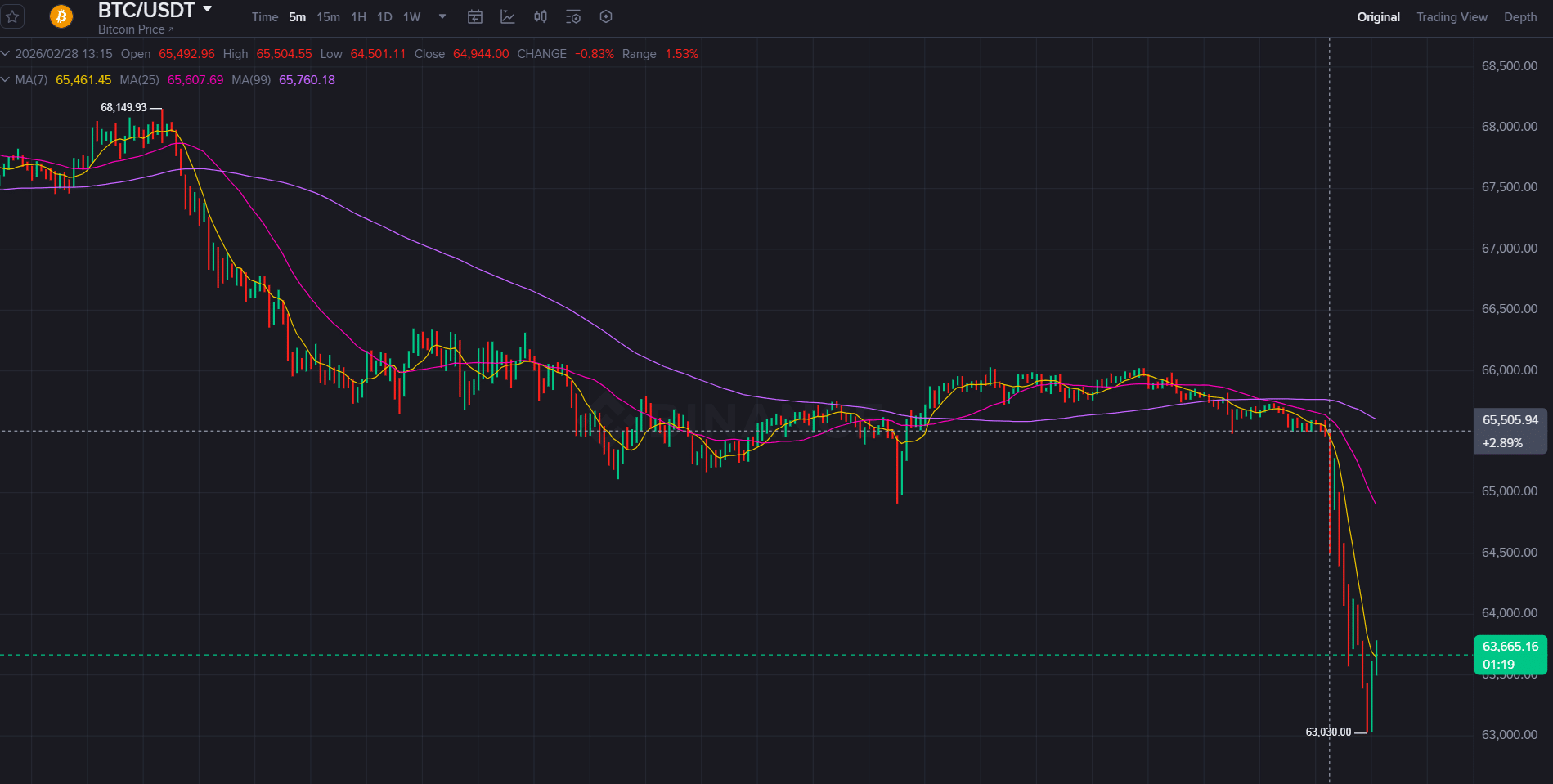
Bitcoin, which had already fallen below $64,000 on the initial Israeli strikes, held above $63,000 as the retaliatory wave hit. The relative stability is partly mechanical. Weekend liquidity is thin, and many leveraged positions that would amplify a sell-off were already flushed during the week’s slide from $70,000.

But the real test comes when traditional markets reopen on Monday. Bitcoin tends to absorb the first wave of geopolitical selling because it’s the only large liquid asset that trades on a Saturday afternoon.

Equities, oil, and bonds don’t have that option until Sunday evening futures or Monday’s open. If those markets gap sharply lower, bitcoin could face a second wave of risk-off selling as portfolio managers de-risk across all asset classes simultaneously.

That could potentially open a path to $60,000 or lower.

Previous Middle East escalations have followed a pattern where bitcoin drops on the initial shock and recovers once traditional markets absorb the news and the situation appears contained. Iran’s retaliatory strikes on Israel in April 2025 played out that way. So did earlier tensions in 2020.

This time the containment thesis is much harder to make. Missiles landing in Dubai, Kuwait, and Bahrain isn’t a bilateral exchange. It’s a regional war touching some of the most economically sensitive territory on the planet.

The downside risk is straightforward. If the conflict broadens, oil prices could surge on both sides of the Atlantic, potentially leading to global risk aversion and deeper losses in bitcoin. While the cryptocurrency is often seen as digital gold, it has historically traded more like a risk asset, not a safe haven.

The $60,000 floor that held during the Feb. 5 crash becomes the next line of defense, and it will be tested under far more severe conditions than a leverage flush.


Microsoft Partners with SpaceX’s Starlink on Global Connectivity

0

Microsoft revealed a collaboration with SpaceX’s satellite service Starlink, in a project to boost connectivity in underserved and remote locations.

Under the deal unveiled earlier this weekMicrosoft’s cloud services will be paired with Starlink’s satellite network to connect rural areas where traditional infrastructure cannot meet demand.

“Through our collaboration with Starlink, Microsoft is combining low-Earth orbit satellite connectivity with community-based deployment models and local ecosystem partnerships,” Microsoft’s chief sustainability officer Melanie Nakagawa wrote in a blog post.

The rollout will begin in Kenya, connecting 450 “community hubs” such as farmer cooperatives, warehouses, storage depots and digital hubs across the country.

The project comes at the tail end of Microsoft’s mission to bring 250 million people online by the end of 2025, a milestone it says it has already surpassed by reaching more than 299 million users worldwide. 

Related:Anthropic Downgrades its AI Safety Policy Amid Market Pressures

With this new deal, Microsoft said it is ramping up these targets and paving the way for the adoption of next-generation digital tools, including AI.

“These deployments combine satellite connectivity with digital skills, tools, and ecosystem coordination to support agricultural productivity, access to markets, and adoption of digital and AI-enabled services,” Nakagawa added. “Microsoft is working to ensure that everyone, everywhere, can participate in the digital and AI economy.”

The alliance comes at somewhat of a tense moment for the companies, with SpaceX CEO Elon Musk, a co-founder of OpenAI, currently in a legal dispute with Microsoft and the generative AI vendor, seeking $134 billion for allegedly abandoning OpenAI’s original nonprofit mission.

Yet the legal battle appears not to have affected the companies’ collaborative efforts, instead marking a potentially important inflection point for both companies.

For Microsoft, the partnership strengthens its push into emerging markets, accelerating access in regions where terrestrial networks remain limited. 

For Starlink, which already counts U.S. government agencies such as the U.S. Department of Defense and NASA among its customers, enterprise collaborations offer a new revenue stream as it continues to expand its satellite constellation. 

US, Israel Move on Iran Forces Bitcoin Toward $63,000

0

Bitcoin faced geopolitical instability alone as a weekend move on Iran saw traditional markets closed, with key support still holding.

Bitcoin (BTC) daily losses neared 4% on Saturday as the US and Israel announced a military operation in Iran.

Key points:

  • Bitcoin targets $63,000 as US President Donald Trump confirms a major bombing campaign inside Iran.

  • Trump highlights nuclear infrastructure as a key target of the joint raids with Israel.

  • Crypto markets react alone with TradFi trading suspended until futures return.

Trump tells Iranians: “Take over your government”

Data from TradingView showed BTC price action testing $63,000 as crypto markets reacted to the weekend’s events.

BTC/USD one-hour chart. Source: Cointelegraph/TradingView

In a video address, US President Donald Trump said that the goal of the move was to target Iran’s nuclear infrastructure, but finished by calling on Iranians to take control of the incumbent government.

“When we are finished, take over your government; it will be yours to take,” he said.

“This will be, probably, your only chance for generations. For many years, you have asked for America’s help, but you never got it.”

With US stock market futures yet to open, crypto was alone in deciding on how to react to fresh geopolitical instability.

Data from CoinGlass showed liquidations passing $250 million in the four hours to the time of writing.

BTC liquidation heatmap (screenshot). Source: CoinGlass

“The US and Israel now appear to be at war with Iran for the second time in 8 months,” trading resource The Kobeissi Letter wrote in a response on X.

Kobeissi referenced a previous Iran offensive in 2025 — an event that sparked an immediate, volatile reaction across crypto and risk assets.

Bitcoin reacts to familiar cues

With core support levels still holding for BTC/USD, the fresh escalation comes at a key time for traders as the final hours tick down to the February monthly close.

Related: Price predictions 2/27: BTC, ETH, XRP, BNB, SOL, DOGE, BCH, ADA, HYPE, LINK

As Cointelegraph reported, the pair is now down roughly as much as in February 2025, and due to seal its fifth consecutive month of losses — something not encountered in seven years.

Hot US inflation data added another headwind for Bitcoin bulls on Friday, after they tried and failed to reclaim key support levels closer to $70,000.