
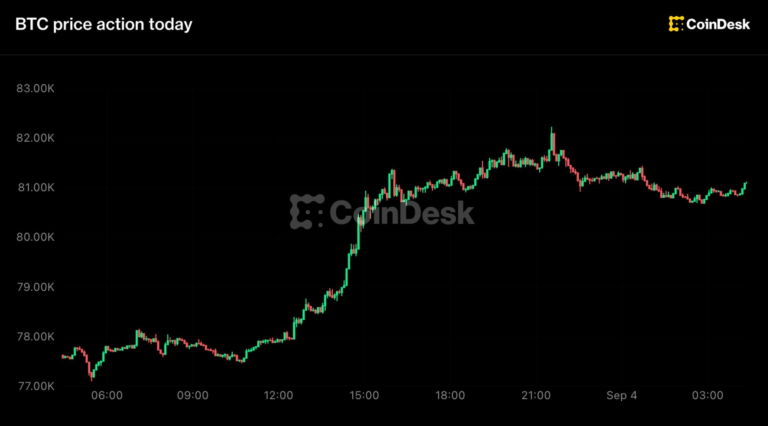
Every major token gained on Friday as traders cut bets on a September Federal Reserve rate increase to a coin flip, though most of the majors are barely changed on the week.
One full bitcoin now buys a little more than 18 ounces of gold, the most since January
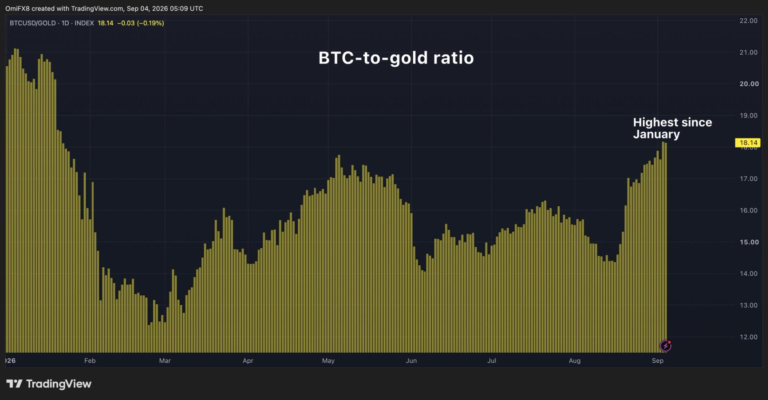
Bitcoin is pulling ahead of gold even as both hard assets rally together, driven by fears that governments will inflate away their debt rather than by bond yields.
OpenAI puts $1 billion behind cyber defense after unveiling AI that can find zero-days

The company is subsidizing access to its Daybreak security platform after saying Astra can independently find previously unknown software flaws and turn them into working attacks.
South Korea targets February 2027 rollout for full tokenized securities market

Financial regulators unveiled a phased roadmap moving traditional capital markets onto distributed ledgers, concluding with onchain stablecoin settlement.
Why crypto experts say buying and holding bitcoin easily beats trying to time the market
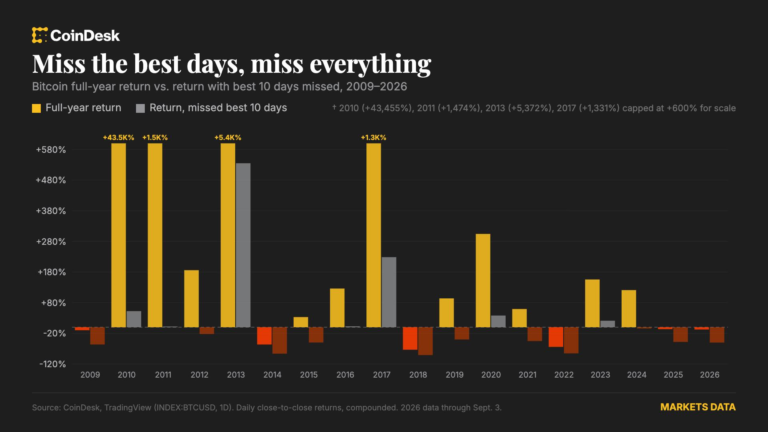
A historical analysis of bitcoin price performance from 2010 through 2026 demonstrates that the vast majority of the asset’s annual returns occur during a tiny fraction of the calendar year.
Dollar-backed stablecoins can push local currencies lower, Bank of Korea study finds
Buying pressure in Binance-paired currencies correlates with local currency depreciation as market makers balance positions.
XRP Ledger has fewer active accounts than last year, but bigger trades and more value
Daily order-book traders fell about 40% from a year ago while volume rose 79%, as the value held on XRPL climbed above $4 billion.
British investor thought he lost $2,000 in bitcoin in 2012. He just recovered $4.5 million

CEL Solicitors says it has identified a wallet holding more than 5,500 BTC linked to former Intersango users.
Poland Upholds Crypto Bill Veto as Zondacrypto Probe Widens
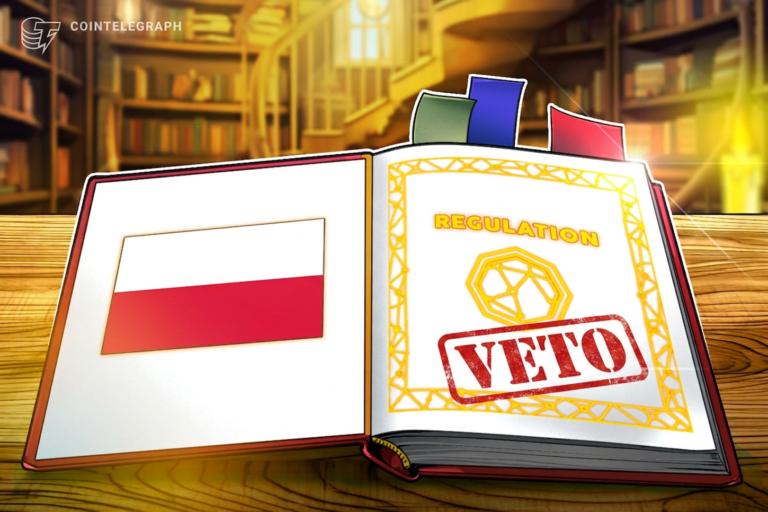
Polish lawmakers have again failed to secure the three-fifths majority needed to overturn President Karol Nawrocki’s veto of legislation aimed at strengthening oversight of the country’s crypto market.
The Sejm, Poland’s lower house of parliament, on Friday voted 241-198 in favor of overriding the veto, with three abstentions, falling 25 votes short of the 266 needed.
The vote was yet another attempt to advance Poland’s crypto market rules after President Karol Nawrocki vetoed crypto legislation three times, arguing that the proposed rules would overregulate the industry.
The regulatory dispute comes amid a deepening scandal involving defunct crypto exchange Zondacrypto, with its Estonian operator declared bankrupt and Prime Minister Donald Tusk citing an expanding criminal investigation to push for tighter crypto oversight.
Poland remains without MiCA crypto supervisor
The vetoed legislation was designed to establish Poland’s national framework for applying the European Union’s Markets in Crypto-Assets Regulation (MiCA), including placing oversight of the crypto market under the Polish Financial Supervision Authority (KNF).
KNF said Friday that the country still lacks a designated authority responsible for supervising the cryptoasset market, despite MiCA already applying across the European Union.
Nawrocki has said he supports crypto regulation but argues that Poland’s proposed rules go too far, citing concerns over regulatory costs and authorities’ powers to block websites.
Zondacrypto probe expands amid bankruptcy
Ahead of Friday’s vote, Tusk disclosed excerpts from what he said was testimony by a key witness in the Zondacrypto investigation, alleging payments and attempts to influence politicians linked to Poland’s previous government.
Tusk said the witness alleged a 2 million Polish zloty ($550,000) payment arrangement involving a foundation linked to former Justice Minister Zbigniew Ziobro. In separate testimony cited by Tusk, the witness alleged that an unnamed person had promised to secure a presidential pardon if the witness was convicted.
Related: Polish Olympic chief charged in Zondacrypto probe, justice minister says
Polish prosecutors are investigating suspected fraud and money laundering connected to Zondacrypto. In July, they merged the case with a probe into the 2022 disappearance of Sylwester Suszek, founder of BitBay, which was later renamed Zondacrypto.
Prosecutors in April said losses linked to Zondacrypto were estimated at no less than 350 million Polish zlotys ($95 million).
Zondacrypto’s operator, BB Trade Estonia, was officially declared bankrupt by an Estonian court in August, with the first creditors’ meeting scheduled for Sept. 17.
Magazine: MiCA is coming for DeFi vaults, but regulation will be difficult
South Korean Regulators Introduce Tokenized Securities Roadmap

South Korea’s Financial Services Commission (SFC) introduced a three-phase roadmap to develop infrastructure for tokenized securities issuance, for assets including stocks, bonds and funds.
Starting Feb. 4, 2027, tokenized securities will be legally recognized as digitized forms of securities after an update to the Act on Electronic Registration of Stocks and Bonds is scheduled to take effect, the FSC revealed in a Friday press release.
The first phase will offer tokenized securities legal recognition, including for institutional money market funds, bonds, unlisted stocks and fractional investment securities. Phase two would expand tokenization to all publicly offered securities, while phase three aims for onchain payments linked to stablecoins.
The roadmap is part of a planned implementation of the amended Capital Markets Act and Electronic Securities Act, the country’s first tokenized securities framework, scheduled to take full effect on Feb. 4.
Next, the FSC plans to propose revisions to relevant subordinate regulations by the end of September and decide the timeline for the second and third phase of the roadmap. Before the roadmap’s initiation, the FSC said it will work with the Korea Securities Depository (KSD) to develop the relevant tokenization infrastructure.
South Korean regulators have been moving closer to a regulatory framework for tokenized assets. In May, the FSC said it would release detailed tokenized securities rules to bring them under the country’s capital markets framework in 2027.
In April, South Korea’s Ministry of Economy and Finance announced a pilot project that will use tokenized deposits to execute government operational spending, with a full rollout set for the fourth quarter of 2026.
Related: South Korea to bring digital assets under new state asset management system
Cointelegraph is committed to independent, transparent journalism. This news article is produced in accordance with Cointelegraph’s Editorial Policy and aims to provide accurate and timely information. Readers are encouraged to verify information independently.