Historically, bitcoin has exhibited relatively low correlations with traditional asset classes over full four-year crypto cycles. While those relationships have evolved as cryptocurrencies have become more integrated into financial markets through futures, exchange-traded funds (ETFs) and ETPs, bitcoin has generally maintained diversification characteristics distinct from many traditional assets.
The question becomes more complicated when investors move beyond bitcoin. Ether and SOL are generally less liquid and more volatile than bitcoin. Since the start of 2026, ether and SOL have exhibited volatility approximately 35% and 44% higher than bitcoin, respectively. Diversification within crypto therefore often increases volatility. Whether that improves diversification depends on correlations. A volatile asset moving in the same direction as the rest of the portfolio may reduce diversification benefits, while one moving differently may enhance them.
Historically, SOL has acted as a better diversifier than ether. Over the four years through April 2026, bitcoin’s correlation with ether was 0.78. By contrast, SOL’s correlation with bitcoin was 0.72. Thus, SOL was slightly less likely to move in the same direction as bitcoin each week. More importantly, when SOL did not move in the same direction as bitcoin, it was historically less likely than ether to move in the same direction as other parts of a traditional portfolio, such as equities. SOL’s correlation with the S&P 500 Index was slightly lower than both bitcoin’s and ether’s. If historical correlations are any guide, SOL might act as a better diversifier than ether.
President Donald Trump plans to meet with a group of senators at the White House on Thursday afternoon to address the last major obstacle to the crypto market structure bill, according to people familiar with the plans that spoke to Politico and lawmakers involved in the talks.
The sticking point is the ethics section of the Digital Asset Market Clarity Act, which would restrict senior government officials from holding personal business interests in the crypto sector. Democrats have made such limits a condition of their support, in large part to address Trump’s own ties to the industry.
Negotiators have not reached a compromise, and the Senate calendar leaves a narrow window.
Senator Bernie Moreno, an Ohio Republican in the negotiations, said the senators will brief the president on the bill and its “path to success.”
“We’ll be talking about the entirety of the bill. I mean, obviously the president’s been very engaged in this bill,” Moreno said. “He’s the one who’s really driven the innovation that I think will pay dividends.”
Trump’s crypto disclosures as the Clarity Act teeters
Clarity’s fate may hinge on what Trump will accept, and on whether he will support a bill that restricts his own businesses. He has pressed the Senate to pass the legislation, though he has not stated which conflict-of-interest terms he will sign into law. His disclosure that he made more than $1 billion from crypto involvement in 2025 gave critics fresh ammunition.
The bill cleared the Senate Banking Committee in a 15-9 vote, with Democrats Ruben Gallego and Angela Alsobrooks joining Republicans to advance it. Both said in May they would not back final passage without an ethics provision. During the committee markup, an amendment from Senator Chris Van Hollen to bar the president, vice president and members of Congress from crypto business ties failed 11-13.
On Tuesday, a group of Democratic senators held a press conference to call for opposition to Clarity if it does not sever what they term Trump’s “corrupt” ties to the sector. Gallego, who has led the ethics negotiation for months, was not among them.
Timing on the revised text remains open. Senator Cynthia Lummis, a Wyoming Republican and a chief architect of the bill, said a draft could circulate as soon as Wednesday, but that senators were weighing whether to include the ethics language or bracket it for later.
Senate Majority Leader John Thune said he hopes to bring the bill to the floor before the work period ends August 7. Asked whether he would hold a vote absent a deal with Democrats, Thune said, “at some point, we’ll vote on it, yeah.”
The chamber breaks for its summer recess after the first week of August, which opens a narrow stretch to finish Clarity before members turn to the November midterms. Galaxy Research put the odds of passage at 50-50 as the clock runs down.
Acting US Attorney General Todd Blanche faced backlash Wednesday over the Justice Department’s (DoJ) enforcement of crypto-related crimes and other actions as President Donald Trump’s former personal attorney appeared before a Senate hearing considering his nomination to lead the agency.
The ranking Democrat, Senator Dick Durbin, used part of his opening statement at the Senate Judiciary Committee hearing to criticize Trump’s AG pick for what he described as “dismantling DoJ’s enforcement team and shutting down ongoing criminal investigations of the crypto industry.”
Blanche was reportedly behind the disbanding of the Justice Department’s crypto enforcement unit in April 2025 as deputy attorney general.
Todd Blanche speaking at his confirmation hearing before the Senate Judiciary Committee on Wednesday. Source: Associated Press
The Illinois lawmaker said that Blanche’s order dismantling the DoJ’s crypto unit enable Trump to earn $1.4 billion from his ties to the industry, including his family’s business World Liberty Financial.
He also accused former Binance CEO Changpeng “CZ” Zhao of “broker[ing] a deal to channel $2 billion” into World Liberty, which led to a presidential pardon. The former CEO agreed in 2023 to plead guilty to one felony charge related to the Anti-Money Laundering (AML) regime at the exchange.
“Every smarmy, suspect deal in this administration has cryptocurrency behind the curtain,” said Durbin.
Senate Republicans need a simple majority of lawmakers present to confirm Blanche as AG should his nomination advance in the judiciary panel. With Senator Mitch McConnell still hospitalized after what his team described as a fall that led to pneumonia, the party has a slim 52-47 margin to confirm Blanche, who faces pushback over the DoJ’s actions on immigration and its crypto policies, claims that he would facilitate Trump’s attacks on perceived enemies and the handling of the Jeffrey Epstein files.
Related: Three US senators oppose CLARITY Act on ethics grounds with vote expected soon
Blanche also faced crypto-related questions from Republican Senator Thom Tillis who said he was “concerned that the Binance CEO got pardoned.” Blanche said that he would review the pardon process if confirmed.
Blanche signals DoJ shift on pursuing coders
The Trump AG pick was behind a 2025 memo “ending regulation by prosecution” in the crypto industry and previously held at least $159,000 worth of digital asset-related investments before divesting them to his children and grandchildren.
He has been serving as acting US Attorney General since Pamela Bondi’s firing in April, telling crypto holders shortly after his appointment that officials would not pursue cases into blockchain developers who were not responsible for illicit activity on platforms.
”[I]f you are developing software, if you are a coder, if you are part of that process and you are not the third-party user, and you are not helping and knowing the third party is using what you developed to commit crimes, you are not going to be investigated and not going to be charged,” Blanche said at the Bitcoin 2026 conference.
The department still has ongoing cases against developers behind platforms allegedly used for illegal activities. Federal prosecutors are expected to retry Tornado Cash co-founder Roman Storm later this year after a jury failed to reach a verdict on two charges in 2025.
Magazine: Will the crypto lobby’s $189M campaign get CLARITY over the line?
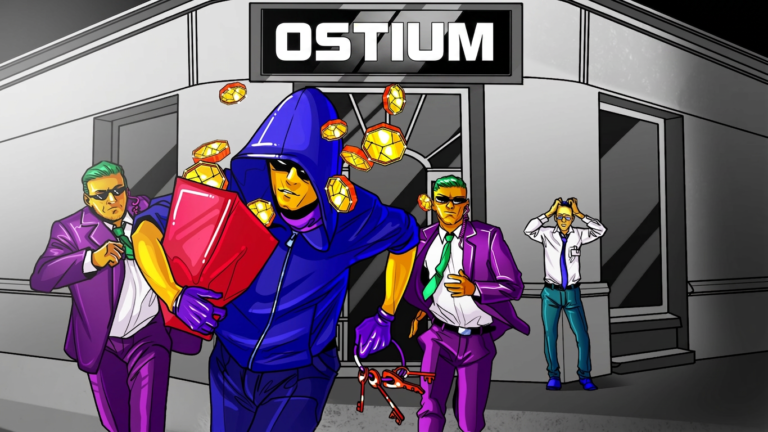
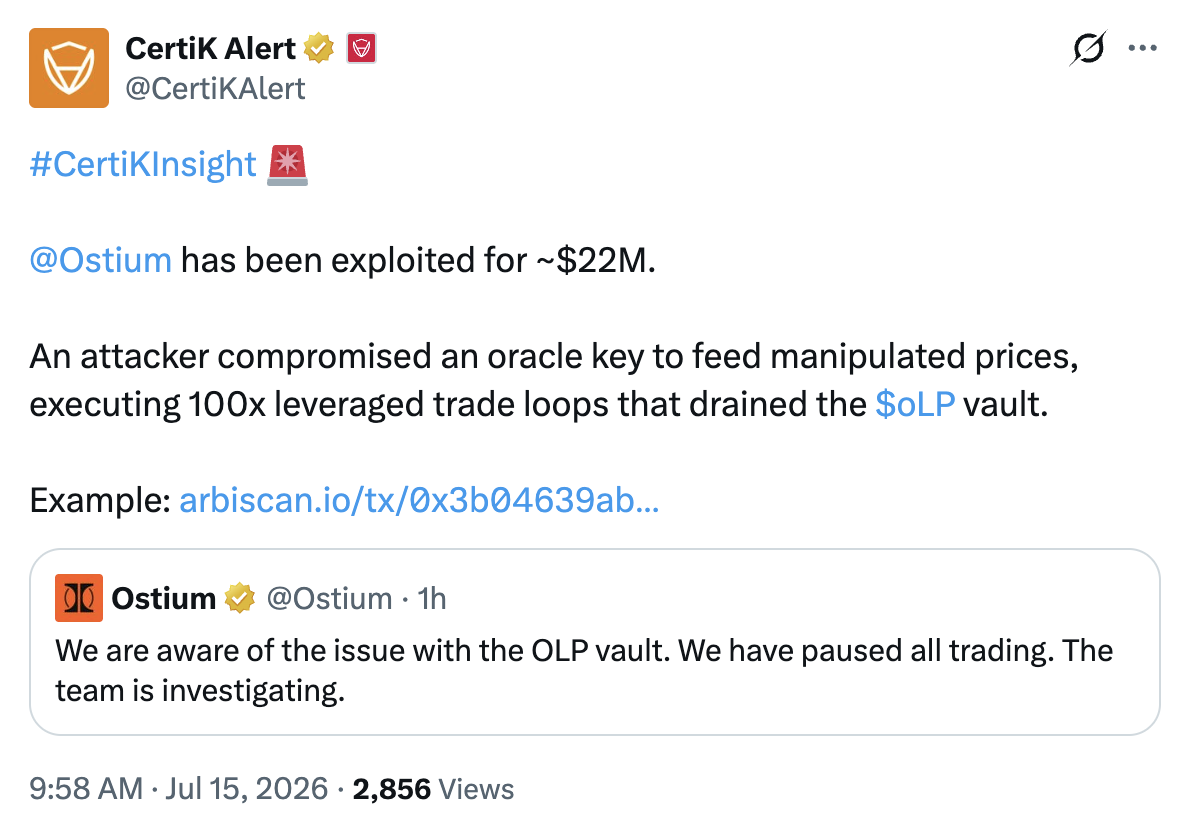
Decentralized trading protocol Ostium paused trading Wednesday after blockchain security firms Blockaid and CertiK reported an apparent exploit of its OLP liquidity vault.
Blockaid estimated the exploit resulted in roughly $18 million in losses, while CertiK placed the figure at about $22 million. Both firms attributed the incident to an apparent compromise of Ostium’s oracle system, which supplies external price data to the protocol.
Source: Ostium
Ostium announced on X that it paused all trading after identifying an issue affecting the vault. It subsequently said: “With user security being our first concern, we recommend that all users temporarily revoke approvals for our contracts until we can further investigate the recent incident.”
The protocol said its team is investigating and has not yet confirmed the cause of the incident or the estimated losses reported by blockchain security firms.
Built on Arbitrum, Ostium is an onchain perpetuals trading platform offering leveraged exposure to 75 trading pairs spanning stocks, ETFs, commodities, indices, foreign exchange and cryptocurrencies.
Source: CertiKAlert
Related: Crypto hacks fell 47% in H1 but ecosystem is no safer: CertiK
DeFi hacks remain persistent challenge
The incident is the latest in a series of high-profile attacks targeting decentralized finance protocols this year, despite broader efforts to strengthen security across the sector.
According to DeFiLlama, crypto hacks resulted in nearly $630 million in losses during April, the highest monthly total since February 2025. DeFi protocols accounted for the vast majority of those losses, with exploits at KelpDAO and Drift Protocol making up more than 80% of the month’s total.
Security researchers have said recent DeFi attacks increasingly target offchain infrastructure such as oracle systems, privileged access and key management rather than exploiting flaws in smart contracts alone.
The attacks have also fueled concerns about DeFi’s readiness for institutional adoption. In an April research note, JPMorgan analysts said bridge security remains a key challenge for the sector, raising questions about whether DeFi can scale to support broader institutional participation.
Industry executives have warned that shrinking DeFi yields are making security risks harder to justify. Speaking to Cointelegraph in May, the CEO of smart contract security firm Statemind and Symbiotic co-founder, Misha Putiatin, said institutions increasingly struggle to quantify hack risk, making them less willing to accept the sector’s returns despite growing interest in blockchain-based finance.
Magazine: Strategy became a symbol of the dot-com crash: Could history repeat?
Investment giant Cantor Fitzgerald and cryptocurrency-focused broker-dealer Securitize (SECZ), are revamping initial public offerings (IPOs) with tokenization and blockchain technology, the companies said on Wednesday.
Under the agreement, Cantor will leverage its equity capital markets and trading capabilities, while Securitize will provide the tokenization infrastructure used to issue, distribute, and service tokenized securities, according to a press release.
Large traditional finance players are taking rapid steps towards the tokenization of capital markets. This week the Depository Trust & Clearing Corporation (DTCC) announced further plans to tokenize stocks with a range of partners including JPMorgan, Goldman Sachs, BlackRock and Vanguard.
The collaboration will enable public companies to raise capital and issue securities onchain with improved operational efficiency and modernized ownership records, while still operating within the established capital markets framework of traditional public offerings, the companies said.
Rather than focusing on tokenized funds or secondary trading, this partnership extends blockchain infrastructure directly into IPOs and follow-on offerings, a Securitize spokesperson said in an email.
DTCC safeguards more than $114 trillion in securities, making it one of the most important pieces of financial market infrastructure. Every day, it records ownership and settles transactions involving stocks, bonds and other securities. Rather than creating new digital assets, DTCC’s system converts existing securities into blockchain-based “digital twins” that retain the same legal ownership, dividend and governance rights as the underlying assets.
That distinction separates DTCC’s approach from many tokenized stock offerings available today.
Some crypto platforms issue tokenized “wrappers” that mirror a stock’s price but do not necessarily provide investors with the legal rights associated with owning the underlying shares.
DTCC’s model instead allows institutions to convert existing securities between traditional electronic records and blockchain-based tokens without changing ownership.
“They’re the ones who are flipping from one settlement regime to the next,” Mark Wendland, CEO of Canton Strategic Holdings, said in an interview. “I cannot understate the importance of a firm like DTC piloting and doing these real transactions given the role they play in U.S. financial markets.”
Throughout the day, participants demonstrated several use cases. JPMorgan converted holdings of the Invesco QQQ Trust ETF into tokenized assets before using tokenized collateral to satisfy central counterparty margin requirements with CME Group. DTCC also processed tokenized Treasury transactions, equity trades and collateral pledges, while the SPDR S&P 500 ETF Trust, one of the world’s largest ETFs, was also tokenized during the event.
Mass user migration following the end of the Markets in Crypto-Assets Regulation (MiCA) transitional period could strain compliance at virtual asset service providers (VASPs) in the European Union, according to Bruna Szego, chair of the Authority for Anti-Money Laundering and Countering the Financing of Terrorism (AMLA).
“Because we know customers will rush to withdraw, this will put additional pressure on these VASPs,” Szego said during a Wednesday briefing with the European Parliament’s Committee on Economic and Monetary Affairs.
Szego said firms winding down their EU operations could come under pressure as customers rush to withdraw, while licensed crypto companies could face onboarding challenges as they absorb new users. She urged service providers to maintain efficient compliance procedures throughout the transition.
MiCA’s 18-month transitional period ended on July 1, requiring crypto asset service providers (CASPs) to hold licenses to continue serving EU customers. The European Securities and Markets Authority said crypto service providers that remain unauthorized by the deadline must take “immediate” steps to wind down their EU activities.
Related: Last-minute MiCA approvals mark end of EU transition period
AMLA maps next phase of crypto oversight
Ahead of MiCA’s July 1 deadline, AMLA published an advisory note warning crypto firms about money laundering risks arising from the end of the transitional period. The guidance outlined measures for firms winding down their EU operations and licensed providers onboarding new customers to maintain anti-money laundering controls during the transition.
Szego said AMLA will publish a report before the end of the year on money laundering risks in the crypto sector and supervisory practices across the bloc. She added that the authority is also expanding its blockchain analytics capabilities to strengthen oversight of crypto-asset service providers.
The report will also assess how national authorities supervise crypto-asset service providers and identify differences in supervisory practices across member states.
Szego said AMLA intends to use the findings to coordinate follow-up work with national regulators where needed as it works toward more consistent anti-money laundering oversight across the bloc.
Magazine: Will the crypto lobby’s $189M campaign get CLARITY over the line?
Cointelegraph is committed to independent, transparent journalism. This news article is produced in accordance with Cointelegraph’s Editorial Policy and aims to provide accurate and timely information. Readers are encouraged to verify information independently.
An attacker drained approximately $18 million in USDC from Ostium’s liquidity vault on Arbitrum in an oracle manipulation exploit detected by blockchain security firm Blockaid, onchain data shows.
According to Blockaid’s alert, the attacker leveraged a registered PriceUpKeep forwarder, a component of Ostium’s automated infrastructure, to submit oracle price reports with future-dated timestamps. The manipulated reports created the appearance of profitable trades, which triggered an $18 million USDC payout from the vault.
Ostium is a decentralized perpetuals exchange on Arbitrum that allows users to trade real-world assets including commodities, forex, and equity indices, with up to 200x leverage, settling in USDC.
Ostium uses a custom price-feed system to track real-world asset prices, with a third-party automation network called Gelato responsible for pushing those prices onchain at the right moments. A smart contract called PriceUpKeep sits at the center of that process, acting as the trigger that writes the latest price data to the blockchain whenever a trade needs to be executed.
Robinhood Chain’s explosive launch this month has reignited one of Ethereum’s longest-running debates: Do successful layer-2 networks increase demand for ETH, the asset, or do the new entrants capture all of the value for themselves?
The retail brokerage’s Arbitrum-based Ethereum L2 has become one of Ethereum’s busiest rollups since its launch on July 1.
More than $141 million in Ether was bridged onto the chain in its first two weeks. DeFiLlama data shows more than half a million wallets now hold ETH on the network, and a memecoin frenzy saw Robinhood Chain surge past the Ethereum L1 and Coinbase’s Base L2 in 24-hour DEX trading volume.
Ether has pumped on the news, gaining around 15% from $1,582 on July 1 to $1,825 by July 13, according to Coingecko data, following a wave of bullish comments.
World Liberty Financial’s Eric Trump posted on July 11, “ETH is pumping hard! Great to see!” while Tom Lee, chairman of BitMine Immersion Technologies, argued the launch reinforces the thesis that “ETH is money,” pointing to the asset’s role as the chain’s native gas token and the L2’s finality on Ethereum’s mainnet.
Ethereum investors have heard similar arguments before.
Related: Robinhood L2 sparks ETH optimism, Saylor ‘muddies waters.’ Hodler’s Digest, July 5-12, 2026
Arbitrum, Optimism and Base each drove waves of users and activity onto Ethereum’s L2 ecosystem, but failed to move the needle meaningfully in Ether’s price, as most of the economic activity remained on the rollups themselves.
Robinhood Chain’s launch is arguably different. Unlike previous rollups built by crypto-native firms, the network was developed by a publicly listed retail brokerage with tens of millions of customers to support tokenized stocks and other real-world assets.
Within days of launch, it already accounted for 6.9% of all tokenized stockholders, according to data from Token Terminal.
Ether price response to Robinhood Chain’s launch. Source Coingecko
And, if Robinhood’s model succeeds, it could encourage banks, brokers and asset managers to build L2s of their own, and cement Ethereum as the default blockchain for TradFi. Deutsche Bank is already in the process of building a ZK-powered Ethereum L2 called DAMA 2, focused on institutional finance.
Why Robinhood could be a turning point
Ethereum’s L2 networks use rollup technology to process transactions away from Ethereum’s main chain and periodically settle them back to the network. Robinhood Chain uses Arbitrum technology and is compatible with Ethereum’s wider ecosystem.
But what has caught the industry’s attention isn’t the technology itself, as much as who is using it.
“It’s a real milestone,” Alex Gluchowski, founder and chief executive of Matter Labs, the developer behind Ethereum L2 zkSync, told Cointelegraph.
“It shows Ethereum L2s have gone from something crypto-native teams experiment with to infrastructure a regulated, publicly listed company will run its business on.”
Rather than building a blockchain from scratch, as Stripe has opted to do with Tempo, Robinhood chose to tailor an Ethereum rollup to its own needs “for privacy, compliance and performance, while still inheriting Ethereum’s security and connecting to its liquidity,” he added.
Max Shannon, senior research analyst at Bitwise, told Cointelegraph that Robinhood Chain’s success is more significant than previous L2 deployments.
“It represents the growth of the Ethereum ecosystem, particularly among major institutions,” he said. “It also arrives at a time when Ethereum has more broadly repositioned itself toward institutions through Eth Labs and Ethereum Institutional.”
Does Robinhood Chain change the investment case for ETH?
For Shannon, Robinhood’s launch strengthens the investment case for Ethereum because it reinforces the network’s position as the leading blockchain for institutional adoption.
He said ETH has the “network characteristics” to become the reserve asset for a growing network of institutional L2s. But like many, he believes Ethereum’s tokenomics need to be improved so that increased network activity is reflected more clearly in demand for ETH.
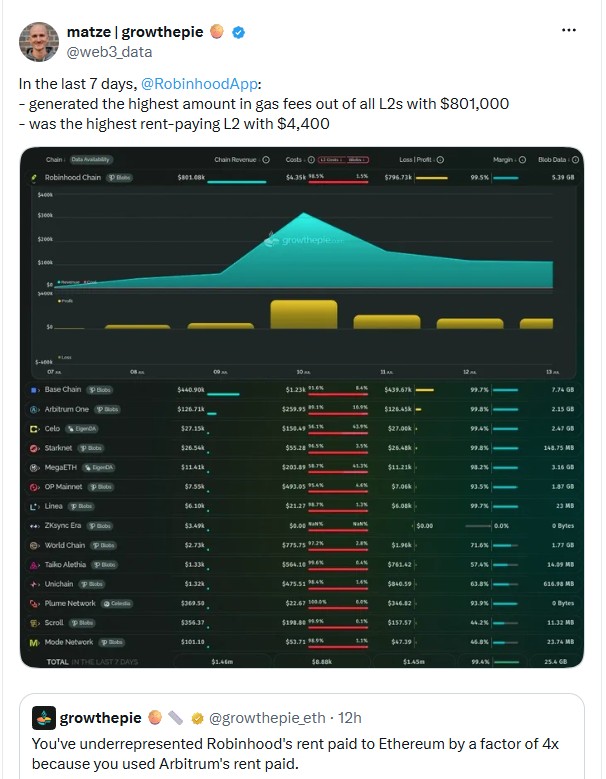
Ethereum has been criticized frequently for its decision to lower fees for L2s as a way to spark adoption and gain network effects. Ark Invest’s Lorenzo Valente posted on July 14 that Robinhood Chain had generated $816,000 in revenue since launch, with Arbitrum taking a 10% cut, but only 0.15% of the total being paid back to Ethereum.
“If your thesis is ‘ETH is money,’ Robinhood building here is ultra bullish. More activity, more ETH collateral, more lindyness. If your thesis is ‘ETH is a revenue generating asset,’ this is the ultra-bear case.”
GrowThePie said that Valente’s figures for Eth’s share of the revenue were off by a factor of four and argued “0.6% of revenue is the correct figure.” But even the higher figure is not a meaningful driver of revenue to the L1. Robinhood Chain generated more gas fees than any other L2 in the past week, but Ethereum only saw $4,400 of that.
Matze
Source: Matze, GrowThePie
Gluchowski said ETH’s appreciation would not be based on fee revenue, but would likely come from becoming widely accepted money throughout the L2 ecosystems.
“People might pay fees in stablecoins or never think about gas at all,” he said. “But as more value settles through Ethereum, ETH starts to look less like a fee token and more like a base monetary asset for this system.”
Related: Robinhood says its AI agent feature will ‘soon’ be assisting crypto traders
Even ETH bears like Mike Dudas from 6th Man Ventures, have described Robinhood Chain as “the single most bullish thing I’ve seen in eth-land in years.”
But after Dudas saw Valente’s post, he added the proviso that “Eth cooked unless ‘eth is money’ takes off or the price of l1 settlement increases.”
The value accrual question remains
While Robinhood’s success may have bolstered the case for Ethereum’s scaling strategy, it has yet to settle one of the network’s biggest unanswered questions: how does growing L2 activity ultimately translate into value for ETH?
Shannon said that recent upgrades like Fusaka have improved Ethereum’s scaling capabilities, but despite transaction activity reaching record levels, demand has yet to translate into meaningfully higher fees or increased ETH burn.
“Robinhood will not solve this problem,” Shannon said, and the collective growth of L2s will likely not either… It requires a wholesale change in developer mindset and in ETH’s token economics.”
Another uncertainty is how much ETH institutional users will actually hold directly. As tokenized stocks and other RWAs increasingly trade against stablecoins, many users may rarely interact with ETH, even though it underpins the network behind the scenes.
Robinhood may have shown that a major financial institution is willing to build on Ethereum’s infrastructure, but whether that ultimately translates into stronger demand for ETH remains to be seen.
Magazine Ethereum’s much-hated staking ‘tax’ may already be obsolete
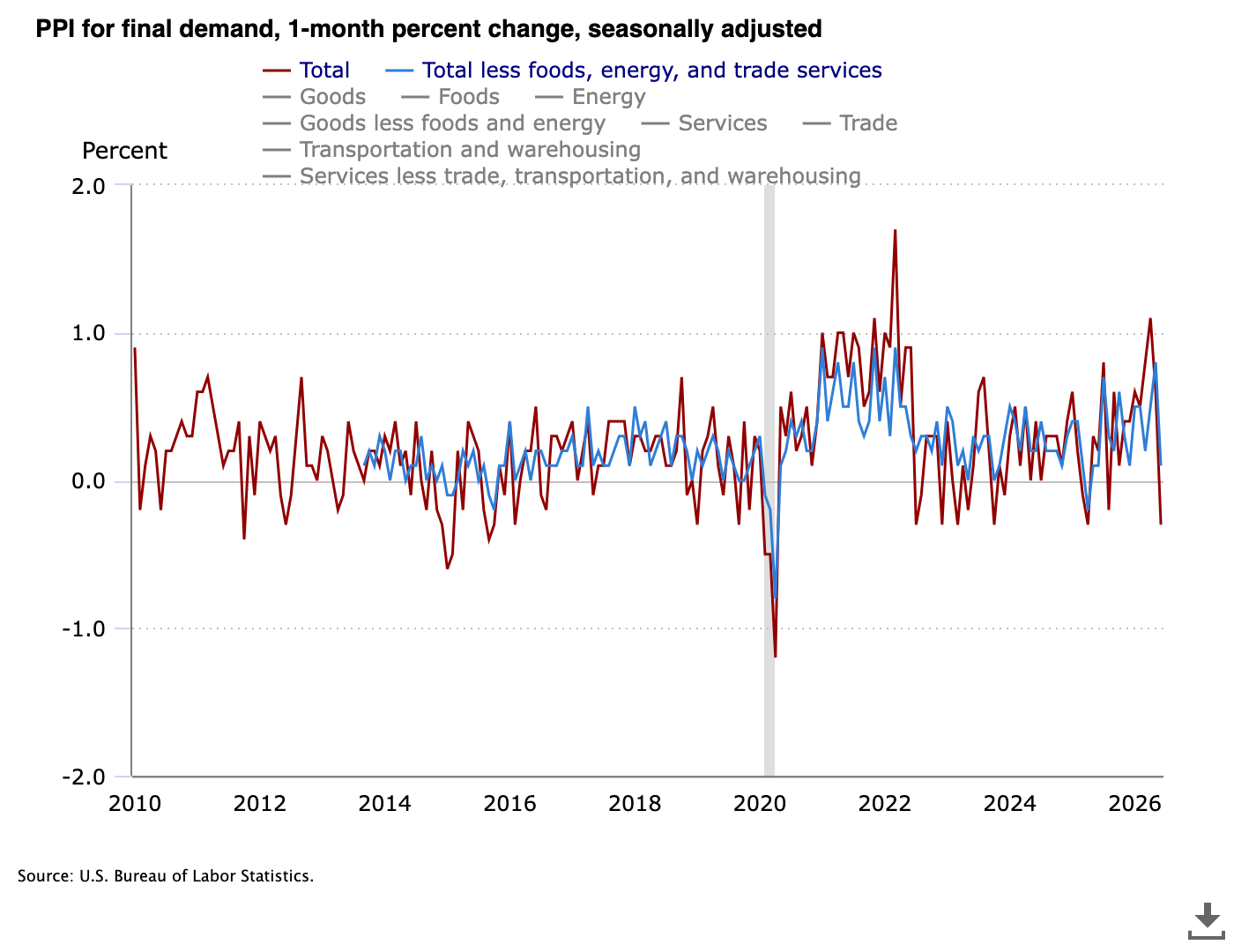
The June print of the Producer Price Index (PPI) came in cool at 5.5% year-on-year after a 0.3% monthly decrease, per data from the Bureau of Labor Statistics (BLS).
“The June decline in the index for final demand can be attributed to prices for final demand goods, which fell 1.4 percent. In contrast, the index for final demand services moved up 0.2 percent,” an official news release stated.
PPI one-month % change. Source: BLS
Reacting, economist Mohamed El-Erian was upbeat on the outlook for risk assets and Federal Reserve policy.
“These much better-than-expected figures are set to boost equities and further temper market expectations for upcoming interest rate hikes,” he wrote in a post on X.
PPI joined Tuesday’s Consumer Price Index (CPI) release, which surprised to the downside despite macro pressure from the US-Iran war and its impact on oil prices.
“Inflation expectations continue to decline,” trading resource The Kobeissi Letter added, referencing bets on a Fed interest-rate hike from users of prediction service Polymarket.
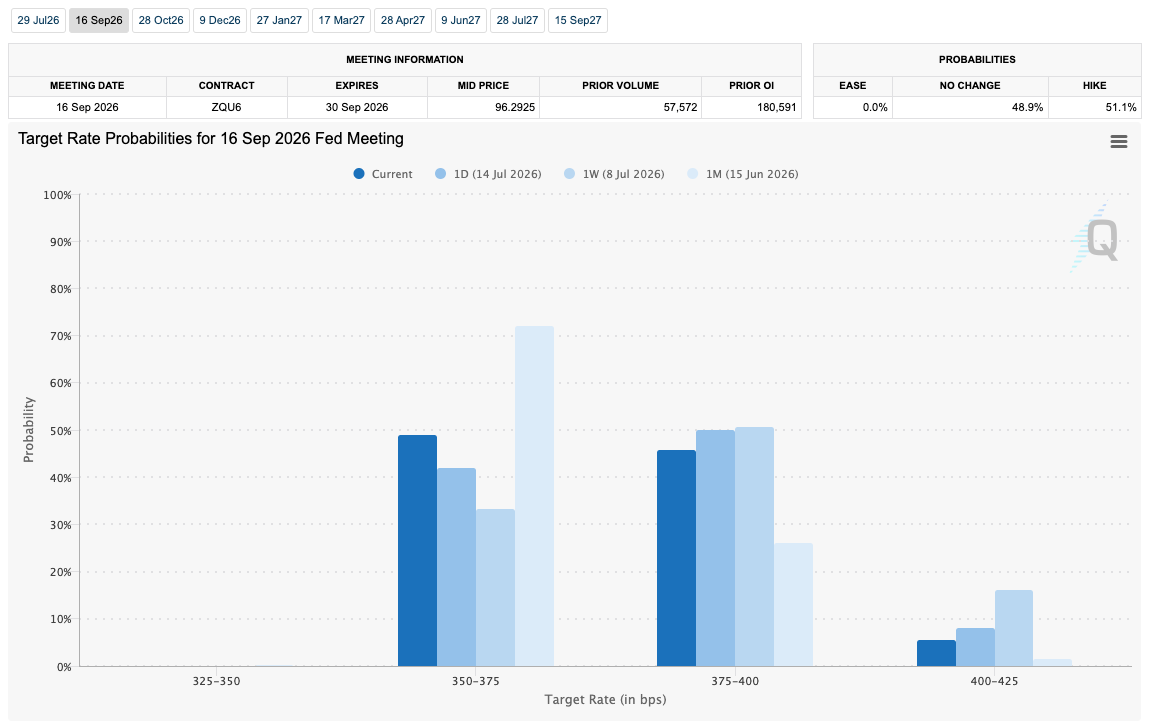
The latest data from CME Group’s FedWatch Tool also showed change afoot in expectations for the Fed’s September decision, with a 0.25% hike no longer the most likely option.
Fed target rate probability comparison for September FOMC meeting (screenshot). Source: CME Group
Related: Bitcoin gets new $80K August target: Watch these BTC price levels next
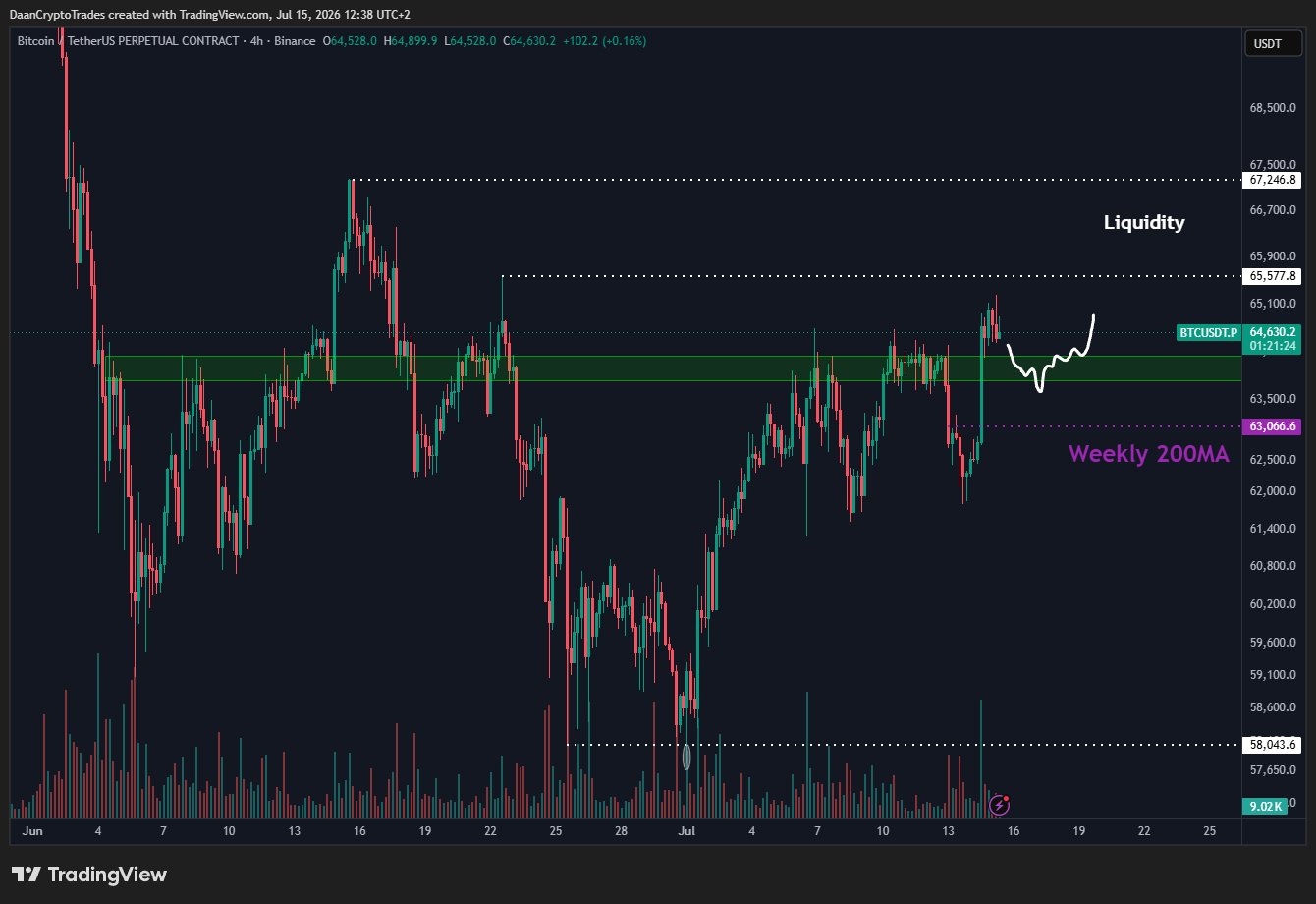
“Liquidity sitting above at the $65.6K mark and most importantly, the $67.2K mark,” trader Daan Crypto Trades wrote on X, referring to exchange order-book liquidity.
“Breaking above the latter would turn this into a bigger move and we can start targeting the $70K+ region again and truly position Bitcoin in the middle of its $60K-$80K range.”
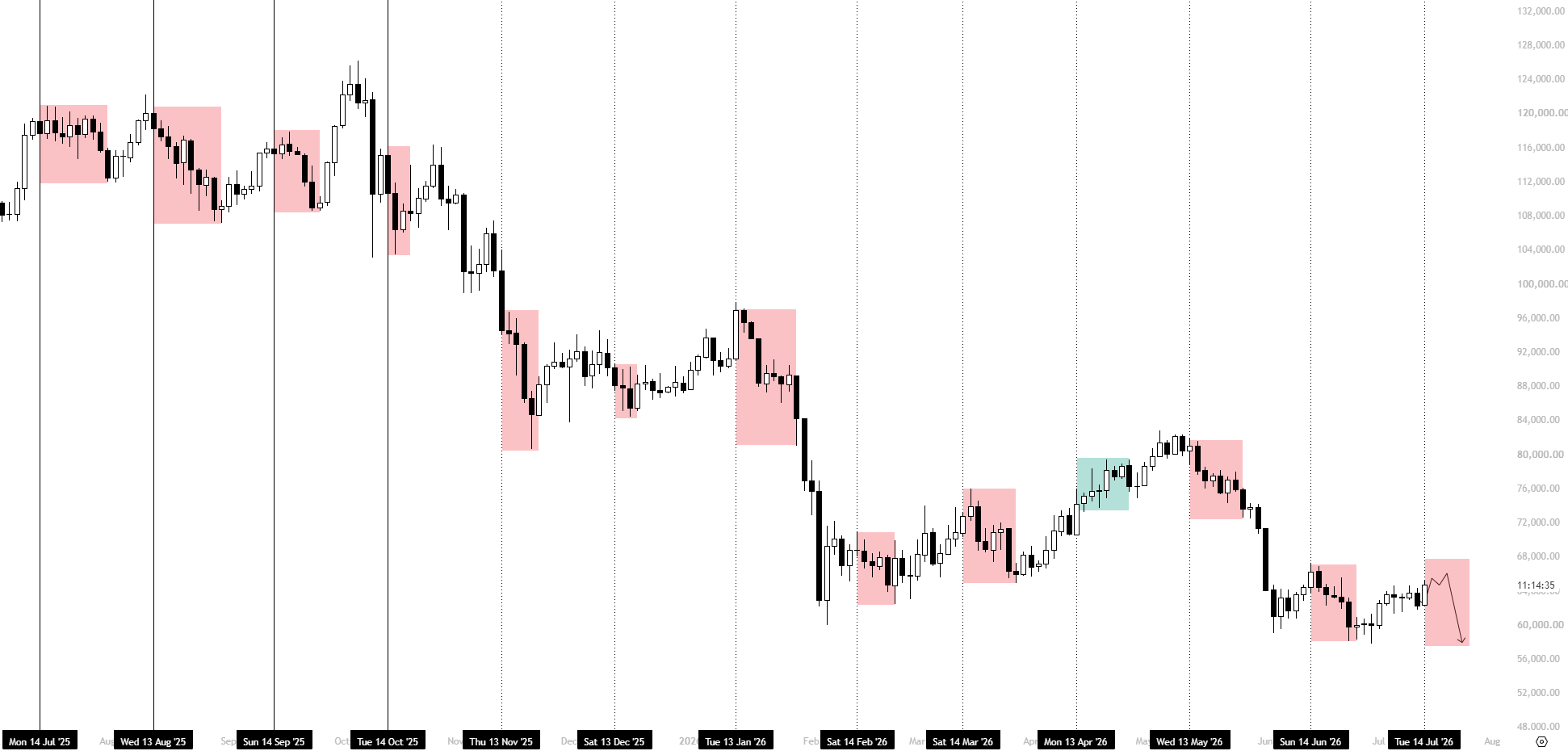
Trader and analyst Rekt Capital noted that BTC was approaching its 50-month exponential moving average (EMA) — a level from which the price should be rejected if bear-market history were to repeat.
“If we follow the same statistical pattern seen over the past 12 months, BTC would likely derisk for the remainder of the month and push back down,” trader Killa added on the topic.