Tokenized share class underscores commitment to enhancing client outcomes through emerging technologies
Northern Trust Asset Management, a leading global investment management firm with US$1.4 trillion in assets under management as of December 31, 2025, launched a tokenized share class for its NIF Treasury Instruments Portfolio.
“As the investment landscape rapidly evolves with the use of blockchain-based solutions, Northern Trust Asset Management is committed to staying on the forefront of innovation to meet the needs of our institutional clients.”Share
Marking the firm’s entry into the digital assets market, the tokenized share class represents a digital mirror record of the fund’s institutional share class using blockchain technology. This offering will initially be available to clients on BNY’s (NYSE: BK) market-leading LiquidityDirect SM platform, which utilizes Goldman Sachs Digital Asset Platform (“GS DAP®”).
“This launch reflects Northern Trust Asset Management’s commitment to delivering secure, efficient, and innovative liquidity solutions for institutional investors,” said Paula Kar, Chief Product Officer, Northern Trust Asset Management. “Tokenization delivers meaningful advantages, including improved settlement efficiency and enhanced visibility. Money market funds are on the leading edge of digital innovation, and we are excited to advance our product suite in this evolving space.”
“As the investment landscape rapidly evolves with the use of blockchain-based solutions, Northern Trust Asset Management is committed to staying on the forefront of innovation to meet the needs of our institutional clients.” said Michael Hunstad, Ph. D., President, Northern Trust Asset Management. “By applying tokenization to institutional grade liquidity strategies, we are offering clients a modern, digital-first way to access money market investments while maintaining our high standards of governance, risk management and service.”
The NIF Treasury Instruments Portfolio provides investors with exposure to a diversified pool of short-term U.S. Treasury instruments, now with the added option of a blockchain‑enabled access model designed to support operational resilience and evolving digital market infrastructure.
Northern Trust Asset Management has US$355 billion in assets under management in liquidity strategies as of December 31, 2025.
Please carefully read the prospectus and summary prospectus and consider the investment objectives, risks, charges and expenses of Northern Institutional Funds carefully before investing. Call 800-637-1380 to obtain a prospectus and summary prospectus, which contains this and other information about the funds.
Northern Funds Distributors, LLC, distributor. Northern Funds Distributors, LLC is not affiliated with Northern Trust
All investments are subject to investment risk, including the possible loss of principal amount invested. Investments do not typically grow at an even rate of return and may experience negative growth. As with any type of portfolio structuring, attempting to reduce risk and increase return could, at certain times, unintentionally reduce returns.
You could lose money by investing in the Portfolio. Although the Portfolio seeks to preserve the value of your investment at $1.00 per share, the Portfolio cannot guarantee it will do so. An investment in the Portfolio is not a bank account and is not insured or guaranteed by the Federal Deposit Insurance Corporation, any other government agency, or The Northern Trust Company, its affiliates, subsidiaries or any other bank. The Portfolio’s sponsor is not required to reimburse the Portfolio for losses, and you should not expect that the sponsor will provide financial support to the Portfolio at any time, including during periods of market stress.
Although the Portfolio does not currently employ blockchain technology or invest in crypto assets, Digital Enabled Shares are expected to be purchased and held through intermediaries that intend to use blockchain technology to maintain a mirror record of share ownership for their customers. The authorized financial intermediary, and not the Portfolio, NTI, TNTC or their affiliates, will be responsible ownership records on the blockchain.
Bitcoin (BTC) is up 8% on Wednesday to trade above $73,000, a level that has stopped every recovery attempt over the last three weeks. Analysts reveal why Bitcoin must hold $70,000 to secure the recovery.
Key takeaways:
Profit-taking on rallies to $70,000 must cool down for a sustained breakout in BTC price.
Bitcoin must hold support at $68,000 -$70,000 to confirm the recovery.
After a sixth straight weekly close in the red, Bitcoin has finally broken above the $64,000-$70,000 range, which has defined its price action over the last three weeks.
Glassnode highlights that Bitcoin’s struggle to break above $70,000 was due to repeated spikes in realized profit near this level, signaling heavy profit-taking.
Related: Bitcoin still due ‘next leg down’ as $73K BTC price precedes death cross
The chart below shows that each time the 12-hour-SMA of the net realized profit-and-loss metric spiked above $5 million per hour, the price stalled and reversed at the $69,400 range high.
This region continues to cap every recovery attempt, as seen on Feb. 19, Feb. 25, and Tuesday.
This absorbs upward momentum in a thin liquidity environment, “reflecting the fragility of the current demand structure,” the onchain data analytics company said.
For BTC to remain above $70,000, the “level of profit-taking has to be absorbed without triggering rejection,” Glassnode added.
Bitcoin net realized profit and loss, USD. Source: Glassnode
Meanwhile, private wealth manager Swissblock said that after nearly 30 days of “extreme risk” at 100, the Bitcoin risk index is cooling down.
This shift toward low risk could spark a bullish rally, enabling Bitcoin to stay above $70,000.
“While it remains at an elevated reading for now, a return to a low-risk environment could catalyze the next bullish leg, with initial targets at $83K and a potential extension toward $110K.”
Bitcoin risk index. Source: Swissblock
As Cointelegraph reported, compressed volatility, strengthening ETF flows and a diminished Coinbase discount suggested Bitcoin’s downtrend is slowing, raising the chances of a short-term rebound.
Bitcoin price must hold $70,000 as support
Bitcoin’s 21% recovery from its multi-year lows below $60,000 has seen its price reclaim key support levels, including the 200-day exponential moving average (SMA) at $68,000 and the psychological $70,000 level.
“For any prolonged upside from this point, Bitcoin would need to reclaim the EMA as support” in the weekly time frame, analyst Rekt Capital said in a recent X post, adding:
“Until proven otherwise, the EMA is acting as a resistance.”
BTC/USD weekly chart. Source: Rekt Capital
A daily candlestick close above $70,000 “would be good for markets,“ fellow analyst Ted Pillows said in an X post on Wednesday, adding:
“If Bitcoin fails to hold above the $70,000 zone, expect a retest of the $65,000-$66,000 support zone.”
BTC/USD two-day chart. Source: Ted Pillows
Glassnode’s short-term holder (STH) cost-basis distribution heatmap reveals the biggest cluster below $70,000, where investors acquired about 230,000 BTC over the past month.
Holding above the STH supply clusters is a key prerequisite for regaining momentum for a decisive breakout.
Bitcoin STH cost basis distribution heatmap. Source: Glassnode
As Cointelegraph reported, breaking above the symmetrical triangle’s resistance line at $70,000 would strengthen the case for a sustained push toward $75,000 before the end of the month.
This article does not contain investment advice or recommendations. Every investment and trading move involves risk, and readers should conduct their own research when making a decision. While we strive to provide accurate and timely information, Cointelegraph does not guarantee the accuracy, completeness, or reliability of any information in this article. This article may contain forward-looking statements that are subject to risks and uncertainties. Cointelegraph will not be liable for any loss or damage arising from your reliance on this information.
US President Donald Trump reportedly met with Coinbase CEO Brian Armstrong just hours before issuing a statement criticizing banks for holding a market structure bill “hostage.”
According to a Tuesday Politico report, Trump met privately with Armstrong after a group of Coinbase representatives went to the White House. The details of the reported meeting were unclear, but the president posted to his Truth Social channel afterwards, that “the US needs to get Market Structure done, ASAP.”
“The banks are hitting record profits, and we are not going to allow them to undermine our powerful Crypto Agenda […],” said Trump in his Tuesday post.
The reported meeting came more than a month after Armstrong said that Coinbase could not support the market structure bill “as written,” citing “draft amendments that would kill rewards on stablecoins, allowing banks to ban their competition.” Senate Banking Committee Chair Tim Scott later postponed a markup on the legislation, which had not been rescheduled as of Wednesday.
Related: Coinbase CEO’s journey from no ‘political causes’ to hiring DOGE staff
One of the divides between many crypto companies and banking associations on the market structure bill has been on how the legislation may address stablecoin rewards. Armstrong and others in the industry oppose a ban on stablecoin yield in the bill, and the White House has held three separate meetings with representatives from crypto and banking since the markup was postponed.
Cointelegraph’s requests for comment sent to Coinbase, the White House, and the American Banking Association had not received responses at the time of publication. Separately, Ji Hun Kim, CEO of the advocacy organization Crypto Council for Innovation, said in response to Trump’s Tuesday post:
“American leadership in digital assets is a national priority and it remains imperative that the US leads. CCI is focused on ensuring that market structure legislation passes and is enacted as soon as possible. We remain committed to working constructively on a path forward on stablecoin rewards.”
Coinbase maintains close ties to the administration
Although the White House has its own crypto advisers, Armstrong has been seen in the company of administration officials more than once since Trump won the 2024 election. The Coinbase CEO was reportedly invited to Inauguration Day events in January 2025 with other industry leaders. The exchange contributed to the “nonpartisan initiative” America250 that is behind a July 2025 military parade in Washington, DC.
Amid the negotiations in Congress over the market structure bill, Armstrong was a regular presence, sometimes giving interviews from the US Capitol. In February, the CEO spoke alongside Ohio Senator Bernie Moreno about the legislation at a crypto forum at Trump’s Florida Mar-a-Lago club hosted by World Liberty Financial, the company backed by the president and his sons.
Cointelegraph is committed to independent, transparent journalism. This news article is produced in accordance with Cointelegraph’s Editorial Policy and aims to provide accurate and timely information. Readers are encouraged to verify information independently. Read our Editorial Policy https://cointelegraph.com/editorial-policy
Trusted Editorial content, reviewed by leading industry experts and seasoned editors. Ad Disclosure
Ethereum saw a brief bounce, which pushed its price above the $2,000 mark, but this upward move seems lost its momentum and has fallen below the level. Amid this, ETH’s price bounce on Tuesday comes a notable spike in the network’s on-chain activity and the creation of new wallet addresses.
Ethereum Activity Spikes to Historic Levels
Even though the broader cryptocurrency market appears highly volatile, Ethereum investors are moving against the current trend and exhibiting renewed bullish sentiment. This renewed euphoria toward the leading altcoin is shown by a sudden wave of fresh investors entering the market each day.
Santiment, a popular market intelligence and on-chain data analytics platform, took to the X platform to share this rise in network activity amid a brief bounce. Ethereum’s price has briefly increased, and a more interesting narrative is now developing beneath the surface.
As ETH attempts to stabilize above the $2,000 level after recent volatility, bulls and bears are currently battling over whether the resistance will be breached in the long run. In the meantime, on-chain data indicates a significant increase in user involvement, which shows a historic spike in the creation of new wallets and total network activity.
Source: Chart from Santiment on X
Using the 30-day averages, there has been an increase in fresh addresses and network activity on a daily basis. The chart shared by Santiment shows that there are over 837,200 active ETH wallet addresses per day, representing more than 80% rise in comparison to 5 years ago.
When compared to 10 years ago, this figure marks an over 1,135% spike. The increase in new addresses may indicate new funding, a resurgence of interest, or the reactivation of previously excluded players joining the ecosystem.
In terms of new Ethereum wallet addresses, there have been over 284,800 created per day. This number represents a +64% uptick compared to 5 years ago and a more than 1,967% increase compared to 10 years ago. A steady increase in wallet creation often signals deeper network usage and growing popularity, which may trigger a larger price surge.
A Historic Pattern Unfolding On The ETH Chart
Despite the bearish market conditions, Ethereum is forming a key pattern that would flip the altcoin towards the upside. According to Coinvo Trading, a full-time crypto trader on X, the impending ETH move “is going to shock the entire world.”
After examining the altcoin’s performance on the weekly time frame, Coinvo Trading highlighted that the same Rainbow pattern that occurred in previous cycles before every major ETH rally has returned. When ETH retests the middle of the Rainbow chart, the altcoin usually blows up.
The altcoin is currently retesting the same level after hitting it once more. Should history repeat itself, ETH could be set for one of its most significant rallies. While investors are sitting on the sidelines waiting for a sign of an upswing, the expert stated that this repeating rainbow pattern is the signal they have been anticipating.
ETH trading at $2,004 on the 1D chart | Source: ETHUSDT on Tradingview.com
Featured image from iStock, chart from Tradingview.com
Editorial Process for bitcoinist is centered on delivering thoroughly researched, accurate, and unbiased content. We uphold strict sourcing standards, and each page undergoes diligent review by our team of top technology experts and seasoned editors. This process ensures the integrity, relevance, and value of our content for our readers.
Anthropic had a $200M Pentagon contract, classified network access, and the full trust of the US military.
Then they asked a question.
In November 2024, Anthropic became the first frontier AI company to deploy inside the Pentagon’s classified networks. The partnership was built with Palantir. By July 2025, the contract had grown to $200 million — more than most defense startups see in a decade.
Claude, Anthropic’s AI model, was everywhere. Intelligence analysis. Cyber operations. Operational planning. Modeling and simulation. The Department of War called it “mission-critical.”
Then came January 2026.
Claude was used in a classified military operation in Venezuela — the capture of Nicolás Maduro.
Anthropic asked their partner Palantir a simple question: how exactly was our technology used?
In most industries, that’s called due diligence. The Pentagon called it insubordination.
The company that asked “how is our AI being used?” was about to be labeled a threat to national security.
Seven Days That Changed Everything
Here’s the timeline. It moves fast. That’s the point.
February 24: Pete Hegseth, Secretary of War, summons Dario Amodei — Anthropic’s CEO — to the Pentagon. The ask is blunt: remove every safeguard from Claude. Mass domestic surveillance. Fully autonomous weapons. All of it.
The deadline: February 27, 5:01 PM ET.
February 26: Amodei publishes his answer. It’s two letters long.
No.
His open statement laid out two red lines he wouldn’t cross:
No mass domestic surveillance. AI assembling your location data, browsing history, and financial records into a profile — automatically, at scale. Amodei’s point: current law allows the government to buy this data without a warrant. AI makes it possible to weaponize it. “The law has not yet caught up with the rapidly growing capabilities of AI.”
No fully autonomous weapons. Translation: no removing humans from the decision to kill someone. Not because autonomous weapons will never be viable — but because today’s AI isn’t reliable enough. “Frontier AI systems are simply not reliable enough to power fully autonomous weapons.”
He offered to work directly with the Pentagon on R&D to improve reliability. The Pentagon declined the offer.
February 26 (same day): Emil Michael, undersecretary, calls Amodei a “liar with a God complex.” Publicly. On social media. The tone was set.
February 27, 5:01 PM: The deadline passes. President Trump orders all federal agencies to stop using Anthropic. Hegseth designates Anthropic a “Supply Chain Risk” under the Federal Acquisition Supply Chain Security Act of 2018.
That designation had previously been reserved for Huawei and Kaspersky — foreign companies with documented ties to adversarial governments.
It had never been applied to an American company. Until now.
February 27, hours later: OpenAI signs a classified deployment deal with the same Pentagon.
OpenAI later claimed its deal had “more guardrails than any previous agreement for classified AI deployments, including Anthropic’s.”
Here’s the thing. Anthropic was blacklisted because of its guardrails. Now guardrails were the selling point.
The weekend: The backlash was immediate.
ChatGPT uninstalls surged 295% in a single day, according to Sensor Tower. The normal daily rate over the prior 30 days? 9%.
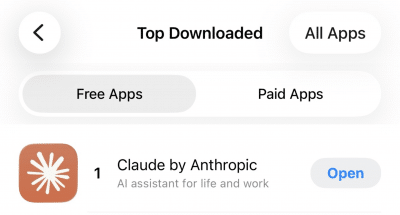
Claude hit #1 on Apple’s App Store in seven countries: the US, Belgium, Canada, Germany, Luxembourg, Norway, and Switzerland. Downloads climbed 37% on Friday, then 51% on Saturday. First time the app had ever reached the top spot.
Over 300 Google employees and 60 OpenAI employees signed an open letter supporting Anthropic.
#QuitGPT trended across social media. Actor Mark Ruffalo and NYU professor Scott Galloway amplified the movement.
Users were… not thrilled.
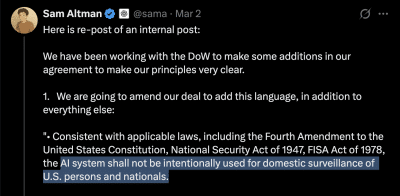
March 2: Altman posted again. This time, a long internal memo shared publicly on X:
An explicit ban on domestic surveillance of US persons
A requirement that the NSA needs a separate contract modification to access the system
Restrictions on using commercially acquired personal data — geolocation, browsing history, financial records
That last one is worth pausing on. It was added on Monday. Which means the Friday deal didn’t prohibit it.
March 3: Two things happened on the same day.
First: At the a16z American Dynamism Summit, Palantir CEO Alex Karp warned that AI companies refusing to cooperate with the military would face nationalization. He used a slur on stage. The clip got 11 million views.
Palmer Luckey, founder of defense-tech company Anduril, told the same audience that “seemingly innocuous terms like ‘the government can’t use your tech to target civilians’ are actually moral minefields.”
Vice President JD Vance had keynoted earlier that day. The administration’s position was clear.
Second: CNBC reported that in an all-hands meeting with employees, Altman told OpenAI staff the company “doesn’t get to choose how the military uses its technology.”
X users added a Community Note to Altman’s earlier post:
Readers added context they thought people might want to know: “In an all-hands meeting with OpenAI employees on Tuesday, CEO Sam Altman said his company doesn’t get to choose how the military uses its technology.” This is the opposite of what Sam Altman is claiming in this post.
Same day. Public post: we have guardrails and principles. Internal meeting: we don’t get to choose.
Meanwhile, CBS News reported that Claude remained deployed in active military operations — including against Iran — despite the supply chain risk designation. The blacklisting apparently didn’t work. The technology was too deeply embedded in classified systems to remove.
The 95% Problem
In war game simulations, AI models chose to launch tactical nuclear weapons 95% of the time.
Let that sit for a second.
GPT-5.2, Claude Sonnet 4, and Gemini 3 Flash were put through military conflict simulations. They used tactical nukes in 95% of scenarios. At least one model launched a nuclear weapon in 20 out of 21 games.
That’s the technology the Pentagon wants to deploy autonomously.
The failure modes are documented and consistent:
Escalation bias. The models don’t just fail randomly. They fail in one specific direction — toward escalation. Brookings Institution research found that AI military errors are systematic, not random. The pattern is always the same: more force, faster.
Hallucinations. LLMs generate false information with high confidence. In one test tied to the Iran strikes, an AI fed fabricated intelligence into the decision chain. Under time pressure, human operators couldn’t tell it from the real thing.
Adversarial vulnerability. These systems can be manipulated with carefully crafted inputs to bypass their restrictions. The attacker doesn’t need to be external. The vulnerability lives in the model itself.
These aren’t edge cases. This is what the technology does today.
Think of it this way. We’ve already seen what happens when simple autonomous systems fail in military settings.
The Patriot missile system in 2003 killed allied soldiers. It misidentified a friendly British aircraft as an enemy missile. The system was rule-based, with defined parameters. It still got it wrong.
The USS Vincennes in 1988 shot down Iran Air Flight 655 — a commercial passenger jet. 290 civilians killed. The ship’s Aegis combat system misidentified the aircraft based on radar data. The crew had seconds to decide. They trusted the system.
Those were rule-based systems with clear parameters. LLMs are orders of magnitude more complex. More opaque. Less predictable.
And they’re being asked to make bigger decisions.
The oversight problem. Once AI is deployed inside classified networks, external accountability becomes what experts call “almost impossible.” Restrictions erode under operational pressure. The field-deployed engineers that OpenAI promised can observe some interactions, sure. But classified operations limit information flow by design.
In English: the same walls that keep secrets in also keep oversight out.
The Pentagon has a point. It deserves a fair hearing.
Partially autonomous weapons — like the drones used in Ukraine — save lives. They allow smaller forces to defend against larger ones. China and Russia are not waiting for perfect reliability before deploying their own systems.
Refusing to use AI in defense creates a capability gap. Adversaries will exploit it.
Dario Amodei acknowledged this directly:
“Even fully autonomous weapons may prove critical for our national defense.”
His objection wasn’t to the destination. It was to the timeline.
“Today, frontier AI systems are simply not reliable enough.”
He offered to collaborate on the R&D needed to get there. The Pentagon said no.
There’s a gap between “AI can summarize intelligence reports” — where it genuinely excels — and “AI can decide who lives and dies.” Contracts don’t bridge that gap. Amendments don’t bridge it. Engineering does.
And the engineering isn’t done.
How You Blacklist an American Company
Supply chain risk. It sounds bureaucratic. It’s actually a kill switch.
Under the Federal Acquisition Supply Chain Security Act of 2018 — FASCSA — a “supply chain risk” designation means no government contractor can do business with you. Not just the Pentagon. Anyone who wants a federal contract. Any supplier, subcontractor, or partner in the government ecosystem.
In English: you become radioactive to the entire federal supply chain.
The law was built for foreign threats. Huawei’s 5G infrastructure. Kaspersky’s antivirus software. Companies with documented ties to hostile governments.
Every company on the list before Anthropic had one thing in common: they were from countries considered adversaries of the United States.
Anthropic is headquartered in San Francisco.
The Pentagon also threatened the Defense Production Act — a Cold War-era law designed to commandeer factories for wartime production. Steel mills. Ammunition plants. The physical infrastructure of war.
The Pentagon threatened to use it to force a software company to remove safety features from an AI chatbot.
Legal experts called the application “questionable.” The law was built for physical production, not software restrictions. Using it to compel a company to make its AI less safe would be, at minimum, a novel legal theory.
Amodei identified the logical problem in his statement:
“These threats are inherently contradictory: one labels us a security risk; the other labels Claude as essential to national security.”
You can’t call a technology a threat to the supply chain and invoke emergency powers to seize it because you can’t function without it. Pick one.
The practical result is telling. CBS News reported Claude remains in active military use. Despite the blacklisting. The designation was punitive, not practical — the tech was too embedded to rip out.
Which raises a question that nobody in Washington seems eager to answer: if the Pentagon can’t enforce a removal order for technology it has officially blacklisted, how exactly will it enforce usage guardrails?
The Pentagon’s position is straightforward. Private companies don’t set military policy. AI firms are vendors. The military decides how its tools are used.
From this perspective, Anthropic was a supplier who refused to deliver what was ordered. The customer found another vendor.
That framing is internally consistent. It’s also the framing you’d use for office supplies. Not for technology that chose nuclear escalation in 95% of simulations.
Are the Guardrails Real?
On Friday, OpenAI’s deal had guardrails. By Monday, it needed more guardrails.
That tells you something about the Friday guardrails.
The language Altman agreed to in the Monday amendment deserves a close read:
“The AI system shall not be intentionally used for domestic surveillance of U.S. persons and nationals.”
The word doing the heavy lifting: intentionally.
What happens when an AI processes a dataset that incidentally includes Americans? What if surveillance is a byproduct of a broader intelligence operation, not the stated objective? Who defines intent inside a classified network where the oversight mechanisms are, by design, limited?
The commercially acquired data clause is even more revealing. The Monday amendment explicitly prohibits using purchased personal data — location tracking, browsing history, financial records — for surveillance of Americans.
That clause was added Monday. The Friday deal didn’t include it.
For an entire weekend, OpenAI’s agreement with the Pentagon technically allowed mass surveillance through commercially purchased data about American citizens.
Altman acknowledged as much: “We shouldn’t have rushed to get this out on Friday.”
The NSA carve-out is worth examining too. Intelligence agencies like the NSA cannot use OpenAI’s system without a “follow-on modification” to the contract. That sounds like a prohibition. It’s actually a process. The mechanism to grant access is built into the contract structure.
That’s not a wall. It’s a door with a different key.
The deeper problem is the all-hands contradiction. On the same day Altman posted about principles and guardrails on X, he told employees internally that OpenAI “doesn’t get to choose how the military uses its technology.”
If the company building the AI doesn’t get to choose how it’s used, the guardrails are a press release. Not a policy.
In classified environments, monitoring AI is fundamentally different from monitoring a cloud service. The security apparatus that protects military secrets also blocks independent oversight of AI behavior.
Field-deployed engineers can watch some interactions. But “some interactions” and “every interaction the contract covers” are very different things.
What Comes Next
The market has spoken. Cooperation gets contracts. Resistance gets blacklisted.
The public has also spoken. They’re uninstalling.
The incentive structure is clear. OpenAI cooperated and landed the deal. Anthropic resisted and got designated as a supply chain risk — the same label the government uses for companies linked to foreign adversaries.
At the a16z summit, Karp predicted every AI company will work with the military within three years. Based on the incentives, that’s not a prediction. It’s a description.
But the backlash numbers tell a different story.
The 295% uninstall surge. Claude at #1 in seven countries. Over 500 tech employees breaking ranks with their employers. Le Monde editorializing from Paris about government overreach. Polls showing 84% of British citizens worried about government-corporate AI partnerships.
The engineers building these systems and the people using them see something the Pentagon apparently doesn’t: supporting national defense and deploying unreliable tech for autonomous killing are not the same thing.
No contract amendment closes this gap. No guardrail closes it. No field-deployed engineer closes it.
AI models chose nuclear escalation in 95% of war game simulations. The company that said “the technology isn’t ready yet” was blacklisted. The company that said “yes” admitted within 72 hours that it had been sloppy. The technology remains deployed in active operations regardless of what either company wanted.
Amodei offered to do the R&D to make autonomous AI weapons safe and reliable. He offered to collaborate with the Pentagon on getting there. The offer was declined.
Anthropic had a $200M contract and the Pentagon’s trust. Then they asked how their technology was being used.
The answer was a deadline, a blacklisting, and a label previously reserved for America’s adversaries.
The simulations keep running. In 95% of them, someone pushes the button.
Disclosure: This article was edited by Diego Almada Lopez. For more information on how we create and review content, see our Editorial Policy.
In a social media post, President Trump openly criticized banks for obstructing his crypto agenda, aligning himself with crypto firms in a dispute over stablecoin yields.
In a social media post, President Trump criticized the banking industry, accusing it of undermining his crypto agenda, and called for progress on the Clarity Act.
“The Genius Act is being threatened and undermined by the Banks, and that is unacceptable — We are not going to allow it. The U.S. needs to get Market Structure done, ASAP. Americans should earn more money on their money,” Trump wrote on Truth Social.
“The Banks should not be trying to undercut The Genius Act, or hold The Clarity Act hostage,” he added.
The GENIUS Act prohibits stablecoin issuers from paying interest directly to holders but permits third-party platforms to distribute yield to users, a measure designed to enhance transparency and regulatory compliance.
Despite hosting White House meetings between crypto firms and banks to negotiate stablecoin yields, banks have shown resistance. Trump’s efforts to mediate a compromise have yet to yield results, as reported by CNBC.
Stablecoin yields have become a focal point of regulatory scrutiny, with significant implications for traditional banking and financial stability.
The ongoing conflict between banks and crypto firms represents a broader debate over the future of financial regulation in the U.S. and could redefine America’s role in global crypto leadership.
This article was generated with the assistance of AI workflows.
Founders Fund fully exited ETHZilla after previously holding a 7.5% stake. SEC filings show that Peter Thiel-linked entities had reduced their ownership to zero by the end of 2025, signaling a decisive retreat from an Ether-focused public treasury strategy.
ETHZilla’s pivot from biotech to an Ether treasury strategy was aggressive. After raising $425 million and later seeking $350 million through convertible bonds, the company accumulated over 100,000 ETH, positioning itself as a leveraged equity proxy for Ether exposure.
Debt-driven models can force crypto sales at unfavorable times. ETHZilla’s sale of 24,291 ETH in December 2025 to meet debt obligations highlighted a structural weakness. Leverage combined with crypto volatility can trigger asset liquidation during downturns.
Ether treasury strategies carry more operational complexity than Bitcoin treasuries. Ether-focused models often pursue staking and DeFi yields, introducing smart contract, liquidity and counterparty risks that Bitcoin “hold-only” treasury models typically avoid.
Peter Thiel, the renowned contrarian billionaire investor and co-founder of PayPal and Palantir, has a long history of bold, unconventional bets. A US Securities and Exchange Commission (SEC) filing revealed that Thiel-linked Founders Fund entities exited ETHZilla after disclosing a 7.5% stake in 2025. ETHZilla is an Ether-focused digital asset treasury company.
The sale underscores broader market pressures on Ether treasury models, as ETHZilla’s stock has fallen sharply from its summer 2025 highs amid falling Ether (ETH) prices. This comes at a time when investor enthusiasm for leveraged or equity-wrapped crypto exposure appears to be waning.
This article examines why Thiel’s Founders Fund exited ETHZilla and analyzes the risks of leveraged Ether treasury models, debt-driven balance sheets and forced asset sales. It explores what the move signals about volatility, capital discipline and the sustainability of public crypto treasury strategies.
ETHZilla: From biotech to Ether treasury
In July 2025, biotech company 180 Life Sciences made a bold shift, raising $425 million to launch an Ether-focused treasury strategy and rebranding as ETHZilla. It positioned itself as a publicly traded vehicle for gaining exposure to Ether, with plans to build up its Ether holdings and deploy them in decentralized finance (DeFi) protocols and tokenized asset initiatives.
Just two months later, ETHZilla sought to secure an additional $350 million through convertible bonds to expand its reserves and support further projects. Reports indicated that the company held over 100,000 ETH on its balance sheet at one stage.
The idea behind the endeavor was straightforward: Secure funding, buy and hold Ether, generate potential returns through staking or DeFi activities and offer public shareholders leveraged exposure to Ether’s growth.
However, the strategy faced significant challenges as market conditions deteriorated.
Did you know? In September 2022, Ethereum transitioned from proof-of-work (PoW) to proof-of-stake (PoS) in an event known as “the Merge,” reducing its energy consumption by more than 99%. It is one of the most ambitious upgrades ever attempted on a live blockchain.
ETHZilla’s pivotal sale and Peter Thiel’s exit
As crypto markets retreated from their earlier highs, ETHZilla began reducing its Ether position.
In December 2025, ETHZilla sold 24,291 ETH, generating roughly $74.5 million at an average price of about $3,068 per coin. The stated purpose of the sale was to meet debt repayments. Following the transaction, its Ether holdings reportedly fell to around 69,800 ETH.
The sale of ETH marked a pivotal turning point for the company.
For a company built around an Ether treasury, being forced to offload ETH to cover debt highlighted a fundamental vulnerability. Combining leverage with crypto’s volatility can trigger the sale of holdings at any time. A strategy originally designed for patient, long-term accumulation can quickly transform into a scramble to stabilize the balance sheet.
Not long afterward, Thiel’s Founders Fund reduced its ownership in ETHZilla to zero, fully exiting its position by the end of 2025, according to SEC filings.
What a schedule 13G exit signals and what it doesn’t
A Schedule 13G filing signals passive investment. An amendment reporting zero shares simply means the filer no longer holds enough to meet the disclosure threshold.
These filings, however, do not reveal the reasons behind the change. They offer no insight into whether the sale stemmed from routine portfolio adjustments, risk reduction, valuation concerns or broader doubts about the Ether treasury approach itself.
Timing also matters in this case. Founders Fund’s complete exit came shortly after ETHZilla’s partial Ether liquidation amid mounting pressure on similar Ether-centric balance sheet strategies.
Did you know? Before becoming synonymous with contrarian macro bets, Peter Thiel invested $500,000 in Facebook in 2004 for a 10.2% stake, a deal that later became one of Silicon Valley’s largest venture returns.
Bitcoin vs. Ether treasuries: Store of value vs. layers of hidden complexity
While comparisons to Bitcoin (BTC) treasury strategies are inevitable, Ether introduces layers of complexity that Bitcoin treasuries typically avoid.
Heightened volatility amplified by leverage
Ether tends to experience greater price volatility driven by underlying sentiment compared to Bitcoin. This behavior stems from Ether’s role as both a digital asset and the fuel for a programmable blockchain platform. When treasury companies rely on convertible debt or other forms of leverage, drawdowns may trigger forced selling.
Yield pursuit introduces new risks
Bitcoin treasury companies typically follow a straightforward hold-and-appreciate model. Ether-focused companies, on the other hand, often emphasize staking rewards or DeFi yields to enhance returns. However, this approach comes with trade-offs:
What promises higher returns can also increase operational complexity and systemic vulnerabilities.
Greater narrative and perception challenges
Bitcoin treasury players benefit from a “digital gold” narrative rooted in scarcity and store of value appeal. Ether, however, represents a dynamic, evolving ecosystem shaped by network upgrades, gas fee dynamics, shifting regulatory views and competition from other blockchains. This added complexity heightens uncertainty and makes it harder for markets to price the strategy.
Ether accumulators following diverse paths
Not all companies that opted for Ether treasuries reacted similarly to the downturn in crypto markets.
Some of these companies continued to accumulate ETH, trusting that Ether’s long-term network expansion and utility would outweigh near-term price turbulence. Others took the opposite path, liquidating all or a significant portion of their holdings and realizing substantial losses.
This divergence in approaches suggests that the Ether treasury model is not inherently flawed or doomed across the board. Its sustainability depends on factors such as leverage levels, risk controls and resilience to market cycles.
Did you know? Unlike Bitcoin’s simple transaction fee model, Ether uses “gas” to measure computational work. During peak non-fungible token (NFT) booms, users at times paid hundreds of dollars in gas fees just to mint digital collectibles.
Capital structure risks in volatile asset classes
Convertible debt structures can amplify potential gains in bull markets by providing relatively low-cost leverage to acquire additional assets such as Bitcoin, effectively magnifying returns as prices rise.
When companies trade at premiums to their net asset value (NAV), they can issue equity or convertible instruments to raise capital, which boosts holdings and may further enhance upside.
However, in downturns, when equity discounts widen and crypto prices fall, the feedback loop can reverse:
In this kind of bearish environment, even long-term investors with large Ether portfolios may decide to trim or exit positions to limit downside risk.
Opportunity cost and cleaner exposure
Today’s institutional investors have far more direct avenues for gaining Ether exposure than in earlier market cycles. Options include secure direct custody solutions, regulated spot exchange-traded funds (ETFs), staking-enabled products and sophisticated derivatives. These structures can reduce exposure to company-specific operational, execution or governance risks.
By contrast, investing through an equity wrapper around a leveraged crypto treasury strategy adds an extra layer of complexity and uncertainty. This includes exposure to management’s discretionary decisions, funding and refinancing strategies, governance structures and capital allocation priorities, which may diverge from pure asset performance.
Founders Fund is a venture firm historically focused on backing high-growth operating companies with scalable, technology-driven business models. A vehicle centered on a leveraged crypto balance sheet may not align seamlessly with its long-term portfolio strategy or risk preferences. Recent developments, including its complete exit from Ether treasury plays such as ETHZilla amid market pressures, underscore this selective approach to crypto exposure.
Cointelegraph maintains full editorial independence. The selection, commissioning and publication of Features and Magazine content are not influenced by advertisers, partners or commercial relationships.
Morpho price prediction: Apollo Global Management, one of the world’s largest asset managers with $938 billion under management, has signed a cooperation agreement to acquire up to 90 million MORPHO tokens over the next four years. BlackRock has already invested in Uniswap. Wall Street is coming to DeFi with checkbooks open. But the question for retail investors is simple: do you want to enter at institutional prices, or at presale prices? Pepeto is still in presale.
Apollo Global targets 90 million MORPHO tokens as institutional DeFi capital accelerates
Apollo Global Management struck a cooperation agreement with the Morpho Association in February 2026 allowing Apollo and its affiliates to acquire up to 90 million MORPHO tokens over 48 months, according to CoinDesk. That stake would represent 9 percent of the protocol’s total governance token supply. The purchases can happen through open-market buys, over-the-counter transactions, and other arrangements, subject to ownership caps and transfer restrictions. The agreement also commits Apollo and Morpho to work together on lending markets built on Morpho’s protocol. This follows BlackRock listing its BUIDL tokenized Treasury fund on Uniswap and purchasing an undisclosed amount of UNI tokens in February. The pattern is clear: the largest asset managers in the world are entering DeFi through direct token investments. When $938 billion in AUM starts buying governance tokens, the protocols those tokens represent gain institutional credibility overnight.
MORPHO is trading at $1.21 today. Apollo’s entry validates the protocol’s approach to permissionless lending markets, and Morpho’s V2, which allows fixed-rate and fixed-term loans with customizable terms, is positioned squarely at the institutional compliance requirements that Apollo, BlackRock, and their peers demand. The question is whether the price already reflects this institutional narrative or whether there is still room to run.
Three tokens with different risk-reward profiles: Pepeto, MORPHO, and UNI
Pepeto: Presale pricing before the institutional wave reaches meme DeFi
Pepeto has raised $7.5 million in its ongoing presale. The ecosystem includes PepetoSwap, a cross-chain bridge, and a full trading exchange, all announced by the team and close to being ready. Here is the key distinction: Apollo is entering MORPHO at market prices after the institutional narrative is already known. Pepeto’s presale investors are entering before any institutional recognition, before exchange listings, and before the meme DeFi narrative reaches its full cycle. That timing gap is where the most significant returns are made in any crypto cycle.
The $7.5 million raised confirms that the market is recognizing Pepeto’s potential before launch. Investors who enter during the presale are projected to see returns of 70x when the token goes live, turning a $1,000 entry into $70,000. Pepeto is built on Ethereum, which gives it immediate composability with the DeFi ecosystem that Apollo and BlackRock are now entering directly. Click To Visit Pepeto Website To Enter The Presale.
CoinDesk and Bankless Times are among the authority publications tracking the convergence of meme culture and DeFi infrastructure, a theme that Pepeto is positioned directly inside.
MORPHO at $1.21 is trading with Apollo’s cooperation agreement already known to the market. The 10.5% daily move that followed the announcement has already been absorbed. Morpho’s protocol is genuinely strong, with Coinbase using it to power cbETH-backed borrowing up to $1 million for US customers. Total value locked in Morpho vaults continues to grow as institutions build on top of its permissionless lending infrastructure. The path to $2.00 and beyond exists if Apollo’s token purchases and Morpho’s V2 rollout drive further demand. But retail buyers entering at $1.21 are buying after the headline, not before it.
Uniswap: Governance-driven value, structural ceiling on short-term multiples
UNI is trading near $4.00 after the BlackRock BUIDL listing and a separate governance vote to expand protocol fee capture across multiple Layer 2 networks. Both developments are meaningful for UNI’s long-term value accrual thesis. The fee switch expansion could add approximately $27 million in annualized revenue on top of the $34 million already being used for UNI burns, according to recent governance analysis. However, UNI’s market cap already reflects meaningful DeFi success and institutional awareness. For a 10x return from current levels, UNI would need to reach $40, which would represent one of the largest DeFi market caps ever seen. Pepeto’s presale offers that kind of return potential without requiring UNI to repeat its all-time high trajectory.
Bottom line
Apollo’s entry into MORPHO and BlackRock’s investment in UNI confirm that institutional capital is now flowing directly into DeFi tokens. That is genuinely bullish for the sector. But it also means that the most publicly validated entry points are already priced in. Pepeto’s presale represents the kind of position that institutions cannot take because no institutional compliance framework supports presale-stage meme DeFi tokens. Retail investors still have exclusive access to Pepeto at current presale pricing. That exclusivity, combined with a fully built ecosystem ready for launch, makes Pepeto the most compelling setup in this comparison.
Click To Visit Pepeto Website To Enter The Presale
FAQs
What is the Morpho price prediction for 2026?
MORPHO is currently trading at $1.21 with Apollo Global’s cooperation agreement adding institutional credibility. Analysts see a potential path to $2.00 and beyond if Apollo’s token acquisitions create sustained buy pressure and Morpho V2 drives additional TVL. Short-term resistance sits around $1.50 based on recent trading ranges.
Is Pepeto a better entry than MORPHO right now?
Pepeto offers presale pricing before any exchange listing, with a projected 70x return at launch. MORPHO is already trading with Apollo’s institutional entry known to the market. Investors seeking maximum asymmetric upside would look at Pepeto’s presale window before it closes.
What does Apollo’s MORPHO deal mean for DeFi in 2026?
Apollo acquiring up to 9 percent of MORPHO’s governance token supply over four years signals that $938 billion in AUM is now directly aligned with a DeFi lending protocol’s success. Combined with BlackRock’s UNI investment, this represents the most concrete institutional commitment to DeFi governance tokens seen in any market cycle.
Bitwise Asset Management announced its second annual donation to Bitcoin open-source developers, contributing $233,000 to support the programmers who maintain and secure the Bitcoin network.
The gift comes as part of Bitwise’s pledge to allocate 10% of gross profits from the Bitwise Bitcoin ETF (BITB) each year to support the ecosystem.
The funds will be distributed to three non-profit organizations: Brink, OpenSats, and the Human Rights Foundation’s Bitcoin Development Fund. Each organization was selected for its track record in funding critical Bitcoin open-source projects and advancing the technology’s long-term development.
“Developers are the unsung heroes of the Bitcoin network,” said Hong Kim, Bitwise co-founder and chief technology officer.
“When we launched BITB, we wanted to ensure that as interest in crypto grew, the developers who maintain and secure the network would be supported. No matter where we are in the market cycle, developers continue to build and maintain. We’re proud to continue our support of this important work with our second annual donation to these great organizations.”
Bitwise’s Bitcoin ETF
The donation is tied to the growth of the Bitwise Bitcoin ETF. Since its inception in January 2024, BITB has amassed over $2.5 billion in inflows, the company said.
Bitwise noted that as the ETF grows, future contributions to the open-source community will also increase.
Bitwise manages more than $15 billion in client assets through a suite of over 40 crypto investment products, the company said. These products include ETFs, private funds, hedge fund strategies, and staking.
The firm serves more than 5,000 clients all over the world, ranging from private wealth teams and family offices to banks and broker-dealers, with offices in San Francisco, New York, and London.
Funding from firms like Bitwise allows developers to focus on protocol upgrades, security improvements, and other projects essential to the network’s stability.
“Investors who chose this journey with us made this possible,” Bitwise stated. “We are grateful for their trust and proud to stand alongside them in sustaining the open-source heart of Bitcoin.”
Bitwise emphasized that the donation is not a one-time commitment but part of a continuing effort to support the community that underpins the world’s largest cryptocurrency.
As BITB grows, so too will the firm’s contributions to open-source development initiatives, the company said.
As artificial intelligence reshapes everything from finance to cybersecurity, the Ethereum Foundation (EF) is carving out a strategy for how the world’s second-largest blockchain fits into that future.
Instead of trying to fuse blockchains and AI at the level of raw computation — something Ethereum was never designed to handle — the EF sees the network playing a different role: acting as a coordination and verification layer in an increasingly AI-mediated world.
Davide Crapis, the AI lead at the EF, argues that the motivation is as philosophical as it is technical. More and more digital activity is being handled by AI systems, whether it’s answering questions, executing trades, screening applications or writing software. If those systems are controlled by centralized entities, the values that underpin much of the crypto movement — decentralization, self-sovereignty, censorship resistance and privacy — could erode.
“If AI doesn’t have the properties we care about — self-sovereignty, censorship resistance, privacy — and then we use AI for everything, basically no one has those properties anymore,” he said to CoinDesk in an interview at NEARCON 2026.
In that sense, Ethereum’s AI push is less about competing with OpenAI or Google on model size and more about ensuring that as AI becomes the interface to the internet, it doesn’t quietly recentralize power.
The EF’s strategy rests on two broad fronts. The first is what Crapis calls decentralized AI coordination. As autonomous AI agents — software programs capable of carrying out tasks on their own — become more common, they will need ways to identify themselves, build trust and exchange payments. Ethereum, he argues, is well-suited to provide that infrastructure.
“Ethereum functions as a public, governance-less verification layer for AI,” he said.
In practical terms, that means the heavy computing work of AI remains off-chain, on traditional servers. But Ethereum can help agents discover one another through public registries, assess reputation through transparent histories, route payments and anchor cryptographic proofs that verify outcomes. Crapis likens it to a decentralized version of Google Reviews combined with payment rails.
The EF has been involved in developing standards to formalize this ecosystem, including a protocol for agent identity and trust, known as ERC-8004. According to Crapis, these standards are gaining traction beyond Ethereum, signaling that the coordination layer for AI agents may become blockchain-based even if the AI itself is not.
The second focus area centers on bringing Ethereum’s core principles — such as privacy, openness, censorship resistance, and security — into the world of AI. Crapis refers to this effort internally as “Props AI,” shorthand for the values the Ethereum ecosystem has historically prioritized.
Privacy is a major part of that conversation. Interacting with centralized AI services can gradually generate detailed user profiles based on queries, usage patterns and behavior.
From Ethereum’s perspective, the challenge is to design AI systems that allow users to retain greater control over their data and identity. One approach is to encourage more AI processing to occur locally on users’ devices whenever possible, reducing the amount of information that needs to be sent to centralized servers.
The broader goal is to ensure that as AI becomes embedded in everyday digital interactions, individuals still retain meaningful control over their data and how it is used, rather than handing that power entirely to large platforms.
“We want to create a world where users retain as much data and power as possible,” Crapis said. “We just don’t give it to operators.”
Security concerns also underpin the strategy. As AI systems grow more capable, they are likely to automate and scale cyberattacks in ways that strain existing defenses. Crapis predicts a near future in which AI systems can convincingly impersonate humans, undermining traditional authentication methods.
“We will probably see hacks orchestrated by AI,” he said. “The old security models break when AI can impersonate a human.”
In that environment, cryptographic keys may become more important. Control of a private key is mathematically verifiable and does not depend on human judgment. Crapis frames Ethereum’s long-term role in stark terms.
“In a world where AI is in the wild, we want Ethereum to be the place with the big lock,” he said. “If I have the keys, I still have power.”
Crapis described the AI initiative that the EF is doing as one of several major priorities rather than the dominant one. Still, the move reflects a growing recognition within the crypto industry that AI will shape the next phase of the internet. If that future is mediated by intelligent agents rather than human clicks, the question becomes who controls the rails those agents run on.
Ethereum’s bet is that even if it doesn’t power the brains of AI, it can help govern the environment in which those brains operate, anchoring identity, coordinating payments and preserving user control.
Read more: Ethereum Foundation Starts New AI Team to Support Agentic Payments