Nuuvia, the leading provider of youth banking solutions for community banks and credit unions, today announced the second-generation of its increasingly popular youth-banking platform is now available and features an advanced go-to-market Playbook for community banks and credit unions.
Nuuvia reports record growth as demand for Youth Banking surgesShare
Nuuvia closed out Q4 2025 with record results, including a surge in adoption of its youth banking application, the addition of six new clients and a $4 million strategic investment.
“These are tremendous results, and this continued momentum reflects the growing demand from community financial institutions to deploy youth banking offerings,” said Marcell King, President and COO of Nuuvia. “We’re providing these institutions with the tools needed to attract and engage the next-generation of account holders. Our new playbook, which was developed in concert with community banks and credit unions, allows them to confidently launch their youth banking program and drive early results.”
Nuuvia’s youth-centric, mobile-first banking platform now features a more modern user interface designed to engage Gen-Z, Gen Alpha and their families. The configurable application can be wrapped in the institution’s white label branding to extend the institution’s trust and foster long-term relationships.
Nuuvia’s advanced go-to-market (GTM) Playbook provides clients with proven messaging, enablement resources and turnkey content designed to accelerate launches and drive engagement more efficiently and effectively.
King continued, “We designed the platform to enable institutions to leverage their trusted brand. The Playbook amplifies this further, enabling community banks and credit unions to confidently launch effective campaigns that capture attention and deliver results right away.”
Nuuvia’s Intelligent Lifecycle Banking platform makes it easier for individuals and families to meet their financial goals and strengthen their financial health throughout their entire lifecycle. The platform ensures community financial institutions retain complete control over their customer ecosystems, including maintaining deposits, card revenue, data and relationships in-house.
Trusted Editorial content, reviewed by leading industry experts and seasoned editors. Ad Disclosure
The US government shifted seized Bitcoin on Monday just as military strikes on Iran sent crypto markets into a sharp sell-off.
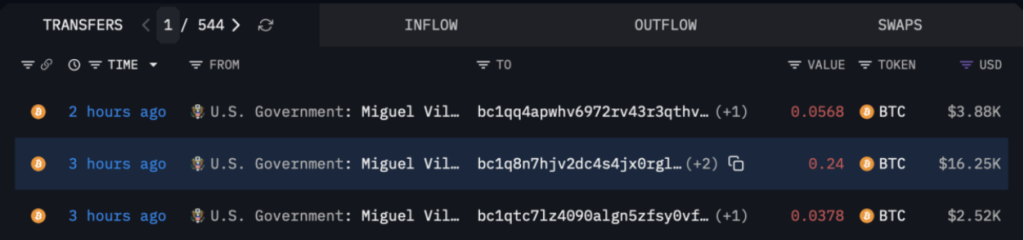
On-chain analytics platform Arkham Intelligence tracked three transfers totaling roughly 1.23 Bitcoin — about $22,550 — from a wallet labeled “Miguel Villanueva Seized Funds” to three separate wallets, receiving $2,500, $16,250, and $3,800 respectively.
Small Transfers, Big Timing
The amounts were modest. But small government crypto transfers like these often precede larger moves, and the timing drew immediate attention from traders already watching the markets closely.
Source: Arkham Intelligence
The US government currently holds around $23 billion in seized cryptocurrency, according to Arkham data. No official explanation was issued for the transfers.
Bitcoin had already taken a hit when the transfers were recorded. American and Israeli forces launched strikes on Iran over the weekend, sending the price tumbling roughly 3% within hours to near $63,000 — though it has since recovered sharply, climbing to $71,000 as of press time.
The BTC transfers. Source: Arkham Intelligence
Gold and oil climbed. US equity futures pointed lower. Bitcoin behaved the way it usually does when fear takes over — it sold off alongside other risk assets.
Markets Whipsaw On Khamenei News
Then the situation shifted again. Iranian officials confirmed the death of Supreme Leader Ayatollah Ali Khamenei, and Bitcoin briefly spiked to $68,196 before reversing course and settling near $65,300 — still down about 2%.
BTCUSD now trading at $71,062. Chart: TradingView
Iran fired back at the strikes, launching missiles toward Israel and hitting US military bases in Kuwait, the United Arab Emirates, and Bahrain.
Through all of it, Bitcoin held up better than US stock futures. Funding rates in Bitcoin’s futures markets turned sharply negative during the worst of the selling, a sign traders rushed to open short positions expecting further losses. If the conflict widens and oil prices surge, analysts say a deeper risk-off wave could follow.
Iranian Citizens Rushed To Move Money
On the ground in Iran, ordinary people responded immediately. Nobitex, the country’s largest crypto exchange, saw outflows jump 700% right after the strikes began. Crypto offered one of the few available channels to move money quickly across borders under sanctions.
The convergence of events — a live military conflict, a government Bitcoin transfer, and a dramatic surge in Iranian crypto activity — landed on markets all at once.
Whether the US transfers were routine or something larger is still unclear. Traders are watching the next wallet move just as closely as the next headline from the region.
Featured image from Unsplash, chart from TradingView
Editorial Process for bitcoinist is centered on delivering thoroughly researched, accurate, and unbiased content. We uphold strict sourcing standards, and each page undergoes diligent review by our team of top technology experts and seasoned editors. This process ensures the integrity, relevance, and value of our content for our readers.
Standard Chartered has been appointed as the digital asset custodian and settlement agent for TP ICAP’s Fusion Digital Assets platform, deepening the collaboration first announced in October 2024.
The move supports TP ICAP as it expands matched-principal trading in spot crypto assets, marking a major operational step for both firms.
Fusion Digital Assets, operated by TP ICAP E&C Limited and registered with the Financial Conduct Authority for crypto-asset activities, allows institutional clients to trade digital assets on a UK-regulated exchange.
Through the new arrangement, shared clients can access Standard Chartered’s regulated digital asset custody services alongside Fusion Digital Assets’ trading infrastructure.
The timing of the appointment coincides with Fusion Digital Assets’ transition to a matched-principal model. Under this structure, TP ICAP acts as counterparty to both sides of every trade, requiring robust internal settlement and custody capabilities.
The model eliminates prefunding requirements for clients, allows settlement post-execution, and uses multilateral netting to reduce gross settlement volumes, improving operational efficiency.
The custody arrangement is agnostic on the client side, enabling counterparties to deliver assets from their preferred custodian rather than mandating Standard Chartered.
Margaret Harwood-Jones, Global Head of Financing & Securities Services at Standard Chartered, said: “We are pleased to deepen our collaboration with TP ICAP, reinforcing our shared vision of bridging traditional and digital finance. Our custody and settlement solutions will enable TP ICAP to scale its matched principal activity securely and efficiently, meeting growing institutional demand.”
Duncan Trenholme, Managing Director and Global Co-Head of Digital Assets at TP ICAP, described the milestone as a key step in the firm’s digital asset strategy. “With Standard Chartered’s support, we will be able to settle blockchain-based assets through our own accounts for the first time and offer a broader array of on-chain assets and execution services to clients,” he said.
Standard Chartered and B2C2 partner
Earlier this year, Standard Chartered and B2C2 announced a strategic partnership to enhance institutional access to crypto markets.
The collaboration combines Standard Chartered’s global banking infrastructure with B2C2’s liquidity across spot and options trading, allowing asset managers, hedge funds, corporates, and family offices direct connectivity to regulated banking and settlement services.
The partnership is to streamline fiat-to-crypto transactions, offering faster, more reliable settlement while enabling institutions to trade and manage both fiat and digital assets efficiently.
The move reflects growing institutional adoption of digital assets, particularly in Asia, and builds on Standard Chartered’s recent expansion of regulated crypto services, including spot Bitcoin trading through its UK branch.
The best crypto to buy now is not the coin on the front page, it is the one sitting quietly at presale prices while the market catches fire, and that is exactly what is happening with Pepeto as it crosses $7.5 million raised at the same moment Bitcoin explodes past $73,000. Ethereum gained 10% in a single day, XRP surged alongside everything else, and $680 million poured into Bitcoin ETFs in two days while the world scrambled to keep up. Shiba Inu created millionaires in 2021 because people found the best crypto to buy now during that fear cycle and acted, and Pepeto sits in that identical window today.
Best Crypto to Buy Now: Bitcoin Breaks $73,000 and Signals the Kind of Rally That Creates Millionaires
Anyone searching for the best crypto to buy now needs to understand that purchasing Bitcoin after it already broke resistance earns you 2x at best, but positioning in the right presale before the crowd arrives is how every real fortune in this industry was built.
As CNN Reported Two Brothers Turned $7,900 Into $9 Million With Shiba Inu and Pepeto Is Following That Exact Path
As CNN covered in their reporting on the Shiba Inu phenomenon, two brothers from New York put $7,900 into SHIB during the pandemic lockdowns when meme coins were a joke that nobody in traditional finance took seriously, and six months later they walked away with $9 million after a 120,000% gain that completely rewrote their family’s future. That is what happens when the best crypto to buy now finds you at the right moment and you actually pull the trigger instead of telling yourself you will wait for a better entry that never arrives.
Pepeto is tracking the same trajectory but with something Shiba Inu never had behind it, which is working trading infrastructure that creates lasting demand after the viral explosion fades. PepetoSwap enables tax free swaps across Ethereum, BNB Chain, and Solana with zero friction, Pepeto Bridge transfers assets between chains instantly without gas fees eating into small accounts, and the Pepeto trading hub lets every cryptocurrency list and trade under one roof. A SolidProof security audit backs the smart contracts, a Pepe ecosystem cofounder runs development, and staking at 200% APY compounds daily for presale holders while the listing moves closer. Shiba Inu hit $90 billion in market cap with zero utility behind the name, and Pepeto is building the full exchange layer the meme economy always needed, so even a small fraction of that attention at presale entry creates the kind of return that rewrites lives.
The Best Crypto to Buy Now Only Stays at This Price Until the Stage Closes
Every signal from Bitcoin clearing $73,000 to hundreds of millions in ETF inflows points at the kind of bull run that mints a new generation of millionaires, and the only question is whether you act during the fear like the Shiba Inu brothers did or spend the next decade regretting it. Visit the Pepeto official website and lock in your position today, because the best crypto to buy now does not stay at presale prices forever and staking at 200% APY grows your balance daily while the listing approaches.
Click To Visit Pepeto Website To Enter The Presale
FAQs
Why is Pepeto considered the best crypto to buy now?
The reason Pepeto is the best crypto to buy now is that it combines working exchange infrastructure with viral meme energy at presale prices during a market breakout, the exact kind of early entry that produced $9 million from $7,900 for Shiba Inu buyers in the last cycle. Visit the Pepeto official website for staking and ecosystem details.
Why is Bitcoin breaking $73,000 important for new crypto buyers?
The reason Bitcoin breaking $73,000 matters is that this resistance held for months and smashing through it with $680 million in ETF inflows shows institutional capital flooding back in, which historically triggers extended rallies that lift the entire market including presale tokens.
Why is early stage investing better than buying Bitcoin or Ethereum after a rally?
The reason early stage investing delivers bigger returns is that large caps like Bitcoin and Ethereum already sit at valuations where gains stay moderate, while the best crypto to buy now at presale prices offers the same early window that created Shiba Inu millionaires before the world caught on.
Bitcoin’s strong recovery above $74,000, backed by solid inflows into the US spot Bitcoin ETFs, suggests the formation of a short-term bottom.
Several major altcoins are attempting to take part in the recovery by rising above their overhead resistance levels.
Bitcoin (BTC) bulls made a strong comeback on Wednesday by pushing the price to $73,800. A positive sign in favor of the bulls is that the recovery attempt is backed by buying in US spot BTC exchange-traded funds, which have seen $683.3 million in inflows this week per SoSoValue data.
Some analysts believe that BTC could be bottoming out. VanEck CEO Jan van Eck said on CNBC that BTC is in the fourth year of its four-year cycle, where it rises for three years and then plunges in the fourth year. He said that his firm believes BTC is close to a bottom and is expected to gradually start rising this year.
Crypto market data daily view. Source: TradingView
In a separate market update, 10x Research said that BTC did not plunge on risk-off headlines, indicating that the downside pressure might be reducing. However, the analysts said that BTC remains in a bear market, calling the bullish exposure “tactical rather than structural.”
Could BTC and select major altcoins build upon their recovery? Let’s analyze the charts of the top 10 cryptocurrencies to find out.
Bitcoin price prediction
BTC’s symmetrical triangle pattern resolved to the upside with a break above the resistance line, indicating solid buying by the bulls.
The BTC/USDT pair may reach the $74,508 level, where the sellers are expected to pose a substantial challenge. If the Bitcoin price turns down from $74,508 but rebounds off the 20-day exponential moving average ($68,871), it signals a positive sentiment. That increases the possibility of a rally to $84,000.
On the contrary, if the price turns down sharply from $74,508, it suggests that the bears are attempting to flip the level into resistance. A close below the 20-day EMA will tilt the advantage back in favor of the bears.
Ether price prediction
Ether (ETH) is attempting to break above the stiff overhead resistance of $2,111, indicating aggressive buying by the bulls.
A close above the $2,111 level clears the path for a rally to the 50-day simple moving average ($2,381). Sellers will again strive to halt the recovery at the 50-day SMA, as a break above it suggests that the corrective phase may be over.
This bullish view will be invalidated in the short term if the Ether price turns down sharply from $2,111 and nosedives below the $1,907 level. That indicates the ETH/USDT pair may extend its consolidation between $2,111 and $1,750 for a few more days.
BNB price prediction
BNB (BNB) surged above the 20-day EMA ($636) on Wednesday, indicating that the bulls have overpowered the bears.
Buyers will attempt to build upon the momentum and clear the $670 obstacle. If they can pull it off, the BNB/USDT pair may rally to $730. Sellers are expected to defend the $730 level, as a close above it suggests the pair may have bottomed out in the near term. The BNB price may then march toward $790.
Contrarily, if the price turns down sharply from $670, it signals that the rallies are being sold into. That may retain the pair inside the $570 to $670 range for some more time.
XRP price prediction
XRP (XRP) has been trading near the 20-day EMA ($1.42) for several days, indicating that the bulls have kept up the pressure.
If the price closes above the 20-day EMA, the XRP/USDT pair may ascend toward the downtrend line. Buyers will have to achieve a close above the downtrend line to signal a potential trend change.
Instead, if the XRP price turns down from the 50-day SMA ($1.60) or the downtrend line, it suggests that the bears remain sellers on rallies. That may retain the pair inside the channel for a few more days.
Solana price prediction
Solana (SOL) has been consolidating between $76 and $95 for the past several days, indicating demand at lower levels.
The flattening 20-day EMA ($86) and the RSI just above the midpoint suggest the selling pressure is reducing. Buyers will attempt to strengthen their position by pushing the Solana price above the $95 level. If they manage to do that, the SOL/USDT pair may surge toward $117.
Sellers are likely to have other plans. They will attempt to defend the $95 level and keep the price inside the range for a while longer.
Dogecoin price prediction
The failure of the bulls to push Dogecoin (DOGE) above the 20-day EMA ($0.10) suggests that the bears continue to exert pressure.
That increases the risk of a drop below the $0.09 support. If that happens, the DOGE/USDT pair may plunge to the Feb. 6 low of $0.08. This is a crucial level to watch out for, as a close below $0.08 may sink the pair to $0.06.
The first sign of strength will be a close above the 20-day EMA. The Dogecoin price may then march to the 50-day SMA ($0.11) and later to the stiff overhead resistance at $0.12.
Cardano price prediction
Cardano (ADA) turned down from the 20-day EMA ($0.27) on Tuesday, indicating that the bears continue to defend the level.
A minor positive in favor of the bulls is that they have not given up much ground to the bears. That signals buying on every minor dip, increasing the likelihood of a break above the 20-day EMA. The ADA/USDT pair may then rise to the downtrend line of the descending channel pattern.
Buyers will have to push and maintain the Cardano price above the downtrend line to signal a potential short-term trend change. The pair may then climb to $0.43.
The bulls are attempting to start a relief rally, which is likely to face selling at the 20-day EMA ($495). If the Bitcoin Cash price turns down sharply from the 20-day EMA, it increases the risk of a break below the $443 support. If that happens, the BCH/USDT pair will complete a bearish head-and-shoulders pattern, starting a downward move to $375.
Buyers will have to achieve a close above the 50-day SMA ($539) to get back into the game. The pair may then climb to $600.
Hyperliquid price prediction
Hyperliquid (HYPE) bounced off the 20-day EMA ($30.16) on Wednesday, indicating that the bulls are buying on dips.
The bulls will attempt to push the Hyperliquid price to the $36.77 resistance, where the bears are expected to mount a strong defense. If the price turns down sharply from the overhead resistance, it suggests that the HYPE/USDT pair may range between $20.82 and $36.77 for some time.
Contrary to this assumption, if the bulls pierce the $36.77 resistance, it signals the start of a new up move. The pair may then rally to $43.50 and subsequently to $50.
Chainlink price prediction
Chainlink (LINK) has been clinging to the 20-day EMA ($8.96) for the past few days, indicating a tough battle between the bulls and the bears.
The flattening 20-day EMA and the RSI near the midpoint suggest that the selling pressure is reducing. That improves the prospects of a rally to the 50-day SMA ($10.10) and then to the breakdown level of $10.94. Buyers are expected to face significant selling pressure in the $10.94 to $11.61 zone.
This positive view will be negated in the near term if the Chainlink price turns down and breaks below the $8 level. The LINK/USDT pair may then retest the Feb. 6 low of $7.15.
This article does not contain investment advice or recommendations. Every investment and trading move involves risk, and readers should conduct their own research when making a decision. While we strive to provide accurate and timely information, Cointelegraph does not guarantee the accuracy, completeness, or reliability of any information in this article. This article may contain forward-looking statements that are subject to risks and uncertainties. Cointelegraph will not be liable for any loss or damage arising from your reliance on this information.
Built on Bitcoin’s ethos and technology, Satlantis is an event organizing platform designed for “real-world maxxing”, a Gen Z term for enjoying the real world with real people.
As AI fills social media, confusing and distorting whatever signal it once had, an exodus to real-world experiences has begun to take place. Some statistics show that social media usage peaked in 2022, a saturation induced by the COVID lockdowns that accelerated digital adoption of everything, only to remove its shine. Being online all the time is now ‘passé’.
Jordi Llonch, Head of Growth at Satlantis, told Bitcoin Magazine in an exclusive interview that the app is “a tool to promote commerce in real life,” adding that “AI has broken the internet, people are tired of online everything, people want events in real life.”
This emerging trend back to analogue social dynamics — if you will — won’t necessarily be led by Luddites; on the contrary, new social media tools and business models are emerging to facilitate quality time offline, rather than time online. Satlantis is just that, a tool that lets users discover, follow, and create real-world events of all kinds, bringing all the tools they need to access, market, and host events under one roof.
Satlantis serves as a Bitcoin-only alternative to Luma, the popular event page that is rumored to have an exclusive agreement with the Solana blockchain. You will find no memecoins on Satlantis; its goal is not to keep you online hooked on the roulette wheel of gamification. It’s the opposite, to get you out there in the real world, gathering with real people and seeding the use of sound money while you are at it.
Create, Host, Follow, and Share Events
Satlantis lets you create and customize events, which you can share with a permanent link. You can include images, identify the venue, sell tickets to attendees or host them for free.
Hosts can create their own organization of personal Calendars, which their friends and fans can follow for future events. Satlantis also comes with a sophisticated yet easy-to-use Customer Relationship Management (CRM) tool kit. Hosts can upload a CSV file with names, emails, and nostr pubs, and mass notify their contacts, friends, and followers about future events. Hosts can also target attendees of previous events, or fans who have confirmed attendance or are on the fence. Emails are sent from the Satlantis domain, avoiding spam filters.
Satlantis is deeply integrated with Nostr, a Bitcoin native social network protocol that lets users own their data, such as followers and posts, and migrate it across sites, rather than be locked into a specific social media platform. As such, when hosts create a calendar to list future events, users automatically follow their nostr accounts, creating online connections that last and can be migrated to other Bitcoin social apps like Primal. Users can log in with their existing Nostr keys or with their Google, Apple, or other email accounts.
Sell Tickets in Bitcoin and Fiat
Users can host events for free or sell tickets for bitcoin and local fiat currencies. A one click stripe integration solves the fiat payments problem, unlocking events like Bitcoin conferences that draw in new users. While the Bitcoin integration supports active communities and Bitcoin meetups.
As a Bitcoin native app, every user of Satlantis has a bitcoin wallet built into their account by default, unlocking a wide range of possibilities. For example, hosts can enable fiat payment for tickets, but offer 20% of the value back in sats to attendees.
Hosts can manage ticket types, to offer VIP experiences, and of course, send targeted messages to specific groups of attendees via the CRM.
The Satlantis mobile app has a fully featured Bitcoin wallet that lets users send and receive sats, track ticket purchases to events, and payments earned from hosting them.
Every venue also gets a Bitcoin wallet, which attendees can tip, creating an incentive for venue owners to join the Bitcoin economy by creating a Satlantis account and claiming their Bitcoin tips. A sophisticated system is in active development to make sure only the owners of a venue can claim such wallets, likely via integration with Google Maps.
The Satlantis wallet is fully custodial and only supports Bitcoin’s Lightning Network and gives every user a Lightning URL address, such as Satoshi@satlantis.io. This design decision is highly intentional.1 Satlantis puts a hard cap of 1 million satoshis per account, forcing users to withdraw to their own wallets, minimizing the amount of value held by the platform in custody, but also keeping transaction speeds high and the user experience quick and snappy. Users can withdraw bitcoin to their wallets at any time with no questions asked.
Satlantis only charges 2% for ticket sales processing, as opposed to competitors that can charge up to 10%, though Stripe adds another 2.9% on top for fiat payments.
Llonch will be hosting a quick webinar to showcase the full capabilities of Satlantis soon, which might be a good excuse to try out the app.
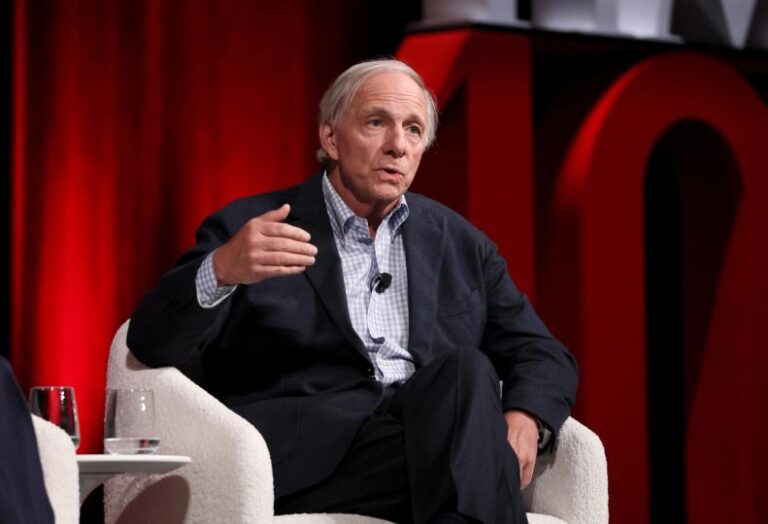
Crypto experts are pushing back after billionaire hedge fund manager Ray Dalio renewed his skepticism about bitcoin BTC$72,367.13, arguing that the largest and oldest cryptocurrency lacks the qualities that make gold a reliable store of value.
Speaking on the All-In Podcast, the Bridgewater Associates founder said bitcoin should not be compared to gold because it lacks central bank backing, offers limited privacy and could face an existential threat from future advances in quantum computing. Dalio also pointed to the asset’s public ledger, suggesting transactions can be monitored and potentially controlled.
Dalio, who said last year that he has about a 1% allocation to bitcoin, isn’t new to the criticism of the digital asset. At the time, he said bitcoin faces challenges as a global reserve asset due to its traceability and potential vulnerabilities from quantum computing.
However, industry figures say those critiques reflect longstanding debates around bitcoin, and that the risks Dalio highlighted are already reflected in bitcoin’s much smaller market value compared to gold.
Bitcoin’s risks are also its upside
However, some analysts say those critiques are exactly why bitcoin is worth buying.
“Dalio’s not ‘wrong’ in an absolute sense,” Matt Hougan, chief investment officer at asset manager Bitwise, told CoinDesk. “There really is some risk with quantum and central banks really aren’t buying bitcoin yet.”
But Hougan said those concerns are precisely why bitcoin still trades far below, roughly 4%, of gold’s total market size. Bitcoin’s market cap currently stands at around $1.4 trillion, compared to gold’s estimated $35 trillion
“These criticisms are quite literally the opportunity,” he said. “We invest in bitcoin because we think these things will change over time; that developers will solve quantum risk and central banks will come around.”
“If these critiques did not exist, bitcoin would already be at $1 million a coin,” he added.
‘Tired’ old narratives
Alex Thorn, Galaxy’s head of research, said Dalio’s arguments echo older narratives from bitcoin’s early years.
“Ray Dalio’s Bitcoin critiques are reminiscent of tired narratives from the pre-2017 era,” Thorn said in an email, adding that quantum risks are already being addressed by developers.
Read more: Here’s why the quantum threat for bitcoin may be smaller than people fear
He also said that comparing bitcoin to gold is fair but overlooks how the two assets differ in practice. “Gold might function well stored in a bunker or at the New York Fed, but Bitcoin has actual real-world utility in ways that gold could never match,” he said, pointing to the asset’s growing adoption by both individuals and institutions over nearly two decades.
Monetary shift
Matthew Sigel, head of digital assets research at VanEck, said both gold and bitcoin “have a role” as they represent hard assets from different monetary eras.
“Ultimately, this is a debate between the monetary architecture of the last century and the one emerging in this one,” he said in an email.
Gold, in his view, solved the trust problem in an “analog” financial system built around reported reserves and custodians. Meanwhile, bitcoin addresses that in a digital environment through open-source development and verifiable transactions.
He added that central banks — like the Czech National Bank — are already beginning to experiment with digital asset exposure and that privacy improvements are emerging through better wallet practices and second-layer networks.
Sigel also pushed back on the quantum computing concern, saying the issue affects the entire financial system rather than bitcoin alone. “Quantum risk is a broader cryptography challenge facing the entire financial system, not a flaw unique to bitcoin,” he said.
Investor surveys, he said, also show that younger investors increasingly favor bitcoin, suggesting a gradual shift in “monetary center.”
Eric Trump, one of the sons of U.S. President Donald Trump and a co-founder of crypto firm World Liberty Financial, went after the banking industry Tuesday over their opposition to allowing stablecoin yield in crypto market structure legislation.
“Big Banks (think JPMorgan Chase, Bank of America, Wells Fargo, etc.) are lobbying overtime to block Americans from getting higher yields on their savings—while trying to block any rewards or perks from being given to customers,” he said in a post on X, the site formerly known as Twitter.
He said banks pay a marginal interest in comparison to the interest paid to them by the Federal Reserve, and keep the funds as profits.
“Today, the banks are desperately targeting crypto/stablecoins, where platforms plan to offer 4–5%+ yields or rewards,” he said.
“The ABA and other lobbyists are spending millions trying to ban or restrict those yields via bills like the Clarity Act, crying ‘fairness’ and using words like ‘stability’—when it’s really about protecting their low-rate monopoly and preventing deposit flight. This is anti-retail, anti-consumer, and straight-up anti-American,” he said.
World Liberty, the company he co-founded, issues its own stablecoin, USD1. The World Liberty umbrella is also in the process of seeking a charter through the Office of the Comptroller of the Currency.
Trump has shared his grievances with banks over the past year, saying at multiple conferences that they debanked him and his family.
His father, the U.S. president, posted about the Clarity Act on Tuesday, urging Congress to advance the bill and similarly attacking banks for being recalcitrant in negotiations over stablecoin yield in the bill. It’s so far unclear whether his post, or indeed Eric Trump’s, will significantly shift the needle in the negotiations.
Donald Trump posted shortly after meeting with Coinbase CEO Brian Armstrong, who publicly withdrew support from the bill in January over the stablecoin provisions and other sections the crypto executive deemed problematic.
Patrick Witt, the White House’s executive director for crypto issues, also pushed back on JP Morgan CEO Jamie Dimon earlier Wednesday, after Dimon said stablecoin issuers should be regulated like banks.
Nvidia released an open source Large Telco Model aimed at enterprises in the telecommunications industry looking for AI models that are trained specifically on their data and knowledgeable about their processes.
The AI hardware-software giant said it built the new model on its Nemotron 3 family of foundation models, which it released in December.
The Large Telco Model (LTM) is trained to understand the telecommunications industry’s language and processes through workflows such as fault isolation, the process of locating the part of a system that is responsible for failure; remediation planning, or planning ways to correct a deficiency or failure; and change validation, the process of approving changes to a system, Nvidia said. Aside from the LTM, Nvidia unveiled its Intent-Driven RAN Energy Efficiency Blueprint, a closed-loop agentic workflow for energy optimization.
The LTM, introduced on Feb. 28 at the Mobile World Congress Barcelona, reflects a trend in which telecommunications companies increasingly require domain-specific models to drive more autonomous networks. Nvidia is not the only model provider working toward providing these domain-specific models. For example, in partnership with Vodafone, Microsoft is deploying Azure-powered agents that can be used for network operations. AMD is also participating in the “Open Telco AI” initiative and providing hardware and compute power to run telco-specific models.
Related:OpenAI Says ChatGPT Instant 5.3 is Less Cringe, More Accurate
Nvidia’s LTM for Telcos
For its part, with the open source LTM, Nvidia is enabling telcos to create their own datasets and integrate them more deeply into their systems and networks.
“[It’s] a model that’s been trained and developed using all the industry standards and information and data sets,” said Susan Welsh de Grimaldo, an analyst at Gartner.
Beyond providing a domain-specific model, Nvidia is also offering a way to address the challenges telco teams face when automating their processes, said Nick Patience, an analyst at Futurum Group.
“Current automation is rules-based,” Patience said. “It breaks down the moment something falls outside the script.”
The LTM focuses on the layer above the system that can interpret the operator’s intent and make decisions that weren’t explicitly stated, using its reasoning mode, he said.
“Network operations have real consequences when they fail, and reasoning models work through multi-step problems rather than pattern-matching to a likely answer,” Patience said.
Nvidia is also focusing on transparency, security, guidelines, and governance for its AI models, recognizing that these are important to enterprises in the telco market, he said.
Related:Vibe Coding Was Just the Beginning
“When you think about autonomous networks and building AI agents for running networks, we’re going to see both human and AI involvement,” Welsh de Grimaldo said. She added that Nvidia, understanding this, realized that the models need to be trained to understand skills building from a network operations engineer’s perspective, which can “drive better improvements in how it’s used in running different functions inside the network.”
Some Obstacles
However, a key challenge Nvidia faces is that it competes with traditional network vendors with well-established customer bases, such as Ericsson and Nokia.
“Nvidia’s new to the domain,” said Lian Jye Su, an analyst at Omdia, a division of Informa TechTarget. He added that while the AI hardware provider has been working with telco vendors for years, this is the first time the vendor is offering its product as a competing alternative. Moreover, AI is not the only answer to some of the challenges in the telco arena.
“Bringing AI to the table does help reduce a lot of the complexity, but fundamentally, there are a lot of more nuanced challenges that Nvidia alone won’t be able to solve,” Su said.
Related:Microsoft Partners with SpaceX’s Starlink on Global Connectivity
Another challenge is that while the model is open source, it remains to be seen “whether telco IT organizations can absorb it fast enough to matter,” Patience said.
Digital asset infrastructure firm Zero Hash has applied for a national trust bank charter with the Office of the Comptroller of the Currency, seeking approval to expand its role in digital asset custody and settlement services.
The Chicago-based firm, which operates under the brand Zerohash, provides crypto infrastructure for banks, brokerages and fintech platforms.
Clients listed on its website include prediction markets platform Kalshi and asset manager BlackRock.
According to a report from Bloomberg, the proposed national trust bank would provide custody for digital assets, fiat currency and other assets. The entity would also offer custodial staking, transfer agent services and stablecoin management.
Zerohash chief legal officer Stephen Gardner is listed as the proposed chief executive officer of the trust bank.
The filing places Zerohash among a growing group of crypto and fintech firms seeking federal trust charters during the second administration of Donald Trump.
In December, the OCC granted conditional approval for trust charters requested by Circle Internet Group Inc., Ripple, BitGo Inc., Fidelity Digital Assets and Paxos.
Trust banks differ from traditional banks. They cannot take deposits or issue loans but can hold assets in custody.
Earlier this year, Mastercard considered acquiring blockchain infrastructure firm Zerohash for up to $2 billion but the company chose to remain independent, rejecting an outright purchase.
The two are now reportedly discussing a strategic investment, allowing Mastercard exposure to Zerohash’s technology and client base while preserving the company’s autonomy.
Kraken secures Federal Reserve master account
Earlier today, Kraken announced that they secured a Federal Reserve master account, gaining direct access to the U.S. central bank’s core payment infrastructure. Kraken Financial, the company’s banking arm, received approval from the Federal Reserve Bank of Kansas City, allowing it to settle U.S. dollar transactions directly through Fedwire, bypassing intermediary banks.
While the master account grants direct payment access, Kraken will not receive the full benefits of a traditional bank, such as earning interest on reserves or borrowing from the Fed’s lending facilities.
The approval marks a significant milestone for the crypto industry, long denied access to the Fed’s payment system. Sen. Cynthia Lummis called it a “watershed milestone.”
Other firms, including Ripple and Custodia Bank, have sought similar access, but regulatory approval remains selective. Kraken’s approval aligns with discussions on “skinny” master accounts, allowing limited Fed access without full bank privileges.