Home Blog Page 861

Bitcoin price holds firm above $70,000. But market conviction is thin, analysts caution – DL News

0

  • Bitcoin jumped to nearly $74,000 on Wednesday.
  • The move is retail traders covering their short positions, analysts say.
  • Still, others are more bullish and see the move as a testament to Bitcoin’s store of value.

Bitcoin’s price surged 5% in the past 24 hours to just over $72,000 amid a broad market rally that saw gold, oil, and the US dollar surge.

But the real test for the top crypto is unfolding now, analysts say.

“The move brings Bitcoin to the level where previous rallies have stalled, and there is no confirmation yet of a break with follow-through,” Nicolai Søndergaard, research analyst at Nansen, said in an investor note shared with DL News.

Søndergaard’s call comes as Bitcoin’s price has been tightly rangebound between $60,000 and $70,000 over much of the past month. Since the October liquidation event, the crypto industry has been sitting some $2 trillion below its peak despite other assets like stocks and gold charging to new highs.

The move above $72,000 is “driven more by short-covering and retail flow than by conviction positioning,” according to Søndergaard.

He cites a “disconnect” between the recent price action and smart money risk appetite.

“Smart money netflows over the past seven and 30 days show persistent distribution across DeFi and governance tokens, not accumulation into strength,” he said.

Others optimistic

Livio Weng, chief executive of Bitfire, argues that the rally underscores Bitcoin’s structural evolution and demonstrates the top crypto’s value as a safe-haven asset.

As the US and Israel continue to strike hard at Iran, Bitcoin’s price action demonstrates renewed independence from US stocks as investors see it as an independent asset, Weng told DL News.

“The US dollar was once the only option, but as America’s global credibility weakens and a period of dollar softness takes hold, Bitcoin and other cryptocurrencies are increasingly favoured for their security, liquidity, portability and divisibility,” he said.

Weng joins a growing chorus of bullish voices which include Maelstrom’s Arthur Hayes, Bitmine’s Tom Lee, David Brickell and Chris Mills of the London Crypto Club. They all see Bitcoin’s price surging amid the geopolitical chaos.

Indeed, investors poured in $462 million into Bitcoin exchange-traded funds, DefiLlama data shows.

That sets up March to be the first positive month for inflows since October, with $1.4 billion in the first week alone.

To be sure, some analysts advise caution given the uncertainties of the conflict in the Middle East.

“Assuming US and Israeli forces can finish the war in ‘a few weeks’ then I’d expect some bearish sentiment to subside,” Sean Dawson, research head at Derive.xyz, told DL News. “A longer, more protracted war would likely sustain risk-off positioning, increase volatility, and keep downside hedging demand elevated across crypto markets.”

US President Donald Trump has said the war could last five weeks, but that it could go “far longer.”

Crypto market movers

  • Bitcoin is up 2.0% over the past 24 hours, trading at $72,597.
  • Ethereum is up 2.7% past 24 hours at $2,126.

What we’re reading

Lance Datskoluo is DL News’ Europe-based markets correspondent. Got a tip? Email him at lance@dlnews.com.

Bitcoin trading firm suggests a bullish BTC strategy with a key financing twist

0

Quant-driven trading firm TDX Strategies is pitching clients a bullish bitcoin trade with an interesting financing twist that helps offset the cost of the bet while reshaping the position’s risk profile.

The Hong Kong–based firm suggested a “bullish risk reversal” strategy on Wednesday, which involves selling a put option (insurance against a downtrend) and using the premium earned to buy bullish call options – essentially funding bullish bets with income from put writing.

This way, the trader effectively pays little or nothing upfront while remaining exposed to a bitcoin rally.

It reflects a broader shift toward more sophisticated, options‑driven positioning, as traders look to stretch their capital further and fine‑tune their risk instead of just piling into spot or straightforward bullish leveraged bets.

A call option is a contract that lets the buyer bet the price of an asset will rise above a specific level, called the strike price, by a certain date. If the price climbs above that strike, the buyer can profit; if it doesn’t, they usually just lose the small fee they paid for the option. It’s analogous to buying a lottery ticket.

A put option does the opposite. It lets the buyer set up protection against a potential drop in the asset below a specific strike price by a certain date. If it does, the put buyer stands to gain; if it doesn’t, the entity stands to lose the initial premium paid. It’s akin to buying insurance.

TDX’s suggested play combines the two in such a way that the trader becomes the seller of out‑of‑the‑money (OTM) puts (insurance) and collects the premium on one leg, then redeploys it to buy an OTM call on the other leg.

The result is a low‑cost bullish structure compared with simply buying a call outright. An out‑of‑the‑money (OTM) call is an option whose strike price is above the current market price of Bitcoin, while an OTM put is one whose strike price is below the current market price.

“The anticipated confirmation of Mojtaba Khamenei as Supreme Leader introduces an added element of risk of immediate retaliatory escalation, however, we view any headline-driven market jitters as a tactical entry point,” TDX said in a market note.

“We are looking to capitalize on temporary weakness to build upside exposure in March and April [expiry], favoring bullish risk reversals (funding OTM calls by selling OTM puts),” TDX added.

The strategy is not without risk. By selling out‑of‑the‑money puts, the trader is obligated to buy Bitcoin at the strike price if the market crashes below that level, which means he ends up acquiring the asset at a price higher than its prevailing market value.

At the same time, while the calls offer upside participation, their high strike prices mean they may expire worthless if the rally falls short of expectations. In effect, the trader trades a lower upfront cost for a more asymmetric payoff: limited upside above the call strike and meaningful downside exposure below the put strike.

The position, therefore, requires close monitoring and may not be suitable for new investors or those with limited capital and a weak grasp of options dynamics.

Eight Sleep Secures Strategic Investment From Tether to Reach $1.5B Valuation

0

Eight Sleep enters a new growth phase as a predictive artificial intelligence (AI) health platform following a $1.5 billion valuation milestone. Eight Sleep announces a strategic funding round led by Tether Investments on March 5, 2026, to transition from sleep optimization to a predictive health platform. The New York-based company currently operates in 34 countries […]

The rally is nearing a two-year ‘make or break’ price zone

0

Bitcoin is surging again and is nearing a key make-or-break level, demanding attention from traders.

The cryptocurrency’s spot price has jumped a full 10% to trade above $72,000 this week, briefly popping above $73,900 on Wednesday, according to CoinDesk data. This impressive bounce, backed by ETF inflows, has fueled hopes of a renewed bull run, but the rally is now confronting a monumental challenge.

Prices are approaching a zone that has historically acted as a pivotal turning point, shaping the market’s direction over the past two years. It is a level where both uptrends and downtrends have previously run their course, and which was cited earlier this year as strong support or a potential demand zone, before it was ultimately breached.

BTC’s price chart. (TradingView)

That zone is roughly $73,750 to $74,400. To understand why it’s significant, look back to the first quarter of 2024. The uptrend at that time, led by ETFs’ debut in the U.S., ran out of steam, with buyer fatigue setting in right around the $73,750 mark. Prices then slipped, eventually hitting around $50,000 in the following months.

Conversely, in early April last year, the same zone performed a different, but equally decisive, role. It marked the exhaustion of a downtrend that began in February above $100,000, with selling finally drying up near $74,400. Prices turned higher in subsequent days, eventually hitting new highs above $126,000 in October.

Hence, this price zone was widely cited as a strong support, an area where buyers may step in arrest the slide early this year as bitcoin began falling. But to the dismay of bulls, prices slipped through early last month, leading to a deeper slide to nearly $60,000.

Now, once again, the zone stands as the key battleground. If bitcoin can break decisively higher, it would signal a profound bullish development, suggesting the market has enough underlying momentum (buying pressure) for a rally higher. On the other hand, a failure to breach this zone will likely confirm that the broader downtrend that began in October is still firmly in control, leaving a difficult path ahead.

Traders, therefore, need to watch price action in the coming days closely.

Tether bets big on $1.5bn AI mattress company Eight Sleep – DL News

0

  • The stablecoin firm announced an investment in the sleep systems firm Eight Sleep.
  • It’s the latest in a growing list of eclectic investments for Tether.
  • Eight Sleep will build out its AI features on Tether’s health app, QVAC.

Italian football clubs, Argentine agricultural firms, brain chips — Tether has invested in them all.

Now, the world’s largest stablecoin issuer is betting big on mattresses.

On Wednesday, the company invested an undisclosed amount in Eight Sleep at a $1.5 billion valuation.

Eight Sleep’s mattresses and covers have grown popular among tech crowds for their personalised sleep insights generated by a network of sensors inside their products.

Tether, which is also investing heavily in artificial intelligence, expects to marry Eight Sleep’s products with the stablecoin firm’s data infrastructure.

Tether issues the dollar-pegged stablecoin, USDT. The token is worth more than $183 billion as of Wednesday afternoon.

The token is the largest of its kind and the third largest cryptocurrency, after Bitcoin and Ethereum.

Founded in 4, Tether’s business has boomed. As the underlying assets have historically been commercial paper, gold, and billions of dollars in US Treasuries, Tether has steadily generated enormous profits in the last few years simply by collecting the yield on American debt.

In 2025, Tether reported $10 billion in net profit, according to its own accounts.

Naturally, with such a vast war chest, the company has been eager to expand beyond its investment horizons.

Eclectic investment portfolio

The investment in Eight Sleep is yet another scatter-shot bet on sectors far beyond cryptocurrencies.

In 2024, Tether invested $200 million for a majority stake in Blackrock Neurotech, which is developing a type of brain-computer interface.

The company has also explored robotics, participating in an $81 million round in the Italian humanoid upstart Generative Bionics in December 2025.

The tie to Eight Sleep, however, rests in Tether’s health app launch, called QVAC Health.

Launched in 2025, the product uses artificial intelligence that runs locally on users‘ devices to help them track metrics such as heart rate, workouts, and, of course, sleep habits.

QVAC is pitched as an offline-capable app that skips the need for large, centralised cloud platforms.

Eight Sleep is expected to build out its own AI features on QVAC.

Liam Kelly is DL News’ Berlin-based DeFi correspondent. Have a tip? Get in touch at liam@dlnews.com.

Humanoid Robots Now Assembling Cars in Europe and China

0

Humanoid robots are increasingly making their presence felt on car production lines, with two major automakers recording significant landmarks.

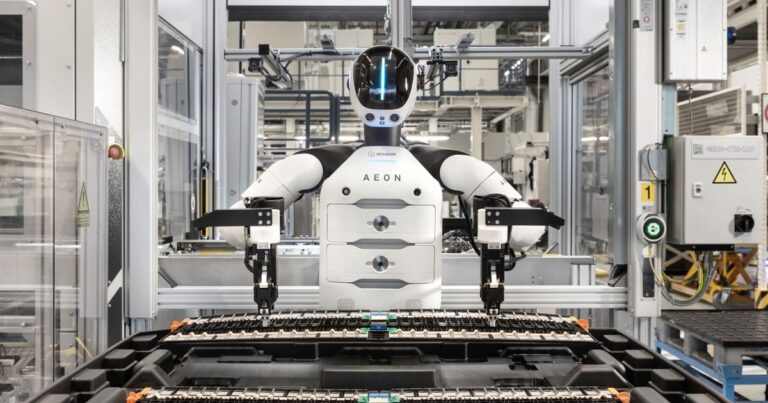
German giant BMW has confirmed it is launching a pilot to introduce humanoid bots at its plant in Leipzig, marking the first time it has used this form of physical AI in Europe.

At the same time, China’s Xiaomi has also successfully debuted a humanoid bot on the production line at its factory in Beijing.

In Leipzig, BMW is using a humanoid bot called Aeon produced by Stockholm-based Hexagon, developed at the company’s facility in Zurich, Switzerland. It has already successfully negotiated one test deployment in December, and faces another in April before a full pilot starts in June.

“The deployment in Leipzig is focusing on testing a multifunctional application of the robot,” BMW said in a press release. “It is based on Aeon’s design, whose human‑like body allows a wide range of hand and gripper elements or scanning tools to be flexibly attached and enables dynamic use on wheels.” The intention is to use the bot in the assembly of high-voltage batteries and component manufacture.

Related:Intrinsic Joins Google to Accelerate Physical AI

Long term, BMW hopes to increase the use of human bots for monotonous, demanding or safety-critical tasks that are challenging for its staff.

The Leipzig deployment follows a previous trial of human bots at its factory in Spartanburg, South Carolina. Within 10 months of their introduction, the Figure 02 bots from U.S. company Figure AI were working 10 hours a day, Monday through Friday, removing and positioning sheet metal for welding. It is estimated they assisted in the production of 30,000 X3 models.

One key takeaway was how quickly the bots were able to transition from lab to production, with Milan Nedeljković, BMW board member, admitting in a press release: “The symbiosis of engineering expertise and artificial intelligence opens up entirely new possibilities in production.”

Meanwhile, in China, Xiaomi —which produces the world’s fastest mass-produced electric saloon, the SU7 Ultra — trailed a humanoid robot for three hours on its production line in Beijing.

As a video released by Xiaomi showed, the bot, which was developed by Xiaomi, was used to pick up screw nuts and place them on specific spots on a car’s floor. Working simultaneously with another bot on the other side of the nut loading station, they achieved a success rate of around 90% in the allotted timeframe.

It is understood more bots are being assessed in other tasks, such as removing plastic films, installing badges and moving boxes.

Related:New York Robotics Consortium Launches with 160 Startups

According to the South China Morning Post, company founder Lei Jun said on social media: “This marks the first step towards stable application of Xiaomi’s humanoid robot in the field of intelligent manufacturing,” adding that he expected a large number would be working in the company’s factories over the next five years.

How many that will be — and what they cost to produce — has not yet been revealed.


Senator Flags White House ‘Corruption’ Concerns Over Iran War Predictions Markets

0

In brief

  • Senator Chris Murphy has alleged people with White House access placed six-figure predictions market bets the day before the U.S. struck Iran.
  • Blockchain analytics firm Bubblemaps previously identified six accounts that collectively made $1.2 million betting on U.S. strikes on Iran, with no prior trading history.
  • Murphy said he plans to introduce legislation banning “destabilizing prediction markets.”

A series of unusually timed prediction market bets placed just hours before U.S. strikes on Iran has triggered fresh accusations of insider profiteering, with Senator Chris Murphy (D-CT) warning that individuals with advance knowledge of military decisions may have made money wagering on war.

“The Iran war is fueling a new kind of corruption: White House officials secretly profiting off war,” Murphy said in a video posted to X. “It’s disgusting. We need to ban it.” 

“It looks like those six big accounts that were set up on Friday made a profit of a million dollars off of us going to war on Saturday,” he added.

Blockchain analytics firm Bubblemaps identified six suspected insider accounts last week that collectively made $1.2 million on Polymarket bets on whether “U.S. strikes Iran by February 28, 2026?” 

Most of the wallets were funded within 24 hours of the attack and bought “Yes” shares just hours before explosions in Tehran, with one account purchasing over 560,000 shares at about 10.8 cents—later paying out nearly $560,000 when the market settled at $1. 

Traders poured $425.4 million into Polymarket’s geopolitics markets in the week ending March 1, compared with $163.9 million the week before, according to user-compiled Dune Analytics data. 

The White House and Polymarket did not immediately respond to Decrypt’s requests for comment.

The backlash against prediction markets comes as the U.S. Senate rejected a bipartisan war power resolution seeking to limit President Donald Trump’s authority to continue military action in Iran without congressional approval, in a 53–47 vote.

Murphy has previously signaled that he plans to introduce legislation banning prediction markets that allow individuals to profit from sensitive government actions.

Last month, the senator wrote on X that he is working on legislation to ban “corrupt and destabilizing prediction markets,” where insiders aware of a given outcome “can rig the game to favor certain bets.”

A New York Times analysis of Polymarket data found more than 150 accounts placed bets of at least $1,000 correctly predicting an American strike by Saturday, a late surge totaling roughly $855,000. 

At least 16 of those accounts each ultimately profited by over $100,000, according to the report.

“If we continue to allow people to bet on war, on military strikes, then you’re going to have people inside the Situation Room who are making decisions not based on what’s good for national security, but based upon whether they’ll make money off of war,” Murphy said on Wednesday. “There’s going to be somebody in that room who’s going to be pushing us into war because they can cash in.”

Murphy also pointed to rising costs facing Americans, saying that at a time when people are struggling to afford groceries and gas, and prices are climbing because of the war, it is “even more outrageous that there are people inside the White House who are making tons of money.”

Last month, Israeli authorities charged an IDF reservist and a civilian with using classified military intelligence to place Polymarket bets ahead of Israel’s operations against Iran. 

On Tuesday, Polymarket pulled a market asking traders to bet on whether a nuclear weapon would be detonated this year, after it drew widespread backlash.

Daily Debrief Newsletter

Start every day with the top news stories right now, plus original features, a podcast, videos and more.