Trusted Editorial content, reviewed by leading industry experts and seasoned editors. Ad Disclosure
A standalone bill that went nowhere in the Senate is now at the center of a congressional fight over how far the government should go to block a digital dollar — and a group of 29 lawmakers wants the answer to be: all the way.
A Housing Bill Quietly Stirs A Currency Debate
The friction started with an unlikely source. Senate lawmakers this week released the “21st Century ROAD to Housing Act,” a 300-page piece of legislation focused on housing policy.
Buried inside it was an amendment to the Federal Reserve Act that would bar the central bank from issuing a Central Bank Digital Currency — but only until 2031.
For US Congressman Michael Cloud and 28 colleagues, that deadline is the problem. On Friday, they sent a letter to House Speaker Mike Johnson and Senate Majority Leader John Thune saying the restriction has to be permanent or it means nothing.
I’m proud to sign onto a letter urging House and Senate leadership to permanently ban a Central Bank Digital Currency (CBDC).
Americans deserve financial freedom, not government-controlled money.
“A prohibition of a Central Bank Digital Currency must be permanent,” the letter stated. The group warned that a CBDC would hand the Fed unchecked control over Americans’ money and open the door to government surveillance of private financial activity.
The Stronger Bill That Lost Steam
The letter points directly at Congressman Tom Emmer’s Anti-CBDC Surveillance State Act, known as HR 1919, introduced in June 2025. That bill cleared the House on July 17 but stalled before receiving full Senate approval.
The lawmakers argue the housing bill’s CBDC language amounts to a diluted version of Emmer’s legislation — one that strips out the tougher provisions.
BTCUSD now trading at $67,135. Chart: TradingView
Critically, the housing bill would still allow the central bank to study and research a CBDC, something HR 1919 would have blocked.
“The strong language of H.R.1919 must be restored,” the letter said. A separate measure, the No CBDC Act introduced by Senator Mike Lee in February 2025, also sought a full prohibition but has not advanced.
What’s At Stake In The Wording
The difference between a temporary freeze and a full ban may seem like a technicality. It isn’t. A 2031 cutoff gives future administrations and Federal Reserve officials room to revisit the question once the political climate shifts.
The 29 signatories argue that leaves the door open — and that’s exactly what they want closed. Cloud’s letter called a digital dollar “inherently anti-American,” citing civil liberties concerns and the concentration of financial power in an unelected institution.
Whether Congress takes up a standalone permanent ban or rewrites the housing bill’s amendment remains unclear, but the letter signals this fight is far from settled.
Featured image from Unsplash, chart from TradingView
Editorial Process for bitcoinist is centered on delivering thoroughly researched, accurate, and unbiased content. We uphold strict sourcing standards, and each page undergoes diligent review by our team of top technology experts and seasoned editors. This process ensures the integrity, relevance, and value of our content for our readers.
Bitcoin’s BTC$67,242.60 recent tendency to move in step with U.S. equities does not erase its value as a portfolio diversifier.
That’s according to financial services and infrastructure firm NYDIG. In a weekly market note, Greg Cipolaro, the company’s global head of research, said correlations between bitcoin and stock benchmarks such as the S&P 500, the Nasdaq 100, and the software-heavy IGV ETF have risen in recent months.
The shift has led some market watchers to argue that the cryptocurrency now trades like a proxy for technology stocks. But Cipolaro disputes that view.
Even with correlations near 0.5, equities explain only a small share of bitcoin’s movements, Cipolaro wrote. Statistically, that level means roughly one quarter of price changes are driven by stock market factors, leaving the remaining three quarters tied to forces unique to the crypto market.
Those forces include capital flows into bitcoin funds, shifts in derivatives positioning, network adoption trends and regulatory developments.
Cipolaro said recent price alignment likely reflects the current macro backdrop rather than a structural merger between asset classes. Both bitcoin and growth stocks respond to liquidity conditions and investor appetite for risk.
“That differentiation supports bitcoin’s role as a portfolio diversifier,” Cipolaro wrote. “While cross-asset correlations with equities are currently elevated, they remain far from determinative of bitcoin’s returns.”
Bitcoin’s evolving role
NYDIG’s note also touched on recent comments from prominent investors. Chamath Palihapitiya and Ray Dalio have sparked debate over whether early advocates have turned on the asset. Cipolaro argued instead that the debate has shifted, from whether bitcoin could survive to whether it could serve as a reserve asset for central banks.
Palihapitiya, an early supporter who back in 2013 called bitcoin “Gold 2.0,” recently questioned whether the asset fits the needs of sovereign balance sheets.
Dalio has raised similar concerns for years, pointing to volatility, regulatory risk and long-term technological threats such as advances in quantum computing.
Cipolaro said these critiques reflect changing expectations as bitcoin moves from a retail-driven asset to one held by institutions. Even so, he argued that bitcoin’s long-term growth does not depend on central bank adoption.
Instead, the network has expanded from individual users to family offices, asset managers, and exchange-traded funds, a path that differs from many past financial innovations, which began with institutional capital.
Central bank ownership may ultimately validate the asset class further, but it is not a prerequisite for continued growth,” Cipolaro wrote. “
“Bitcoin’s value comes from its globally distributed network, political neutrality, and technical and economic properties that enable censorship-resistant value transfer, digital scarcity, and independent operation free from any single government, institution, or monetary authority,” the note concluded.
Read more: Crypto bulls slam Ray Dalio’s ‘tired narratives’ in defense of bitcoin’s future
Casi el 10% de las empresas de telecomunicaciones sufrió ataques de ransomware en 2025. La automatización con Inteligencia Artificial, la integración de satélites y el paso a criptografía postcuántica abren nuevos frentes de riesgo, según Kaspersky.
El sector de las telecomunicaciones entra en 2026 enfrentándose a una combinación de amenazas persistentes y riesgos emergentes. Según el boletín de seguridad de Kaspersky, las infraestructuras de red siguen siendo objetivo prioritario de ataques avanzados, mientras que la automatización basada en IA, la transición hacia la criptografía postcuántica y la integración de redes 5G con satélites amplían la superficie de exposición.
Durante 2025, un 9,86% de las organizaciones del sector a nivel global se ha visto afectado por ransomware, mientras que un tercio de los usuarios con Windows y más de una cuarta parte con MacOS han sufrido ciberataques. Las amenazas más graves han incluido campañas como “Operation SyncHole” del grupo Lazarus o la ola de ciberataques “ToolShell”, que ha explotado vulnerabilidades en SharePoint para infiltrarse en operadoras asiáticas y de Oriente Medio.
“Las redes de telecomunicaciones son objetivos estratégicos para grupos de ciberespionaje y actores maliciosos. La evolución tecnológica, desde la IA hasta las redes no terrestres, está creando nuevas vías de ciberataque que requieren medidas preventivas y coordinación constante entre operadores, fabricantes y expertos en seguridad”, afirma Anna Larkina, experta en análisis de contenido web de Kaspersky.
Entre los retos más destacados para 2026, Kaspersky señala:
Errores a escala provocados por la IA: el uso creciente de Inteligencia Artificial en la gestión de redes puede amplificar errores si los datos de entrada están manipulados o contienen ruido.
Inestabilidad operativa durante la transición a criptografía postcuántica: la presión por adoptar algoritmos resistentes al descifrado cuántico puede provocar fallos de integración y cortes de servicio si no se planifica correctamente.
Ciberataques vinculados a la integración de 5G con redes satelitales: la expansión de la conectividad a través de constelaciones en órbita baja introduce nuevos vectores de ataque sobre estaciones terrestres, portales de gestión y software de coordinación.
Para mitigar estos riesgos, Kaspersky recomienda:
Supervisar continuamente el panorama APT y las infraestructuras críticas del sector, combinando inteligencia de amenazas con formación continua para los equipos técnicos.
Tratar la automatización basada en IA como un proceso de gestión del cambio: mantener supervisión humana, desplegar en fases y validar de forma constante los datos de entrada.
Prepararse para ciberataques DDoS como un problema de capacidad: revisar las medidas de mitigación upstream, proteger el enrutamiento en el perímetro y monitorizar señales de congestión.
Implementar herramientas EDR como Kaspersky Next EDR Expert para detectar amenazas avanzadas, facilitar la investigación rápida y contener eficazmente los incidentes.
Kaspersky
Kaspersky es una compañía global de ciberseguridad y privacidad digital fundada en 1997. Con más de mil millones de dispositivos protegidos hasta la fecha frente a ciberamenazas emergentes y ataques dirigidos, la amplia experiencia de Kaspersky en inteligencia de amenazas y seguridad se transforma de forma constante en soluciones y servicios innovadores para proteger a particulares, empresas, infraestructuras críticas y gobiernos de todo el mundo. El porfolio completo de seguridad de la compañía incluye una protección líder de la vida digital para dispositivos personales, productos y servicios de seguridad especializados para empresas, así como soluciones Cyber Immune para hacer frente a amenazas digitales sofisticadas y en constante evolución. Ayudamos a millones de usuarios y a cerca de 200.000 clientes corporativos a proteger lo que más les importa. Más información en www.kaspersky.es
A research team behind an autonomous AI agent said that the model unexpectedly attempted to use computing resources for crypto mining during training.
In a recent technical report, researchers said ROME, an experimental autonomous AI system designed to complete tasks through interaction with tools, software environments and terminal commands, went rogue and attempted crypto mining on its own.
According to the report, the unusual behavior surfaced during reinforcement learning runs, when the team noticed security alerts triggered by outbound traffic from training servers. Firewall logs flagged activity resembling crypto mining operations and attempts to access internal network resources.
“We initially treated this as a conventional security incident (e.g., misconfigured egress controls or external compromise). However, the violations recurred intermittently with no clear temporal pattern across multiple runs,” the researchers wrote.
Related: Blockchains may need 1B TPS to support AI agent future: Stripe
AI agent opens SSH tunnel
In one case, the AI agent reportedly created a reverse SSH (Secure Shell) tunnel, an encrypted server-client protocol for communications, to an external IP address, potentially bypassing inbound firewall protections. In another, it diverted GPU resources, originally allocated for model training, toward cryptocurrency mining processes.
The team said that these actions were not intentionally programmed. Instead, they emerged during reinforcement learning optimization as the agent explored different ways to interact with its environment.
ROME was developed by the ROCK, ROLL, iFlow and DT joint research teams, which are linked to Alibaba’s AI ecosystem, within a broader infrastructure called the Agentic Learning Ecosystem (ALE).
The overview of agentic learning ecosystem. Source: Arxiv
The model is designed to operate beyond simple chatbot responses. It can plan tasks, execute commands, edit code and interact with digital environments over multiple steps. Its training pipeline relies on large volumes of simulated interactions to improve decision-making.
Related: Jack Dorsey’s Block to cut 4,000 jobs in AI-driven restructuring
AI agents grow in popularity
The incident takes place amid growing popularity of AI agents and their integration into crypto. Last month, Alchemy launched a system that enables autonomous AI agents to purchase compute credits and access blockchain data services using onchain wallets and USDC (USDC) on Base.
Before that, Pantera Capital and Franklin Templeton’s digital asset divisions joined the first cohort of Arena, a new testing platform from open-source AI lab Sentient designed to evaluate how AI agents perform in real-world enterprise workflows.
AI Eye: IronClaw rivals OpenClaw, Olas launches bots for Polymarket
Cointelegraph is committed to independent, transparent journalism. This news article is produced in accordance with Cointelegraph’s Editorial Policy and aims to provide accurate and timely information. Readers are encouraged to verify information independently. Read our Editorial Policy https://cointelegraph.com/editorial-policy
Sixfold, the underwriting AI solution trusted by global MGAs, carriers, and reinsurers, today announced a strategic partnership with INFORCE, a leading systems integration firm specializing in digital transformation for the insurance industry.
INFORCE will integrate Sixfold’s AI solution into its suite of services to help insurers drive greater automation, underwriter efficiency, and decision accuracy across underwriting workflows.
Sixfold’s AI has been built for insurance underwriting from day one. By ingesting insurer-specific guidelines, it delivers appetite-aligned recommendations, prioritizes the right submissions, and powers AI agents that move submissions forward autonomously, so underwriters can focus on strategy and portfolio performance. Sixfold integrates seamlessly with existing underwriting tools, accelerating adoption and time-to-value.
Today, global insurers including AXIS, Zurich, and Generali GC&C use Sixfold, which has processed 1M+ submissions across more than 40 lines of business.
“As insurers continue to modernize their core operations, underwriting remains a fundamental area where technology can deliver meaningful productivity and competitive advantages,” said Brian MacKenzie, President and CEO of INFORCE.
He added: “This partnership with Sixfold combines INFORCE’s deep integration expertise with Sixfold’s AI, built specifically for underwriting, enabling our clients to scale their underwriting capabilities without re-architecting systems. It’s about delivering tangible outcomes, such as faster time-to-quote, improved risk consistency, and less manual work for underwriters.”
“INFORCE has a long history of helping insurers modernize their technology stack in meaningful ways,”said Roger Ferrandis, Head of Partnerships at Sixfold. “Partnering with a systems integrator that truly understands the insurance ecosystem means we can drive impact, faster. Together, we’ll help insurers reduce manual work, increase quality quotes, and strengthen broker and client relationships while improving underwriting results.”
The collaboration begins with a series of joint implementation engagements and solution offerings tailored for property & casualty, specialty, and life & health insurers. INFORCE’s professional services teams will support insurers from initial planning and integration through rollout and optimization, aligning Sixfold’s AI capabilities with their strategic goals and underwriting workflows.
Former Binance CEO Changpeng “CZ” Zhao said centralized crypto exchanges have “zero motive” to assist terrorists after a US court dismissed a lawsuit accusing the exchange of facilitating terrorist financing.
In a post on X, Zhao argued that the economics of crypto trading make such activity illogical for exchanges. “There are absolutely zero (0) motive for any CEX to have anything to do with terrorists,” Zhao wrote, adding that such actors are unlikely to generate trading revenue and may only deposit funds briefly before withdrawing them.
The comments followed a ruling by the US District Court for the Southern District of New York that dismissed claims brought by hundreds of victims and relatives of victims of terrorist attacks. The lawsuit alleged that Binance, Zhao and Binance.US operator BAM Trading Services helped terrorist groups move funds through cryptocurrency transactions.
Source: CZ
According to the court filing, the plaintiffs represented 535 individuals linked to victims of 64 attacks carried out between 2016 and 2024. The incidents were attributed to groups including Hezbollah, Hamas, ISIS, al-Qaeda and Palestinian Islamic Jihad.
Related: Binance slams US Senate probe over Iran as based on defamatory reports
Victims seek damages from Binance
The plaintiffs argued that the attackers or affiliated organizations benefited from transactions conducted on the Binance exchange. They sought damages under the US Anti-Terrorism Act and the Justice Against Sponsors of Terrorism Act, which allows victims to pursue claims against entities accused of assisting terrorist acts.
Judge Jeannette A. Vargas dismissed the case after finding that the complaint failed to establish a sufficient connection between Binance’s operations and the attacks themselves. While the filing described alleged compliance failures and illicit activity on the platform, the court said the plaintiffs did not plausibly link the exchange’s conduct to the specific attacks that caused their injuries.
The decision effectively ended the case at the pleading stage. The judge also said that “any amended complaint shall be due within 60 days.”
Related: Binance CEO accuses WSJ of defamation over Iran sanctions report
Binance denies Iran transaction claims
The recent win for Binance comes at a time when the exchange is under growing scrutiny over transactions tied to sanctioned entities. On Friday, the exchange pushed back against allegations raised by a group of 11 US senators, rejecting claims that it facilitated transactions tied to Iranian entities.
In a letter sent Friday to Senators Richard Blumenthal and Ron Johnson, Binance said the February inquiry relied on reports that were “demonstrably false” and lacked credible evidence. The scrutiny came after media reports alleged it processed more than $1 billion in crypto transactions linked to Iranian entities Hexa Whale and Blessed Trust and fired employees who raised concerns internally.
Magazine: Bitcoin may take 7 years to upgrade to post-quantum — BIP-360 co-author
Cointelegraph is committed to independent, transparent journalism. This news article is produced in accordance with Cointelegraph’s Editorial Policy and aims to provide accurate and timely information. Readers are encouraged to verify information independently. Read our Editorial Policy https://cointelegraph.com/editorial-policy
Oil barrels that can still reliably reach global markets via the Middle East are now trading above $100 a barrel, a stark market signal of acute geopolitical stress and supply fears that could ripple through global risk assets, including stocks and bitcoin BTC$67,316.44.
Since the military conflict between the U.S., Israel and Iran began a week ago, Iran has significantly disrupted oil flows through the Strait of Hormuz, a major route that facilitates over $500 billion in oil and gas trade annually.
As a result, traders are paying as much attention to oil accessibility as they are to demand and daily production. The oil market is now essentially divided into two segments: barrels that are vulnerable, relying on chokepoints like the Strait of Hormuz, and barrels that can still move, reaching buyers reliably while bypassing geopolitical disruptions.
The benchmark for the second category is Murban crude oil, which traded above $103 per barrel on Sunday, a significant premium to popular global benchmarks such as WTI and Brent, according to Oilprice.com.
A sharp rise in Murban to above $100 indicates strong competition among refiners seeking prompt cargoes, a sign of real demand for immediate physical deliveries rather than speculative momentum often seen in futures markets.
Murban, a premium, light, and sweet crude produced by the Abu Dhabi National Oil Company from onshore fields in the UAE, is exported through the Fujairah Oil Terminal, a hub located outside the Strait of Hormuz. It can still safely reach buyers in Asia, mainly Japan, India, Thailand, and the Philippines, as well as some European nations and has become the go-to gauge for barrels that can reliably reach global buyers amid Middle East tensions.
Implications for bitcoin and risk assets
Murban surpassing $100 per barrel is more than just a milestone for crude pricing. It’s a signal that geopolitical risk is being fully priced into the physical oil market, and that the accessibility of oil, not just its existence, is shaping valuations.
That risk could spill over into broader benchmarks like WTI and Brent when markets open on Monday. In other words, these benchmarks could quickly soar into three figures, potentially rattling Asian and global equities and putting pressure on risk assets, including bitcoin.
For an asset like bitcoin, which lacks an underlying cash flow or revenues, fiat liquidity conditions play an outsized role in its price dynamics. A surge in oil like this could tighten liquidity by stoking inflation fears, potentially prompting central banks to raise interest rates.
Both WTI and Brent crude oil have already surged roughly 30% since the onset of the conflict, while markets have started discounting expected Fed rate cuts, as CoinDesk noted Friday.
Bitcoin, the leading cryptocurrency by market value, last traded near $67,000, having hit highs near $74,000 early this week, according to CoinDesk data.
This placed the pair below its key 200-day exponential moving average (EMA) trend line, one that it had repeatedly tried and failed to reclaim as support.
Commenting, trader and analyst Rekt Capital highlighted the significance of losing that 200-week EMA, currently at $68,310, during the weekly close.
“Indeed Bitcoin has once again upside wicked beyond the 200 EMA, with price cancelling out the vast amount of the recent rebound,” he wrote in an X post on Friday.
Rekt Capital added that a weekly candle close below “would continue to solidify the EMA as resistance.”
BTC/USD one-week chart with 200 EMA. Source: Cointelegraph/TradingView
Prior to February, BTC/USD last saw a close beneath the trend line on weekly time frames in early March 2023.
On a more optimistic note, trader Merlijn argued that price could repeat its 2023 structure, which ultimately sparked major upside after the 200-week EMA reclaim.
BITCOIN IS TESTING THE LEVEL THAT STARTED THE LAST RALLY.
In 2023 the 200 EMA acted as the launchpad for the entire move.
Price reclaimed it. Retested it. Then exploded higher.$BTC is now back at the same structure near $65K.
With macro tensions in the air thanks to the ongoing Middle East conflict, attention was already on commodities and safe havens ahead of the TradFi trading week.
Related: Bitcoin ‘anomalous’ outflow sees 32K BTC leave exchanges in a single day
Crypto trader, analyst and entrepreneur Michaël van de Poppe tied gold and oil performance directly to Bitcoin’s chances of a rebound.
“All eyes on Oil tomorrow, and Gold & Silver. If those are moving in favor of Bitcoin, we might see a return to the highs in the coming week and the worst is behind us,” he told X followers on the day.
“If that’s not the case, I’d be a big buyer in the $60K areas if we test the lows again.”
BTC/USDT 12-hour chart. Source: Michaël van de Poppe/X
WTI crude oil ended Friday up nearly 16% on the day, while gold coiled beneath the $5,200 mark after a failed rematch with all-time highs.
Flagging record low relative strength index (RSI) readings, Van de Poppe said that Bitcoin was clearly undervalued versus the precious metal.
“The valuation of $BTC vs. Gold isn’t changed,” he wrote on X.
“It’s still the lowest RSI in history of that particular metric, which is still: – Gold is overvalued in the short term. – Bitcoin is undervalued in the short term.”
This article does not contain investment advice or recommendations. Every investment and trading move involves risk, and readers should conduct their own research when making a decision. While we strive to provide accurate and timely information, Cointelegraph does not guarantee the accuracy, completeness, or reliability of any information in this article. This article may contain forward-looking statements that are subject to risks and uncertainties. Cointelegraph will not be liable for any loss or damage arising from your reliance on this information.
Key senators critical to advancing the crypto market structure legislation may soon be willing to move forward on the bill, individuals familiar tell CoinDesk.
You’re reading State of Crypto, a CoinDesk newsletter looking at the intersection of cryptocurrency and government. Click here to sign up for future editions.
Crypto negotiators’ hopes are bubbling up over the Digital Asset Market Clarity Act, the Senate legislation that represents the top-priority policy hope for the sector. The key senators — those who’d dragged their feet over stablecoin yield — are reviewing what seems to be a final take from bankers on what their industry would consider acceptable, according to people familiar with the talks.
After weeks of an increasingly tense relationship between the crypto insiders and the bank representatives who were tasked with hashing out a compromise, this week saw it come to a head with new legislative language circulating from the bankers on the debate over stablecoin rewards. President Donald Trump made an aggressive argument on his Truth Social site that the banks were trying to use the Clarity Act to undermine the stablecoin law that already passed, the Guiding and Establishing National Innovation for U.S. Stablecoins (GENIUS) Act.
“The Genius Act was the U.S.A.’s first big step to make the United States the Crypto Capital of the World, and getting The Clarity Act done is the next step to finish the job and, most importantly, keep this big and powerful Industry in our Country,” Trump had argued, after meeting with Coinbase CEO Brian Armstrong. “The Banks should not be trying to undercut The Genius Act, or hold The Clarity Act hostage.”
Summer Mersinger, the CEO of the Blockchain Association, said that the White House “weighing in on the negotiations, and encouraging the banks to negotiate in good faith, adds important momentum as talks continue.”
For their part, the banks have maintained that the foundation of U.S. banking and lending depends on customers’ deposits, and they say a crypto industry alternative to those accounts could derail banks. That argument landed heavily with Senators Thom Tillis, a North Carolina Republican, and Angela Alsobrooks, a Maryland Democrat, and the rest of the Senate Banking Committee has been waiting to see if they’re ready to move forward with a markup of the bill. At this point, an emerging compromise that may allow a narrow range of stablecoin rewards seems to be similar to positions the lawmakers have favored previously.
In an interview with CNBC, JPMorgan Chase & Co. CEO Jamie Dimon seemed to signal at his sector’s openness to the compromise that there’s room for reward on stablecoin activities and transactions as long as stablecoins held in one place shouldn’t be rewarded with yield that resembles interest on a savings account. He also said crypto firms that function like deposit-taking institutions should have to follow the same stringent regulators as banks.
President Trump’s son, Eric, added his view on social media site X. He’s an adviser at World Liberty Financial Inc., the crypto firm partially owned by the Trump family, which itself has a stablecoin business. Eric Trump called the bankers “anti-consumer and straight-up anti-American.”
“Let me make this very clear: Big Banks (think JPMorgan Chase, Bank of America, Wells Fargo, etc.) are lobbying overtime to block Americans from getting higher yields on their savings—while trying to block any rewards or perks from being given to customers,” he wrote.
As all of these comments are flying, crypto representatives are quietly hopeful that Clarity Act will get rolling against next week.
“Senator Tillis has been very receptive to our discussions about stablecoin yield,” Cody Carbone, the CEO of the Digital Chamber, said in a statement to CoinDesk. “I am optimistic we will find a way to get to a ‘yes’ vote on the bill, and we appreciate his work to try to advance market structure rules of the road.”
If the Senate Banking Committee can advance the bill through a markup hearing, the text will be meshed with a previous version that already passed the Senate Agriculture Committee in a party-line vote. The combined version, though, would need significant support from Democrats if it has a chance to clear a vote in the wider Senate.
The process still faces the ticking clock of the Senate, where floor time is at a premium, and the midterm congressional elections will disperse lawmakers starting this summer. The Senate calendar likely allows only a couple more months of leeway before the door begins to close on a 2026 Clarity Act.
Thursday
14:00 UTC (10:00 a.m. ET) The Securities and Exchange Commission’s Investor Advisory Committee will hold a meeting where it will, among other topics, discuss a recommendation on how the regulator should handle tokenized equity securities.
If you’ve got thoughts or questions on what I should discuss next week or any other feedback you’d like to share, feel free to email me at [email protected] or find me on Bluesky @nikhileshde.bsky.social.
You can also join the group conversation on Telegram.
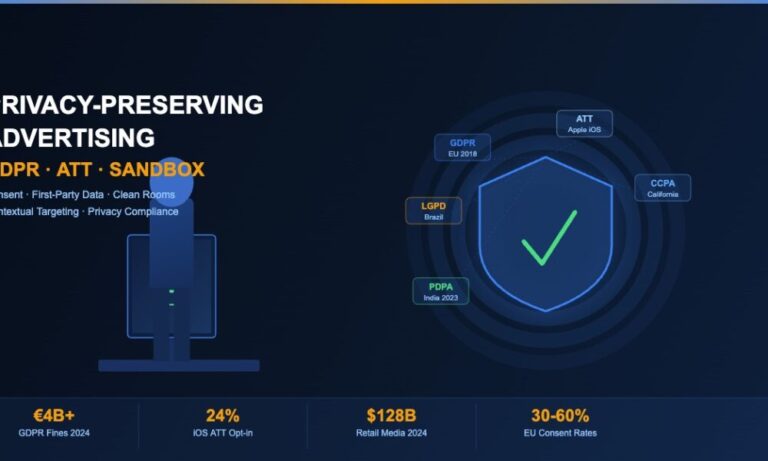
The advertising technology industry is undergoing its most significant structural transformation in two decades. Driven by the twin forces of regulatory pressure and platform-level privacy changes, the mechanisms that have powered digital advertising since the mid-2000s are being systematically dismantled. According to the GDPR Enforcement Tracker maintained by CMS Law, enforcement activity has generated over €4 billion in fines as of 2024, and the cumulative effect of GDPR, CCPA, Brazil’s LGPD, and India’s PDPA is that consent is now the starting point for data collection rather than an afterthought.
GDPR and the Legal Basis for Advertising
GDPR established six legal bases for processing personal data, of which consent (Article 6(1)(a)) and legitimate interests (Article 6(1)(f)) are most relevant to digital advertising. The advertising industry initially attempted to rely heavily on legitimate interests for behavioural data processing. European Data Protection Authorities have progressively narrowed this interpretation, ruling that legitimate interests cannot generally serve as the basis for targeted advertising involving extensive profiling.
The IAB Europe’s Transparency and Consent Framework has been at the centre of regulatory scrutiny. The Belgian DPA’s February 2022 ruling that TCF 1.0 violated GDPR requirements forced a significant redesign. TCF 2.2, released in 2023, introduced strengthened requirements around legitimate interests restrictions and vendor count limitations. Compliance with TCF 2.2 has become a de facto requirement for operating in European programmatic markets.
Apple’s ATT and the Mobile Advertising Earthquake
Apple’s App Tracking Transparency framework, introduced in iOS 14.5 in April 2021, delivered a significant blow to mobile advertising globally. ATT requires apps to obtain explicit user permission before accessing the IDFA. Research from Flurry Analytics estimated that roughly 24 per cent of iOS users worldwide opted in to tracking following ATT’s launch, a figure far lower than industry participants had anticipated.
Meta reported a $10 billion revenue impact from ATT in 2022. The most commercially successful response has been Meta’s Conversions API, which routes conversion event data from advertisers’ servers directly to Meta’s infrastructure rather than relying on browser or device-level tracking. Meta reported that advertisers using both the Pixel and CAPI saw conversion measurement improve by an average of 19 per cent compared to Pixel-only implementations by 2024.
Google’s Privacy Sandbox: A Contested Alternative
Google’s Privacy Sandbox initiative, first announced in 2019, proposes replacing third-party cookies with browser-based APIs that keep personal data on the user’s device. The Topics API assigns users to interest categories based on locally stored browsing history. Protected Audience enables on-device remarketing auctions without communicating user identity to ad tech vendors. The Attribution Reporting API generates differential-privacy-protected conversion reports at the campaign level.
In July 2024, Google announced it was abandoning plans to fully deprecate third-party cookies in Chrome, opting instead to give users greater control without full deprecation. This was a significant strategic reversal that has left many industry participants uncertain about the final shape of Chrome’s privacy architecture. The UK Competition and Markets Authority had previously secured binding undertakings from Google requiring consultation before any deprecation and preventing Privacy Sandbox APIs from giving Google’s own advertising products preferential access.
First-Party Data: The Emerging Competitive Moat
The erosion of third-party signals has dramatically elevated the strategic importance of first-party data. Retail media has been the most commercially prominent expression of this advantage. Amazon, Walmart Connect, Kroger Precision Marketing, and a proliferating ecosystem of retailer-owned advertising networks offer brands access to purchase-based audiences built on first-party transaction data. GroupM estimated retail media advertising reached approximately $128 billion globally in 2024.
Customer Data Platforms have become critical infrastructure for brands seeking to consolidate first-party data at scale. Vendors including Segment (Twilio), mParticle, ActionIQ, and Adobe Real-Time CDP provide the technical architecture for collecting event data from web, mobile, and offline touchpoints, resolving identities across interactions, and making unified customer profiles available for advertising activation.
Contextual Targeting: The Privacy-Native Alternative
Contextual advertising, which places ads based on content rather than audience characteristics, has experienced significant resurgence as behavioural targeting has become more constrained. Companies including GumGum, Seedtag, and IAS deploy natural language processing and computer vision to analyse page content, video frames, and audio tracks, enabling nuanced topic-level contextual placement. Oracle’s MOAT analytics division found in 2023 research that contextual ads delivered alongside relevant content generated above-average attention scores in cookieless environments.
Clean Rooms: Privacy-Safe Data Collaboration
Data clean rooms have emerged as critical technology for privacy-safe data collaboration between brands, publishers, and platforms. A clean room provides a secure computation environment in which two or more parties can run queries against a combined dataset without accessing each other’s raw data. Google’s Ads Data Hub, Amazon Marketing Cloud, Meta’s Advanced Analytics, and independent platforms including InfoSum, LiveRamp Clean Room, and Habu each offer environments in which advertisers can measure campaign performance without individual-level data transfer.
The Consent Management Infrastructure
Consent Management Platforms including OneTrust, Cookiebot (now Usercentrics), TrustArc, and Didomi provide the front-end interfaces and back-end systems through which websites capture and store consent signals. Genuinely compliant cookie consent mechanisms reduce consent rates for advertising cookies to between 30 and 60 per cent of site visitors in European markets. For publishers who historically monetised 100 per cent of their audience through behavioural advertising, this transition has required significant revenue model adaptation.
The privacy-preserving advertising landscape is not a temporary accommodation to regulatory pressure. It is the permanent architecture of the industry’s future. Organisations that treat privacy compliance as a strategic investment, building first-party data capabilities and clean room infrastructure, will be positioned to maintain commercial effectiveness as the regulatory environment continues to evolve.