

XRP is gaining renewed bullish momentum as growing attention around XRP Ledger utility and the RLUSD stablecoin fuels optimism that the network could potentially evolve into a powerful engine for everyday global payments. XRP and RLUSD May Drive Next Phase of Blockchain Payments as XRPL Focuses on Utility Momentum around real-world blockchain payments is strengthening, […]
MoonPay Launches Non-Custodial Financial Layer to Power the Autonomous AI Agent Economy

MoonPay, the global crypto payments and stablecoin infrastructure firm, has launched MoonPay Agents. The new non-custodial software layer gives AI agents direct access to wallets and funds, unlocking their ability to transact autonomously.
According to the firm, the role of artificial intelligence is rapidly shifting. AI agents are no longer simply answering questions; they are now taking action, executing strategies, and allocating capital. However, their ability to participate in the digital economy has been heavily constrained by a lack of direct access to financial value.
MoonPay Agents aims to solve this fundamental bottleneck by providing the financial infrastructure needed for the emerging agent economy, powering the full life cycle from funding and execution to off-ramping back to fiat currency.
Bridging the gap between AI and capital

The new infrastructure is built on MoonPay CLI, the firm’s developer-focused command-line interface. The software enables AI systems to generate and manage non-custodial wallets, which are stored directly on the user’s own device.
To initiate the process, a user must first complete KYC verification and fund their agent’s wallet through MoonPay’s global on-ramps. Once this initial human input is complete, the AI agent can independently trade, swap tokens, and move digital assets on behalf of the user programmatically.
Ivan Soto-Wright, CEO and founder of MoonPay, highlighted the necessity of this infrastructure: “AI agents can reason, but they cannot act economically without capital infrastructure. MoonPay is the bridge between AI and money. The fastest way to move money is crypto, and we’ve built the infrastructure to let agents do exactly that: non-custodial, permissionless, and ready to use in minutes.”
Enabling the full financial life cycle
With a single installation of MoonPay CLI, users and developers can spin up a non-custodial wallet and let an AI agent optimise their crypto workflow. The product supports a wide array of financial capabilities:
- Virtual accounts: Agents can receive bank payments directly into US, EU, or GBP accounts, or accept funds via Apple Pay, Venmo, or PayPal.
- Ramps: Users can move between fiat and crypto directly from the terminal.
- Recurring buys: Automated, scheduled purchases ensure agents always have the necessary funds to operate.
- x402 compatibility: The system enables seamless machine-to-machine payments across compatible endpoints, requiring zero human input.
- Swaps and trading: Agents can execute real-time cross-chain swaps, trading strategies, and market automation.
MoonPay designed the new layer to scale across thousands, and eventually millions, of autonomous agents. The infrastructure can be embedded directly into various AI workflows—including trading agents, gaming agents, commerce agents, and treasury agents.
Any developer building an AI agent that requires the movement of value can integrate MoonPay as the default financial rail via its API and infrastructure layers. Running on the same stack that already powers nearly 500 enterprise companies, MoonPay ensures the underlying rails can support the speed and scale required as AI systems begin to execute financial actions en masse.
Mojtaba Khamenei Appointed Iran’s Supreme Leader, State Media Reports

Iran’s Assembly of Experts has named Mojtaba Khamenei, the 56-year-old son of the late Supreme Leader Ayatollah Ali Khamenei, as the country’s new supreme leader, according to state media reports on Sunday. In a significant development amid the ongoing conflict with the United States and Israel, Iranian state media announced that the clerical Assembly of […]
BTC falls sharply along with stocks as oil soars nearly 20%,

In what’s become a familiar scenario in crypto over the past few months, prices are starting the week on the wrong foot.
After little sign over the weekend of any de-escalation in the U.S. war against Iran, the price of oil has exploded higher in Sunday evening U.S. trade. April WTI crude oil futures are currently up 19.1% to $108.35 per barrel. That’s roughly double the price at the start of 2026 and the highest level in about four years.
That surge, in turn, has sent U.S. stock index futures down by nearly 2% across the board. Futures for Japan’s Nikkei 225 are lower by 3.1% shortly before that stock market opens for Monday trade.
Bitcoin is lower by 2% and trading just below $66,000. Ether (ETH) and solana (SOL) are down closer to 1.4%.
A check of other commodity prices finds the precious metals and copper all trading modestly lower.
Florida becomes first US state to pass stablecoin framework

Florida, the southeastern US state that has positioned itself as a leader in digital asset policy, today became the first state in the nation to pass a comprehensive regulatory framework for payment stablecoins.
The legislation now awaits signature from Governor Ron DeSantis, a vocal proponent of crypto-friendly policies who has backed efforts to establish Florida as a hub for blockchain innovation.
The bill establishes a licensing regime for qualified stablecoin issuers while simultaneously launching a pilot program that would allow the state’s Department of Financial Services to accept stablecoin payments for government services.
By structuring the framework to comply with the federal GENIUS Act signed into law by President Trump in July 2025, Florida lawmakers have created a pathway for issuers to operate under state supervision while meeting nationally recognized standards.
Under the framework, qualified stablecoin issuers operating outside Florida must provide written notice to the state’s Office of Financial Regulation before offering services in the state.
The law outlines that some payment stablecoins will fall solely under the supervision of the Office of Financial Regulation, while others will be jointly overseen with the Office of the Comptroller of the Currency at the federal level.
The bill also limits the ability of stablecoin issuers to offer yield to holders. Qualified payment stablecoin issuers will be prohibited from paying interest if such payments are restricted under federal law.
Disclosure: This article was edited by Estefano Gomez. For more information on how we create and review content, see our Editorial Policy.
Why Is Crypto Crashing: FDIC Clarifies Tokenized Deposit Rules as Pepeto Raises $7.4M With 300x Potential

Experts explain why crypto is crashing as the FDIC clarifies tokenized deposit rules. Pepeto defies the downturn raising $7.4M with 300x potential and exchange products near launch.
Why Is Crypto Crashing: FDIC Says a Deposit Is a Deposit Even When Tokenized
Crypto analysts believe the downturn is a regular part of the cycle, driven by long term whale sales, ETF outflows, and geopolitical events affecting digital assets. According to CoinDesk, the FDIC confirmed that tokenized deposits will retain the same legal protections as traditional deposits, with Acting Chair Travis Hill stating that moving a deposit from traditional finance to a blockchain should not change its legal nature.
According to Bloomberg, the FDIC is also developing regulatory clarity for tokenized deposits and stablecoin issuance, confirming that the infrastructure layer for the next cycle is being built at the federal level right now.
Despite investors wondering why crypto is crashing, proactive traders are pouring capital into exchange infrastructure presales, and Pepeto has raised $7.4M amid the volatility because exchange products at presale pricing capture the recovery returns.
Cryptos to Look Out For in March 2026
1. Pepeto: Exchange Infrastructure Defying the Crash
Despite the majority of investors wondering why crypto is crashing, proactive traders raised $7.4M for Pepeto’s exchange infrastructure because they understand that the projects building confirmed products during fear phases capture the strongest returns when capital rotates back.
The founding team created PEPE and delivered a $7 billion market cap before returning to build PepetoSwap, a cross chain bridge, and a full trading exchange, all announced and close to launch. All cryptocurrencies will be traded on the platform, and the SolidProof audit returned zero critical vulnerabilities.
A 300x move from the current price of $0.000000186 is the math that happens when confirmed exchange products meet the open market. For those running the staking math, a $10,000 position earns $20,900 per year at 209% APY, which breaks down to $1,741 per month compounding on top of whatever price appreciation the listing delivers. The Pepeto official website is where conviction converts into positions. The quiet phase where smart money accumulates before the crowd is ending as media coverage grows, search interest rises, and once mainstream demand arrives the presale entry you see today cannot survive.
2. BNB: Is a Push Toward Higher Levels Coming
BNB trades near $620 in early March 2026, holding strong above $500 while the rest of the market asks why crypto is crashing. The quarterly burn mechanism and Binance exchange revenue provide a floor, and BlackRock institutional exposure supports long term prospects. But at a $75 billion market cap, even a strong recovery delivers a fraction of what exchange infrastructure presales at ground floor pricing provide.
3. LINK: Oracle Revenue Grows Amid the Downturn
Chainlink trades near $8.52 in early March 2026 with CCIP cross chain revenue growing as the oracle network processes billions in data feeds. The Chainlink NYSE ETF boosted institutional visibility, but at a $6 billion market cap the explosive early stage entry that created LINK’s first millionaires closed years ago. For those asking why crypto is crashing while searching for asymmetric returns, exchange infrastructure at presale pricing delivers the math that large caps cannot match.
Final Words: The Recovery Belongs to Those Who Built During the Fear
In every market cycle without exception, the investors who accumulated during fear phases captured the returns that everyone else spent years wishing they had entered. The FDIC just confirmed that tokenized deposits retain their legal protections, proving the infrastructure layer is being built.
Pepeto has $7.4M raised and exchange products launching into the recovery. Every 24 hours without entering means staking yield not compounding in your wallet, another stage filling, and the listing getting one day closer while your position sits at zero. Enter the presale at the Pepeto official website before another day passes and another round of staking rewards compounds in wallets that moved while yours sits empty.
Click To Visit Pepeto Website To Enter The Presale

FAQs
Why is crypto crashing in March 2026?
Crypto is crashing due to whale selling, ETF outflows, and macro events, while Pepeto raises $7.4M building exchange infrastructure during the fear phase.
What should I buy during the crypto crash?
Pepeto offers exchange infrastructure with the PEPE founding team at presale pricing, capturing recovery returns that large caps at mature valuations cannot deliver.
How does the FDIC tokenized deposit ruling affect presales?
The FDIC confirming deposit protections on blockchain validates exchange infrastructure, benefiting presales like Pepeto with $7.4M raised and confirmed products.

Bitcoin Sell-off To $65K Likely As Traders Run From Global Risks

Key takeaways:
-
Bitcoin faced pressure as rising oil prices and weak US data sparked risk-off sentiment and drove investors to gold.
-
A redemption spike in private credit funds from BlackRock and Blackstone signaled growing anxiety among retail investors.
Bitcoin (BTC) saw a 7% correction between Thursday and Friday following a failed attempt to reclaim the $74,000 level. The pullback tracked weak US macroeconomic data and a spike in oil prices as the US and Israel-Iran war entered its seventh day. Traders now question whether Bitcoin can maintain support above $65,000.
Typically, deteriorating economic conditions pave the way for monetary stimulus, often boosting the stock market in anticipation of increased liquidity. However, this cycle saw the S&P 500 retreat as a generalized risk-off sentiment erased all of Bitcoin’s gains from Wednesday.
US retail sales fell 0.2% in January compared to the previous month, while the US economy shed 92,000 jobs in February. Despite the cooling labor market, investors lack confidence that the Federal Reserve will cut interest rates further, as rising energy costs typically generate inflationary pressure.

US Treasury markets currently price a 78% probability that interest rates will remain steady between 3.5% and 3.75% through late April. A flight to safety pattern emerged as gold surged while the Russell 2000 Small Capitalization index hit a two-month low. Bitcoin’s drop below $85,000 in late January hindered its reputation as an uncorrelated asset, especially as silver rose to become the second most valuable asset.

Traders also fear a wave of corporate layoffs driven by artificial intelligence automation. Kansas City Fed President Jeff Schmid noted that AI is increasingly filling roles that once required manual labor. Schmid added that “older Americans are retiring,” causing a real-time structural change in the labor market, according to Yahoo Finance.
War and credit strain weigh on Bitcoin’s outlook
A prolonged war suggests increased US government spending, reducing the fiscal capacity for monetary stimulus aimed at economic expansion. Investors increasingly fear rising logistics costs beyond the commodities sector. Shipping giant Maersk announced on Friday the temporary suspension of two routes connecting the Middle East to Asia and Europe.
Bitcoin’s retest of the $68,000 level on Friday indicates that technical resistance levels identified by analysts may be secondary to geopolitical events impacting the oil and energy industries and, by extension, global growth prospects. The current weakness in risk assets appears to be a reflection of poor macroeconomic visibility rather than a structural collapse.
Related: Lyn Alden tips Bitcoin outperforming gold over next ‘two to three years’

A potential deterioration in trader expectations could originate within the US private credit market. BlackRock reportedly limited withdrawals from one of its largest credit funds following a spike in redemption requests, according to a Bloomberg report on Friday. Earlier this week, Blackstone’s flagship private credit fund fulfilled requests to tender a record 7.9% of shares, signaling rising retail anxiety.
Currently, the 3% option-adjusted spread for riskier firms is hovering within the normal range seen over the last six months. Periods of significant economic turmoil typically push this indicator above 5.0%, a level last seen in March 2023. As a result, there is no clear sign that Bitcoin will break below $65,000, even with the ongoing uncertainty surrounding global economic growth.
This article does not contain investment advice or recommendations. Every investment and trading move involves risk, and readers should conduct their own research when making a decision. While we strive to provide accurate and timely information, Cointelegraph does not guarantee the accuracy, completeness, or reliability of any information in this article. This article may contain forward-looking statements that are subject to risks and uncertainties. Cointelegraph will not be liable for any loss or damage arising from your reliance on this information.
Startup Starcloud Plans First Bitcoin Mining Satellite in Low-Earth Orbit

A Washington startup says the next frontier for computing—and possibly bitcoin mining—may orbit hundreds of miles above Earth. Bitcoin Mining Heads to Space as Starcloud Prepares Starcloud-2 Satellite Launch According to a report by PCMag, Redmond-based space technology and artificial intelligence (AI) infrastructure company Starcloud is advancing plans to place data centers in low-Earth orbit, […]
‘The Second Century Begins’: Saylor’s Declaration Ignites Huge Bitcoin Buying Anticipation

Strategy’s massive bitcoin accumulation is back in focus after Michael Saylor shared a chart highlighting continued corporate buying, reinforcing the firm’s position as the largest public-company holder and sparking speculation that another acquisition cycle may be underway. Michael Saylor’s Bitcoin Chart Signals Ongoing Corporate Treasury Accumulation Institutional attention around corporate bitcoin accumulation resurfaced after Strategy’s […]
US Digital Advertising and Small Business: How SMEs Are Competing Online
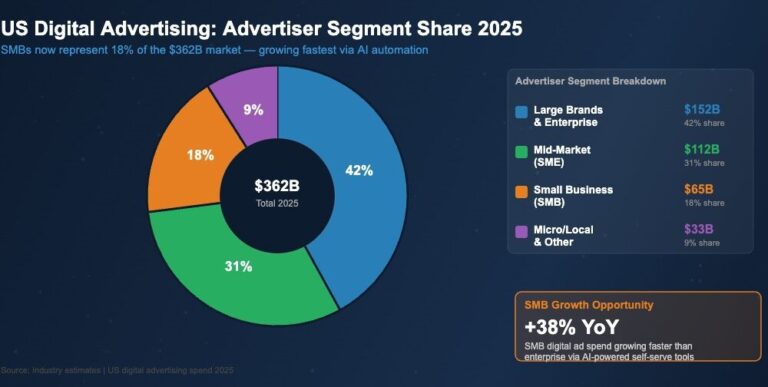
The owner of a regional bakery chain in Ohio does not think about digital advertising in the same terms as the vice-president of media at a Fortune 500 consumer goods company. The bakery owner thinks about whether the $800 she spent on Meta campaigns last month generated enough new customers to justify the next month’s budget. The media VP thinks about brand equity frameworks, cross-channel attribution methodologies, and the quarterly reviews she owes her board. These are different problems at different scales, and yet in 2025 both of them are participating in the same $362 billion US digital advertising market, using tools built on the same underlying platforms, and competing — indirectly — for the same consumer attention.
The inclusion of small and medium-sized enterprises at scale is one of the most commercially important and least-discussed aspects of US digital advertising’s sustained growth. The market’s ability to sustain double-digit percentage expansion at the $362 billion level has been driven, in meaningful part, by the addition of millions of businesses that were not participating in digital advertising at all five years ago. The democratisation of digital advertising access through AI-powered self-serve tools represents one of the structural growth drivers that analysts most consistently underestimated when projecting the market’s trajectory.
How Big the SMB Advertising Market Actually Is
Precise data on SMB digital advertising spend is difficult to obtain because the category is defined inconsistently across different research methodologies. The most credible industry estimates suggest that businesses with fewer than 500 employees collectively account for approximately 27 per cent of total US digital advertising spend, or roughly $98 billion of the $362 billion 2025 total. That figure includes micro-businesses spending $200 per month on Facebook ads, mid-sized regional businesses with dedicated digital marketing budgets in the $50,000 to $500,000 annual range, and everything in between.
The headline number is less important than the growth rate. SMB digital advertising spend grew at approximately 22 per cent in 2025, nearly double the overall market growth rate of 13 per cent, driven by the continued expansion of AI-powered tools that reduce the expertise threshold required to run effective digital campaigns. As explored in TechBullion’s analysis of the structural drivers of US digital advertising growth, SMB democratisation is one of the three primary budget pools sustaining above-market-expectation growth rates.
| Business Size | Est. 2025 Digital Ad Spend | YoY Growth | Primary Platform |
|---|---|---|---|
| Enterprise (1,000+ employees) | ~$152 billion | +9% | Programmatic, CTV, retail media |
| Mid-market (100-999 employees) | ~$112 billion | +13% | Search, social, some retail media |
| Small business (10-99 employees) | ~$65 billion | +22% | Meta, Google Search, TikTok |
| Micro/local (under 10 employees) | ~$33 billion | +38% | Meta Advantage+, Google PMax |
The AI Automation Unlock
The growth of SMB digital advertising is inseparable from the development of AI-powered campaign automation tools that have materially changed what is required to run effective digital advertising campaigns.
Meta’s Advantage+ suite automates virtually every element of campaign management that previously required specialist knowledge. The advertiser provides creative assets and a defined objective, and Advantage+ handles audience targeting, creative testing, placement optimisation, and budget allocation automatically. For a small business owner who previously found Facebook’s Ads Manager interface too complex to navigate confidently, Advantage+ represents a fundamental change in accessibility.
Google’s Performance Max operates on similar principles. A retail business creates a campaign, provides Google with its product feed and creative assets, and Performance Max automatically generates advertising across all of Google’s surfaces — Search, Shopping, YouTube, Display, Gmail, and Maps — optimising toward the conversion objective that the advertiser defines. When a small business that previously ran no digital advertising begins spending $1,500 per month through an AI-automated campaign, that budget is incremental to the total market. Across millions of small businesses, this additive effect has contributed meaningfully to sustaining market growth above the rates predicted from the behaviour of large advertisers alone.
Where SMBs Are Spending and Why
The platform distribution of SMB digital advertising spend reflects the accessibility and targeting capabilities of different platforms rather than simply their scale. Meta remains the dominant platform for SMB advertising, accounting for approximately 38 per cent of small business digital ad spend. The platform’s combination of demographic targeting, lookalike audience tools, and Advantage+ automation makes it accessible for businesses targeting consumer audiences regardless of category. The ability to start campaigns with modest daily budgets, pause and restart without penalty, and receive clear reporting on campaign outcomes makes Meta the default entry point for businesses entering digital advertising for the first time.
Google Search captures a significant portion of SMB performance spend, particularly for businesses in service categories where purchase intent is expressed through search queries. Local services advertising, which allows service businesses to advertise on a pay-per-lead basis, has grown substantially as a specific SMB-oriented product. TikTok’s growing share of SMB advertising reflects the platform’s effectiveness for product-based businesses targeting younger consumer demographics, where effective creative can achieve significant reach even at low spend levels.
The $413 Billion Market Needs SMBs to Keep Growing
The US digital advertising market’s trajectory toward $413 billion in 2026 and the $645 billion that forecasts suggest by 2029 depends substantially on the continued expansion of the SMB advertiser base. Large enterprise advertising budgets are significant but relatively predictable: they grow broadly in line with company revenues and are subject to the same budgetary cycles that have always governed large corporate marketing investment. SMB advertising, by contrast, is highly responsive to the quality of available tools.
| SMB Digital Advertising Driver | Current Status | Growth Potential to 2028 |
|---|---|---|
| AI automation accessibility | Rapidly improving | High — tools still maturing |
| New business formation | Post-pandemic recovery | Medium — macro-dependent |
| Platform self-serve improvement | Major investment by Meta, Google | High — ongoing development |
| Attribution and measurement | Still enterprise-dominated | Medium — emerging solutions |
When Meta or Google introduces a capability that meaningfully improves the ROI of small business campaigns, adoption can be rapid and the effect on total market demand can be substantial. The trajectory of AI campaign automation — which is still in relatively early stages of penetration across the full SMB market — suggests that this responsiveness will continue to drive above-market growth rates in the SMB segment for several years. For the digital advertising market as a whole, as explored in TechBullion’s analysis of the path to $645 billion by 2029, the SMB expansion story is one of the most reliable sources of incremental market demand available through the end of the decade. As covered in TechBullion’s overview of the AdTech investment outlook, the infrastructure serving the SMB advertising tier is among the highest-growth segments of the broader advertising technology market.
Related reading: The Shift to Digital | Performance Advertising in the US | US Digital Ad Forecast 2026 | AdTech Investment Outlook