Home Blog Page 815

Stablecoins are starting to reshape payments and banking, Macquarie says

0

Stablecoins are evolving from a niche crypto trading tool into a potential layer of global financial infrastructure, according to Australian investment bank Macquarie.

While most U.S. dollar-denominated stablecoin activity, mainly in Tether’s USDT and Circle’s USDC, still comes from crypto trading, accounting for about 90% of volume, the bank said adoption is expanding across payments, remittances, treasury operations and tokenized assets, increasingly linking traditional finance with decentralized finance.

“Stablecoin adoption is making strides in cross-border remittances, but adoption as form of payment still has room to grow, presenting an attractive total addressable market (TAM) opportunity,” analysts led by Paul Golding said in the Monday note.

Regulatory progress is helping drive the shift. The analysts pointed to developments such as the U.S. GENIUS Act, Europe’s MiCA framework and emerging Asia-Pacific regulations as factors pushing stablecoins from speculative uses toward institutional settlement tools.

Read more: Stablecoin market expands, bitcoin rallies as Iran war panic cools

Stablecoins are cryptocurrencies designed to maintain a fixed value, typically pegged to the U.S. dollar, and are widely used across digital asset markets for trading, payments and transfers.

Tether’s USDT is the largest stablecoin by market value and trading volume, serving as a key source of liquidity across crypto exchanges, while Circle’s USDC is the second largest and is widely used in institutional and decentralized finance applications. Together, the tokens underpin much of the crypto market’s activity and are increasingly being explored for payments, remittances and settlement.

Stablecoin growth has been rapid. Macquarie estimates the combined market capitalization of major coins at about $312 billion as of March 2026, up roughly 50% year over year and representing about 7%–8% of the total crypto market.

Transaction activity is rising even faster. Adjusted stablecoin transfer volume reached roughly $11 trillion in 2025, the bank said, suggesting onchain dollars are becoming a meaningful economic tool both within crypto markets and in some real-world payment corridors.

Payments networks and fintech firms are beginning to integrate the technology. The report noted that Visa (V) and Mastercard (MA) now support USDC settlement, allowing card obligations to be discharged onchain.

Banks are experimenting with similar systems. Macquarie pointed to initiatives including JPMorgan’s JPMD tokenized deposit product, Citi’s Token Services and tokenized deposit pilots at HSBC as evidence that blockchain-based settlement is gaining traction among large financial institutions.

Read more: Standard Chartered says U.S. regional banks most at risk in $500 billion stablecoin shift

Kraken’s xStocks starts points program, hinting at possible ecosystem token

0

Kraken-linked tokenized equities platform xStocks plans to launch a rewards program aimed at traders liquidity providers and DeFi builders using its onchain stock tokens.

The initiative dubbed xPoints will track activity across supported trading venues and integrations. Participants can earn points by trading tokenized U.S. equities providing liquidity or using the assets in decentralized finance (DeFi) applications.

Points programs have become a common strategy in crypto to drive early usage of new platforms. In many cases projects later convert accumulated points into governance tokens or other ecosystem rewards. While xStocks has not announced a token yet, the initiative could pave the way for a potential token launch.

xStocks said the points program is meant to align long-term contributors with the growth of its ecosystem. Participants who accumulate points may gain access to future benefits tied to the platform once the program concludes though details have not been disclosed.

The move comes as tokenized equities have emerged as one of the fastest-growing sectors in crypto. The category now holds more than $1 billion in value locked, tripling in size over the past six months, RWA.xyz data shows.

xStocks said its tokenized stock offering has processed more than $25 billion in transaction volume during the eight months since launch and has expanded across several blockchain networks.

Traditional financial firms have also showing interest in tokenized stocks. Earlier this week, Nasdaq said it plans to work with Kraken to distribute tokenized versions of public stocks to investors outside the U.S., part of a broader push by the exchange operator to bring blockchain infrastructure into capital markets.

Read more: Tokenization still at start of hype cycle, but needs more use cases, specialists say

GFA Exchange Hits 10,000 UK Business Milestone to Plug Private Credit Data Gap Ahead of AIFMD 2

0

UK fintech portfolio intelligence platform GFA Exchange has reached a major milestone, with its market terminal now featuring live data on 10,000 UK lower mid-market businesses.

The platform’s comprehensive coverage consists of the top 1,000 companies across all UK Government Industrial Strategy sectors, alongside dedicated monitoring for the Real Estate and Retail industries.

Regulatory pressure mounts for private credit

This development comes at a critical moment for the private credit industry, which is facing mounting pressure to deliver genuine data transparency amid tightening credit conditions.

The upcoming UK transposition of the Alternative Investment Fund Managers Directive (AIFMD 2), which takes effect on 16 April 2026, expands reporting obligations for Alternative Investment Fund Managers, requiring them to cover the full risk profile of every portfolio position. Concurrently, the Financial Conduct Authority (FCA) has signalled consultations on rules covering leverage, regulatory reporting, and risk management, further reinforcing the immediate need for transparency.

Moving away from manual spreadsheets

Traditionally, many lower mid-market fund managers have relied heavily on manual spreadsheets and quarterly reporting, which fail to provide structured, real-time portfolio risk data. This time gap between a problem arising and reaching a fund manager’s attention can result in millions in unexpected default costs.

Operating as a market terminal for private credit fund managers with assets under management between £100million and £2billion, the GFA Terminal aims to bring public market-style data infrastructure to private credit. By aggregating and standardising borrower intelligence daily, the platform provides fund managers with:

  • A live risk score—known as the proprietary GFA Score—applied across all portfolio loans.
  • Automated monitoring and risk alerts triggered when borrower health indicators shift.
  • Sector benchmarking and portfolio heatmaps allowing managers to compare their portfolios against best-in-class entities.
  • LP-ready reporting infrastructure, available to users on an annual licence basis.
Industry perspective
Joel Blake OBE, founder and CEO of GFA Exchange

Joel Blake OBE, founder and CEO of Birmingham-based GFA Exchange, highlighted the urgency of modernising these operational processes.

“Lower mid-market private credit has delivered strong returns on relationship-based deal flow, but monitoring processes haven’t kept pace,” Blake explained. “Fund managers oversee significant capital with lagging information, at exactly the moment regulators and LPs demand greater transparency.”

He added: “With AIFMD 2 arriving in April, the GFA Exchange Terminal closes that gap, providing real-time risk intelligence and the ability to benchmark loan portfolios against the UK’s growth companies.”

Bitcoin Price Jumps Above $70,000 After Oil Price Volatility

0

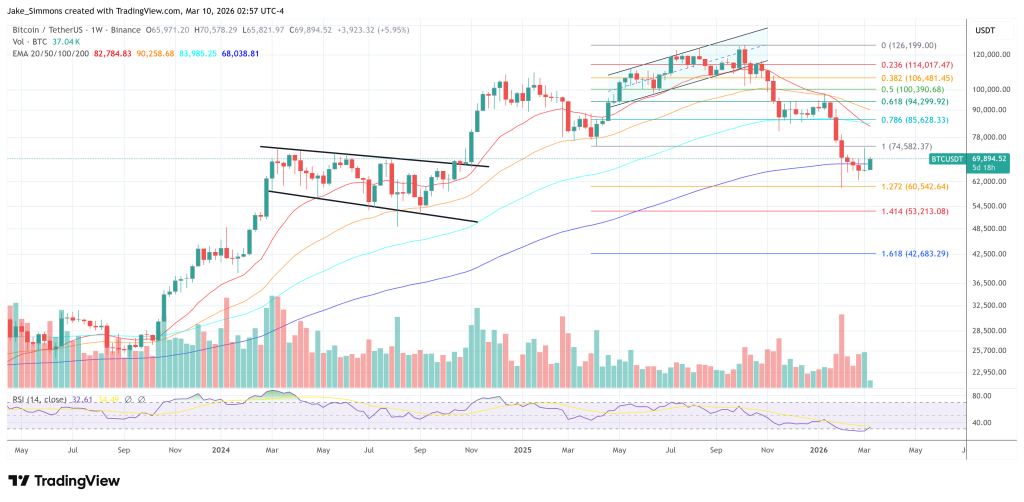
Bitcoin price steadied this week after a burst of volatility tied to tensions in the Middle East and a surge in oil prices. As of this morning, the bitcoin price is around $70,000 after being above $71,000 in early trading. 

The turbulence began over the weekend when disruptions near the Strait of Hormuz pushed crude oil above $100 per barrel. Risk assets across global markets reacted to the shock.

Bitcoin price fell alongside equities during the initial sell-off, sliding into the mid-$60,000 range before finding support.

Bitcoin price finds support

The pullback triggered a wave of on-chain activity. Blockchain data from Glassnode shows nearly 600,000 BTC changed hands between $60,000 and $70,000 during the correction, equal to more than $40 billion worth of bitcoin. Over 200,000 BTC of that volume appeared in the last two weeks alone.

The shift created a dense ownership cluster in that range. In total, about 1.558 million BTC last moved between $60,000 and $70,000, up from roughly 997,000 BTC at the start of the year.

Analysts say this concentration could form a key support zone because a large group of holders now shares a similar cost basis.

Checkonchain data also shows that about 60% of circulating bitcoin currently sits in profit, leaving around 40% of holders with an average purchase price above $70,000. The mix highlights the uneven distribution of entry points after bitcoin’s rapid climb earlier in the year.

Institutional flows continued to shape market structure during the volatility. U.S. spot bitcoin exchange-traded funds recorded roughly $568 million in net inflows last week after five weeks of outflows. The products now hold more than $55 billion in cumulative net inflows since their launch, according to data from SoSoValue.

Market maker Enflux said the bitcoin price held up well relative to other assets during the initial energy-driven risk-off move. The firm noted that the asset stabilized in the mid-$60,000 range even as oil spiked and equities dropped.

Macro developments shifted again Monday after comments from U.S. President Donald Trump suggested the conflict with Iran could end sooner than expected. Oil prices fell from weekend highs and equity markets reversed earlier losses, which helped lift risk assets across the board.

Nasdaq’s tokenized stocks

While macro forces drove short-term trading, a separate development in capital markets drew attention across the crypto industry yesterday. 

Nasdaq announced plans to launch tokenized stocks through a partnership with Payward, the parent company of crypto exchange Kraken. The initiative will distribute blockchain-based versions of public equities through Kraken’s xStocks platform.

The framework aims to tokenize both stocks and exchange-traded products while preserving existing shareholder rights and corporate governance structures. Kraken will serve as a distribution partner and settlement layer for the tokenized assets.

Nasdaq expects the system to launch in the first half of 2027, pending regulatory approval.

Also yesterday, Strategy said they spent a whopping $1.28 billion to buy 17,994 more bitcoin last week, raising its total holdings to 738,731 BTC worth about $50 billion at current prices.

At the time of writing, Bitcoin is near $69,400.

Iran Conflict Noise Sends Crypto Higher, But Analysts See Limited Upside

0

Trusted Editorial content, reviewed by leading industry experts and seasoned editors. Ad Disclosure

Bitcoin crossed back above $70,000 on Monday as traders responded to signals that the US military campaign against Iran might be winding down — pushing the broader crypto market up 3% in 24 hours before a fresh round of war rhetoric from US President Donald Trump complicated the picture.

The gains were tied directly to comments Trump made in a CBS News phone interview, where he suggested Iran had been so thoroughly struck that little remained of its military capability.

Oil prices plunged on the news, dropping from a four-year high of $118 a barrel down to roughly $85 — a 25% slide that eased inflation fears and nudged investors back toward riskier assets like crypto.

Relief Rally Or Just Noise?

Analysts were quick to pump the brakes. Industry observers said the headline comments were hard to take at face value, noting that other members of Trump’s cabinet had described the conflict as still in its opening phase, with US military assets still active in the region.

Crypto would keep tracking other risk assets in the near term, with oil — not any crypto-specific narrative — still calling the shots on macro sentiment.

Market observers said that while the conflict was unlikely to be resolved soon, tradable bounces were possible, and Bitcoin could outperform as a potential store of value during periods of prolonged uncertainty.

Bitcoin enjoyed a slight gain today amid the ongoing conflict in the Middle East. Image: Steel Valley Bitcoin

Will A Ceasefire Lift Crypto Price?

Others offered a similar read. A genuine ceasefire, they said, could spark a strong rally in digital assets — driven by falling energy prices, reduced inflation pressure, and renewed appetite for risk.

But caution prevailed. Doubts persisted amid mixed signals, with Iran’s Revolutionary Guard publicly dismissing Trump’s remarks as “nonsense” and insisting Tehran, not Washington, would decide when fighting stops.

BTCUSD trading at $70,862 on the 24-hour chart: TradingView

Trump’s Own Words Muddy The Outlook

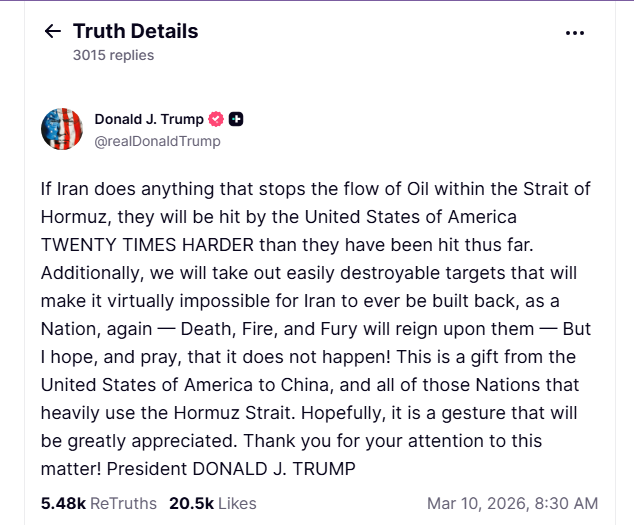
The uncertainty deepened when Trump posted on Truth Social hours after the CBS interview, threatening that Iran would be struck “20 times harder” if it moved to block oil flows through the Strait of Hormuz.

At a Republican fundraising event in Florida the same day, he told supporters: “We’ve already won in many ways, but we haven’t won enough.”

Reports indicate US forces have struck more than 3,000 Iranian targets since operations began. That backdrop — ongoing military activity, contradictory presidential statements, and an adversary refusing to acknowledge defeat — leaves crypto in a holding pattern.

The 3% gain looks more like a reaction to a headline than the start of a sustained move. Until the geopolitical picture clarifies, digital assets appear content to follow oil’s lead rather than forge a path of their own.

Featured image from Mudrex, chart from TradingView

Editorial Process for bitcoinist is centered on delivering thoroughly researched, accurate, and unbiased content. We uphold strict sourcing standards, and each page undergoes diligent review by our team of top technology experts and seasoned editors. This process ensures the integrity, relevance, and value of our content for our readers.

Stellar (XLM) Gaines 5.1%, Leading Index Higher

0

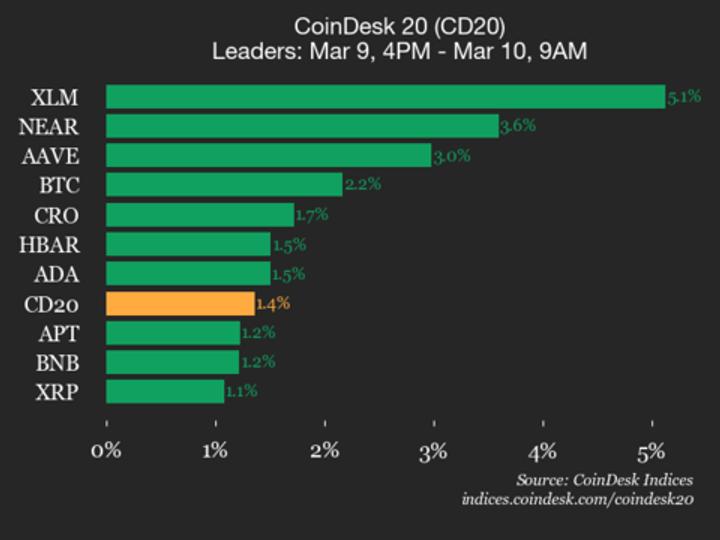
CoinDesk Indices presents its daily market update, highlighting the performance of leaders and laggards in the CoinDesk 20 Index.

The CoinDesk 20 is currently trading at 2004.71, up 1.4% (+26.87) since 4 p.m. ET on Monday.

Fifteen of 20 assets are trading higher.

Leaders: XLM (+5.1%) and NEAR (+3.6%).

Laggards: BCH (-1.0%) and UNI (-0.5%).

The CoinDesk 20 is a broad-based index traded on multiple platforms in several regions globally.

Ethereum Flips Key Level, IPO Genie ($IPO) Quietly Becomes the Best Presale to Buy Now

0

Ethereum is back above a level the market had been watching closely, and that shift changes the tone across crypto. When ETH regains a major zone, it usually does more than lift confidence around large caps. 

It also pushes attention toward projects that still look early, differentiated, and positioned for stronger upside if broader momentum continues. That is exactly why this crypto presale of 2026 discussion now matters. 

Ethereum may be the headline today, but IPO Genie ($IPO) is increasingly becoming the project many are starting to watch more carefully.

Why Ethereum Reclaiming This Level Matters for Sentiment

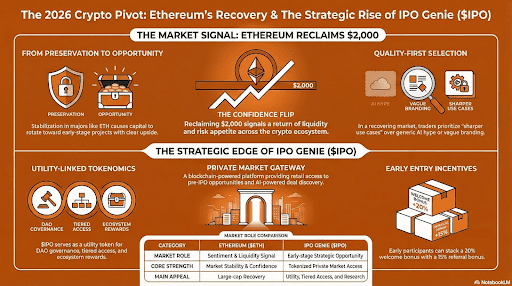
Ethereum reclaiming the $2,000 zone is not just a technical talking point. It matters because ETH remains one of the market’s clearest signals for confidence, liquidity, and risk appetite. When it loses a major level, pressure spreads quickly. When it climbs back above one, even without a breakout, the market starts to look healthier.

That shift does not instantly make every asset attractive. What it does is change the conversation. The focus moves from capital preservation to selective opportunity. In crypto, that often becomes the moment when traders begin scanning for earlier-stage Web3 projects with stronger positioning than the average launch.

This is why Ethereum’s move matters beyond Ethereum itself. It creates the kind of setup where quality starts to stand out again.

Why Market Recovery Often Sends Attention Toward Earlier-Stage Projects

Once Bitcoin and Ethereum begin to stabilize, capital rarely stays concentrated in majors alone. It usually starts moving toward projects with clearer upside potential, stronger thematic relevance, and a better chance of gaining attention before the market becomes crowded again.

That does not help every presale. The market has already seen too many launches built on

  • vague AI branding, 
  • weak utility, 
  • or hype with no durable foundation. 

When confidence returns, quality matters even more. Projects need a sharper use case, a stronger reason to exist, and better alignment with where the market is heading.

That is where IPO Genie enters the picture. It is not trying to compete as another generic token launch. It is built around access, utility, and a part of finance that has historically remained out of reach for most retail participants.

What IPO Genie Is and Why the Private Market Access Angle Matters

Live Presale with $0.0001292: ipogenie.ai 

IPO Genie is positioned as a private market crypto investment project built around a simple but powerful idea. That is private, and pre-IPO opportunities have historically been reserved for institutions, funds, and accredited circles, while everyday participants have largely remained on the outside.

IPO Genie aims to address part of that access 99% gap through blockchain infrastructure, tokenization, and “AI-powered deal discovery.” The project’s core appeal is not built on ownership claims. According to the project, $IPO is a utility token, not equity. Its role is tied to

  • ecosystem participation, 
  • DAO governance involvement,
  • tiered access, 
  • rewards eligibility where applicable, 
  • and platform-linked features.

That matters because it gives the token a more credible place inside the platform. Instead of acting like a placeholder for speculation, it is presented as a private market access token connected to how users engage with the system. In a market crowded with abstract promises, that kind of clarity is a real advantage.

Why IPO Genie Feels More Strategic Than a Typical Presale

The strongest presales like $HYPER, $OZ, $ZKP, & $DSNT usually sit where multiple market trends meet without becoming messy or overextended. IPO Genie does that well. It connects AI-assisted research, tokenized private market access, utility-led participation, and early-stage positioning in one focused concept.

That combination gives the project more structure than a typical AI presale token. It is not selling a vague future. It presents a defined use case tied to access, platform function, and a market segment that already carries strong appeal.

Category Ethereum IPO Genie ($IPO)
Role today Sentiment signal Early-stage opportunity
Core strength Market confidence Tokenized private market access
Main appeal Recovery in a major asset Utility, access, and positioning
Market fit Large-cap stability More targeted than generic AI presales
Why it stands out now Supports broader confidence Could benefit as attention rotates into quality presales

That is why IPO Genie fits the Best return presale conversation without relying on reckless promises. The case is built on stronger positioning, clearer differentiation, and the possibility of earlier discovery before broader market attention arrives.

Why $IPO Could Hold Attention Longer Than Most Presales
A presale earns serious interest when the token has a role that is easy to understand and tied to the actual platform function. IPO Genie presents $IPO as a presale utility token connected to governance participation, tiered access mechanics, rewards eligibility where applicable, and broader ecosystem use.

The platform logic strengthens that case. AI-assisted research and deal discovery support the idea that access should be informed, structured, and tied to a wider product experience rather than pure speculation. Tokenomics also supports the setup by aligning early-stage distribution with ecosystem growth, utility-driven engagement, and participation across the platform.

Real-world Proof: A real-world case study adds further weight. In early February 2026, Redwood AI appeared as a deal discovery proof point on the IPO Genie platform, showing pre-IPO deal flow, not a promise, but a live result.

That creates a more durable demand case than the average launch. Interest is not framed only around price action. It is tied to 

  • what the token unlocks, 
  • how it fits into the platform, 
  • and why access could matter if the product gains traction.

Why IPO Genie is Among the Most Powerful Presale Opportunities in March 2026

Among the most powerful presale opportunities in March 2026, IPO Genie stands out because it combines timing, utility, and market relevance in a way few presales currently do. Ethereum’s recovery helps improve the backdrop. IPO Genie gives that improving backdrop a more asymmetric expression.

It is an early-stage crypto opportunity built around access instead of empty branding. It also enters the market at a time when quality presales remain scarce, which makes stronger positioning even more important.

IPO Genie is giving 15% referral bonus to both the joiner and the inviter.

That means you can get a 20% welcome bonus + 15% referral bonus together. 

Grab This Opportunity Now to lock in the bonuses and get ahead while others wait. 

For anyone looking at the title question closely, the logic is straightforward. Ethereum flipping a key level matters because it improves confidence. IPO Genie matters because it offers a more compelling early-stage setup while that confidence rebuilds.

According to the 7th March report, the $IPO is at the head of the crypto presales list in Q2 2026 due to the strong fundamentals. So, this is one of the reasons analysts consider it for financial freedom 

Catch It Before It Turns Crowded

Ethereum reclaiming a key level may be today’s signal, but IPO Genie looks like the project trying to turn that signal into a more strategic opportunity. As the market steadies, attention usually shifts toward assets with clearer utility, sharper positioning, and a stronger reason to be noticed before the crowd fully arrives. So, that’s why analysts say the $IPO has quietly become the best crypto presale to invest now for massive gains. 

For anyone evaluating a crypto presale 2026 project with a more distinctive use case, IPO Genie deserves a closer look now. Visit the official website, study the whitepaper, and review the project’s risk disclosures carefully before making any decision.

If you want to invest in the legitimate crypto presale of Q1 2026, then the $IPO is the best one among the trending early-stage opportunities. 

Join the Best Return Crypto Presale of 2026!

Official website | Twitter (X)  | Telegram



Ethereum ‘Ultrasound Money’ Pivot Did Not Help ETH Price Beat Bitcoin

0

Ether (ETH) has dropped roughly 65% against Bitcoin (BTC) since Ethereum’s 2022 shift to Proof-of-Stake (PoS), casting doubt on the network’s “ultrasound money” thesis.

Key takeaways:

ETH/BTC three-day performance chart. Source: TradingView

Ether’s ultrasound money narrative disappoints

The idea behind “ultrasound money” was that Ether would become even scarcer than Bitcoin.

Supporters argued that Ethereum’s 2021 EIP-1559 upgrade, which began burning a portion of transaction fees, combined with the sharp decline in new ETH issuance following the 2022 Merge, would make Ether deflationary over time.

ETH’s new annual supply rate has averaged about -0.19% after the burn mechanism went live in 2021, according to Ultrasound.MONEY.

Ethereum burn and supply growth since the Merge. Source: Ultrasound.MONEY

Since Ethereum’s shift to PoS in 2022, however, ETH supply has grown at an annualized rate of about 0.23%, though lower than Bitcoin’s current annual inflation rate of 0.85%.

Bitcoin annual inflation rate. Source: BitBo.IO

However, Ethereum’s supply growth since the Merge undermines the promises of deflation. ETH turns deflationary only when mainnet activity is sufficient to burn more coins than the network issues to validators.

That condition has weakened. Ethereum’s average transaction fee is about $0.21 in March, down roughly 54% from a year earlier, according to YCharts.

Ethereum average transaction fees. Source: YCharts

Lower fees mean the Ethereum network burns less ETH.

Moreover, most of Ethereum’s activity has moved to cheaper layer-2 networks. L2beat shows rollups handling 926 user operations per second (UOPS) on March 7, compared to just 22.36 on Ethereum’s mainnet.

Ethereum L1 vs rollups daily average UOPS. Source: L2beat

While the shift helps the network scale, it weakens the burn-heavy conditions required to make Ethereum deflationary.

Why is ETH underperforming BTC?

Ether price has underperformed BTC partly because investors trust Bitcoin’s fixed supply, according to analyst Handre.

Bitcoin’s strictly enforced 21 million coin cap and fixed supply schedule appeal to investors as it makes BTC more predictable in the longer term. This resistance to change makes Bitcoin stand out from the monetary policies of most altcoins.

“Every scaling debate, every upgrade proposal, every attempt to change Bitcoin’s monetary policy has failed because the economic majority understands what they’re protecting,” Handre said.

Related: Ether’s path to $2.5K may be trickier than expected: Here’s why

Ethereum, by contrast, is not as predictable when it comes to monetary policy, particularly now that ETH supply is growing modestly again.

Handre added:

“Every altcoin promises scarcity but delivers inflation by design. Ethereum abandoned its ‘ultrasound money’ narrative the moment it became inconvenient.”

The investors’ preference is visible in the United States’ ETF market. As of March, spot Bitcoin ETFs held more than $91.9 billion in assets under management, compared with about $12.1 billion for spot Ethereum ETFs.

US Bitcoin and Ethereum ETF balances. Source: Glassnode

Ether never delivered a convincing breakout in dollar terms either.

Between 2021 and 2026, ETH only marginally exceeded its previous all-time high near $4,800 before losing momentum, unlike Bitcoin, whose price doubled from the 2021 peak to the 2025 record high.

Proof-of-Stake, Ethereum, Bitcoin Price, Markets, Tech Analysis, Market Analysis, Ether Price
ETH/USD weekly price chart. Source: TradingView

The underwhelming performance by ETH over the past five years suggests that reduced issuance alone was not enough to create sustained new demand.

Sentiment has also been pressured by periodic ETH sales linked to Vitalik Buterin and the Ethereum Foundation.

Public criticism from Culper Research, which said it was short Ether due to Buterin’s selling, has amplified the view among some traders that Ethereum’s insiders are distributing into strength rather than reinforcing long-term conviction.