Home Blog Page 813

HumaTek Lists $HUMC Token on PancakeSwap

0

Miami, FL., March 10, 2026 / AlexaBlockchain/ – HumaTek, a Florida-based humanitarian technology company, today announces its expansion into simplified DeFi trading by officially unveiling its $HUMC token on PancakeSwap, the largest decentralized exchange (DEX) and DeFi application by total value locked.

HumaTek’s $HUMC token will be available for purchasing, trading, and swapping across more than eight major chains, including: BNB Smart Chain, Ethereum, Base Mainnet, Arbitrum One, ZKSync Era, Linea Mainnet, Aptos, and opBNB Chain. This listing enhances overall accessibility for users across multiple chains and welcomes new partners engaging in HumaTek’s blockchain-based humanitarian aid ecosystem. HumaTek’s growing ecosystem aims to build a “bridge” between transparent, efficient global aid distribution with smart contracts and artificial intelligence capabilities.

“Listing on PancakeSwap is a significant achievement for HumaTek, allowing us to expand our $HUMC coin across chains,” says Thomas LaRocca, CEO and Founder of HumaTek.

“This milestone benefits our community and strengthens our direct humanitarian efforts. PancakeSwap’s efficiency and low fees enable transparent aid distribution to donors, regardless of geographical boundaries.”

Over the past few months, HumaTek has directly worked with the community in its hometown of Tampa, Florida to leverage its platform for direct assistance. HumaTek was recently listed among the sponsors for The Vice’s local motorsports charity event in Clearwater Beach, FL and The Cars & Couture 15th Annual Fashion Gala annual event in February. Jacob’s Touch Foundation to award grants of up to $5,000 to families affected by autism in the Tampa Bay community. Humatek also completed a 3000 Food Meal Program on Chain in the Local Tampa Bay Community and is about to send 30 Laptop Computers to Colombia as part of its Youth Education Program with our partnership with e-Cycle Florida using HumaCoin ($HUMC).

The $HUMC token, a utility asset, provides access to services across HumaTek’s ecosystem, including transaction tracking, smart contract execution, and decentralized reporting.

About HumaTek
HumaTek is a humanitarian technology company focused on developing blockchain-based solutions that enhance transparency and efficiency in global aid distribution. Through its native token, $HUMC, and related applications, HumaTek enables real-time tracking and transparent reporting for humanitarian contributions.

For more information, please visit www.humatek.io.

Forward-Looking Statements & Disclosures
This press release contains forward-looking statements concerning the listing of $HUMC, PancakeSwap, and projected adoption. These statements are based on current expectations and estimates, and actual results may differ due to regulatory, market, operational, or competitive risks. Please refer to HumaTek’s published whitepaper and legal disclosures before trading $HUMC.

Source: HumaTek

The article “HumaTek Officially Lists $HUMC Token on PancakeSwap, Expanding Humanitarian Presence Across the Blockchain” was first published on AlexaBlockchain. Read the complete article here: https://alexablockchain.com/HumaTek-Lists-HUMC-Token-on-PancakeSwap/

Submit Your Blockchain and Crypto Press Release here.

Disclaimer: This is a press release, provided by the company/ company representative. AlexaBlockchain does not endorse, guarantee, or accept responsibility for the content, accuracy, quality, advertising, products, or other materials presented in this publication. Readers are advised to conduct their own due diligence before taking any actions related to the company mentioned herein. AlexaBlockchain expressly disclaims any liability for damages or losses, whether direct or indirect, arising from or related to the use of or reliance on any content, goods, or services referenced in this press release.

Image Credits: HumaTek, Shutterstock, Canva, Wiki Commons

Bitmine Secures 60,976 Ethereum In Volatile Condition, But Here’s How They Are Making Money

0

Trusted Editorial content, reviewed by leading industry experts and seasoned editors. Ad Disclosure

Ethereum may be back above the pivotal $2,000 price level, but the broader cryptocurrency landscape is still struggling to regain a bullish trajectory. Even with the market struggling with persistent volatility, Ethereum buying activity on the institutional level does not seem to be slowing down yet. 

Another Major Ethereum Buy From Bitmine

When it seems like sentiment is cooled down, Bitmine Immersion Technologies has doubled down on Ethereum, the second-largest cryptocurrency asset, again. In the highly volatile sector, the company continues to expand its digital asset holdings, with strategic ETH purchases.

The report from Milk Road, a market expert and investor, Bitmine has secured an additional 60,976 units of Ethereum valued at over $122 million despite ongoing turbulent market conditions. This strategic move during the period of uncertainty underscores the company’s long-term confidence in the network and its prospects. 

During this period, Milk Road highlighted that people tend to see Bitimine’s $10 billion in paper losses and neglect what lies beneath the surface. The $10 billion in paper losses are the result of ETH’s 62% drop from its prior highs on average, and the position is strongly underwater at current prices. However, the business continues to purchase ETH and make actual money from the stack.

Bitmine currently holds over 4.53 million ETH, representing 3.76% of ETH’s entire supply in circulation. It is worth noting that over 3 million of its ETH holdings are locked away in staking contracts, and they don’t just sit idle. 

With this massive staked ETH, the company currently earns approximately $174 million per year from the stack. Furthermore, this notable value is being generated and added to the company’s balance sheet annually, regardless of ETH’s price.

This is a key feature that sets the Ethereum treasury model apart in the crypto sector, even compared with the Bitcoin treasury model. Milk Road made reference to Michael Saylor’s Strategy, stating that their BTC treasury generates yield only when the price appreciates. Meanwhile, with ETH, yields can be generated from different areas such as price appreciation and staking, as evidenced by the 174 million per year from Bitmine’s staking, irrespective of market conditions. 

ETH Is Mirroring A Key Chart Pattern

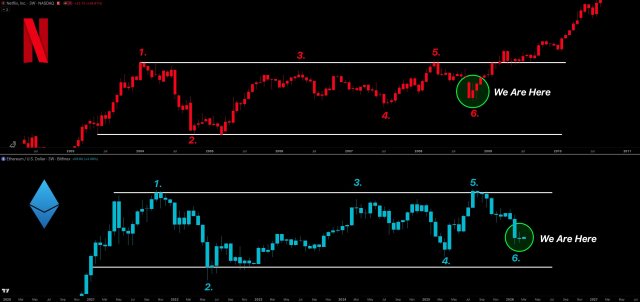
While Ethereum’s price struggles, a market expert known as Crypto Tice has outlined a compelling, bold trend on ETH’s chart when compared to Netflix. After comparing the movement of both charts, the expert has predicted a massive upswing for ETH, similar to Netflix’s notable surge in 2009.

For years, Netflix was trapped in a range, and after multiple tests of support and rejection from resistance, the asset exploded hundreds of percent higher. Currently, ETH is exhibiting the exact same trend, with related compression, frustration, and capitulation from the crowd. 

Ethereum
Source: Chart from Crypto Tice on X

With Ethereum mirroring this trend, the expert believes that history is about to repeat itself and ETH could see a violent upward move. “The assets that make people the most uncomfortable at the bottom are the ones that make people the most regretful at the top,” Crypto Tice added.

Ethereum
ETH trading at $2,055 on the 1D chart | Source: ETHUSDT on Tradingview.com

Featured image from Getty Images, chart from Tradingview.com

Editorial Process for bitcoinist is centered on delivering thoroughly researched, accurate, and unbiased content. We uphold strict sourcing standards, and each page undergoes diligent review by our team of top technology experts and seasoned editors. This process ensures the integrity, relevance, and value of our content for our readers.

Bhutan Keeps Selling Its Bitcoin, Reserves Sold By Over Half

0

Bhutan’s state-owned investment arm has steadily sold portions of the country’s Bitcoin reserves, moving about $42.5 million in BTC and USDT so far in 2026 through a small set of recurring counterparties.

Data from blockchain analytics firm Arkham Intelligence shows that the Royal Government of Bhutan transferred 175 BTC, valued at $11.85 million, on Monday to an address that had previously received 184 BTC in February. 

The February activity included multiple transfers totaling roughly $30.7 million, including two sends to QCP Capital, a trading firm, and a $1.5 million USDT transfer to a Binance hot wallet.

The pattern suggests a planned treasury drawdown and liquidity management strategy rather than panic selling. Bhutan mined much of its Bitcoin using surplus hydropower, giving the government a near-zero cost basis. Every sale, therefore, represents a profit for the state.

Bhutan’s Bitcoin stack peaked around 13,000 BTC in late 2024, after several years of accumulation through state-backed mining operations. 

tSince then, the holdings have fallen to approximately 5,400 BTC, a 58% reduction. 

Dollar value has also dropped due to the decline in Bitcoin prices from roughly $126,000 at the peak to around $69,000 today. Holdings once worth over $1.5 billion are now valued near $374 million.

Druk Holding and Investments (DHI), Bhutan’s sovereign wealth fund, manages the country’s cryptocurrency assets. 

Bhutan is one of the world’s largest bitcoin holders

The fund oversees state-owned enterprises and acts as the principal financial arm of the government. In December, Bhutan pledged up to 10,000 BTC to fund Gelephu Mindfulness City, a special economic zone designed to hold digital assets for its financial reserves.

The transfers have consistently gone to the same counterparties in similar sizes, with no clear correlation to price movements. This pattern points to structured liquidity management rather than reactive selling.

Bhutan ranks as the seventh-largest government Bitcoin holder, behind the first place United States, which holds 328,372 BTC valued at nearly $22 billion. 

Bhutanese Prime Minister Tshering Tobgay has previously noted that Bitcoin proceeds support public services, including healthcare, environmental initiatives, and salaries for public employees. 

Surplus hydropower generated during summer months has enabled the kingdom to continue state-backed mining operations efficiently.

Since the 2024 Bitcoin halving, mining rewards declined to 3.125 BTC, reducing overall profitability and prompting some energy resources to be redirected to high-performance computing. 

DeFi Insurance Is The Final Frontier Of Onchain Finance

0

Opinion by: Jesus Rodriguez, co-founder of Sentora

If you look at decentralized finance (DeFi) as a stack of computational primitives, it’s remarkably complete — yet fundamentally broken.

We have automated market makers for liquidity, like Uniswap. We have lending markets for capital efficiency, and bridges for cross-chain “packet switching.” Step back and look at the architecture from a systems engineering perspective.

There is a gaping hole where the risk backstop should be.

Insurance is the “missing primitive” of the decentralized web. It is the translation layer that turns scary, opaque technical risk into a legible line item — a number you can compare, hedge and budget for. Without it, we aren’t building a financial system; we’re building a very sophisticated, high-stakes casino.

Insurance hasn’t worked, so far

A lot of chatter has been spent on why onchain insurance hasn’t “mooned” despite billions in total value locked (TVL). Personally, I suspect the failure is structural, not just a “lack of interest.” We’ve been fighting against the physics of risk management.

Most first-generation protocols tried to use DeFi-native assets, like Ether (ETH) or protocol tokens, to insure the very same DeFi stack those assets live in. This is a classic “reflexivity” trap. When a major exploit happens, the entire ecosystem usually suffers a setback. The collateral loses value at the exact moment the payout is triggered. In systems terms, this is a positive feedback loop of failure. It’s like trying to insure a house against fire using a bucket of gasoline. To work, insurance requires uncorrelated capital: assets that don’t care if a specific smart contract gets drained.

Historically, we relied on retail yield farmers to provide “cover.” These users don’t wake up caring about actuarial tables or underwriting. They care about APY and points. This is not the stable, long-term underwriting base that is required to build a multibillion-dollar risk engine. Real insurance requires a “low cost of capital” base — institutional-grade assets that are happy to sit and collect a steady 2%-4% spread without needing to “degenerate” into 100% APY schemes.

The scaling imperative

We’ve spent years obsessing over TVL as the North Star of DeFi. TVL is a vanity metric; it tells you how much capital is sitting in the “danger zone.” The metric we actually need to optimize for — the one that actually measures the maturity of the industry — is total value covered (TVC).

If we have $100 billion in TVL but only $500 million in TVC, the system is effectively 99.5% “naked.” In any traditional engineering discipline, this would be considered a catastrophic failure in safety margins. You wouldn’t fly in a plane that was 0.5% “safety tested.”

The scaling imperative for the next era of DeFi is to bridge this gap. We need a path where TVC scales linearly with TVL. Currently, they are decoupled. TVL grows exponentially based on speculation, while TVC crawls linearly because the “risk markets” are illiquid and manually managed. Scaling DeFi isn’t just about Layer 2 throughput; it’s about “risk throughput.”

Pricing the ghost in the machine

We often talk about risk as an ethereal, spooky thing that happens to other people. In a mature financial system, risk is a commodity. It needs to be assetized.

Think of DeFi insurance as the pricing engine of risk. Currently, when you deposit into a vault, you are consuming a bundle of risks: smart contract risk, oracle risk and economic design risk. These risks are currently unpriced — they are just hidden baggage you carry.

By building a robust insurance primitive, we turn those hidden risks into tradable assets. We move from “I hope this doesn’t break” to “The market says the probability of this breaking is exactly 0.8% per annum, and here is the tokenized instrument that pays out if it does.”

Related: AI will forever change smart contract audits

This assetization is powerful because it creates a market signal. If the cost of cover for Protocol A is 5% while Protocol B is 1%, the market has effectively “priced” the security of the code. Insurance isn’t just a safety net; it’s the global oracle for protocol health. It turns “security” from a vague marketing claim into a hard, liquid price.

The dream of programmable insurance

The “end state” of this technology isn’t just a decentralized version of Geico — it’s a transition from legal insurance to computational insurance.

Think about the difference between a traditional legal contract and a smart contract. Traditional insurance involves 40-page PDFs, adjusters and a six-month claims process. It is a “human-in-the-loop” bottleneck.

Programmable insurance is a primitive that can be integrated directly into the transaction stack. It includes granular cover and atomic payouts. You don’t just “insure a protocol” in the abstract. You insure a specific LP position, a specific oracle feed, or even a single high-value transaction. If the state of the blockchain detects an exploit, the payout happens in the same block. There is no “claims department”; there is only “state verification.”

This makes insurance a “first-class citizen” in the code. You can imagine an “Insurance” button on every swap or deposit, much like how you choose “priority gas” today. It becomes a toggle in the UI.

The next wave of DeFi adoption

The real challenge for DeFi adoption isn’t convincing another 1,000 degens to use a bridge; it’s onboarding the fintechs and neobanks.

These entities are already knocking on the door. They are considering the 5% onchain risk-free rates and comparing them to their legacy rails, which are clogged with overheads and rent-seekers. However, for a neobank (think of firms such as Revolut, Chime or Nubank), “The code is the law” is not a valid risk management strategy. Their regulators — and their own risk committees — simply won’t allow it.

For these players, insurance isn’t a “nice to have”; it’s a hard requirement for deployment. They represent the next “trillion-dollar” wave of liquidity, but they are currently standing on the sidelines. They need a “wrapper” that makes DeFi look like a bank account.

If we can provide a robust, programmatically backed insurance layer, we aren’t just protecting degens; we are providing the “regulatory-compliant shield” that allows a neobank to put $1 billion of customer deposits into a lending vault. Insurance is the bridge between “crypto-native” and “global finance.”

We’ve spent the last few years building the “engine” of the new financial system. We have the pistons (liquidity), the transmission (bridges) and the fuel (capital). But we forgot the brakes and the air bags.

Until we solve the insurance primitive, DeFi will remain a niche experiment for the risk tolerant. By shifting our focus from TVL to TVC, moving toward uncorrelated collateral and embracing the “pricing engine” of assetized risk, we can finally turn this experiment into a resilient, global utility.

Strap in. There is a lot of code to write and even more risk to underwrite.

Opinion by: Jesus Rodriguez, co-founder of Sentora.