Supporters of BIP-110 view Bitcoin as a public utility whose scarce block space should be reserved primarily for monetary settlement. Inscriptions and other data-heavy applications represent consumption of a limited resource that should be protected for financial transactions, even if doing so requires introducing new consensus rules.
DOG Mode starts from the opposite premise.
Leonidas argued Bitcoin should remain a neutral marketplace for block space, where any valid transaction is equally legitimate provided the sender pays the prevailing fee. From that perspective, there is no objective distinction between a bitcoin payment and an Ordinals inscription.
Rather than seeking permission through a protocol upgrade, the intention for DOG Mode is to remove policy restrictions that its supporters argue Bitcoin itself never required.
The proposal also raises a more subtle question about Bitcoin’s infrastructure.
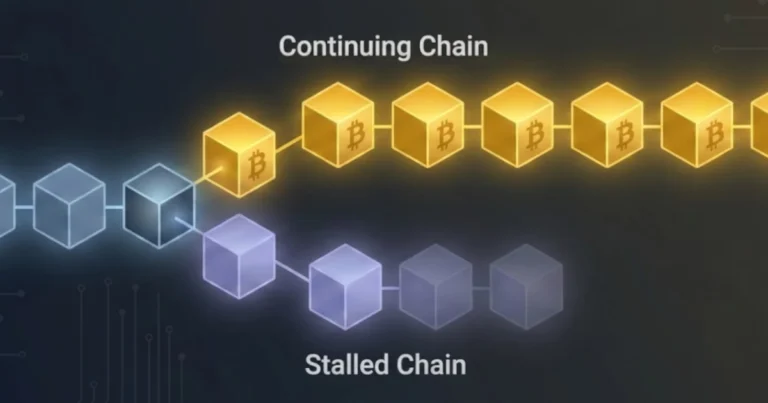
If enough nodes begin running different policy software, the network’s mempool — the collection of unconfirmed transactions waiting to be mined — could become increasingly fragmented. Consensus would remain intact, but different parts of the network could relay different transactions, affecting fee estimation and how quickly some transactions reach miners.
That fragmentation already exists to a degree, but DOG Mode could widen those differences by encouraging broader acceptance of transactions that many default nodes currently refuse to relay.
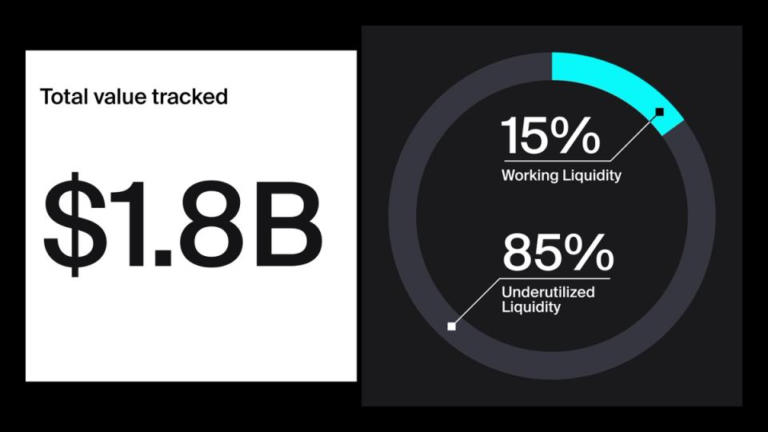
Around 54% of liquidity in positions below $1,000 was out of range, compared with 26% for positions above $1 million. Yet positions worth more than $1 million accounted for 47% of all idle capital, or roughly $260 million.
While contract-managed positions stayed within a more consistent range, individual wallets accounted for between 82% and 94% of the attributed idle capital on Uniswap v3, depending on the chain. That suggests liquidity deposited directly by users and requiring manual adjustments is more likely to go unattended and fall out of range.
Dune estimated that these out-of-range providers, that are sitting idle, could be missing roughly $150 million in fees each year, based on a blended in-range fee APR of about 35%.
Liquidity providers deposit token pairs that decentralized exchanges use to complete swaps. They earn a share of the fees paid for trades using that liquidity pool while their positions remain in the range they set.
However, the research said that the figure is not guaranteed recoverable income. Keeping positions active can add transaction costs, execution risk and exposure to unfavorable price movements.
1inch commissioned the research ahead of the planned launch of Aqua, a new liquidity protocol. Dune said it developed the methodology and reached its conclusions independently.
On Wednesday, DTCC completed its first live production trades involving tokenized securities, marking a major step toward bringing blockchain technology into traditional financial markets.
Broadridge’s findings suggest those efforts are influencing the broader industry. Sixty-eight percent of respondents said tokenization will at least partially reshape financial markets within the next three to five years, while nearly one-third plan to increase investment in tokenization projects by 26% to 50% or more over the next two years.
The survey also found firms are not preparing for an all-onchain future. Instead, 92% expect digital and traditional assets to coexist for the foreseeable future, and 69% plan to integrate tokenization into existing infrastructure rather than build separate blockchain-native systems.
That mirrors the approach taken by many large financial institutions, which have generally focused on connecting blockchain networks to existing trading, custody and settlement systems instead of replacing them.
Adoption remains uneven across the industry. Forty-four percent of capital markets firms said they already have tokenization initiatives in production or operating at scale, compared with 20% of asset managers and 9% of wealth managers.
The survey also pointed to where firms expect tokenization to gain traction first. About 80% of respondents believe tokenized mutual funds and money market funds will play a meaningful role within five years, reflecting the rapid growth of tokenized Treasury products. By comparison, only about half expect tokenized equities to achieve similar adoption over that period.
“This week we have seen some large blocks in BTC topside call spreads,” Jean-David Péquignot, chief commercial officer at Deribit, told CoinDesk.
Options flow of this size and repetition often reflects institutional positioning rather than retail activity, given the capital required and the precision of the strike selection.
The timing is notable for two reasons. First, it suggests confidence in bitcoin’s recent bounce to $64,000 from under $58,000 earlier this month. More importantly, the trade targets the July 31 settlement, two days after the Federal Reserve’s July 29 interest rate decision. The call spread flow suggests that at least some large traders expect the meeting to serve as a catalyst for a move toward $72,000.
Fed funds futures currently point to a hold at the July meeting, with most trackers putting the probability of the central bank keeping its benchmark rate unchanged at 3.5%-3.75% in the 75%-80% range. The remaining odds are split between a rate hike and, to a lesser extent, a cut.
Rate-hike fears have ebbed following June inflation data, which showed a sharp deceleration in price pressures at both the consumer and producer levels. Much of the relief traces to a sharp pullback in oil prices during the month, tied to a ceasefire between the U.S. and Iran; core inflation, which strips out food and energy, was flat.
Foundry Digital, the world’s leading Bitcoin mining pool operator, has said it will allow mining clients how the pool should signal on the BIP-110.
The Rochester, New York-based firm said Friday in an email to miners that they will be able to vote by using their hashrate — literally computing power — to vote either for or against the proposal.
BIP-110, or the Bitcoin Improvement Proposal 110, is a proposal aimed at temporarily restricting spam on the blockchain. If it goes through, a soft fork — a backward-compatible rule change — would take effect, restricting the amount of non-monetary data on the network.
“As miners, it’s important for you to have a voice and participate in the governance of the network,” Foundry said in its announcement.
“It’s one of the more actively debated proposals in Bitcoin right now, and miners play a direct role in whether it activates,” the company added.
Also known as the “reduced data temporary soft fork,” the proposal would cap the amount of arbitrary, non-monetary data that transactions can carry.
Its rules limit most new outputs to 34 bytes, restore an 83-byte limit on OP_RETURN outputs, and reject data pushes above 256 bytes.
Those for the proposal say that the soft fork would allow Bitcoin to function as pure peer-to-peer money.
But opponents, including Strategy founder Michael Saylor and Blockstream co-founder Adam Back, argue it converts a policy dispute into a consensus change that could invalidate fee-paying transactions.
Foundry’s process
Under Foundry’s process, each vote carries weight based on an account’s average 10-day hashrate on the pool between July 6 and July 15. Foundry said it will signal based on the majority of hashrate-weighted votes across the signaling period, which it expects to run through early August at block 961,632.
The company’s starting position is no. It said that until “Yes” votes cross 51% of voting hashrate, Foundry signals “No” with all of its blocks. A crossing of that threshold switches the pool to “Yes” with all of its blocks.
Foundry controls about a third of network hashrate, a share that makes its position consequential for the outcome. Analysts at BGeometrics identified decisions by Foundry and Antpool as capable of moving daily signaling into a meaningful range. A mandatory signaling window near block 961,632, projected for early August, will force the question before the activation timeline closes.
Accounts that do not respond count as “No” votes. Foundry said owners can change their choice while the window remains open, and that individual votes stay confidential, though aggregate results may be shared.
This is a guest post by Jason Hughes, VP of Development and Engineering at Ocean Mining. Opinions expressed are entirely his own and do not necessarily reflect those of BTC Inc. or Bitcoin Magazine. The article originally appeared on X.com and has been published with the permission of the author.
Let me start off by saying I’m not pro BIP110, and I’m not anti-BIP110. If it actually succeeds as something that gains true consensus within the network and ends up being enforced by a majority of the network… cool. If so, then we’ll go with it because the network has spoken and accepted it, and all nodes, including non-BIP110 nodes, will be pulled along for the ride. Unfortunately for proponents of the proposal, that simply isn’t currently the case by any measurable metric, nor does it appear to have a trajectory suggesting that will change, either.
There’s been a lot of misleading information about this whole thing, especially in the context of mining. A few quick key bullet points to briefly counter some hyperbole from proponents: BIP110 is NOT inevitable. It CAN fail. BIP110 can and will cause a chain split/fork in a minority hashrate situation. BIP110 is NOT without risk to miners choosing to adopt it. Miners not supporting BIP110 are not suddenly mining “invalid” blocks just because a proposal that isn’t yet adopted simply exists. You’re not a bad person or evil simply because you don’t like or support BIP110. (The fact that I feel the need to point out that last part is actually kind of sad…)
I was going to write a long post to help keep miners informed about things they need to remain aware of as this all plays out… before realizing I already did so months ago, as a document I authored that I had hoped could be put out as a miner education piece at OCEAN. Sadly, it never got published. So I went ahead and updated it, and well, here it is.
Again, keep in mind this was written months ago, intended to be as agnostic as possible in an effort to make it acceptable as a corporate post. That effort failed, so I’m posting it as a personal document today instead. As a miner making important decisions about your operations, you need to be aware of all of this without the sugarcoating and, frankly, outright misleading information coming from some of the BIP110 proponents. You must be vigilant and decide what’s right for you.
While there is certainly some misleading information from the opposition as well, nothing I’ve seen is nearly as egregious as the extremely premature claims of victory and accompanying hyperbole pushed by the BIP110 side. Summarizing my doc a bit, my personal suggestion to miners is this: Signal if you support BIP110. Do not signal if you don’t support BIP110 or don’t care. Either way, monitor the network on/around/before block 961632.
If you continue to see non-signaling blocks from major pools, you can be reasonably certain they’re not going to suddenly decide later to throw away millions of dollars’ worth of revenue to backtrack and signal for BIP110. If they do, by some chance, start to signal for BIP110, you should monitor that and consider switching as required to stay on the heaviest chain. The key point is that, realistically, only one side can win. It’s either BIP110 succeeds, and miners not on the BIP110 side fail, or BIP110 fails, and miners on the non-BIP110 side succeed.
Moving on, let’s dive into a small fraction of my rationale.
QUICK FACT: Between 7 and 15% of Bitcoin Nodes are signaling support for BIP110.
Depending on which centralized crawler you look at… no way to know for sure [how many BIP110 nodes are signaling support]. My personal private crawler puts this number much lower, but that’s a discussion for another day. Suffice it to say, I think it’s logical and correct to say that even 15% is not a majority.
“But Jason! UASF got Segwit activated with fewer nodes!”
Yep, because many miners, merchants, users, etc., all actually wanted Segwit. There was tremendous economic and community weight behind it. Without rehashing that whole thing, as plenty of resources on the topic from before BIP110 are worth a read, suffice it to say that BIP110 and Segwit activations are not quite comparable, as many have already pointed out. Segwit, for example, went into its UASF territory with around 1/3rd of the network’s hashrate already signaling support. With that kind of backing, the UASF to help push the MASF over the tipping point made a lot of sense. It doesn’t make sense here for BIP110.
QUICK FACT: 0.6% of blocks over the past 60 days have signaled support for BIP110.
[0.6% is a] pretty stark contrast to even Segwit’s low baseline support. Yes, I know it’s increased slightly in the past couple of weeks, but no new entrants. Just more clearly rented hashrate from one of the same small proponents.
Something to keep in mind is that mining BIP110 signaling blocks via DATUM on OCEAN carries virtually no risk to the miner up until the fork point at block 961632. The cost is negligible, as you’re effectively guaranteed to recoup rental costs, etc.
It’s awesome that the ability to do so exists, and I wouldn’t have it any other way… but just something to keep in mind when weighing signaling from such blocks in the grand scheme of things from a risk-reward, money-on-the-table perspective.
“But Jason! Miners have no incentive to signal until the last minute!”
I also see no evidence to suggest that this could be the case. Subjectively, I disagree with the premise, as it’s not in a mining pool’s best interest to destabilize the network in such a way. Part of the reason for early signaling and lock-in periods is to help coordinate upgrades in a smooth fashion. Waiting until the last minute negates that benefit entirely. I see no compelling rationale or upside to doing so.
Continuing on this, as part of my personal node monitoring setup, I specifically monitor nodes known to belong to various entities, such as other mining pools, exchanges, large lightning nodes, merchants, etc. A supermajority of which are monitored with explicit permission and confirmation/coordination.
QUICK FACT: All major mining pools I monitor are currently running some variant of Bitcoin Core v30 or v31 (except OCEAN).
Expanding on that, most [mining pools] have updated their nodes since the proliferation of BIP110’s release, even since the release of Knots 29.3. Additionally, it is known that many mining pools run modified versions of their node software to facilitate various requirements of their specific infrastructure. Such changes would need to be ported to a BIP110-compatible client, tested, evaluated, and deployed ahead of time. I currently see no evidence that this is the case currently.
As far as I can tell, the pools are aware but ignoring.
This is one of the funniest and most ridiculous arguments I’ve heard from the pro-BIP110 crowd. Comparing a consensus change that can be unilaterally enforced upon the network by miners and accepted by 100% of existing nodes (a soft fork), with a hard fork which no existing node will accept… is disingenuous at best. T
ightening rules (like BIP110): Soft fork, can be enforced by miners if they choose to do so. Loosening rules (like canceling a halving): Hard fork, can not be enforced by miners without effectively 100% buy-in from the entire network… which isn’t likely to happen. Comparing the two is, bluntly, just stupid.
“But Jason! If you don’t upgrade to the latest consensus rules, you’re insecure! You’ll lose funds! You’ll mine invalid blocks! You’ll [insert additional hyperbole here]!”
This would be true of a consensus change that has, well, consensus. While BIP110 has made a valiant effort to gain that consensus, it has yet to have any measurable majority at what is now arguably the 11th hour. Not in nodes, not in hashrate, not in the social layers (consensus.health has a cool visual there where you’ll find me in the middle).
If somehow BIP110 gains 51%+ of the network hashrate on/before block 961632… then, alright. It’s enforced, since as a soft fork a majority of miners can unilaterally enforce it in the absence of a fully adopted URSF (effectively a misnomer, as this would kind of be a hard fork).
“But Jason! It can’t gain consensus by already having consensus! You have to give it a chance!”
Firstly… no I don’t, even though I have. Second, it’s a rushed proposal that never had the time to even try and gain real consensus. It’s been 7 months since the release of the first BIP110 client. There’s ~3 weeks to go before “mandatory” signaling starts as of now (less by the time you read this). 90% of the time available has passed with no change in overall sentiment from any relevant players. If it hasn’t gained sufficient adoption in the past 7 months, it’s not likely to do so in the next 3 weeks.
“But Jason! CSAM! CSAM! Pedophiles! CSAM!”
I’ll be the first to say, even I personally overstated the risk here early on when Core proposed its OP_RETURN change. I personally expected something particularly egregious to hit the chain almost immediately, and to the best of my knowledge, that’s not yet happened. Could it still happen? Yeah, I suppose.
But considering from a technical perspective, byte-for-byte the same contiguous arbitrary data can provably end up stored in the current chain or the BIP-110 chain without much issue… this particular argument for BIP-110 falls pretty flat to me at this point.
Do I want CSAM in the chain? Of course not. Am I a pedophile if I don’t support BIP110? Also not.
Concluding Thoughts
I could continue to go on and on and on, but I’ll stop here. I’ve wasted enough time on this. I’m sure I’ve done plenty to annoy both sides of the BIP110 debate at this point, as I don’t adopt either stance. I’m sure I’ll catch flak from all angles simply for daring to speak my mind on it.
Overall, I mostly think it was silly to approach addressing a real problem (the OP_RETURN default change in Bitcoin Core) with the maximum anti-spam manifesto based soft fork proposal… which provably cannot stop spam, arbitrary data, etc. 🤦♂️ (Yes, I know, proponents will claim it’s not about spam… and will also make semantic arguments that it does stop data as well… neither of which appears to be correct.)
I’ll close with the concession that I could be wrong. I’m not Nostradamus, and I can’t accurately predict the outcome with 100% certainty. I can only go by what the data tells me, and so I give BIP110’s success less than a 5% chance of actually succeeding… and I consider that generous. You can take my opinions on this however you wish, but I highly recommend you don’t discount the actual data points, remain vigilant, and do what’s best for you and your mining revenue. Don’t be gaslit by either side of the debate, and make your own decisions.
Here’s a link to the same document linked above for ease of access.
Bitcoin (BTC) has been counting down to its next bottom for nearly two months, a classic onchain metric suggests.
Key points:
BTC supply in loss passed 50% for the first time this bear market in early June.
In previous bear markets, that event sparked a countdown to a new BTC price macro bottom.
Separate data hints that the bull market’s “emotional premium” has now gone.
Supply in loss countdown already Bitcoin’s second-longest
In its H1 2026 Round-Up report, crypto research company K33 Research flagged more than 50% of the BTC supply now being held at a loss.
A typical bear-market feature, supply in loss has become a yardstick for progress toward macro bottoms for BTC/USD.
K33 data shows that once supply in loss passes the 50% mark, the bottom has come no more than 101 days later. Bear markets have provided various time frames, with the shortest bottom “window” lasting just 13 days in 2022.
The 2018 bear market required 23 days to reach its floor, while in 2014, Bitcoin continued to decline for 101 days after the 50% supply-in-loss mark was hit.
In 2026, supply in loss repeated standard bear-market behavior, crossing 50% on June 5. Since then, 42 days have elapsed, making this year’s bottom window Bitcoin’s second-longest ever.
BTC supply in loss and days until bear-market bottom (screenshot). Source: K33 Research
In accompanying commentary, K33 observed that returns over the year following the phenomenon “tend to be very solid.”
Earlier this month, Axel Adler Jr., a contributor to onchain analytics platform CryptoQuant, estimated that supply in loss was around two months away from levels that correspond to bear-market bottoms.
CryptoQuant data puts supply in loss at 46% as of July 17.
“Distribution of capital” teases silver lining
Continuing, CryptoQuant eyed what it described as “rare” readings from Bitcoin investor cost-basis models.
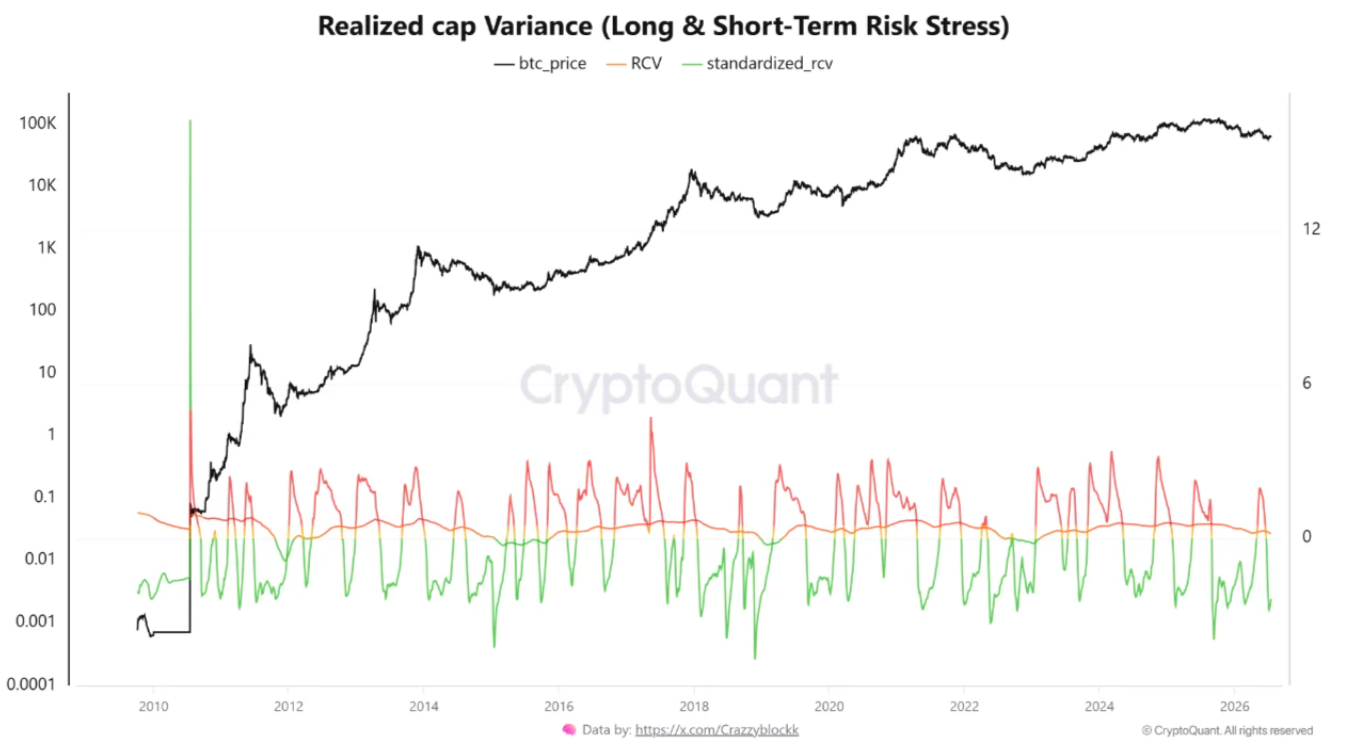
The realized cap variance (RCV) model, which measures the difference between realized cap and market cap, currently sits in the bottom 6% of its historical range.
“Instead of tracking price alone, it isolates the variance between realized cap and market cap relative to its own rolling history, capturing how stretched or compressed investor cost basis has become versus current valuation,” contributor Crazzyblockk explained in a QuickTake blog post on Thursday.
“When that variance compresses into deeply negative z-score territory, the emotional premium built during rallies has largely been priced out. The metric doesn’t read narrative, it reads the distribution of capital.”
Bitcoin RCV data (screenshot). Source: CryptoQuant
At -2.35, standardized RCV’s Z-score is once again pointing to the final stages of the Bitcoin bear market.
“Every prior stretch where the model spent extended time below a -2.0 z-score, late 2018, mid-2022, early 2015, preceded forward twelve-month returns north of 75%,” the post noted.
“The most extreme reading in this dataset, -4.68 in November 2018, landed almost exactly on Bitcoin’s cycle bottom near $3,792.”
Cardano developer Input Output is handing control of core blockchain infrastructure to outside teams, reducing the network’s dependence on the company that built it, Input Output announced Friday.
Input Output said the handover is the next phase of Cardano’s decentralization. It covers Cardano’s Haskell node, Plutus smart-contract platform, Daedalus wallet, Hydra scaling technology and developer relations.
Specialist companies include Se7en Labs, a development agency specializing in Solana blockchain infrastructure, and Teragone, a specialist software development and cryptographic research team that leads the development of Mithril, a stake-based signature protocol for the Cardano blockchain. Both will take responsibility for some of the components. The handover will begin in August and continue into 2027.
Cardano has already moved protocol decisions and governance to its community. Input Output said the next step is to spread responsibility for developing and maintaining the software.
“The last stage of the Voltaire era is full decentralization of node and reference blueprint development,” Input Output CEO and Cardano founder Charles Hoskinson said in the statement.
“Both Stripe and PayPal do approximately the same amount of payment volume, but Stripe has about one-fifth the net revenue,” Hadick said. “From a financial perspective, this is obviously accretive, and it helps them connect their merchant processing business, which is at risk of being commoditized, with a broad subset of PayPal’s more than 400 million accounts.”
Hadick also cautioned that executing a deal of that size would be difficult. “M&A integration in something of this size is incredibly hard,” he said.
Beyond merchant payments
Eric Queathem, CEO of Velocity, said the acquisition would also give Stripe access to one of the world’s largest consumer payments ecosystems, providing a platform to expand beyond merchant payments.
The proposed acquisition would also determine who controls the consumer side of blockchain-based payment infrastructure, complementing Stripe’s existing merchant network and stablecoin capabilities.
Several executives said the competitive focus has shifted from proving blockchain technology works to controlling distribution.
Pankaj Bengani, founder and CEO of Meld, agreed with Larbi that the race is on.
“The race has shifted from proving the technology works to owning distribution,” said Bengani, adding that “stablecoins have graduated from experiment to core payments infrastructure.”
Citi analysts reached a similar conclusion in a research note, writing that stablecoin competition has become “a default-setting game,” with scale accruing to whichever stablecoin becomes the default across the largest merchant, consumer wallet or autonomous transaction base, rather than to the issuer with the best technology.
The Bitcoin bottom may be in — but don’t get your hopes up: It might struggle to go up anytime soon, according to one investment firm.
A Friday report from European asset management firm CoinShares said that investors last week threw fresh cash at Bitcoin — and other crypto — exchange-traded products, indicating a change in sentiment.
But other factors may hold digital asset markets from going higher, James Butterfill, head of research at CoinShares, wrote.
“We have said for some time that Bitcoin has probably reached, or is close to, its floor,” the report read. “But we see no significant upside potential from here.”
The report added that current macroeconomic headwinds, such as the US bombing Iran and rising oil prices, could see inflation go up again.
Bitcoin’s price was up earlier this week, hitting a seven-day high of $65,501 on news that inflation in the US was softer than expected. It has since erased those gains and was recently trading for $64,010.
The price of Bitcoin has typically done well on news that inflation is coming down because investors expect interest rates to come down. But Butterfill said that “a rate cut does not look probable at this stage.”
Bitcoin’s worst run on record
CoinShares’ data showed that investors pulled a total of $8 billion out of funds giving crypto exposure — “the worst run on record.”
Last week, though, things reversed when $287 million hit crypto funds, CoinShares said, with the data so far showing that this week looks likely to be another positive streak.
The price of Bitcoin has typically done well when US investors — previously excluded from crypto investing — have bought shares in exchange-traded funds approved in 2024.
The products — handled by the likes of BlackRock, Fidelity, and Grayscale — allow more traditional investors or Wall Street institutions to buy positions in Bitcoin via shares that trade on stock exchanges.
Since BTC’s October all-time high of $126,080, crypto markets have faced a battering as those investors have fast cashed out of the funds. Bitcoin has struggled to make gains, especially after the US and Israel started bombing Iran, leading to a surge in the price of oil.
The leading cryptocurrency is now nearly 50% below its record.
“The dominant picture is that the current setup is prompting interest in adding positions, but caution prevails while sentiment remains broadly negative,” CoinShares added.