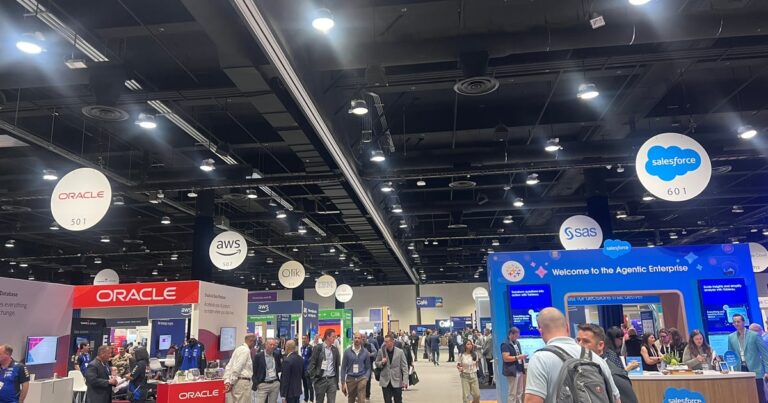
ORLANDO — As a 140-year-old business, Pittsburg Plate Glass Industries is well supplied with a diverse array of data across its operations. With a presence in multiple countries, the company faced challenges with data literacy and data discoverability and sought to address them to scale its AI productivity goal.
“We’ve had poor discoverability, unclear data product ownership,” said PPG’s Bob Howden, senior IT manager of data and analytics, during a presentation at the Gartner Data & Analytics Summit 2026 on March 9. “We have gaps in the lineage; we have multiple sources. We have 170 sources in our database.”
Along with these problems, PPG also had a disconnected metadata system that would have made it challenging to scale or achieve its goal of accelerating its day-to-day AI initiatives or boost ROI on existing data in 2026.
To address the situation, PPG turned to data cataloging vendor Atlan.
Related:French AI Startup Building World Models Raises $1.03 billion
PPG’s journey highlights a trend in enterprises seeking to deploy AI applications: without a strong data environment, success is hard. This challenge is leading enterprises to realize that not only is a good data environment needed, but that data must also include context that the AI system can feed on.
“The challenge I think we have today with AI is really the context,” Howden said in an interview. “We have a lot of data. It used to be data inaccuracy was a problem but understanding that data in a larger context and making and providing AI the ability to give solid answers is probably our biggest challenge.”
The need for better context in the data on which AI systems depend arises because the types of data AI agents use have changed.
“Now we’re looking at versions of AI that need either streaming data or unstructured data and more access to data,” said Beena Ammanath, lead at the Global Deloitte AI Institute. Structured data includes data that can be easily entered into spreadsheets. Unstructured data is data from images, written documents, and other sources. “You need unstructured data to make your AI robust. AI and generative AI need more varieties of data.”
While providing context to the data feeding the AI system is important, that is only the beginning, said Saravanan Balasubramaniam, senior vice president of AI and data delivery at Truist Financial, one of the country’s biggest bank holding companies, during an interview.
Enterprises should also ensure that structured and unstructured data align, he said. He noted, for example, that if a bank, such as Truist, gives two different answers to the same client for the same question, it can lead to legal action.
Related:Dealing With AI’s Effect on Jobs and Opportunities in Data
“If I have to pull in multiple documents about the customer and get an answer, then the document should be clear, clean,” Balasubramaniam said. “The identity resolution has to happen on the document level. The name cannot be William in one place and Will in another place.”
He added that without alignment between structured and unstructured data and without context or identity resolution, data quality problems will likely recur within either the AI system or the agent.
Providing an AI agent with the right data, with the correct context and synchronization within structured and unstructured data, could lead the system to understand faster than a human can.
“Their perception of the context might be easier, quicker, smarter,” said Paul Bell, global head of data trust and integrity at Entain PLC, an international sports betting and gambling company, in an interview.
After failing to break out of its local trading range, BTC/USD looked increasingly devoid of bullish cues as traders stayed wary of price breakdowns.
“Not much has changed, price is still consolidating inside the range,” trader Cryptorphic told X followers in their latest analysis.
“The weekly candle closed bearish, and overall the structure still leans sideways unless we get a clear breakout or breakdown.”
BTC/USDT one-day chart. Source: Cryptorphic/X
Trader Killa flagged areas of high potential liquidations as the next short-term price targets.
“If we start pushing down toward the monthly open and weekly open around $66K–$66.9K, there’s a strong likelihood that the $64K liquidity pool gets swept,” they explained on the day.
“If we start pushing above 72-73K, the next POI is 74-76K.”
BTC liquidation heatmap. Source: Killa/X
For trader and analyst Mark Cullen, meanwhile, there was reason to hope for a move higher if bulls could cement $70,000 as support.
“70K is critical, $BTC needs to get back above and hold for another attempt at a range break out. If it can do that then high 70K’s / low 80K’s will be on the cards before the end of the month,” he summarized.
BTC/USD four-hour chart. Source: Mark Cullen/X
BTC price may see “highly volatile environment”
Earlier, Cointelegraph reported that significant resistance is expected to halt any BTC price advances beyond the $70,000 mark.
Related: Bitcoin permabull Arthur Hayes says he wouldn’t bet $1 on BTC right now
Many market participants continue to expect new macro lows to result from the current rangebound structure, with these currently as low as $50,000 or less.
Examining open interest (OI) on Bitcoin futures markets, BorisD, a contributor at onchain analytics platform CryptoQuant, warned of ongoing volatility to come.
“Looking at the most recent days, the 30-day Open Interest change has entered a strong recovery phase. This suggests that new positions are being added back into the market and that volatility is likely to increase over the next few weeks,” he wrote in a “Quicktake” blog post on Tuesday.
“In the coming weeks, Bitcoin may face a highly volatile environment. As Open Interest continues to rise, leverage in the market also builds up. This can open the door to stronger price swings, sudden directional moves, and another round of forced liquidations.”
Bitcoin futures aggregated OI 30-day % change. Source: CryptoQuant
This article does not contain investment advice or recommendations. Every investment and trading move involves risk, and readers should conduct their own research when making a decision. While we strive to provide accurate and timely information, Cointelegraph does not guarantee the accuracy, completeness, or reliability of any information in this article. This article may contain forward-looking statements that are subject to risks and uncertainties. Cointelegraph will not be liable for any loss or damage arising from your reliance on this information.
US spot Bitcoin exchange-traded funds (ETFs) saw increased inflows on Tuesday, even as BTC dipped below $70,000.
Spot Bitcoin (BTC) ETFs recorded $251 million in inflows, building on Monday’s $167 million in gains, according to SoSoValue data.
The inflows continue a positive trend in March, with cumulative monthly gains now at $1.56 billion versus $576.6 million in outflows.
The inflows came despite Bitcoin briefly falling to $69,400 on Tuesday, according to CoinGecko. It traded at $69,810 at the time of writing, down 0.7% over the past 24 hours.
Daily flows in US spot Bitcoin ETFs since March 2. Source: SoSoValue
XRP selling eases as Goldman Sachs tops ETF holdings
Following a three-day outflow streak, some altcoins, including Ether (ETH), flipped into the positive territory, seeing minor inflows at $12.6 million. Solana (SOL) funds posted no inflows.
XRP (XRP) funds, by contrast, posted about $3.9 million in outflows, extending their selling streak to a fourth straight session, though the pace of redemptions eased from Monday’s larger withdrawals.
Daily flows in US spot XRP ETFs since March 2. Source: SoSoValue
Bloomberg ETF analyst James Seyffart noted in a post on X that XRP ETFs have held up well despite the asset’s volatility. According to CoinGecko, XRP dropped around 5% over the past 30 days, trading at $1.38 at the time of writing.
Related: Spot Bitcoin ETFs post second straight weekly inflows for first time in 5 months
“They’ve taken in a cumulative $1.4 billion since launch,” Seyffart said, adding that Goldman Sachs emerged as the largest XRP ETF holder. As of Dec. 31, the investment bank held around $154 million in XRP ETFs, compared with $23 million and $5.3 million held by Millennium Management and Logan Stone Capital.
13F filers for spot XRP ETFs as of Dec. 31, 2025. Source: James Seyffart
In another post on X, Seyffart provided a breakdown of four groups of ETFs, highlighting that XRP ETFs are largely driven by retail demand.
13F ownership snapshot for spot crypto ETFs. Source: James Seyffart
Only 15.9% of XRP ETF assets under management are reported in 13F filings, compared with 48.8% for SOL ETFs, which are more institutionally held. Bitcoin and Ether ETFs fall in between, with 24% and 27% of assets disclosed in filings, respectively.
Magazine: The debate over Bitcoin’s four-year cycle is over: Benjamin Cowen
Cointelegraph is committed to independent, transparent journalism. This news article is produced in accordance with Cointelegraph’s Editorial Policy and aims to provide accurate and timely information. Readers are encouraged to verify information independently. Read our Editorial Policy https://cointelegraph.com/editorial-policy
Ethereum is seeing a growing divergence between the level of activity on the network and spot prices, suggesting that transactional activity alone isn’t driving demand for Ether.
Ethereum network activity has been reaching record highs, according to CryptoQuant, including active addresses, token transfers, and smart contract calls.
Total active addresses spiked to over 1.1 million in February, more than double the prior-year period, while token transfers topped a million in March, up from around 750,000 in December, according to CryptoQuant data.
Smart contract and automated protocol token transfers have also climbed to record levels, reflecting the growth of decentralized finance (DeFi), stablecoins, automated protocols and layer-2 ecosystems.
Ethereum layer-2 Lisk’s head of research, Leon Waidmann, also observed on X on Wednesday that Circle’s USDC (USDC) usage on Ethereum just hit an all-time high, according to Token Terminal.
However, despite the network activity, the price of Ether (ETH) remains down almost 60% from its peak, indicating “a clear divergence between network usage and asset performance,” said Julio Moreno, head of research at CryptoQuant, on Tuesday, calling it an “adoption paradox.”
The findings challenge previous notions that crypto network activity translates into demand for the asset that drives price increases.
ETH price dynamics driven by capital flows
Moreno added that the yearly change in Ethereum’s realized capitalization has turned negative, showing that capital is exiting from Ether.
“This aligns closely with ETH price weakness and suggests that ETH price dynamics are driven primarily by capital flows rather than network activity growth.”
Ethereum realized cap 1-year change. Source: CryptoQuant
Related: Ether funding rate flips negative: Are ETH bears back in control?
ETH price is in deep bear territory
Ether is currently trading at just above $2,000, consolidating just above the levels it ranged at for over a year in the 2022-2023 bear market.
However, it’s not just Ether suffering, as the broader crypto market is down 44%, or around $2 trillion from its October peak.
Many altcoins are down 80% amid a liquidity drought, amplified by a risk-off investment environment due to ongoing geopolitical conflict.
Magazine: China’s ‘50x’ blockchain boost, Alibaba-linked AI mines Bitcoin: Asia Express
Cointelegraph is committed to independent, transparent journalism. This news article is produced in accordance with Cointelegraph’s Editorial Policy and aims to provide accurate and timely information. Readers are encouraged to verify information independently. Read our Editorial Policy https://cointelegraph.com/editorial-policy
Skipr, an Abu Dhabi-based startup building an autonomous trust fabric for the artificial intelligence (AI) era, has closed its $2million seed funding round. The raise places the company at a $10million valuation.
The fresh capital will support the startup’s expansion from Hub71, Abu Dhabi’s global tech ecosystem, as it scales its sovereign AI infrastructure for both national and enterprise deployments.
Securing AI-to-AI communication
As intelligent systems increasingly operate autonomously across different organisations, clouds, and international borders, a new challenge has emerged: ensuring these systems can safely work together.
Skipr addresses this critical gap by providing a secure method for AI systems to communicate, coordinate, and exchange value. Crucially, the platform ensures that governments and enterprises retain full sovereign control over their data and decision-making processes.
Purpose-built for sovereign-grade use cases, Skipr enables organisations to connect systems, deploy applications, and facilitate trusted interactions between AI tools across disparate networks. The company achieves this through:
Cryptographic identity.
Policy-driven routing.
Auditable interoperability.
Together, this technology ensures that data, decisions, and transactions are shared safely, transparently, and in strict alignment with regulatory and national requirements.
Early deployments and strategic positioning
Skipr is already collaborating with telecommunications operators, AI and cybersecurity laboratories, and data centre partners. Through these partnerships, the firm is deploying autonomous, sovereign AI digital services at a national and enterprise scale. These early deployments position the company as a key enabler for entities transitioning toward AI-ready, cross-jurisdiction digital environments.
Andreas Hartl, CEO at Skipr Technologies, commented on the successful raise: “This funding accelerates our work on what we believe is a foundational layer for the AI era. As AI systems become autonomous and interconnected, secure AI-to-AI interoperability under sovereign control is no longer optional. We are building the trust infrastructure nations and enterprises need to deploy AI safely, confidently, and at scale.”
Operating as part of the Hub71+ Digital Assets specialist ecosystem, Skipr sits within Abu Dhabi’s rapidly growing network of technology innovators, regulators, and strategic partners focused on developing globally relevant digital infrastructure.
Elon Musk said late Tuesday that the payments features on social application X will go live next month.
Dubbed X Money, the feature turns X into a fintech app with peer-to-peer transfers, bank deposits, a debit card, cashback re
The platform is licensed in over 40 U.S. states through subsidiary X Payments and has Visa as a partner for account funding.
Dogecoin rallied as much as 8%, before reversing gains, after the annoucement despite it containing zero references to crypto. It hit nearly $0.10 over the past day before settling around $0.093, making it the best-performing major crypto over both 24-hour and seven-day periods.
The reflexive move reflects a pattern that has played out multiple times since 2021. Musk says something about X payments, and DOGE pumps on speculation he’ll integrate it.
Musk has called dogecoin his “favorite cryptocurrency” and Tesla accepted DOGE for merchandise in 2022. But X Money as described is a pure fiat product, with peer-to-peer transfers, bank linking, debit card. That’s closer to Venmo with a social media app attached, not a crypto wallet.
As such, X’s head of product Nikita Bier said in February that crypto trading tools would come to X through Smart Cashtags, but clarified the platform wouldn’t execute trades or act as a brokerage.
It would provide data and links that redirect users to exchanges. Musk recently reposted a third-party forecast of X Money’s future features that included “crypto integration,” but the company hasn’t confirmed anything.
The more interesting question for crypto markets isn’t whether DOGE gets added. It’s the 6% yield.
Six percent on a balance inside a social media app used by hundreds of millions of people is higher than virtually every U.S. savings account and competitive with money market funds. Whether it’s subsidized by X to drive adoption, generated by lending deposits, or backed by some other mechanism matters enormously for how regulators view it.
The timing collides with Congress fighting over the CLARITY Act, which would set rules for yield-bearing stablecoin products.
The Senate Banking Committee is targeting mid-to-late March for markup. The core policy question is whether non-bank platforms should be allowed to offer deposit-like yields to consumers.
X Money isn’t a stablecoin product, but it’s targeting the exact same consumer demand, people looking for better returns than their bank offers, through a different regulatory path.
If X Money launches at scale with 6% APY before the CLARITY Act passes, it creates an awkward comparison. A fiat fintech product inside a social media app gets to offer yields that crypto stablecoin products are being legislated out of.
Trusted Editorial content, reviewed by leading industry experts and seasoned editors. Ad Disclosure
After the country’s first stablecoin bill (the GENIUS Act) passed last year, the proposed crypto market structure bill, the CLARITY Act, faced significant delays in the US Congress, particularly due to growing opposition from the traditional banking sector.
In this climate, Coinbase’s Chief Policy Officer, Faryar Shirzad, has outlined five critical recommendations on what Congress should avoid when it comes to regulating stablecoins.
Coinbase CPO Urges Congress Not To Favor Banks
First, Shirzad cautioned against undermining the bipartisan goals established in the country’s stablecoin legislation, which was signed into law last year by President Donald Trump.
He stated that the GENIUS Act aims to strengthen the US dollar, increase demand for US Treasuries, and encourage digital asset innovation within the United States, rather than allowing this innovation to migrate to other countries, such as China.
Coinbase’s CPO said that any amendments to the rewards framework should reinforce these goals, not diminish them.
Shirzad also highlighted the importance of consumer interests, warning against legislative measures that might extract funds from consumers based on unverified claims regarding deposit flight risks.
He noted that stablecoins are designed to make transactions faster and more affordable, with banks themselves being among the foremost adopters.
Revisiting settled laws to favor banks and potentially hamper non-bank platforms would represent poor public policy, especially if rooted in unreliable premises, Shirzad claimed.
Potential Pitfalls For Stablecoins
The Coinbase official also emphasized the need for precise regulatory authority, advising Congress not to introduce vague enforcement powers that could be misused in the future.
Ambiguous regulations could allow succeeding administrations to undermine Congress’s original intent, which could inadvertently lead to the prohibition of lawful activities in the space. Therefore, Shirzad urged lawmakers to establish clear statutory guidelines that provide firm boundaries for any regulations.
Another critical point raised by Shirzad pertains to the need for legislation that does not disrupt existing lawful businesses. He claimed that the stablecoin ecosystem currently involves partnerships among issuers, platforms, and technology providers.
Coinbase’s CPO further claimed that any new legislation should set guidelines for the future rather than retroactively invalidate legitimate commercial agreements or target specific companies.
Finally, Shirzad called for Congress to listen to the voices of voters. While bank executives hold considerable political sway in Washington, he stated that ‘tens of millions of Americans” are invested in cryptocurrencies, and their opinions should carry equal weight. The Coinbase executive concluded:
Stablecoins strengthen the dollar, increase demand for U.S. Treasuries, and modernize payments. They’re also going to be a big commercial opportunity for banks of all sizes. Congress should focus on clear rules that allow innovation to grow in America — not policies that push it offshore.
The daily chart shows Coinbase’s stock, COIN, inching closer to $200 on Tuesday’s trading session. Source: COIN on TradingView.com
Featured image from OpenArt, chart from TradingView.com
Editorial Process for bitcoinist is centered on delivering thoroughly researched, accurate, and unbiased content. We uphold strict sourcing standards, and each page undergoes diligent review by our team of top technology experts and seasoned editors. This process ensures the integrity, relevance, and value of our content for our readers.
Here’s the thing about oil: when tankers start disappearing from tracking systems in one of the world’s most important shipping lanes, it tends to make investors nervous about everything — including crypto.
Iran has moved 11.7 million barrels of crude oil to China since the current conflict escalated, even as global sanctions pressure mounts. Meanwhile, Bitcoin is holding near $70K with white knuckles, and the broader crypto market is soaking in what the Fear and Greed Index calls “Extreme Fear.”
Tankers going dark, supply lines getting squeezed
Multiple oil tankers transiting the Strait of Hormuz have reportedly “gone dark” — meaning they’ve switched off their Automatic Identification System transponders to avoid detection. In English: ships are going invisible in the narrow waterway through which roughly 20% of the world’s oil supply passes daily.
This isn’t a new trick. Iranian-linked vessels have played hide-and-seek with satellite tracking for years to evade sanctions. But the scale and frequency appear to be intensifying alongside the broader Middle Eastern conflict, tightening an already anxious global supply picture.
The 11.7 million barrels that have flowed from Iran to China since hostilities began represent a significant volume, though it’s worth putting that in context. China consumes roughly 16 million barrels per day across all sources. So Iran’s conflict-era shipments cover less than a single day of China’s total appetite — but they’re a crucial marginal supply that keeps Chinese refiners happy and Iranian coffers from running dry.
China, for its part, appears to be playing the long game. Its onshore crude stockpile has ballooned to a record 1.31 billion barrels, enough to cover 113 days of imports without a single new tanker arriving. That’s not just a strategic reserve — it’s a geopolitical insurance policy that would make any actuary weep with admiration.
The message from Beijing is clear: whatever happens in the Strait of Hormuz, China has months of buffer. Whether that buffer actually holds if a full-blown supply crisis materializes is another question entirely.
Crypto sits in the blast radius
Geopolitical shocks have a way of landing on crypto’s doorstep, even when the connection seems indirect. Oil price spikes feed into inflation expectations, which feed into interest rate expectations, which feed into how much appetite institutional investors have for risk assets. It’s a chain reaction, and Bitcoin sits at the end of it.
As of the latest data, Bitcoin slipped about 0.5% over 24 hours but managed a 3.2% gain over the past week, trading near the $70K level. Ethereum didn’t fare as well, dropping 0.8% in a day and sliding below $2,100. Solana traded essentially flat at around $86, down a modest 0.4%.
None of those moves are dramatic on their own. Crypto traders have seen far worse on a random Tuesday. But the broader sentiment picture tells a more concerning story.
The Fear and Greed Index sits at 15 — deep in “Extreme Fear” territory. A week ago it was at 10, which means sentiment has technically improved, though going from “absolutely terrified” to “merely terrified” isn’t exactly cause for celebration.
The most telling signal might be what’s performing best. The top-gaining category over the past seven days? US Treasury-backed stablecoins, up 38.1% in adoption metrics. When the hottest trade in crypto is essentially a tokenized version of parking your money in government bonds, you know the market is in full defensive mode.
What this means for investors
The Iran-China oil corridor creates a fascinating tension for crypto markets. On one hand, persistent geopolitical instability has historically been cited as a bull case for Bitcoin — the “digital gold” narrative that positions BTC as a hedge against exactly this kind of global disorder. On the other hand, actual market behavior tells a different story. When oil shocks threaten to reignite inflation and push central banks toward tighter policy, risk assets across the board tend to suffer, and crypto suffers alongside them.
The key variable to watch is whether the Strait of Hormuz situation escalates beyond tankers playing transponder games. A genuine disruption to the 20-odd million barrels per day that transit through the strait would send oil prices into territory that makes 2022’s spike look quaint. That scenario would almost certainly trigger a broad risk-off move that drags crypto down with equities, regardless of any safe-haven thesis.
China’s record stockpile actually introduces an interesting wrinkle. If Beijing can absorb a short-term supply disruption without panic buying on the open market, it could dampen the price shock that ripples through to Western economies. That would be relatively positive for risk assets, crypto included. But 113 days of import cover sounds more impressive than it might prove in practice — strategic reserves are politically difficult to draw down, and the psychological impact of a Hormuz crisis would likely overwhelm any rational calculation about buffer capacity.
For crypto-specific positioning, the dominance of treasury-backed stablecoins as the week’s top performer is a signal worth heeding. Capital isn’t leaving the crypto ecosystem entirely — it’s rotating into the safest possible on-chain instrument. That’s a pattern we’ve seen before major market moves in both directions. It means dry powder is accumulating, and when sentiment shifts, that capital has to go somewhere.
The Extreme Fear reading also deserves historical context. Single-digit and low-teens readings on the Fear and Greed Index have, over Bitcoin’s history, frequently preceded significant rallies — though the timing is notoriously unreliable. Being fearful when others are fearful isn’t contrarian; being willing to act on a thesis while others are frozen is.
Bottom line
Oil market disruptions in the Strait of Hormuz are squeezing global supply psychology while Iran quietly funnels crude to a China that’s stockpiling at record levels. Crypto markets haven’t panicked, but they haven’t shrugged it off either — they’re sitting in Extreme Fear, rotating into stablecoins, and waiting to see whether this geopolitical tremor becomes an earthquake. The next move likely depends less on anything happening on-chain and more on whether ships in a narrow Middle Eastern waterway keep their lights on.
Disclosure: This article was edited by Estefano Gomez. For more information on how we create and review content, see our Editorial Policy.
Sentiment in the bitcoin BTC$69,951.35 market has flipped bullish and traders are betting on a rally above $80,000, with traders positioning for a rally above $80,000.
That’s the message from decentralized exchange offering on-chain trading in crypto futures and options.
“Current options pricing shows roughly a 35% probability that BTC will reach above $80K by the end of June,” Nick Forster, founder of on-chain options platform, Derive.xyz, told CoinDesk in an email. “Combined with the recovery in skew, this activity suggests many traders expect bitcoin to recover toward the $80K level between June and September.”
Options are derivative contracts that let you bet on BTC prices moving up or down, but with a inbuilt safety net that ensures you lose only a small upfront fee, not your whole account, if the bet fails. It’s akin to buying a lottery ticket.
A call lets you bet on price rallies, while a put lets you bet on price dumps. The latter is, therefore, seen as a protective hedge.
Traders typically track options skew – that telltale pricing gap between calls and puts – to sniff out where the market’s leaning. Calls pricier than puts indicates Bullish tilt, while put premium suggests otherwise.
BTC’s skew recovers
Bitcoin’s seven day and 30-day skews have clawed back to -6% from the -25% panic lows in early February, when BTC cratered toward $25,000.
The shift signals traders dialing back on protective puts – less crash hedging, more steady nerves.
“Despite earlier fears of a catastrophic crash of the crypto markets, derivatives markets suggest those concerns may have been overstated. BTC skew – a key measure of sentiment in options markets – has rebounded sharply from around -25% (normalized by at-the-money implied volatility) to roughly +10% today, signaling a significant shift away from aggressive downside hedging,” Forster said.
Skews based on leading centralized options exchange Deribit paint a similar picture.
According to Forster, put shorting (writing) has surged across venues in recent days, a sign that traders are willing to take on downside risk in exchange for premium, which is consistent with expectations of stabilizing or rising prices.
At press time, bitcoin changed hands near $70,000, up nearly 5% for the month, according to CoinDesk data.
Since the emergence of ChatGPT and chatbots, the artificial intelligence (AI) hype has evolved into “agentic payments,” billed as the next wave of internet commerce in which humans won’t be transacting.
It will be AI agents paying each other: The idea is simple: build automated payment rails using AI agents that traditional firms like credit card companies struggle with.
And the narrative around agentic payments is only growing, with crypto CEOs like Brian Armstrong and CZ hyping AI agents and McKinsey saying AI agents could mediate $3 trillion to $5 trillion of global consumer commerce by 2030.
This is where x402, an agentic payments protocol supported by a consortium that includes Coinbase, comes into play. The idea is ambitious: embed payments via stablecoins directly into the internet’s communication layer so software can charge other software automatically.
Supporters of x402 believe that the protocol could enable a new class of internet businesses built around tiny automated payments. Traditional payment rails, such as credit card networks, were designed for human commerce, not thousands of sub-cent payments between software services.
“Existing payment processors will find it difficult to onboard these merchants. Not because the technology is lacking, but because when a processor says yes to a merchant, it takes on that merchant’s risk,” said Noah Levine, a partner at a16z crypto.
Take the scenario Levine laid out as an example: an AI agent tasked by a human to complete research might call a specialized API tens of thousands of times. Each request might cost a fraction of a cent.
Over the course of a week, those calls might generate $40 in revenue for the developer running the service. Credit card firms struggle with these small payments and merchants, as they can’t verify them.
“Processors reject applicants they cannot underwrite. A tool with no website, no entity, and no track record is extremely difficult to underwrite,” Levine added.
On top of that, processing fees alone can exceed these micro payments, and payment processors usually require a middleman and an operating history before approving a merchant account.
X402 could solve this problem with agentic payments via stablecoins.
Even the name x402 itself hints at the project’s ambition. It references HTTP 402 — “Payment Required” — a status code reserved in the early days of the internet for a future where payments could be built directly into web requests. That vision never materialized in the traditional web, and the supporters of x402 think crypto rails could finally make it possible.
However, the problem is that the tech is still early and hasn’t translated into onchain use quite yet.
‘Mostly a mirage’
Onchain analysis from Artemis suggests that roughly half of observed x402 transactions reflect artificial activity, calling them “gamified” activities rather than genuine commerce.
“The x402 ‘agent payments’ boom is still mostly a mirage,” Artemis analyst wrote on X in February.
Recent daily snapshots show about 131,000 transactions generating roughly $28,000 in volume, with the average payment worth around $0.20.
The network has recorded sharper bursts of activity, including one day in February that logged 3.8 million transactions and roughly $2 million in volume. But onchain analysts at Artemis say much of that spike was due to infrastructure testing and experimental use.
Artemis categorizes these “gamed” transactions into two buckets: Self-dealing, where the same wallet acts as both buyer and seller, and wash trading, where the seller funds the buyer’s wallet, which then sends the money back immediately after the transaction.
In other words, a lot of the traffic running through the protocol today does not yet resemble commerce.
However, in these early days of network testing, such types of transactions are to be expected. “As teams move from testing to production and start serving real users, these percentages should naturally decline,” Artemis said.
“Open standards like x402 are designed to be permissionless and open, meaning no single entity governs every interaction – much like how no one ‘controls’ every computer using HTTP. Naturally, this means people will experiment with the system in sometimes unintended ways,” Erik Reppel, Head of Engineering for Coinbase Developer Platform and Founder of x402 told CoinDesk.
A $7 billion ecosystem?
This gap between what’s real and what’s “gamed” transaction can make the ecosystem look underwhelming at first glance.
And looking at the total ecosystem’s total market cap (aggregate value of all tokens and projects built within a network and not to be confused with the total market cap of the network’s token, as the token for x402 doesn’t exist), which currently is around $7 billion, seems out of sync with about $28,000 in daily payment volume.
Given the gap, some might even be ready to dismiss the thesis as wishful thinking, sort of like crypto gaming of the past with massive valuations and few users.
But CoinGecko’s category shouldn’t be taken at face value as it includes Chainlink’s LINK token, which has a market cap of $6.3 billion. LINK isn’t a pure-play x402 asset.
While Chainlink supports the protocol through integrations such as its Chainlink Runtime Environment, LINK predates x402 and plays a far broader role across other crypto infrastructure. Its inclusion in the category artificially inflates it, setting expectations too high for such a new protocol.
Still early?
While adjusting for the large contribution from LINK token’s market cap, the ecosystem may look closer to the reality of the transactions, the core challenge remains: the merchants that x402 is designed to serve are still rare.
The x402 protocol isn’t trying to replace cards or traditional payment systems. Instead, it’s targeting a new category of digital commerce — small automated services used by AI agents and software systems.
As AI tools make it easier to build and launch software, a growing number of developers are creating small, single-purpose services — data feeds, image processors, code-testing tools — designed to be consumed not by humans but by other software.
And that takes time.
“At its core, it’s a micropayments rail,” said an Artemis analyst. “Its true utility emerges at small transaction sizes, powering things like pay-per-use APIs, content generation, and agent coordination.
For now, however, those merchants remain rare at this stage of this new agentic commerce.
Earlier attempts at similar ideas in crypto have struggled to gain traction. Micropayment systems tied to the Lightning Network, browser monetization models like BAT$0.09734 ecosystem, and various decentralized compute marketplaces all promised new internet economies but often failed to attract sustained real-world usage.
The narrative around agentic commerce is growing faster than the usage that would justify it. The gap between the protocol’s ecosystem size and roughly $28,000 in daily payment volume shows that the infrastructure for agentic payments is arriving first, but the economy it’s meant to support may take longer to develop.
However, the vision behind x402 — an internet where AI agents seamlessly pay each other through stablecoins — remains compelling. “We’ll probably overestimate how fast agentic commerce takes off in the next year, but we’re largely underestimating what it can become in five,” said the Artemis analyst.
“When agentic commerce arrives, you’ll either have adopted the standard or you’ll be left behind.”