Home Blog Page 792

Corporate Ethereum Demand Drives ETH Treasury Holdings To All-Time High

0

Trusted Editorial content, reviewed by leading industry experts and seasoned editors. Ad Disclosure

Ethereum’s price continues to face downside pressure, but demand and adoption have not died down in certain areas of the market, especially the ETH treasury. Digital asset treasury has become a key part of the market since it was introduced, and the ETH treasury has grown exponentially, breaking records.

Ethereum Treasury Accumulation Reaches Historic Milestone

Amid ongoing volatile market conditions, the Ethereum treasury is turning heads, attracting a significant wave of demand and interest from corporate firms. After recent moves by multiple financial behemoths to own an ETH treasury reserve, the initiative is now positioned at a crucial moment that could trigger a new phase.

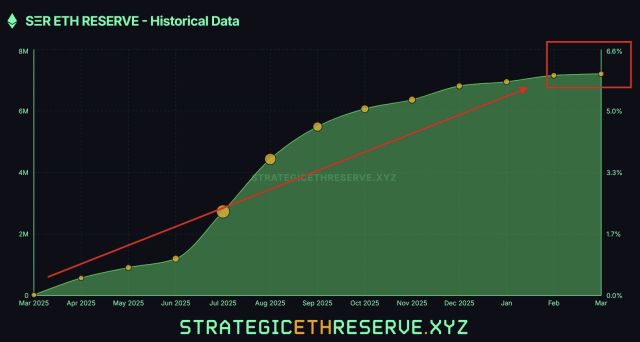
A new report from Leon Waidmann, an optimist and the head of research at Lisk, shows that Ethereum is experiencing an increasing wave of institutional belief as corporate treasury companies’ holdings of ETH reach all-time highs. Businesses are steadily including the leading altcoin on their balance sheets, indicating a broader shift in how they classify ETH.

Specifically, these large financial firms no longer view Ethereum as a speculative asset but as a strategic digital reserve asset within the evolving crypto economy. Looking back to a year ago, the Ethereum treasury was not a thing. However, within the period, the initiative has witnessed immense growth, with millions of ETH now held by corporate companies in the crypto and financial sectors.

Ethereum
Source: Chart from Leon Waidmann on X

Data shared by Waidmann shows that over 7.4 million ETH is now being held in treasury reserves among institutions. When compared to the overall supply of Ethereum in circulation, this figure represents approximately 6.6% of the stack.

Even though Ethereum Treasury companies have received a lot of criticism, the expert claims that some of it is only partially understandable. Given the substantial growth from 0 to 74 million ETH within 12 months, Waidmann believes the ETH treasury is still massively underappreciated.

A major company at the forefront of the adoption is Bitmine Immersion Technologies, as the public firm continues to add ETH to its crypto vault. On Tuesday, the firm, run by Tom Lee, bought an additional ETH worth over $120 million. 

Following the purchase, Bitimine’s ETH holdings are valued at a staggering $9.21 billion, which is currently equivalent to 3.75% of the total ETH supply. Furthermore, a huge portion of its ETH holdings, particularly $6.18 billion, is locked away in staking. This marks over 2.5% of the entire ETH supply.

ETH’s Price Next Month Hinges On The Stochastic RSI

In an analysis using the 1-day time frame, Merlin The Trader, an investor and market expert, revealed that Ethereum’s Stochastic Relative Strength Index (RSI) has flipped from the overbought region. Interestingly, this key setup has appeared multiple times in the past, and could dictate its next possible move.

The last time the setup occurred, the expert stated that ETH’s price dropped from the $3,400 level to the $1,800 mark. Currently, the same setup and Bollinger Band structure are developing. If ETH holds above $2,000, the pullback will be void. Meanwhile, losing the level will trigger a downside move to the $1,600 mark.

Ethereum
ETH trading at $2,038 on the 1D chart | Source: ETHUSDT on Tradingview.com

Featured image from Pexels, chart from Tradingview.com

Editorial Process for bitcoinist is centered on delivering thoroughly researched, accurate, and unbiased content. We uphold strict sourcing standards, and each page undergoes diligent review by our team of top technology experts and seasoned editors. This process ensures the integrity, relevance, and value of our content for our readers.

Paraguay Adopts Stricter Crypto Oversight, Mandates Detailed Transaction On Bitcoin Reporting

0

Paraguay’s National Directorate of Tax Revenue (DNIT) has issued General Resolution No. 47/26, imposing comprehensive reporting requirements for bitcoin and crypto activity. 

The rule targets Bitcoin (BTC) and other digital assets. It mandates that residents and entities disclose nearly all transactions exceeding $5,000 per year.

The resolution requires platforms and administrators to submit detailed data, including wallet addresses, blockchain networks, and transaction hashes. Obligated parties must also report the date and time of each transaction, the amount and USD value, fees paid, and counterparty information, according to local reporting.  

The measure covers buying, selling, trading between cryptocurrencies, mining, staking, yield farming, airdrops, lending income, payments, and transfers between personal wallets.

Officials describe the initiative as a step toward integrating cryptocurrencies into the national tax system. 

“Proper identification and monitoring will strengthen oversight and compliance,” the DNIT stated. The regulation does not create new taxes but increases transparency for fiscal authorities.

The resolution aligns with recommendations from the Financial Action Task Force (FATF). Since 2019, FATF has urged countries to enforce strict reporting requirements on virtual assets to prevent money laundering and terrorism financing. 

Paraguay, as a member of GAFILAT, has incorporated these guidelines to improve anti-money laundering enforcement and reduce international scrutiny.

The regulation arrives during a period of broader legal and financial transition. Law No. 7572/2025 on the Securities and Products Market formalizes oversight of tokenized assets, while the Securities Superintendency (SIV) regulates tokens representing property or credit rights. 

DNIT’s authority, by contrast, covers all cryptocurrency transactions, including decentralized digital assets used as a medium of exchange.

Paraguay aims to professionalize its capital market. Over the last decade, the market’s share of national GDP rose from 1% to 15%. 

Paraguay’s changing crypto oversight

The government is also moving to mine Bitcoin using seized rigs and to develop tokenization projects in agribusiness and real estate. Officials hope to attract foreign investment, reduce intermediation costs, and enforce mandatory audits for smart contracts. 

Separating custody functions from stock exchange operations at the Paraguayan Securities Depository (Cavapy) is planned to strengthen transparency.

Regional trends reinforce Paraguay’s direction. Brazil introduced similar reporting rules in 2023, and Argentina has proposed comparable legislation. 

Multilateral agencies, including the International Monetary Fund and Inter-American Development Bank, provided technical support for integrating blockchain analysis and taxation into fiscal systems.

Market responses have been measured. Exchanges operating in Paraguay have started updating policies to comply with the new resolution. 

The DNIT resolution represents the first phase of Paraguay’s comprehensive cryptocurrency oversight. Implementation will continue through 2026, with subsequent phases addressing taxation and compliance verification, according to reports. 

Tether Backs Ark Labs to Bring Stablecoins Back to Bitcoin

0

The strategic investment is the latest in a string of Bitcoin infrastructure bets by the stablecoin giant.

USDT issuer Tether has made a strategic investment in Ark Labs, the team developing Arkade, a programmable infrastructure layer for Bitcoin.

The $5.2 million funding round is aimed at expanding stablecoin access on the Bitcoin network and brings the total funding raised by Ark Labs to $7.7 million. Arkade is designed to enable instant, programmable transactions on Bitcoin for both retail users and financial institutions, positioning the network as a more viable platform for everyday payments and commerce.

“Improving access to USD₮ on the most secure and widely recognized blockchain supports greater financial inclusion, more efficient cross-border payments, and stronger global liquidity,” said Tether CEO Paolo Ardoino in a blog post.

Ark Labs CEO Marco Argentieri said Bitcoin has long lacked the programmable infrastructure needed for financial applications, and that Tether’s involvement would help accelerate development of payments, lending, and digital asset solutions being built on Arkade.

The Ark Labs deal is part of a broader infrastructure push. Last week, Tether led a $7.5 million raise for Utexo, a startup building Bitcoin-native USDT settlement rails using Lightning and RGB technology.

Launched in 2014, USDT has grown into the dominant force in the stablecoin market. USDT currently has a market cap of roughly $183 billion, making it the largest circulating stablecoin.

The stablecoin sector’s rapid growth has been driven in part by regulatory clarity, with the GENIUS Act signed into law in July 2025, creating the first federal regulatory framework for stablecoins in the U.S.

The Rise of an AI That Doesn’t Just Talk — It Works

0

Imagine having a digital partner that does more than respond to prompts. Instead of simply offering advice or explanations, it actively completes tasks, builds projects, and delivers finished results. That vision is quickly becoming reality with Genspark AI Workspace, a new generation productivity environment designed around intelligent autonomous agents.

Rather than functioning like a typical chatbot, this platform operates as a full AI-driven workspace capable of taking over repetitive, time-consuming responsibilities. From building reports and designing websites to producing professional video content, the system aims to remove the busywork that consumes much of modern professional life.

For anyone hoping to reclaim hours of lost productivity and focus on creative or strategic work, adopting this type of AI ecosystem could mark a major shift in how work gets done.

Most AI tools stop at providing suggestions or text output. Genspark takes the next step: it executes tasks. Its architecture allows multiple intelligent agents to collaborate on complex projects, delivering completed outcomes rather than fragments of information.

Below are the core capabilities that define the platform.

One of the most powerful components inside Genspark AI Workspace is its Deep Research system.

Instead of performing a quick web search and returning a few links, the platform conducts an extensive information sweep across thousands of credible sources. It then organizes and synthesizes that information into a structured analysis.

The result is a comprehensive report that may include:

  • verified references
  • summarized insights
  • structured conclusions
  • data comparisons
  • visual explanations

For professionals handling complicated topics—market analysis, technology reviews, or academic subjects—this tool essentially functions like a dedicated research assistant.

With a single request, users can explore complex subjects that would normally require hours or even days of investigation.

Another major strength of the platform lies in its intelligent productivity tools. Instead of manually creating documents, spreadsheets, or presentations, users can generate them through simple instructions.

AI Slides

Creating professional presentations traditionally requires hours of editing layouts, arranging text, and sourcing visuals. With AI Slides, the process is dramatically simplified.

You provide a topic, and the system automatically:

  • structures the presentation flow
  • writes the slide content
  • adds relevant images and visual elements
  • formats everything in a polished, meeting-ready design

The output resembles something prepared by a professional design team.

AI Sheets

Complex spreadsheet formulas can be intimidating even for experienced users. AI Sheets removes that barrier by converting everyday language into functional data analysis tools.

Users can simply describe what they want to calculate, and the system will:

  • generate advanced spreadsheet formulas
  • collect and organize raw data
  • build templates automatically
  • detect patterns and trends

Instead of memorizing complicated Excel functions, you simply explain the task.

AI Docs

For writing-intensive work, the platform also provides a dynamic document generator.

This feature can create:

  • legal agreements
  • research papers
  • business proposals
  • project plans
  • technical documentation

The AI adapts each document using flexible templates, ensuring the tone and structure match professional standards.

Perhaps the most fascinating capability inside Genspark AI Workspace is the AI Developer module.

This feature allows non-programmers to build software using natural language commands. In practice, that means someone without coding experience could create digital products simply by describing them.

Possible outputs include:

  • fully functional business websites
  • native mobile applications
  • simple video games
  • automation scripts and tools

The system can also connect with GitHub, allowing users to manage code repositories and submit pull requests just like professional developers.

For entrepreneurs or creators, this dramatically lowers the barrier to launching new ideas.

The platform also acts as a creative studio by integrating several cutting-edge AI media models into one interface.

Instead of juggling different services, users can generate images and videos directly inside the workspace.

AI Image Tools

Image generation is powered by a collection of advanced models, including:

  • Nano Banana Pro
  • GPT Image
  • FLUX
  • Seedream

These systems allow creators to produce concept art, marketing visuals, or social media graphics within seconds.

AI Video Tools

Video generation is equally powerful thanks to integrations with advanced generative video systems such as:

  • Sora
  • Gemini Veo
  • Kling
  • Seedance

This enables users to produce animated sequences, promotional clips, or cinematic visuals without a traditional production pipeline.

A New Type of Work Experience

Beyond individual features, the real transformation comes from how these tools work together.

Intelligent Meeting Notes

The platform can automatically:

  • record meetings
  • transcribe conversations
  • identify key discussion points
  • generate concise summaries

With one click, the final summary can be shared with teammates.

Multi-Model Intelligence

Instead of forcing users to choose between different AI systems, the workspace integrates several leading language models simultaneously, including:

This multi-model approach ensures tasks are handled by whichever system performs best.

Highly Customizable Workspace

Tools such as AI Designer and modular AI Pods allow users to personalize their workspace according to how they prefer to work. Whether you’re a developer, content creator, or business analyst, the interface adapts to your workflow.

To understand the real impact, compare typical productivity timelines with AI-powered execution.

Task Traditional Tools AI Workspace
Creating a presentation 3–5 hours ~2 minutes
Conducting market research 1–2 days ~5 minutes
Building a landing page Around 1 week ~10 minutes
Analyzing spreadsheet data Requires advanced formulas Voice instruction

These differences highlight the broader shift from manual software usage to instruction-based automation.

The platform is optimized for modern mobile environments:

  • Android 11 or newer
  • iOS 15 or newer

These requirements ensure the system can process AI tasks efficiently and deliver smooth performance.

  1. Is there a free version?

Yes. Many core features and AI models can be tested without cost. Premium tiers increase computational capacity and unlock all unique features, which is especially useful for complex software development or large-scale projects.

  1. Do I need programming knowledge for the AI Developer tool?

No coding experience is required. Users can describe their ideas in natural language – either in English or their native language – and the system will generate and deploy the code automatically.

  1. Is my spreadsheet data secure?

The platform implements enterprise-level encryption protocols. Data uploaded into AI Sheets remains protected and is not used for public training unless explicit permission is given.

Tools like Genspark AI Workspace represent a shift in how people interact with technology.

For decades, productivity software required users to learn complex interfaces and workflows. Now the model is reversing: instead of adapting to software, you simply tell the system what you want done.

In other words, the future of work may not revolve around mastering tools—it may revolve around mastering instructions.

Read More From Techbullion



Why bitcoin and crypto aren’t ready for real-world adoption

0

For more than a decade, the cryptocurrency industry has promised to reinvent money. Permissionless. Trustless. Borderless. Immune to the recurring failures of traditional finance.

Yet, commonly cited estimates of global ownership all languish below 10% — and the proportion actually using crypto for payments and other tangible uses is likely even less. After billions in venture funding, endless meme coins and nonstop media cycles, crypto remains a niche product held by a tiny fraction of the world’s population. The uncomfortable question is whether crypto has delivered anything indispensable to everyday people.

It hasn’t.

Built for speculators, not users

The largest smart-contract network in the world introduced programmable finance and launched an entire pseudo-decentralized ecosystem. But the onchain experience remains daunting. Users must manage private keys, navigate fragmented exchanges, parse multiple token standards, cross a variety of bridges, and absorb transaction fees that spike without warning. For developers, this is manageable. For everyday users, it’s prohibitive.

One high-speed blockchain marketed itself as the answer: faster, cheaper, higher throughput. Repeated network outages told a different story. Financial infrastructure that goes offline repeatedly cannot realistically serve as the backbone of global commerce. Meanwhile, the network’s enthusiastic embrace of memecoins left ordinary users holding worthless tokens while insiders quietly exited.

Another major project positioned itself as a bridge between crypto and banking institutions. Retail adoption for everyday spending remains nonexistent. Most market activity still centers on speculation rather than commerce, while insiders continue liquidating their personal holdings into the hands of true believers.

Across ecosystems, the pattern repeats: heavy trading volume, much of it wash trading, masking modest real-world usage. Founders unlock their holdings and dump on the people who believed in them most.

Permissionless in theory, custodial in practice

Crypto markets celebrate self-custody and decentralization. In practice, most users hold assets on centralized exchanges because self-custodial wallets remain incomprehensible to anyone outside the industry.

Those exchanges layer on leverage, derivatives and yield instruments that everyday people neither understand nor want. Deposits are frequently rehypothecated — reused as collateral elsewhere — creating synthetic exposure that echoes the very financial engineering crypto claimed to replace. When markets turn volatile, these structures amplify forced liquidations. Price swings cascade through leveraged positions, and true onchain price discovery becomes impossible to separate from derivatives-driven noise.

The result is a paradox: a technology designed to eliminate opaque balance sheets has spawned a new generation of them.

The adoption ceiling

If crypto were solving clear everyday problems, utilization would reflect it. But paying rent in crypto remains a fantasy. Small businesses won’t price goods in volatile native tokens and remain hesitant about stablecoins. Transaction fees are unpredictable. Wallet recovery intimidates new users. Interfaces are confusing and fragmented.

For most holders, crypto is something to buy and hope appreciates, not something to use. Many barely understand what the underlying technology does. A financial revolution that requires tutorials, Discord communities and gas fee calculators has not crossed into mainstream simplicity. People don’t want another tutorial. They want utility they can actually control.

The UX problem no one wants to admit

Most crypto products are built by engineers for engineers, with little consideration for users encountering the technology for the first time. Slippage tolerances, bridging risk, liquidity pools and yield strategies greet newcomers before they’ve completed a single transaction. A single mistake can permanently destroy funds. The onboarding experience is less like opening a bank account and more like configuring a server.

Simply put: The user experience is terrible.

Contrast this with modern consumer finance apps, where transfers are intuitive and costly errors are rare.

Mass adoption will not come from more chains or ever-more-complicated concepts that users must untangle. It will come from abstraction, from making the underlying complexity invisible, the way Apple and Microsoft once hid the command line behind the operating system. Crypto needs to be as easy as sending a text message. Until it is, it will stay in its niche.

The synthetic spiral

Perhaps the most underexamined problem in crypto markets is the dominance of offchain financialization. Perpetual futures routinely exceed spot volume. Leveraged tokens multiply exposure. Lending desks re-collateralize deposits. Wrapped assets circulate across chains. The same underlying token can support multiple layers of claims simultaneously.

The consequences are not theoretical. Bitcoin recently lost half its value, with billions in leveraged long positions liquidated in single-day cascades. Forced selling triggered more forced selling. Prices deviated violently from any reasonable measure of fundamental value, and retail participants, overwhelmingly positioned long, absorbed the damage. The crash was not driven by a change in Bitcoin’s utility or a collapse in adoption. It was driven by the very leverage and synthetic structures the market had layered on top of it.

This is the trap: In trying to escape traditional finance’s complexity, crypto rebuilt it, only faster, more automated and with fewer second chances.

What needs to change

Moving beyond minuscule crypto use requires an honest shift in priorities.

  • Simplify the experience. Key management, gas abstraction and cross-chain interaction must become invisible. The technology should disappear behind the task.
  • Prioritize real utility over token velocity. Products should enable payments, savings and transfers in ways that are tangibly better than existing systems, usable in daily life rather than merely speculative.
  • Ensure transparent backing and verifiable supply. Onchain proof must replace opaque leverage structures. No exceptions.
  • Deliver predictable costs. Fee volatility is incompatible with financial infrastructure. Everyday tools shouldn’t behave like auction houses.
  • Design for humans, not developers. Consumer-grade UX is not cosmetic. It is existential.

A crossroads

Speculation built awareness. It funded infrastructure. It attracted talent. But speculation alone does not build permanence.

The next chapter of crypto will not be written in token prices or meme cycles. It will be written by projects that quietly integrate into daily life, enabling transactions that are simpler, cheaper and more transparent than the systems they aim to replace. That means tools ordinary people can actually use, seamlessly integrated into their daily lives. Yields that don’t require a Ph.D. to understand. Payment rails that feel as natural as the apps people already trust, backed by infrastructure that serious finance demands.

Until then, the promise of the financial revolution remains exactly that.

And the emperor, for all the code written in his name, still doesn’t have a wallet most people can use.

U.S. Midterms Followed By Strong Bitcoin Gains

0

New research from Binance suggests the upcoming 2026 United States midterm elections could set the stage for a recovery in both Bitcoin and equities, even as markets face pressure from geopolitical tensions and rising energy prices.

In a report released this week, Binance Research found that risk assets have shown a consistent rebound after U.S. midterm election cycles. Historical data shows the S&P 500 has produced an average return of 19% in the 12 months following midterm elections, with no negative annual return recorded since 1939.

Bitcoin has shown an even stronger pattern in the limited number of cycles since its emergence as a liquid asset. In the three post-midterm years on record, the cryptocurrency delivered an average gain of 54%, according to the report.

“Once election outcomes are determined and uncertainty is resolved, markets have historically staged powerful rallies,” the report stated.