Home Blog Page 79

Bitcoin (BTC) price steadies as analysts warn more downside lies ahead

0

The crypto market enters the final stretch of the month in a perilous position with bitcoin still below $60,000 and ether (ETH) less than $1,600.

The bitcoin price has now lost more than 50% of its value since October’s record high, with analysts suggesting that more downside is on the cards over the coming months.

On Monday, the largest cryptocurrency is marginally in the black, rising by 0.6% since midnight UTC to $59,800 despite the broader market structure and chart formation skewing bearish.

Solana (SOL) has recovered after tumbling to its lowest point since late 2023 early this month. It has advanced by more than 13% since Thursday and 2% since midnight.

U.S. equities rose overnight as Nasdaq 100 futures traded up 1% while S&P 500 futures added 0.75%. Both indexes remain in a downtrend since setting record highs on June 15.

Derivatives positioning

  • Over $200 million in futures positions have been forcibly closed, or liquidated, by exchanges in the past 24 hours, with longs accounting for the bulk of the amount.
  • There are signs of a turnaround over the past four hours: the nearly $20 million in liquidations included $13 million in shorts. That shows how BTC’s bounce to $60,000 caught some bears off guard.
  • BTC’s futures market offers little excitement. Open interest (OI) is back in ranges seen earlier this month, erasing the minor pop to 775K BTC seen on Friday. Traders seem less willing to take on risk.
  • The same is true for ether, where OI remains locked at around 14.2 million ETH.
  • Open interest positioning in SOL feels relatively elevated at 72.70 million SOL, just short of the record high of over 76 million SOL set on June 24. That suggests potential for more volatility in Solana’s native token.
  • AVAX rose over 5% last week, decoupling from market leader BTC’s weakness. But that hasn’t been enough to draw traders into leveraged bets. OI continues to decline, standing at 38.07 million tokens, the lowest since April 1. That raises questions about the sustainability of the price gains.
  • The 24-hour OI-adjusted cumulative volume delta (CVD) remains bearish. Most top 25 tokens, except TRX, XMR and ZEC, show negative values, a sign that bears are leading price action by selling via market orders rather than limit orders.
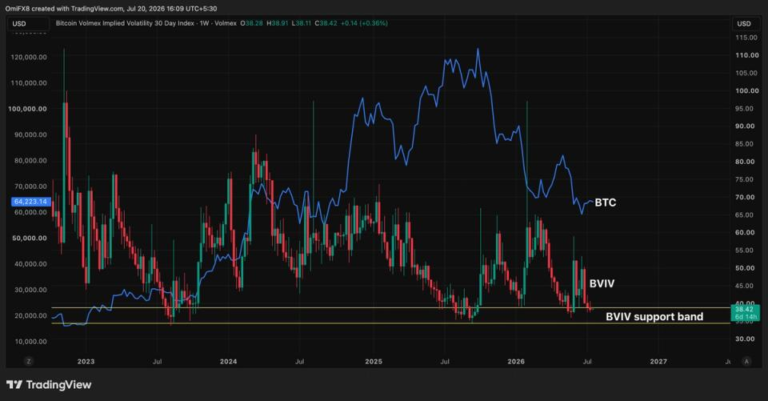
  • Volatility indexes, though, offer some good news. The BVIV, which tracks BTC’s 30-day implied volatility, dropped 5% to 47% today, pausing its two-week upswing. That suggests a renewed bet on market calm, typically a feature of grinding upswings in spot prices.
  • On Deribit, BTC and ETH options continue to show a bias for puts, or downside protection. In BTC’s case, the $60,000 put now has notional open interest of nearly $1 billion, almost rivaling the $1.11 billion sitting in the $80,000 call. These two have been the key option levels for at least two months. Should prices slide below $60,000, the next big options cluster is at $50,000, with notional OI of $712 million.
  • Over the weekend, traders sold strangles in the July 10 expiry on HYPE options on the decentralized platform Derive, according to data tracked by Laevitas. Shorting a strangle is a bet on price consolidation.

Token talk

  • The altcoin market is little changed, trading in line with the biggest cryptocurrencies as traders appear apathetic toward more speculative assets until bitcoin confirms its next move.
  • Privacy coins dash (DASH) and zcash (ZEC) are up by more than 2% on Monday. The move comes after both assets lost between 18% and 30% in the past two weeks alone, suggesting it is more of a relief rally than a meaningful recovery.
  • lost 1.5% since midnight, joining AI token FET in the red.
  • CoinMarketCap’s “Altcoin Season” indicator is at 49/100, a level it has held for most of June as investors focus on bitcoin’s next move.

Europe’s unlicensed crypto firms face ‘wipeout’ as MiCA transition deadline nears

0

The locked capital needed for a MiCA spot license is relatively small, somewhere between 50,000 euros ($57,000) and 150,000 euros by class, according to Patrick Gruhn, founder and CEO of Perpetuals.com Ltd. (PDC).

What becomes costly is the license itself, which can be as high as 700,000 euros in year one and 250,000 euros a year after for a lean firm, or into the millions for a large exchange, Gruhn said via email. “Call it 12–24 months to the first authorized trade with maybe €100k lawyer fees,” he said.

As for the number of jobs that could be lost due to MiCA, no reliable estimate exists. However, many of the 80% of pre-MiCA platforms facing extinction are tiny shell entities, Gruhn said.

“That overstates the situation significantly,” Gruhn said. “And much of it is reallocation, since licensed firms have to hire compliance staff and the offshore ones don’t.”

Changing environment

Nevertheless, MiCA threatens to stifle crypto as an industry in some countries. The situation is particularly harsh in Poland, where domestic legislative delays and presidential vetoes have meant the Polish Financial Supervision Authority (KNF) has faced roadblocks in establishing a fully functional crypto application and licensing regime.

Mateusz Kara, CEO of Morphic Financial Group, which is headquartered in London and has deep roots and operations in Poland, said the MiCA deadline could “wipe out Polish crypto.”

Bitcoin remains below key onchain and technical levels, leaving it in no man’s land

0

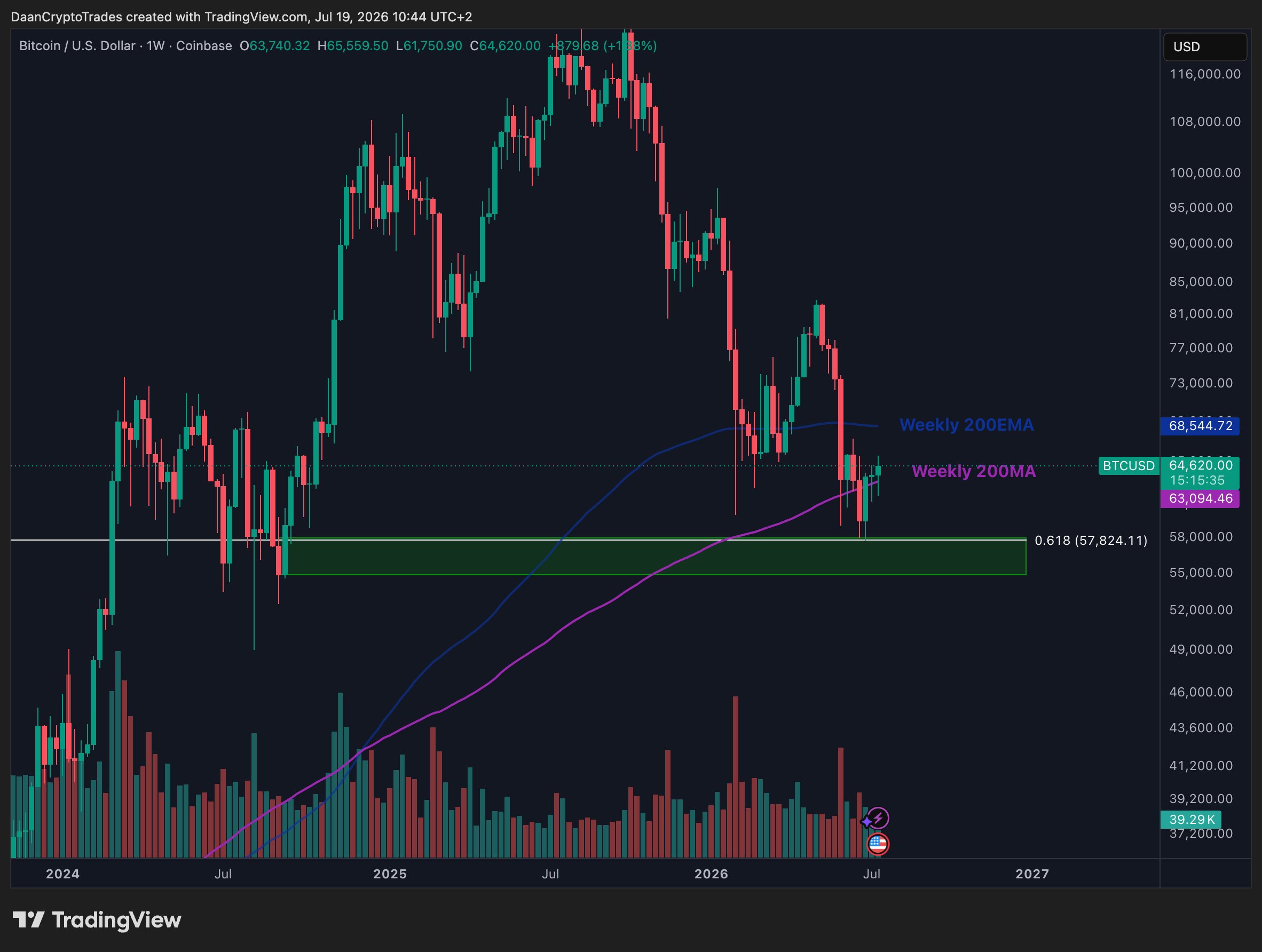
Bitcoin is currently trading below $60,000, placing it in “no man’s land,” a zone where price sits between major on chain support and resistance levels. BTC has failed to reclaim several important technical and on chain thresholds, so the path of least resistance appears to remain to the downside.

Several key valuation metrics now sit above the current price. The True Mean Price, currently around $76,300, estimates the average acquisition cost of coins after adjusting for lost or inactive supply, providing a more accurate measure of the network’s economic cost basis.

The 200-Day Moving Average, at $75,500, is a widely followed technical indicator that smooths price action over the past 200 days and is often used to distinguish long term bull and bear trends. The 128-Day Moving Average, at $70,900, tracks bitcoin’s intermediate trend, while the Short Term Holder Cost Basis, at $69,600, represents the average purchase price of investors who have held bitcoin for less than roughly 155 days.

Crypto exchange BitMEX removes CEO, CFO and head of growth

0

BitMEX, the troubled cryptocurrency exchange reportedly looking for a buyer, has cleared out its executive team, removing chief executive Stephan Lutz, chief financial officer Ina Steiner, and chief growth officer Raphael Polansky, CoinDesk has learned.

The firm’s former global general counsel and chief operating officer, Peter Wilkinson, has taken over as CEO. The moves were highlighted in recent postings on LinkedIn.

Wilkinson, Lutz, Steiner and Polansky did not immediately respond to requests for comment.

Crypto exchange and derivatives trading platform BitMEX was co-founded in 2014 by Arthur Hayes, Ben Delo and Samuel Reed. In 2020, BitMEX was alleged to have failed to implement adequate anti-money laundering measures in place, and later pleaded guilty to the charges. Hayes, Delo and Reed resigned shortly after the U.S. brought criminal charges.

BitMEX is presumably looking to streamline its costs and appear more attractive to prospective buyers, as an ongoing depression in digital asset prices weights on the crypto industry.

It was during the last crypto downturn in 2022 that Lutz took over as CEO from Alexander Hoeptner, who became CEO in early 2021, when Hayes and his co-founders stepped down.

The latest crypto winter has prompted numerous crypto and tech firms to shed staff.

BitGo Cuts Nearly 15% of Staff Six Months After IPO, Refocuses on Stablecoins and AI

0

Crypto custodian BitGo is cutting approximately 15% of its workforce, CEO Mike Belshe announced Thursday, as the company refocuses on stablecoins, settlement, and AI infrastructure following a difficult post-IPO stretch.

BitGo is cutting nearly 15% of its workforce, CEO Mike Belshe announced Thursday, as the crypto custodian restructures around what it calls its highest-priority areas.

Belshe posted the announcement on X, saying the company needs to be “sharper, more focused” and concentrate resources on five areas: security, trading, stablecoins, settlement, and AI-powered infrastructure. The cuts affect roughly 85 to 90 employees, per reports on X. BitGo, which went public roughly six months ago under the ticker $BTGO, has seen its stock fall approximately 73% since the IPO.

“The ecosystem has evolved, and the way we build financial services has changed dramatically,” Belshe wrote. “To keep winning for our clients, we need to be sharper, more focused, and concentrate our people and energy on the areas that matter most.”

BitGo went public around December 2025, joining a wave of crypto companies listing on public markets. The stock’s decline of roughly 73% from its IPO price reflects broader pressures on publicly listed crypto infrastructure firms. In Q1 2026, BitGo reported a net loss of $60.7 million. The company recently announced a $50 million share buyback program, which lifted the stock roughly 11%, though shares remained about 65% below the IPO price at the time of that announcement.

The Restructuring

Belshe described the action as a one-time event. “We don’t anticipate further reductions,” he wrote, adding that affected employees heard directly from their manager and HR before the announcement went public.

BitGo, founded in 2013, is one of the largest regulated crypto custodians globally and a major provider of wallet infrastructure, settlement services, and trading tools to institutional clients.

BitGo’s reduction follows several similar moves across crypto infrastructure in 2026. The Ethereum Foundation cut roughly 20% of its staff in a sweeping reorganization. Coinbase reduced its workforce by approximately 14%, framing the cuts around AI. Robinhood cut 10%, and Matter Labs trimmed staff while pivoting to an institutional privacy platform. Dune Analytics cut 25% as it doubled down on AI and institutional data tools.

Bitcoin Trader Says ‘It’s 2022 Again’ As RSI Offers A Classic Bull Signal

0

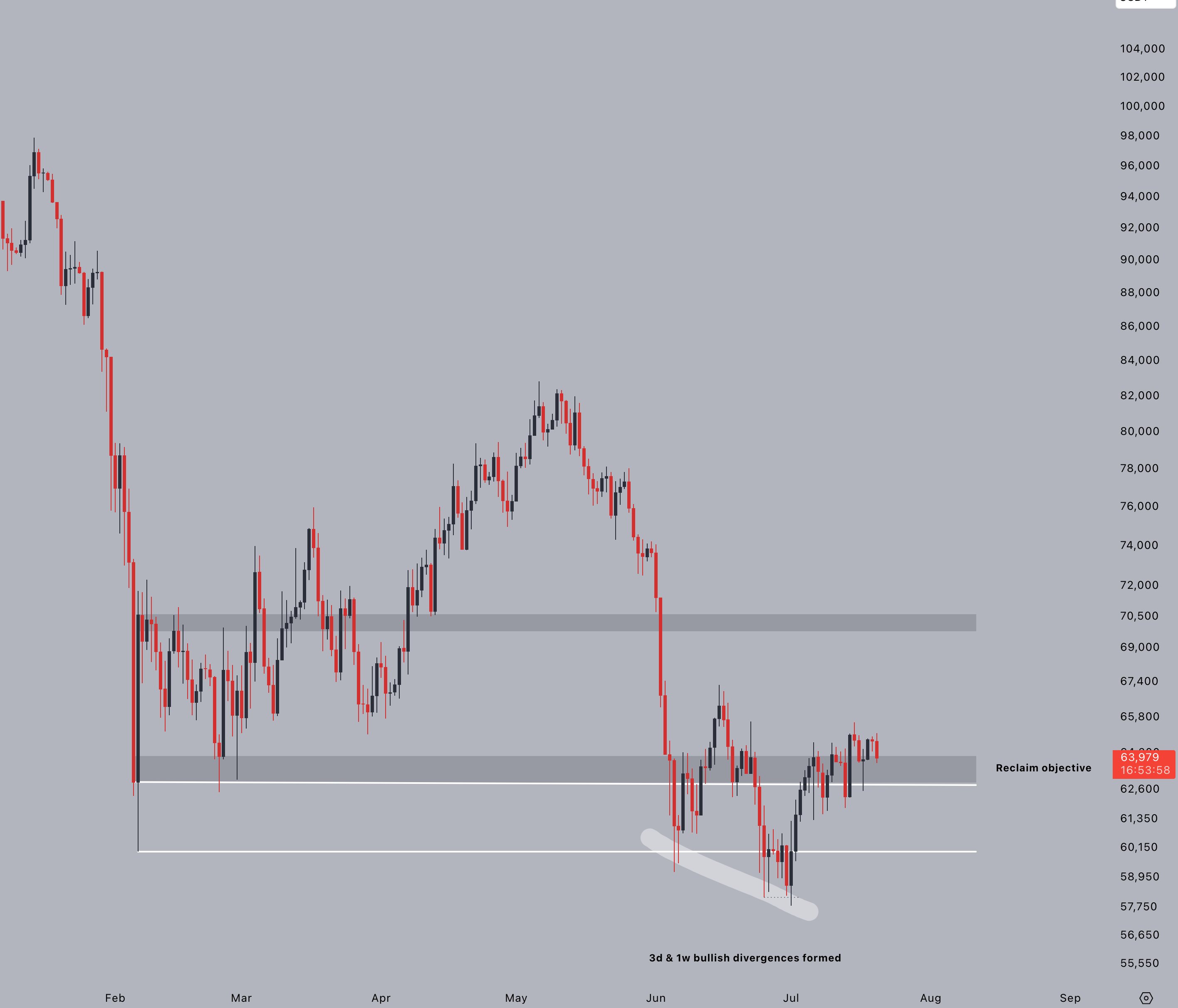
Bitcoin (BTC) continued its battle to reclaim $60,000 into the weekend as chart cues fueled hopes of a recovery. 

Key points:

  • Bitcoin RSI signals spark comparisons to the end of the 2022 bear market as a bullish divergence filters through.
  • Analysis sees “encouraging” evidence of buyers defending the market at $60,000.
  • Some traders still see new lows coming, but these could take until August.

Analysis on Bitcoin RSI: “It’s 2022 again”

Data from TradingView showed BTC/USD cooling volatility after returning above the $60,000 mark.

BTC/USD one-hour chart. Source: Cointelegraph/TradingView

A series of higher swing lows on hourly time frames combined with encouraging readings from the relative strength index (RSI) indicator.

On the four-hour chart, a bullish divergence was occurring, where RSI makes higher lows while price makes lower lows. This caught the attention of market participants, who began to anticipate a BTC price reversal as a result.

Uploading a chart comparing the current bear market with 2022, pseudonymous trader Rod argued that history was repeating itself.

“Once you see it, you can’t unsee it,” they wrote in a post on X

“It’s 2022 again.”

BTC/USD one-week chart with RSI data. Source: Rod/X

At the time, a weekly RSI bullish divergence kicked in while BTC/USD set its bear-market low of $15,600 — an event that subsequently provided a durable market floor.

Four-hour RSI, meanwhile, fell to just 11.4 at the start of June, marking one of its lowest levels on record.

BTC/USD four-hour chart with RSI data. Source: Cointelegraph/TradingView

On Friday, crypto analyst Lukasz Wydra added daily time frames to the mix of RSI bull signals.

“The bullish RSI divergence on the Bitcoin chart has now been officially confirmed. It may still deepen, but at the same time we can clearly see that Binance continues to defend the price,” he told X followers.

Wydra described the RSI signals as an “encouraging sign.”

BTC/USD one-day chart. Source: Lukasz Wydra/X

New BTC price lows remain popular target

Other traders stuck to existing predictions of further downside pressure entering sooner or later.

Related: BTC price four-year trend calls for $76K as analysis says Bitcoin ‘not broken’

Niels Klaver, cofounder of crypto platform STABL Agency, repeated calls for a trip to $55,000 “before any big move” to change the status quo.

BTC/USD comparison. Source: Niels Klaver/X

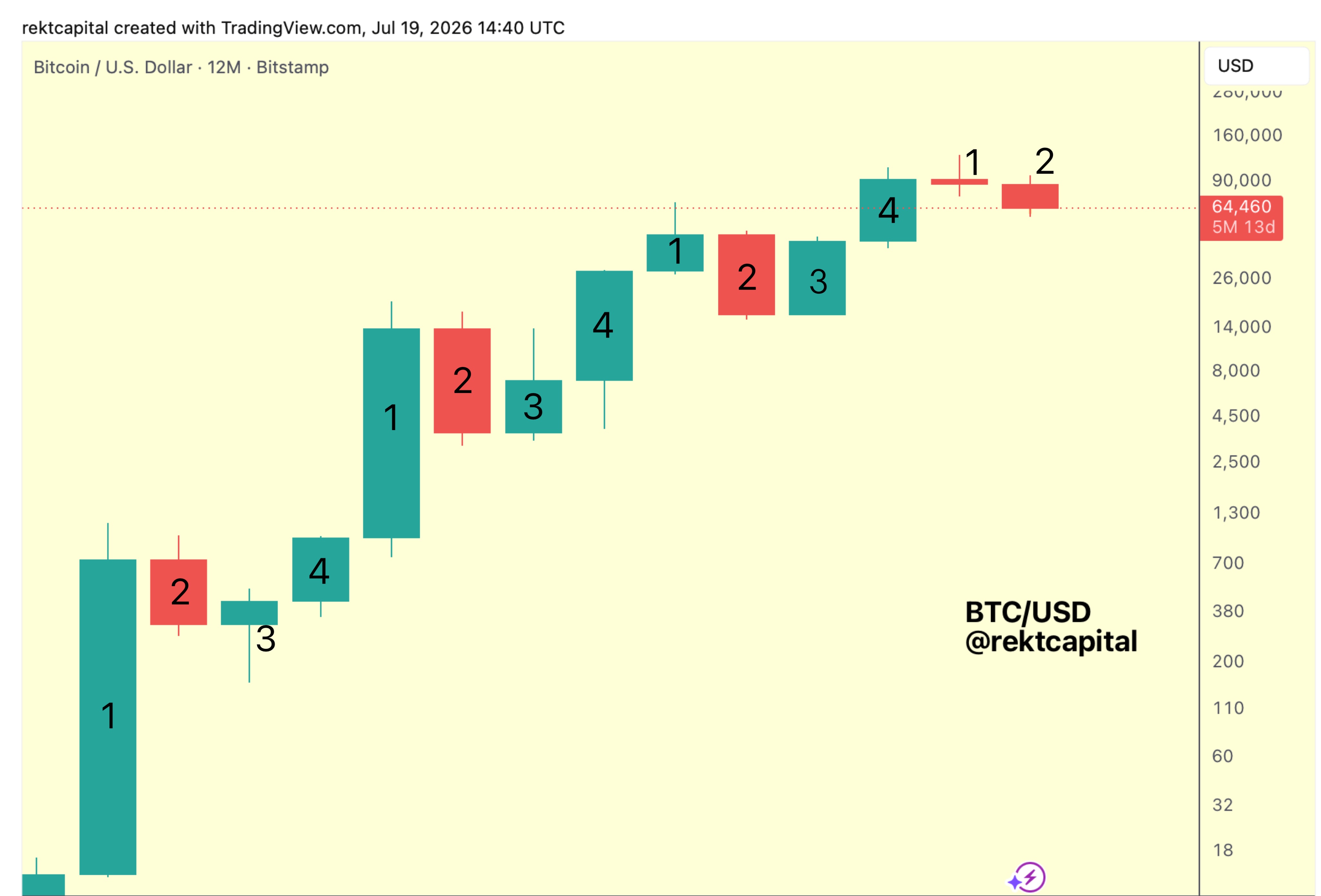
Trader and analyst Rekt Capital suggested that a relief bounce could characterize the market next month thanks to July typically contrasting with June price action.

Once it confirmed the 50-month exponential moving average (EMA) as new resistance, BTC/USD would then see “August cancellation of relief and additional downside due to $60k weakening as support,” he wrote this week.

BTC/USD one-month chart with 21, 50EMA. Source: Rekt Capital/X

Dubai Crypto Market Reaches 50 Licensed Firms Under VARA

0

The Virtual Assets Regulatory Authority (VARA), Dubai’s crypto regulator, has granted its 50th virtual asset service provider (VASP) license.

On Monday, VARA said its latest approval went to tokenized assets platform Tribe Tokenisation FZE.

The milestone provides one measure of the growth of Dubai’s crypto licensing regime, though license totals alone do not show how many firms are operational or the level of business they generate.

A VARA spokesperson told Cointelegraph that holding an active license does not necessarily mean a firm has completed its commercial launch. Newly licensed companies may go through a controlled operationalization period before offering services or onboarding customers.

Related: Senate Dems urge probe into $500M crypto deal between Trumps, UAE

At the end of 2025, VARA classified 39 licensed VASPs as fully operational. The spokesperson said the regulator is validating an updated figure for 2026.

Dubai’s bid to attract crypto firms

Dubai has spent the past several years positioning itself as a global hub for digital asset businesses. As part of that effort, the emirate established VARA in March 2022 as a dedicated crypto regulator and has sought to attract crypto businesses through a standalone licensing framework.

Against that backdrop, Dubai’s 50 licensed VASPs exceed the totals reported in Hong Kong and Singapore, two other jurisdictions competing to attract regulated crypto businesses. Each jurisdiction licenses different types of crypto businesses, meaning the headline totals do not represent identical categories of firms.

As of Friday, the Monetary Authority of Singapore (MAS) listed 37 major payment institutions (MPI) authorized to provide digital payment token (DPT) services. Singapore regulates DPT services within its broader payments regime rather than through a standalone VASP regulator like VARA.

List of licensed virtual asset trading platforms in Hong Kong. Source: SFC

Hong Kong’s Securities and Futures Commission (SFC) has listed 13 formally licensed virtual asset trading platforms. The count is narrower because the regime is specifically limited to platform operators.

The VARA spokesperson attributed Dubai’s market growth to its activity-based regulatory framework and broader financial ecosystem, and said the regulator also considers transaction volumes, assets under management, employment and audited financial data when assessing market activity.

Magazine: Japanese pension fund tips 1% in crypto, G7 urges action on NK hackers: Asia Express

Binance Tells EU Users It Will Wind Down Services as MiCA Deadline Hits

0

Binance has begun notifying European Union customers it will restrict services after withdrawing its Greek MiCA application, realizing the EU-exit risk that surfaced earlier this month as the bloc’s July 1 enforcement deadline nears.

Binance has started telling European Union users it will wind down services in the bloc after failing to secure a license under the Markets in Crypto-Assets framework, the realization of an EU-exit risk that surfaced earlier this month.

The world’s largest exchange emailed customers in France, Italy, Poland and Spain that it can no longer accept new registrations and will restrict services, CoinDesk reported Friday, citing a company spokesperson. The notices land days before a June 30 cutoff: under MiCA’s transitional schedule, crypto firms must hold a license from at least one EU member state by July 1 to serve residents across the bloc, and unlicensed firms must wind down their EU activities.

The user notices follow Binance’s withdrawal of its MiCA application in Greece on Wednesday, after the Hellenic Capital Market Commission left the filing without a formal decision as the transition period closed. Binance said it will instead pursue authorization in another EU member state, which it has not yet named.

Binance framed the wind-down around continuity of access in a blog post to European users.

“Your assets remain safe and secure, and will remain accessible at all times,” the exchange wrote, adding that “some users may be impacted depending on their country and account status, and we will communicate directly with affected users on next steps and available options.”

The notice directs affected customers to keep watching their email and in-app alerts for account-specific instructions. Binance did not specify in the post which services would be curtailed or on what timeline.

July 1 Wall

ESMA set out what unauthorized providers must do once the transitional period ends. They must immediately stop onboarding new EU clients, halt marketing, and limit services to what customers need to sell, transfer, or close positions. The European Securities and Markets Authority added that national regulators could pursue coordinated enforcement against significant unauthorized cross-border providers after the deadline.

The pressure is not unique to Binance. Roughly 83% of crypto-asset service providers active in the EU have yet to secure MiCA authorization, per ESMA’s statement. The framework requires a single national license that then passports across all 27 member states through ESMA oversight.

From Risk to Reality

The exit had been building. The Defiant reported June 16 that Greek regulators appeared set to reject the Greek application, a characterization Binance disputed at the time, saying the HCMC had found its filing compliant. By Wednesday the exchange had withdrawn the application outright and said it was “not leaving Europe.” The Friday user notices convert that posture into operational reality for EU customers.

Binance intends to file next in France, where its local unit already holds a Digital Asset Service Provider registration with the markets regulator AMF, the Financial Times reported Friday. Any approval would likely come after July 1, leaving a gap during which Binance cannot serve EU residents. “Our ambitions in Europe remain the same, and we are confident we will secure a MiCA licence in the coming months,” the exchange said in its June 24 blog post.

Licensed Rivals Pull Ahead

MiCA’s licensing teeth are forcing the largest exchange out of the bloc while compliant rivals consolidate access. Ripple secured a preliminary CASP license from Luxembourg’s CSSF last Monday, a step toward full passporting across the 30-country European Economic Area. Kraken, Coinbase and Bitvavo already hold MiCA authorizations, and WhiteBIT cleared an Austrian license this month.

Binance’s EU footprint is narrower than its global scale suggests. Euro-denominated pairs account for roughly 1% of its global spot volume, CryptoQuant analyst Maartunn told Cointelegraph this week, limiting the direct revenue hit even as the symbolic weight of the bloc’s largest exchange exiting under enforcement lands across the sector.

Binance said it will continue contacting affected users directly with account-specific next steps before the July 1 deadline.

Base Resumes Block Production After Roughly Two-Hour Mainnet Halt

0

Coinbase-incubated Layer 2 Base stalled block production for about two hours Thursday after an invalid block triggered a consensus fault, before the network recovered. The outage renewed scrutiny of single-sequencer risk on major rollups.

Coinbase-incubated Layer 2 Base stopped producing blocks for about two hours on Thursday after an invalid block stalled its chain, before the network recovered and resumed normal operation. The halt revived questions about the centralized sequencer that orders transactions on most major rollups.

Base mainnet block production turned “unhealthy” around 12:03 p.m. ET Thursday, according to the Base status page. The team identified the trigger as a problematic block interfering with subsequent block building, then isolated a consensus fault that caused an invalid block to be sequenced and blocked new blocks after height 47,806,542. Sequencing resumed by 1:51 p.m. ET, and Base confirmed healthy block building roughly two hours after the stall began.

Funds Secure

Base disclosed the incident on its own channel as it unfolded. “Base Mainnet is currently halted while the team works on an issue with block production,” the network posted on X, adding that all funds were secure and asking users to be patient while it worked on a fix.

Ecosystem node operators had to restart their nodes to recover syncing, the status page noted. Base said its long-planned Beryl hardfork still activated as scheduled at 2:00 p.m. ET, minutes after recovery. The team said it had found the root cause and would publish a full post-mortem.

Sequencer Risk

Like most leading rollups, Base settles transactions to Ethereum but relies on a single sequencer to order and produce blocks. When that component fails, the chain stops advancing even though user funds and the underlying Ethereum settlement remain intact. The design keeps assets safe but leaves liveness dependent on one operator, the failure mode that surfaced Thursday.

Base ranks among the largest Layer 2 networks by total value locked, holding more than $4 billion across protocols, per DefiLlama. That scale means a multi-hour stall ripples through decentralized exchanges, lending markets, and bridges built on the chain, even when no assets are lost.

Base has been moving to dilute the sequencer dependency. Its Azul upgrade in late May introduced multi-proofs and pushed the chain toward Stage 2 decentralization, the rollup-maturity benchmark that limits how much control any single party retains over a network.

Base did not give a timeline for the post-mortem. The chain has continued producing blocks normally since the Thursday recovery.

$4 billion gone. Spot bitcoin ETFs are on track for their worst month on record

0

U.S. spot bitcoin ETFs have recorded $4.06 billion in net outflows this month, according to data from SoSoValue. It marks the largest monthly redemption on record, exceeding the previous high of $3.56 billion in February 2025.

Last week, the funds saw redemptions of about $1.79 billion, the second-highest weekly outflow since trading began in January 2024. (These figures could shift slightly based on flows over the final two trading days of the month.)

This trend runs counter to expectations early in the month of renewed demand following SpaceX’s IPO on June 12.

Spot ETFs serve as a widely followed barometer for institutional investors seeking regulated exposure to bitcoin without directly holding the cryptocurrency.

June’s outflows followed $2.43 billion in net redemptions in May, bringing the two-month total close to $6.5 billion. That figure is comparable to the current market capitalization of zcash (ZEC), currently ranked among the world’s 15 largest cryptocurrencies by market cap.

On a year-to-date basis, net outflows tally roughly $5 billion in the first half of 2026.

The impact of this collapse in institutional demand is evident in bitcoin’s price performance, which has declined around 30% in the first half, underperforming nearly every major asset class except Strategy (MSTR). Shares in the bitcoin-holding publicly listed firm have tanked by 45%.