Home Blog Page 772

Currency.com Launches Crypto-Native Visa Platinum Card for Global Clients

0

Currency.com, a global digital finance provider, has announced a new crypto-native card product for its clients, powered by Rain’s infrastructure. The collaboration marks an important milestone in Currency.com’s roadmap as it continues to build a vertically integrated, private wealth platform for crypto-native individuals and businesses. 

The new product enables real-time card issuance, global acceptance through the Visa network, and high transaction limits tailored to the needs of sophisticated clients. Users can deposit USDC and spend directly, without the need to pre-fund cards, move assets between wallets, or manually convert crypto into fiat before making payments. 

For clients, the benefits are straightforward and just as valuable: immediate access to their funds, global usability, and an overall smoother operational experience. Whether managing personal wealth or running international business operations, users can now bridge digital assets and everyday payments with greater flexibility and control.

This partnership adds a new crucial layer to Currency.com’s growing service stack — particularly for high-net-worth individuals and corporate clients who require seamless access to their digital assets in everyday financial operations.  

By partnering with Rain, a company focused on building modern stablecoin-based payment infrastructure, Currency.com ensures wide cross-border coverage and streamlined settlements. Transactions are settled with Visa directly in stablecoins by Rain, making the card truly crypto-native. This structure reduces friction, simplifies treasury flows, and improves overall efficiency for users. 

“Our integration with Rain represents a significant step in our long-term strategy of bringing digital finance into everyday financial life”, said Konstantin Anissimov, Global CEO of Currency.com. “For crypto users, access and usability of funds matter most of all, and this collaboration is our way of removing unnecessary friction from that process. Our clients shouldn’t have to think about converting, transferring, or pre-funding. They should be able to move from holding digital assets to spending them globally in a matter of seconds. That’s the standard we’re setting.”

Wall Street pushes tokenized stocks, but institutions aren’t eager to trade them

0

Wall Street is racing toward tokenized equities and 24/7 trading, but many institutional investors are wary of the instant settlement model.

Tokenization refers to representing traditional assets such as stocks on blockchain networks. In theory, the approach could modernize market infrastructure that dates back decades, allowing securities to move and settle instantly while potentially enabling 24/7 trading.

That vision has gained momentum in recent months. Both ICE, the owner of the New York Stock Exchange, and Nasdaq, have recently announced large partnerships with native crypto exchanges, aimed at bringing tokenized stocks to market.

But for many institutional traders, the shift raises practical concerns about liquidity, financing and how markets function day to day.

“Institutional investors generally do not like instant settlement,” said Reid Noch, vice president of U.S. equity market structure at TD Securities. While the technology could streamline the back end of markets, he said, forcing trades to settle immediately would create new frictions for professional investors.

The current U.S. system settles stock trades one business day after execution, known as T+1 settlement. That delay allows brokers and trading firms to net positions and manage funding throughout the day. Instant settlement, by contrast, would require transactions to be fully funded before they occur.

“No one really wants to be prefunded,” Noch said. If instant settlement became the standard across the market, trading firms would need to arrange financing throughout the day, potentially increasing costs and reducing liquidity at key moments.

The impact could be especially visible during periods of heavy activity, such as the market close when large volumes of trades are executed simultaneously. Balance sheet constraints could make those periods more expensive for investors, spreading liquidity more unevenly throughout the trading day.

Retail traders, however, may embrace tokenized markets more quickly. Many of the proposed benefits — such as holding shares directly in digital wallets or trading outside traditional market hours — are aimed at individual investors rather than large institutions.

Retail already accounts for roughly 20% of U.S. equity trading volume, though in certain stocks the share can rise to more than half of daily activity. In highly speculative “meme stocks,” retail participation has at times exceeded 90%.

Tokenized trading venues could particularly appeal to international retail investors seeking access to U.S. stocks when American markets are closed, Noch said. For those investors, opening accounts with crypto platforms may be easier than navigating the requirements of traditional brokers.

Over time, institutional investors may follow if liquidity shifts to tokenized venues. “If retail liquidity migrates there and becomes meaningful, institutions won’t really have a choice but to participate,” Noch said.

Still, the transition carries risks. One concern is market fragmentation if multiple versions of the same stock exist across different blockchains or tokenized platforms. That could weaken the transparency and price discovery that underpin the U.S. equity market.

“Generally, most companies only have one stock,” Noch said. “If suddenly there are multiple tokenized versions with different rights or liquidity profiles, that could create confusion about what investors actually own.”

Despite those concerns, industry momentum continues to build. Exchanges are already exploring longer trading hours, with some proposing nearly round-the-clock markets within the next few years.

Tokenization could ultimately become part of that shift — modernizing infrastructure behind the scenes while gradually reshaping how investors access stocks. But for now, the technology may advance faster among retail traders than the institutions that dominate today’s markets.

Ethereum And Solana Are Topping Developer Activity Again, But Why Are Their Prices Struggling?

0

Trusted Editorial content, reviewed by leading industry experts and seasoned editors. Ad Disclosure

Ethereum and Solana are currently leading developer activity in the crypto space, while developer activity in the broader ecosystem declines. This comes as prices continue to struggle with the ongoing war between the U.S. and Iran, which is sparking rising oil prices. 

Ethereum And Solana Lead Developer Activity Amid Broad Decline

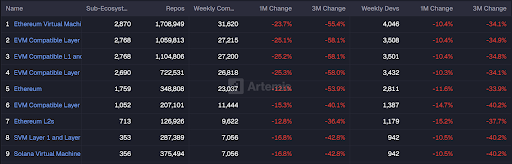
Artemis data show that the Ethereum and Solana ecosystems are leading in developer activity amid declines in weekly commits and weekly active developers in crypto. In the Ethereum ecosystem, the Ethereum Virtual Machine (EVM) is seeing the most activity, with 31,620 weekly commits. 

It is worth noting that several sectors in the Ethereum ecosystem currently rank among the top seven in developer activity. Meanwhile, the Solana ecosystem comes next, with the Solana Virtual Machine (SVM) Layer 1 and Layer 2 seeing the most activity, at 7,056 weekly commits. However, there has been a significant decline in the crypto ecosystem as a whole. 

Further data from Artemis shows that weekly commits have dropped from a yearly high of around 870,900 in March last year to as low as 217,500 in February. Notably, weekly commits crashed around the time of the crypto market’s infamous ‘October 10’ crash, which led to the largest liquidation event in crypto history. 

Ethereum
Source: Chart from Artemis

Similarly, the weekly active developers have also declined from a yearly high of 10,600 in May last year to as low as 4,000. This metric has been declining since the October 10 crypto market crash, suggesting that current price action is affecting developer sentiment. Ethereum and Solana have also seen declines in their weekly commits and developer activity despite leading in these metrics. 

The Ethereum network has seen a 54% decline in weekly commits over the last three months and a 34% decline in developer activity over this same period. Meanwhile, the Solana network has seen 43% decline in weekly commits over the last three months and a 40% decline in developer activity over the same period. 

Why Prices Continue To Struggle 

Ethereum and Solana prices continue to struggle, as experts note that the crypto market is in a bear market. CryptoQuant’s Head of Research, Julio Moreno, recently reiterated this, stating that the bear market is still on despite the relief rally that Bitcoin saw this week, which pushed ETH and SOL higher. 

Market analyst Doctor Profit recently stated that Bitcoin is likely to bottom between September and October, suggesting that Ethereum and Solana could still see larger declines. Meanwhile, Moreno told The Block that ETH could decline to $1,500 by the third quarter of this year or the early part of the fourth quarter if the bear market persists. The analyst also noted that Ethereum is facing an “adoption paradox,” with network activity rising while the ETH price falls.

Ethereum
ETH trading at $2,077 on the 1D chart | Source: ETHUSDT on Tradingview.com

Featured image from Pixel Plex, chart from Tradingview.com

Editorial Process for bitcoinist is centered on delivering thoroughly researched, accurate, and unbiased content. We uphold strict sourcing standards, and each page undergoes diligent review by our team of top technology experts and seasoned editors. This process ensures the integrity, relevance, and value of our content for our readers.

Wall Street Titan Druckenmiller Predicts Stablecoins Will Power the Future of Global Payments

0

Wall Street legend Stanley Druckenmiller just tossed a polite grenade into the global payments debate, predicting that within 10 to 15 years the machinery moving money around the planet won’t rely on SWIFT wires or card networks—but on blockchain-powered stablecoins that settle transactions faster, cheaper, and without bankers checking the clock. Faster, Cheaper Payments? Druckenmiller […]

Tide Enters the Telecom Battleground with UK’s First Business Banking Mobile Plan

0

Tide, the UK business management platform recently valued at $1.5billion, has entered into a new strategic partnership with telecom infrastructure provider Gigs. Together, the firms are launching a native mobile offering powered by Vodafone’s 5G network, expanding Tide’s all-in-one app capabilities to include direct telecommunications services.

This milestone marks the very first time a UK business banking provider has directly integrated a full mobile plan and phone number into its core platform.

Undercutting traditional business telecoms

The new embedded service aims to significantly undercut traditional UK business telecom providers by offering highly competitive rates directly to its existing user base. Tide members who are currently subscribed to the platform’s Smart, Pro, and Max tiers can now instantly add a dedicated business number via a free eSIM. This base offering comes complete with unlimited calls and text messages.

For entrepreneurs and small businesses requiring heavier connectivity, the platform offers an upgraded premium package. Users can opt for unlimited 5G data alongside 10 gigabytes of European Union roaming for a flat rate of £15 per month.

With nearly 800,000 UK members—which represents approximately 14 per cent of the entire small business market—Tide possesses a massive potential subscriber base for this new telecom venture. By embedding this service, the fintech is allowing small business owners to access and manage their essential digital connectivity within the exact same app where they already manage their daily business finances and cash flow.

The European embedded connectivity wave

This launch highlights a broader industry trend, signalling that telecommunications connectivity is rapidly turning into a new, highly competitive battleground for European financial technology firms. The embedded connectivity wave is gaining significant momentum, following closely on the heels of the Revolut Mobile launch in the UK, which was also powered by Gigs in December.

The movement extends well beyond the European market. Across the globe, major fintech leaders including Nubank, Klarna, Wealthsimple, and Sezzle have already made their own successful forays into the telecommunications space by leveraging Gigs’ infrastructure.

Brazil industry giants representing 850 companies decry stablecoin tax threat

0

Brazil’s leading cryptocurrency and fintech industry groups have warned that expanding a financial transaction tax to stablecoin operations could harm innovation and violate existing law.

In a joint statement shared with CoinDesk, industry associations ABcripto, ABFintechs, Abracam, ABToken and Zetta said recent discussions about extending a tax on financial operations (locally known as Imposto sobre Operações Financeiras, or IOF) to stablecoin transactions raise legal and economic concerns.

The organizations represent more than 850 companies across Brazil’s financial technology, virtual asset and market infrastructure sectors, the statement reads.

The debate centers on a levy applied to certain financial transactions, including foreign exchange operations. According to the associations, applying the tax to stablecoin transactions would conflict with Brazil’s current legal framework and harm the country’s crypto industry.

They argue that the Constitution defines the IOF as applying only to the settlement of currency exchange transactions involving the delivery of national or foreign fiat currency. Stablecoins, they said, do not meet that definition.

Brazil’s Virtual Assets Law, enacted as Law No. 14,478 in 2022, explicitly states that virtual assets are not considered national or foreign fiat currency, the statement says. The industry groups say this distinction means stablecoins cannot legally be treated as instruments representing foreign currency under the IOF rules.

As a result, the organizations say any attempt to extend the tax through a decree or an administrative rule would be unlawful. Under Brazil’s constitutional framework, new taxes or expanded tax triggers must be approved through the legislative process.

“In this context, any expansion of tax incidence on operations with stablecoins through a decree or administrative rule is illegal, since acts of this nature cannot create or expand a tax triggering event,” the document reads.

The groups also cautioned against conflating monitoring rules from Brazil’s central bank with taxation policy. They said oversight of digital asset transactions does not automatically justify applying the IOF tax to those activities.

Industry representatives argue that policy missteps could damage a rapidly expanding sector. Brazil has emerged as one of the world’s largest crypto markets, with an estimated 25 million people participating in the ecosystem.

Brazil’s stablecoin adoption

The associations said the country’s crypto sector has grown alongside a broader wave of financial innovation, including fintech platforms, digital payments, and blockchain infrastructure. They also noted that similar taxes on stablecoin transactions are not widely used in other major economies.

Stablecoin usage in Brazil has surged dramatically in recent years, turning the country into one of the largest markets for the assets in Latin America and globally.

Dollar-pegged tokens like Tether’s USDT and Circle’s USDC now dominate crypto activity as Brazilians use them to hedge volatility in their fiat currency, the real (BRL), move money across borders at lower cost, and provide liquidity for trading.

Brazil’s crypto market, according to an auditor at Brazil’s tax authority, Receita Federal, is moving between $6 and $8 billion per month, with 90% of that being stablecoin flows.

Not all of them are U.S. dollar stablecoins, as BRL-pegged stablecoins are gaining traction. Trading in tokens linked to the Brazilian real reached about $906 million in the first half of 2025, according to Dune data.

Ex-JP Morgan and Dresdner Kleinwort traders launch crypto prop platform

0

Velotrade, a Hong Kong-based firm founded by former institutional derivatives traders from JPMorgan and Dresdner Kleinwort, has unveiled its funded trading platform that provides traders with capital while sharing profits based on performance, according to a Friday statement.

Crypto proprietary trading is a model that allows traders to trade digital assets using capital provided by a proprietary trading firm rather than their own funds.

To access a funded account, most retail models require traders to pass a challenge that evaluates profitability and risk discipline. If successful, traders will receive a funded account and earn a share of the profits, provided they continue to follow the firm’s trading rules and risk limits.

Built from scratch for crypto trading, Velotrade’s framework removes restrictions such as consistency rules, time limits, and news or weekend trading bans, the company stated.

The platform uses institutional liquidity bridges and AI-driven hedging to mirror trader positions, ensuring the firm only earns when traders succeed.

“We are not here to collect challenge fees and hope people fail,” Gianluca Pizzituti, CEO and co-founder of Velotrade. “Our revenue model is tied to trader performance. That changes everything about how you design rules, and how you treat the people trading your capital.”

Velotrade offers traders access to prop accounts ranging from $5,000 to $200,000 without requiring personal capital at risk.

The platform focuses exclusively on crypto assets with up to 6x leverage on Bitcoin and Ethereum. Payouts are available after 14 days, then weekly on request, processed in USDC or USDT.

Velotrade brings combined institutional experience spanning three decades. Vittorio De Angelis, executive chairman, traded equity derivatives at JP Morgan and Dresdner Kleinwort before rising to co-head of equity derivatives at Bank of America.

Pizzituti previously operated a proprietary high-frequency trading operation focused on foreign exchange and equity indices in Singapore before establishing the original Velotrade trade finance business in Hong Kong.

The founding team previously built Velotrade Management Limited, a trade finance platform established in 2016 that has distributed more than $2.5 billion to clients globally and continues to operate.

Disclosure: This article was edited by Vivian Nguyen. For more information on how we create and review content, see our Editorial Policy.

Sky TVL Surges 38% in March

0

Sky is now the fourth-largest DeFi protocol as RWA-backed yields drive inflows.

Sky, the successor to MakerDAO, is off to a strong start this month, with its total value locked (TVL) climbing to $7.52 billion, a 38% increase since March 1, according to DefiLlama.

This makes Sky the fourth-largest decentralized finance (DeFi) protocol by TVL, trailing Aave, Lido, and EigenCloud. The sUSDS savings pool alone accounts for approximately $6.5 billion in deposits and has attracted nearly $1.3 billion since the start of the month.

Sky Savings Pool

As DeFi yields have dried up in the wake of the market downturn, Sky’s fixed 3.75% savings rate is higher than stablecoin supply rates on major protocols like Aave and Morpho. For example, supplying USDT or USDC on Aave’s Ethereum markets currently yields less than 2%.

“Yield is definitely the main factor, but it’s also one of the lowest risk, liquid yield sources in DeFi,” Sam MacPherson, CEO of Phoenix Labs, told The Defiant.

Sky founder Rune Christensen also emphasized that users are prioritizing safety amid the market turbulence.

“Honestly, it’s the classic story of how Sky, just like Maker used to, always does better in bear markets because it’s just focused on a solid product that can be trusted to be stable and deliver good returns,” Christensen told The Defiant.

The SKY token has rallied alongside the surge in TVL. The token is up approximately 4% over the past seven days and 12% over the past month, according to CoinGecko.

SKY Chart
SKY Chart

The token remains about 26% below its all-time high, per CoinGecko, with a market capitalization of roughly $1.7 billion.

Bitcoin Hit a Major Milestone—Most Miners Won’t Be Around for the Next One

0

In brief

  • The Bitcoin network mined its 20 millionth coin this week, leaving just 1 million remaining—a supply that could take 115 years to fully unlock.
  • Analysts expect many publicly traded Bitcoin miners to exit the business entirely by 2027 and 2028, liquidating Bitcoin holdings to fund pivots into AI and high-performance computing.
  • Despite dwindling block rewards, one analyst argues the impact on Bitcoin’s price may be limited—miners now hold just 0.5% of circulating supply, compared to Strategy’s holdings of seven times that amount.

The Bitcoin network saw its 20 millionth BTC mined this week, leaving just 1 million coins left to be paid as rewards to miners.

The milestone has crypto industry observers taking stock of the rapidly changing Bitcoin mining industry, and weighing the economics of a shifting landscape against expectations of Bitcoin’s performance as an investment.

Mining companies help secure the Bitcoin network and verify transactions, expending large amounts of energy in a race to solve cryptographic puzzles in exchange for transaction fees and newly created Bitcoin as rewards. It’s taken miners 16 years to mine the 20 millionth coin from Bitcoin’s inception, but it could take roughly 115 years to unlock the remaining supply, according to Wolfie Zhao, the head of research at TheEnergyMag.

That doesn’t necessarily mean the Bitcoin mining industry will look the way it does for the next century. John Todaro, a managing director and senior research analyst at Needham & Company, expects many publicly traded miners to exit Bitcoin mining in 2027 and 2028.

“​​We believe a large portion of the public Bitcoin miners will sell down nearly all of their Bitcoin holdings before year-end 2026 as they embark on [capital expenditure] spend related to AI workloads,” he wrote in a recent note shared with Decrypt. In other words, Bitcoin mining companies are pivoting to AI.

All the publicly traded Bitcoin miners the firm covers have allocated a portion of their compute power to high-performance computing, or HPC, and AI. It’s a shift that’s been going on for years.

And it’s easy to see why, he added.

“Stubbornly low hash price combined with the upcoming 2028 halving presents a concerning environment for Bitcoin mining operations,” he told Decrypt. “Many operators are at or near breakeven costs today, while NOI margins in HPC are north of 80%.”

NOI refers to net operating income, which measures revenue minus operating expenses, excluding financing costs and taxes. So it stands to reason that mining firms are adjusting their revenue split to favor better margins.

Ross Gan, the chief communications officer at Bitdeer, told Decrypt the firm has Bitcoin’s technological infrastructure in its DNA.

Bitdeer, the Singapore-based miner led by Bitmain co-founder Jihan Wu, illustrates the fork in the road facing the industry. Wu helped industrialize Bitcoin mining in the first place—Bitmain, which he co-founded in 2013, once controlled roughly three-quarters of the global market for Bitcoin mining chips. Now Bitdeer is converting several of its facilities into AI data centers while simultaneously developing its own next-generation mining hardware.

“The miners that endure will be the ones that control more of the stack themselves. We demonstrate how that matters by designing and deploying our own high-efficiency ASICs and securing long-term energy capacity worldwide,” Gan said. “Vertical integration has proven to be one of the clearest markers of long-term survivability.”

He added that up until recently, Bitcoin has been treated as a key monetization engine that was complemented by AI infrastructure to keep long-term revenues stable.

“That duality may no longer be a nice-to-have in the future,” Gan said.

HIVE Digital Technologies, formerly HIVE Blockchain, was founded in 2017 and went public later that year on the Toronto Stock Exchange. The company began investing in high performance computing, or HPC, infrastructure much earlier than many of its competitors. So early, in fact, that it was still generating revenue from Ethereum mining when Executive Chairman Frank Holmes mentioned it on an earnings call.

“The Ethereum mining margins that we experienced during the quarter enabled us to continue the upgrade of our data center assets in Sweden and Iceland and also diversify our business by starting to invest in HPC assets,” he said in November 2021.

It wasn’t until a year later that Ethereum developers executed the merge, changing the network from a proof-of-work to proof-of-stake consensus mechanism and rendering Ethereum mining obsolete.

The Canadian company has built its business around finding creative ways to source power from hydro-electric and otherwise stranded energy, Holmes told Decrypt.

“Bitcoin miners have led the world in sourcing stranded and surplus energy and in building Tier I power infrastructure at scale,” he said. “There is enormous energy abundance in the world, especially in hydro-rich regions like South America and Canada, but the winners will be operators that can secure it at low cost, structure around it intelligently, and turn that energy into durable computing infrastructure.”

Even as analysts, like Todaro, predict that some Bitcoin mining firms will begin winding down by the end of 2027, Holmes sees the squeeze ahead of the next halving event—forecast for mid-2028—as a challenge to get even more efficient.

“Block rewards will decrease, but that does not mean the industry will disappear. It means the bar rises,” he added. “The miners that survive will be the ones with the best power, the best sites, and the most flexibility.”

But what happens to the price of Bitcoin when block rewards get all the way to zero? Investors have known that Bitcoin has a finite supply since its inception, so theoretically it’s priced in.

The most apt comparison comes from the Bitcoin whitepaper itself: “The steady addition of a [constant amount] of new coins is analogous to gold miners expending resources to add gold to circulation,” pseudonymous BTC creator Satoshi Nakamoto wrote in 2008. The comparison has been adopted widely by Bitcoin fans, including BlackRock CEO Larry Fink, Strategy founder Michael Saylor, and even Federal Reserve Chairman Jerome Powell.

The global gold supply hasn’t been exhausted yet, so investors can’t skip ahead a few chapters for a preview of what BTC might do in 115 years. But Todaro pointed out that the very gradual reduction in block rewards should dampen effects on Bitcoin’s price.

He expects the majority of selling pressure to come from newly produced BTC, not long-time HODLers. And even if Bitcoin miners liquidate their holdings as they exit the business, they’re not the whales they used to be.

“Bitcoin miners do not hold as much Bitcoin on their balance sheets on a relative basis as they historically have,” he said. “They hold ~0.5% of the circulating supply, while Strategy alone holds 7x more BTC than all the miners combined.”

Daily Debrief Newsletter

Start every day with the top news stories right now, plus original features, a podcast, videos and more.


Pumpfun Launches Automated Buyback Tool for AI Agent Tokens

0

The feature lets tokenized agents direct onchain revenue toward buying back and burning their own tokens.

Solana-based memecoin launchpad pumpfun has rolled out a new feature that connects AI agents to tokenonomics, allowing projects to automatically funnel agent-generated revenue into token buybacks and burns.

The tool, called Tokenized Agents, targets what pumpfun describes as a core problem in the growing “agentic economy” – a lack of value alignment between successful AI agent projects and the communities that form around them.

How It Works

Under the new system, developers launch a token on the platform, set a revenue buyback percentage, and integrate their agent using a provided configuration file. When the agent earns revenue, whether from SaaS products, trading, or other sources, a portion is automatically used to buy back and burn the token.

Buybacks are executed by a centralized buyback authority and instantly burned. Only revenue denominated in SOL and USDC is eligible, and a minimum threshold of $10 in accumulated revenue is required before a buyback is triggered.

It’s worth noting that the agents themselves are not deployed on pumpfun, whose role is limited to enabling the onchain buyback-and-burn mechanism tied to the token.

Existing Tokens Can Opt In

The feature is not limited to new launches. Existing tokens on the bonding curve or migrated to PumpSwap can activate the Tokenized Agent toggle from their coin page. Multiple unrelated agents can also contribute revenue toward buybacks for the same token.

Token creators retain the ability to adjust buyback percentages at any time. Revenue not allocated to buybacks remains claimable by the creator. Creator fees, which are rewards generated from trading volume, are enabled by default, though creators can opt to redirect them as cashback for traders instead, a feature the platform introduced in February.

The launchpad’s native PUMP token is up 8% over the past week amid a broad market rebound.

PUMP Chart