“Large Bitcoin whales have been building up their positions over the last two months, while medium-sized wallets have been selling. This divergence in behaviour could be a ‘constructive signal’ for BTC in the medium term, according to CryptoQuant [data],” Alex Kuptsikevich, the chief market analyst at FxPro, said in an email.
Blockchain analysis firm Glassnode noted that the market looks much more balanced now than it did a month ago.
“Overall, the market appears increasingly balanced, with long-term conviction providing support while speculative participation remains contained,” it said.
There are also signs of growing participation in BTC futures and options. Recently, a trader (or group of traders) purchased large bull call spreads in bitcoin, targeting $72,000 by month-end.
In short, the buyer profile right now appears diverse
Risks, however, remain. The most important near-term headwind is U.S. Treasury bond issuances, which could drain liquidity from the system and weigh on risk assets.
“Treasury bill settlements are expected to result in net new issuance of $56 billion, followed by an additional $37 billion on Thursday and a smaller coupon settlement of $13 billion on Friday. Treasury bill issuance will likely remain heavy until Labor Day, creating a headwind for risk assets as we move through the summer,” Mott Capital Management’s Founder Michael Kramer said in a blog post.
Coinbase Vice Chair Ryan VanGrack said the Clarity Act has gained “tremendous momentum” in the Senate, in a CNBC “Squawk Box” appearance that made the case for a federal crypto framework and touched on bitcoin, blockchain, and the industry’s uneasy truce with Wall Street.
VanGrack, a former SEC official, framed the Clarity Act as an overdue set of rules rather than a giveaway. “It’s not about no regulation,” he said. “This is about imposing regulation on the industry for the first time.” He described a “win-win-win” for American investors, innovators, and standards should the measure pass, and said a bipartisan group of senators has kept up work “even in the last few weeks and days.”
Clarity Act updates
The House passed its version of the Clarity Act last year, and attention has shifted to the Senate, where the path to 60 votes remains the central hurdle.
The Senate Banking Committee advanced the bill in a 15-9 vote this spring, with two Democrats crossing over, and House members have urged the Senate to act before the August recess. The measure sits in a narrow window as negotiators work out remaining terms.
President Trump added his voice last week, posting on Truth Social in support of Senator Lindsey Graham and calling on the Senate to pass the bill. Trump framed the stakes in terms of competition with China, a message he has repeated as he presses the chamber to move.
VanGrack said Democrats have won concessions that strengthen the bill’s consumer protections.
JUST IN: 🇺🇸 Coinbase Vice Chair talks CLARITY ACT on CNBC
“The Democrats have obtained meaningful concessions to make what was already a strong consumer protection bill, THAT much stronger” 👏 pic.twitter.com/y3n04dKdRi
— Bitcoin Magazine (@BitcoinMagazine) July 20, 2026
He pointed to an illicit-finance framework, an “FTX loophole” that the text would close, insider-trading safeguards, and added disclosures.
“Across the board, the Democrats have obtained meaningful concessions to make what was already a strong consumer protection bill that much stronger,” he said.
He said the bill would not change how crypto is classified as a commodity or a security in a fundamental sense, and would preserve the registration, examination, and surveillance structure from the House version.
Asked how the industry reconciles with skeptics like JPMorgan chief Jamie Dimon, VanGrack pointed to a wave of bank and institutional deals.
“Not a week goes by,” he said, where a firm fails to announce a new crypto project or investment. He predicted an “inevitable convergence,” a point at which the market stops separating traditional finance from crypto and treats each as a modern financial institution.
That convergence has played out in public, and in conflict. JPMorgan and Coinbase announced a partnership to widen crypto access, and the bank has moved to accept bitcoin as loan collateral and to let clients trade it.
Dimon, for his part, has declared war on the Clarity Act and aimed a crude insult at Coinbase CEO Brian Armstrong, a reminder that the détente carries friction.
Is bitcoin real?
The interview turned to a sharper question from CNBC’s Andrew Ross Sorkin: whether blockchain is real but bitcoin is not. VanGrack called it “a fair question” and said the technology’s benefits stand on their own — faster settlement, more transparency, and round-the-clock transactions.
He argued that no one building a financial system today would recreate the infrastructure of the past century. He cited Citadel Securities, which he said made another large investment in the crypto economy last week, as a sign that major institutions are trending the same course.
Sorkin pressed the harder edge of the design: the technology aims to remove the counterparty a customer might call when something goes wrong. VanGrack conceded the point as fair, then countered with the costs of the current system — days to reconcile trades and the counterparty risk that delay creates.
“I’m not here to tell you it’s the wrong technology,” he said. He acknowledged open questions, including whether crypto accounts should carry interest or loyalty rewards, a debate that bankers have raised and that the law will settle as “a blunt instrument.”
He closed on the case for Clarity Act passage. “In the absence of clarity, you do not have a federal oversight and framework,” he said. “So whether you love crypto or hate crypto, you should want” the Clarity Act.
U.K. politicians want to know the extent to which the country’s banks have choked-off cryptocurrency firms by refusing them bank accounts and introducing restrictions on crypto-related payments in a cross-party inquiry kicked off on Tuesday.
The Crypto and Digital Assets All-Party Parliamentary Group (APPG) is chaired by Ed Vaizey, a former Minister for the Digital Economy and a member of the House of Lords, and Gurinder Singh Josan, a Labour MP, according to a press release.
Ever since crypto came into being, difficulties around attaining banking relationships have made life hard for players in the space, with a systematic debanking of firms and individuals, particularly in the U.S. being referred to as “Operation Chokepoint 2.0.”
Several major U.K. banks have also introduced restrictions on crypto-related payments, the APPG said in a statement. As such, the inquiry will focus on a dearth of bank accounts for crypto businesses, including associated professional services such as insurance.
Cointelegraph is committed to providing independent, high-quality journalism across the crypto, blockchain, AI, and fintech industries.
All news, reviews, and analyses are produced with full journalistic independence and integrity. For more details on our standards and processes, please read our Editorial Policy.
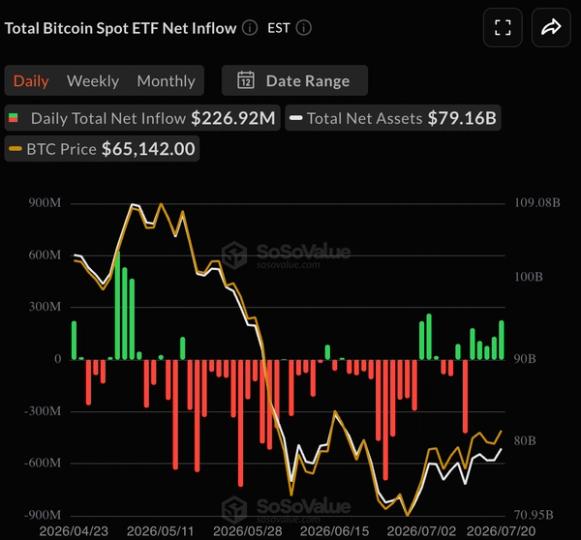
U.S. spot bitcoin ETFs took in about $227 million on July 20, a fifth consecutive day of net inflows for the first time since late April, per SoSoValue data. Ether ETFs added about $38 million, led by BlackRock’s ETHA.
The five-day run has pulled in roughly $727 million, the most sustained stretch of buying since the record outflows of June. Total bitcoin ETF assets have climbed back to about $79 billion from a July low near $75 billion. BlackRock’s ETHA drove the ether side with about $34 million.
Bitcoin has held its range near $63,000 as last week’s chip-driven selloff paused, and the return of the ETF bid is the piece that had been missing through a quarter of mostly outflows.
The test is what it holds through. The Fed meets July 28 and 29, and Big Tech earnings land this week, with Alphabet, Tesla and Intel reporting the numbers that will show whether AI spending, the trade bitcoin has moved with all month, is still climbing.
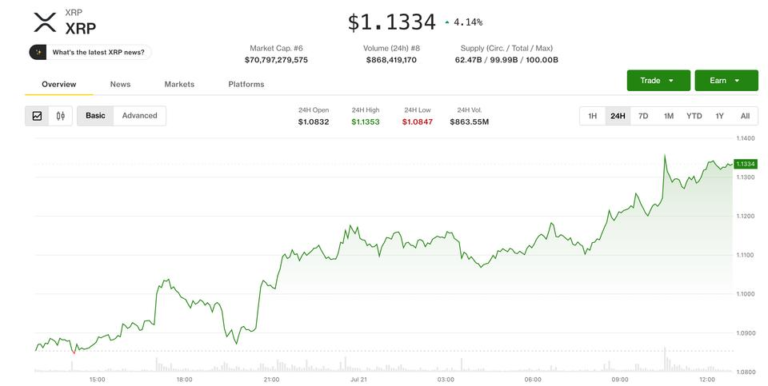
• Volume increased during the breakout attempt, with CoinGecko showing 24-hour trading volume of about $1.27 billion.
• XRP held above the $1.08-$1.10 area through the session, keeping the short-term recovery structure intact.
Technical Analysis
• The key short-term level is $1.13. A sustained break above it would confirm the triangle breakout watched by traders and bring $1.35 into focus.
• The hourly structure has tightened into a symmetrical triangle, with price compressing between lower highs and higher lows before the latest push higher.
• The daily chart remains more cautious. XRP is still trading inside a descending channel, with the 100-day and 200-day moving averages above price and sloping lower.
• The $1.24-$1.28 area remains the bigger resistance zone because it lines up with the channel’s upper boundary and major moving averages.
• Support remains strongest around $1.02-$1.06, where buyers have repeatedly stepped in over recent weeks.
What traders should watch
• $1.13 is the immediate breakout level. Holding above it would strengthen the short-term bullish setup.
• $1.14 is the next nearby level after marking the top of the latest 24-hour range.
• $1.24-$1.28 is the major resistance zone that XRP needs to clear before the daily chart turns meaningfully stronger.
• $1.02-$1.06 remains the key demand zone. Losing it would expose $0.88-$0.92.
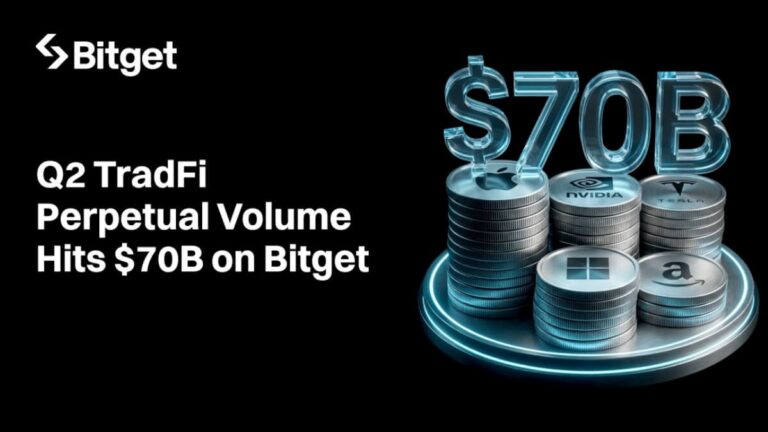
Global, July 21, 2026— Bitget, the world’s largest Universal Exchange (UEX), has emerged as one of the leading venues for TradFi trading products, generating nearly $70 billion in TradFi perpetual trading volume in Q2 2026, according to the TokenInsight Q2 2026 Crypto Exchange Report. The report cements Bitget’s growing presence in the rapidly expanding TradFi segment, where crypto exchanges are increasingly connecting digital asset infrastructure with global financial markets.
The report found that TradFi perpetuals became one of the fastest-growing segments across crypto exchanges during Q2, with monthly trading volume increasing from $52 billion in January to $268 billion in June. Equity perpetuals became the main growth driver during the quarter as exchanges expanded into tokenized stocks, IPO products, and other real-world assets. TokenInsight noted that TradFi perpetuals have evolved from an emerging product category into a strategically important area of competition for exchanges.
Bitget’s growth in TradFi markets follows a series of product launches under its Universal Exchange strategy, including IPO Prime and Stocks 2.0, which were highlighted by TokenInsight among the industry’s notable Q2 developments. The report also found that TradFi perpetuals accounted for 8.61% of Bitget’s total derivatives volume, the second-highest penetration rate among major centralized exchanges.
During the quarter, Bitget maintained a top-three position across both commodity and equity perpetual markets, while recording nearly $70 billion in TradFi perpetual trading volume. The exchange also expanded its broader derivatives position, with futures open interest market share increasing from 7.81% in Q1 to 8.58% in Q2, marking one of the strongest gains among major exchanges tracked by TokenInsight.
“The data points to a market that is starting to catch up with the vision behind our Universal Exchange,” said Gracy Chen, CEO of Bitget. “UEX is built around the belief that investors don’t want separate platforms for crypto and traditional finance, they want frictionless access to opportunities across both. The trading volumes we’re seeing today reinforces that this is where the market is heading.”
The findings come as the broader exchange industry shifts toward multi-asset trading. While total crypto exchange volume declined modestly to $16.5 trillion in Q2, spot activity recovered from $3.3 trillion to $4.5 trillion as market participants responded to renewed volatility and Bitcoin’s repeated tests of the $60,000 support level.
Bitget’s Universal Exchange ecosystem brings together crypto, tokenized equities, commodities, and other global assets through a unified trading experience. As TradFi and crypto markets continue to converge, Bitget continues expanding the infrastructure needed to support increasingly diverse trading activity.
Bitget is the world’s largest Universal Exchange (UEX), serving over 125 million users and offering access to over 2M crypto tokens, 500+ tokenized stocks, ETFs, commodities, FX, and precious metals such as gold. The ecosystem is committed to helping users trade smarter with its AI agent, which co-pilots trade execution. Bitget is driving crypto adoption through strategic partnerships such as MotoGP™. Aligned with its global impact strategy, Bitget has joined hands with UNICEF to support blockchain education for 1.1 million people by 2027. Bitget currently leads in the tokenized TradFi market, providing the industry’s lowest fees and highest liquidity across 150 regions worldwide.
Risk Warning: Digital asset prices are subject to fluctuation and may experience significant volatility. Investors are advised to only allocate funds they can afford to lose. The value of any investment may be impacted, and there is a possibility that financial objectives may not be met, nor the principal investment recovered. Independent financial advice should always be sought, and personal financial experience and standing carefully considered. Past performance is not a reliable indicator of future results. Bitget accepts no liability for any potential losses incurred. Nothing contained herein should be construed as financial advice. For further information, please refer to our Terms of Use.
Source: Bitget
The above article “Bitget Blocks 150 Million Cyber Threats in Major Security Push” was first published on AlexaBlockchain. Read the complete article here: https://alexablockchain.com/bitget-blocks-150-million-cyber-threats-in-major-security-push/
Submit Your Blockchain and Crypto Press Release here.
Disclaimer: This is a press release, provided by the company/ company representative. AlexaBlockchain does not endorse, guarantee, or accept responsibility for the content, accuracy, quality, advertising, products, or other materials presented in this publication. Readers are advised to conduct their own due diligence before taking any actions related to the company mentioned herein. AlexaBlockchain expressly disclaims any liability for damages or losses, whether direct or indirect, arising from or related to the use of or reliance on any content, goods, or services referenced in this press release.
Capital B, the Paris-listed bitcoin treasury company once known as The Blockchain Group, will combine every 10 existing shares into one new share beginning September 8, according to a regulatory filing the company published Monday.
The consolidation reduces the number of outstanding shares from 300,650,632 to 30,065,063. Each new share will carry a par value of €0.80, up from €0.08 for the existing stock. The company framed the transaction as a “purely technical exchange” that leaves the aggregate value of each shareholder’s holdings unchanged, save for the treatment of fractional entitlements.
Capital B said the move aims to “support the company’s institutional development and to open the company’s shares to a broader universe of investors.”
Many institutional funds operate under internal rules that bar them from holding stocks below a set price, and some exchanges impose minimum-price thresholds for continued listing. A higher quoted price per share removes one barrier to that participation.
Capital B shares trade near €0.48 on Euronext Growth Paris and have declined about 40% since the start of the year, per Google Finance data. Should the company’s market value hold, each consolidated share would open near €4.80.
Key dates for Capital B shareholders
The reverse split period runs from August 6 through September 7. Shareholders who hold a number of shares divisible by 10 will see their positions converted with no action required.
Those holding leftover shares can buy or sell stock before the deadline to reach a round multiple of 10. For investors who do not, financial intermediaries will sell the shares tied to fractional entitlements and distribute the cash proceeds, with payments set to begin September 14.
September 7 marks the final trading day for the existing shares. The consolidated shares start trading the following day under a new ISIN, the code exchanges use to identify a security. The company has set September 9 as the record date and September 10 for settlement and delivery.
Capital B will also pause conversions of certain convertible bonds and exercises of share warrants from August 17 through September 10. After the split, the company will adjust conversion prices and warrant ratios to reflect the reduced share count, multiplying bond conversion prices by 10 while dividing warrant ratios and unvested free shares by 10.
Treasury strategy stays central
The share restructuring does not add bitcoin to the balance sheet or raise new capital on its own. It changes the number and nominal value of shares through a technical consolidation, a step the company tied to its goal of reaching a wider investor base.
Capital B’s bitcoin holdings
Capital B holds 3,139 BTC, a figure that ranks it as the second-largest listed corporate bitcoin holder in Europe, according to BitcoinTreasuries.net. Germany’s Bitcoin Group SE sits ahead of it with 3,605 BTC, the data shows. Capital B, which describes itself as Europe’s first bitcoin treasury company, built much of that position through fundraising rounds during the first half of 2026.
In May, it acquired 192 BTC for €13 million after completing three capital raises.
The company has moved to widen its access to capital. In June, shareholders approved authority for as much as €5 billion in capital increases and €100 billion in credit instruments, resolutions that drew more than 95% support from votes cast. Those approvals give the board financing capacity for future purchases.
Capital B measures progress through bitcoin held per fully diluted share rather than total reserves alone, a framework common among bitcoin treasury companies. The firm has also said it is developing a bitcoin-backed credit product for the European market, though it has not set a launch date.
Bitcoin miner Hut 8’s shares rose Monday after the Toronto Stock Exchange- and Nasdaq-listed firm said it had signed a second 15-year lease worth $9.8 billion for its AI data center.
Hut 8 shares peaked as high as $106 a pop before dropping to around $101. They closed Monday up over 10%.
The deal will see the Toronto-based firm’s Beacon Point campus in Texas data center cover 352 megawatts of IT capacity. The tenant using the data center’s will have its capacity doubled to 704 MW.
Hut 8 added that the campus has a base-term contract value of $19.6 billion over 15 years, rising to as much as $50.2 billion if renewal options are exercised.
Asher Genoot, CEO of Hut 8, said: “The real test of our power-first approach is what our partners are willing to commit against it. Our tenant at Beacon Point chose to double its footprint at the site, the strongest validation an asset can receive.”
Hut 8 last year signed a deal with American Data Centers Inc., a company backed by President Donald Trump’s sons Eric and Donald Jr., to contribute its Bitcoin mining equipment and help debut their American Bitcoin mining firm.
AI pivot
Hut 8 is one of a number of top publicly listed miners that have started directing resources to providing the infrastructure for high-powered computing.
The company in December secured a Google-backed partnership with Anthropic and Fluidstack to build up to 2.3 gigawatts of AI data center capacity in the U.S.
A number of Bitcoin miners have already gone all-in on the industry as minting the biggest digital coin by market cap becomes harder and demand for AI compute surges.
As the price Bitcoin has dipped, it has become harder for Bitcoin miners to make ends meet.
Nasdaq-listed Bitfarms last year announced that it would wind down mining operations to focus on high-performance computing.
Instead of dropping mining operations completely, a number of Bitcoin miners have instead marketed themselves as “compute” or “digital infrastructure” companies while switching between minting digital coins and providing compute for AI — depending on which is more profitable.
Top miners Terawulf, IREN, and Cipher Mining all last year signed multi-year HPC contracts with Alphabet Inc.’s Google and Microsoft.
Both the crypto mining and HPC industries require huge amounts of energy and data centers — but the move isn’t always easy: AI data centres require more expertise than Bitcoin mining.
Celsius co-founders Shlomi Daniel Leon and Hanoch “Nuke” Goldstein have been ordered to pay over $6 million to settle Federal Trade Commission charges alleging they misrepresented the safety of the Celsius platform before the company collapsed.
Goldstein, Celsius’ former chief technology officer, was ordered to pay $2.014 million under an order signed Monday by US District Judge Denise Cote. Leon, the firm’s former chief strategy officer, was ordered to pay $4.1 million under a separate order entered on June 29.
The settlements extend the fallout from the 2022 collapse of Celsius beyond its former CEO Alex Mashinsky. The crypto lending platform, which held $25 billion in assets at its peak, owed its users $4.7 billion when it filed for bankruptcy in July 2022.
The order also bars Leon from marketing or selling products or services that can be used to deposit, exchange, invest or withdraw assets, the FTC said in a statement Monday.
“Similarly, Goldstein has agreed to a ban on marketing or selling retail products or services that can be used to buy, sell, deposit, withdraw, distribute or trade cryptocurrency.”
Related: Celsius’ Mashinsky gets permanent trading ban in CFTC settlement
FTC allegations against Celsius co-founders
The FTC alleged that Celsius falsely told customers it held sufficient reserves to meet withdrawal demands, maintained a $750 million insurance policy covering customer deposits and did not issue unsecured loans.
“The FTC, however, alleged that the promises were false and that its top executives continued to claim that customers’ deposits were safe days before the company filed for bankruptcy,” it said.
Mashinsky settles FTC case for $10 million
In April, Mashinsky agreed to an FTC settlement that permanently bars him from promoting asset-related products and required him to pay $10 million as part of a broader, partially suspended $4.72 billion judgment.
The $2.014 million and $4.1 million payments from Goldstein and Leon, respectively, will also be credited against the $4.72 billion judgment. The judgments reflect the consumer harm alleged by the FTC.
Separately, Mashinsky was sentenced to 12 years in prison in May 2025 after pleading guilty to commodities and securities fraud charges, with prosecutors saying he misled Celsius customers about the company’s profitability, investment risks and the safety of customer funds.
Magazine: Binance & OKX users face $1900 fines in Vietnam, Coinbase in China? Asia Express