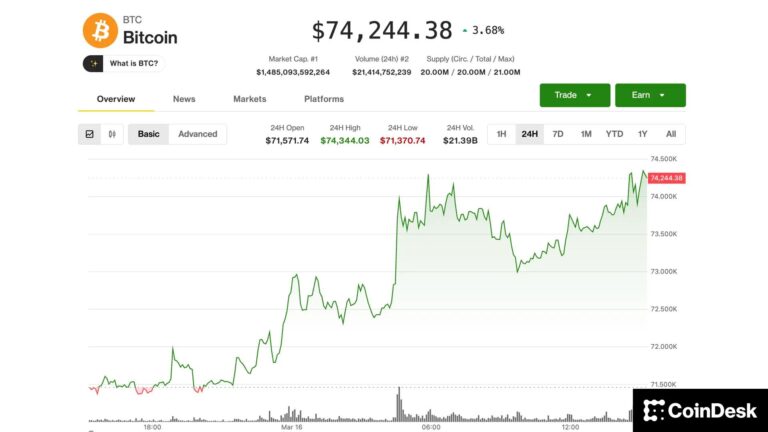
Cryptocurrencies started the week on a strong footing with bitcoin BTC$73,470.16 surging above $74,000 and U.S. equities bounced as oil prices eased.
In morning U.S. trade, BTC hit its strongest price since early February at $74,500, up 3.9% over the past 24 hours. The largest crypto broke out of its six-week range, boosting sentiment across the broader market and lifting appetite for smaller, riskier tokens.
Bitcoin (BTC) price action in 2026 (TradingView/CoinDesk)
Bitcoin’s bounce from its earlier February bottom of $60,000 is now nearing 25%, a notable move given several bounces of about that amount during 2022’s long crypto winter. These rebounds failed multiple times that year before the final November flush to below $16,000, which came alongside the FTX collapse.
Altcoins are outpacing bitcoin over the past 24 hours. Ether (ETH), solana (SOL) and ADA$0.2857 have each climes more than 7%, suggesting renewed appetite for higher risk crypto assets after a period when capital largely concentrated in bitcoin.
U.S. equity indexes also were making moves higher after recent losses. The Nasdaq and S&P 500 were each more than 1% higher in the morning trading. Meanwhile, oil prices, a key driver of recent macro volatility, pulled back. Crude futures dropped about 4% Monday after briefly topping $100 per barrel over the weekend on Iranian strikes on energy infrastructure in the Middle East.
The Monday action happened as tensions around the Strait of Hormuz — a critical oil shipping route between the Persian Gulf and global markets — appeared to ease slightly. U.S. President Donald Trump called on other nations to help secure the waterway, while some Pakistani oil tankers reportedly have crossed the Strait, suggesting that traffic through the corridor has not been fully disrupted.
Crypto-related stocks were higher on Monday, with Circle (CRCL) up 6%. Strategy (MSTR) and Coinbase (COIN) were about 5% and 3% higher, respectively.
Bitcoin miners gain too
Amsterdam-based AI infrastrcuture provider Nebius (NBIS) signed an agreement with Meta (META) valued at up to approximately $27 billion, marking one of the largest AI compute partnerships announced this year.
Under the five-year deal, Nebius will provide roughly $12 billion in dedicated AI compute capacity across multiple locations. The infrastructure will be built on one of the first large-scale deployments of NVIDIA systems, designed to support Meta’s expanding AI workloads.
Shares of Nebius rose about 13% following the announcement, while Meta gained 2.5%.
The deal appears to be lifting sentiment across the broader AI compute and data center cohort. Among bitcoin-related names: IREN (IREN) was higher by 6%, Galaxy Digital (GLXY) by 8%, and Cipher Mining (CIFR) by 7%.
While, TeraWulf (WULF) secured a $500 million, 364 day senior secured bridge facility led by Morgan Stanley to fund construction of its Hawesville, Kentucky data center, providing development capital while longer term project financing is arranged. Shares are up about 12% following the announcement.
Institutional investors may be proving more resilient bitcoin holders than critics expected, according to Bitwise CIO Matt Hougan, who says ETF flow data suggests professional investors have largely held onto their positions during the crypto market’s steep decline.
“The best evidence we have is in the ETF market,” Hougan said. “Bitcoin ETFs accumulated roughly $60 billion in net flows from their launch in January 2024 through October 2025. Since October 2025, prices are down 50%, but we’ve seen less than $10 billion in outflows from ETFs.”
Bitcoin exchange-traded funds attracted roughly $60 billion in net inflows between their launch in January 2024 and October 2025, Hougan told CoinDesk. Since then, the cryptocurrency’s price has fallen about 50%, yet ETFs have seen less than $10 billion in outflows.
“In other words, despite a punishing bear market, professional investors have proven to be ‘diamond hands’ in bitcoin,” he said.Hougan’s Bitwise offers a suite of digital asset investment products, including the Bitwise Bitcoin ETF (BITB). BITB has just under $3 billion in assets under management. The leading spot bitcoin ETF, BlackRock’s iShares Bitcoin Trust (IBIT) has more than $55 billion in AUM.
Bitcoin remains a ‘non-consensus asset’
Hougan said the data challenge a common criticism that institutional investors, often considered more sensitive to macroeconomic shocks and liquidity cycles, could sell their bitcoin exposure quickly during periods of market stress. However, he added, the opposite dynamic may be at play currently.
“Despite its progress in recent years, bitcoin remains a non-consensus asset,” he said. “Institutional investors who buy bitcoin today are still sticking their neck out and standing out from their peers.”
That career risk means institutions allocating to bitcoin today tend to have unusually strong conviction in the asset, said the CIO at Bitwise, a San Francisco-based company with over $15 billion in client assets under management.
That career risk means institutions allocating to bitcoin today tend to have unusually strong conviction in the asset, said the CIO at Bitwise, a San Francisco-based company with over $15 billion in client assets under management.
“As a result, the institutional investors who decide to allocate have very high conviction,” Hougan said. “They are not 51% convinced bitcoin is a good idea; they are 80% or 90% convinced. Otherwise, they wouldn’t take the risk.”
Because of that dynamic, he said he believes institutional capital could remain “very sticky” even during volatile market cycles “for the foreseeable future.”
The $1 million BTC question
Hougan said the behavior of institutional investors during downturns strengthens his long-term $1 million bitcoin outlook, on which he doubled down in the interview.
“The wildest thing about my $1 million prediction is that it’s not wild at all,” Hougan said. “All you need for bitcoin to get to $1 million is for the global store of value market to continue to grow as it has for the past 20 years and for bitcoin to become a minor but material part of that market.”
For Hougan, the resilience of institutional investors through volatile market cycles is part of that broader maturation process.
“It just needs what’s been happening for the past 10-20 years to keep happening for the next 10 years, and we’ll get there,” he said.
Singapore has over 1,500 fintech companies competing for the same customers. The ones acquiring users through organic search in 2026 are not doing it by accident. They are executing a small number of high-leverage SEO strategies with consistency. Here is what is working.
1. Targeting High-Intent Comparison and Review Keywords
Fintech customers research extensively before committing to a product. Queries like “best savings account Singapore”, “Syfe vs StashAway”, and “lowest FX fee Singapore” carry enormous commercial intent, and the startups ranking for them are converting organic traffic directly into sign-ups.
The key distinction is architecture. High-performing fintech sites build dedicated comparison landing pages rather than burying these topics in blog posts. They use FinancialProduct schema to expand SERP real estate, and they update pages quarterly to reflect rate and fee changes, signalling freshness on queries where recency matters.
Execution priorities:
Create standalone pages for each comparison keyword cluster, not just blog content
Implement FAQPage and FinancialProduct schema markup to increase click-through rates
Refresh pages whenever product features, rates, or fees change
Build internal links from informational content toward these high-conversion comparison pages
2. Building Trust Through E-E-A-T and Regulatory Content
Fintech falls squarely under Google’s YMYL (Your Money or Your Life) classification, meaning every page on a fintech website is held to a higher standard of credibility before Google will rank it. For startups competing against established banks and global platforms, this is the playing field.
The framework that governs this is E-E-A-T: Experience, Expertise, Authoritativeness, and Trustworthiness. In practical terms, this means content authored by credentialed individuals, MAS licensing clearly disclosed on product pages, compliance-accurate regulatory information with citations to primary sources, and transparent author bios with industry credentials on every published piece.
The fintech startups gaining ground here are not just adding author names to articles. They are building entire trust architectures:
Named authors with verifiable credentials on all content
MAS licensing status prominently displayed on service and product pages
Regulatory content linked directly to MAS circulars and official guidelines as primary sources
“Last reviewed” dates on all compliance-sensitive content to signal currency and accuracy
In a YMYL vertical, E-E-A-T is not optional. It is the minimum entry requirement for competitive rankings.
3. Programmatic SEO for Product and Corridor Combinations
Some of Singapore’s most visible fintech brands are scaling their organic footprint through programmatic SEO. They are building hundreds or thousands of data-rich pages from repeatable templates rather than writing each article from scratch.
Wise is the most documented example. Their programmatic SEO approach produced individual landing pages for every remittance corridor and currency pair, each populated with live rates, transfer limits, and fee data. This allowed them to grow from 7.7 million to over 16 million monthly organic visits without proportionally increasing ad spend, and every page captured a user already looking for exactly that product.
For Singapore fintech startups, the same model applies to:
Remittance platforms: one page per corridor (“send money Singapore to Indonesia”, “send money Singapore to India”)
FX and multi-currency accounts: live rate pages for each currency pair
Lending platforms: loan calculator pages segmented by loan type, tenure, and borrower profile
Business banking tools: pages targeting specific industries or company sizes
The differentiator is genuine data utility on each page. Thin programmatic content triggers Google’s quality filters. Pages that surface live, accurate, decision-relevant data rank and convert.
4. Local Link Building to Establish Domain Authority
Backlinks remain one of Google’s strongest ranking signals, and fintech operates in a vertical where the bar for link quality is especially high. A single editorial link from a credible publication carries more weight than dozens of directory submissions. And low-quality links in a YMYL category can actively suppress rankings.
The link building strategies that work for Singapore fintech startups are covered in detail in this step-by-step local link building guide, but the highest-leverage approaches for fintech specifically include:
Publishing original data: proprietary transaction insights, survey results, or market reports that journalists at e27, Tech in Asia, and The Business Times will cite
Pitching expert commentary to fintech publications around MAS policy updates, BNPL regulation, and digital banking trends
Getting listed in MAS-adjacent fintech startup databases and investor directories
Building partnerships with non-competing professional services firms, legal, accounting, corporate secretarial, that serve the same SME or startup customer base
Speaking at or sponsoring Singapore Fintech Festival, which typically generates multiple high-authority inbound links from industry media
Quality over volume is non-negotiable. One link from a high-authority, topically relevant publication consistently outperforms twenty links from low-quality sources.
5. Building a Content Architecture That Converts, Not Just Ranks
Traffic without conversion is a vanity metric. The fintech startups seeing the strongest SEO returns in 2026 treat their content library as an acquisition funnel, not a publishing exercise.
As AccuraCast’s analysis of B2B fintech SEO strategies highlights, company employees making fintech purchase decisions conduct significantly more research than retail consumers. This makes content architecture, how pages connect, how intent stages map to topics, and how readers are guided toward action, more important than content volume alone.
A conversion-oriented content architecture maps every piece of content to a specific stage:
Awareness: “how does digital banking work in Singapore”, “what is a payment gateway” captures early-funnel readers and builds topical authority
Consideration: “best digital bank Singapore 2026”, “Wise vs YouTrip” captures readers actively comparing options
Decision: “[Brand] review”, “how to open [Brand] account” captures readers ready to act
Every article should have a defined next step: an internal link to a product page, a sign-up CTA, or a lead magnet. Fintech startups that treat the blog as a standalone content effort rather than an integrated acquisition channel leave significant conversion volume unrealised.
Map each article to a keyword cluster and funnel stage before writing begins
Use pillar-cluster structures to build topical authority in key fintech verticals
Track assisted conversions from organic traffic, not just rankings and sessions
Run quarterly content audits to update underperformers, consolidate thin content, and remove pages with no ranking potential
The fintech companies winning in organic search are executing these five strategies with consistency over a 12-to-24-month horizon. SEO compounds and the startups that build the right foundations now will significantly outpace competitors relying on paid acquisition alone.Many fintech companies lack the in-house capacity to run a full SEO programme while simultaneously building their product. For those evaluating outside support, this list of leading SEO agencies in Singapore includes pricing benchmarks and service comparisons to help founders make an informed decision.
South Korea’s Financial Intelligence Unit (FIU) has fined cryptocurrency exchange Bithumb 36.8 billion won ($24.6 million) and ordered a six-month partial suspension of new-user services after uncovering millions of anti-money laundering (AML) violations, according to local reporting.
The FIU’s investigation found roughly 6.65 million breaches of the country’s AML and customer verification rules. About 3.55 million involved failures to verify customer identities, while 3.04 million cases concerned transactions that should have been blocked but were allowed.
Authorities also identified 45,772 transactions with 18 unregistered overseas exchanges.
The sanctions, part of ongoing regulatory oversight of South Korea’s top crypto platforms, include a reprimand for Bithumb’s CEO and a six-month suspension for the exchange’s reporting officer.
Existing customers can continue trading, while the restrictions primarily affect new user account activity, including deposits and withdrawals.
Bithumb, founded in 2014, is one of South Korea’s largest exchanges by trading volume. The fine is the country’s largest imposed on a virtual asset exchange, slightly surpassing a 35.2 billion won penalty handed to Upbit in 2025.
The violations were uncovered during on-site inspections of South Korea’s five largest crypto exchanges between 2024 and 2025.
Regulators have emphasized that strict compliance with customer verification and AML obligations is critical to maintaining market trust.
Bithumb’s bitcoin blunder
The announcement comes just weeks after Bithumb accidentally sent billions of dollars worth of Bitcoin to users during a promotional event.
The exchange had planned to distribute small cash rewards through a “Random Box” event at around 6 p.m. local time. Winners were supposed to receive between 20,000 and 50,000 Korean won.
Instead, staff reportedly entered the payment unit as Bitcoin rather than won.
As a result, some users received at least 2,000 BTC each, worth roughly 196 billion won per person based on prices near 98 million won per Bitcoin at the time, according to social media screenshots and accounts.
The operational error briefly caused Bitcoin prices on the platform to drop over 10% below broader market levels. Bithumb stated the incident did not result in any customer losses.
The FIU will finalize the fine after giving Bithumb at least 10 days to submit its opinion.
Authorities said the enforcement action signals continued tightening of crypto market oversight in South Korea.
At the time of writing, Bitcoin is trading near $74,000.
Metaplanet Inc. unveiled a $255 million equity financing on Monday designed to turbocharge its bitcoin treasury strategy, with potential proceeds climbing to roughly $531 million if accompanying warrants are fully exercised. Tokyo-Listed Metaplanet Raises Capital to Accelerate Bitcoin Holdings Tokyo-listed Metaplanet Inc. (TSE: 3350; OTCQX: MTPLF; ADR: MPJPY) said March 16 it will raise approximately […]
Strategy and Bitmine both announced fresh crypto buys today, while Metaplanet revealed its latest capital raise.
Strategy and Bitmine — the two largest digital asset treasury companies by crypto holdings — disclosed fresh crypto acquisitions on Monday, continuing the aggressive accumulation that defined their activity last week.
Strategy acquired 22,337 BTC for approximately $1.57 billion at an average price of ~$70,194 per Bitcoin. The Michael Saylor-led firm now holds 761,068 BTC, acquired for a total of ~$57.61 billion at an average cost of about $75,696 per coin — meaning the entire treasury sits just 1.8% underwater at current prices, with BTC currently trading around $74,300.
The buy is 4,343 BTC larger than the previous purchase, disclosed last week, which had an average per coin price of $70,946, as The Defiant reported.
MSTR shares were trading around $146, up about 5% on the day so far, according to Yahoo Finance.
Also today, March 16, the CEO of Metaplanet, Simon Gerovich, added to that momentum, announcing a new capital raise for the Japanese Bitcoin treasury firm. Metaplanet raised $255 million from investors, and said an additional monetization of its equity could bring in another $276 million. The move gives the firm up to $531 million to invest in Bitcoin, toward Metaplanet’s goal of holding 210,000 BTC.
Per data from Bitcointreasuries, Metaplanet is currently the fourth-largest Bitcoin DAT, holding 35,102 BTC.
ETH Moves
Bitmine Immersion Technologies, the dominant Ethereum treasury company, also reported a fresh purchase this week. Bitmine announced today that its ETH holdings have reached 4,595,562 tokens, at an average price of $2,185 per token. The firm bought 60,999 ETH in the past week, per a press release. The latest purchase is only slightly larger than the previous week’s of 60,976 ETH, but both are notably above Bitmine’s average weekly buy of 45,000-50,000 ETH.
Bitmine now owns 3.81% of the total ETH supply, advancing toward its stated “alchemy of 5%” target. Chairman Tom Lee also noted that Bitmine acquired 5,000 ETH directly from the Ethereum Foundation to enable the EF to fund its operations without selling into the open market.
BMNR shares rallied 11% today, trading at $22.80, per Yahoo Finance. The spot price of ETH is up over 9% today to trade near $2,300.
The moves are part of a broader wave of institutional DAT activity. As The Defiant reported in August, DAT companies collectively held over $100 billion in digital assets at the time, led by publicly listed companies such as Strategy, Metaplanet, and SharpLink Gaming. The crypto treasury strategy for public firms moved from an experiment, led by Strategy, to a trend last year, as The Defiant reported.
This article was written with the assistance of AI workflows. All our stories are curated, edited and fact-checked by a human.
Authorities from the United States, United Kingdom and Canada have launched a coordinated crackdown on crypto fraud, rolling out a new multinational initiative called Operation Atlantic aimed at disrupting approval-phishing scams and identifying victims before criminals drain additional funds. U.S. Secret Service Launches International Operation to Protect Crypto Investors Law enforcement officials said the operation […]
Fintech ecosystems rarely emerge overnight. They are built gradually with policy reforms, infrastructure development and the steady rise of entrepreneurial experimentation. Algeria’s fintech sector is following precisely this trajectory.
Two years ago, in a previous column for The Fintech Times, I explored Algeria’s early fintech landscape and the country’s tentative shift “from oil to algorithms.” That earlier analysis observed the beginnings of a digital finance ecosystem, where startups such as Banxy, DFA, ESREF Pay, and the regional super-app Yassir were beginning to reshape how financial services might operate in the Algerian market.
Fast forward to 2026, and Algeria’s fintech ecosystem remains relatively small compared with regional leaders such as Egypt or the United Arab Emirates (UAE). Yet what the country lacks in scale, it is beginning to make up for in direction.
Regulation is evolving. Startups are gaining visibility. And policymakers are increasingly recognizing fintech as a strategic component of Algeria’s broader digital economy.
The story of fintech in Algeria today is therefore less about explosive growth and more about institutional progress.
Regulation and Policy: The Framework Begins to Form
Algiers the capital and largest city of Algeria IMAGE SOURCE GETTY
In emerging fintech markets, regulation often determines whether innovation flourishes or stagnates. For Algeria, the past few years have represented an important turning point.
Authorities have gradually begun integrating financial technology into broader economic modernization efforts. Initiatives such as the national Fintech Strategy 2024-2030 aim to encourage digital payments, financial innovation and technological entrepreneurship within the country’s financial services sector.
At the same time, Algeria has begun strengthening its integration with regional financial infrastructure. In 2025, the Bank of Algeria joined the Pan-African Payment and Settlement System (PAPSS) – a move intended to simplify cross-border payments across Africa and support deeper financial integration under the African Continental Free Trade Area.
Such developments are particularly significant in a country where cash transactions still dominate large segments of the economy. Digital financial infrastructure-whether mobile wallets, payment gateways or neobanking platforms-cannot scale without a regulatory framework that enables innovation while maintaining financial stability.
For Algerian fintech founders, the gradual emergence of such frameworks represents a long-awaited signal that the ecosystem is beginning to mature.
The Ecosystem: Small but Expanding
In quantitative terms, Algeria’s fintech sector remains modest. Current ecosystem estimates suggest that around 30 to 35 fintech startups operate in the country, covering areas such as digital payments, mobile banking, financial infrastructure and crypto-enabled financial services.
Yet fintech represents only a portion of a broader startup landscape that is steadily evolving. Rankings of Algeria’s technology ecosystem highlight dozens of emerging startups in sectors ranging from mobility platforms to SaaS and e-commerce.
Within this wider ecosystem, fintech has begun to carve out its own identity.
Much of the activity is concentrated in payments and financial access – unsurprising in a country where digital commerce and online transactions are still developing. The challenge for fintech founders is therefore not simply building financial technology but helping accelerate the country’s broader digital transformation.
In many respects, the Algerian fintech market today resembles the early stages of other emerging ecosystems: small, experimental and focused on solving fundamental financial access problems.
Startups Shaping the Market
Despite the sector’s modest size, several startups have already begun to define Algeria’s fintech narrative.
One of the most notable examples is Banxy, widely regarded as Algeria’s first fully mobile-based banking platform, offering digital accounts and payment services through a smartphone application.
Another player is Digital Finance Algeria (DFA), a financial technology company focused on developing digital banking infrastructure and helping financial institutions adopt modern financial technology systems.
Meanwhile, ESREF Pay and payment platforms such as UbexPay are working to expand Algeria’s digital payment ecosystem by enabling online transactions for businesses and merchants.
Perhaps the most prominent Algerian technology success story is Yassir, the country’s best-known startup. Originally launched as a ride-hailing platform, the company has expanded into a regional super-app offering mobility, delivery and digital financial services across North Africa and beyond.
Yassir’s growth illustrates a broader trend within fintech: the rise of platform-based ecosystems where financial services are embedded within everyday digital applications.
The company has also continued to expand partnerships and technological collaborations, including initiatives aimed at accelerating digital service development within Algeria’s technology ecosystem.
Looking Ahead: A Gradual Digital Transformation
Algeria’s fintech ecosystem in 2026 remains a work in progress.
Digital payment adoption is still relatively limited. Venture capital investment in the sector remains modest compared with other African fintech hubs. And the regulatory framework, while improving, continues to evolve as authorities balance innovation with financial stability.
Yet the broader trajectory is becoming clearer.
Regulators are establishing frameworks. Entrepreneurs are experimenting with new financial technologies. Consumers are gradually becoming more comfortable with digital financial services.
Individually, these developments may appear incremental.
Collectively, however, they signal something more significant: the emergence of a fintech ecosystem that, only a few years ago, barely existed.
For Algeria, fintech is not yet a headline-grabbing success story. But the foundations – policy, infrastructure and entrepreneurial ambition – are now firmly in place.
And in the world of emerging fintech markets, that is often how transformation begins.
South Korea has fined crypto exchange Bithumb 36.8 billion won (about $24.5 million) and imposed a six-month partial business suspension after finding widespread violations of Anti-Money Laundering (AML) rules, according to a Yonhap News Agency report.
According to Yonhap, regulators identified about 6.65 million violations during an AML inspection, including failures related to customer identity verification, transaction restrictions and record-keeping requirements. Authorities found Bithumb facilitated 45,772 crypto transfers involving 18 unregistered overseas virtual asset service providers (VASPs), in violation of South Korea’s AML rules.
The Financial Intelligence Unit (FIU) under the Financial Services Commission (FSC) reportedly decided on the penalties following a sanctions deliberation committee meeting reviewing the exchange’s compliance with the Act on Reporting and Use of Specific Financial Transaction Information.
The sanction includes the largest fine yet imposed on a South Korean crypto exchange, following an ongoing regulatory crackdown on AML compliance.
South Korea imposes a six-month partial ban on Bithumb
Under the measures, Bithumb will be banned from processing external crypto transfers for new customers for six months, from March 27 to Sept. 26.
However, existing users will face no trading restrictions, while new customers can still buy or sell crypto and deposit or withdraw Korean won from the exchange.
Related: South Korea plans to use AI for crypto tax enforcement
The FIU said it had repeatedly warned Bithumb to halt transactions with unregistered overseas crypto firms. However, the regulator said the exchange failed to comply and was unable to implement effective blocking measures.
On March 9, the FIU gave Bithumb a preliminary notice of a six-month partial suspension, citing its concerns over Bithumb’s violations before determining the final sanctions.
South Korea’s broader AML enforcement drive
Apart from Bithumb, the FIU has also previously penalized other South Korean exchanges for AML violations.
In February 2025, the regulator imposed a three-month restriction on crypto deposits and withdrawals for new Upbit customers after finding violations tied to dealing with unregistered VASPs. Upbit also received a 35.2 billion won (about $23.5 million) penalty.
The crackdown later reached crypto exchange Korbit. In December 2025, the FIU imposed a 2.73 billion won (about $1.8 million) fine and an institutional warning on the exchange over AML and customer-verification breaches.
Magazine: China’s ‘50x’ blockchain boost, Alibaba-linked AI mines Bitcoin: Asia Express
Cointelegraph is committed to independent, transparent journalism. This news article is produced in accordance with Cointelegraph’s Editorial Policy and aims to provide accurate and timely information. Readers are encouraged to verify information independently. Read our Editorial Policy https://cointelegraph.com/editorial-policy
Tokyo-listed investment firm Metaplanet has secured approximately $255 million from global institutional investors as it accelerates a corporate strategy centered on accumulating Bitcoin, with additional warrants that could lift total funding to roughly $531 million.
The capital was raised through a placement of new shares priced at 380 yen ($2.39) each, representing a small premium to the market price.
The financing package also includes fixed-strike warrants exercisable at 410 yen ($2.57) per share, which carry a 10% premium to the placement price and could generate an additional $276 million if fully exercised before their March 2028 expiration, according to CEO Simon Gerovich.
The fundraising effort forms part of the company’s broader push to expand its bitcoin treasury. Metaplanet said it intends to allocate up to 56.9 billion yen, or about $357 million, toward purchasing additional bitcoin between April 2026 and March 2028.
The firm currently holds 35,102 BTC, valued at roughly $2.6 billion at recent market prices. The holdings place Metaplanet among the largest corporate bitcoin treasuries globally, though still well behind industry leaders such as Strategy and MARA Holdings.
Metaplanet’s aggressive bitcoin plans
Metaplanet’s management has outlined aggressive accumulation targets. The company aims to increase its holdings to 100,000 BTC by the end of 2026 and 210,000 BTC by the end of 2027, part of a strategy to position bitcoin as the centerpiece of its balance sheet and long-term capital structure.
Beyond the share placement and fixed-price warrants, the company’s board also authorized the issuance of 100 million new “MS Warrants.”
These instruments are tied to the company’s modified net asset value, or mNAV, a metric comparing the firm’s market capitalization with the value of its bitcoin holdings.
The mechanism allows warrants to be exercised only when Metaplanet’s shares trade above a specified multiple of that metric, a structure designed to ensure any new equity issuance increases bitcoin holdings on a per-share basis.
The company also suspended the exercise of older warrants representing up to 210 million shares, a move intended to limit dilution and prioritize the new financing structure tied more directly to its bitcoin treasury strategy.
Not all of the newly raised capital will go toward bitcoin purchases. According to company disclosures, about 21.1 billion yen ($132 million) will be used to repay borrowings under Metaplanet’s credit facility, while roughly 6.3 billion yen ($39.5 million) will be allocated to support its bitcoin income generation business, including margin collateral for options underwriting.
Metaplanet currently maintains a $500 million credit facility backed by bitcoin collateral, with approximately $280 million drawn as of March 11. The company has said it aims to keep borrowings below 10% of the net asset value of its bitcoin holdings to maintain financial flexibility.
Shares of Metaplanet rose nearly 5% Monday as bitcoin climbed above $73,000, reflecting investor interest in companies adopting treasury strategies tied directly to the digital asset.
The firm has rapidly expanded its holdings over the past year, increasing from fewer than 2,000 BTC at the start of 2025 to more than 35,000 BTC today.
Last week, the company announced plans to expand beyond holding bitcoin by launching two subsidiaries—Metaplanet Ventures and Metaplanet Asset Management—and disclosed a planned investment in Japanese stablecoin issuer JPYC Inc.
The company said Metaplanet Ventures would deploy about ¥4 billion ($25 million) over the coming years to back startups building bitcoin financial infrastructure in Japan, including lending, payments, custody, derivatives and compliance tools.
At the time of writing, Bitcoin is trading near $74,000.
Earlier today, Strategy, led by Michael Saylor, bought 22,337 more bitcoin for $1.57 billion, raising its total holdings to 761,068 BTC. The average acquisition cost is $75,696 per coin, giving the holdings a current market value of about $50 billion.