Home Blog Page 748

AI Innovation vs. Adoption: Why They Are Misaligned

0

ORLANDO — While AI innovation continues to move at a rapid pace, enterprises are still slowly adopting the technology and incorporating it into their workflows and systems.

For many enterprises, the slow adoption rate is due to a need to reorient their data environments. Others are still looking at governance, and still others are thinking about what the future of work will look like.

In this Q&A from the Gartner Data & Analytics Summit last week, Beena Ammanath, global head of Deloitte’s AI Institute, dives deep into the challenges enterprises face when adopting AI technology. 

Why does the interest in AI not match the current level of adoption?

Beena Ammanath: The pace of technology change moves at its own pace. Newer models and AI iterations are coming out, but the pace of adoption of that technology and enterprise moves at the pace of change management within the enterprise. That’s two different speeds. That’s the difference between AI and applied AI. 

Related:Nvidia Devises a More Secure OpenClaw Stack for Enterprises

When you take AI as a core technology, yes, it’s moving fast. You see a lot of headlines about it, but when you try to apply it in a bank or healthcare environment, it moves at a different speed. Because when you apply it in the enterprise world, there are a number of challenges that come with scaling AI. 

What are some of the challenges that come with applying AI in an enterprise environment?

Ammanath: One of the things about scaling AI is around having the right data foundation. 

Most CEOs or chief AI officers are caught in that in-between phase where there’s pressure from leadership to see AI value, but the foundation isn’t right. Investing in the foundation is a bigger investment, not an immediate return. Laying the foundation will lead to more long-term, sustainable value from it.

The second one is in a risk-averse or high-risk environment, like financial services or healthcare, where you want to have the right governance model. If you don’t have the right governance model, you can’t build trust, and adoption naturally slows. 

So, governance becomes a big factor when you want to scale.

What shift in data management has led to the emphasis on a strong data foundation being more important now than ever?

Ammanath: Most data management systems and data foundations were designed for some form of data processing. But now we’re looking at versions of AI that mean streaming data, unstructured data, and greater access to data. We’re looking at autonomous agents. These data points were not set up to support these three emerging areas. They were static data points built over time and not meant for streaming or unstructured data. 

Related:New Microsoft AI Agents to Help Modernize Enterprises

Now with AI, you need unstructured data to make your AI robust. With generative AI, you need more varieties of data.

How does having a strong data foundation influence the speed of the application of physical AI?

Ammanath: Physical AI is advancing very rapidly. What has happened now is that the software part of AI has grown. The software part has now evolved and can do better, smarter things in the physical world. 

Typically, when you’ve talked about AI in the past, we’ve focused more on software than on infrastructure or hardware. Now you’re bringing in more of that intelligence into the physical world. It’s not just manufacturing. You hear about robots doing household work or being an aid. We’ve seen it in hospitals where you’re using it for patient lifting or patient transportation. You see it in banks from a vault management perspective. 

Physical AI is definitely growing, but I think that’s also been in the making for a while.

The data foundation for that is actually stronger because of the IoT wave that we had 10 years ago. Manufacturing is more ready because the sensors already exist. 

How much does sovereign AI inform data?

Related:AI Customer Support Startup Now Valued at $2 billion

Ammanath: It will have a huge impact outside the U.S. Sovereign AI is where there is a dependency on certain organizations, certain geographies. It’s a huge topic outside of the U.S. on what happens in a world where you’re fully reliant on certain companies and geographies for what you might be doing in AI. 

It started in the EU and the Middle East, and now, almost all countries are beginning to think about the need for sovereignty, like what needs to be owned, what data needs to be within the country, and what can be uploaded to the cloud. 

What are some of the other obstacles organizations are facing in this age of AI?

Ammanath: One is the workforce impact. It’s understanding what the future of the workforce and talent looks like. What does the job of the future look like at the task level, and how do you start preparing? If people gain AI fluency, is it to do their current job faster or to help them prepare for a future job? For example, in a financial analyst’s job, 60% of their time usually goes into gathering and organizing the data and sourcing it, 20 to 30% into modeling, and 10% into actually synthesizing the insights and applying them to the business. Part one and part two can be done with AI. In the next few years, it will become more reliable, and you can have AI handle that part, and the financial analyst will have to focus mostly on part three. But if you train them on doing the existing jobs faster, you’re not preparing the financial analyst for what their job will look like two years from now, which is more focused on part three. 

But can we really know what the role will look like in two or three years?

Ammanath: That’s the work that needs to happen at the leadership level.

The first step was to have the entire workforce trained on AI, and I see more and more leadership conversations on what we are training them for. It’s more about getting to the next level of what training should look like for future work. For that, you need to figure out what the jobs of the future are and what the tasks are. 

You won’t believe how many times I get asked, “Is AI going to take away the job?” It’s not that it’s going to take it away, but it’s going to certainly change. 

My job is changing right now. It’s not this one day, suddenly turning on the switch, and then the job is different. It’s slowly changing all of our jobs. But it’s not sudden. 

It’s going to be incremental. Similar to the adoption of AI, job changes are not going to happen overnight. Over time, jobs will change and evolve. 

It proves to me again that the adoption of AI moves at a different speed than the creation of core AI. That’s the fundamental difference. 

Editor’s note: This interview has been edited for clarity and conciseness.
 

Uniswap (UNI) drops 4.1%, leading index lower

0

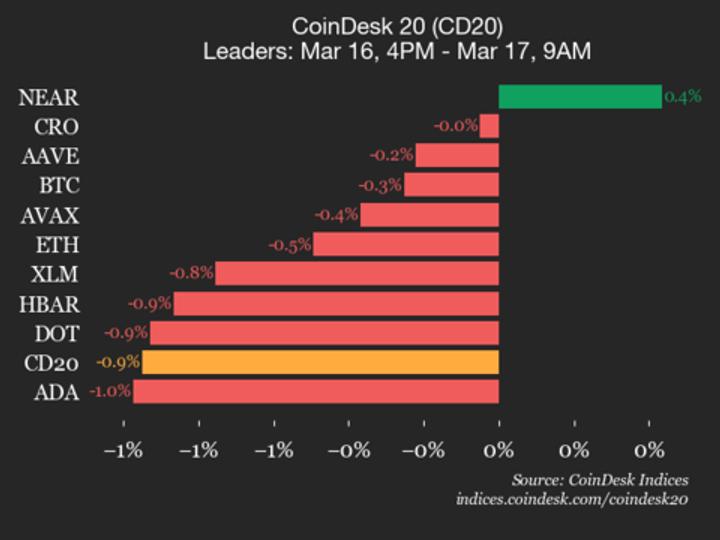
CoinDesk Indices presents its daily market update, highlighting the performance of leaders and laggards in the CoinDesk 20 Index.

The CoinDesk 20 is currently trading at 2148.63, down 0.9% (-20.59) since 4 p.m. ET on Monday.

One of 20 assets are trading higher.

Leaders: NEAR (+0.4%) and CRO (+0.0%).

Laggards: UNI (-4.1%) and SUI (-4.0%).

The CoinDesk 20 is a broad-based index traded on multiple platforms in several regions globally.

Bitget Expands Spot Market with Ondo Securities Offerings

0

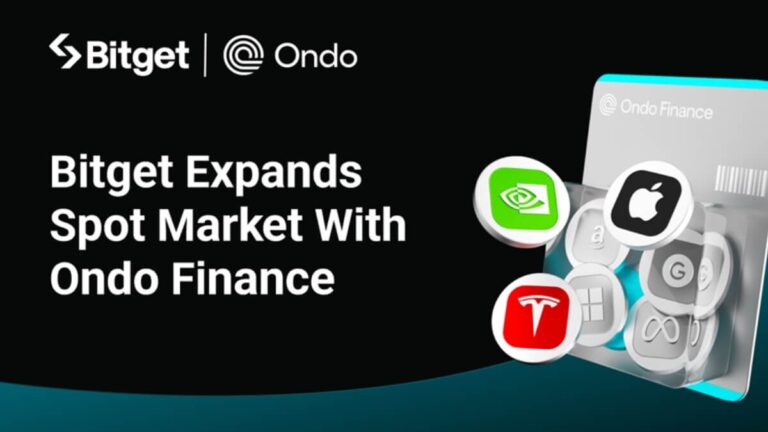
Global, March 17, 2026 / AlexaBlockchain/ – Bitget, the world’s largest Universal Exchange, is expanding its spot market with a new batch of Ondo Global Markets tokenized securities, bringing major U.S. equities, index ETFs, and precious metals into a single trading environment alongside digital assets. The rollout adds a new layer to Bitget’s multi-asset model, allowing users to trade crypto and traditional market exposures side by side, around the clock, within one USDT-based account.

The new listings are set to include some of the most recognized names in global markets. On the equities side, the lineup covers Tesla (TSLAon), NVIDIA (NVDAon), Apple (AAPLon), Alphabet (GOOGLon), Microsoft (MSFTon), Amazon (AMZNon), Meta (METAon), and AMD (AMDon).The expansion also brings broader market exposure through index ETF products including SPYon, IVVon, QQQon, IWMon, and ITOTon, alongside commodity-linked assets such as IAUon and SLVon, giving users a direct way to access gold and silver-linked instruments from the same spot interface used for crypto trading.

This launch builds on an existing relationship between Bitget and Ondo that has steadily expanded over the past several months. In September 2025, Bitget and Bitget Wallet introduced access to more than 100 tokenized assets through Ondo Finance. Recently Bitget deepened that collaboration by adding 98 new tokenized U.S. stocks and ETFs. Bitget has also publicly reported strong traction in the category, stating that Ondo tokenized stock trading on the platform captured about 73% of market share in early December before rising to roughly 89% later that month, reflecting fast-growing user demand for blockchain-based access to global markets. Ondo Global Markets is now the largest tokenized stock provider globally.

Unlike traditional market access that remains tied to brokerage rails and limited trading windows, the new spot listings are designed for continuous access. Users can buy and sell these assets on a 24/7 basis from Bitget’s spot trading page, giving traders a way to respond to macro events, earnings developments, and weekend market sentiment without waiting for conventional exchanges to reopen. This structure fits the broader direction of the tokenized asset market, where traders increasingly expect global assets to move with the same speed and accessibility as crypto.

“Market movements are no longer bound by date and time, user expectations no longer stop at the boundary between crypto and traditional finance. This expansion with Ondo brings some of the world’s most watched equities, index products, and precious metals into our spot market in a way that feels native to how modern users already trade,” said Gracy Chen, CEO at Bitget.

“Bitget is now offering tokenized equities alongside crypto and becoming the everything app, powered by Ondo,” said Ian De Bode, President of Ondo Finance. “Ondo tokenized stocks, ETFs, and commodities are available for trading on every Bitget platform, in size.”

The latest rollout advances Bitget’s Global Alpha in One strategy and adds further depth to its Universal Exchange model, where crypto, tokenized real-world assets, and broader market instruments are brought together in one place.

To find out more about Ondo spot stocks on Bitget, please visit here.

About Bitget

Bitget is the world’s largest Universal Exchange (UEX), serving over 125 million users and offering access to over 2M crypto tokens, 100+ tokenized stocks, ETFs, commodities, FX, and precious metals such as gold. The ecosystem is committed to helping users trade smarter with its AI agent, which co-pilots trade execution. Bitget is driving crypto adoption through strategic partnerships with LALIGA and MotoGP™. Aligned with its global impact strategy, Bitget has joined hands with UNICEF to support blockchain education for 1.1 million people by 2027. Bitget currently leads in the tokenized TradFi market, providing the industry’s lowest fees and highest liquidity across 150 regions worldwide.

Risk Warning: Digital asset prices are subject to fluctuation and may experience significant volatility. Investors are advised to only allocate funds they can afford to lose. The value of any investment may be impacted, and there is a possibility that financial objectives may not be met, nor the principal investment recovered. Independent financial advice should always be sought, and personal financial experience and standing carefully considered. Past performance is not a reliable indicator of future results. Bitget accepts no liability for any potential losses incurred. Nothing contained herein should be construed as financial advice. For further information, please refer to our Terms of Use.

About Ondo Global Markets
Ondo Global Markets is an issuance and redemption platform for tokenized publicly traded U.S. stocks and ETFs. It enables investors outside the United States to gain economic exposure to these assets by minting, transferring, and redeeming securities-backed tokens. Each token is fully backed by the corresponding stock or ETF (together with cash in transit).

About Ondo Finance
Ondo Finance is a blockchain-based platform focused on tokenizing real-world assets and bringing institutional-quality financial products onchain. By bridging traditional finance and decentralized infrastructure, Ondo aims to make capital markets more accessible, transparent, and efficient.

Source: Bitget

The article “Bitget Expands Spot Market With Ondo Tokenized Stocks, ETFs and Precious Metals” was first published on AlexaBlockchain. Read the complete article here: https://alexablockchain.com/Bitget-Expands-Spot-Market-With-Ondo-Tokenized-Securities/

Submit Your Blockchain and Crypto Press Release here.

Disclaimer: This is a press release, provided by the company/ company representative. AlexaBlockchain does not endorse, guarantee, or accept responsibility for the content, accuracy, quality, advertising, products, or other materials presented in this publication. Readers are advised to conduct their own due diligence before taking any actions related to the company mentioned herein. AlexaBlockchain expressly disclaims any liability for damages or losses, whether direct or indirect, arising from or related to the use of or reliance on any content, goods, or services referenced in this press release.

Image Credits: Bitget, Shutterstock, Canva, Wiki Commons

BTC price target cut to $112,000 at Citigroup; ETH trimmed to $3,175

0

Wall Street investment bank Citigroup lowered its 12-month price targets for bitcoin and ether (ETH), citing slower legislative momentum in the U.S., softer network activity, and reduced expectations for ETF inflows.

Citi now sees bitcoin reaching $112,000 and ether $3,175 over the next year, down sharply from prior forecasts of $143,000 and $4,304.

The revised targets still suggest substantial upside. Bitcoin was trading around $74,000 at the time of publication. Ether was at $2,330.

The bank said inflows remain the key upside driver, though it lowered its 12-month demand assumptions, even as recent ETF demand has picked up modestly despite geopolitical uncertainty.

“ETF demand where we reduce the assumption to $10 billion and $2.5 billion (ETH) is still the most important positive factor,” analyst Alex Saunders said in the Monday report.

Crypto markets have struggled to regain momentum after bitcoin’s run to record highs in October, with prices drifting lower amid weak risk appetite and fading post-halving enthusiasm. BTC has traded below key technical levels, while ether has lagged further, weighed by soft onchain activity. Despite the subdued price action, ETF inflows have remained resilient, helping to stabilize the market even as broader macro uncertainty and geopolitical tensions continue to cap upside.

According to Saunders, the outlook hinges heavily on U.S. regulation. The analyst said the window to pass digital asset legislation this year is narrowing, with market-implied odds falling to around 60%. While broader global policy remains supportive, he argued that headline U.S. legislation would be a stronger catalyst for institutional flows than incremental rulemaking.

The CLARITY Act, a sweeping U.S. crypto market-structure bill, has cleared the House but remains stalled in the Senate as lawmakers negotiate competing proposals, leaving its path forward uncertain.

The legislation is seen as critical because it would establish clear rules for how digital assets are classified and which agencies oversee them, resolving a long-running turf battle between the Securities and Exchange Commission (SEC) and The Commodity Futures Trading Commission (CFTC) that has created legal ambiguity for investors and firms.

By defining categories of tokens and setting registration frameworks for exchanges, the bill aims to reduce regulatory risk and provide the certainty many institutional investors need before allocating more capital to crypto markets.

The analyst also flagged weakening momentum in the crypto market since bitcoin’s October peak, citing futures liquidations, positioning fatigue, and prices sitting below key technical levels. Bitcoin may continue to range trade, with around $70,000 seen as an important psychological level tied to pre-election pricing.

In the bank’s framework, the bull case depends on stronger end-investor adoption, particularly via ETFs, with a target of $165,000 for bitcoin and $4,488 for ether. The bear case reflects recessionary macro conditions, with targets of $58,000 for BTC and $1,198 for ETH.

Ether’s outlook is more uncertain, the report said, given its sensitivity to onchain activity, which has recently been weak. Still, there is potential upside from stablecoin growth, tokenization trends and possible regulatory focus on DeFi, which could lift usage and demand.

Read more: Bitcoin outperforms gold and stocks in global turmoil as ETFs and Strategy accumulate

Daos May Need To Ditch Decentralization To Court Institutions

0

Decentralized autonomous organizations (DAOs) were built on an ideological premise that is now running up against the realities of running a business, where decentralization collides with the need for legal ownership and control.

On March 11, DAO Across Protocol made a controversial proposal to transition to a private company through a token-to-equity exchange buyout. Risk Labs, the team behind Across (ACX), said that the token and DAO structure “materially” impacted its ability to close deals with enterprises and institutions.

The industry reaction has been split. Decentralized finance (DeFi) researcher Ignas called it a “huge failure of crypto.”

“It feels like a betrayal of the crypto spirit: investment access for everyone, anywhere, globally,” Ignas said on X. “I hope other DAOs don’t follow them.”

Responses to the researcher’s post suggested it may indeed be becoming a trend. Source: Dan Jarvis, Ignas

The DAO structure is holding back Across’ stablecoin business

Crosschain Bridge Across Protocol currently operates under a token and DAO structure, with Risk Labs overseeing development through a foundation model.

Risk Labs’ proposal outlines a transition to a newly formed US C-corporation that would take over protocol development and commercialization. ACX holders could exchange their tokens for equity in the new entity or opt into a buyout.

“[DAOs] were supposed to replace the archaic organizational infrastructure that is marked by greed and a lack of trust,” Matthew Pinnock, founder of DeFi project Altura, told Cointelegraph.

“However, as the industry increasingly moves toward real-world assets and institutional capital, protocols are running into structural limitations. Institutions typically need a clear legal counterparty that can sign contracts and undergo due diligence, something a decentralized collective cannot easily provide,” Pinnock added.

Related: Perp DEXs become the latest battleground for blockchains

Across co-founder Hart Lambur said that in Across’ case, having a token “generally hurts more than it helps.”

“We launched the Across token very early, at a very low valuation, and with a very broad airdrop. We picked this strategy so that we could build value in public with our community,” Lambur said on X. “Today, the macro environment has changed. Tokens are undervalued and underappreciated.”

ACX is down 97.5% from its all-time high. Source: CoinGecko

Across is positioned around stablecoin infrastructure, which partly explains its transition. The goal is to enable fund movements across stablecoins at parity, with fees absorbed by issuers or partners rather than end users. Lambur said that securing related agreements requires contracts and offchain payment arrangements that are not well suited to DAO structures.

ShapeShift dissolved its corporate entity to become a DAO

As protocols rethink DAO structures, ShapeShift offers a counterpoint. The crypto trading platform transitioned into a DAO in 2021, dissolving its corporate entity in favor of tokenholder governance.

Tim Black, product lead at ShapeShift DAO, said many teams adopted DAO structures during the last cycle as part of a broader narrative, without fully accounting for the operational complexity involved.

Related: Banks will run RWAs on two blockchain rails, says RedStone co-founder

“What Across is proposing is essentially admitting that. They’re saying the DAO experiment helped bootstrap the network, but a company structure is better suited to the next phase,” Black told Cointelegraph.

“Many teams quietly operate like companies already,” he added. “Shapeshift was innovative in using workstreams, mirroring departments, but they still create more friction than collaboration over time.”

ShapeShift started becoming an organization governed by FOX token holders in 2021. Source: Erik Voorhees

Social media debates steered toward tokenized equity as the way to go over the traditional corporate structure, with Ignas claiming that it would be progress for the industry. But Black thinks that says more about token designs than the concept, as many governance tokens already function as pseudo equity.

“The original idea behind governance tokens was coordination, not ownership… If they just become equity substitutes, then the experiment has basically collapsed back into the corporate model it was supposed to challenge,” he said.

Across’ corporate structure isn’t finalized

If transitions like Across’ become more common, the outcome may not be a single direction for DeFi, but a split in how protocols are structured and operated.

“One side becomes corporate crypto, protocols run like fintech companies with tokens functioning more like shares. The other side stays genuinely decentralized and accepts the operational friction that comes with that,” said Black.

That shift is already being shaped by the influx of institutional capital and RWAs, which impose requirements that DAO structures often struggle to meet. 

“That is why we are seeing DAOs taking the regulatory black pill and dropping the D that made them decentralized autonomous organisations,” Pinnock said.

As protocols adapt, some are moving toward clearer legal frameworks and centralized execution layers, while others continue to prioritize open participation and community governance.

Though Across is eyeing a corporate structure, it still operates as a DAO today. It framed its proposal as a “temperature check” to signal that no final decision has been made. It still needs to pass a governance vote and get the blessing of its token holders.

DAO members are expected to vote on the proposal in early April. Source: Across

Magazine: Metaplanet’s Japan Bitcoin bet, Bithumb ordered suspension: Asia Express