

Mounting investor losses are drawing scrutiny to Gemini as class action lawsuits allege the crypto exchange misled markets about its growth strategy and financial outlook, fueling a sharp post-IPO decline and eroding confidence. Class Action Lawsuits Filed Against Gemini as Exchange Expansion Story Unravels Into Credibility Crisis A securities dispute highlights investor losses as multiple […]
FinScan and Nexus AML partner to scale data-first AML operations

FinScan, an Innovative Systems solution and leading provider of advanced AML and sanctions compliance solutions, this month announced a strategic partnership with Nexus AML to deliver data-first financial crime operations for regulated institutions worldwide.
Data quality has emerged as one of the most significant operational challenges in financial crime compliance. In a FinScan poll of 550 compliance professionals, 59% reported that data quality consumes most of their time.
Through this partnership, Nexus AML clients have the opportunity to leverage FinScan’s unique real-time data cleansing and sanctions, watchlist, and payment screening capabilities to reduce alert volumes and improve accuracy. In turn, FinScan’s clients and prospects can leverage Nexus AML’s AI operational services and expertise to help scale operations, manage case load volatility, and improve regulatory defensibility.
“FinScan and Nexus AML share the belief that financial crime compliance must be both operationally scalable and strategically grounded in high-quality, compliance-ready data,” said Deborah Overdeput, Chief Operating Officer at Innovative Systems. “Our partnership brings together two complementary strengths: operational excellence in clearing and investigating alerts, and a data-first screening approach that reduces those alerts in the first place. Together, we’re helping institutions build AML programs that are more efficient, defensible, and sustainable.”
“When we saw FinScan’s data-first approach in action, particularly how it reduces false positives at the source, we recognized a strong strategic alignment,” said Rob Cutler, Managing Director at Nexus AML. “As a trusted advisor to our clients, we focus on improving compliance and screening processes and easing operational pressure. Data quality is foundational to effective screening and case management. FinScan’s ability to reduce false positives at the source allows institutions to focus their investigative resources where they matter most.”
FinScan’s data quality and enrichment capabilities assess, clean, standardize, and continuously monitor customer and transaction data so it remains “match-ready” for AML screening. This approach significantly improves screening accuracy, reduces false positives and negatives, and saves teams valuable time and resources—turning a traditionally manual challenge into an automated, defensible compliance asset.
Nexus AML delivers expert-led AI and automation services across screening, transaction monitoring, KYC, customer due diligence (CDD), and enhanced due diligence (EDD). Operating on a flexible cost-per-case model, Nexus AML supports institutions experiencing peaks and troughs in AML caseloads, helping clear backlogs efficiently while maintaining regulator-ready standards.
Carney Takes Regulation-First Approach to Crypto in Canada

Cryptocurrencies and blockchain technology have increasingly become part of Canada’s core financial system over the past year.
In November, the country introduced stablecoin regulations as part of the Canada Stablecoin Act. Introduced as part of the budget, it gives the Bank of Canada the power to regulate stablecoins in the country.
Elsewhere, policymakers are finalizing amendments to laws for crypto asset funds, including those for cold wallets and custodians.
The changes highlight a pragmatic, but regulation-first approach to crypto, which observers have come to expect from Prime Minister Mark Carney’s government.
Increased scrutiny and new standards for crypto raise the bar
When Canadian Prime Minister Mark Carney assumed office last year, industry observers expected a cautious approach to crypto in Canada.
Carney had previously expressed skepticism about crypto. As Governor of the Bank of England, he said that “Cryptocurrencies act as money, at best, only for some people and to a limited extent, and even then only in parallel with the traditional currencies of the users. The short answer is they are failing.”
Still, he called for regulating the crypto space, and said that the underlying technologies could “improve financial stability; support more innovative, efficient and reliable payment services as well as have wider applications.”
In May 2025, Morva Rohani, executive director of the Canadian Web3 Council, said, “With Mark Carney at the helm of the Liberal Party, we anticipate a pragmatic but regulation-first approach to crypto and stablecoins.”
Focusing on regulation has led to increased scrutiny and higher standards for the cryptocurrency industry in Canada.
Naveen Maher, chief compliance officer of Canadian crypto exchange operator WonderFi, noted that the Canadian Securities Administrators (CSA) had closed off the “restricted dealer” registration category. The status was created for targeted firms that do not fit into traditional dealer categories, such as crypto trading platforms. Now they have to become full investor dealers through the CSA, and become members of the Canadian Investment Regulatory Organization (CIRO), a non-profit, national self-regulatory organization.
It led to some consolidation. “That’s a significant shift and it’s removed several players who were sitting in that interim status with a hope that the rules wouldn’t tighten further,” said Maher.
WonderFi “made the call early to get fully registered under CIRO” through its trading platform Coinsquare. This required significant investment and compliance, but now allows the firm to operate “under the highest available regulatory standard in Canada.”
“The firms that delayed that transition are now looking at a much steeper climb,” Maher said.
Policymakers are also finalizing amendments to National Instrument 81-102, the primary Canadian regulation investment funds and mutual funds, including those containing crypto.
“These rules raise the bar across the industry and favor established firms like ours, who already have the infrastructure to absorb them,” Maher said.
Ottawa is also moving to implement the Crypto Assets Reporting Framework from the Organisation for Economic Co-operation and Development. Implementation has been delayed until Jan.1, 2027, but according to Maher, “It will impose annual reporting obligations on every crypto service provider operating […] For other smaller or offshore players, this may be a real issue.”
Rohani told Cointelegraph on Friday that regulators are also enforcing registration requirements more visibly. On Monday, Canada’s Financial Transactions and Reports Analysis Centre (FINTRAC) revoked the money services businesses (MSB) registrations of 47 crypto businesses.
“Industry reaction has been that this is a counterparty risk moment, if your partners are not fully compliant, your own operations are exposed,” she said.
Crypto industry and regulators still have different priorities
Standards for crypto in Canada may have come closer to those governing the rest of the financial industry, but the policymakers and the blockchain industry are still apart on certain issues.
For the government, the big one was stablecoins, according to Maher. “Once the US moved on stablecoin legislation, Ottawa followed.” After stablecoins, everything else points in the same direction, which is bringing crypto into the traditional financial system, on regulators’ timeline,” she said.
Rohani said that “Canada is beginning to treat parts of crypto as closer to the core financial system rather than purely peripheral, but the primary lens is still risk management.”
The stablecoin legislation was part of this latter concern. “This shift is being driven by Carney in response to rapid developments in the US, particularly frameworks like the GENIUS Act, which are viewed as a geopolitical risk.”

Furthermore, the government is “focused on stability, consumer protection, and ensuring that new digital instruments do not introduce systemic risk,” said Rohani.
The industry, meanwhile, is seeking more “clear, workable” rules concerning stablecoins, custody and asset tokenization.
Per Maher, the crypto sector needs harmonization. “Right now, you have FINTRAC, the CSA, CIRO, the CRA [Canada Revenue Agency], and provincial regulators all touching different parts of the same business. The coordination is improving but it’s still fragmented.”
She also noted issues of product access. Stating that Canadians can’t hold crypto in their registered retirement savings plans or their tax-free savings accounts “in any straightforward way.”
Some policymakers still not sold on crypto
In 2018, Carney said that the “underlying technologies” behind crypto “are exciting.” This separation of blockchain from crypto still continues and is visible in the Canadian government’s regulatory approach.
Rohai said, ”There is still a clear distinction. Policymakers are more comfortable with blockchain as infrastructure.” This is exemplified with Project Samara, where Export Development Canada issued a $100 million Canadian dollar bond on Hyperledger.
Policymakers, “remain cautious on crypto assets themselves, which are still viewed primarily through a risk and investor protection lens.”
Maher said that the blockchain/crypto split is “not subtle,” stating that Carney has a preference for central bank digital currencies over decentralized assets.
“This view shapes the administration’s posture which is comfortable with digital assets as a regulated investment category and considerably less comfortable with anything which sits outside that box,” she said.
Financial products which “map cleanly on the existing frameworks” like Bitcoin exchange-traded funds move forward. “DeFi, self-custody, on-chain settlement sits in a different category, and the industry is aware of it.”
Magazine: Are DeFi devs liable for the illegal activity of others on their platforms?
Cointelegraph Features publishes long-form journalism, analysis, and narrative reporting produced by Cointelegraph’s in-house editorial team with subject-matter expertise. All articles are edited and reviewed by Cointelegraph editors in line with our editorial standards. Research or perspective in this article does not reflect the views of Cointelegraph as a company unless explicitly stated. Content published in Features does not constitute financial, legal, or investment advice. Readers should conduct their own research and consult qualified professionals where appropriate. Cointelegraph maintains full editorial independence. The selection, commissioning, and publication of Features and Magazine content are not influenced by advertisers, partners, or commercial relationships. This content is produced in accordance with Cointelegraph’s Editorial Policy.
Prediction market Kalshi raises $1 billion at double its December valuation: Bloomberg

Kalshi Inc. raised more than $1 billion in a funding round led by Coatue Management, Bloomberg reported Thursday, citing people familiar with the matter.
The round valued the prediction market platform at $22 billion, Bloomberg said, double the valuation of the previous round in December, when it also raised $1 billion. That funding round was led by Paradigm, with participation from veteran venture capital firms including Sequoia Capital, ARK Invest, Andreessen Horowitz and CapitalG, Alphabet’s growth-equity arm.
The New York-based company declined to comment when approached by CoinDesk.
The new investment highlights investor interest in the fast-growing market despite criticism from legislators regarding insider trading and manipulation. In February, trading volume on the platform exceeded $10 billion, or 12 times its level just six months earlier, KalshiData shows. Its biggest rival, Polymarket, has grown at a similar pace, though it focuses primarily outside the U.S. Kalshi’s annualized revenue is currently $1.5 billion, according to the Bloomberg report.
Kalshi, which is regulated as a financial exchange, offers contracts tied to the outcome of a wide array of real-world events. It was founded in 2018 and exploded in popularity receiving permission to offer trading on the outcome of the 2024 U.S. presidential election. The company is overseen by the Commodity Futures Trading Commission (CFTC), allowing it to operate nationwide under federal rules, unlike traditional gambling companies that answer to state regulators.
Still, prediction market providers are facing pushback in over a dozen state actions, with state-level regulators arguing that they have jurisdiction over at least sports-related betting products.
Last month, Kalshi reported uncovering and penalizing two users for insider-trading activity, including an editor for the popular social-media star MrBeast. The company at the time also revealed more than a dozen active insider-trading cases among 200 it investigated.
On Thursday, the Ninth Circuit Court of Appeals denied Kalshi’s attempt to stave off an expected temporary restraining order from Nevada, clearing the way for a ban on its operations in the state. On Wednesday, Arizona charged Kalshi with 20 criminal counts, accusing it of operating an illegal gambling business and offering election wagering in the state.
What Happens to Bitcoin if Bank of America’s ‘Three Conditions’ for Fed Rate Hikes Hit?

In brief
‘Uncomfortably high’
Daily Debrief Newsletter
Start every day with the top news stories right now, plus original features, a podcast, videos and more.
Kalshi Raises $1B at $22B Valuation: Report

The deal doubles the valuation from Kalshi’s previous round in November.
CFTC-regulated prediction market platform Kalshi is raising around $1 billion at a $22 billion valuation in a new funding round, according to multiple reports. The new round is led by Coatue Management, per The Wall Street Journal, which was first to report the news on Thursday. March 19.
The deal doubles the valuation from Kalshi’s previous round in November, which also raised $1 billion, but at an $11 billion valuation, as The Defiant reported.
A person familiar with the matter told Bloomberg yesterday that Kalshi’s annualized revenue stands at $1.5 billion.
The latest raise marks an 11x valuation from less than a year ago. Last June, Kalshi raised $185 million at a $2 billion valuation, led by Paradigm, followed by a $300 million raise in October at $5 billion.
Regulatory Questions
The raise comes despite regulatory hurdles in the U.S., as Kalshi remains embroiled in several lawsuits with U.S. state gambling regulators. The ongoing battle between prediction market platforms like Kalshi and state regulators centers on the question of whether state or federal regulators are responsible for the oversight of these platforms.
Kalshi is licensed by the Commodity Futures Trading Commission’s (CFTC), and thus argues it should be subject to federal oversight, without requiring licensing on a state by state basis.
The Trump administration’s CFTC has vocally backed the company’s position that its contracts fall under federal jurisdiction. Last week, the agency launched a sweeping review of prediction markets and issued an advance rulemaking notice and a staff advisory.
Just yesterday, the same day the fundraising news came out, a U.S. federal appeals court denied Kalshi’s emergency motion to block a potential temporary restraining order from the state of Nevada. The court decision clears the way for Nevada state regulators to seek a temporary ban on Kalshi’s operations there.
Earlier this week, Arizona hit the company with 20 criminal counts accusing it of operating an illegal gambling business and offering election wagering. At least nine other states have taken some form of legal action against Kalshi, with outcomes so far split across jurisdictions, ESPN reported.
Prediction Market Sector
Kalshi sees an average of more than $30.5 million in trading volume daily, per data from KalshiData. Meanwhile, on-chain prediction market Polymarket continues to lead the sector by volumes, consistently seeing over $150 million in daily trading volume in the past month, per data from TokenTerminal.
Last year, monthly prediction market volumes grew 130-fold from early 2024, making the sector one of the fastest-growing in finance, as The Defiant reported previously.
Polymarket received CFTC approval to operate in the U.S. in November 2025, backed by a $2 billion strategic investment from Intercontinental Exchange. Polymarket has also reportedly been exploring a raise at roughly a $20 billion valuation, meaning Kalshi’s new mark would put it modestly ahead of its rival on paper.
This article was written with the assistance of AI workflows. All our stories are curated, edited and fact-checked by a human.
Wall Street is ‘ring-fencing’ the blockchain tech as Nasdaq’s tokenization plan wins a major regulatory battle

The SEC’s fresh approval of Nasdaq’s tokenized securities framework marks a key turning point for how stocks could trade in the future: it brings blockchain into the core of U.S. equity markets, but on Wall Street’s terms.
The regulatory green light allows Nasdaq to test a system where certain stocks and ETFs can be issued and settled as blockchain-based tokens while trading alongside traditional shares. In practice, investors could hold tokenized versions of securities in digital wallets, with clearing and settlement handled by the Depository Trust & Clearing Corporation (DTCC).
However, the effort isn’t a sweeping overhaul of market operations; rather, it focuses on post-trade plumbing.
DTCC executive Brian Steele said the firm aims to build “safe, secure tokenization services to advance a more resilient, inclusive, cost-effective and efficient financial system,” while working with exchanges and market participants to scale adoption.
Read more: Here is why Nasdaq and owner of NYSE are putting the $126 trillion equity market on blockchain
‘Biggest beneficiaries’
One of the main reasons Wall Street giants are moving to tokenizing stocks is that they can offer traders around-the-clock trading.
Traditional equity markets operate within fixed trading hours and rely on multi-day settlement cycles. Creating tokens of stocks on blockchain rails brings the possibility of near-instant settlement and, eventually, around-the-clock trading.
Val Gui, general manager at Kraken’s tokenized stock platform xStocks, called the approval “a clear signal the $126 trillion equity market will be shifting onto blockchain rails,” pointing to a future where stock ownership becomes “24/7 and global.”
“This builds on the SEC’s work with the DTC, and it’s an encouraging one,” said Ian De Bode, president of tokenization firm Ondo. “Progress toward 24/7 markets, even in permissioned form, is positive.”
“The biggest beneficiaries will be global investors… who have long lacked seamless, around-the-clock access to U.S. equities,” he added.
For that connection, Nasdaq said it is tapping crypto exchange Kraken to distribute stock tokens globally.
Wall Street keeps control
Still, Nasdaq’s model does not replace the old financial system. It only extends it to onchain securities.
Tokenized shares will still trade through brokers and settle via DTCC, with blockchain used mainly as an alternative record of ownership.
“Nasdaq is effectively ring-fencing the benefits of blockchain within the existing TradFi [traditional finance] stack,” said Maylea Ma, deputy general counsel at 1inch, a decentralized exchange (DEX) aggregator.
Investors may see faster settlement or more flexible ownership features, she said, but only inside a permissioned system that still relies on intermediaries.
“If tokenized equities cannot connect to broader onchain liquidity and non-custodial execution, the efficiency gains will be incremental rather than transformational,” Ma said.
‘Still a step behind’
While the move is a step towards the future of trading, U.S. is still lagging behind other jurisdictions.
Jesse Knutson, head of operations at Bitfinex Securities, who has worked on tokenized issuances in frontier markets like Kazakhstan and El Salvador, said the approval reflects regulatory progress but also highlights how far U.S. efforts still have to go.
“The flexibility of tokenization is what markets really want” offering 24/7 trading, fractionalization, real-time settlement and the ability to self-custody, he said.
In places like Kazakhstan’s Astana International Financial Centre (AIFC) and El Salvador, regulators have already allowed tokenized securities to be issued and traded with fewer legacy constraints, including more direct investor access and blockchain-native settlement. Other hubs such as Switzerland and the UAE also moved faster to establish frameworks for digital asset issuance and trading, giving firms room to experiment.
“It’s an encouraging move… but it’s still a step behind more progressive jurisdictions,” Knutson said.
To be fair, U.S. regulators oversee the world’s largest and most dominant equity market — worth roughly $62 trillion — which leaves less incentive and flexibility to overhaul the existing systems in favor of newer blockchain-based models. Any changes must fit within a deeply entrenched market structure built around investor protection, intermediaries and centralized clearing.
But for now, the SEC’s decision suggests a clear direction: Tokenization is coming to public markets, and it will be shaped, at least initially, by the same institutions and rules that define them today.
Rivian’s Bet on AI Attracts $1.25 Billion Uber Deal

Uber will invest up to $1.25 billion in EV maker Rivian as part of a deal that could see the ride-hailing giant ultimately buy as many as 50,000 robotaxis from the California-based company.
Under the deal, made public on March 19, Uber — along with its fleet partners — has committed to buy 10,000 self-driving versions of the automaker’s R2 SUV, with robotaxi operations scheduled to start in San Francisco and Miami in 2028. This initial investment stretches to $300 million.
Should a number of defined “autonomous milestones” be reached, further investment will follow as part of a plan to roll out robotaxis across 25 cities in the U.S, Canada and Europe by 2031. Uber and its fleet partners will also have the option of buying another 40,000 autonomous robotaxis in 2030.
Over the past 18 months, Uber has been busy signing a series of deals with automakers, AI vendors and tech giants as part of its long-term vision to offer self-driving options across its fleet globally.
Among the more prominent collaborations are with Waymo in Phoenix, Austin and Atlanta, plus in Las Vegas with Motional, where it is also planning to work with Amazon’s Zoox.
Further afield, Uber has paired up with China’s WeRide in the Middle East and has revealed plans to operate its first robotaxis in Japan in tandem with British self-driving AI vendor Wayve and automaker Nissan.
“We’re big believers in Rivian’s approach – designing the vehicle, compute platform, and software stack together, while maintaining end-to-end control of scaled manufacturing and supply in the U.S.,” Uber CEO Dara Khosrowshahi said in a statement.
“That vertical integration, combined with data from their growing consumer vehicle base and experience managing the complexities of commercial fleets, gives us conviction to set these ambitious but achievable targets,” he said.
The R2 features Rivian’s third-generation autonomy platform, which includes a multimodal sensor suite comprising 11 cameras, five radars and one Lidar. The platform is driven by two of Rivian’s in-house RAP1 AI chips.
The platform uses a continuously self-improving data flywheel that learns about human driving using real-world data from the customer fleet, with the knowledge base expanding in real time.
This base fuels Rivian’s Large Driving Model. According to Rivian: “Its LLM-like architecture enables us to apply advances in generative AI directly to our autonomy stack, including reinforcement learning, which distills superior driving strategies to the on-board models with minimal compute overhead.”
The Uber deal could serve as vindication for Rivian CEO CJ Scaringe, who made clear how pivotal automation was to the company’s future at its first-ever Autonomy and AI Day in December.
Bitcoin Is Rising To The Quantum Challenge, Galaxy Report Says

Trusted Editorial content, reviewed by leading industry experts and seasoned editors. Ad Disclosure
Bitcoin’s quantum risk is real, but the network is not sleepwalking into it. That is the core conclusion of a March 19 research note from Galaxy Digital, which argues that while a sufficiently powerful quantum computer could one day threaten exposed Bitcoin wallets, developers are already doing substantial work on mitigation and migration.
Will Owens, a research analyst at Galaxy, frames the current debate as more polarized than the underlying facts justify. On one side are those who argue quantum computing is still decades away. On the other are those warning that the window may be far shorter and that Bitcoin needs to move now. Galaxy’s position sits between those camps: urgency is warranted, but so is perspective.
Bitcoin Is Getting Ready For The Quantum Threat
The report makes one point repeatedly. Not all bitcoin is equally exposed. Funds are only vulnerable when public keys are visible on-chain, which means the biggest long-term risk sits with legacy wallet formats, reused addresses, some exchange or custodian setups, and older outputs including coins believed to be tied to Satoshi Nakamoto. Citing analysis from Project Eleven, Galaxy says roughly 7 million BTC, worth about $470 billion at recent prices, may be vulnerable under a broad “long exposure” definition, though it notes other estimates come in lower depending on methodology.
That distinction matters because Bitcoin’s UTXO model still gives it structural protection that account-based chains do not. As Galaxy puts it, “In Bitcoin, public keys are typically revealed only when coins are spent, meaning a large share of the supply remains protected behind hashed addresses until transaction time.” The report adds: “This distinction does not eliminate risk for Bitcoin, but it does materially affect the scope and sequencing of exposure in a potential Q-day event.” In other words, Bitcoin has a narrower attack surface than many casual discussions imply.
Galaxy also pushes back hard on the idea that Bitcoin developers are ignoring the issue. Owens writes that recent social media criticism has overstated the gap between public perception and actual technical work. Ethan Heilman, one of the co-authors of BIP 360, said the proposal has received “more comments than any other BIP so far in history of BIPs,” according to the report.
It also cites two blunt remarks from active contributors: “Yes, developers are working on [quantum resistance]. I can point to many people working on this,” said Matt Corallo. Hunter Beast struck a similar tone: “We are working very hard on this very serious problem, and we think that it is the most serious concern that people have raised about Bitcoin.”
The technical path forward is beginning to take shape. Galaxy highlights BIP 360, or Pay-to-Merkle-Root, as the leading protective proposal. The design would remove Taproot’s always-visible key-path spend and create a more quantum-resilient output structure via soft fork, reducing long-exposure risk without forcing Bitcoin to immediately choose a final post-quantum signature standard.
From there, the conversation branches into harder territory. One layer is protection for future outputs. Another is mitigation for coins that are already exposed and may never migrate. That is where proposals like Hourglass enter the discussion. Rather than freezing vulnerable coins outright or allowing quantum-capable actors to sweep and dump them freely, Galaxy describes Hourglass as a “harm reduction” approach designed to limit the rate at which exposed coins could be extracted and sold during a quantum event.
The report also surveys fallback and emergency ideas, including hash-based signatures such as SLH-DSA, Tadge Dryja’s commit/reveal design for a worst-case early CRQC scenario, and seed phrase zero-knowledge proofs for recovery and authentication. None solves the entire problem alone. Together, though, they suggest Bitcoin’s response is becoming broader and more concrete.
Galaxy is careful not to understate the governance problem. Bitcoin upgrades remain slow by design, and the report points to the long timelines around SegWit and Taproot as reminders that even well-supported changes can take years. Still, Owens argues this threat is different. “There is no constituency,” he writes, “that benefits from Bitcoin being vulnerable to quantum attack.” That alignment of incentives may prove decisive if the risk becomes more immediate.
Overall, Galaxy’s message is straightforward: the threat is serious, the debate is no longer theoretical, and the work to prepare for it is already underway.
At press time, BTC traded at $70,360.
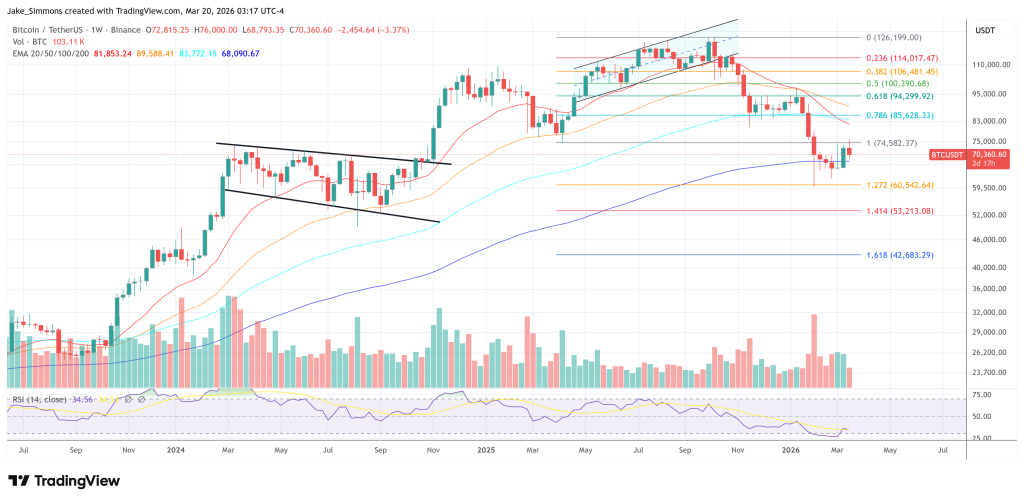
Featured image created with DALL.E, chart from TradingView.com

Editorial Process for bitcoinist is centered on delivering thoroughly researched, accurate, and unbiased content. We uphold strict sourcing standards, and each page undergoes diligent review by our team of top technology experts and seasoned editors. This process ensures the integrity, relevance, and value of our content for our readers.
Crypto firms are slashing jobs — and they’re mostly citing the same reason – DL News

- Crypto firms have laid off hundreds of employees so far this year.
- They broadly attribute the cuts to AI.
- It’s unclear if firms are simply window dressing pre-planned cutbacks.
Crypto firms are cutting hundreds of employees from their workforces despite a hiring spree for crypto roles among some of Wall Street’s biggest firms.
Some of the latest victims? Employees at Crypto.com, a Singapore-based crypto exchange founded in 2016, who announced on Thursday that it had cut 12% of its workforce.
And like many of the firms reducing their workforce, Crypto.com broadly blames their actions on one thing: artificial intelligence.
“We are joining the list of companies integrating enterprise-wide AI,” Kris Marszalek, Crypto.com’s CEO and co-founder, said.
“Companies that do not make this pivot immediately will fail. Companies that move immediately and pair the best AI tools with top-performers will achieve a level of scale and precision that was previously impossible.”
The exchange joins more than half a dozen crypto firms that have announced similar layoffs since the start of the year, which includes fellow exchange Gemini, data platform Messari, and Optimism Labs, the firm behind the Ethereum layer 2 blockchain.
For years, analysts have warned that as AI develops it will increasingly replace white collar employees, particularly in administration, customer service, and entry-level roles.
AI window dressing?
It’s not just crypto firms cutting jobs and blaming it on AI.
Amazon, Meta, Atlassian, and dozens more firms have also laid off thousands of employees in recent years as they pivot to integrating AI into their workflows.
Yet it’s unclear if these firms are simply window dressing pre-planned cutbacks by framing them as efficiency gains brought about by AI adoption.
In January, research conducted by Oxford Economics, an independent global advisory firm, cast doubt on the idea that AI is to blame for increasing unemployment.
According to the firm’s analysis, “firms don’t appear to be replacing workers with AI on a significant scale,” suggesting companies may be using the technology as a cover for routine headcount reductions.
What’s more, some companies are reportedly rehiring staff they initially thought they could replace with AI, indicating the technology is not yet fully mature for mass replacement.
Earlier this week, Block, the fintech firm behind Cash App, quietly rehired some of the 4,000 employees it laid off last month as part of its AI-driven restructuring.
Still, many of the crypto firms cutting jobs are keen to advertise them as a necessary consequence of increasing their efficiency through AI.
“We’re doubling down on Messari as an AI-first company serving institutions through research and AI products,” Diran Li, the firm’s new CEO, said on Monday after previous CEO Eric Turner stepped down amid widespread job cuts at the firm.
It’s a similar story over at Gemini, the crypto exchange started by Cameron and Tyler Winklevoss.
“Not using AI at Gemini will soon be the equivalent of showing up to work with a typewriter instead of a laptop,” the exchange said in a Thursday letter to shareholders. “As a result, we have reduced the size of our workforce by roughly 30% since the start of 2026.”
Not just AI
Not everyone is blaming AI for their job cuts, however.
Optimism Labs, one of the most active organisations scaling the Ethereum blockchain, cut some 20 jobs on March 12.
“This is about doing fewer things well, making decisions faster, and reducing coordination overhead,” Jing Wang, the firm’s CEO, said.
The cuts come after Coinbase announced plans to stop sharing revenue from its layer 2 network Base with Optimism in February.
More recently, the Algorand Foundation, a nonprofit that helps develop the Algorand blockchain, announced that it had cut its workforce by 25%.
“This decision was not taken lightly and is in response to the uncertain global macro environment as well as the broader downturn in crypto markets,” the foundation said on Wednesday.
Since the start of the month, the US and Israel’s war with Iran has caused oil and gas prices to soar, sending shockwaves throughout the global economy.
Analysts warn that a spike in inflation driven by higher oil prices could spell further trouble for stocks, gold and crypto.
Tim Craig is DL News’ Edinburgh-based DeFi Correspondent. Reach out with tips at tim@dlnews.com.