Bitcoin climbed 3.1% to $70,352 on Tuesday morning, recovering from the weekend’s slide below $68,000, with ether (ETH), solana’s SOL, dogecoin and xrp gaining between 2-4%.
The Wall Street Journal reported Tuesday that Saudi Arabia has agreed to give the U.S. military access to King Fahd Air Base, reversing its earlier position that its bases couldn’t be used to attack Iran. The UAE has taken similar steps.
Gulf states joining the war directly would transform the conflict from a U.S.-Israel operation into a broader regional coalition, a significant escalation from what markets had been pricing.
Iran’s deputy speaker ruled out talks with the U.S., echoing the Fars news agency denial from Monday evening. The Strait of Hormuz remains effectively shut with only a trickle of vessels making their way through.
Traditional markets responded immediately. S&P 500 futures fell 0.5%. European shares were set to drop 0.8% at the open. Brent crude jumped 4% to about $104. The dollar strengthened 0.3%. Gold fell 1.5%, extending what is now its longest daily losing streak on record.
The gold collapse continues to be the most disorienting signal in global markets. A safe-haven asset falling to record losing streaks during an active and widening war breaks every historical precedent.
The most likely explanation is forced selling by funds facing margin calls across other positions, with gold being the most liquid asset to sell. But whatever the cause, it makes bitcoin’s relative stability even more notable. The token that’s supposed to be the volatile one is holding a range while the one that’s supposed to be steady is in freefall.
The five-day window Trump gave Iran expires Saturday, but Saudi Arabia joining the conflict changes the calculus entirely. A regional coalition fighting Iran is a different war from a U.S.-Israel air campaign, and it puts oil infrastructure on both sides of the Gulf at risk.
Bitcoin is holding $70,000 on a Tuesday morning where everything else is deteriorating. Whether that’s resilience or just the market waiting for the next headline to react to is the question the rest of the week will answer.
Bitcoin (BTC) spot volumes on Binance have dropped to their lowest level since September 2023, indicating that the current intraday price rise may not be backed by strong demand.
The rally above $71,700 on Monday appears to be driven mainly by news headlines and liquidations in the Bitcoin futures markets.
Binance volumes and exchange flows signal the demand gap for BTC
Crypto analyst Darkfost said that March is on track to record the lowest Binance spot volume since Q3 2023, at roughly $52 billion, compared to the $88 billion recorded in September 2023. The activity levels align with the prior bear market conditions, pointing to the reduced participation.
BTC spot trading volume. Source: CryptoQuant
The exchange flow data shows a similar slowdown. Crypto analyst Arab Chain reported $6.38 billion in seven-day cumulative flows on Binance and $5.14 billion on Coinbase. The Binance flows have dropped to the lowest level since 2024, indicating reduced deposit activity.
However, the lower inflows may also coincide with a reduced supply to sell, as fewer coins move onto the exchanges. The Coinbase flows remain relatively stable, reflecting the steadier participation from the long-term investors.
The large-holder activity added another layer. Market analyst Gaah identified a record surge in the whale inflow momentum, which tracks the rate of change in large transfers to the exchanges.
The current reading of 74.3 surpasses all prior cycle peaks over the past 11 years, with a higher level last recorded at 124.6 in 2015.
The elevated inflow velocity signals an aggressive capital rotation and hedging, increasing BTC’s sensitivity to short-term volatility over the next few weeks.
The BTC rally followed reports that President Trump had deferred the planned US strikes on Iran’s energy infrastructure for five days after citing progress in the diplomatic discussions, a claim later rejected by Iran’s foreign ministry, which denied that any talks had taken place.
BTC still pushed to a weekly high of $71,789 on Binance during the US market session, driven by the above external catalyst rather than by spot demand or futures positioning, leading the move.
Data shows the rally coincided with a reduction in leverage. The aggregated open interest declined by about 9,700 BTC, marking a 4% drop over 13 hours.
The open interest tracks the total number of active futures contracts, and the decline during a price increase signals that the positions were being closed rather than new ones being opened.
BTC/USDT price, aggregated open interest, liquidation, and Coinbase premium. Source: velo.data
This type of move typically occurs when short positions are forced out of the market, reducing the total exposure while pushing the price higher. Binance recorded over $44 million in short liquidations within one hour, the largest since the one-hour long liquidations of $53 million on Feb. 6.
The Coinbase premium (in percentage terms) remained negative during the move, indicating limited spot demand from US participants.
The falling open interest, high liquidations, and weak premiums suggest the move higher was driven by positions being closed rather than new money entering the market, with most of the activity clustered around the $71,000–$72,000 range.
Related: Gold slides as traders eye sub-$50K BTC: Five things to know in Bitcoin this week
This article does not contain investment advice or recommendations. Every investment and trading move involves risk, and readers should conduct their own research when making a decision. While we strive to provide accurate and timely information, Cointelegraph does not guarantee the accuracy, completeness, or reliability of any information in this article. This article may contain forward-looking statements that are subject to risks and uncertainties. Cointelegraph will not be liable for any loss or damage arising from your reliance on this information.
Delaware lawmakers introduced Senate Bill 19 on Monday afternoon, aiming to establish one of the nation’s first state-level regulatory regimes for payment stablecoins aligned with federal law. SB19 Requires 1:1 Reserves and Monthly Audits for Stablecoin Firms The proposed Delaware Payment Stablecoin Act or Delaware Banking Modernization Act lays out a licensing and oversight structure […]
From fine dining to breweries, leading operators and local icons are choosing Square for its stand-out product innovation, ease of use, and transparent pricing
Square’s comprehensive platform, product velocity, and intuitive design and pricing are driving restaurants to switch to the platform. Square recently reported that GPV from its food and beverage sellers grew 16% year-over-year in Q4 of 2025¹ as more businesses from fine dining establishments to breweries choose Square to power their operations.
“Restaurants are tired of overpaying for technology that isn’t working for them and their businesses. At Square, our food and beverage business is growing, and that’s because we’re committed to serving sellers with innovation, transparency, and ease of use,” said Nick Molnar, Head of Sales and Marketing at Block. “Even with more complex business models, restaurants are using Square to save time and money so they can focus on hospitality.”
How leading operators are using Square
For Michelin-recommended Anajak Thai, Square’s purpose-built features for fine dining and its dedicated support were the key differentiators in switching their business over. The legendary Los Angeles restaurant leverages Square Handheld for quick and precise tableside service, and they use Square’s direct integration with OpenTable to manage reservations and uplevel their hospitality through diner insights and data.
“Our restaurant can’t afford downtime or clunky technology. Square’s platform is intuitive and reliable,” said Justin Pichetrungsi, James Beard–awarded chef and owner of Anajak Thai. “But what really sets Square apart is the people behind the product – they listen, they care about our success, and they’re constantly innovating. That’s the kind of partner you want when you’re running a business at this level.”
Saucy Brew Works in Cleveland, Ohio transitioned to Square to enhance operational efficiency and unlock savings and flexibility for future growth. Across their five locations, the business is using Square Handheld, Square Stand, Square Staff, and the Square Kitchen Display System to manage front and back-of-house operations, and they are using integrations like Restaurant365 and Tripleseat to help power employee scheduling and event management, respectively. The brewery is also rolling out Square Bitcoin payments to all of its locations, and as a result of the switch to Square, they’re set to save on costs between processing and subscription fees.
“Our previous point-of-sale provider was getting out of touch on what a small business needed as far as pricing. It came to a point where we realized we were overpaying and they were underdelivering,” said Michael Grasso, director of restaurant operations at Saucy Brew Works. “With Square, sitting down with the team made the difference. They laid everything out really well so we could see the value.”
Lotus of Siam, a renowned Thai restaurant chain based in Las Vegas, also looked for cost savings and ease of use when shopping for a new point of sale provider to power their three locations. Given frequent internet blackouts in their area, too, they needed a reliable platform like Square that offered easy mobile and offline payments. Lotus of Siam is using Square Handheld, Square Stand, and Square Staff to manage the front and back of house, and have been leveraging insights from Square AI to both better understand their business and onboard employees faster.
“Square is dummy-proof, and it’s a lot easier to read when you’re looking at your sales and your reports. I have three managers who don’t have to call me in the middle of the night and ask me, ‘Hey, how do I do this?’” said Penny Chutima, owner of Lotus of Siam. “And so it actually helps us manage our funds a lot better. We’re also getting cost savings on the product, too – as of today, we’re now saving five figures with Square.”
Why the Square difference matters
Today’s restaurant operators face unprecedented pressure: labor costs are climbing, consumer expectations are rising, and the technology landscape has become increasingly fragmented. Many find themselves juggling multiple disconnected systems, each with its own pricing model and learning curve. The result is wasted time, wasted money, and a constant struggle to keep up – leaving little room for the strategic decisions that actually grow a business.
That’s where Square comes in. Square delivers technology that simplifies operations, reduces costs, and gives restaurants back the freedom to focus on what matters most – their customers and their business. Which is why leading hospitality businesses across all segments are making the switch.
With just over a week left in the month of March, bitcoin is narrowly on track to avoid a historic losing streak. The asset is up around 2% on the month, holding above $68,000. However, a late pullback would see bitcoin close six consecutive months in the red, matching the longest negative streak on record, last seen between August 2018 and January 2019.
From a technical standpoint, the 200-week moving average, (200WMA), remains a key level to watch. This metric, which tracks bitcoin’s long-term trend by averaging its closing price over the past 200 weeks, has historically acted as strong support during bear markets.
In the current cycle, the 200WMA sits near $59,000. bitcoin dropped to as low as $60,000 in early February and has since consolidated above this level for nearly two months, suggesting continued strength at this key support. Notably, the 2022 bear market remains the only cycle where bitcoin spent a prolonged stretch below the 200WMA, from June through December.
BTC 200WMA (Glassnode)
Beyond USD price action, bitcoin is also beginning to show relative strength against gold. It is on track to post its first positive monthly candle versus gold in eight months, with the bitcoin to gold ratio currently around 16 ounces. Gold, meanwhile, is trading near $4,200 after recently dropping towards $4,000, 5% down on the day. Gold is now down over 25% from its January all time high, wiping out $7.5 trillion in market cap value.
Historically, each cycle has seen smaller drawdowns in the bitcoin to gold ratio from its peak. In this cycle, bitcoin declined roughly 71% against gold from its all-time high in December 2024. These peak to trough cycles have typically lasted around 400 days, suggesting the current downturn may be over denominated in this ratio.
If bitcoin can maintain support above the 200WMA while regaining strength against gold, it would reinforce the view that the broader uptrend remains intact.
Bitcoin climbed above $71,000 today, offering bulls their first glimpse of relief since February’s collapse.
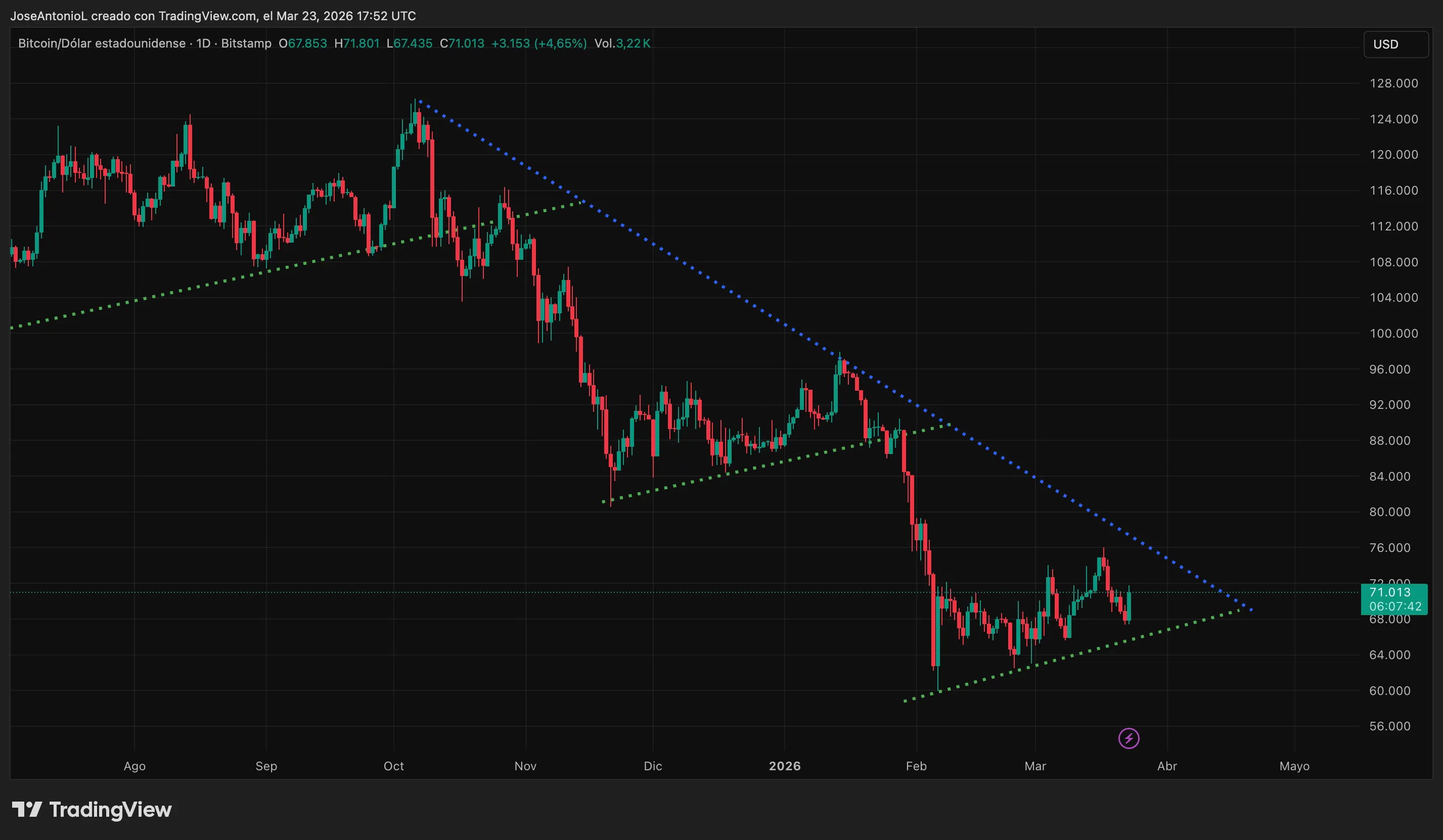
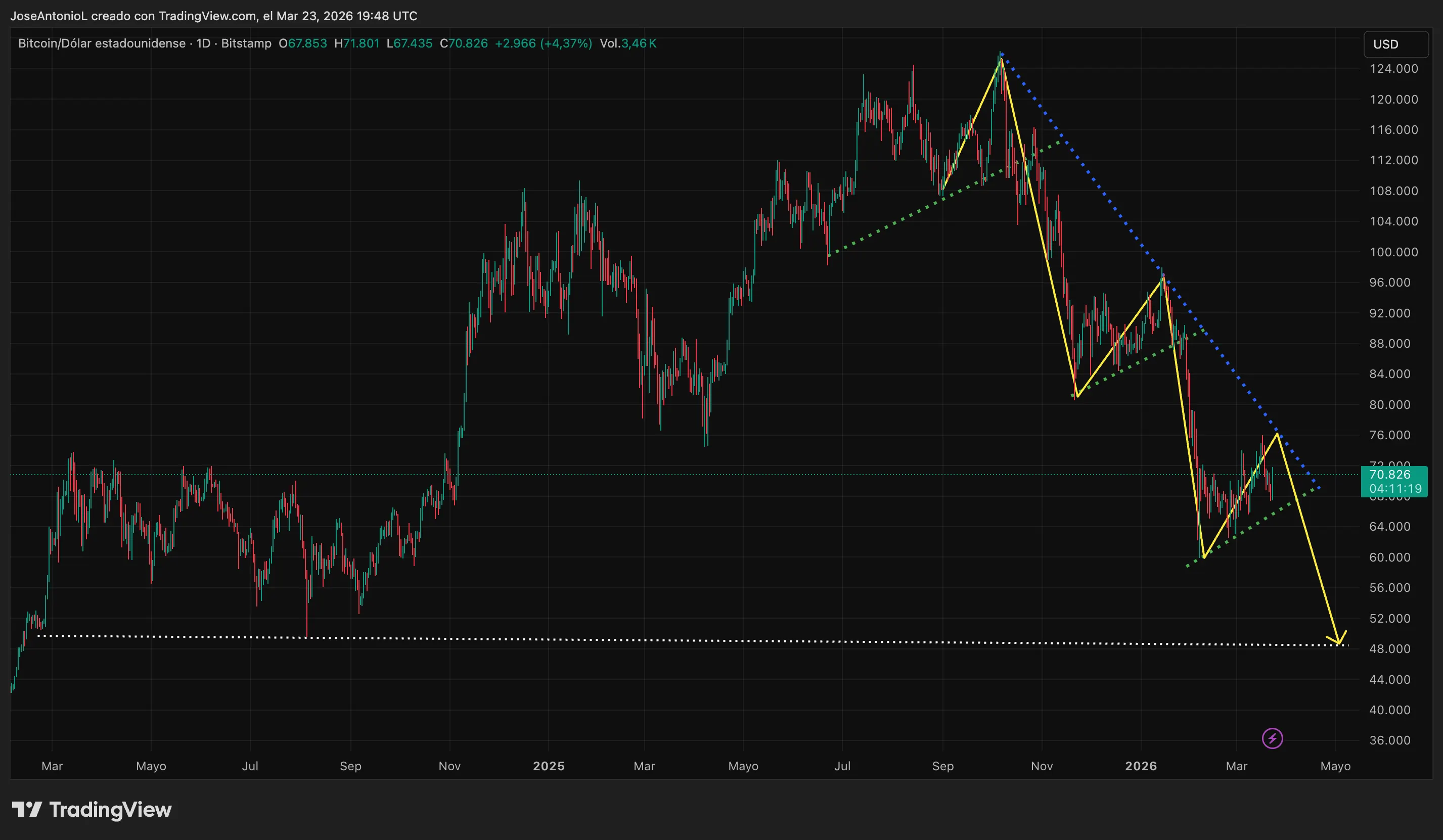
At the same time, the price move has formed the same compressive wedge pattern that preceded Bitcoin crashes in October 2025 and January 2026.
On Myriad, traders are calling it a toss up on whether Bitcoin pumps to $84K or dumps to $55K first.
After a brutal February that took Bitcoin from the mid-$90,000s all the way down to a $59,000 low, the market finally has something to feel decent about. BTC is up roughly 4.65% today, trading around $71,013 and shaking off some of the fear that dominated the last several weeks.
The problem is, in doing so, Bitcoin has drawn an all too familiar pattern on its charts—and one that suggests a price crash could be in the cards.
The broader market, meanwhile, is still anticipating hard times. Stocks sunk to four-month lows after news of a delay to potential U.S.-Iran military strikes, pushing crypto alongside equities in a mild risk-on move. WTI crude dropped sharply, and the crypto market is once again in “extreme fear” territory, based on the Crypto Fear and Greed Index.
Despite this, some Bitcoin bulls believe this is a good time to buy, considering the last time Bitcoin had a similar spike was at the beginning of the month. So who’s right? Here’s what the charts say:
Bitcoin (BTC) price: by the numbers
Bitcoin is, indeed, having a nice start to the week: a 4.6% spike, going from $67,844 to a daily high of $71,811, before settling around its current price of $70,985. This movement is trying to break past the resistance of the average price of Bitcoin in the last 200 days, which is a real test of trend strength.
Bitcoin price data. Image: Tradingview
Dig deeper and the picture gets more nuanced. The ADX—the Average Directional Index, which measures how strong any trend actually is—sits at 19.1. That’s below 25, the threshold traders use to confirm a trend has real legs. At 19.1, it’s a sign of a weakening trend, which means bears are struggling to maintain the broader crash’s momentum.
The exponential moving averages, or EMAs, tell a similar story. The 50-day exponential moving average is still trading below the 200-day, which traders would interpret as the clearest signal of a bearish trend. Exponential moving averages smooth out price action over time to help identify where the price of an asset finds support or resistance. When the short-term average sits below the long-term one, it usually means the prevailing direction is still down, even during bounces.
The Relative Strength Index, or RSI, at 51.5 is also neutral. It is not screaming buy or sell, which makes sense. Bitcoin is in that in-between zone where it’s too early to celebrate and too soon to panic (again).
The Squeeze Momentum Indicator is on, with momentum reading a modest 0.26. This number tracks when a market is coiling up energy before a big move—like a spring being compressed or prices stabilizing after a major trend. It’s on right now, meaning the spring is loading. But with momentum still low, we haven’t seen a direction yet.
Fool me once…
Here’s what makes this moment more than a run-of-the-mill bounce: The chart is drawing a pattern it has now drawn twice before—and both times, it ended badly.
Bitcoin price data. Image: Tradingview
There’s a blue descending resistance line running from Bitcoin’s October 2025 peak, around $125,000, all the way down through the current price level. This is the roof. Bitcoin keeps trying to push up and the line keeps capping it. (That’s why it’s called a resistance.)
Below price action, there are three green dotted ascending lines, running parallel to each other. These are the supports. After each major crash, Bitcoin compresses: It bounces off the ascending green floor, climbs toward the blue ceiling line, and the range gets tighter and tighter until something breaks and the price crashes.
It happened after the October 2025 crash. Bitcoin recovered into that same wedge structure, touched resistance, and then broke down hard one month later.
It happened again after the January 2026 crash. Same wedge, same compression. Then the February 2026 wipeout to $59,000.
And right now Bitcoin is forming the exact same structure. The ascending support line is acting as the floor once more. The descending blue line is sitting just overhead, roughly around $70,000 depending on when it arrives. If the pattern holds, a third rejection somewhere in April or May 2026 would be on the table.
Bitcoin price data. Image: Tradingview
On Myriad, a prediction market built by Decrypt’s parent company Dastan, the question on everyone’s mind is framed plainly: “BTC next move: Pump to $84K or Dump to $55K?”
Right now, traders are placing 51.4% odds on the bullish outcome. But that’s not a ringing endorsement of Bitcoin’s health—it’s a toss up, and likely a reflection of how extreme the $55K scenario feels.
Most traders probably can’t stomach betting on a number that low, not because they’re convinced BTC is going up, but because the downside seems too painful to price in. The gap between bulls and bears is tight and follows the market sentiment.
The one thing that could change the story
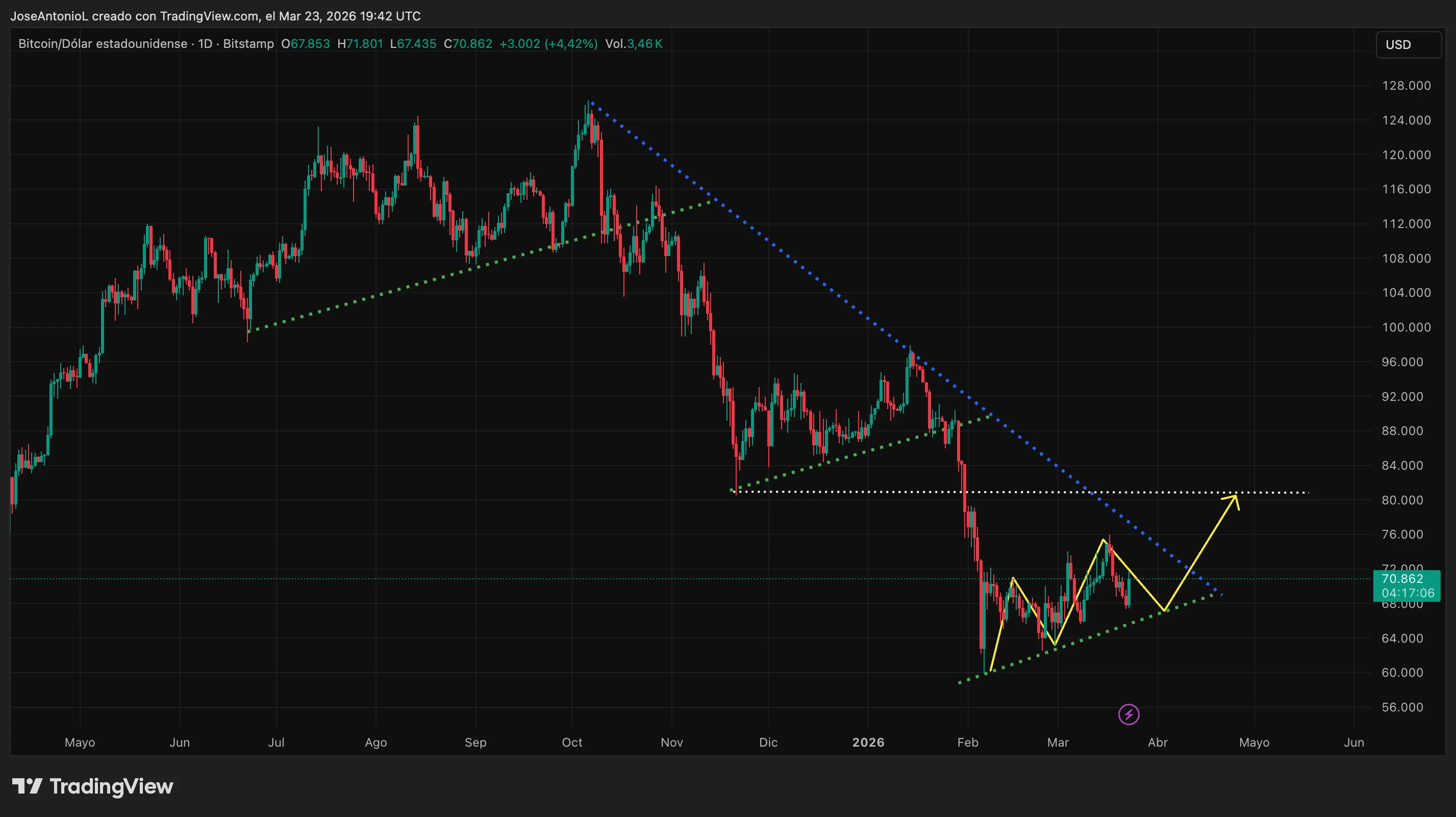
There is a scenario, though, where everything flips. If Bitcoin can break through that descending blue resistance with a strong, high-volume candle—not just touch it, but close decisively above it—followed by a series of candlesticks closing on top of the broken resistance, that would be a real signal. It would suggest the pattern has finally been broken, and that the market may have actually found a bottom around the $59,000–$64,000 range from early March.
If it respects its current support, the $80K zone becomes the next technical milestone to conquer.
That would be the kind of move that forces even skeptics to reconsider. Resistance lines that get convincingly broken tend to flip into support. (That’s just how these market dynamics work.)
But right now? The pattern is intact. Bitcoin may look nice in the short term. The immediate indicators look neutral instead of heavily bearish, the daily candle is green, and the shorts are hurting a little. None of that is reason to ignore what three data points of the same setup are telling us.
For bulls, the champagne will likely have to wait.
Disclaimer
The views and opinions expressed by the author are for informational purposes only and do not constitute financial, investment, or other advice.
Daily Debrief Newsletter
Start every day with the top news stories right now, plus original features, a podcast, videos and more.
Balancer Labs, the team behind the decentralized finance protocol Balancer, is shutting down after mounting financial pressure and a $116 million hack in November, with executives proposing continuation of the protocol under a leaner, more cost-effective structure.
“After careful consideration, I have decided to wind down Balancer Labs. This is not a decision I take lightly,” one of Balancer Protocol’s founders, Fernando Martinelli, said on Monday, adding that Balancer Labs has become a “liability rather than an asset to the protocol,” as it has been operating without revenue.
Balancer Labs CEO Marcus Hardt added that it was spending too much to attract liquidity relative to the revenue the protocol is making, a strategy that came at the cost of diluting Balancer (BAL) token holders.
Source: Marcus Hardt
Balancer was one of the more notable DeFi protocols during the 2020–2021 bull market, reaching a peak of $3.3 billion in total value locked (TVL) in November 2021.
However, that figure fell to $800 million by October 2025, with the hack leading to another $500 million TVL drop over the next two weeks. Balancer’s TVL has since fallen to $158 million, showing how challenging it is for DeFi protocols to recover from large-scale hacks.
Martinelli said the November exploit “created real and ongoing legal exposure” and that maintaining a corporate entity that carries the liability of past security incidents wasn’t sustainable.
Balancer Labs executives outline restructuring plan
Moving forward, Hardt and Martinelli are pushing for Balancer’s future to be managed by the Balancer Foundation and the protocol’s decentralized autonomous organization.
Martinelli advocated for Balancer to adopt a more “lean continuation path,” which involves cutting BAL emissions to zero, restructuring fees to enable Balancer’s DAO to capture more revenue, reducing the team as much as possible and targeting lower operating costs.
“Balancer still has real value to build from here. If we can make this transition work, we have a real chance to build a stronger and more sustainable protocol on the other side of it,” Hardt said.
Balancer DAO members have been asked to vote on two proposals reflecting possible changes in Balancer’s operational restructuring and BAL’s tokenomics.
Related: OP_NET launches Bitcoin DeFi push without bridges or wrapped BTC
Despite the tokenomics issues, Martinelli noted that Balancer is “still generating real revenue” at over $1 million across the past three months:
“That’s not nothing — that’s a functioning protocol buried under a broken tokenomics model and an overweight cost structure,” he said.
“The problem isn’t that Balancer doesn’t work. The problem is that the economics around Balancer aren’t working. Those are fixable.”
Magazine: Are DeFi devs liable for the illegal activity of others on their platforms?
Cointelegraph is committed to independent, transparent journalism. This news article is produced in accordance with Cointelegraph’s Editorial Policy and aims to provide accurate and timely information. Readers are encouraged to verify information independently. Read our Editorial Policy https://cointelegraph.com/editorial-policy
SEC defines when crypto assets become securities while outlining five core categories, tying regulatory treatment to issuer-driven profit expectations and clarifying how different types of digital assets are evaluated under U.S. law. SEC and CFTC Outline Crypto Asset Classification Rules A regulatory shift is redefining how crypto assets are treated under U.S. securities law, as […]
Bitcoin BTC$70,450.78 is trading near $68,250, returning to a price range that dates back to early February after multiple failed attempts to convincingly surpass $75,000.
The most recent selloff occurred on Saturday, after U.S. President Donald Trump threatened to “obliterate” Iran’s power plants unless the country opened the Strait of Hormuz within 48 hours.
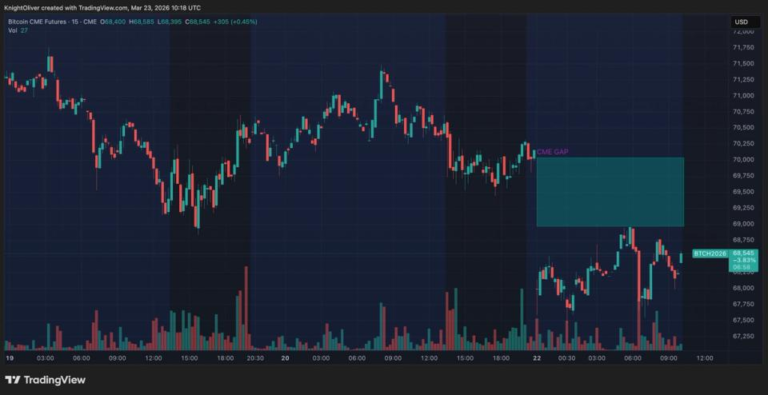
The weekend price action led to a CME gap — the difference between the price of bitcoin when futures on the exchange end the week on Friday and when they resume trading on Sunday evening. That gap would be filled if bitcoin recovers to $70,000 on Monday.
Gold and silver took another leg down on Monday with January’s record highs now seemingly confirmed as a result of speculative mania rather than a genuine safe-haven move.
In contrast, the Dollar Index (DXY) is back trading above 100, buoyed by inflation fears and a halt to the Fed’s interest-rate-cutting cycle.
The altcoin market has underperformed bitcoin since midnight UTC, with decentralized finance (DeFi) tokens ETHFI, HYPE and SKY losing around 3% while BTC is in the black after falling on Saturday and Sunday.
Derivatives positioning
Over $400 million worth of leveraged crypto futures bets have been liquidated in the past 24 hours. More than $280 million were longs, the most since Feb. 25, a sign bullish bets have taken a sizeable hit due to bitcoin’s Sunday drop.
Open interest (OI) in futures tied to gold token PAXG has increased 4% in 24 hours as investors pulled capital from futures on major cryptocurrencies, including BTC. Ether’s OI increased by just under 1%.
On decentralized exchange Hyperliquid, Brent crude, WTI crude, gold and silver perpetuals rank among the top 10 perpetual contracts by open interest, surpassing major tokens such as XRP. Volume profiles show a similar bias for traditional commodities.
Funding rates paint a mixed picture of the market sentiment. Traders seem to be chasing bearish exposure in tokens such as XRP, BNB, SOL, TRX, DOGE and ADA, as evidenced by their negative funding rates. Meanwhile, rates for BTC, BCH, HYPe, XMR, and LINK remain positive, indicating strong sentiment.
BCH and LINK also boast a positive 24-hour cumulative volume delta. This, coupled with positive funding rates, points to sustained net buying pressure, with leveraged traders positioning for further upside in both tokens.
BTC’s 30-day implied volatility index, BVIV, has bounced to 60% from 53% on Wednesday, indicating renewed uncertainty and fear as the Iran war drags on and major banks point to a sustained oil price rally ahead.
Ether’s volatility index, EVIV, jumped to 84% on Sunday, the highest since early February.
On Deribit, BTC put options are priced at a premium of eight volatility points to call options out to the June-end expiry. This indicates a strong demand for hedging against potential price declines.
Block flows featured an outsized demand for BTC put spreads, a bearish strategy and ETH straddles, a bet on volatility.
Token talk
CoinDesk’s DeFi Select Index (DFX) is the worst-performing benchmark on Monday, losing 0.75% since midnight UTC, while the CDMEME and SCPXC are down by around 0.4%
Privacy tokens bucked the bearish trend, with DASH, NIGHT, and XMR all rising by 3% to 5% over the past 24 hours. The sector performed well at the tail end of 2025, buoyed by improving sentiment around anonymous transactions and improved regulatory clarity.
CoinMarketCap’s “Altcoin Season” index is at 49/100, receding slightly from last week’s high of 53, but substantially higher than last month, when it dipped to 22.
One reason to be optimistic is the average relative strength index (RSI), which is currently in “oversold” territory, suggesting a bounce for several altcoins could be on the cards this week.
Aave v4 cleared an initial hurdle with near-unanimous support from the Aave DAO.
If it passes another vote, it will debut with “conservative parameters and minimal assets.”
A forthcoming version of the multibillion-dollar Aave protocol dubbed “v4” cleared an initial hurdle on Monday when Aave DAO voted to launch the “next-generation credit infrastructure” on Ethereum.
Aave v4 still faces another vote in the coming weeks. But its near-unanimous support from the DAO was significant, as its impending release had become a point of contention within the DAO.
The current version of the protocol, Aave v3, is the largest in decentralised finance, with more than $25 billion in user deposits. But its creator Aave Labs has pushed for the DAO to turn its attention to v4.
Aave is the largest protocol in DeFi.
That push was among several issues that led to the acrimonious departures of two major contributors to the DAO, Bored Ghosts Developing and Aave Chan Initiative. Both have said they will not seek DAO renewal of their contracts this year.
Last month, Aave Labs proposed pausing work to improve v3 and even changing its lending and borrowing parameters in order to compel users to migrate to v4.
Bored Ghosts said it was a step too far.
“We believe even proposing this on the main revenue-maker & fully functional engine of Aave, is borderline outrageous,” it wrote.
Labs later backtracked, saying there would be “no forced migration.”
“While we think it is important for the DAO to align strategically behind V4 as part of this proposal, the timeline is up for discussion,” Labs wrote in the Aave governance forum.
“Aave V3 is a battle-tested protocol, and it will continue to operate as a core part of the ecosystem for as long as the DAO decides it should.”
Still, Labs says v4 will dramatically expand the amount of revenue the DAO can collect through a hub-and-spoke model that allows for tailored lending markets without fracturing liquidity.
“At launch, [v4] will serve V3 users with higher capital efficiency and more advanced features,” the company previously wrote.
The proposal approved on Monday by the DAO prioritises security over “immediate growth.”
“It will bring V4 online with conservative parameters and minimal assets,” the proposal reads. “When live conditions support it, the DAO can lift caps, extend or resize credit lines, onboard additional assets, and configure new Hubs or Spokes.”
Aleks Gilbert is DL News’ New York-based DeFi correspondent. Have a tip? Email him at aleks@dlnews.com.