Home Blog Page 673

OpenAI Needed to Cut Sora for Enterprise Strategy

0

OpenAI’s decision to shut down its Sora AI video app and end its deal with Disney is another telltale sign that the AI vendor is focusing on enterprises and beginning to streamline some of its consumer commitments.

OpenAI on March 24 said goodbye to the Sora app, though the exact timeline for its departure is unclear. The decision to let go of the app comes six months after the vendor launched Sora 2, a video model, and a new social media app that lets users create and remix a feed featuring both AI and humans. With the Sora app going viral, Disney agreed to invest $1 billion in equity in OpenAI, which would have made Disney a key corporate backer. The deal involved a three-year licensing agreement that would have enabled Sora users to generate short videos using Disney Animation, Pixar, Marvel and Star Wars.

With its decision to get rid of Sora, OpenAI continues the transition it began in 2025, when the AI vendor increasingly started targeting the enterprise, especially as it seeks to go public. Despite the virality and success the ChatGPT maker has had with its AI chatbot, and even with the Sora app, it has made moves in the last year that suggest more financial opportunities in the enterprise market than with consumers. For example, it has formed multiple partnerships, including with other vendors such as Oracle and Nvidia. Added to that, its rival Anthropic has found enormous success in the enterprise market with its Claude chatbot.

Related:Musk Reveals Chip Megaproject Spanning Tesla, SpaceX and XAI

A Needed Move

The decision to let go of the Disney deal can then be seen as a positive sign that the vendor is becoming more focused, said Mark Beccue, an analyst at Omdia, a division of Informa TechTarget.

“They can’t chase everything,” Beccue said. Moreover, video is inference-heavy, which is expensive, and OpenAI might have realized that. “They’re understanding that now a little better or realizing they can’t do everything, and they’re going to shed compute loads that aren’t as important.”

On the other hand, OpenAI’s decision to end Sora and even let go of its deal with Disney is also indicative of what the vendor is hearing from investors as the company seeks an IPO, Beccue added. He said that, given OpenAI’s high cash burn rate, investors might advise the company to take steps to address it. In 2025, the vendor’s actual revenue was about $13 billion, but its net loss was $8 to $9 billion. Therefore, Beccue said it won’t be surprising if the vendor decides to shed other projects and refine and reorganize its internal team.

“They’re a little late to the game on getting their ducks in a row on what is their go-to market strategy,” Beccue said. “There’s always more money consistently in enterprise than there is in consumer.”

Related:AI2’s Computer Use Agent Can Execute Actions Online

BitGo, ZKsync build tokenized deposit infrastructure to bring banks onchain

0

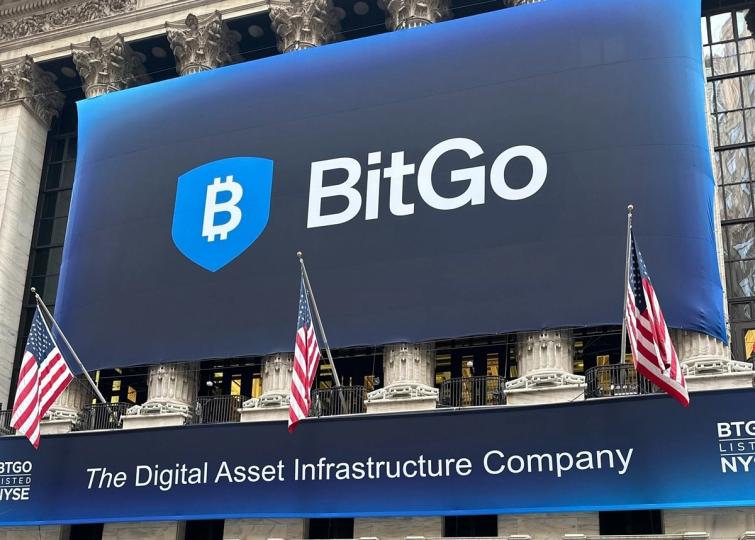
BitGo and ZKsync are teaming up to offer banks a full-stack infrastructure for tokenized deposits, as financial institutions look to bring traditional money onto blockchain rails without stepping outside regulatory boundaries.

The effort combines BitGo’s institutional custody and wallet services with ZKsync’s Prividium, a permissioned, privacy-preserving blockchain designed for regulated entities. The joint offering aims to enable banks to issue, transfer, and settle tokenized deposits while maintaining compliance and control.

The move reflects a growing trend among crypto infrastructure firms to court banks by packaging blockchain capabilities into compliance-friendly systems—sidestepping the need for institutions to build and manage complex onchain architecture themselves.

Tokenized deposits have emerged as a new trend for banks experimenting with blockchain-based payments. Unlike stablecoins, which typically sit outside the traditional banking system, tokenized deposits keep funds within it, potentially enabling programmable transactions without altering existing regulatory frameworks.

ZKsync creator Matter Labs is positioning its Prividium network as a bridge between public blockchain innovation and institutional requirements such as privacy and permissioning. Matter Labs CEO Alex Gluchowski said in a press release that tokenized deposits represent “how banks bring money onchain without leaving the regulatory system.”

The companies said the combined stack is already being tested with regulated financial institutions, with broader production rollout targeted for later this year.

Read more: BitGo, Susquehanna Crypto offering institutional OTC access to prediction markets

Pundit Says Real XRP Adoption Is Here, What Investors Are Missing

0

Trusted Editorial content, reviewed by leading industry experts and seasoned editors. Ad Disclosure

According to a pundit, the loudest argument against XRP has never been about technology; it has been about proof that the XRP Ledger is doing something outside of the XRP price movements. XRP keeps getting judged almost entirely by its price, but that outlook is becoming increasingly difficult to sustain.

A crypto pundit known as X Finance Bull on X has pointed to a dataset that most market participants are overlooking, and the numbers embedded in it tell a story that reveals real XRP adoption is already creeping in.

The XRP Numbers Nobody Is Looking At

XRP briefly pushed above $1.50 and touched $1.60 last week, but that move was rejected and the price has since fallen back to the low-$1.40s. Despite the price action, many analysts are still bullish based on XRP’s adoption potential. At the time of writing, XRP is trading at $1.42, which helps explain why many investors still feel like adoption has not shown up where it matters most. 

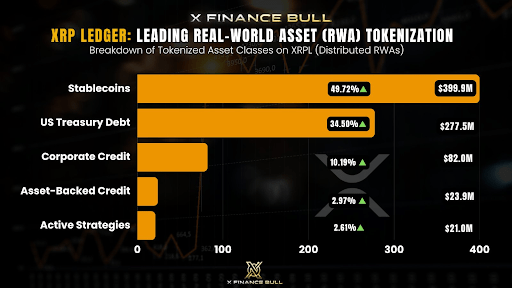
That is the gap X Finance Bull focused on in his post on X. His point was that investors are still searching for real adoption in the price chart, even though the XRP Ledger itself is showing rising use in tokenized finance. According to the figures he shared, XRPL now holds more than $804 million in distributed real-world assets across five classes, led by $399.9 million in stablecoins and $277.5 million in tokenized US Treasury debt. 

The image attached to his post also places corporate credit at $82 million, asset-backed credit at $23.9 million, and active strategies at $21 million. 

XRP Price

XRP Ledger Numbers. Source: @Xfinancebull On X

Stablecoins And Treasury Products Are Doing Much Of The Heavy Lifting

The most interesting line item in the data is stablecoins. As noted by X Finance Bull, the real-world asset tokenization of the stablecoin category has climbed to $399.9 million, up nearly 50% in recent months, with the majority of the inflows based on RLUSD. 

Furthermore, XRPL is now a major venue for tokenized Treasury exposure. According to a February report, RWA.xyz data showed that the XRP Ledger held roughly 63% of the circulating supply for OpenEden’s TBILL product at the time.

That Treasury position has kept growing. In February, Doppler Finance and OpenEden announced a partnership to increase RWA yield on XRPL through TBILL and USDO, a regulated yield-bearing stablecoin.

These numbers matter for XRP’s price action and adoption because they move the conversation away from retail excitement and into infrastructure. Many traders are overlooking the fact that capital is still falling on XRPL-backed securities despite the current poor 2026 market conditions.

Interestingly, daily transactions processed on the XRP ledger have also tripled in the past year. All these provide a strong case that institutional-style adoption is already happening at the infrastructure level. However, XRP’s price performance in 2026 has not reflected the on-chain activity described above.

XRP price chart from Tradingview.com
Price restarts recovery trend | Source: XRPUSDT on Tradingview.com

Featured image from Dall.E, chart from TradingView.com

Editorial Process for bitcoinist is centered on delivering thoroughly researched, accurate, and unbiased content. We uphold strict sourcing standards, and each page undergoes diligent review by our team of top technology experts and seasoned editors. This process ensures the integrity, relevance, and value of our content for our readers.

Visa Bridges Capital Markets and Onchain Payments on Canton Network – Crypto News Bitcoin News

0

Digital Asset Giant Visa Named Super Validator for Canton Network

The payments giant Visa (NYSE: V) announced Wednesday that it will help financial institutions migrate payment flows onchain while maintaining the strict privacy standards required by regulated entities. Visa now stands as one of 40 Super Validators on the network, a role specifically reserved for institutions tasked with stewarding the network’s core infrastructure.

The move addresses a longstanding barrier to entry for legacy banks: the inherent transparency of public blockchains. While transparency is often cited as a benefit of distributed ledger technology, it remains a “dealbreaker” for banks that cannot legally expose sensitive transaction data or payroll details to the public.

Canton Network utilizes a configurable privacy model, allowing organizations to utilize shared infrastructure without leaking confidential information. This architecture permits banks to execute settlement and treasury operations without the risk of exposing proprietary trading positions or margin movements.

Rubail Birwadker, Visa’s Global Head of Growth Products and Strategic Partnerships, emphasized that the firm is bringing “Visa-grade trust, governance, and operational rigor” to the platform. This allows regulated firms to experiment with stablecoin payments without overhauling their existing risk and compliance frameworks.

To date, the Canton Network has seen significant adoption across capital markets for the issuance and trading of tokenized assets. With Visa’s entry, the ecosystem aims to connect those capital market activities directly with onchain payment and settlement layers.

Eric Saraniecki, Head of Network Strategy for Digital Asset and co-creator of Canton, noted that Visa’s participation signals the technology has matured into “production-ready infrastructure.” He suggests this marks a new phase where transactions move with blockchain speed while staying secure.

The partnership is a natural extension of Visa’s broader digital asset roadmap. The company’s stablecoin settlement operations have already reached an annualized run rate of $4.6 billion globally, reflecting a growing appetite for blockchain-based liquidity.

Furthermore, Visa currently supports more than 130 stablecoin-linked card programs across 50 countries. The firm’s specialized Stablecoins Advisory Practice within Visa Consulting & Analytics (VCA) will now guide clients on how to align Canton Network participation with their broader corporate objectives.

As a Super Validator, Visa possesses voting power to shape critical decisions regarding the network’s future and its underlying payment infrastructure. This positioning allows Visa to influence how institutional-grade governance is applied to decentralized networks.

Visa remains “chain-agnostic,” focusing on networks that prioritize a payments-first, institutional approach. By spanning both the governance and payment layers on Canton, Visa offers a familiar bridge for banks wary of the “wild west” nature of many public chains.

FAQ

  • What is the Canton Network? Canton is a public, permissionless blockchain designed to meet the privacy and governance requirements of regulated financial institutions.
  • Why is privacy-preserving blockchain technology necessary for banks? Institutional privacy is required because banks cannot expose sensitive data like payroll or trading positions on a transparent public ledger.
  • What is Visa’s specific role as a Super Validator? As a Super Validator, Visa helps secure the network and holds voting power to shape critical decisions regarding onchain payment infrastructure.
  • How does this impact Visa’s overall stablecoin strategy? This integration complements Visa’s $4.6 billion annualized stablecoin settlement volume by providing a secure, private environment for institutional treasury use cases.

Ondo Tokenizes Five Franklin Templeton ETFs

0

The partnership brings growth, large-cap, fixed income, equity income, and gold ETFs onchain through Ondo Global Markets.

Ondo Finance has partnered with Franklin Templeton to tokenize five of the asset manager’s exchange-traded funds (ETFs). The deal marks the first time Templeton-managed ETFs are available on-chain, extending the $1.7 trillion asset manager’s blockchain footprint beyond its tokenized money market fund.

The five ETFs span a broad range of asset classes: the Franklin Focused Growth ETF (FFOG), an actively managed fund targeting innovative U.S. companies; the Franklin U.S. Large Cap Multifactor Index ETF (FLQL); the Franklin Responsibly Sourced Gold ETF (FGDL); the Franklin High Yield Corporate ETF (FLHY); and the Franklin Income Equity Focus ETF (INCE). The products will be available through Ondo’s Global Markets platform.

Under the arrangement, Franklin Templeton continues to manage the underlying ETFs while Ondo provides tokenization infrastructure and digital distribution. Ondo will acquire shares of the ETFs and issue blockchain-based tokens representing their economic exposure — tokens that do not grant direct ownership of the underlying shares but instead pass through returns to holders. That structure opens the door to DeFi use cases, such as on-chain collateralization, that are not available with traditional fund shares.

The tokenized ETFs will initially be available in Europe, Asia-Pacific, the Middle East, and Latin America, with U.S. availability contingent on further regulatory clarity around how third parties can distribute registered funds on-chain.

The structure bypasses the need for a brokerage account, targeting crypto-native investors who hold assets primarily in wallets and stablecoins. Liquidity will be supported by Ondo’s market makers, including during periods when traditional markets are closed, enabling around-the-clock trading.

The deal also represents a significant expansion for Ondo Global Markets, which launched in September 2025 with over 100 tokenized U.S. stocks and ETFs on Ethereum. Since then, the platform has grown into the largest tokenized securities platform by TVL, with over $700 million locked, according to DeFiLlama.

The Franklin Templeton tie-up adds a new dimension: rather than tokenizing individual equities, Ondo is now wrapping actively managed funds from a top-tier asset manager, offering diversified exposure through a single token.

Ondo’s Rapid Rise

Ondo Finance’s overall TVL stands at roughly $2.7 billion, according to DeFiLlama. The protocol first crossed $1 billion in March 2025 following the launch of Ondo Nexus, and broke through $2 billion less than a year later in January 2026. Ethereum remains the dominant network for Ondo’s tokenized assets, with Solana and BNB Chain accounting for smaller shares.

The platform also received a regulatory boost in late 2025, when the SEC closed a multi-year investigation into Ondo Finance without bringing charges.

The ONDO token is trading at approximately $0.26 with a market cap of about $1.2 billion, according to CoinGecko, down more than 85% from its all-time high of $2.14 in December 2024.

This article was written with the assistance of AI workflows. All our stories are curated, edited and fact-checked by a human.

How a Hot Desk Boosts Productivity for Modern Workers 

0

Workspaces shape how people think, interact, and perform during the day. A quiet corner may help you concentrate, while a lively environment may spark new ideas. Many professionals now look beyond traditional offices for places that better match how they work. In growing business hubs like Sri Lanka, hot desks attract freelancers, startups, and remote teams who want more choice in their work environment. 

This shift reflects a simple idea. The space around you affects how productive you feel. Understanding how hot desks influence focus, creativity, and collaboration can help you make smarter choices about where you work. 

How Hot Desks Increase Productivity for Modern Workers 

Hot desks change the way people approach their workday. Instead of sitting in one assigned spot from morning to evening, you can move between spaces that suit the task at hand. Some areas support quiet focus; others invite conversation and collaboration. 

This variety creates a work environment that responds to your needs rather than forcing you into one routine. Several factors explain how these environments improve productivity. 

Freedom to Choose the Right Work Environment 

Control over your surroundings affects how engaged you feel at work. When you choose where to sit or how to organize your workday, you often feel more responsible for your results. 

Hot desks allow that freedom. You may start your morning in a quiet area while planning your tasks. Later, you may move to a more open space for meetings or conversations with colleagues. This change of setting keeps your energy steady throughout the day. 

A hot desk supports this idea of choice. Instead of working at the same desk every day, you can select a space that fits your needs at the moment. Some days call for quiet focus. Other days involve brainstorming or quick discussions. The ability to adjust your environment helps you stay focused and comfortable. 

Many professionals notice that productivity improves when they match their surroundings with the type of work they are doing. It becomes easier to concentrate, and the workday feels less repetitive. 

Environmental Variety Encourages Creative Thinking 

Routine often shapes how you think. Sitting in the same place every day can lead to predictable habits. The mind grows comfortable with familiar surroundings, and new ideas may come more slowly. 

Hot desks introduce subtle variety. Different seating areas, lighting styles, and layouts create small changes in your environment. Even a simple shift to another desk can refresh your thinking. 

Your brain reacts to these changes. New surroundings provide visual and mental stimulation. That stimulation can help you see problems from another angle or approach tasks with renewed focus. 

Creative professionals often benefit from this change of environment. Designers, marketers, and strategists rely on fresh thinking. A new workspace can prompt new connections between ideas. It does not need to be dramatic. Small changes during the day often make a difference. 

The result feels natural. Your mind stays active, and you avoid the dullness that sometimes appears in rigid office settings. 

Informal Collaboration Sparks New Ideas 

Productivity rarely happens in isolation. Conversations with others often shape better ideas and solutions. 

Hot desking brings together people from many industries and backgrounds. You might sit near a startup founder, a consultant, or a software developer. These shared environments create chances for informal discussions. 

A short conversation during a coffee break may lead to an interesting idea. Someone may share advice about a challenge you face. Another professional may introduce a different way of thinking about a project. 

These moments do not feel like formal meetings. They happen naturally throughout the day. That casual interaction often leads to meaningful insights. 

Traditional offices sometimes separate teams into departments. Employees interact mainly with the same group every day. Hot desks remove those boundaries. They allow people from different fields to share knowledge and experiences. 

The exchange of ideas expands your perspective. It also makes work feel more connected and collaborative. 

A Sense of Community Strengthens Motivation 

Working alone for long periods can drain motivation. Many remote workers know this feeling well. The silence of a home office may help you focus, but it can also create a sense of isolation. 

Hot desks offer a different atmosphere. You remain independent, yet you share the environment with other professionals who concentrate on their own work. 

This shared energy influences how you approach your tasks. Seeing others engaged in their projects often encourages you to stay focused on your own. The environment becomes quietly motivating. 

Community also brings a sense of belonging. Conversations with familiar faces can make the workday more enjoyable. People often exchange ideas, support one another, or celebrate small successes together. 

These connections do not interrupt productivity. They often strengthen it. When you feel connected to the people around you, work becomes more engaging. Many professionals find that this balance between independence and community keeps their motivation steady throughout the week. 

Movement and Flexibility Reduce Mental Fatigue 

Sitting in the same place for hours can affect both your body and your mind. Concentration fades when your environment remains unchanged. 

Hot desks encourage movement. You might switch desks during the day or move to a lounge area for a quick discussion. These small changes help refresh your attention. 

Movement also breaks the monotony of long work sessions. Standing, walking, or shifting to another seat can restore energy. Your mind receives a short reset before returning to the next task. 

This rhythm keeps the workday dynamic. Instead of feeling stuck in one position, you adapt your environment to your needs. The result often feels more natural and less draining. Over time, this flexibility supports better focus and sustained productivity. 

Conclusion 

Productivity depends on more than effort or discipline. The space where you work influences how clearly you think and how easily you connect with others. Hot desks reflect a growing shift toward environments that support choice, interaction, and movement throughout the day. 

When you can adapt your surroundings to match your tasks, work becomes smoother and more engaging. A hot desk represents this modern approach to working. It allows professionals to adjust their environment, meet new people, and maintain fresh energy during the day. As work continues to change, flexible spaces will likely remain a natural part of how many people work and collaborate. 



Prediction Markets Don’t Just Forecast Power

0

Welcome to our institutional newsletter, Crypto Long & Short. This week:

  • Ryan Kirkley on how crypto prediction markets can risk incentivizing manipulation and amplify misinformation at scale.
  • Top headlines institutions should pay attention to by Francisco Rodrigues.
  • Geodnet decoupling suggests fundamental re-rating in Chart of the Week.

Thanks for joining us!

-Alexandra Levis


Expert Insights

Prediction Markets Don’t Just Forecast Power – They Reshape It

By Ryan Kirkley, Co-Founder and CEO of Global Settlement Network

Prediction markets are often pitched as neutral forecasting tools: efficient ways to aggregate information and convert collective belief into a price. That case is not entirely wrong. The academic literature has long found that prediction markets can produce forecasts that outperform many conventional benchmarks. But as someone who believes in crypto’s role in modernizing market infrastructure, I think we should be honest about what the sector is building here. The crypto version of prediction markets is no longer just about forecasting. It is about financializing real-world instability.

That distinction matters. On Polymarket, for example, users can bridge assets from Ethereum, Solana, Bitcoin and other chains; those deposits are converted into USDC.e on Polygon, where fully backed yes/no positions trade and settle on-chain as tokenized claims. In other words, crypto does not merely host these markets. It gives them global reach, cross-chain funding and low-friction settlement. That is impressive market design. It is also exactly what makes the social risk larger.

Once you turn war, political violence, public disorder or institutional breakdown into tradable crypto instruments, you create new incentives for bad actors. The first is obvious: people with privileged information can try to monetize it. U.S. regulators have long recognized that not every event belongs inside a financial market. CFTC Regulation 40.11 bars event contracts involving terrorism, assassination and war, among other categories deemed contrary to the public interest. That is not anti-market moralizing. It is recognition that some contracts do more than reveal information; they can distort behavior around the underlying event.

The second problem is even more serious: prediction markets can reward people who are not just informed about an outcome, but capable of influencing it. Academic research has warned that when traders have outside incentives, or can take actions that affect the underlying event, information aggregation can break down. A market is supposed to measure probability. But when the market itself becomes a source of incentive, it starts to reshape the probability it claims to observe.

That concern is no longer theoretical. Reuters reported this month that markets on Iran strikes and Ayatollah Ali Khamenei’s ouster drew ethics and insider-trading scrutiny after unusually well-timed bets were flagged; in a separate report, Reuters noted that Polymarket removed bets on a nuclear explosion after public backlash. Even if only a small number of traders are acting on nonpublic information, the message to everyone else is corrosive: access, not insight, may be what gets rewarded.

There is a third risk, and it is deeply crypto-native: these platforms increasingly function as media engines as much as markets. Axios reported in February that prediction-market accounts were spreading false, misleading or context-free claims to millions on social media, turning market odds into viral narratives before facts were established. When screenshots of thin or sensational markets circulate as “truth,” bad actors do not need to influence the event itself. They only need to influence the information environment around it.

For advisors and allocators, the mistake is to treat every liquid market as legitimate simply because price discovery exists. Crypto has real work to do: modernizing settlement, improving transparency and making capital markets more programmable. But building the most efficient rails for speculating on war, regime change or civic breakdown is not financial innovation. It is moral hazard at internet scale. Prediction markets do not just forecast power. In their current crypto form, they reshape it by rewarding those most willing to exploit instability.


Headlines of the Week

Francisco Rodrigues

While this week has shown clear progress on the regulatory front, market anxiety coupled with AI disruption has started to affect the crypto industry.


Chart of the Week

Geodnet decoupling suggests potential fundamental re-rerating

Geodnet, a Decentralized Physical Infrastructure Network (DePIN) protocol providing high-precision positioning for Robotics and Physical AI, shows a clear fundamental decoupling. While its price has trended sideways alongside an underperforming DePIN index (down 3% relative to BTC, as per CoinDesk Data), monthly token burns have reached $500,000, currently neutralizing roughly 60–80% of new emissions. This divergence is driven by the growing data revenue from autonomous drone fleets and humanoid robot developers. As the network pivots from infrastructure build-out to a high-margin data layer for the machine economy, the current supply-demand imbalance suggests a potential fundamental re-rating.


Listen. Read. Watch. Engage.

Looking for more? Receive the latest crypto news from coindesk.com and market updates from coindesk.com/institutions.


Note: The views expressed in this column are those of the author and do not necessarily reflect those of CoinDesk, Inc., CoinDesk Indices or its owners and affiliates.

XRP Realizes Its Quietest Month Of 2026 – Traders Watch for What Comes Next

0

Trusted Editorial content, reviewed by leading industry experts and seasoned editors. Ad Disclosure

XRP is consolidating around $1.43. The market is restless. And beneath the surface, a volatility indicator is flashing a signal that seasoned traders have learned not to ignore.

A new Arab Chain report, drawing on data from the Binance XRP Realized Volatility (30D) indicator, shows that volatility has collapsed to its lowest reading since the start of 2026. That is not a sign of a market at rest. In crypto, that kind of compression has a name — and a history.

The numbers are specific: the 30-day Realized Volatility currently stands at 0.5266, a sharp contraction from the elevated readings that accompanied XRP’s price surges earlier this year. More telling still, the Volatility Z-Score has turned negative at -0.9048 — meaning current volatility is now running nearly a full standard deviation below its historical average. The market is not just quiet. It is historically quiet.

What that means in practice is straightforward. Volatility does not stay compressed indefinitely. It builds, and then it releases — in one direction or the other. XRP at $1.43 is not a market drift. It is a market coiling.

Compression Before the Break

The report is direct about what the data describes: XRP has entered a consolidation phase in which price movement has narrowed to the point of near-stasis. That is not a neutral observation. Volatility compression — the technical term for exactly this condition — is one of the most reliable precursors to a sharp directional move in either market.

Binance: XRP Realized Volatility (30D) | Source: CryptoQuant

The stabilization near $1.43 is itself a data point. When price holds a level while volatility simultaneously contracts, it signals something specific: supply and demand have reached an equilibrium so tight that neither side is willing to commit. That standoff cannot last. Markets resolve equilibrium through movement, not through continued stillness.

The arithmetic reinforces the tension. With the 30-day Realized Volatility hovering at 0.52 and the Z-Score sitting at -0.9048, the market is statistically overdue for a volatility expansion. The threshold to watch is the Z-Score returning to positive territory — historically, that crossing has preceded the kind of sustained directional activity that defines a new trend rather than a temporary spike.

Compressed volatility at historic lows. Price anchored at a key level. The setup is not ambiguous. What remains unknown is the direction — and that is precisely what makes the next move consequential.

The XRP Chart Does Not Flatter

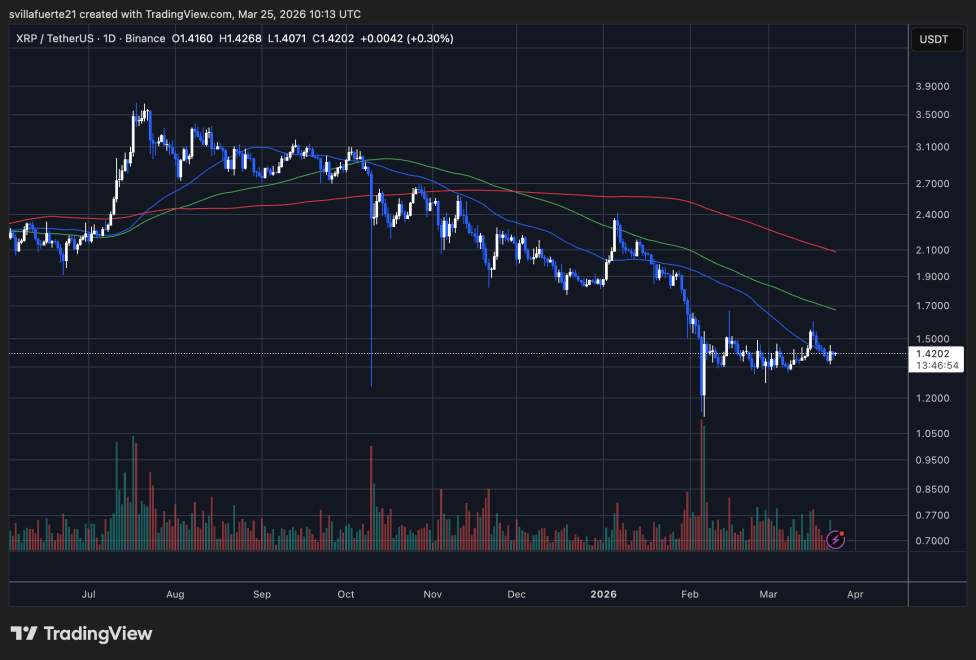
XRP is trading at $1.4202, up a marginal 0.30% on the day — a number that flatters neither bulls nor bears. The daily candle opened at $1.4160, reached $1.4268, and has spent the session going nowhere. That price action, viewed in isolation, tells one story. Viewed against the chart behind it, it tells another.

XRP consolidates around $1.4 level | Source: XRPUSDT chart on TradingView
XRP consolidates around the $1.4 level | Source: XRPUSDT chart on TradingView

The longer context is unambiguous. XRP peaked near $3.80 in late July 2025 and has been in a structured downtrend for eight consecutive months. Every rally attempt across that period — September, October, the brief recovery in early 2026 — was sold into. Each lower high confirmed the trend rather than challenged it.

What the February capitulation wick to $1.15 established is the only constructive development visible on the chart: a floor that was tested and held. Since then, XRP has consolidated between roughly $1.40 and $1.55, trading beneath all three major moving averages — the short-term blue, the mid-term green, and the long-term red — all of which are still sloping downward.

That is the problem. Price has stabilized. The trend has not. Consolidation below declining moving averages is not recovery. It is hesitation — and hesitation resolves in the direction of least resistance until proven otherwise.

Featured image from ChatGPT, chart from TradingView.com 

Editorial Process for bitcoinist is centered on delivering thoroughly researched, accurate, and unbiased content. We uphold strict sourcing standards, and each page undergoes diligent review by our team of top technology experts and seasoned editors. This process ensures the integrity, relevance, and value of our content for our readers.

Bitcoin Surges to $72K Peak Following Reports of Washington’s Ceasefire Proposal – Markets and Prices Bitcoin News

0

Geopolitical Thaw Sparks Bitcoin Rebound

Bitcoin surged on Wednesday, riding a wave of renewed optimism across global markets as the Trump administration’s “15-point plan” to end hostilities with Iran sparked a shift back into risk assets. After hovering tentatively below the $70,000 mark in early trading, the cryptocurrency gained steady momentum, eventually hitting an intraday peak of $72,026 by 7:30 a.m. EST. However, it later pared some gains to consolidate near $71,000.

The cryptocurrency’s price action once again moved in lockstep with global equities, which were buoyed by reports that Tehran had received a comprehensive de-escalation framework from Washington. The proposal—which reportedly includes sanctions relief and a temporary ceasefire—initially fueled speculation that the Trump administration had successfully opened a channel with a pragmatic faction within the Iranian government.

However, the rally faced headwinds later in the day as the Iranian military publicly mocked the overtures, claiming the U.S. was “negotiating with itself.” Despite the public rejection, the mere existence of a formal proposal was enough to send traders back into a buying frenzy.

‘Peace Trade’ Speculation

The “peace trade” was further amplified by a decline in energy prices. As news of the proposal broke, West Texas Intermediate crude briefly dipped below $90 per barrel, easing global inflation concerns.

Polymarket bettors recalibrated their positions, with some segments pricing in a ceasefire by April at increasingly higher odds. Speculation is mounting that the near-impossible odds seen earlier in the week were an early indicator of the current diplomatic breakthrough, despite lingering skepticism from regional analysts.

The ripple effect of this geopolitical optimism was felt across all major indices. Japan’s Nikkei 225 jumped nearly 1,500 points, or approximately 3%, while major Asian and Western indices posted gains between 1% and 2%.

Meanwhile, bitcoin’s resurgence pushed its market capitalization back above the critical $1.4 trillion threshold. This lifted the total crypto economy over the $2.5 trillion mark, effectively liquidating roughly $58 million in short positions over a 24-hour window. Analysts now eye the $72,000 resistance level as the final hurdle before a potential run toward $76,000, the next target once the Strait of Hormuz is reopened.

FAQ ❓

  • Why did bitcoin rise? Optimism over U.S.–Iran peace talks boosted risk assets.
  • How high did it go? Bitcoin hit an intraday peak of $72,026 before easing.
  • What fueled the rally? Falling oil prices and global equity gains added momentum.
  • What’s next? Traders eye $72K resistance before a possible run toward $76K.

Obex Starts Deploying $1B in USDS Into Mortgages, AI Hardware, and Solar Energy

0

The Sky-backed stablecoin incubator’s inaugural class of eight projects marks the protocol’s biggest push yet to diversify beyond crypto-native yield sources.

Obex, the stablecoin incubator administered by Framework Ventures and backed by a $2.5 billion mandate from the Sky ecosystem, on Tuesday announced its inaugural cohort of eight projects and began deploying up to $1 billion in USDS across them.

The first class includes Maple, USDAI, Daylight, Centrifuge, Securitize, River, TVL Capital, and Better. All eight are either already part of, or intend to join, the Sky ecosystem, spanning structured credit, fintech lending, energy finance, AI infrastructure, tokenization, crypto capital markets, and real estate.

“Our industry is at an inflection point. We’re moving beyond circular DeFi yield sources and toward high-quality yield from private credit markets, fintech, energy infrastructure, AI CapEx, real estate, and other productive sectors,” said Parker Edwards, partner at Framework Ventures, in a press release viewed by The Defiant.

The deployment marks the first major move by Obex, which raised $37 million in November 2025 in a round co-led by Framework, LayerZero, and the Sky ecosystem. The Sky community separately voted to provide up to $2.5 billion worth of USDS for deployment into approved, incubated projects that graduate from the program.

The move comes amid strong momentum for Sky, the protocol formerly known as MakerDAO. USDS currently has roughly $11.6 billion in circulation, making it the third-largest stablecoin by market cap, according to Coingecko. Sky’s total value locked (TVL) surged 38% in March to $7.52 billion, making it the fourth-largest DeFi protocol. The protocol’s fixed 3.75% savings rate on sUSDS has attracted capital as DeFi yields elsewhere have compressed.

“Honestly, it’s the classic story of how Sky, just like Maker used to, always does better in bear markets because it’s just focused on a solid product that can be trusted to be stable and deliver good returns,” Sky founder Rune Christensen told The Defiant earlier this month.

In addition to receiving capital, cohort members plan to launch Sky-aligned products designed to bootstrap USDS usage within their ecosystems.

Tokenization Tailwind

The deployment arrives amid rapid growth in the tokenized real-world asset (RWA) sector. The sector tripled in value to approximately $26 billion over the past year, according to RWAxyz.

RWAs became Wall Street’s gateway to crypto in 2025, with onchain tokenized assets tripling to nearly $19 billion over the course of the year. The momentum has only accelerated into 2026, with RedStone projecting the market could reach $50-60 billion by year-end.