Home Blog Page 671

Ripple Enters Singapore Central Bank Initiative With RLUSD Pilot

0

Trusted Editorial content, reviewed by leading industry experts and seasoned editors. Ad Disclosure

Ripple has joined BLOOM, a new initiative from the Monetary Authority of Singapore (MAS), the country’s central bank, and is partnering with trade finance technology firm Unloq on a pilot that uses RLUSD and the XRP Ledger to test programmable settlement in cross-border trade. For crypto markets, the move adds another real-world institutional use case around stablecoin-based settlement infrastructure, this time inside a central bank-led framework.

Announced Wednesday, the pilot sits within MAS’s BLOOM initiative, short for Borderless, Liquid, Open, Online, Multi-currency. The program is designed to expand settlement capabilities using tokenized bank liabilities and regulated stablecoins, positioning Singapore as a testing ground for interoperable payment rails in regulated financial environments.

Ripple Joins Singapore Central Bank Project

Ripple’s specific role in the initiative comes through a joint project with Unloq, a supply chain finance technology provider. The two companies plan to pilot a trade finance workflow built around Unloq’s SC+ infrastructure, which combines trade obligations, settlement conditions and financing workflows into a single execution layer. Ripple said the setup will use its institutional infrastructure, the XRP Ledger and RLUSD.

The core pitch is straightforward: use digital settlement assets to reduce frictions that still slow cross-border trade. In the model described by the companies, payments are released only when commercial conditions are met, such as shipment verification. That creates a more conditional, programmable settlement flow, while also aiming to improve risk visibility and financing access for small and medium-sized businesses.

Fiona Murray, Ripple’s managing director for Asia Pacific, framed the initiative as a regulatory and utility play. “Singapore continues to take a leading role globally in providing the regulatory clarity necessary for the digital asset space to thrive. Ripple is incredibly excited to be part of BLOOM, an initiative that perfectly aligns with our commitment to compliant, real-world utility for blockchain technology.”

She then tied the pilot directly to the mechanics of the platform. “Built on the XRP Ledger, SC+ Solution, Unloq’s smart-contract-driven trade finance platform uses RLUSD to automatically trigger payments the moment the shipment is verified. This partnership combines Unloq’s supply chain expertise with Ripple’s secure technology to make global trade faster and more transparent.”

That matters because the release is not pitching blockchain as a parallel system detached from existing finance. Instead, the emphasis is on integrating digital settlement rails into current trade and financing processes without forcing counterparties to rebuild commercial relationships from scratch. In other words, the pilot is less about replacing trade finance than about reducing operational lag and settlement uncertainty inside it.

Unloq made that case explicitly. Letitia Chau, the company’s president and chief risk officer, said, “BLOOM represents an important step toward modernising trade finance infrastructure in a controlled and regulated environment. Through SC+, we are demonstrating how digital settlement rails can be integrated into existing trade and financing workflows without disrupting commercial relationships.”

She added that the pilot is also meant to test whether the model can scale beyond a narrow proof of concept. “Collaboration with MAS and Ripple enables us to explore scalable, interoperable models for cross-border trade.”

For Ripple, the announcement extends a broader push to position RLUSD as a settlement asset for enterprise use cases rather than a simple exchange-traded stablecoin. The release repeatedly places RLUSD alongside tokenized bank liabilities, suggesting the company wants the stablecoin discussed in the same institutional conversation as other regulated digital cash instruments being explored for settlement.

At press time, XRP traded at $1.4227.
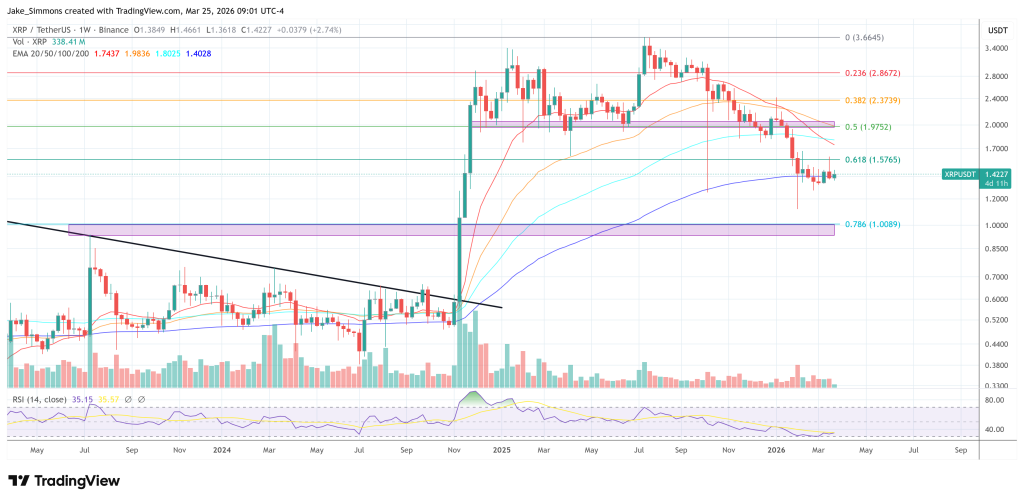
XRP price chart
XRP must rise above the 0.618 Fib, 1-week chart | Source: XRPUSDT on TradingView.com

Featured image created with DALL.E, chart from TradingView.com

Editorial Process for bitcoinist is centered on delivering thoroughly researched, accurate, and unbiased content. We uphold strict sourcing standards, and each page undergoes diligent review by our team of top technology experts and seasoned editors. This process ensures the integrity, relevance, and value of our content for our readers.

Binance tightens market maker rules and warns token issuers to disclose partners

0

Binance, the largest crypto exchange by volume traded, released guidelines placing tighter obligations on token issuers and liquidity providers.

The new rules require projects to disclose their market maker’s identity, legal entity and contract terms. They also ban profit-sharing and guaranteed-return arrangements, which the exchange said can create incentives that conflict with fair trading. Token lending agreements must clearly say how borrowed tokens can be used.

The rules are “intended to help projects conduct stronger due diligence on their market-maker partners and remind users to be mindful of market conditions,” a Binance spokesperson said in an email. The company is looking to foster “a fair and efficient marketplace, and we do not tolerate misconduct.”

The new policy targets a part of the crypto market that often works behind the scenes. Market makers usually post buy and sell orders to keep trading active and reduce sharp swings in price, which, in a healthy market, can help users buy or sell without major slippage, especially when a token is newly listed.

Binance said problems occur when firms act less like neutral liquidity providers and more like sellers with hidden incentives. The exchange flagged behavior such as selling that clashes with token release schedules, one-sided trading and activity that inflates volume without moving prices in a natural way.

In the blog post, Binance said it will take “swift, decisive action against any misconduct,” including blacklisting market makers. It’s unclear whether Binance plans to name the market makers it blacklists.

DeFi Generated $8 Billion in Onchain Yield in 2025: Analysis

0

A breakdown of DeFi’s yield sources reveals that borrowing demand, trading fees, and funding rates drove the bulk of returns, while more than half of stablecoin deposits in the Ethereum ecosystem are earning less than U.S. Treasuries.

Decentralized finance (DeFi) produced roughly $8 billion in onchain yield in 2025, according to a detailed analysis published by researcher Vadym that maps the full spectrum of where DeFi returns actually originate. The breakdown reveals that yield is abundant in aggregate but unevenly distributed, often circular, and in many cases difficult to package into structured products.

The findings land as yields across DeFi have dried up. Borrowing rates on major lending platforms have converged with the Federal Reserve’s policy rate, and “safe” stablecoin supply rates now average roughly 3% — below U.S. Treasuries and the Secured Overnight Financing Rate. On Aave, the 30-day average yield on USDC and USDT sits around 2%. Out of more than $20 billion in stablecoin vaults across Ethereum and its Layer 2s, 58% of TVL is earning under 3% APY, the report notes.

Where the $8 Billion Comes From

The analysis identifies five primary yield sources, each with distinct risk profiles and scalability constraints.

AMM trading fees were the largest single category at roughly $4.2 billion, with Uniswap, Meteora, and Raydium accounting for 62% of the total. But the analysis cautions that these fees are notoriously difficult to capture in structured products. Liquidity providers — particularly those using concentrated liquidity — frequently lose money to toxic order flow, and LP-manager vaults have failed to gain meaningful traction.

Borrow interest generated approximately $1.76 billion across money markets, including Aave, Morpho, Spark, Maple and Fluid. Money markets account for more than 60% of total DeFi TVL, making lending the sector’s economic backbone. However, the analysis found that roughly half of all borrowing demand is recursive — users borrowing to loop back into other yield sources, such as liquid staking tokens or yield-bearing stablecoins. On Aave’s Ethereum deployment, about 39% of borrowing demand goes toward leveraging ETH staking rewards, while another 11.6% loops Ethena’s sUSDe.

Perps funding fees, largely pioneered onchain by Ethena, contributed around $300 million. Ethena’s sUSDe derives its yield from staking rewards and short funding rates — a mechanism that drew both praise and alarm when it launched in 2024.

Real-world assets generated an estimated $600–900 million, with U.S. Treasuries holding the largest share of the RWA market at about 41% and private credit at 25%.

Network staking rewards and MEV comprise the remainder, with Ethereum’s issuance totaling roughly one million ETH in 2025. The MEV-derived portion of staking yield has been trending downward as private order flow routing — now handling about 90% of swaps — has reduced frontrunning opportunities.

Untapped and Underdeveloped Sources

The analysis also highlights categories where yield capture remains negligible. Insurance underwriting generated just $5.5 million in premiums in 2025, mostly through Nexus Mutual. Options — despite CeFi open interest of $30–50 billion — have roughly $1.8 billion in onchain OI with no breakout structured product. Volatility selling and protocol risk transfer remain largely untapped, which the analysis flags as a potential opportunity as risk curation grows more competitive.

Sky’s Balancing Act

As a case study in how protocols assemble these disparate yield sources, the analysis examines Sky (formerly MakerDAO), whose 3.75% USDS Savings Rate has attracted significant capital amid the compression. Sky’s TVL surged 38% in March, making it the fourth-largest DeFi protocol, with the sUSDS savings pool alone accounting for approximately $6.5 billion in deposits.

The breakdown reveals that approximately 70% of Sky’s income derives from offchain origination — primarily USDC earning Coinbase rewards through the peg stability module (PSM), and RWA exposure through products like BlackRock’s BUIDL and Janus Henderson funds. The remaining 30% flows from onchain sources, with Spark acting as Sky’s primary allocation arm, routing capital into Sparklend, Maple’s institutional lending, Anchorage, and other yield-bearing opportunities depending on prevailing rates.

The implication, the analysis argues, is that even as TradFi yield increasingly flows through permissioned channels, its redistribution happens onchain, providing a floor for DeFi rates and potentially setting the stage for a next generation of yield derivatives, including fixed-rate products, interest-rate swaps and structured tranches.

This article was written with the assistance of AI workflows. All our stories are curated, edited and fact-checked by a human.

Ethereum roadmap updates so far in 2026

0

Network News

ETHEREUM FACES KEY MOMENT WITH QUANTUM, AI CHANGES AHEAD: The first couple of months of 2026 have forced the Ethereum community into a kind of introspection—one that goes beyond price, beyond technical upgrades, and into the question of what the network is actually trying to be. Even before this year, there has been a sense among builders and executives that Ethereum was on the verge of another growth phase—this time driven not by crypto-native users but by institutions and technology. Neobanks, as some argued, would quietly onboard millions by abstracting away the complexity of wallets and gas fees. Ethereum, in this framing, wouldn’t need to win users directly. It would sit beneath the interface, powering a new financial stack that, on the surface, looked nothing like crypto. It was a continuation of a long-running thesis: that Ethereum’s success would come from invisibility. That vision has been shaped in part by years of previous upgrades aimed at improving user experience and reducing costs. Changes like “proto-danksharding”, introduced in the Dencun upgrade, significantly lowered fees for layer 2 networks by increasing data downloads for transactions, while ongoing improvements to the base layer have made transactions more efficient. While the price of the network’s ether (ETH) token has been determined by market forces, these upgrades have, together, helped move Ethereum closer to a model where users interact with applications without needing to understand the underlying infrastructure. But that narrative began to change a few weeks into the year, when Vitalik Buterin, delivered a sharp reality check to the broader ecosystem: “You are not scaling Ethereum.” The comment cut through what had, until then, been a largely celebratory conversation around rollups. These types of networks, also known as layer-2 (L2) networks, process transactions off Ethereum and then bundle them back onto the main chain to make it faster and cheaper. Layer-2 networks have exploded over the last few years, transaction fees have come down, and activity has spread—but the deeper question was whether any of this amounted to coherent scaling. — Margaux Nijkerk Read more.

SOLANA FOUNDATION RELEASES DEVELOPER PLATFORM FOR INSTITUTIONS: The Solana Foundation is launching a new developer platform aimed at making it easier for financial institutions to build blockchain-based products, with early users including Mastercard, Western Union and Worldpay. The Solana Developer Platform (SDP), currently available for developers to test, is a toolkit that enables enterprises to create and scale financial applications on Solana without deep crypto infrastructure expertise. The SDP will also integrate AI tools such as Anthropic’s Claude Code and OpenAI’s Codex. The platform bundles services from more than 20 infrastructure providers — spanning custody, compliance, wallets and payments — into a single interface, streamlining what has traditionally been a fragmented process for institutions entering the space. At launch, SDP includes two live modules. The issuance module enables companies to create tokenized deposits, stablecoins and tokenized real-world assets, while the payments module supports fiat and stablecoin flows, including on- and off-ramps and onchain transactions. A trading module is expected later in 2026. The involvement of traditional payments firms underscores growing institutional interest in blockchain-based settlement. — Margaux Nijkerk Read more.

BALANCER LABS TO SHUT DOWN: The company that built decentralized finance (DeFi) powerhouse Balancer is closing. Balancer co-founder Fernando Martinelli announced that Balancer Labs, the corporate entity that incubated and funded the decentralized exchange protocol, will be shutting down. The decision comes roughly five months after a v2 exploit in November 2025 that drained approximately $110 million in digital assets, as CoinDesk first reported, including osETH, WETH, and wstETH, the third known security breach for the project and the one that created the legal exposure Martinelli cited as the reason for shutting down BLabs. “BLabs, as a corporate entity, has become a liability rather than an asset to the protocol’s future and is just not sustainable as is without any sources of revenue,” Martinelli wrote in a governance forum post. Martinelli added he “seriously considered” shutting everything down entirely. But he stopped short of calling for a full wind-down because the protocol still generates revenue. — Shaurya Malwa Read more.

BITCOIN MINING CONCENTRATION TRIGGERS SMALL ‘REORG’: Bitcoin’s mining concentration problem just showed up on the blockchain itself, triggering a small “reorg.” At the center of the story is Foundry USA, the largest bitcoin mining pool, representing a group of miners who combine their computing power to verify transactions, mine blocks, and split the rewards in BTC. On the blockchain, there are many miners, and sometimes two or more find a block at nearly the same time. When that happens, the network temporarily has two competing versions of the blockchain. Eventually, the network reorganizes back into a single chain, depending on which version grows faster. This process is called a blockchain reorganization, or “reorg.” That’s what happened earlier this week: Foundry and AntPool both mined blocks at roughly the same time, causing a chain split. Foundry then produced several consecutive blocks, moving slightly faster than its competitors, and became the chain the network followed. The result: the blockchain reorganized to Foundry’s version, and the blocks mined by AntPool and ViaBTC were orphaned or effectively erased from the ledger. Those miners earned nothing for the work they had done. — Shaurya Malwa Read more.


In Other News

  • The New York Stock Exchange (ICE) is teaming up with tokenization specialist Securitize to help design the infrastructure behind tokenized securities trading. Securitize is aiming to go public this year via a SPAC deal with Cantor Equitize Partners (CEPT). CEPT shares are higher by 6% premarket. ICE shares are flat. The two firms signed a memorandum of understanding to build NYSE’s planned Digital Trading Platform. Securitize will serve as a design partner, focusing on how transfer agents — the entities that track ownership and handle corporate actions — operate when securities are issued and settled on blockchain rails. Securitize, backed by large asset managers like BlackRock and Ark Invest and registered with the SEC as a transfer agent, is expected to be among the first firms eligible to mint tokenized versions of stocks and ETFs on the platform, subject to regulatory approvals. The firm’s broker-dealer arm could also take part in trading, giving it a foothold across both issuance and market activity. The move comes as traditional exchange behemoths like NYSE and Nasdaq are doubling down on tokenization efforts to bring blockchain rails into stock trading. — Kristzian Sandor Read more.
  • BlackRock Chairman and CEO Larry Fink used his annual letter to shareholders to argue that digital assets and tokenization could help update the financial system, even as he warned that the U.S. economic model is leaving too many people behind. In the letter, Fink said the current system has delivered most of its gains to people who already own assets, while many workers have been shut out of market growth. He tied that imbalance to a wider problem in the U.S., where rising inequality, high government debt and weak participation in capital markets are putting pressure on the old model of finance. “Capitalism is working—just not for enough people,” Fink wrote. His proposed fix centered on tokenization and digital distribution as tools to expand access to investing and make markets run better. Tokenization, Fink said, could “update the plumbing of the financial system” by making investments easier to issue, trade and access. The idea is simple: If ownership of assets is recorded on digital ledgers, moving a fund share, bond or other security could become faster and cheaper. In practice, that would allow a regulated digital wallet to hold not just payments, but also tokenized bonds, ETFs and fractional interests in assets such as infrastructure or private credit. — Helene Braun Read more.

Regulatory and Policy

  • Crypto industry insiders got their first look at the revised market structure bill in the Senate, and the opening impression was that the language on allowable stablecoin yield was overly narrow and unclear, according to a person familiar with the current draft. The new language, which was announced Friday by Senators Angela Alsobrooks and Thom Tillis, would ban yield payments for simply holding a stablecoin. It would also restrict any approach that makes the program equivalent to a bank deposit, and it imposes further limits on other potentially allowed activities, the person said, adding that the mechanics of determining activities-based stablecoin rewards remain uncertain. The crypto industry got its first look at the revised section of the Digital Asset Market Clarity Act earlier this week during a closed-door review on Capitol Hill in Washington, an attempt to clear a roadblock to getting a hearing in the Senate Banking Committee. Bankers had insisted that stablecoin rewards look nothing like interest-bearing bank deposits, because they argued the competing product could hamstring the industry and strangle lending. So, the compromise will allow rewards programs for users’ stablecoin activities but not balances. — Jesse Hamilton Read more.
  • Brazil’s new finance minister, Dario Durigan, is expected to delay a public consultation on applying a tax on financial operations, locally known as Imposto sobre Operações Financeiras (IOF), to some cryptocurrency transactions, Reuters reported, citing sources familiar with the matter. Durigan took office on March 20 after Fernando Haddad stepped down to run for governor of São Paulo. Reuters said the new minister wants to focus on microeconomic measures and avoid proposals that could trigger conflict with Congress during an election year. The postponed consultation centered on a draft decree that could classify some crypto transactions as foreign exchange operations. — Francisco Rodrigues Read more.

Calendar

  • Mar. 24-26, 2026: Digital Asset Summit, New York City
  • Mar. 30-Apr. 2, 2026: EthCC, Cannes
  • Apr.15-16, 2026: Paris Blockchain Week, Paris
  • May 5-7, 2026: Consensus, Miami
  • Sept. 29-Oct.1, 2026: Korea Blockchain Week, Seoul
  • Oct. 7-8, 2026: Token2049, Singapore
  • Nov. 3-6, 2026: Devcon, Mumbai
  • Nov. 15-17, 2026: Solana Breakpoint, London

Starling Bank Launches UK’s First Agentic AI Money Manager to Automate Personal Finance

0

Starling Bank has rolled out the UK’s first Agentic AI money manager, introducing a conversational interface capable of actively managing personal finances on a customer’s behalf. Launched for personal current account holders, the in-app tool—dubbed ‘Starling Assistant’—responds to both voice and written natural language prompts. Unlike generative AI, which primarily focuses on “thinking” and generating text, agentic AI is designed to do the “doing,” authorising the system to execute specific banking instructions autonomously.

The assistant is uniquely designed to streamline money management while actively improving financial literacy skills. For example, users planning a holiday can simply instruct the AI to calculate the necessary monthly savings for their trip and automatically set up transfers into a dedicated ‘Space’. Similarly, customers can command the tool to establish a comprehensive payday routine by creating dedicated digital spaces for groceries, bills, and travel, while specifying the exact transfer amounts for each.

Beyond active automation, the assistant allows users to thoroughly interrogate their spending habits. Customers can ask the AI for detailed insights, such as counting their active direct debits, summarising remaining monthly bills, or pulling specific transaction histories with individual payees.

Accessibility and gamified financial awareness

Beyond routine transactions, the Starling Assistant introduces tailored support for users with accessibility or vulnerability needs who might prefer not to speak directly with a human service agent. The tool can guide users in financial distress, assist hard-of-hearing customers in setting up sign language services, and instantly help implement gambling blocks.

To boost financial awareness in a more engaging way, the AI can even generate interactive quizzes about a user’s spending patterns, challenging customers to guess their top merchants, total monthly spend, or highest spending categories. Customers can also ask practical, day-to-day questions, such as how to find their PIN, order a new card, or set up Apple Pay.

The technology and privacy framework

The new tool represents the culmination of eight years of dedicated AI development spearheaded by Harriet Rees, Starling’s Group chief information officer, who also serves as the Government AI Champion for Financial Services and Chair of the Bank of England‘s AI Taskforce. Built on Starling’s proprietary tech platform using Google Gemini and Google Cloud technologies, the assistant consolidates previous UK-first features—like Spending Intelligence and Scam Intelligence—into a single, proactive interface.

Addressing inevitable data privacy concerns, Starling confirmed that the AI assistant operates strictly as an opt-in service. All customer data remains securely housed within the bank’s own Google Cloud environment and is not utilized to train external foundational models.

Industry perspectives
Raman Bhatia, Group CEO at Starling

Harriet Rees emphasized that it is time for the industry to embrace a new era of banking powered by agentic AI.

“At Starling, we want to encourage our customers to trust that AI can help them with money management and we’re excited to be pioneering the use of this cutting edge technology to help people be good with money,” Rees stated. She added that by asking simple questions, customers can build good money habits and better organise their finances.

Raman Bhatia, Starling’s Group CEO, echoed this sentiment, highlighting the transformative potential of the technology. Bhatia noted that agentic AI represents the definitive next step in banking, expressing his excitement that Starling’s customers will be the first to benefit from the platform.

While currently available to personal account holders, Starling plans to roll out the assistant to business and joint accounts in the near future.

Market structure bill compromise draws wide-ranging reaction from fractured crypto crowd

0

Coinbase is walking a tightrope in the negotiation over the Clarity Act, telling the staffs of U.S. senators that the company is not happy with where the lawmakers landed in their latest compromise, according to people familiar with the situation, but it hasn’t openly declared its opposition.

The proposed agreement was shown to stakeholders in the crypto industry on Monday and the banking industry on Tuesday. From the crypto industry side, it received mixed reactions, according to people familiar with the meeting on Monday. Some stakeholders were dissatisfied — most notably Coinbase — but others were “pleasantly surprised,” one of the people said. No one was able to take a copy of the text with them, and it has not yet been released for circulation.

Those familiar with the Monday gathering said there were still issues to work out, and suggested the proposal might impede stablecoin-related products and services beyond what they’d hoped for.

The new proposal would direct some regulatory agencies to draft rules establishing how, exactly, issues like rewards might be overseen. Some have had concerns about regulators issuing subjective criteria for how permissible activity would be governed, noting that there may end up being different types of rewards programs. Any rulemaking would need to be neutral, they said.

And the language was also said to potentially restrict firms’ ability to tie rewards to the scale of stablecoin transactions in an account, which could be an obstacle for a program akin to credit card rewards.

Through the months of negotiation, Coinbase CEO Brian Armstrong has been a leading voice, and his opposition of an earlier effort at stablecoin yield compromise helped derail a planned Senate hearing. A White House favorite in the crypto sphere, Armstrong leads the company that potentially has the most to lose from narrowing its stablecoin rewards programs.

On an industry call this week, people said Coinbase clashed with others over the bill, suggesting a fracturing of crypto views on how to proceed. Giving up certain stablecoin rewards could be costly for some, but losing the Clarity Act’s full-fledged establishment of crypto within the U.S. financial system is — for others — seen as a bigger risk.

The updated text that is released — expected either late this week or early next week — will likely have been revised from the text shared Monday and Tuesday, though lawmakers are unlikely to want to rewrite too much of the long-debated text.

So far, the bankers haven’t publicly shared their views on the proposal.

The crypto industry’s potential concerns with the approach pitched this week, first reported by CoinDesk, already caused chaos in the market for leading U.S. stablecoin issuer Circle and Coinbase’s stock. Circle stock dropped 20% on Tuesday, though it ticked up slightly on Wednesday. However, Tuesday’s news from its chief rival, Tether, about submitting to an audit may have been another factor in the hit to Circle’s shares, observers noted.

Despite negative responses to the Clarity Act revisions, Patrick Witt, the White House’s crypto adviser, criticized the “uninformed” people making predictions about the Clarity Act’s status.”It’s all going to work out,” he posted Wednesday on social media site X (formerly Twitter). “Bullish.”

One of the people advocating taking a step back:

“Everyone should take a chill pill and stay off Twitter,” the person said.

US Lawmakers Hold Hearing on Tokenized Real-World Assets

0

Crypto industry executives on Wednesday told the US House of Representatives Committee on Financial Services that existing investor protections and financial surveillance regulations should apply to tokenized securities.

The hearing was held as legislators consider the Capital Markets Technology Modernization Act of 2026 and are exploring the impact of asset tokenization on capital markets and the “need to balance innovation with investor protection and market integrity,” according to a statement by panel chairman, Representative French Hill.

Tokenized real-world assets (RWA), traditional financial instruments represented by tokens on blockchain networks, reduce transaction costs and settlement times, Summer Mersinger, CEO of crypto advocacy organization Blockchain Association, told the committee.

“By replacing flawed manual record-keeping processes with more transparent timestamps and stamped records, tokenization lowers the cost and re-imagines US financial markets,” she said.  

Blockchain Association CEO Summer Mersinger outlines the benefits of RWA tokenization for US lawmakers. Source: GOP Financial Services Committee

Mersinger and the other witnesses agreed that existing securities laws apply to tokenized instruments, arguing that the technology and the medium used to record securities transactions do not fundamentally alter investor protection laws or jurisdictional oversight.

Supporters of RWA tokenization contend the technology removes intermediaries from the settlement and clearing process, reducing transaction costs and improving capital velocity by introducing near-instant settlement times. 

AML provisions and sanctions compliance remain lawmaker priority

Lawmakers questioned the panel about how tokenized asset issuers and platforms could enforce know-your-customer (KYC) checks, anti-money laundering provisions, and sanctions compliance.

Illinois Representative Bill Foster asked: “Once things are tokenized, are they going to be treated on a private, permissioned blockchain, or a variety of public blockchains, which often allow anonymous participation through self-hosted wallets?” 

SEC, United States, RWA, RWA Tokenization
Representative Bill Foster questions the panel about anti-money laundering provisions and financial surveillance techniques. Source: GOP Financial Services Committee

John Zecca, Nasdaq executive vice president and global chief legal, risk, and regulatory officer, told Foster that the exchange can collect KYC information at the protocol level because its system runs on a permissioned blockchain network.

Christian Sabella, managing director and deputy general counsel of the Depository Trust and Clearing Corporation (DTCC), the world’s largest clearinghouse company, said it was also possible to embed identifying information at the token level.

These identifiers would be immutable and would remain regardless of whether the RWA token was trading on a permissioned or a permissionless network, Sabella added. 

SEC, United States, RWA, RWA Tokenization
DTCC executive Christian Sabella explains how RWA tokens could be surveilled. Source: GOP Financial Services Committee

Salman Banaei, general counsel for Plume Network, a permissionless RWA-focused blockchain, said the network embeds anti-money laundering (AML) and sanctions compliance checks at the token level, which allows tokens to be frozen.

However, Banaei told Foster that government regulators do not yet have a technological solution to identify wash trades or identify market participants with 100% confidence.

Magazine: Meet the onchain crypto detectives fighting crime better than the cops