Home Blog Page 663

Bitcoin miners are losing $19,000 on every BTC produced as difficulty drops 7.8%

0

The math has turned against bitcoin miners, and the war is making it worse every week.

Checkonchain’s difficulty regression model, which estimates average production costs based on network difficulty and energy inputs, pegged the figure at $88,000 per bitcoin as of March 13.

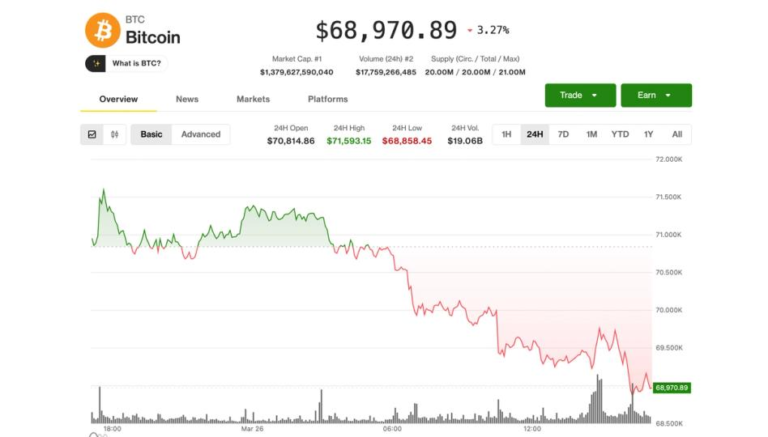
Bitcoin is trading at $69,200 as on Sunday morning, creating a gap of nearly $19,000 per coin and meaning the average miner is operating at a 21% loss on every block produced.

The cost squeeze has been building since October’s crash took bitcoin from $126,000 to below $70,000, but the Iran war accelerated it. Oil above $100 feeds directly into electricity costs for mining operations, particularly the estimated 8-10% of global hashrate operating in energy markets sensitive to Middle Eastern supply.

The Strait of Hormuz, which handles roughly 20% of the world’s oil and gas flows, remains effectively closed to most commercial traffic. And Trump’s 48-hour ultimatum on Saturday threatening to attack Iran’s power plants added a new layer of risk for miners.

The network is already showing the stress. Difficulty dropped 7.76% on Saturday to 133.79 trillion, the second-largest negative adjustment of 2026 after February’s 11.16% plunge during Winter Storm Fern. Difficulty is now nearly 10% below where it started the year and far below November 2025’s all-time high near 155 trillion.

The hashrate has retreated to roughly 920 EH/s, well below the record 1 zetahash level reached in 2025. Average block times during the last epoch stretched to 12 minutes and 36 seconds, well above the 10-minute target.

(CoinDesk)

Hashprice, the metric tracking expected miner revenue per unit of computing power, is hovering around $33.30 per petahash per second per day according to Luxor’s Hashrate Index. That’s near breakeven for most hardware and not far from the all-time low of $28 hit on Feb. 23.

When miners can’t cover costs, they sell bitcoin to fund operations. That selling adds supply pressure to a market already dealing with 43% of total supply sitting at a loss, whales distributing into rallies, and leveraged positioning dominating price action. Mining economics aren’t just a sector story. They’re a market structure story.

The publicly traded miners have been adapting by diversifying into AI and high-performance computing, which offer more predictable revenue than mining bitcoin at a loss. Marathon Digital, Cipher Mining, and others have been building out data center capacity alongside their mining operations.

The next difficulty adjustment is projected for early April and is expected to decline further according to CoinWarz data. If bitcoin stays below $88,000, and there’s no sign of a return to that level in the near term, the miner exodus continues and difficulty keeps falling.

The network self-corrects by design, making it cheaper to mine as participants leave. But the period between when costs exceed revenue and when difficulty adjusts low enough to restore profitability is where the damage happens, both to miners and to the spot market absorbing their forced selling.

Ripple linked token falls 3% as bitcoin weakness caps recovery

0

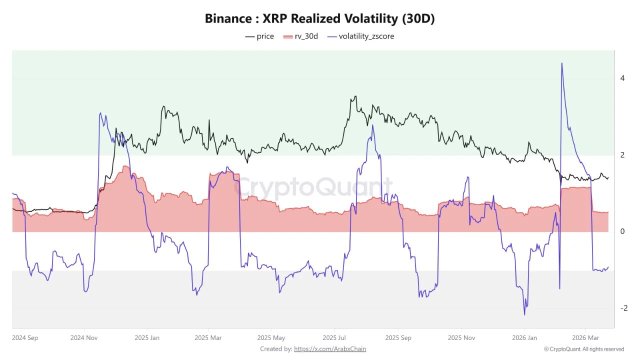
XRP slipped lower after another failed recovery attempt, with high-volume selling pushing the token back toward key support near $1.40.

News Background

  • XRP remains stuck in a broader corrective phase that has persisted since its mid-2025 peak, with rallies consistently failing to build follow-through.
  • The latest pullback comes after a brief mid-March rebound stalled below $1.60, reinforcing the pattern of lower highs that has defined price action in recent months.
  • Macro conditions continue to weigh on sentiment, with crypto markets trading cautiously following the Federal Reserve’s latest policy stance. XRP’s structure remains largely technical, with traders focused on whether the token can stabilize or continue drifting lower within its established range.

Price Action Summary

  • XRP fell from $1.4457 to $1.4079, down roughly 2.6%
  • Price traded near $1.44–$1.45 before breaking down late in the session
  • Selling accelerated on a volume spike more than 3x the daily average
  • The token stabilized near $1.40 after setting a low around $1.4018

Technical Analysis

  • The key move was the late-session break below $1.44 support, which triggered a sharp drop on elevated volume — a sign of active selling rather than passive drift.
  • Short-term structure remains weak. XRP continues to form lower highs, and recent recovery attempts have stalled below $1.60, keeping the broader downtrend intact.
  • The $1.40 area is now acting as immediate support, with buyers stepping in after the breakdown. A minor bounce has formed, but price remains below prior support levels that have now turned into resistance.
  • On higher timeframes, XRP is still trading within a descending channel that has guided price since mid-2025, reinforcing the idea that rallies are corrective unless key resistance levels are reclaimed.

What traders say is next?

  • Traders are focused on whether XRP can hold above $1.40.
  • If support stabilizes, the token may consolidate before attempting another move toward $1.44–$1.45, with a broader test near $1.55–$1.60 needed to shift momentum.
  • If $1.40 breaks, downside risk opens toward the $1.30–$1.32 zone, where weaker support lies and previous moves have lacked strong buyer interest.

Resolv Labs’ Stablecoin Depegs Amid Exploit

0

A stablecoin tied to the crypto project Resolv Labs has lost its peg to the US dollar after an attacker was able to exploit the token’s contract to create millions of tokens for themselves.

Resolv Labs posted to X on Sunday that it had experienced an exploit that allowed an attacker to mint 50 million unbacked Resolv USR (USR). “The team has currently paused all the protocol functions to prevent further malicious actions and is actively working on recovery,” it added.

The X account “yieldsandmore” had posted to the platform earlier on Sunday that USR had crashed after on-chain data showed an attacker was able to mint 50 million USR by depositing $100,000 worth of the stablecoin USDC (USDC).

The attacker was also able to mint an additional 30 million USR tokens, according to the crypto security company PeckShield.

The crypto fund D2 Finance said that the minting function on USR’s contract was somehow broken. “Either the oracle was gamed, the off-chain signer was compromised, or the amount validation between request and completion is simply missing,” it added.

Source: D2 Finance

The exploit comes after crypto-related hacks declined sharply in February, with $49 million lost to exploits over the month, compared to $385 million in January, with attackers increasingly preferring phishing scams over protocol exploits.

Attacker cashing out “at full speed” depegs USR 

D2 Finance said the attacker quickly moved the 50 million USR they minted to multiple crypto protocols, swapping the tokens for the stablecoins USDC and USDt (USDT) before “aggressively” converting them to Ether (ETH).

“The attacker’s exit playbook is textbook DeFi hack cashout running at full speed,” it said.

D2 Finance added that USR was selling as low as 50 cents on some trades as liquidity and slippage worsened across protocols, with “multiple failed transactions visible on-chain showing the urgency.”

The firm estimated that the attacker was able to extract around $25 million from the attack amid USR’s depeg.

Related: Google Threat Intel flags ‘Ghostblade’ crypto-stealing malware

USR is currently trading at around 87 cents, around 13% off from the $1 peg the token aims to maintain, according to CoinGecko.

The token had crashed to a low of 2.5 cents on a USR/USDC pool on the protocol Curve Finance, USR’s most liquid pool with a 24-hour volume of $3.6 million, per DEX Screener.

USR’s price compared to USDC on Curve showing its flash-crash and depeg on Sunday. Source: DEX Screener

USR hit its bottom on Curve at 2:38 am UTC on Sunday, just 17 minutes after the attacker minted $50 million worth of the token. The pool has since recovered to trade at 84.5 cents.

Magazine: Meet the onchain crypto detectives fighting crime better than the cops