Bearish momentum entered into Saturday’s daily close and crypto longs suffered. Over $300 million in longs and nearly $100 million in shorts were liquidated in the 24 hours to the time of writing, per data from CoinGlass.
Crypto liquidation history (screeshot). Source: CoinGlass
In so doing, BTC/USD set up a fresh showdown around its 200-week exponential moving average (EMA) near $68,300.
As Cointelegraph reported, the 200-week EMA was of major importance in prior BTC price cycles, but has become “unreliable” in 2026 due to failing to offer support.
Last week, trader and analyst Rekt Capital said that price should retest the 200-week trend line as support from above in order for it to provide the foundation for upside continuation.
“More, there’s also a chance that Bitcoin could simply meander in and around the 200-week EMA for a while, never really turning it into convincing resistance, never really turning it into convincing support, before ultimately breaking down into additional Macro Downside over time anyway,” he noted on X.
BTC/USD one-day chart with 200-week EMA. Source: Cointelegraph/TradingView
Others also retained bearish predictions, including trader Roman, who reiterated his $50,000 target.
“There are still 0 signs of bear market exhaustion on HTF. No divs, no bear PA exhaustion, no momentum loss, etc,” he told X followers on Sunday, referring to higher time frames.
“I still have high confidence in seeing 50k and likely a bit lower.”
BTC/USD one-week chart. Source: Roman/X
BTC price “range game continues”
A potential silver lining on the day came from a “golden cross” involving two other moving averages.
Related: Bitcoin RSI signals potential bottom as analysts flag key setup
Here, the 21-day simple moving average (SMA) crossed over its 50-day equivalent, signalling stronger recent price momentum.
BTC/USD one-day chart with 21-day, 50-day SMA. Source: Cointelegraph/TradingView
Commenting, Keith Alan, cofounder of trading resource Material Indicators, was cautiously optimistic.
“The Golden Cross will likely deliver some short term bullish momentum. Must watch to see if it develops into something durable,” he acknowledged in an X post.
“For now…the range game continues.”
BTC/USD one-day chart. Source: Keith Alan/X
Earlier in March, the BTC/USD chart produced two “death crosses,” a structure that typically implies more downside pressure to come. These in turn sparked warnings of a collapse below $40,000.
This article does not contain investment advice or recommendations. Every investment and trading move involves risk, and readers should conduct their own research when making a decision. While we strive to provide accurate and timely information, Cointelegraph does not guarantee the accuracy, completeness, or reliability of any information in this article. This article may contain forward-looking statements that are subject to risks and uncertainties. Cointelegraph will not be liable for any loss or damage arising from your reliance on this information.
The divergence between gold and Bitcoin (BTC) in 2026 can be explained by two distinct segments of buyers, according to Stephen Coltman, head of macro at crypto exchange-traded product (ETP) provider 21Shares.
Gold’s rally over the last three years has been primarily fueled by central bank buying, while Bitcoin is more widely held by individuals than financial institutions, Coltman told Cointelegraph. He said:
“Physical gold has a greater geopolitical strategic role currently, as the asset of choice for state actors who want to store wealth in a way that is protected from rival powers. This has meant that it has traded with greater sensitivity to deteriorating international relations.”
However, BTC has more utility for individuals who may use it as an alternative “lifeline” when local banking infrastructure fails during times of crisis, and accessing the traditional financial system is not possible.
Gold falls below the 50-day exponential moving average, a key support level. Source: TradingView
“Shortly after the conflict started, both the Dubai and Abu Dhabi exchanges were shut down following missile and drone strikes from Iran,” which, he said, is a “stark reminder” of how valuable 24/7 access is in wartime situations or other emergencies.
Coltman told Cointelegraph that the inverse correlation between BTC and gold means that investors should hold both to benefit from each asset’s unique properties.
Ongoing macroeconomic and geopolitical shocks over the last several years drove gold to an all-time high of nearly $5,600 per ounce in January 2026.
However, heightened volatility dragged the precious metal back down to about $4,497 per ounce, leading to renewed debate among analysts about gold’s role as a store of value asset, and how it will perform against Bitcoin in the coming years.
Related: Bitcoin vs gold shows potential bottom signals as BTC bulls defend $70K
Financial analysts are split on gold versus BTC dominance
Bitcoin is likely to outperform gold over the next three years, according to macroeconomist Lyn Alden.
“It’s usually a pendulum between the two. If gold has gone up as much as it did, the entire diminishing return story per cycle is going to be erased in the coming one, too,” Alden said.
However, former hedge fund manager Ray Dalio expects that BTC will never replace gold as a store-of-value asset because it still trades like a risk-on asset with correlation to technology stocks, while gold is entrenched as a reserve asset in the banking system.
Magazine: Is China hoarding gold so yuan becomes global reserve instead of USD?
Cointelegraph is committed to independent, transparent journalism. This news article is produced in accordance with Cointelegraph’s Editorial Policy and aims to provide accurate and timely information. Readers are encouraged to verify information independently. Read our Editorial Policy https://cointelegraph.com/editorial-policy
Gerald Celente says markets are sending mixed signals as geopolitical stress builds, warning that war, debt, and policy distortions are masking deeper economic fractures. AI Bubble, War Risks, and Market Signals Clash, Celente Says Global markets are exhibiting an unusual divide, and Gerald Celente contends the behavior is far from ordinary. A veteran trends forecaster […]
Trusted Editorial content, reviewed by leading industry experts and seasoned editors. Ad Disclosure
Her lawyer puts the total losses from the botched HAWK token launch at roughly $200,000 — a figure that, in the world of crypto, barely registers. But for Hailey Welsh, better known online as the “Hawk Tuah Girl,” the fallout from that December 2024 disaster was anything but small.
Hawk Tuah: Death Threats And Silence Followed The Crash
Welsh told YouTube channel Channel 5 that she went into hiding for months after the token’s collapse, driven there by a wave of death threats and public anger.
“I’m sitting here, and I’m the one getting hit for this,” she said. “It’s rough.” She described pulling her head down whenever she stepped outside, bracing for hostility wherever she went. The experience, she said, left her traumatized.
The HAWK memecoin launched in December 2024 and exploded almost immediately. Within hours, its market cap surged past $490 million. Then it collapsed just as fast — down more than 90% the next day, bottoming out around $40 million.
It has since fallen to just over $1 million. The crash was widely labeled a rug pull, though Welsh insists she had no hand in engineering it.
She told Channel 5’s Andrew Callaghan that she was approached and agreed to promote the coin without fully grasping what she was getting into.
She said she received none of the proceeds and lacked the technical knowledge to launch a token in the first place. A Federal Bureau of Investigation probe examined her role in 2025. Investigators cleared her of any wrongdoing.
Lawsuit Targets Creators, Not Welsh
An investor lawsuit filed in December 2024 named the team and entities behind the coin — not Welsh. The suit alleged those parties sold unregistered securities.
Welsh was kept out of the legal action entirely, which tracks with her account of being a public face rather than a decision-maker.
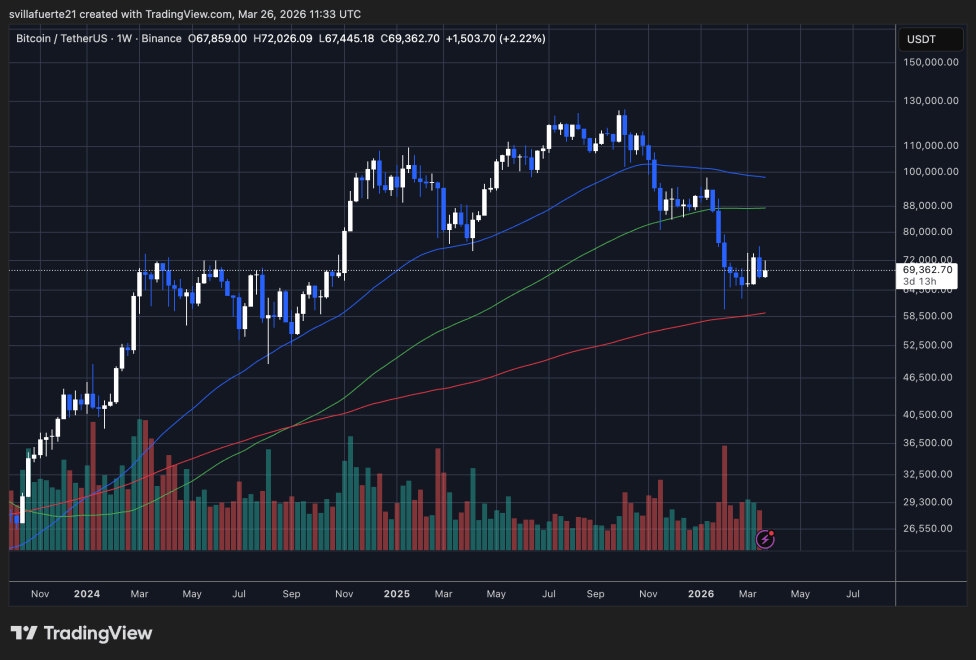
BTCUSD now trading at $68,777. Chart: TradingView
Still, not everyone is moved by her version of events. Onchain analyst ZachXBT said the broader crypto community had warned Welsh repeatedly not to move forward with a token launch.
She launched one anyway. When it collapsed, he said, she went quiet while investors absorbed the losses.
Hawk Tuah Girl Now Tells Others To Avoid Crypto Entirely
More than a year after the incident, Welsh says she still does not understand the crypto industry. Her advice to anyone considering getting involved: stay out.
She told Callaghan that people need to be careful about what they attach their name to — a lesson she learned the hard way.
Whether Welsh was a victim, a willing participant, or something in between remains a matter of debate. What is not in dispute is that the coin was launched, it failed, and real people lost money.
Her lawyer’s $200,000 estimate of retail losses may sound modest against the token’s once-massive valuation, but it was real money that belonged to real people who bought in on her name.
Featured image from Getty Images, chart from TradingView
Editorial Process for bitcoinist is centered on delivering thoroughly researched, accurate, and unbiased content. We uphold strict sourcing standards, and each page undergoes diligent review by our team of top technology experts and seasoned editors. This process ensures the integrity, relevance, and value of our content for our readers.

The current Bitcoin (BTC) bear market can be explained by the four-year cycle and long-term BTC holders selling at the $100,000 psychological level, according to Anthony Scaramucci, managing partner of the SkyBridge investment firm.
Bitcoin’s four-year market cycle has been “muted” by institutional investors and inflows from BTC exchange-traded funds (ETFs) that have cushioned volatility, Scaramucci said, but the altered market dynamics have not fully erased BTC’s traditional cycles. He said:
“We’re in a four-year cycle, and there were some traditional whales, some OG’s, that believe in the four-year cycle, and guess what happens in life when you believe in something? You create a self-fulfilling prophecy.”
BTC will continue to see choppy price action for most of the year, until the fourth quarter of 2026, when prices will start to rise again in a new bull market cycle, he said.
Scaramucci shares his BTC forecast in a sit-down with Scott Melker of the “Wolf of All Streets” podcast. Source: The Wolf of All Streets
Scaramucci said that market participants, including himself, were widely expecting BTC to climb to $150,000 in 2025, driven by US President Donald Trump’s pro-crypto agenda and US regulators warming up to the digital asset industry.
However, the October market crash, which dragged BTC down from an all-time high of about $126,000 to a low of $60,000, completely shattered the widely held consensus.
Markets often move in opposite ways to the prevailing investor sentiment, Scaramucci said, citing Bitcoin’s price action in the early months of 2023, following the November 2022 collapse of the FTX exchange, as an example.
Bitcoin bottomed out in December 2022 following the collapse of the FTX crypto exchange and started rising again in January 2023. Source: TradingView
“It was at a period of great disinterest and great apathy that the bull market started again,” he said, adding that the current BTC bear market is a “garden variety” correction in line with previous downturns.
To be sure, crypto industry executives, analysts, and market participants continue to debate whether Bitcoin’s four-year cycle theory is still valid after BTC ended 2025 in the red or if changing market dynamics have permanently altered how the price of BTC moves.
Related: Bitcoin price aims to hold $70K amid rising inflation concerns
Could Iran war and geopolitical turmoil bring BTC more pain?
The price of BTC fell below $69,000 on Saturday as the war in Iran entered its third week, jolting risk assets across the board.
Bitcoin’s current price action. Source: CoinMarketCap
Stock market investors saw the S&P 500 index extend its decline on Friday, dropping by about 1.3%. A day earlier the gauge closed below its 200-day moving average, a key technical indicator closely watched to assess the overall trend of equities markets, for the first time in 10 months.
Some analysts now forecast a potential 50% drop in BTC’s price in 2026 if it continues to exhibit a positive correlation with the S&P 500 index.
Magazine: The debate over Bitcoin’s four-year cycle is over: Benjamin Cowen
Cointelegraph is committed to independent, transparent journalism. This news article is produced in accordance with Cointelegraph’s Editorial Policy and aims to provide accurate and timely information. Readers are encouraged to verify information independently. Read our Editorial Policy https://cointelegraph.com/editorial-policy
As platforms such as Polymarket gain mainstream visibility during U.S. election cycles and major geopolitical events, their prices are increasingly cited as real-time signals of truth. The pitch is seductive: let people put money behind beliefs, and the market will converge on reality faster than polls or pundits. But that promise collapses when a contract creates a financial incentive for someone to change the very outcome it claims to measure.
The problem is not volatility. It is design.
When a forecast becomes a plan
The most extreme example is the assassination market, a contract that pays if a named individual dies by a certain date. Most major platforms do not list anything so explicit. They do not have to. The vulnerability does not require a literal bounty.
It only requires an outcome that a single actor can realistically influence.
Consider a sports-adjacent case: a prop market on whether there will be a pitch invasion during the Super Bowl. A trader takes a large position on “yes,” then runs onto the field. It is not hypothetical. It has happened. That is not a prediction. It is execution.
The same logic extends well beyond sports. Any market that can be resolved by one person taking one action, filing one document, placing one call, triggering one disruption or staging one stunt embeds an incentive to interfere. The contract becomes a script. The trader becomes the author.
In those cases, the platform is not aggregating dispersed information about the world. It is pricing the cost of manipulating it.
Political and event markets carry a higher risk
This vulnerability is not evenly distributed across the prediction universe. It concentrates on thinly traded, event-based or ambiguously resolved contracts. Political and cultural markets are especially exposed because they often hinge on discrete milestones that can be nudged at relatively low cost.
A rumor can be seeded. A minor official can be pressured. A statement can be staged. A chaotic but contained incident can be manufactured. Even when no one follows through, the mere existence of a payout changes incentives.
Retail traders understand this instinctively. They know a market can be correct for the wrong reasons. If participants begin to suspect that outcomes are being engineered, or that thin liquidity allows whales to push prices for narrative effect, the platform stops being a credibility engine and starts looking like a casino with a news overlay.
Trust erodes quietly, then all at once. No serious capital operates in markets where outcomes can be cheaply forced.
“All markets are manipulable” misses the point
The standard defense is that manipulation exists everywhere. Match fixing happens in sports. Insider trading happens in equities. No market is pure.
That confuses possibility with feasibility.
The real question is whether a single participant can realistically manipulate the outcome they are betting on. In professional sports, results depend on dozens of actors under intense scrutiny. Manipulation is possible but costly and distributed.
In a thin event contract tied to a minor trigger, one determined actor may be enough. If the cost of interference is lower than the potential payout, the platform has created a perverse incentive loop.
Discouraging manipulation is not the same as designing against it.
Sports as a structural template
Sports markets are not morally superior. They are structurally harder to corrupt at the individual level. High visibility, layered governance, and complex multi-actor outcomes raise the cost of forcing a result.
That structure should be the template.
It is product integrity
Prediction platforms that want long-term retail trust and eventual institutional respect need a bright-line rule: do not list markets whose outcomes can be cheaply forced by a single participant, and do not list contracts that function as bounties on harm.
If a contract’s payout can reasonably finance the action required to satisfy it, the design is flawed. If resolution depends on ambiguous or easily staged events, the listing should not exist. Engagement metrics are not a substitute for credibility.
The first scandal will define the category
As prediction markets gain visibility in politics and geopolitics, the risks are no longer abstract. The first credible allegation that a contract was based on non-public information, or that an outcome was directly engineered for profit, will not be treated as an isolated incident. It will be framed as proof that these platforms monetize interference with real-world events.
That framing matters. Institutional allocators will not deploy capital into venues where the informational edge may be classified. Skeptical lawmakers will not parse the difference between open-source signal aggregation and private advantage. They will regulate the category as a whole.
The choice is simple. Either platforms impose listing standards that exclude easily enforceable or easily exploitable contracts, or those standards will be imposed externally.
Prediction markets claim to surface the truth. To do that, they must ensure their contracts measure the world rather than reward those who try to rewrite it.
If they fail to draw that line themselves, someone else will draw it for them.
Trusted Editorial content, reviewed by leading industry experts and seasoned editors. Ad Disclosure
XRP is exhibiting a large-scale technical formation on its monthly chart that has drawn significant attention. Egrag Crypto, a widely followed XRP analyst on X, has identified a macro W pattern developing across years of price history.
This is a structure that, if it plays out in full, has a 25% to 35% chance of carrying the XRP price to a target of $22. The pattern structure has a higher chance of bullish continuation, but only if key levels continue to hold in the short term.
Macro W Formation Shows Breakout And Retest In Progress
Egrag’s chart analysis shows a large W-shaped structure developing across higher timeframes on the XRP chart. The W formation spans years of XRP price action on the monthly timeframe, and the first leg is already completed. The second leg has now entered into a breakout followed by a pullback into the former resistance zone.
That pullback is currently playing out around the $1.60 region, which is shown in the chart below as a bullish hammer candle. The breakout above resistance has already occurred, and price action is now attempting to confirm that level as support. The presence of this bullish hammer candle shows that buyers are stepping in during the retest.
As long as XRP holds within the $1.60 to $1.80 range, then the bullish structure is still in place. A loss of this area would begin to compromise the pattern’s structural integrity. Invalidation, by contrast, will happen if the XRP price undergoes a breakdown through $1.40 to $1.20 or a continued failure to break above $2.00.
XRP Price Chart. Source: @egragcrypto On X
Price Targets To Watch Out For
Although the analysis projects a much higher target for XRP, the immediate focus is on reclaiming $2.00. Egrag identifies this level as the key trigger that would shift the structure from a simple retest into a confirmed continuation.
XRPUSD currently trading at $1.39. Chart: TradingView
A move above $2.00, followed by sustained acceptance, would indicate that XRP has regained strength after the pullback. From there, the next level to watch sits around $3.30, which aligns with the upper boundary of the current range shown on the chart.
Only after a full expansion through these levels would the $22 target begin to come into view. The projected $22 target is based on a measured move from the macro W structure, combined with the neck resistance, historical expansion multiples, and macro cycle behavior. However, Egrag does not treat this outcome as guaranteed.
Egrag was explicit about the chances of XRP’s next move from the current price. A full expansion to $22 carries a 25% to 35% likelihood, while a partial move into the $3 to $8 range is assigned a 50% to 60% probability. An outright failure and break below $1.20 is given just a 10% to 15% probability. At the time of writing, XRP is trading at $1.40.
Featured image from Shutterstock, chart from TradingView
Editorial Process for bitcoinist is centered on delivering thoroughly researched, accurate, and unbiased content. We uphold strict sourcing standards, and each page undergoes diligent review by our team of top technology experts and seasoned editors. This process ensures the integrity, relevance, and value of our content for our readers.
Trump: US will hit Iranian power plants unless Strait of Hormuz reopens.
Prolonged conflict would be “negative for Bitcoin,” says expert.
Bitcoin not yet a proven “safe haven asset,” analyst explains.
US President Donald Trump’s threat to attack Iranian power plants if Tehran refuses to reopen the Strait of Hormuz has sent the Bitcoin price back below the $70,000 mark.
And experts say the deepening conflict in the Middle East could take a heavy toll on Bitcoin prices, with the spectre of an incoming global recession looming over crypto markets.
“A prolonged conflict in the Middle East would generally be negative for Bitcoin,” Georgii Verbitskii, founder of the crypto trading platform TYMIO, told DL News. “Any disruption to global trade routes increases uncertainty across financial markets.”
This uncertainty will put pressure on equities, Verbitskii said. “Bitcoin is still highly correlated with risk assets, particularly US stock indices. When those markets come under pressure, Bitcoin usually follows.”
The warning comes as experts spoke of an incoming “double-whammy” for risk assets in the wake of the Federal Reserve’s decision not to cut interest rates at its March meeting.
David Lawant, Anchorage Digital’s head of research, told DL News earlier this week that crypto “isn’t immune to macro[economic] headwinds.”
‘No safe haven’
Trump’s warning came hours after suggestions he may “wind down” the conflict.
“Within 48 hours from this exact point in time, the United States of America will hit and obliterate [Iran’s] various power plants, starting with the biggest one first,” he wrote on Truth Social on Saturday.
Tehran has countered by saying the strait remains open to maritime transport, with the “exception of Iran’s enemies.”
Missiles continued to fall across the Middle East on Saturday night and Sunday morning, with Bitcoin prices tumbling by around 3% in the past 24 hours.
“The ongoing Middle East conflict remains the primary lens for traders, investors, and even policymakers worldwide,” Han Tan, chief market analyst at crypto exchange Bybit’s education arm Bybit Learn, told DL News.
Tan said major central banks and others have expressed concern about the “uncertainty surrounding the war’s duration and intensity.”
Rising oil prices could spark inflationary forces in global economies, Tan said.
And Bitcoin investors who expect the world’s most popular cryptocurrency to act as a gold-like hedge against inflation may see their hopes dashed during the conflict, the analyst warned.
“The prudent stance is to withhold from prematurely according the safe haven title to Bitcoin just yet,” Tan said. “Bitcoin is yet to prove its merits on that front.”
Verbitskii concurred.
“Bitcoin is not yet behaving as an independent geopolitical hedge,” Verbitskii said. “It is still largely reacting to global liquidity conditions and movements in traditional financial markets.”
At the time of writing, Bitcoin was trading at $68,700.
Tim Alper is a News Correspondent at DL News. Got a tip? Email him at tdalper@dlnews.com.
Gold and silver posted one of their steepest weekly pullbacks in years as macro forces flipped the script on safe-haven demand. Gold Sees Sharpest Weekly Loss in Years Precious metals took a sharp step lower this past week, with gold and silver logging their most punishing declines in over a decade as traders unwound crowded […]
The U.S. Securities and Exchange Commission and Commodity Futures Trading Commission published interpretive guidance explaining how they might define what is or isn’t a security in crypto; the CFTC also issued a no-action letter for a non-custodial wallet provider to facilitate derivatives and prediction markets transactions; Arizona is filing criminal charges against a prediction market provider; and by the way we kind-of-sort-of have hints of movement on market structure legislation.
What a week, huh?
You’re reading State of Crypto, a CoinDesk newsletter looking at the intersection of cryptocurrency and government. Click here to sign up for future editions.
The narrative
The U.S. Securities and Exchange Commission published interpretive guidance this week — joined by the Commodity Futures Trading Commission — laying out how it approached the question of what in crypto it will deem a security.
Why it matters
What is, and isn’t, a security has long bedeviled the industry. We had efforts at somewhat defining this from the SEC in the past — Bill Hinman’s “When Howey met Gary (plastics)” speech, for example — but this week’s interpretative guidance is one of the most specific efforts to define this for the industry.
Breaking it down
The SEC laid out several categories it saw in the crypto space, with one of these categories being digital securities. These are cryptocurrencies that meet the definition of a security under any other context, but happen to be tokenized, the guidance said. For example, if a crypto asset meets the prongs of the Howey Test, it’s a security.
This is the category of tokens the SEC will oversee.
Other categories include payment stablecoins, digital tools, digital collectibles and digital commodities, which are generally not securities unless the issuers or operators take actions that might meet securities regulations, such as fractionalizing the tokens in question.
“We establish a straightforward taxonomy of crypto assets — most of which are not securities — and clarify how the Supreme Court’s Howey test applies when a crypto asset is part of an investment contract,” SEC Chair Paul Atkins and Commissioners Hester Peirce and Mark Uyeda wrote in an oped for CoinDesk.
The CFTC said it would sign on to the guidance and administer it under the Commodities Exchange Act.
“Market participants — from innovators and issuers to individual investors — should review this interpretation to better understand the regulatory jurisdiction between the SEC and CFTC,” the CFTC said in a press release. “The interpretation will be published on CFTC.gov and in the Federal Register.”
Congressman Troy Downing (R-Mont.) called the guidance “very positive,” but said Congress still needed to pass market structure legislation as a future administration could undo the interpretative guidance.
“Just having another two or three years of this and then having ambiguity out there doesn’t make most people comfortable on doing any kind of big investment,” he told CoinDesk. “But it’s a great start because this is exactly what the industry wants, and it allows some people to move forward.”
Chris LaVigne, a partner at the law firm Withers, said the guidance “predictably concludes that most crypto assets and many common crypto activities are not securities,” though the agency kept some discretion to being an enforcement action in this area.
“The guidance moves the securities inquiry away from the asset or activity itself (which are mostly deemed digital commodities not within the purview of the SEC) and re-centers the analysis on the transactions and representations in which these assets or activities arise or are marketed,” he said. “By doing so, the SEC did not completely eliminate uncertainty or its enforcement role, because it concludes that a crypto asset that is not a security can nonetheless be sold as part of an investment contract if it is marketed with promises of profit derived from the issuer’s essential managerial efforts.”
A crypto that was marketed as a security may eventually be deemed something else “once those promises are fulfilled or no longer operative,” he said. This might affect securities more broadly than just crypto assets.
It’s less clear what may constitute a commodity under the guidance.
Jason Gottlieb, a partner at Morrison Cohen, said the Commodity Exchange Act defines commodities as a list of products (excluding onions and motion picture box office receipts), services and other issues “in which contracts for future delivery are presently or in the future dealt in.”
This legal definition diverges from the definition seemingly being used in the guidance. The CFTC’s approach to crypto over the past decade has evolved since some early lawsuits, where it claimed jurisdiction over bitcoin BTC$68,696.20, leading it to seemingly have jurisdiction over non-security cryptocurrencies. But this definition needs to be codified by market structure legislation, he told CoinDesk.
“People need to understand that jurisdiction is still uncertain. The SEC is clearly saying ‘we don’t have jurisdiction if the token does not meet these criteria,'” he said. “Just because the SEC does not have jurisdiction does not mean the CFTC does.”
Gottlieb said he was part of a case before the Seventh Circuit Court of Appeals seeking to gain clarity on this question, but market structure legislation would be needed to cleanly grant the CFTC jurisdiction over all non-security cryptocurrencies.
The status of that legislation also remains up in the air. Senator Cynthia Lummis (R-Wyo.), speaking at the DC Blockchain summit earlier this week, said she anticipated a markup may happen in the final weeks of April. The issue of stablecoin yield may be resolved with an agreement that stablecoin issuers and their partner firms would not describe their products using bank terminology, though she cautioned that she hadn’t seen any specific language yet.
The flip side, several individuals told me, is that the Clarity Act might require the SEC to go back to the drawing board on how it’s defining securities in crypto. But this falls under the category of bridges that can be crossed when they’re reached.
Senator Tim Scott (R-S.C.), the chair of the Senate Banking Committee, said lawmakers are also close to agreements on issues like ethics and quorums on the regulatory agencies — some of the outstanding areas of disagreement on the bill.
Downing said he saw an April time frame as doable for advancing market structure legislation. The closer lawmakers get to the end of the year, however, the less likely it would be that anything could be passed, he said, pointing to the midterm election. “But I don’t think it’s impossible.”
Senator Kirsten Gillibrand (D-N.Y.) said on stage at the DC summit that she was “optimistic” there would be a markup soon, which would then lead to the Banking and Agriculture Committee’s bills combining.
The combined bill would need to incorporate areas of bipartisan agreement, she said.
“One of the issues that I think is very important that people should be aware of is the Senate wants an ethics provision,” she said. “I think the House would have had even more support on the Democratic side if they had retained their ethics provisions in their bill. It’s very important that members of Congress do not get rich off of this industry, because they have access to non-public information, because they have positions of power and authority.”
Downing said the market structure bill needed to address consumer protections and money laundering, without being so restrictive that companies would be scared to do anything.
“Nobody wants bad actors in their space and nobody wants that reputation of bad actors using this as a tool to do bad things,” he said. “… If you bring those [provisions] in too narrow, nobody’s going to do anything innovative.”
He said he understood why banks might be concerned about the yield issues.
“Community lenders, community banks are worried about depositors all exiting the market, in which case you’re not doing mortgages on small farms in Montana, right?” he said.
Late Friday, Senators Angela Alsobrooks and Thom Tillis told Politico they had reached an agreement on the yield issue, though the details had not been shared with the banking or crypto industries as of press time.
Kalshi was just ordered to cease offering most of its prediction markets in the state of Nevada for at least two weeks, pending a hearing on April 3.
The order came after an appeals court refused to grant an administrative motion that could have blocked the state court’s action. Earlier in the week, the state of Arizona filed criminal charges against Kalshi, alleging some of its election and other contracts violate state law.
In Nevada, a judge ruled that Kalshi can’t offer sports, election or entertainment-related event contracts at least temporarily.
According to the order by Judge Jason Woodbury, the record in Nevada’s case against Kalshi so far suggests that it offers products defined by state law, making its conduct subject to Nevada’s gaming regulators.
“The question of federal preemption in this regard is nuanced and rapidly evolving,” the judge wrote. “At the moment, the balance of convincing legal authority weighs against federal preemption in this context.”
The Arizona action goes further, alleging misdemeanor violations on small bets placed on professional football and college basketball games, upcoming elections and on whether bills become law and whether public figures will show up to sporting events.
“Arizona law prohibits operating an unlicensed wagering business, and separately bans betting on elections outright,” Arizona Attorney General Kris Mayes’ office said in a press release.
Kalshi co-founder Tarek Mansour called the charges a “total overstep” that “have nothing to do with gambling or the merits.”
There’s a broader growing backlash to prediction markets. Senator Catherine Cortez-Masto, who represents Nevada, wrote an opinion piece saying prediction markets “blatantly violate state and tribal laws and regulations.”
“To ensure responsible gaming, casinos, sportsbooks and online gaming sites have to follow minimum age requirements, participate in integrity monitoring and support critical consumer protections, like programs that help people with gambling addictions,” she said. “Yet, this past year, emboldened by limp and overly permissive federal regulators like the Commodity Futures Trading Commission (CFTC), so-called ‘prediction markets’ have transformed themselves into illegal sportsbooks, offering their users illicit sports wagers.”
This week
There are no hearings or public meetings scheduled (at least pertaining to crypto).
If you’ve got thoughts or questions on what I should discuss next week or any other feedback you’d like to share, feel free to email me at [email protected] or find me on Bluesky @nikhileshde.bsky.social.
You can also join the group conversation on Telegram.