Home Blog Page 658

Overview of The Kingdom of Bahrain’s Fintech Ecosystem in 2026

0

The Kingdom of Bahrain has long taken a different approach and was the first in the region to diversify its economy and used financial services and fintech to do so. How is the economy and fintech ecosystem in 2026?

When I last examined Bahrain’s financial services economy, the Kingdom was already positioning itself as a regulatory pioneer. By 2026, that foundation has evolved into something more deliberate: a fintech ecosystem defined by alignment between regulator, industry and infrastructure.

Bahrain is no longer just an early mover. It is becoming a system builder.

Digital Transformation as Economic Strategy

Fintech in Bahrain is inseparable from its broader economic diversification strategy.

As hydrocarbons have gradually declined in relative importance, financial services and digital industries have become central to the country’s economic model. By last year, non-oil sectors accounted for approximately 85 per cent of gross domestic product (GDP), with financial services contributing around 17 per cent, reinforcing the sector’s importance to national growth.

This transformation is underpinned by a clear policy direction.

Government initiatives, supported by the Bahrain Economic Development Board (EDB), continue to position fintech as a key pillar of economic diversification. This includes the main catalyst of fintech, Bahrain Fintech Bay, being an active player in the Kingdom. Digitalisation is being applied across sectors – from payments and banking to public services – creating a more integrated digital economy.

At the infrastructure level, Bahrain benefits from near-universal mobile penetration and a digitally literate population, enabling rapid adoption of digital financial services.

Fintech, in this context, is not an isolated industry. It is a core component of national economic transformation.

Financial Services Sector: Digital Transformation in Practice
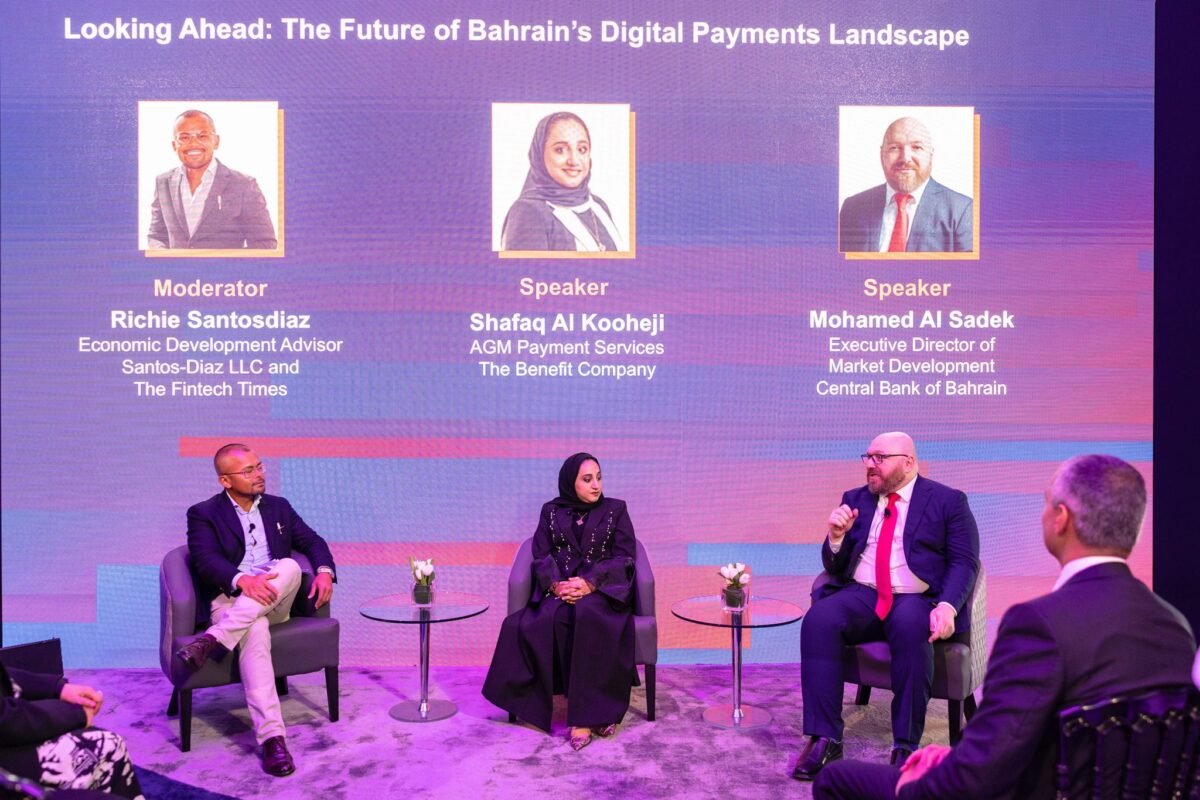
Event in 2025 announcing amongst other things a framework for licensing and regulating stablecoin issuers. Pictured: Mohamed Al Sadek, Shafaq Al Kooheji, and Richie Santosdiaz IMAGE SOURCE CENTRAL BANK OF BAHRAIN

Bahrain’s financial services sector has long been one of the most developed in the Gulf Cooperation Council (GCC) region, and it is now undergoing a significant digital shift.

The Central Bank of Bahrain (CBB) plays an active and central role as a unified regulator, overseeing banking, fintech and capital markets under a single framework. Bahrain was among the first in the region to introduce a regulatory sandbox in 2017, and an open banking framework in 2018, and crypto-asset regulations and licensing frameworks.

Last year, which I got to witness in-person, saw the CBB announce the introduction of a framework for licensing and regulating stablecoin issuers.

Banks and fintech companies are increasingly interconnected through API-driven systems, digital onboarding processes and real-time payment infrastructure. Platforms such as Tarabut Gateway have scaled open banking capabilities across the region, while digital asset platforms like CoinMENA operate under regulatory oversight.

Fintech Ecosystem: From Sandbox to Scale

Bird view of Manama city, Bahrain. Skyline with modern skyscrapers standing on the coast of Arabian Gulf IMAGE SOURCE GETTY

Bahrain’s fintech ecosystem has evolved from experimentation to structure.

Back in 2022 the country’s sandbox hosted around 25 fintech companies, spanning areas such as BNPL, robo-advisory and crypto services.

This year, the ecosystem has expanded significantly. Industry estimates suggest that Bahrain now hosts over 100 fintech companies and digital financial service providers, supported by institutions such as Bahrain FinTech Bay (BFB).

Growth has been driven by various factors such as regulatory clarity, access to regional markets, strong institutional coordination and alignment with Islamic finance frameworks

The fintech market itself is projected to grow from $1.4billion last year to $5billion by 2033, reflecting sustained expansion across payments, digital banking and wealthtech.

Unlike many markets, Bahrain’s fintech ecosystem has not been built on startup volume alone. It has been built on regulatory infrastructure.

Compared with its GCC neighbours, Bahrain does not face severe financial inclusion challenges. Access to banking services is already relatively high, supported by a mature financial system. However, further sub sector penetration (such as in insurance where historically as in the Middle East was lower than other developed economies) and also amongst the lower-skilled expatriate community can see further financial inclusion.

Digital wallets, open banking platforms and alternative lending solutions are expanding access to financial services for small businesses and underserved segments. At the same time, Shariah-compliant fintech solutions are opening new avenues for inclusive finance within Islamic banking frameworks.

Recent developments highlight Bahrain’s continued fintech momentum.

The launch and expansion of FinHub973, the Central Bank’s cross-border digital innovation platform, has strengthened collaboration between financial institutions and fintech firms, enabling testing, prototyping and scaling of solutions.

At the same time, partnerships between fintech firms and global players are increasing. Last year, crypto platform CoinMENA partnered with United Arab Emirates (UAE)-based digital bank Zand to facilitate cross-border digital asset transactions, reflecting growing regional integration.

More broadly, Bahrain continues to attract international fintech firms seeking a regulatory testbed.

As noted in recent Fintech Times coverage, the country’s appeal lies in its “single regulator, fast approvals and supportive ecosystem”, allowing fintech companies to move from pilot to production quickly. This combination of regulatory agility and institutional support remains one of Bahrain’s defining strengths.

As with much of the Middle East, unfortunately 2026 has seen better days with the conflict with Iran. Despite that, Bahrain’s fintech ecosystem in 2026 remains optimistic given all the effort and successes it has achieved.

The country has built a financial system where regulation, infrastructure and innovation move in alignment that is boosting its economic diversification efforts.

White House Clears DOL Key Rule Proposal

0

Trusted Editorial content, reviewed by leading industry experts and seasoned editors. Ad Disclosure

The Department of Labor’s (DOL) proposed rule to allow crypto investment options for 401(k) retirement plans has cleared the White House’s regulatory review, bringing digital assets closer to the US’s $10 trillion market.

White House Clears DOL’s Proposed 401(k) Rule

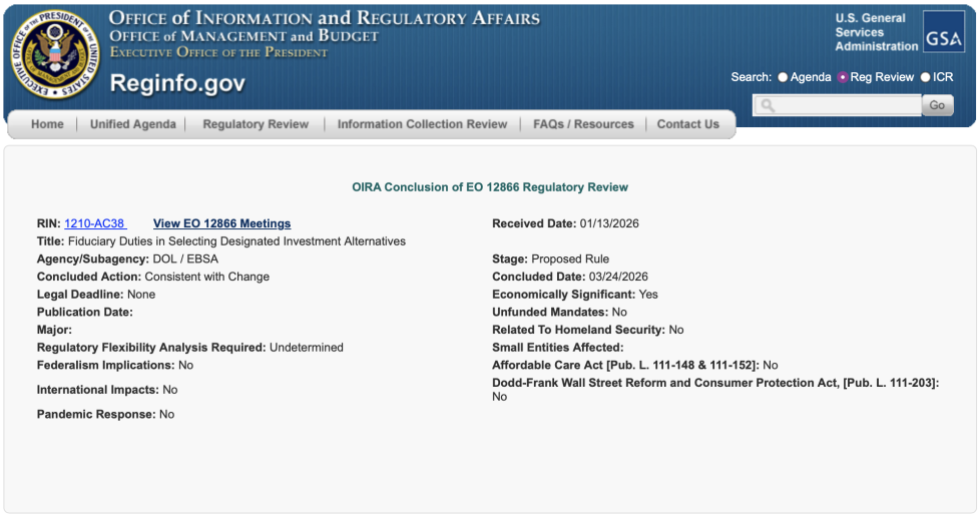
The White House’s Office of Information and Regulatory Affairs (OIRA) has concluded its review of a proposed rule submitted by the Department of Labor that could pave the way for crypto exposure in 401(k) retirement plans.

Notably, the Labor Department rescinded a 2022 guidance that discouraged fiduciaries from including crypto investments in 401(k) plans. The guidance followed a Biden-era executive order (EO) that required the government to assess the risks and benefits of digital assets.

As reported by Bitcoinist, it directed plan fiduciaries under the Employee Retirement Income Security Act (ERISA) to exercise extreme caution before incorporating crypto assets into their investment menus, asserting that the digital asset industry’s early stage could pose significant risks.

The DOL’s proposal, named “Fiduciary Duties in Selecting Designated Investment Alternatives,” could amend the fiduciary guidance for plans governed by the Employee Retirement Income Security Act (ERISA).

crypto

White House concludes regulatory review of DOL's proposed rule. Source: OIRA

This could potentially allow plan sponsors to include cryptocurrencies and private equity as designated investment alternatives. The federal agency marked the action as “consistent with change” and designed the proposal as an “economically significant” rule in its review, which concluded on March 24.

According to the OIRA website, the proposed rule carries no legal deadline for finalization. However, the DOL is expected to formally release the proposal in the coming weeks, allowing for a standard 60-day public comment period. Following this, revisions will be made, and a final rule will be issued.

US Push To Allow Crypto In Retirement Plants

The proposal follows an executive order signed by President Donald Trump last August seeking to allow more private equity, real estate, cryptocurrency, and other alternative assets in 401(k) retirement accounts.

The order directed the DOL, the Securities and Exchange Commission (SEC), the Treasury Secretary, and other federal agencies to reduce regulatory barriers that prohibited investments in alternative assets in their defined contribution retirement plans and explore ways to facilitate access to these assets.

In January, Bitwise’s CIO, Matt Hougan, discussed the possibility of 2026 being the year investors can own Bitcoin and other cryptocurrencies in 401(k) retirement plans, citing that the inclusion of digital assets is becoming more common in individual retirement accounts (IRAs).

The executive argued that providers are slow to adapt, but acknowledged that the Trump administration’s pro-crypto stance, which effectively removed the ban on crypto from 401(k)s, has opened the door to the multi-trillion-dollar market.

Recently, some US states have pushed to embed crypto into their public financial systems. In February, Indiana lawmakers advanced House Bill 1042 (HB 1042), also known as the Bitcoin Rights Bill, which requires several state-administered programs, including retirement plans for teachers, public employees, and legislators, to offer self-directed brokerage accounts with at least one digital asset investment option.

Multiple US lawmakers have backed the Trump Administration’s initiatives. In September, nine House members requested that the SEC Chairman, Paul Atkins, provide prompt assistance in implementing the president’s executive order and collaborate with the DOL to safeguard workers.

In addition, House of Representatives member Troy Downing introduced a bill to codify Trump’s directive and grant it the “force and effect of law.” This move aimed to facilitate investors’ access to Bitcoin and other alternative assets within their 401(k) retirement plans.

crypto, bitcoin, btc, btcusdt

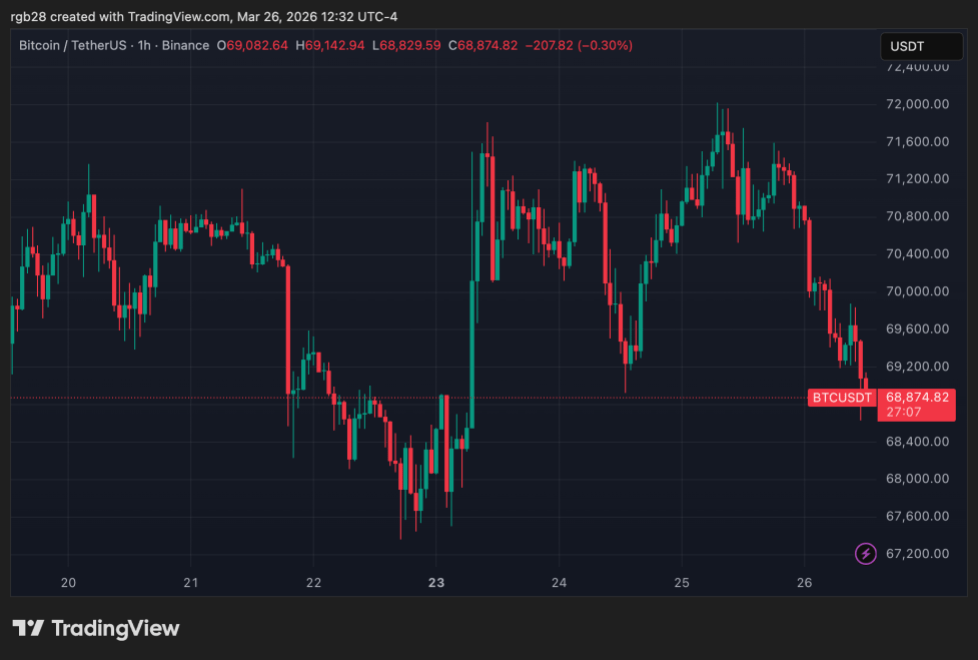
Bitcoin (BTC) trades at $68,874 in the one-week chart. Source: BTCUSDT on TradingView

Featured Image from Unsplash.com, Chart from TradingView.com

Editorial Process for bitcoinist is centered on delivering thoroughly researched, accurate, and unbiased content. We uphold strict sourcing standards, and each page undergoes diligent review by our team of top technology experts and seasoned editors. This process ensures the integrity, relevance, and value of our content for our readers.

Mixin Expands Gas Fee Subsidy Program – Crypto News Bitcoin News

0

Eliminating the Cost of Onchain Transactions

Mixin, a privacy-first platform for digital asset transactions, has announced a major expansion of its gas fee subsidy program, further reducing costs for users moving assets across multiple blockchains.

Launched in 2025, the program allows users to import external Web3 wallets into the Mixin ecosystem and conduct onchain transactions. While users initially pay gas fees, those costs are fully reimbursed at the start of the following month, effectively eliminating one of the biggest hurdles in everyday crypto usage.

In a media release, Mixin said gas fees have long been a pain point for blockchain adoption, often making small or frequent transfers impractical. This claim is supported by multiple studies, including research published in Frontiers in Blockchain (2024), which found that volatile and high Ethereum gas fees directly reduce user willingness to transact.

Another study from the same year concluded that fee spikes discourage everyday usage and make blockchain less competitive than traditional payment systems. Similarly, a 2023 MDPI study showed that stabilizing fees through Ethereum’s EIP-1559 upgrade improved transaction throughput, underscoring how fee volatility undermines adoption.

Scaling Accessibility Across Major Networks

Mixin’s subsidy model seeks to address this challenge by ensuring transactions remain accessible and cost-efficient, even during periods of network congestion.

“Our goal has always been to make cryptocurrency as simple and private as sending a text message,” said Cedric Fung, co-founder of Mixin. “By subsidizing those costs across supported networks, we’re removing friction from how people move value online.”

The subsidy currently covers major assets and networks, including bitcoin, ethereum and solana, with no restrictions on transaction volume or frequency. Users can move funds between imported Web3 wallets and Mixin’s privacy wallets, which already offer instant, fee-free transfers via Mixin’s decentralized network.

Beyond financial transactions, Mixin integrates encrypted messaging using the Signal Protocol, enabling users to coordinate payments privately within a chat-based interface.

Fung said:

“The future of finance is social, private, and multi-chain. Mixin is building a messaging layer where people can communicate, coordinate, and move value without friction.”

FAQ ❓

  • What is Mixin’s gas fee subsidy? It’s a program that reimburses blockchain gas fees, making transfers effectively free.
  • When did the subsidy launch? Mixin introduced the program in 2025 to remove cost barriers in crypto adoption.
  • Which blockchains are covered? The subsidy applies to major networks like Bitcoin ( BTC), Ethereum ( ETH), and Solana ( SOL).
  • Why does this matter for adoption? Studies show high and volatile fees discourage everyday crypto use, so Mixin’s model boosts accessibility.

Macro risks mount as Ukraine adds to oil market uncertainty

0

Ukraine has complicated President Donald Trump’s efforts to stabilize oil markets amid the Iran war, amplifying risks for financial markets, including cryptocurrencies.

For nearly a month, markets have been gripped by a single concern: the Iran war. Disruptions in the Strait of Hormuz – a critical oil chokepoint – have driven prices sharply higher, stoking fears of sticky inflation, a risk-off shift, and renewed Fed rate hikes.

To cool things down, the Trump administration quickly lifted sanctions on Russian crude for the short term, opening the tap to compensate for oil supply disruptions caused by the Iran war.

It came across as a solid plan to stabilize energy markets until Ukraine blew it up.
This week, Ukraine launched drone strikes on ports and refiners in Russia’s Leningrad, leading to what one observer described as “the most serious threat” to the country’s oil exports since Putin’s full-scale invasion of Ukraine in 2022.

The damage is significant, with roughly 40% of Russia’s oil export capacity offline. Oilprice.com editor Michael Kern described it as “a logistics problem first – and a supply problem second,” underscoring that moving oil to buyers is now as difficult as producing it.

“In conjunction with the war in the Middle East and de facto closure of the Strait of Hormuz and subsequent oil/LNG production outages, the Russian disruption adds a fresh element to already sky-high oil prices,” Kern noted.

In other words, oil prices may remain elevated longer than initially expected. For risk assets, including bitcoin and other cryptocurrencies, that’s an issue because higher sticky energy prices could lead to sticky inflation, potentially putting pressure on global central banks to raise borrowing costs and drain liquidity.

Traders are already prepping for a potential Fed rate hike in the short term. According to Bloomberg, flows in the options market tied to overnight interest rates indicate traders are wagering on a rate increase within two weeks.

Taken together, these factors suggest bitcoin’s recent resilience may face tests, with the $65,000–$75,000 range vulnerable to a downside break.

At press time, bitcoin traded near $68,500, down nearly 2% over the past 24 hours, according to CoinDesk data. WTI oil, which slipped nearly 10% to $83.95 per barrel on Monday, has since bounced back to $93.50. Brent crude is once again trading above the $100 mark.

A Generational Investment Window: Taranis Capital Highlights the GCC as the new Epicentre for Tech and Biotech

0

Taranis Capital, a DFSA-regulated investment firm based in Dubai, has published a strategic outlook highlighting what it describes as one of the most compelling and time-sensitive investment environments in modern history. According to the firm, the convergence of capital, policy, infrastructure, and geopolitical positioning has created a rare, asymmetric opportunity to deploy capital into data centres, biotechnology, and disruptive technology across the GCC.

At a time when global markets are actively characterised by high volatility, capital fragmentation, and regulatory uncertainty, the GCC is rapidly emerging as a stable, policy-driven ecosystem. This unique environment offers institutional investors both vital downside protection and exponential upside potential.

A structural shift in global capital

The firm notes that the GCC is no longer a passive recipient of capital; rather, it has transformed into an active architect of global investment corridors. This structural shift is deeply underpinned by robust sovereign balance sheets, long-term national visions, and an unprecedented commitment to economic diversification. With massive initiatives such as Saudi Vision 2030 and the UAE’s forward-looking economic strategies leading the charge, trillions of dollars are currently being strategically deployed into infrastructure, technology, and knowledge-based industries.

Powering the digital economy

A core pillar of this investment window is the rapid development of digital infrastructure. The exponential global growth of artificial intelligence and cloud computing has placed data centres at the absolute core of national security and economic resilience. Taranis Capital asserts that the GCC is uniquely positioned to capitalise on this surging demand due to its strategic geographic positioning, advanced connectivity infrastructure, government-backed initiatives, and ready access to competitive energy sources. Because current demand is severely outpacing supply, the sector presents a high-barrier, yield-generating infrastructure opportunity backed by long-term contracted revenues.

Simultaneously, the region is becoming a powerful launchpad for next-generation disruptive technologies spanning fintech, AI, and cybersecurity. Supported by progressive regulatory frameworks, digital transformation at scale, and sovereign capital, the GCC is effectively leapfrogging traditional legacy markets. This creates access to high-growth, venture-scale returns within a highly stable macroeconomic environment.

Furthermore, the region is actively transitioning from a mere consumer of healthcare products into a biotechnology innovation and manufacturing hub. Driven by national mandates focused on knowledge transfer, localisation, and economic sovereignty, regional governments are heavily incentivising local manufacturing and international R&D partnerships.

The timing differentiator
Nicholas S. Bingham, founding partner and CEO of Taranis Capital

Nicholas S. Bingham, founding partner and CEO of Taranis Capital, emphasized the urgency of this strategic window.

“We are witnessing a once-in-a-generation realignment of global capital,” Bingham stated. “The GCC is no longer emerging—it has emerged. Data centres, biotechnology, and disruptive technology are not isolated sectors; they are the foundational pillars of future economies.”

Bingham concluded that for investors, this is not simply a passive opportunity, but a strict strategic imperative, adding that those who act now will help fundamentally define the next decade of global growth. The firm advises that early participants will secure a distinct advantage at an institutional scale by accessing strategic assets well before the market reaches full saturation.

Tether hires KPMG for USDT audit, brings in PwC as it gears up for U.S. expansion

0

The unnamed “Big Four” firm that Tether selected to audit its $185 billion dollar-pegged USDT stablecoin is KPMG, the Financial Times reported Thursday, citing people familiar with the matter.

Tether has also engaged PwC to prepare its internal systems ahead of the audit, marking the most concrete step yet toward full financial scrutiny for the world’s largest stablecoin issuer. CoinDesk has contacted Tether for comment on the matter.

CoinDesk reported earlier this week that Tether had said it had entered a formal engagement with a Big Four auditor, but the stablecoin issuer did not identify the firm. CFO Simon McWilliams said at the time that Tether was “already operating at Big Four audit standard” and that “the audit will be delivered.”

All this comes as the El Salvador-based company prepares for a U.S. expansion and a potential fundraising round. The Financial Times previously reported that Tether faced investor hesitation in efforts to raise $15 billion to $20 billion at a $500 billion valuation, with concerns centered on pricing and regulatory risk.

The audit push lands at a pivotal moment. USDT, with roughly $185 billion in circulation, functions as the reserve currency of crypto markets and a major buyer of U.S. Treasury bills, linking digital assets to traditional financial systems at scale.

A full financial statement audit would go well beyond the monthly attestations currently published by BDO Italia, requiring a detailed review of assets, liabilities, internal controls and reporting systems.

That level of disclosure has long been a sticking point for critics, as Tether has faced persistent questions about its reserves since its launch in 2014 and historically fought transparency.

In 2021, CoinDesk filed a FOIL request with the New York Attorney General’s office seeking documents on USDT’s reserve composition. Tether fought the release in court and lost twice.

The documents, received after a two-year legal battle in 2023, revealed that Tether held the vast majority of its $40.6 billion in reserves at Bahamas-based Deltec Bank as of March 2021, with heavy exposure to commercial paper issued by Chinese and international banks, including Agricultural Bank of China, Bank of China Hong Kong, and ICBC.

Tether’s move toward greater transparency aligns with a shifting regulatory backdrop in the United States as crypto as a whole becomes a mainstream asset class used by Wall Street.

The GENIUS Act, signed into law last July, established the first federal framework for stablecoins in the U.S., under which Tether has already launched a compliant dollar-pegged token, USAT.

What Rising US Bond Yields Mean for Bitcoin

0

In brief

  • U.S. 10-year Treasury yields have surged to around 4.42%, forcing markets to reassess the outlook for interest rates and financial conditions.
  • Bitcoin has held a tight range near $68,000, declining less sharply than equities during the recent macro-driven selloff.
  • Options markets show investors are still buying downside protection, signaling caution but not panic, according to QCP Capital.

Bitcoin is trading near $68,000, holding a relatively narrow range even as a sharp rise in U.S. Treasury yields signaled growing pressure across global markets.

The yield on the benchmark 10-year U.S. Treasury note climbed to around 4.42% on Thursday, up roughly 46 basis points since late February, data shows.

“The current pace of the surge in the US 10Y Note Yield, and US Treasury Yields more broadly, is in line with what we saw in April 2025, during Liberation Day,” The Kobeissi Letter analysts wrote Thursday on X.

“However, this time the backdrop is far more complex, and containing the bond market is not as simple as it may appear,” they added. “This will soon be the market’s biggest story.”

Such moves in the bond market are often meaningful because yields affect borrowing costs throughout the economy, from mortgages to corporate loans, while frequently setting the tone for risk assets, including stocks and crypto.

The month-long rise in yields has been driven in part by oil prices and geopolitical tensions in the Middle East as the U.S and Israel’s war with Iran approaches its fifth week since its Supreme Leader was assassinated. 

Higher energy prices typically feed into inflation, and when inflation expectations rise, bond investors demand higher yields to compensate for the erosion of purchasing power. That repricing has forced investors to reconsider the outlook for interest rates.

Interest-rate futures markets now show expectations that the Federal Reserve will keep rates higher for longer, a shift from late 2025, when markets were pricing in multiple rate cuts through 2026. 

Higher interest rates typically weigh on risk assets by increasing financing costs, making safer assets, such as government bonds, more attractive relative to stocks and crypto.

Despite that backdrop, Bitcoin has declined less sharply than equities in recent weeks and has largely traded between about $68,000 and $71,000. The asset is down 3.3% on the day to $68,400, but remains up 3.9% since the Iran conflict began.

Analysts have said the crypto is currently being pulled in opposite directions by macroeconomic forces.

In a market note on Thursday, digital-asset trading firm QCP Capital said Bitcoin’s price action remains “range-bound and headline-driven,” with options markets showing continued demand for downside hedging but not extreme levels of stress. 

In other words, investors are paying for protection against further declines, but markets are not yet pricing in a severe selloff.

There are also signs that some investors are accumulating Bitcoin during dips. 

Recent net outflows from exchanges suggest coins are being moved into storage rather than positioned for immediate sale, QCP wrote. All while Bitcoin’s share of the total crypto market has been rising, in a sign investors are favoring the world’s largest crypto during uncertain periods.

For now, traders are keeping an eye on the bond market as the key signal to watch. 

If the 10-year Treasury yield continues rising toward the 4.5% range, financial conditions would likely tighten further, increasing pressure on equities and blue-chip cryptocurrencies.

That would leave Bitcoin trading less on crypto-specific developments and more on macroeconomic forces, according to the experts.

Daily Debrief Newsletter

Start every day with the top news stories right now, plus original features, a podcast, videos and more.

BTC, ETH, SOL, ADA slide as Trump extends Iran deadline but war risks persist

0

Bitcoin fell to $68,507 on Friday morning, down 3.2% over the past 24 hours and 2.7% on the week, after a familiar pattern played out for the fifth consecutive week: a de-escalation headline followed immediately by an escalation headline.

U.S. president Donald Trump extended his deadline for Iran to reach a ceasefire deal by 10 days and said talks were going “very well.” Brent crude dipped 1.3% to $106. Then the Wall Street Journal reported the Pentagon is looking at sending up to 10,000 additional ground troops to the Middle East, and whatever relief had built evaporated.

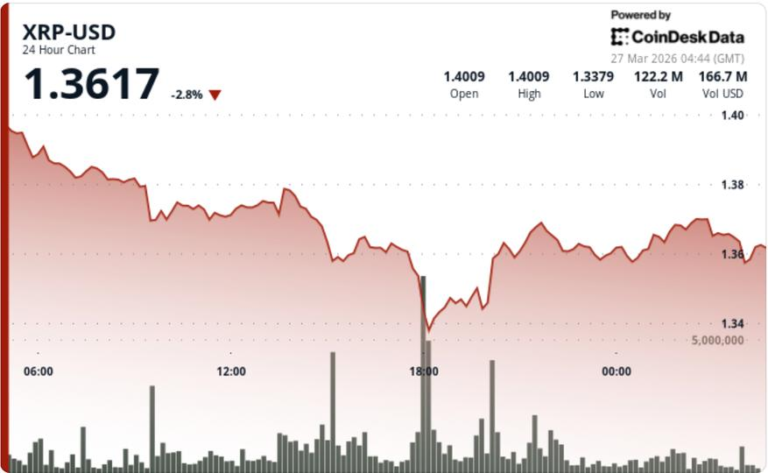
The broader crypto market shed nearly 1% to a total cap of $2.4 trillion. Ether dropped 4.6% to $2,050, back below the level it’s been fighting to hold all month. Solana fell 5.3% to $85.93. XRP lost 2.8% to $1.36, now down 6.5% on the week. BNB slid 2.3% to $626. Dogecoin dropped 2.8% to $0.091. Tron was the only major in the green at 1.2% daily and 2.4% weekly.

Asian equities fell 0.6% on Friday after Wall Street hit its lowest level since September on Thursday. South Korean tech stocks led losses, with Samsung and SK Hynix dragging the KOSPI down 2.3%. Taiwan dropped 1.2%. The war’s fifth week is producing the same pattern as the first four, where headline-driven whipsaws that leave everyone stopped out and the underlying trend unresolved.

FxPro chief market analyst Alex Kuptsikevich noted that the crypto market cap is approaching its 50-day moving average but still holding above it, which he called “a bullish sign.”

The market “must make an early decision,” he said, “either break through the uptrend line from early February or confirm the 50-day MA as support and break the downtrend.”

The institutional data beneath the price action tells a different story from the daily selloff.

Bitcoin ETFs have attracted $2.5 billion over the past month, according to Bloomberg, offsetting nearly all the outflows that had been ongoing since January. BlackRock’s bitcoin ETF has ranked among the top 2% of all ETFs by inflows year-to-date. Net bitcoin outflows from exchanges last month signaled a shift toward accumulation, with investors buying coins and withdrawing them to self-custody.

BlackRock itself offered a notable framing this week, saying that large investors are concentrating in bitcoin and ether while shunning the broader altcoin market.

The 10-day extension on the Iran deadline pushes the next binary event to early April.

XRP slides toward $1.35 as liquidation wave signals weak support

0

Sharp late-session selling and rising leverage suggest a bigger move is coming, with downside risk building.

Bernardo Mingrone Appointed as New Group CEO

0

WHY THIS MATTERS: The leadership transition at Nexi marks a crucial strategic inflection point for Europe’s largest payments processor. Outgoing CEO Paolo Bertoluzzo successfully executed a decade of M&A and consolidation, establishing a true European payments powerhouse. The appointment of Bernardo Mingrone signals a shift from integration to intensive execution. His core mandate is to leverage Nexi’s unique scale and cash generation capabilities to fend off global competitors—namely US acquirers—while navigating the region’s accelerated push for instant payments infrastructure. For merchants and financial institutions across the continent, this change determines who sets the pace for innovation in digital payments and whether European firms can sustain their advantage against global rivals in a fiercely competitive processing landscape. This is a bellwether for the long-term viability of scaled, continental payment leaders.

The Board of Directors of Nexi S.p.A., which met under the chairmanship of Marcello Sala, has named Bernardo Mingrone as Chief Executive Officer and General Manager of the Group. Bernardo Mingrone, Deputy General Manager and CEO of Nexi Payments, succeeds Paolo Bertoluzzo, who led over the past 10 years the Group’s transformation journey.

Chairman Marcello Sala commented: “Bernardo Mingrone is the most suitable person to lead Nexi in its next phase of development. He has a deep knowledge of the Group and brings a proven track record of execution in complex and evolving environments. We are confident that he will further build on the Group’s solid foundations and strengthen its positioning as a European leader in digital payments. On behalf of the entire Board of Directors, I would also like to thank Paolo Bertoluzzo for his contribution to Nexi’s growth and transformation journey, which has led the Group to become today a strategic infrastructure for Europe.” 

Bernardo Mingrone, newly appointed Group CEO of Nexi, said: “I would like to thank the Board of Directors and our shareholders for the trust they have placed in me. Nexi plays an essential role in the payments ecosystem and is built on solid foundations: a unique European scale, strong cash generation capabilities and significant growth potential, in a rapidly evolving market. I am honoured to lead the Group in this new phase of its journey and determined to fully capture its opportunities, alongside our clients and partners across Europe. I am confident that, thanks to the quality and commitment of our people, we will continue to strengthen our positioning and create value over time.”

Paolo Bertoluzzo commented: “I am proud of what we have achieved over the past 10 years, transforming Nexi from a small local player into a European leader in digital payments, with strong Italian roots and a unique positioning and capabilities. Our continued investments in technology, innovation and people have enabled Nexi to steadily grow revenues and margins, with an EBITDA increased beyond Euro 1.9 billion, accelerate cash generation beyond Euro 800 million and begin returning capital to shareholders. I am pleased that the leadership baton is being passed to Bernardo, who will best interpret this new phase of the company. I would like to thank the Board of Directors for its constant support. Above all, I would like to thank Nexi’s people: it is only thanks to their extraordinary expertise, passion and energy that this successful journey has been, and will continue to be, possible.” 

Following the resignation of Paolo Bertoluzzo, effective today, as Director and General Manager by reason of reaching an agreement with the Company to this end, the Board of Directors, subject to the favourable opinion of the Board of Statutory Auditors, has coopted Bernardo Mingrone as a Director of Nexi.  

The agreement with Paolo Bertoluzzo, approved by the Board of Directors in relation to the termination of his executive employment relationship and offices, in full compliance with the current remuneration policy (including with respect to the malus and claw-back mechanisms applicable to the variable remuneration), provides for the payment, by the end of April 2026, of a lump-sum amount equal to 24 months of gross remuneration and the 2026 MBO bonus calculated on a pro rata temporis basis. 

The agreement also provides for the pro rata maintenance of participation in the LTI plans, in accordance with the relevant plan rules. Following changes in Nexi’s ownership structure, the Directors Luca Bassi (nonindependent), Elena Dimanina (non-independent, member of the Remuneration and Nomination Committee) and Enrico Trovati (non-independent) have also resigned.

As a result, today the Board of Directors – upon proposal of Evergood H&F Lux S.à r.l. pursuant to the existing shareholders’ agreement and subject to the favourable opinion of the Board of Statutory Auditors – has co-opted Alessandro Daffina, Saba Nazar and Luca Velussi as Directors of Nexi. 

Alessandro Daffina and Saba Nazar have declared that they meet the independence requirements set out in Article 148, paragraph 3 of the Consolidated Law on Finance (TUF), as referred to in Article 147-ter, paragraph 4 of the TUF, as well as the independence requirements under the Corporate Governance Code. 

The Company will proceed with the assessment of the independence requirements of the directors who declared to meet the same. Luca Velussi has therefore been appointed as a member of the Company’s Remuneration and Nomination Committee. The confirmation of the Directors co-opted today will be submitted to the Shareholders’

Meeting convened for 29 April 2026. 

The curricula vitae of the newly appointed Directors are available on Nexi’s website at https://www.nexigroup.com/en/group/governance/corporate-bodies/. 

FF NEWS TAKE: A leadership change at a payments processor with Nexi’s geographic footprint fundamentally moves the needle for Europe. Mingrone inherits a complex, scaled platform built through relentless M&A. The critical question is whether he prioritises organic growth and deeper technological integration or pursues further consolidation across the continent. We will be closely watching for any strategic shifts regarding Nexi’s long-term capital allocation and its definitive stance on the competitive friction emerging from the European Payments Initiative (EPI).