Enterprise developers looking to give agents more autonomy can now do so safely with a new auto mode capability introduced in Claude Code, which allows the AI agent to perform tasks such as editing files and running commands without needing to ask for permission at every step.
The AI lab revealed on March 24 that the new auto mode provides a safer alternative to the somewhat risky permission-skip setting, which allows the large language model (LLM) to bypass all permissions without any safety checks. However, it does not require enterprise developers to supervise the LLM and approve every single permission, making auto mode a balanced setting that is palatable for times when developers are using the LLM for long-running tasks.
Auto mode is another instance of how AI technology is continuously shifting and changing the coding process and role of the enterprise developer. It also shows that the current top value application of AI continues to be coding. While Anthropic’s Claude is considered a strong coding model, the coding opportunity has led other AI vendors, notably OpenAI, to try to demonstrate that their models can code well too. For example, OpenAI highlighted high-level coding skills when it released GPT-5.4 mini and nano last week.
Related:OpenAI Rethinks ChatGPT Shopping Strategy
The Benefit of Auto Mode
In auto mode, specifically, Anthropic has provided another illustration of how humans will become more supervisors of what AI is doing.
“It’s more of a guidance, a shepherding process,” said Bradley Shimmin, an analyst at Futurum Group.
The feature helps reduce the time enterprise developers spend monitoring the LLM, and it also helps manage costs, said Lian Jye Su, an analyst at Omdia, a division of Informa TechTarget.
“There’s not so much back and forth, which means time can be saved, so a quicker time to market, and cost can be saved as well,” Su said. He added that allowing Claude to run longer without needing to stop to ask for certain permission could mean users have to expend fewer tokens.
Lower Quality Code
Despite the upside of auto mode, it could also lead to “a greater risk of introducing hallucination and running into context degradation and decoherence, wherein the model gets lost and confused and starts doing stuff that you don’t want it to do,” Shimmin said.
It is also possible that giving Claude the option to run for longer without asking for permission could degrade code quality, because the model might have decided on one course of action, but safeguards and permissions already predetermined by the system lead it to another.
Related:Anthropic’s Claude Can Now Take Control of Your Computer
“Risk theory is producing long-term technical debt in the form of perhaps having to maintain code that is not doing what you really expect it to do, or code that is somehow not as performant, dependable, or stable,” Shimmin said.
Despite the possibility of leading to lower coding quality levels, auto mode will force enterprise developers to evaluate the results, Su said.
“You still need a human in the process of evaluation and verification,” he said. “A human now becomes more of an evaluator and a lot more passive in the active coding process.”
Trusted Editorial content, reviewed by leading industry experts and seasoned editors. Ad Disclosure
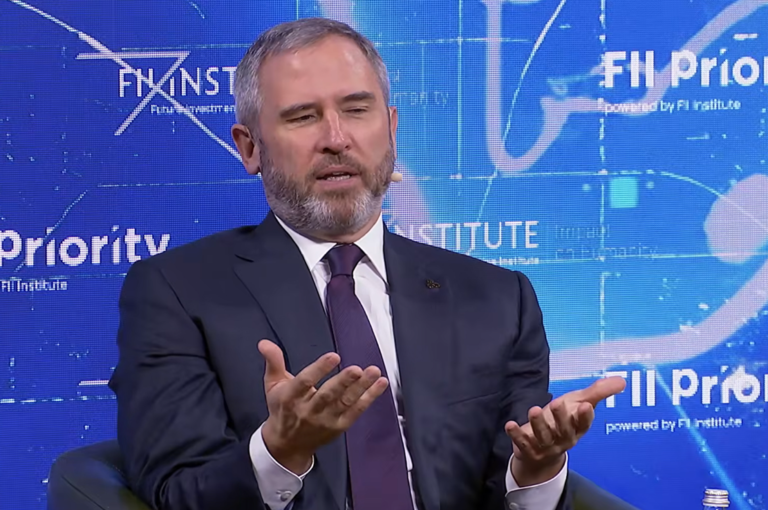
Ripple’s decision to launch RLUSD was not a sudden expansion beyond XRP so much as a move to internalize a business it was already helping power at scale. Speaking at FII Priority Miami 2026, Ripple CEO Brad Garlinghouse said the company’s role in stablecoin flows had grown large enough that building its own product became the logical next step.
Why Ripple Entered the Stablecoin Market
Garlinghouse said the turning point came well before RLUSD’s launch 13 months ago. “Two years ago, we were minting 20% of all USDC,” he said, tying that activity directly to Ripple’s payments business. With more than $100 billion in payment flows already processed, Ripple concluded that if it was already a major engine behind stablecoin usage, it made sense to bring that function in-house.
He also linked the decision to a moment of stress in the stablecoin market. Garlinghouse pointed to USDC’s temporary depeg during the Silicon Valley Bank collapse as a reminder that institutional users care about balance-sheet strength as much as blockchain rails.
“Circle came out and said, hey, we’ll stand in the gap. We’ll guarantee the peg. And it didn’t move because at that point, Circle didn’t have a balance sheet,” he said. “Ripple has on our balance sheet, you know, 60, 70 billion dollars of crypto. We have about four billion dollars of US dollars. And so I think we’re in a position to really have a very compliant, very institutional focused stablecoin.”
According to Garlinghouse, stablecoins are increasingly adopted not because companies want exposure to crypto branding, but because they want a better way to solve treasury, settlement and cross-border transfer problems. That broader shift, he argued, is already reshaping how the sector is perceived.
Garlinghouse compared the current state of crypto to the internet industry in the late 1990s, when companies led with the technology rather than the use case. “We don’t talk about anything as an internet company now because it’s just prevalent in the background,” he said. “And I think that’s where some of the blockchain and crypto based solutions are heading”. Companies, he added, “just want to solve a payments problem. They want to solve a custody problem.”
On market structure, Garlinghouse expects the stablecoin field to get more crowded before it gets smaller. He said the biggest banks are already evaluating whether they should issue their own stablecoins, but questioned whether the market benefits from too many dollar-backed instruments that ultimately serve the same economic function. “We don’t need, you know, 50 US dollar stablecoins. Like, why? Like, they’re all, it’s still, at the end of the day, a U.S. dollar,” he said.
That does not mean he sees no room for differentiation. Instead, he argued that trust, licensing and reserve transparency will become the real competitive variables as the market matures. Ripple, he said, has deliberately taken a compliance-first route, pursuing not just a New York Department of Financial Services license but also an OCC license.
He added that the sector as a whole needs more regulatory verification and disclosure, pointing even to Tether’s renewed push for an audit as evidence that transparency is becoming harder to avoid.
Garlinghouse was similarly upbeat on the US policy backdrop. He described passage of the Genius Act as a major unlock for demand and said corporate executives are now actively asking whether stablecoins should be part of their operations. While he said follow-on legislation around asset classification has been slower, he argued the tone in Washington has already shifted sharply, citing recent coordination between the SEC and CFTC and predicting further progress by the end of May.
“So I think we already have made huge progress in this administration to provide some of that structure and Clarity [Act]. I think clarity will still pass. I was in Washington two days ago, and I think we’ll still get something. […] I’ll predict by the end of May we’ll get something across,” Garlinghouse said.
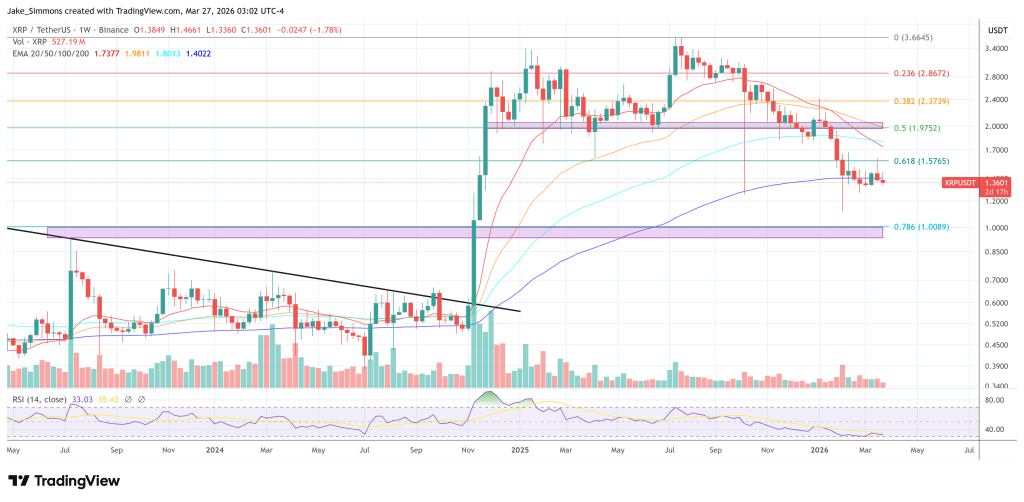
At press time, XRP traded at $1.36.
XRP drops below the 200-week EMA again, 1-week chart | Source: XRPUSDT on TradingView.com
Featured image from YouTube, chart from TradingView.com
Editorial Process for bitcoinist is centered on delivering thoroughly researched, accurate, and unbiased content. We uphold strict sourcing standards, and each page undergoes diligent review by our team of top technology experts and seasoned editors. This process ensures the integrity, relevance, and value of our content for our readers.
Bitcoin dropped under $67,000 as Middle East tensions and rising yields pressured risk assets.
Over $1.33 billion was liquidated this week, with heavy leveraged positions stacked between $70,000 to $75,000.
Experts expect choppy near-term action with potential relief rally contingent on easing macro pressures.
Bitcoin and the broader crypto market continue to stack losses this week as March comes to a close, with experts anticipating rangebound price action and increased volatility in the near term.
The leading crypto dropped to lows of $66,400 Friday, Bitcoin’s lowest level since March 9. It is currently trading at $66,633, down 3.9% in the past 24 hours and 5.6% on the week, according to CoinGecko data.
Bitcoin’s drop this week is primarily driven by macroeconomic risk-off conditions resulting from the geopolitics, involving the Middle East war, Andri Fauzan Adziima, research lead at cryptocurrency exchange Bitrue, told Decrypt.
The ripple effects of this war have raised oil prices, leading to fears of sticky inflation. Though Bitcoin continues to outperform gold and the U.S. stock market since the war began on February 28, it dropped over 6% from over $75,000 to below $70,000 as the U.S. Federal Reserve kept the interest rates steady last week.
“Like all other macro assets, Bitcoin is trading to geopolitical headlines,” Thahbib Rahman, research analyst at crypto research platform Block Scholes, told Decrypt. “Trump’s uncertain tone yesterday around the likelihood of a ceasefire coincided with Bitcoin falling to $67,000.”
In addition to geopolitical pressure, 10-year U.S. Treasury yields rose for four consecutive weeks in response to the confusing mixed messages around the U.S.-Iran war.
The U.S. dollar index rose 0.57% this week to 100.148, continuing to weigh down on risk assets, including Bitcoin.
Despite Bitcoin’s relatively tiny range, extending from $72,000 to $66,200, over $1.33 billion has been liquidated this week, CoinGlass data show. That reflects “heavy leveraged positions stacked above current levels, especially $70,000 to $72,000, and up to $73,000 to $75,000, with thinner liquidity on the downside, Adziima said.
Users of Myriad, a prediction market owned by Decrypt’s parent company Dastan, turned bearish on Bitcoin’s outlook, putting a 56% chance on its next move taking it to $55,000, up 10% on the day.
Experts continue to expect heightened volatility and a potential choppy price action in the near term, with a potential relief rally in the mid-term, contingent on easing macro and geopolitical pressures.
“Thin weekend volume raises odds of a quick liquidity sweep lower toward $67,000 to $68,000 support first,” Adziima explained.
From a macro perspective, Myriad users assign a 66% chance that oil’s next move could see it rally to $120, underscoring the uncertain geopolitical landscape.
Daily Debrief Newsletter
Start every day with the top news stories right now, plus original features, a podcast, videos and more.
In a defining moment for the Kingdom’s financial infrastructure, Lean Technologies has become the first company granted a Major Payment Institution license by the Saudi Central Bank (SAMA) to provide Open Banking services.
This inaugural license marks a critical inflection point for the Saudi financial sector, signaling that Open Banking has officially graduated from the testing phase of SAMA’s regulatory sandbox into a fully licensed, commercial activity.
From sandbox to systemic infrastructure
Hisham Al-Falih, CEO and co-founder of Lean Technologies
Lean Technologies began its journey as one of the first participants admitted into SAMA’s Regulatory Sandbox. Operating under strict governance, the financial infrastructure provider connected over one million bank accounts and analyzed more than one billion transactions, establishing itself as a deeply integrated Open Banking provider in the Kingdom.
“When we founded Lean over six years ago, we held a conviction: that open, regulated access to financial data would become the foundation upon which the next generation of Saudi financial services would be built,” said Hisham Al-Falih, CEO and co-founder of Lean Technologies.
“Receiving this license from SAMA is the moment that validation becomes official. With this license, we have the platform, the partnerships, and the regulatory standing to extend the reach of our infrastructure to thousands of merchants, tens of thousands of SMEs, and millions of end users across the Kingdom”.
Driving financial inclusion and better underwriting
Lean’s infrastructure is already powering a wide array of financial services through partnerships with leading Saudi institutions, including Tabby, Tamara, Abdul Latif Jameel, Sukuk, and Tasheel. The technology enables enhanced KYC, improved risk assessment models, and the creation of data-driven products across sectors like BNPL, consumer finance, and automotive.
One of the most consequential impacts of this Open Banking layer is its ability to broaden financial access for Saudi Arabia’s growing workforce of non-traditional income earners. By utilizing Lean’s verified, real-time data, lenders can properly assess the affordability of freelancers, gig workers, and individuals with multiple income streams—segments that legacy credit infrastructure historically struggled to evaluate.
Abdulmajeed Alsukhan, CEO and co-founder of Tamara, highlighted the tangible business impact of this data access:
“Lean has unlocked the full potential of cash-flow data in our underwriting”.
“With access to rich, verified financial information, we can now responsibly serve customers that were previously difficult to underwrite”.
“This has expanded our access to credit, increased approval rates by more than 32% in our new consumer financing product, and driven strong, risk-adjusted growth”.
Looking ahead to Vision 2030
The successful rollout of a licensed Open Banking layer represents a core component of the Kingdom’s broader Vision 2030 objectives. The milestone validates SAMA’s structured approach to financial innovation, which balanced the need to scale new technologies with robust consumer protection and systemic integrity.
An Australian court ordered Binance Australia Derivatives to pay $6.9 million after misclassifying retail clients and exposing them to high-risk crypto products.
The Federal Court of Australia has ordered Oztures Trading Pty Ltd, trading as Binance Australia Derivatives, to pay a 10 million Australian dollar ($6.9 million) penalty after the company admitted to misclassifying more than 85% of its Australian client base and exposing retail investors to high-risk crypto derivatives without required protections.
The Australian Securities and Investments Commission (ASIC) said the affected group included 524 retail investors who were wrongly treated as wholesale clients between July 2022 and April 2023. Those clients later incurred $6.3 million in trading losses and paid $2.6 million in fees.
Binance also admitted in a statement of agreed facts to multiple compliance failures, including not providing product disclosure statements to retail clients, not making a target market determination and not maintaining a compliant internal dispute resolution system.
The penalty comes on top of the around $9 million in compensation that Binance’s local derivatives unit was ordered to pay to affected clients in November 2023.
Court order against Binance Australia Derivatives. Source: The Federal Court of Australia
Binance did not immediately respond to Cointelegraph’s request for comment.
Related: White House clears review of proposal to allow crypto in 401(k) retirement plans
This is a developing story, and further information will be added as it becomes available.
Cointelegraph is committed to independent, transparent journalism. This news article is produced in accordance with Cointelegraph’s Editorial Policy and aims to provide accurate and timely information. Readers are encouraged to verify information independently. Read our Editorial Policy https://cointelegraph.com/editorial-policy
Trusted Editorial content, reviewed by leading industry experts and seasoned editors. Ad Disclosure
Vietnam’s police has dismantled an “exceptionally large” multi-billion dollar crypto scam centered on selling fake digital currencies.
Inside The Multi-Billion Dollar Crypto Scam
The Vietnam’s Ministry of Public Security (national police) announced on Thursday the arrest of at least seven people in relation with ONUS, a Vietnamese-based crypto investment app and exchange that was used by millions of Vietnamese investors, AFP reports through Nampa.
140 people were summoned for questioning before the arrest of fintech and blockchain entrepreneur Vuong Le Vinh Nhan (aka Eric Vuong) and six accomplices, on charges of property appropriation and money laundering. The platform suddenly became inaccessible around March 20, leaving retail users locked out and scrambling for answers.
The police claims Vuong’s group has been operating since 2018, allegedly creating fake coins, issuing and selling them through ONUS, while manipulating supply, demand, and prices to manufacture paper gains and lure in more victims. The scam leaves millions of users affected, and at least one investor saying they were “devastated” after losing over $15,000.
A Country Of Booming Crypto Scams
Vietnam has become one of the world’s hottest retail‑crypto markets, with around 17 million digital asset holders. Hanoi bans crypto as a means of payment but allows speculation in a legal grey zone, which scammers exploit: this is not Vietnam’s first case of high-profile crypto fraud.
The country has already seen multiple digital assets frauds and Ponzi‑style schemes. Back in 2018, around 32,000 people may fell victim to a $658 million Initial Coin Offering (ICO) scam for two different cryptocurrencies, both of which were launched by Ho Chi Minh City-based company Modern Tech JSC. In 2024, Vietnamese authorities dismantled another large-scale cryptocurrency scam orchestrated by a company called ‘Million Smiles,’ protecting nearly 300 potential victims from financial exploitation, after it had already swindled around $1.17 million.
Takeaways For Traders
Emerging‑market retail booms combined with regulatory grey areas are turning Southeast Asia into a hotspot for “short‑cycle” high‑yield scams, even as regulators worldwide step up enforcement. It would not come as a surprise if we see Vietnam’s policy change its trajectory into an strategy of more pressure for clear rules on token issuance, exchanges, and marketing, and less tolerance for “experimental” platforms operating at scale.
For traders, the ONUS saga is a reminder that jurisdictional risk matters just as much as chart patterns. Enforcement in regulatory grey zones can flip from hands‑off to aggressive overnight, and when that happens, liquidity on localized platforms tends to disappear far faster than most risk models assume. “Too‑good‑to‑be‑regulated” is no longer a clever marketing line; it is a working definition of counterparty risk.
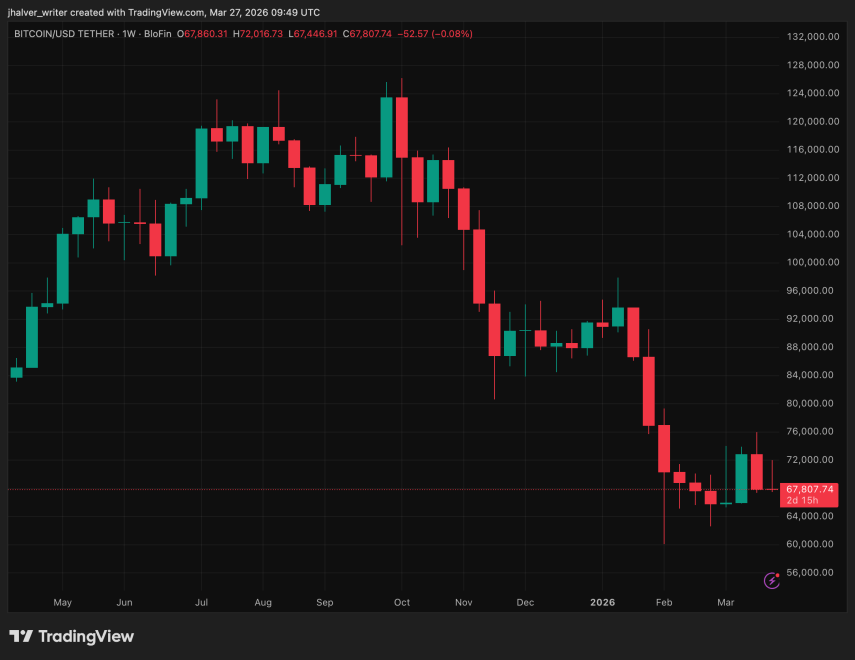
BTC’s price crashed under $68k. Source: BTCUSDT on Tradingview
Cover image from Perplexity, BTCUSD chart from Tradingview
Editorial Process for bitcoinist is centered on delivering thoroughly researched, accurate, and unbiased content. We uphold strict sourcing standards, and each page undergoes diligent review by our team of top technology experts and seasoned editors. This process ensures the integrity, relevance, and value of our content for our readers.
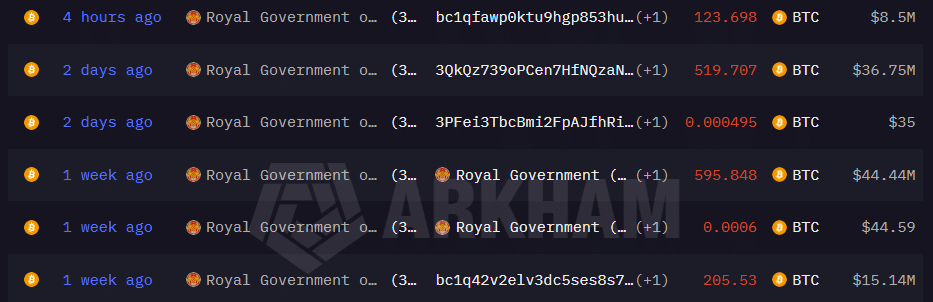
The Royal Government of Bhutan, which became one of the first sovereign Bitcoin miners by using surplus hydroelectric power, has moved 643 BTC worth over $45 million to external wallets over the past two days, according to Arkham Intel data.
Bhutan once held more than 13,000 BTC and now appears to be systematically converting its digital reserves into capital.
Bitcoin traded at $66,500 at press time, down 4% in the last 24 hours, per TradingView.
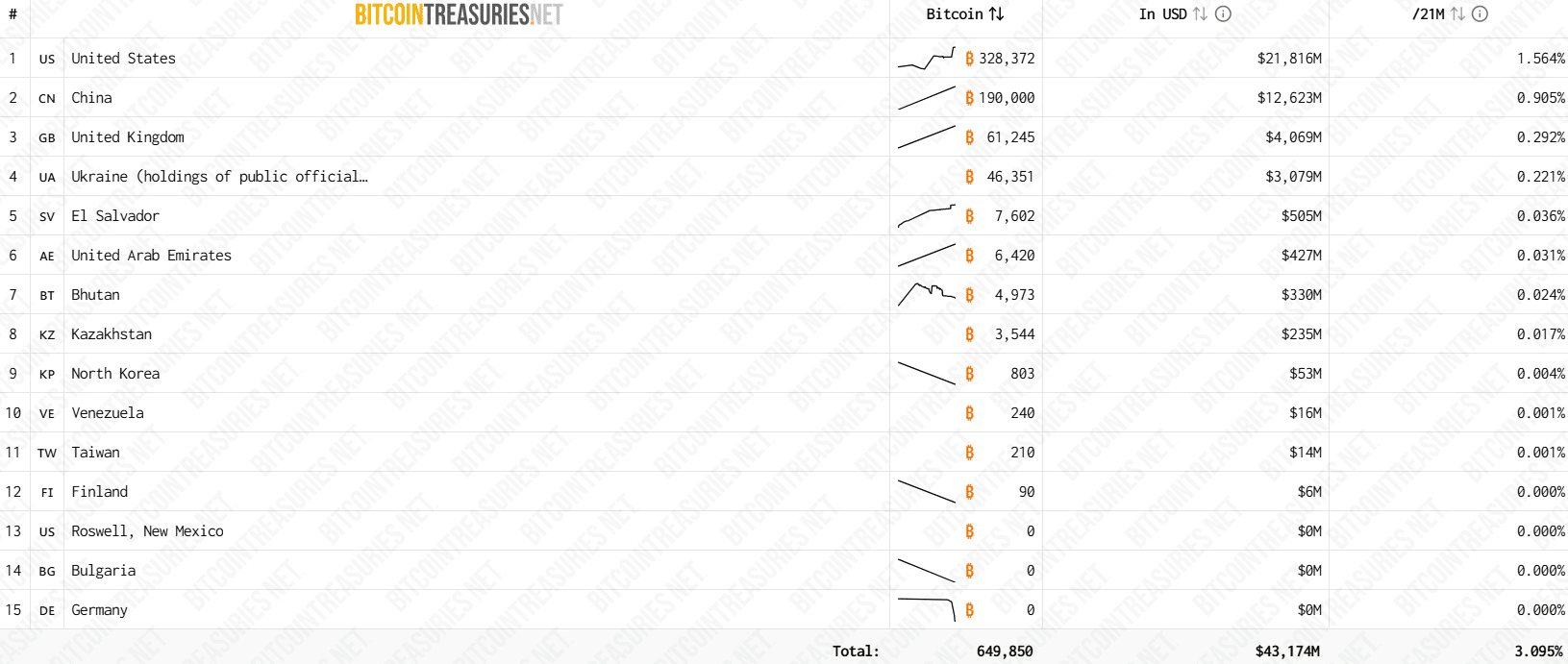
Despite recent Bitcoin sales, Druk Holdings, the investment arm of the Bhutanese government, still holds 4,329 BTC, worth more than $290 million. This keeps Bhutan among the world’s leading governments in terms of digital asset holdings.
Source: BitcoinTreasuries.NET
The US continues to dominate global government Bitcoin holdings, controlling over 328,000 BTC valued at $22 billion, a growth fueled by last October’s landmark seizure of 127,271 BTC.
The case involving the Prince Group, a Cambodian-based transnational criminal organization accused of large-scale investment scams and human trafficking, has sparked international controversy, with China claiming the Bitcoin stash originated from a 2020 theft of mining assets linked to its firms, including LuBian, which has ties to Iran.
Disclosure: This article was edited by Vivian Nguyen. For more information on how we create and review content, see our Editorial Policy.
Hong Kong Web3 Festival 2026 is honored to welcome ENI as a Gold Sponsor.
Hong Kong, 27th March 2026, ZEX PR WIRE — The Hong Kong Web3 Festival (“Web3 Festival”), co-hosted by Wanxiang Blockchain Labs and HashKey Group and organized by W3ME, is Asia’s premiere crypto conference since 2023. It convenes the world’s smartest minds in the Web3 and crypto space to discuss the latest trends and policies shaping the future of decentralized technology. Since its inception, the festival has established itself as the definitive gathering point for innovators, investors, and institutions committed to driving the next wave of digital transformation.
Hong Kong Web3 Festival 2026 will take place from April 20 to 23 at Hong Kong Convention and Exhibition Centre. The previous three editions brought together over 350 exhibitors and more than 1,200 speakers for in-depth discussions, attracted a cumulative total of 100,000 visitors, and saw over 400 diverse side events. It has solidified its status as a leading crypto event, influencing Hong Kong’s Web3 landscape and setting the tone for conversations that extend well beyond the region’s borders.
Web3 Festival 2026 ultimately will have up to 400 speakers representing all aspects of Web3 and crypto on its stages. It has also attracted registrations from thousands of executives and corporate decision-makers in traditional finance and real economies. This enables the conference to be a high-level platform for in-depth dialogues and high-value connections. Whether attendees come seeking strategic partnerships, investment opportunities, or simply to stay ahead of the curve, the festival consistently delivers an environment where meaningful progress is made and new ideas take root.
The 2026 edition places particular emphasis on the convergence of traditional finance and crypto, the rise of AI-powered blockchain applications, and the expanding role of real-world assets in decentralized ecosystems. These focal areas reflect the maturation of the industry and the growing demand for solutions that bridge the gap between established financial systems and the possibilities unlocked by Web3 infrastructure.
As Asia’s premier crypto event, Web3 Festival leverages Hong Kong’s unique position as a global financial center and innovation powerhouse, bridging the vast market potential of Mainland China with worldwide Web3 advancements. This unique positioning enables the event to bring together the best resources from across the globe, offering attendees first-hand Web3 updates and networking opportunities. Hong Kong’s progressive regulatory environment and its role as a gateway between East and West make it the ideal host city for a conference of this scale and ambition, attracting participants from every corner of the industry who recognize the city’s central importance in shaping the global Web3 agenda.
ENI joins this landmark event as a Gold Sponsor, bringing its cutting-edge blockchain technology to the forefront of one of the most influential stages in the industry. ENI is an ultra-high-performance, modular Layer 1 blockchain engineered specifically for hyper-scale commercial adoption. Its architecture is designed to meet the demands of enterprise-level applications, offering the speed, scalability, and flexibility that modern Web3 use cases require. ENI’s participation as a Gold Sponsor reflects its commitment to engaging with the global Web3 community and accelerating the path toward mainstream blockchain adoption. For more information about ENI, visit https://eni.top
Get tickets to Hong Kong Web3 Festival 2026 at https://luma.com/hkweb3festival_2026 and explore partnership opportunities at https://tally.so/r/w5YEbP
US spot Bitcoin exchange-traded funds (ETFs) logged $171 million in outflows on Thursday, their biggest day of redemptions since March 3, when they posted $348 million in outflows.
BlackRock’s iShares Bitcoin Trust ETF (IBIT) led the outflows with $41 million, Fidelity’s Wise Origin Bitcoin Fund (FBTC) followed with $32 million, the ARK 21Shares Bitcoin ETF (ARKB) sold $30.5 million, and Grayscale’s Bitcoin Trust ETF (GBTC) sold $24 million, according to data from Farside Investors.
The outflows follow a period of demand for Bitcoin ETFs, which attracted $1.36 billion in monthly inflows so far in March and are on track for their first month of net accumulation since October 2025, when ETFs clocked $3.42 billion in net inflows, according to Sosovalue data.
US-listed spot Bitcoin ETFs are a signal of institutional demand for Bitcoin (BTC), which fell below the $70,000 mark on Thursday. BTC fell 4.7% over the past week and traded at $67,780 at the time of writing, according to CoinMarketCap.
Bitcoin ETF flows, in USD, million. Source: Farside Investors
Still, Bitcoin ETFs are just “one good day away” from reversing their year-to-date outflows, said senior Bloomberg ETF analyst Eric Balchunas, who praised the ETFs for their “incredible fortitude” amid Bitcoin’s 46% correction from the $126,198 all-time high in October 2025.
“For context, when gold fell 40% in a short time frame about 10 years ago, it saw 1/3 of its investors bail,” said Balchunas in a Tuesday X post.
Related: Morgan Stanley files amended S-1 for MSBT Bitcoin ETF
Investors fear weekend war escalation
The Bitcoin ETF sell-off follows reports that the US Department of War is sending thousands of soldiers to the Middle East, sources familiar with the matter told Reuters on Tuesday.
On Thursday, US President Donald Trump announced an extension to the ceasefire on Iranian energy infrastructure by 10 days to April 6, citing constructive ongoing negotiations.
Source: Truth Social, President Donald Trump
Despite the extension of the ceasefire, market participants remain worried about another unexpected weekend escalation, Kyle Rodda, senior financial analyst at Capital.com, told Cointelegraph. He said:
“Amidst the headline risk and he-said, she-said games about whether negotiations between the US and Iran are taking place, the US is moving assets and personnel towards the Middle East to prepare for what looks like a limited ground invasion.”
Investors are jittery about any potential escalation after being caught off guard by the initial US and Israeli strikes on Iran on Feb. 28, which occurred in the middle of constructive negotiations, Rodda added.
Magazine: Bitcoin’s ‘biggest bull catalyst’ would be Saylor’s liquidation — Santiment founder
This article does not contain investment advice or recommendations. Every investment and trading move involves risk, and readers should conduct their own research when making a decision. While we strive to provide accurate and timely information, Cointelegraph does not guarantee the accuracy, completeness, or reliability of any information in this article. This article may contain forward-looking statements that are subject to risks and uncertainties. Cointelegraph will not be liable for any loss or damage arising from your reliance on this information.