Home Blog Page 654

H100 eyes Europe’s largest bitcoin treasury with 3,500 BTC in proposed acquistions

0

H100 Group (H100), a Stockholm-based publicly listed bitcoin treasury company focused on providing institutional exposure to bitcoin, said it signed a letter of intent to acquire Norwegian peers Moonshot AS and Never Say Die AS to increase its holdings of the largest cryptocurrency.

If completed, the deal would roughly triple H100’s bitcoin stash to around 3,500 BTC, positioning it among Europe’s largest listed bitcoin treasury firms. Beyond that, H100 said it aims to strengthen its institutional profile, improve liquidity and expand its relevance in capital markets.

The announcement follows the company’s January announcement that it plans to combine with Future Holdings AG, a Zurich-based bitcoin treasury company. Both are backed by Adam Back, a British cryptographer and co-founder of Blockstream.

The transaction is structured as a bitcoin-for-bitcoin exchange, meaning ownership in the combined entity will be determined solely by the amount of bitcoin contributed. This approach preserves bitcoin exposure per share for existing investors, avoiding dilution while significantly scaling the company’s balance sheet.

The acquisition will be executed as an all-share transaction with no cash consideration.

The target companies collectively hold about 2,450 BTC.

Definitive agreements are expected by April 22, with completion anticipated shortly after the company’s annual general meeting in May, subject to final approvals.

The announcement sent H100 shares up 2% on the day.

Navigating Market Risks and the Impact of AI in FinTech with Forex.com Analyst

0

StoneX is bridging the gap between traditional finance and the digital asset ecosystem as institutional demand for sophisticated liquidity tools reaches a new threshold. Following the recent launch of its digital asset lending capability, the firm is focusing on providing the infrastructure necessary for financial institutions to integrate these assets into broader portfolio strategies.

Razane Ramzi, appearing on the News and Views podcast from The Fintech Times, explained that the industry is shifting from a speculative phase toward one defined by regulated, institutional-grade infrastructure. This evolution is driven by the need for capital efficiency and seamless workflows that mirror traditional market standards.

Unlocking Institutional Liquidity

The introduction of institutional crypto-lending services marks a significant expansion of the StoneX Digital suite. By allowing clients to use digital assets as collateral, the firm enables market participants to access liquidity without exiting their positions. Brian Mulcahy, CEO of StoneX Digital, recently noted that institutional participants increasingly require financing tools that align with both digital and traditional asset workflows.

The lending programme initially focuses on Bitcoin as collateral, with plans to extend eligibility to other large-cap digital assets as demand develops. Each transaction is structured to support disciplined collateral management and defined risk parameters, ensuring the service remains within a rigorous risk-management framework.

Regulatory Clarity as a Catalyst

A primary driver of this institutional adoption is the emergence of clear regulatory frameworks, such as the Markets in Crypto-Assets (MiCA) regulation in the EU. StoneX Digital recently secured a Crypto-Asset Service Provider licence from the Central Bank of Ireland, allowing it to offer execution and custody services across the European Union.

This regulatory milestone provides the “green light” many traditional firms required to enter the space. Ramzi suggested that as jurisdictions like the UAE and Hong Kong also refine their virtual asset regimes, the global landscape is becoming more predictable, reducing the friction that previously hindered large-scale participation.

Integrating Traditional and Digital Workflows

One of the core challenges for institutions has been the fragmentation between traditional and digital trading desks. StoneX is addressing this by building a unified framework where clients can manage digital asset execution alongside exchange-traded products and derivatives.

This integration extends to reporting and margin management. By allowing for cross-product functionality, firms can achieve a panoramic view of their global positions. The goal is to ensure that digital assets are not treated as an isolated silo but as a productive component of a modern, diversified portfolio.

The Role of Infrastructure

The shift toward “plumbing” over headlines reflects a maturing market. Beyond trading, StoneX is leveraging its Swift Service Bureau and StoneX Messaging Hub to support financial institutions in their migration to ISO 20022 standards. These infrastructure improvements are vital for ensuring that cross-border payments and digital asset settlements meet the requirements for speed, traceability, and transparency.

As institutional comfort grows and operational barriers fall, the focus is moving toward how these technologies can create long-term productivity gains. Whether through programmable payments or tokenised securities, the emphasis remains on building a financial system that is agile, secure, and deeply responsive to the needs of the global economy.

Would you like me to look into more details regarding the specific impact of the MiCA licence on StoneX’s European expansion?

BlackRock is betting billions that tokenized funds will do for Wall Street what the internet did to mail

0

BlackRock Chairman and CEO Larry Fink used his annual letter to shareholders to argue that digital assets and tokenization could help update the financial system, even as he warned that the U.S. economic model is leaving too many people behind.

In the letter, Fink said the current system has delivered most of its gains to people who already own assets, while many workers have been shut out of market growth. He tied that imbalance to a wider problem in the U.S., where rising inequality, high government debt and weak participation in capital markets are putting pressure on the old model of finance.

“Capitalism is working—just not for enough people,” Fink wrote.

His proposed fix centered on tokenization and digital distribution as tools to expand access to investing and make markets run better.

Tokenization, Fink said, could “update the plumbing of the financial system” by making investments easier to issue, trade and access.

The idea is simple: If ownership of assets is recorded on digital ledgers, moving a fund share, bond or other security could become faster and cheaper. In practice, that would allow a regulated digital wallet to hold not just payments, but also tokenized bonds, ETFs and fractional interests in assets such as infrastructure or private credit.

“Half the world’s population carries a digital wallet on their phone,” Fink wrote. “Imagine if that same digital wallet could also let you invest in a broad mix of companies for the long term—as easily as sending a payment.”

Fink compared tokenization today to the internet in 1996, arguing that it will not replace traditional finance overnight, but could gradually connect old and new systems. He said policymakers should focus on building that bridge “as quickly and safely as possible” and called for clear buyer protections, counterparty-risk standards and digital identity checks to reduce illicit finance risks.

The comments add to BlackRock’s broader push into digital assets. In the same letter, Fink said the firm had built “early leadership” in the space, citing nearly $150 billion in assets connected to digital markets.

BlackRock’s USD Institutional Digital Liquidity Fund (BUIDL) is the largest tokenized fund in the world, and the firm also manages $65 billion in stablecoin reserves and nearly $80 billion in digital asset exchange-traded products.

Still, much of the letter focused on deeper stresses in the U.S. financial system. Fink warned that banks, corporations and governments can no longer fund large economic shifts on their own, especially as the country tries to rebuild manufacturing capacity, expand energy supply and compete in artificial intelligence.

He also argued that Social Security remains a critical safety net but may need structural reform, including some exposure to long-term market returns, to remain sustainable.

For Fink, tokenization sits inside that bigger picture. It is not a bet on hype, but a bet that better rails could help more people become investors rather than bystanders.

His broader message was that finance needs an upgrade, and that digital assets may become part of that overhaul.

Kalshi and Polymarket back $35 million fund as prediction markets boom despite regulatory pressure

0

Two early Kalshi employees are raising up to $35 million for 5c(c) Capital, a fund aimed at backing startups building around prediction markets, according to a Fortune report.

The fund has already attracted support from an unusual mix of competitors and top investors. Backers include Kalshi CEO Tarek Mansour and Polymarket CEO Shayne Coplan, alongside venture heavyweights such as Marc Andreessen through Moneta Luna, Ribbit Capital founder Micky Malka, and former Multicoin managing partner Kyle Samani.

5c(c) Capital is led by Adhi Rajaprabhakaran, an early trader tied to Kalshi’s market making operations, and Noah Zingler Sternig, the company’s former head of operations. The name references a clause tied to the federal regulation of commodities and derivatives, a category that now includes prediction markets.

The fund plans to invest in roughly 20 companies over the next two years, targeting areas such as market making, prediction market indices, and broader infrastructure. Its first close is expected within the next month.

The launch comes as prediction markets emerge as one of the most talked-about sectors in Silicon Valley. Kalshi is reportedly raising $1 billion at a $22 billion valuation, while Polymarket is targeting a valuation near $20 billion, highlighting the scale of investor demand for platforms that allow users to trade on real-world outcomes.

These platforms enable users to take positions on everything from crypto price movements to major global events, blending elements of finance, forecasting, and speculation into a single market structure.

At the same time, the sector is facing growing pressure from regulators. State authorities have raised concerns that prediction markets resemble sports betting platforms and should follow the same rules, while companies argue they fall under federal oversight as regulated financial products.

Disclosure: This article was edited by Estefano Gomez. For more information on how we create and review content, see our Editorial Policy.

NovaBay Rebrands as ‘Stablecoin Development Corporation’ With Nearly 9% of SKY Supply

0

The company, which generated less than $10 million in revenue last year selling eyecare products, raised $134 million to bet entirely on the Sky protocol’s governance token.

NovaBay Pharmaceuticals is changing its name to Stablecoin Development Corporation and its NYSE American ticker to SDEV, effective April 3, the company announced Monday. The rebrand completes a pivot from wound care to crypto that began with a $134 million private placement in January.

As of March 16, the company held approximately 2.06 billion SKY tokens — roughly 8.78% of the total supply of the Sky protocol’s governance token. SKY is currently trading at around $0.07, according to Coingecko, implying the position is worth roughly $144 million. The token is up 10% over the past month.

SKY Chart

The Deal

The January private placement drew capital from R01 Fund LP, Framework Ventures, Tether Investments, and Sky Frontier Foundation. As part of the transaction, the company received approximately 943.6 million SKY tokens valued at around $58 million, along with $25 million in cash and $51 million in stablecoins. Since closing, it has spent an additional $70.7 million acquiring roughly 1.09 billion SKY on the open market at an average price of about $0.065.

The company has staked the majority of its holdings and reported cumulative staking rewards of approximately 26.6 million SKY.

The strategy mirrors Michael Saylor’s playbook of using a public equity vehicle to offer leveraged exposure to a single crypto asset. CEO Michael Kazley framed the approach around stablecoins broadly, calling them “the most compelling structural opportunity in digital finance.”

The bet comes at a pivotal moment for the Sky ecosystem.

Sky’s TVL has surged 38% this month to $7.52 billion, making it the fourth-largest DeFi protocol. The growth has been fueled by Sky’s fixed 3.75% savings rate exceeding yields on major lending platforms like Aave and Morpho in a risk-off environment.

“Honestly, it’s the classic story of how Sky, just like Maker used to, always does better in bear markets because it’s just focused on a solid product that can be trusted to be stable and deliver good returns,” Sky founder Rune Christensen told The Defiant.

NovaBay describes itself as an “on-chain holding company” focused on “long-duration participation in protocol-aligned digital asset ecosystems.”

This article was written with the assistance of AI workflows. All our stories are curated, edited and fact-checked by a human.

Wayve, Uber and Nissan Launch Robotaxi Pilot in Tokyo

0

Uber’s global rollout of robotaxis is gathering momentum with the company confirming its first autonomous vehicle partnership in Japan.

The ride-hailing giant has signed a memorandum of understanding with local automaker Nissan and U.K.-based AI company Wayve to develop robotaxis and launch a pilot service in Tokyo, expected to be operational by the end of the year.

“The goal is to integrate Wayve’s end-to-end AI autonomous driving system into Nissan’s base vehicle [the Leaf], which can accommodate the Wayve AI Driver and connect to Uber’s ride hailing platform, matching robotaxis with individuals seeking transportation,” according to a release from the companies.

Initially, the vehicles will feature trained safety operators inside, but as is the case in the U.S, where Uber is working with other partners, including Waymo, the robotaxis will eventually drive themselves, with no human monitors on board.

Related:Microsoft Cuts Back on Unnecessary Copilot AI in Windows

Robotaxis have become a regular sight in a number of cities in the US, where Waymo is leading, and in China, where local vendors Baidu Apollo Go, Pony.ai and WeRide are among the main players. The Chinese companies have also made inroads into the Middle East.

Japan, however, has lagged a little behind until now, with Tokyo in particular recognized as a stiff challenge due to its dense traffic, complex roads, and high safety standards.

Unlike some other companies’ autonomous driving tech, Wayve’s AI Driver does not rely on HD mapping, with the vendor — which recently raised another $1.2 billion — using an end-to-end “embodied” AI approach, enabling the tech to learn more like humans and applying diversity, which means it can be used with different vehicles in different markets.

“Tokyo represents an important step forward in bringing embodied intelligence to one of the world’s most sophisticated mobility markets. We have been testing our technology throughout Japan since early 2025, building extensive experience in the country’s unique road environments,” CEO Alex Kendall said in a statement.

Partnering with Uber and Nissan to begin pilot deployment of Robotaxi allows us to introduce this technology in a responsible way, while continuing to learn and expand.”

Uber and Wayve are planning robotaxi launches in a number of locations later this year, including on the challenging roads of Wayve’s home city of London — regularly named as the one of the world’s slowest, most congested cities in traffic surveys, and behind only Colombia’s Barranquilla in 2025.

Meanwhile, also piloting its autonomous driving tech in Japan is Nvidia-backed, Silicon Valley-based Nuro.  

Related:Rivian’s Bet on AI Attracts $1.25 Billion Uber Deal

It’s being tested in Tokyo in Toyota Prius cars, despite Nuro having had no previous experience on local roads, and Nuro says its experience there will enable future deployments elsewhere.


Capital B Acquires 44 Bitcoin, Boosting Holdings To 2,888

0

Capital B, Europe’s first Bitcoin Treasury Company, has completed the acquisition of 44 bitcoin for €2.7 million, bringing its total holdings to 2,888 BTC. 

The purchases were executed as part of the company’s ongoing Bitcoin Treasury Company strategy, which aims to increase the number of bitcoin per fully diluted share over time, according to a company press release seen by Bitcoin Magazine. 

The company also finalized multiple capital raising operations. An “ATM-type” capital increase with TOBAM generated €0.5 million through the issuance of 669,906 new shares at €0.76 per share. 

Additionally, €3 million was raised via share subscription warrants, with €2 million subscribed by TOBAM and €1 million by UTXO Management. 

These operations funded the latest BTC acquisition and supported the company’s broader treasury strategy.

Capital B reported a year-to-date (YTD) BTC Yield of 0.72%, equivalent to a gain of 20.4 BTC and €1.2 million. The company also achieved a quarterly BTC Yield of 0.72%, highlighting the incremental growth of its bitcoin holdings relative to fully diluted shares. The average acquisition cost of its BTC portfolio stands at €92,495 per coin, representing a total investment of €267.1 million.

Swissquote Bank Europe SA, a Luxembourg-registered virtual asset service provider (VASP), executed the bitcoin acquisition and provided secure custody through Taurus technology. The company maintains an additional 60 BTC for operational needs, separate from its treasury holdings.

Capital B is listed on Euronext Growth Paris and specializes in data intelligence, artificial intelligence, decentralized technology consulting and development, and corporate treasury. 

Bitcoin surges

Bitcoin surged to $71,000 on Monday, rebounding from weekend lows near $67,000, following a sudden easing of geopolitical tensions after Donald Trump announced a five-day pause on planned U.S. strikes against Iran. 

The pause came after what Trump described as “very good” and “productive” talks with Tehran, reversing the market’s defensive posture from prior threats to target Iranian energy infrastructure. 

Amid this backdrop, Strategy continued its corporate bitcoin accumulation, albeit at a slower pace. Between March 16 and March 22, the company acquired 1,031 BTC for $76.6 million at an average price of $74,326 per coin, funded through common stock sales. This contrasts with the prior two weeks, when Strategy deployed over $1 billion into bitcoin via equity and preferred share offerings, signaling a more measured approach.

Strategy now holds 762,099 BTC, purchased for approximately $57.7 billion at an average cost of $75,694 per coin. 

Disclaimer: Bitcoin Magazine is owned by Nakamoto Inc. (NASDAQ: NAKA). Nakamoto Inc. also owns UTXO Management.

Traders get crushed as a Trump social media post triggers a massive $415 million crypto whipsaw

0

Crypto market traders were whipsawed on both sides on Monday afternoon, with over $400 million in liquidations across long and short positions in the past 4 hours.

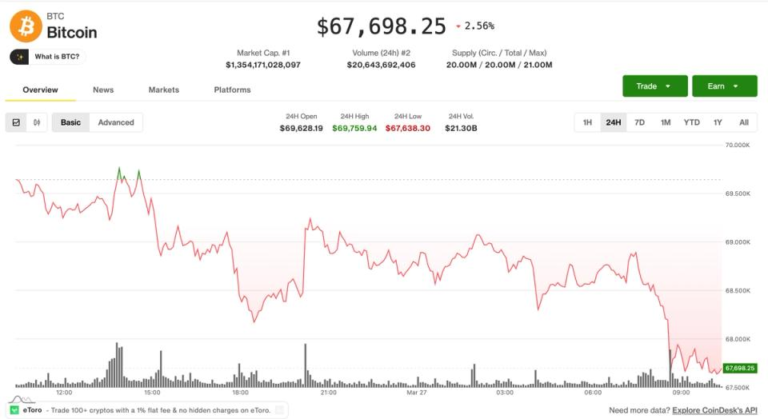
Bitcoin spiked from $67,500 to above $71,200 on Monday afternoon after U.S. President Donald Trump posted on Truth Social that he had instructed the Pentagon to postpone all strikes against Iranian power plants for five days, saying the U.S. and Iran had “very good and productive conversations.”

Then Iran reportedly denied everything.

“There is no direct or indirect communication with Trump,” Iran’s semi-official Fars news agency reported, citing an anonymous source, adding that Trump “retreated after hearing that our targets would be all power plants in West Asia.” Bitcoin gave back roughly $1,200 from its high within minutes.

CoinGlass data shows $415 million in liquidations in the four-hour window around the two headlines, with short liquidations accounting for $280 million and longs taking $135 million. The nearly 2-to-1 ratio suggests the market was heavily positioned for escalation when Trump’s post landed.

Of the total liquidations, bitcoin accounted for $140 million, ether at $120 million, and Brent oil futures on Hyperliquid at $64 million. Tokenized gold lost $20.9 million, while tokenized silver losses stood at $19.8 million

Crypto liquidation. (CoinGlass/CoinDesk)

Meanwhile, the oil liquidations were almost entirely one-sided.

The XYZ:BRENTOIL contract on Hyperliquid saw $64.4 million wiped, with the vast majority hitting longs who had been positioning for Trump’s 48-hour ultimatum to trigger an attack on Iran’s power plants rather than a postponement. Those traders were right about the direction of the war but wrong about the direction of the next Truth Social post.

Bitcoin spent the Asia session grinding between $67,500 and $68,500, ripped $3,700 higher in an hour on the Trump post, then faded $1,200 as Iran’s denial hit.

As of Monday evening, it was holding $70,000, up 2.3% on the day, sitting in the middle of a range it carved out in a few hours of headline-driven volatility.

The session reinforced what the Binance futures-to-spot data flagged earlier this month. When derivatives dominate trading activity at 5x the volume of spot, every headline gets amplified through liquidation cascades in both directions. Shorts get squeezed on the de-escalation post, then longs get caught when the counter-headline arrives.

The net movement ends up modest, but the damage to leveraged traders is not.

Senators Reveal Bipartisan Bill to Outlaw Sports Prediction Markets

0

In brief

  • Adam Schiff and John Curtis plan to introduce a bipartisan bill banning sports-related prediction markets.
  • The proposal targets platforms like Kalshi and Polymarket, arguing many of their offerings are unlicensed sports bets.
  • The move escalates a broader fight between states, federal regulators, and prediction market firms over regulation.

A bipartisan duo of U.S. senators plan to introduce legislation Monday that would ban American prediction markets from offering sports-related wagers.

The proposed bill, from Adam Schiff (D-CA) and John Curtis (R-UT), would prohibit prediction market platforms like Polymarket and Kalshi from offering sports markets that they allege constitute unlicensed sports betting by another name. News of the impending bill was first reported by the Wall Street Journal.

“Too many young people in Utah are getting exposed to addictive sports betting and casino-style gaming contracts that belong under state control, not under federal regulators,” Curtis said, in a statement.

The senators said the legislation would prohibit any CFTC registered entity from listing a contract resembling a sports bet or casino-style game, and also “reinforce Congress’ original intent that the Commodity Exchange Act does not permit sports gambling.”

In the last year, a growing number of states have sued the nation’s top prediction market platforms, arguing their sports-related markets should comply with state gambling laws. The platforms have pushed back, arguing that because the sports-related wagers are tied to event contracts, they should instead be regulated at the federal level by the CFTC. 

A number of judges have not been convinced by that argument. On Friday, Nevada became the first state to successfully ban a prediction market platform, Kalshi—at least temporarily—as the state’s lawsuit against the company proceeds to trial. 

Last week, Arizona filed criminal charges against Kalshi, for allegedly operating an illegal gambling service and allowing unlicensed election wagering.

A Kalshi spokesperson told Decrypt that today’s proposed bill would push activity offshore and protect the “monopoly” of U.S. casinos.

“It’s clear this bill is motivated by casino interests that are threatened by competition,” the spokesperson said. “They’re more worried about protecting their monopolies than protecting consumers.”

Over 80% of Kalshi’s lifetime trading volume comes from sports-focused markets, according to data from Dune.

The Trump CFTC has aggressively taken the side of prediction market platforms in the ongoing jurisdictional dispute over sports wagers, which is likely to ultimately be decided by the Supreme Court. CFTC Chair Mike Selig has pledged to put the agency’s resources behind companies fighting against state regulators.

So far, the states that have challenged the CFTC’s legal interpretation run the political spectrum, from Democratic mainstay Massachusetts to deep-red Tennessee. Last month, Utah’s Republican Governor, Spencer Cox, condemned the Trump CFTC’s approach to prediction markets, arguing the platforms are “destroying the lives of families and countless Americans, especially young men.”

On Friday, Rep. Alexandria Ocasio-Cortez (D-NY), the prominent progressive lawmaker, added her voice to the growing chorus of prediction market skeptics.

“I know as a politician these companies are going to spend a billion dollars against me for saying it but… pervasive gambling is not good for society,” she said. “It turns life into a casino, traps people in addiction and debt, surges domestic violence, and fosters manipulation.”

Daily Debrief Newsletter

Start every day with the top news stories right now, plus original features, a podcast, videos and more.

Michael Saylor’s Strategy (MSTR) renews $42 billion BTC buying plans

0

Strategy (MSTR) has unveiled a $42 billion at the market (ATM), equity program, split between $21 billion of Class A common stock (MSTR) and $21 billion of its Variable Rate Series A Perpetual Stretch Preferred Stock, Stretch (STRC), according to an 8-K filing.

The company also introduced a new $2.1 billion ATM for its STRK preferred stock, replacing a prior STRK program that had more than $20 billion remaining.

The company expanded its sales syndicate. Strategy added Moelis & Company, A.G.P./Alliance Global Partners, and StoneX Financial, bringing the total number of agents to 19. These firms act as intermediaries, selling shares into the market over time, allowing the company to raise capital gradually rather than through large, one-time offerings.

As of March 22, Strategy still had capacity remaining on its existing ATM programs. This included approximately $6.24 billion of common stock, $1.98 billion of STRC, $20.33 billion of STRK, and $1.62 billion of STRF available for issuance.

The company last week purchased another 1,031 bitcoin, bringing holdings up to 762,099 coins. Shares are modestly higher on Monday as bitcoin trades up slightly from the Friday close at $71,300.