The Federal Trade Commission has warned PayPal, Visa, Mastercard, and Stripe against debanking practices.
President Trump and his sons have frequently bemoaned debanking practices.
The Trump family claims it got into crypto because of unfair treatment from banks.
The US Federal Trade Commission has warned top payment companies to abide by President Donald Trump’s debanking executive order.
FTC Chairman Andrew N. Ferguson told the CEOs of PayPal, Stripe, Visa and Mastercard that the payment giants should not refuse customers services following reports that some people had been blocked based on their political or religious beliefs.
“It is inconsistent with American values to deny law-abiding individuals the ability to run their legitimate businesses and feed their families because they attracted the ire of rogue American officials, overzealous activists, or, more worryingly, foreign governments seeking to control public discourse,” he wrote.
Trump and his sons have decried debanking practices, claiming unfair banking practices forced them into crypto.
The president in January sued JPMorgan Chase and its CEO, Jamie Dimon, for allegedly debanking him. The bank has denied the allegations.
In a Thursday statement, Ferguson said that any debanking practices may lead to investigations and enforcement action from the regulator.
He added that the FTC in recent years had already taken action against payment infrastructure firms for “unfair or deceptive practices.”
Trump last year claimed that JPMorgan Chase cut him off as a customer before Bank of America also denied him services. The president’s sons, Eric and Donald Jr., have also repeatedly bemoaned unfair banking practices.
The Trump family-backed crypto company World Liberty Financial claims it will “unlock financial access for all by replacing the limits of traditional banking.”
Under the new president’s administration, regulators have taken a far more friendly approach to watchdogging the crypto space.
World Liberty Financial has applied for a banking licence earlier in a bid to get its stablecoin used by institutions and retail investors.
PayPal, Stripe, Visa and Mastercard all have big crypto ambitions. Each of the giants warned by the FTC has debuted a blockchain or accelerated stablecoin ambitions since Trump took to the White House.
None of the payments companies mentioned by the FTC immediately returned requests for comment.
Mathew Di Salvo is a news correspondent with DL News. Got a tip? Email at mdisalvo@dlnews.com.
The way people consume live sports has changed dramatically over the past few years. What was once tied to television schedules and fixed viewing habits has now become a flexible digital experience shaped by speed, convenience, and accessibility. Today’s audiences expect to stay connected to matches in real time, often across multiple devices, without interrupting the flow of their daily routines.
This shift has been driven by broader changes in digital behavior. Users are now accustomed to instant access in nearly every area of online life, from entertainment and shopping to news and communication. Sports have followed the same path. Fans no longer want to rely on a single screen or wait for a traditional broadcast window. They want access that feels immediate, easy to navigate, and responsive to the way they already use the internet. the way they already use the internet.
The rise of mobile-first consumption has made this even more noticeable. Many viewers now discover, follow, and revisit live events through their phones before ever opening a laptop or turning on a television. A quick score check can turn into a longer viewing session, while a breaking update or key moment can instantly pull users back into the match. This has changed not only where sports are watched, but how they are experienced throughout the day.
Another major development is the growing expectation for continuity. Sports audiences no longer separate live coverage, highlights, previews, reaction, and discussion into completely different experiences. They increasingly expect these elements to exist within the same digital flow. A platform that can support this behavior naturally becomes more valuable, not just as a destination, but as part of a user’s everyday media habit.
This evolution also shows how the sports industry is being shaped by the same forces affecting the wider digital economy. Speed, usability, convenience, and trust are now central to audience retention. the sports industry is being shaped by the same forces affecting the wider digital economy. Speed, usability, convenience, and trust are now central to audience retention. The platforms that understand these expectations are better positioned to grow, especially as user attention becomes more selective and more difficult to keep.
Looking ahead, live sports access will continue to evolve alongside changing consumer habits. Fans still care about the core emotions that make sports compelling — anticipation, momentum, tension, and unforgettable moments. Fans still care about the core emotions that make sports compelling — anticipation, momentum, tension, and unforgettable moments. What has changed is the path they take to reach those moments. In the digital era, the most successful platforms will be the ones that make that path feel seamless.
Trusted Editorial content, reviewed by leading industry experts and seasoned editors. Ad Disclosure
One part of the last bull run that disappointed investors was the fact that altcoins seemed to completely fall behind against Bitcoin. Going by previous bull markets, the expectation was that altcoins would rally once the Bitcoin price topped, leading to the legendary ‘altcoin season.’ While there has been nothing like that since then, many in the space have still not given up hope of an altcoin season, predicting that it is only a matter of time before altcoins rally again.
Altcoins Are Getting Ready To Take Off
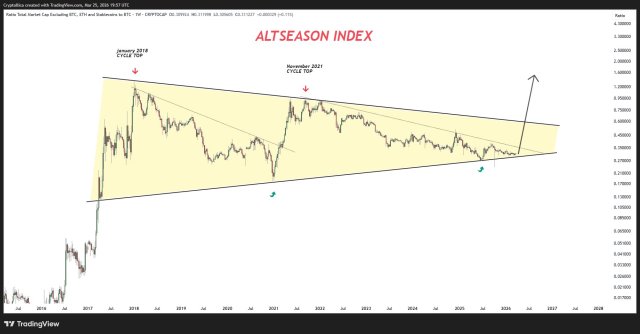
Crypto analyst Cryptollica shared a chart showing that altcoins have actually been trading in an interesting trend for a while. According to the post, these cryptocurrencies have been compressing inside a massive wedge, and this did not begin recently.
Cryptollica pointed out that the total altcoin market cap has actually been compressed inside this massive wedge since 2018. This would mean that it has been this way for more than seven years, and that even the explosive altcoin season that was experienced in 2021-2022 also happened inside of this massive wedge.
Using the same trend over the years, the crypto analyst point out that the altcoin market has actually bottomed back in 2025. A similar trend was seen in early 2021, after which followed a legendary altcoin season that saw various altcoins hitting multiple new all-time highs at rapid speed.
If the crypto analyst is correct and the altcoin market is about to break out of this wedge, then it would be very bullish for price. The analyst predicts an over 500% increase, which would mean the likes of Ethereum, Solana, and other altcoins would be hitting new all-time highs.
Source: X
Altcoin Season Index Stays Neutral
The Altcoin Season Index measures how the top 100 altcoins are performing against Bitcoin. The more of the altcoins are performing better than Bitcoin, the higher the chances that the market is experiencing an altcoin season. This index charts the performance on a scale of 1-100, and in an altcoin season, the index sits above 75.
Presently, the index is sitting at 50, which means that altcoin season is still not here. The Bitcoin dominance has since dropped below 60%, but remains quite high at 58.8%. Hence, it is unlikely that the altcoin season is starting now. This is because an altcoin season usually happens when the Bitcoin dominance drops.
Altcoin market cap still below $3 billion | Source: Crypto Total Market Cap Excluding BTC on TradingView.com
Featured image from Dall.E, chart from TradingView.com
Editorial Process for bitcoinist is centered on delivering thoroughly researched, accurate, and unbiased content. We uphold strict sourcing standards, and each page undergoes diligent review by our team of top technology experts and seasoned editors. This process ensures the integrity, relevance, and value of our content for our readers.
Crypto firms are embracing fresh guidance from US regulators after the Securities and Exchange Commission and Commodity Futures Trading Commission designated 16 digital assets as commodities.
Ripple CEO Brad Garlinghouse called the joint framework a “huge step forward” after years of enforcement he described as politically motivated under former SEC Chair Gary Gensler, who pushed the Ripple lawsuit forward after assuming office in 2021.
The crypto entrepreneur also urged Congress to codify SEC-CFTC guidance into law to avoid another Gensler-style crackdown that could harm crypto innovation and US competitiveness.
“We certainly want to see more. We want to see this codified in law in case there is another former chair of the SEC, Gary Gensler, who I think really did act in bad faith around this,” said Garlinghouse on ‘Mornings with Maria’ this morning.
“We want to make sure that we can’t have another Gary Gensler moment where they try to weaponize policy in a way that is about politics, not about what’s good for the United States, which is why we need to see these things codified,” he argued.
On the CLARITY Act, Garlinghouse described watching the legislative process as messy but encouraging, with key stakeholders working toward compromise on the bill. He predicted the bill would pass by the end of May.
“From this White House, we’re seeing amazing leadership to push this forward,” Garlinghouse said. “I think we’re going to get there. It’s just taking a little longer than we thought.”
Ripple’s boss said passage of the key market structure bill would not materially change Ripple’s business but would “unlock” US banks that have been hesitant to engage with crypto and encourage more financial institutions to participate in the industry.
Ripple sees record growth as acquisitions drive new revenue
Ripple has continued to grow strongly despite a volatile crypto market. Garlinghouse noted that while the market was flat heading into 2026, Ripple’s core business kept expanding.
The acquisitions of Ripple Treasury and Ripple Prime drove growth, he said. Ripple Treasury has exceeded expectations, giving CFOs real-time global liquidity and enabling instant cross-border payments.
Ripple Prime has also scaled, tripling its revenue run rate and strengthening Ripple’s position with major financial institutions, opening up new counterparties and revenue streams.
This year, Ripple’s focus is on bringing these businesses together to unlock synergies rather than launching new ventures, Garlinghouse explained. The company has backed this strategy with a 50% increase in headcount and over $1 billion in investments.
Ripple aims to deepen corporate adoption, expand its brokerage arm, and strengthen the utility and trust in XRP, Garlinghouse said.
Disclosure: This article was edited by Vivian Nguyen. For more information on how we create and review content, see our Editorial Policy.
The Delta Team Tactical FRT is engineered with precision and practicality in mind. It features a compact, ergonomic design that balances weight and control, making it suitable for extended use without causing fatigue. Typically constructed from high-strength materials, it withstands heavy-duty applications, ensuring reliability in demanding conditions.
Its design focuses on functionality, offering intuitive handling with a firm, non-slip grip. This makes the FRT easy to manipulate under stress or in emergency scenarios. Common models in the series may vary slightly in size or feature enhancements, but all retain the core focus on rapid response performance. Key specifications include lightweight construction, ergonomic form, and a modular design suitable for a range of tactical applications.
The Delta Team Tactical FRT is ideal for law enforcement, military personnel, survivalists, and outdoor enthusiasts who demand a tool that performs efficiently in high-stakes environments.
Performance Analysis
Performance is the cornerstone of any tactical tool, and the Delta Team Tactical FRT excels in several critical areas:
Functionality and Efficiency: This FRT is designed to handle a wide range of tactical scenarios efficiently. Whether it’s breaching, cutting, or general field operations, the tool performs consistently, providing confidence in high-pressure situations.
Speed and Responsiveness: Quick deployment and ease of use are crucial in fast-paced environments. The tool’s design allows for rapid action, ensuring that users can respond without hesitation. Its balanced weight and smooth mechanics contribute to a fluid handling experience.
Precision and Accuracy: While not all FRTs require extreme precision, the ergonomic design and responsive controls of this model make it suitable for tasks that demand accuracy. Users can rely on consistent results even during repetitive or high-stress operations.
Ease of Use: Designed with user-friendliness in mind, this FRT requires minimal training. Even novices can achieve competent handling quickly, while seasoned professionals appreciate the intuitive design and practical features.
Durability Assessment
Durability is a significant factor when evaluating the value of tactical equipment. The Delta Team Tactical FRT is constructed from high-grade materials that resist wear, tear, and environmental challenges:
Material Quality: Components are typically made from hardened metals or reinforced polymers, providing resistance to deformation, scratches, and impact damage. This ensures long-term reliability in demanding conditions.
Wear and Tear Resistance: Field testing shows the tool maintains performance even after repeated heavy use. Joints, fasteners, and moving parts are engineered for longevity, reducing the need for frequent repairs.
Environmental Resilience: This FRT performs well under diverse environmental conditions, including extreme heat, moisture, and rough terrain. Its corrosion-resistant surfaces and robust construction make it ideal for both outdoor adventures and professional tactical operations.
Maintenance Requirements: Minimal upkeep is required to keep the FRT operational. Regular cleaning and lubrication of moving parts are sufficient, making it a low-maintenance option for busy professionals.
Value Evaluation
Assessing value goes beyond the initial purchase price. The Delta Team Tactical FRT offers a competitive cost-to-performance ratio:
Price vs. Competitors: Compared to similar tactical tools, the FRT offers features typically found in higher-priced models, providing excellent value for money.
Cost-to-Performance Ratio: Users benefit from a tool that combines versatility, performance, and durability without breaking the budget. Its robust construction ensures long-term use, effectively reducing replacement costs.
Longevity vs. Cost: The extended lifespan of the FRT justifies its investment. Professionals who rely on consistent performance find that the tool outlasts many alternatives in its category.
Customer Support and Warranty: Reputable sellers often provide comprehensive support and warranty coverage, ensuring peace of mind for users in case of defects or operational issues.
Pros and Cons
Pros:
High performance in rapid response situations
Durable construction and long lifespan
Ergonomic and easy to handle
Minimal maintenance requirements
Excellent cost-to-performance ratio
Cons:
May feel heavy for casual recreational use
Limited specialized accessories compared to premium models
Requires familiarization for first-time users
Real-World Applications
The Delta Team Tactical FRT proves its worth in diverse scenarios. In field exercises, it facilitates rapid maneuvering and effective execution of tactical operations. Outdoor enthusiasts benefit from its multi-functionality, while survivalists appreciate its reliability under harsh conditions. Feedback from users consistently highlights its practical design, durability, and ease of deployment in real-world situations.
Comparison with Other Tactical FRTs
When compared to other tactical FRTs on the market, this model stands out for its balance of performance, durability, and price. While some competitors may offer advanced specialized features, the FRT excels in versatility and consistent reliability. It is especially suited for those who prioritize a dependable tool for everyday tactical and outdoor use.
Final Verdict
This Delta Team Tactical FRT review demonstrates that the tool is a solid investment for anyone seeking reliable, high-performance tactical equipment. It combines speed, precision, and durability while offering excellent value. Suitable for professionals and outdoor enthusiasts alike, it delivers consistent performance across a variety of environments. Overall, it represents a dependable choice for anyone in need of a versatile, long-lasting tactical tool.
Additional Tips
To maximize the FRT’s lifespan, regular cleaning and occasional lubrication of moving parts are recommended. Always store it in a dry environment and inspect for wear after extensive use. Following safety protocols during operation ensures optimal performance and longevity.
The chances of former FTX CEO Sam Bankman-Fried getting a pardon didn’t seem great this year, and a recent downtick on prediction markets shows that they aren’t getting any better.
Both major prediction markets in the United States, Polymarket and Kalshi, have the likelihood of Bankman-Fried receiving a presidential pardon this year at 11% and 9%, respectively.
Chances of a pardon have decreased 1% on Kalshi and 2% on Polymarket after a CNN interview on March 21 with Bankman-Fried’s parents, Joseph Bankman and Barbara Fried. In the interview, both explained why they’re challenging their son’s fraud conviction.
The change may be small, but the interview and the public appeals for a reconsideration of the case have drawn renewed attention to Bankman-Fried’s parents’ role.
Bankman-Fried odds on Polymarket. Source: Polymarket
Bankman and Fried challenge FTX narrative
In a new interview with CNN’s Michael Smerconish, Fried and Bankman said that the judgement against their son was wrong. “There’s an appeal on the case, but we don’t think it’s fraud,” Bankman said.
Bankman and Fried both agreed that Alameda Research had borrowed customer funds from their son’s exchange FTX. But Bankman said that the funds “were not used improperly.” On the exchange, “you were able to put in money, and you were able to borrow money. Alameda acted like everybody else, putting in money and borrowing money.”
Bankman and Fried’s claim challenges the public narrative on the case, one in which they themselves were involved. Bankman worked as a paid advisor to FTX, chiefly concerned with the exchange’s efforts regarding “effective altruism,” while Fried served as a political consultant, per the CNN interview.
FTX attempted to sue them as the exchange was restructuring in 2023. In a complaint in the Delaware Bankruptcy Court, FTX sought to recover millions of dollars that it claimed Bankman and Fried “fraudulently transferred and misappropriated.”
“Bankman played a key role in perpetuating this culture of misrepresentations and gross mismanagement and helped cover up allegations that would have exposed the fraud committed by the FTX Insiders,” the complaint alleged.
Chiefly, FTX claimed that “Bankman and Fried discussed with Bankman-Fried the transfer to them of a $10 million cash gift and a $16.4 million luxury property in The Bahamas.” The exchange sought the return of both of these funds and of the luxury property.
The case was eventually dismissed without prejudice in February 2025. This means that the case is not permanently closed and the plaintiffs could still refile at a later time and different venue.
A year later, in February 2026, Fried filed an appeal on behalf of her son. Documents filed in the New York Southern District Court said that new testimony, “would have refuted three principal claims the Government made about FTX’s financial condition on which its allegations of fraud rested.” These were that:
FTX was insolvent on Nov. 11, 2022,
There was no prospect that customers would be repaid, and
Alameda regularly ran a multi-billion-dollar deficit in its account on FTX.
Speaking to CNN, Bankman said that “the money was always there” and that Alameda “always had more than enough security to cover everything.” He said that everyone has already gotten paid back; “the money never left the companies.”
Fried said that “all the money was turned over by Sam voluntarily when there was a liquidity crisis. All the assets ended up in the estate in FTX which was taken over by the debtors, so-called debtors, who ran the bankruptcy. All the money, it was there, every penny of it.”
Looking for a pardon
The appeal filing also moved to change the judge, claiming “many instances of extreme prejudice” that Judge Lewis Kaplan showed to Bankman-Fried during the trial.
In the interview, Fried claimed that “Sam’s prosecution was essentially political.” She added that the “Biden administration had decided to destroy crypto, to strangle the baby in the crib, if I can use that horrible metaphor.”
Rather than clearly state the administration was not going to legalize crypto and outline how it would punish offenders, “they quite deliberately tried to sabotage the crypto industry behind the scenes.”
She further claimed the prosecutions were being used for political ambition. “I am describing a part of the Biden administration that I think did really bad things,” she said.
Bankman-Fried made significant political donations to the Biden administration and to Democratic lawmakers. But in the CNN interview, his parents attempted to distance him from liberal politics.
Bankman said, “Sam came to DC and did contribute to Biden. But by the time he got to DC, he had had bad experiences with the Biden administration on crypto and on business in general.”
Bankman-Fried’s donations to Democratic candidates and organizations in 2020. Source: Open Secrets
“He ended up giving at least as much to Republicans. To think of Sam as just a liberal Democrat was never true,” he said.
Bankman-Fried himself has attempted to downplay any support he’d given to Democratic politicians. Last year, he told the media that he was “really frustrated and disappointed with what I saw of, you know, Biden’s administration of the Democratic Party.”
He also tried to liken himself to Trump in regards to his prosecution and frustrations with Judge Kaplan. Kaplan found Trump guilty of sexual abuse and defamation, awarding the plaintiff E. Jean Carroll $88 million in damages.
His parents doubled down on these claims and appeared to make a direct appeal to Trump. When asked, “What does Sam Bankman-Fried’s mother want to say to the President of the United States?” Fried replied, “I think that Sam was a victim of an out-of-control prosecution and I know that Trump himself feels he was.”
“I would say also that being one of the most brilliant, talented young men of this generation and the amount of good that he can do in this world, if he is free to live a life he wants, it would be of enormous benefit to the economy, to a lot of things that Trump cares about in this world. He [Trump] ought to regard Sam as a huge asset going forward for the country.”
Pardons have become an industry unto themselves. A Campaign Legal Center analysis showed that Trump usually pardons allies in exchange for loyalty, rewards people who broke the law on his behalf or, crucially, offers brokered pardons, “where deep-pocketed individuals hire well-connected lobbyists or political fixers to secure clemency.”
Amid the most recent push for a pardon, Pro-crypto Senator Cynthia Lummis told Politico, “I hope the president doesn’t fall for that. […] He hurt a lot of people.” Trump himself indicated to The New York Times that he would not pardon Bankman-Fried.
According to Bloomberg, Fried and Bankman have been exploring ways to get a pardon for their son since Trump took office in January of last year. This reportedly included speaking to lawyers and “other figures considered to be in Trump’s orbit.”
On March 18, Bankman-Fried wrote a post through legal proxies, supporting Trump’s decision to bomb Iran. Polymarket odds show the chance of a US/Iran ceasefire by year’s end at 78%, some 68 points higher than a pardon for Bankman-Fried.
Source: Aleph
Magazine: Nobody knows if quantum secure cryptography will even work
Cointelegraph Features publishes long-form journalism, analysis, and narrative reporting produced by Cointelegraph’s in-house editorial team with subject-matter expertise. All articles are edited and reviewed by Cointelegraph editors in line with our editorial standards. Research or perspective in this article does not reflect the views of Cointelegraph as a company unless explicitly stated. Content published in Features does not constitute financial, legal, or investment advice. Readers should conduct their own research and consult qualified professionals where appropriate. Cointelegraph maintains full editorial independence. The selection, commissioning, and publication of Features and Magazine content are not influenced by advertisers, partners, or commercial relationships. This content is produced in accordance with Cointelegraph’s Editorial Policy.
Bitcoin (BTC) has shed all its March gains, currently down 1.40% on the monthly chart and 24.6% for the first quarter of 2026. Bitcoin’s longer-term performance aligns with a deep drawdown cycle for BTC, which may extend until the end of 2026 and many analysts expect another 40% drop in price.
This scenario pushes Bitcoin’s recovery into Q2 2027, as a deeper BTC price drop tends to take longer to recover from.
Bitcoin drawdown depth extends the recovery timeline
Ecoinometrics data shows a clear link between the drawdown depth and recovery duration. Each additional 10% decline has historically added about 80 days to the time required to reclaim the prior highs.
At the current 48% drawdown, the full recovery cycle is estimated to be near 300 days from the October peak of $126,000 in 2025.
Bitcoin drawdown analysis based on correction depth. Source: Ecoinometrics
Currently, roughly 172 days have passed, leaving about 125 to 130 days if the cycle low is already confirmed at $60,000. However, the cycle lows might not have been tagged yet, with BTC potentially looking at further downside in the coming weeks.
The Bitcoin Combined Market Index (BCMI), which combines market-value to realized-value (MVRV), net unrealized profit/loss (NUPL), spent output profit ratio (SOPR) and market sentiment, currently sits near 0.27.
This level is notably above the 0.15 threshold that has marked the cycle bottoms in every major downturn since 2018.
In the 2018 cycle, BCMI reached 0.15 as Bitcoin fell to $3,100 from its $20,000 peak. In 2020, the index dropped to 0.147 when the price was $5,100. Similarly, in November 2022, BCMI fell to 0.12 as BTC formed its cycle lows at $15,880.
With the index still elevated relative to these historical bottom zones, a move toward 0.15 in 2026 likely requires further downside in BTC’s price. Such a scenario aligns with a deeper capitulation phase for BTC, consistent with the prior cycle resets.
Related: Bitcoin dips under $66K as oil sparks ‘unsustainable’ US inflation risk
Deeper BTC lows extend the recovery window to Q2 2027
Crypto trader Ardi noted that the whale delta vs retail delta reached its most aggressive sell level at -22.13 since October 2024. The chart illustrates the BTC price breaking below a rising trendline, while underlying flows show consistent distribution from the larger participants. Ardi said,
“Larger players are selling into this structure harder than they have in 18 months. That does not mean price has to collapse immediately. But it does mean this level is being tested with real sell pressure pressing into it.”
Bitcoin price, whale vs retail delta. Source: X
From a liquidity standpoint, CMCC Crest managing partner Willy Woo outlined a similar weakness for BTC’s price. Woo accurately mapped out last month that BTC would rebound to the mid-$70,000 region in March, before aligning with the bearish trend as “the broader regime is heavily bearish with both spot and futures liquidity deteriorating.”
From a cycle perspective, Woo expects a deeper reset before a confirmed bottom forms. Woo identified the $40,000–$45,000 range as a typical bear market floor, with timing skewed toward Q4 for the end of the bearish phase.
The framework places the return of a stronger bullish momentum into early 2027.
Bitcoin flow model by Willy Woo. Source: X
If Bitcoin extends its decline toward the $40,000–$45,000 range, the drawdown from the $126,000 peak deepens to roughly 64–68% from all-time highs. Based on Ecoinometrics’ model, the additional downside significantly stretches the recovery timeline.
At a 60%+ drawdown, the total recovery period historically expands to around 440 days from the cycle peak. In this scenario, a potential reclaim of the prior all-time high is expected to fall sometime after Q2 2027.
It is important to note that these timelines are based on historical drawdown patterns and do not represent predictions. The current macroeconomic conditions may alter that recovery path as well.
The Kobeissi Letter noted that the rate cuts are now expected only by December 2027, with a 51% chance of a rate hike by March 2027. This unexpected development may impact Bitcoin’s recovery pace relative to past cycles.
Related: Bitcoin gained 655% the last time this supply in profit metric dropped to 50%
This article does not contain investment advice or recommendations. Every investment and trading move involves risk, and readers should conduct their own research when making a decision. While we strive to provide accurate and timely information, Cointelegraph does not guarantee the accuracy, completeness, or reliability of any information in this article. This article may contain forward-looking statements that are subject to risks and uncertainties. Cointelegraph will not be liable for any loss or damage arising from your reliance on this information.
In the heart of Dubai, where towering icons meet endless ambition, stories of global talent shaping the city’s future stand out. Elena Yurgeneva, founder and CEO of Alpha Star Properties, is one such figure bridging continents with her expertise in ultra-luxury property and quietly contributing to the emirate’s status as a premier destination for discerning investors.
Yurgeneva’s journey began in Moscow, a city whose blend of timeless architecture and rapid modern evolution sparked her lifelong passion for real estate. As a university student, she started her career and later on stepped into the industry at Knight Frank, one of the world’s leading property consultancies. Her rise was swift: advancing to senior executive roles, including Member of the Board and Regional Director for Residential Sales Russia and the CIS. In these positions, she led luxury residential sales teams, navigated complex high-value deals, and contributed to key market reports that analyzed pricing dynamics, buyer preferences, and investment trends in Moscow’s premium sector during a transformative era.
This early immersion in one of Europe’s most challenging and rewarding luxury markets laid a strong foundation. Yurgeneva then extended her reach to the continent’s most sought-after enclaves, the Côte d’Azur with its Riviera glamour, Lake Geneva’s serene sophistication, and Lake Como’s historic elegance. As a trusted advisor to ultra-high-net-worth individuals (UHNWI), she orchestrated transactions for extraordinary properties: grand palaces steeped in history, restored castles, private islands offering seclusion, alpine chalets, and expansive estates. Each deal honed her skills in discretion, cross-jurisdictional navigation, and delivering exceptional results under high expectations.
The turning point came in 2007, when Yurgeneva recognized Dubai’s unparalleled momentum, its visionary infrastructure, tax advantages, strategic global positioning, and growing appeal as a safe haven for wealth preservation and lifestyle. Relocating to the emirate, she immersed herself fully in its real estate ecosystem. Over the ensuing years, she has closed luxury transactions exceeding $20 billion, establishing herself as a reliable guide for international clients seeking off-market opportunities in Dubai’s prime and ultra-prime segments.
In 2022, she launched Alpha Star Properties, a boutique agency deliberately designed for selectivity rather than scale. Specializing in properties valued at $5 million and above, the firm excels in off-market sourcing, providing clients with access to hidden gems that never appear on public listings. What truly sets Alpha Star apart is its unwavering emphasis on protection and precision: exhaustive due diligence, strategic private marketing to qualified global buyers, expert negotiation focused on client outcomes, and seamless end-to-end support through handover.
Yurgeneva often shares a guiding principle in market discussions: true luxury investing prioritizes legal integrity and long-term resilience over fleeting appeal. In Dubai’s evolving landscape, where 2026 brings more balanced growth, with prime residential prices projected to rise moderately at 3-5% amid greater buyer selectivity and emphasis on quality, she stresses that informed choices safeguard capital against cycles and ensure enduring value.
Her leadership style is empowering and forward-looking. She invests in continuous team development, integrates technology to refine client experiences, and builds a collaborative culture grounded in shared purpose. “Leadership is about inspiring others and creating an environment where they can thrive,” she reflects. “My goal is to empower my team and ensure they are motivated and supported.” This approach has sustained Alpha Star’s reputation through market shifts and competition.
Yurgeneva’s commitment reaches further: she actively mentors aspiring real estate professionals, authoring the book How to Become Rich Selling Real Estate to share proven strategies for succeeding in competitive environments. Through her online program “Secrets of Success,” tailored specifically to Dubai’s dynamic market, she offers step-by-step guidance on building expertise, adapting to trends, and achieving top performance.
At the core of her mentoring is an empowering message: success in real estate is accessible to anyone with genuine passion and determination. “Never stop learning and stay adaptable,” she advises. “The market is always evolving stay informed on industry trends, build a strong network, and remain true to your values.” She believes driven individuals, irrespective of background, can attain financial independence and make positive contributions.
Looking to the future, Yurgeneva envisions expanding Alpha Star Properties beyond Dubai entering new international markets, launching innovative tech-enhanced services, and forging a global network of agents united by excellence, integrity, and service. Her ambition is to create ripple effects: not just business growth, but meaningful empowerment for professionals and lasting positive impact in communities.
In an era when Dubai’s real estate continues to draw worldwide attention with ultra-luxury and waterfront segments expected to lead appreciation amid HNWI migration and limited supply, Elena Yurgeneva exemplifies the blend of international pedigree and local dedication that strengthens the emirate. Her story inspires: a testament to resilience, strategic foresight, and the power of sharing knowledge to elevate an entire industry.
Trusted Editorial content, reviewed by leading industry experts and seasoned editors. Ad Disclosure
The Bitcoin market remains in a bear phase that has now lasted six months. During this time, the premier cryptocurrency has established a local low of $60,000, while the cycle peak and current all-time high remain at $126,000. Notably, prominent analyst Burak Kesmeci has provided insights, highlighting the key price levels that define the current market setup.
Bitcoin In Correction Range But Downside Risk Remains – Details
In a QuickTake post on March 27, Kesmeci notes that current price levels indicate Bitcoin is 53% below its all-time high. The analyst explains that while this margin suggests a heavy loss, it also aligns with an expected correction range of 40%-70%. However, the 2017-2018 and 2021-2022 bear markets experienced respective drawdowns of 84% and 77%, respectively, indicating a potential crash still exists in this current cycle.
Meanwhile, on-chain cost basis data from key market participants provides further insight into Bitcoin’s current positioning. As of March 24, 2026, new whales, defined as large holders with coins aged less than 155 days, have a cost basis of approximately $82,800. This level now acts as a significant resistance zone, sitting well above the current market price of $66,000, and indicating a large cohort of recent institutional buyers remains underwater, which limits upward momentum as prices approach this region.
Source: CryptoQuant
On the other hand, stronger support levels exist as Binance user deposit addresses hold a cost basis near $58,900, while miner-associated whale wallets sit slightly lower at $55,900.
Further supporting this structure, the short-term holder (STH) cost basis map as of March 26 highlights a consistent pattern of overhead resistance. The overall STH realized price is positioned at $86,900, with sub-cohorts such as the 1M–3M group at $82,600 and the 3M–6M group at $96,000. Additionally, the 365-day simple moving average stands at $97,700. Together, these levels form a dense resistance cluster that Bitcoin must overcome to signal any meaningful trend reversal.
In contrast, the only nearby resistance currently in play is the STH 1W–1M cost basis at $70,100, which remains above the current price level. On the lower end, the realized price at $54,300 continues to serve as the macro support floor, marking a critical threshold for long-term market structure.
Bitcoin Price Overview
At press time, Bitcoin trades at $66,012 on the daily chart, reflecting a 4.21% loss. Meanwhile, trading volume is up by 17.29% and valued at $45.68 billion. According to Kesmeci’s analysis, every major cost cluster lies ahead. Bitcoin must successfully clear all these levels to confirm a change in market direction. Therefore, until there is a decisive reclaim of $86,900, there are likely no indications of a bullish reversal or new higher price levels to consider.
BTC trading at $66,231 on the daily chart | Source: BTCUSDT chart on Tradingview.com
Featured image from Unsplash, chart from Tradingview
Editorial Process for bitcoinist is centered on delivering thoroughly researched, accurate, and unbiased content. We uphold strict sourcing standards, and each page undergoes diligent review by our team of top technology experts and seasoned editors. This process ensures the integrity, relevance, and value of our content for our readers.
Walrus is marking one year since its mainnet launch, having surpassed 450TB of data stored from partners including Team Liquid, Decrypt, and Allium.
In its first year, the verifiable data platform has introduced major product upgrades, efficiency improvements and integrations including batch storage solution Quilt and agentic memory SDK MemWal.
Walrus aims to put AI and onchain finance at the heart of its roadmap as it targets long-term storage for agents.
Walrus celebrates its one-year anniversary on March 27, bringing to a close 12 months in which it passed many significant milestones.
Launched by Sui developer Mysten Labs, the decentralized data storage layer went live barely a week after the Walrus Foundation raised $140 million in a private funding round led by Standard Crypto, with participation also coming from a16z, Electric Capital and Franklin Templeton Digital Assets.
Based on the simple premise of programmable storage and greater scalability, Walrus enables developers to customize the logic by which their apps store and access data, while also harnessing an advanced data encoding algorithm—Red Stuff—that increases throughput and resilience.
And it’s thanks to its capabilities that Walrus has attracted significant adoption over the past year, signing numerous partnerships that have served to highlight its real-world utility and potential.
This includes deals with real-world asset blockchain Plume, developer CCP Games, esports organization Team Liquid, and Decrypt, which is now storing its news articles, videos and photos on Walrus’ platform.
Such adoption has enabled Walrus to grow precipitously within its first 12 months, hitting 409 TB in total data stored in early March before passing 450 TB this week—surpassing the 385 TB stored on Arweave.
Quality and quantity
For Rebecca Simmonds, the Walrus Foundation’s Managing Executive, this milestone is significant not simply because of the quantity of data stored, but because of its quality.
“The fact that we’ve now surpassed 450TB of unencoded data in under a year is meaningful precisely because the data comes from real organizations,” she said. “This includes Team Liquid migrating 250TB of esports archives, Decrypt moving over their media library, Allium bringing 65TB of institutional-grade blockchain data from Bitcoin, Ethereum, Sui and other top networks.”
According to Simmonds, there are several reasons why organizations are choosing Walrus, including its use of erasure coding—which breaks data into fragments—enabling it to offer stronger fault tolerance at a lower replication factor.
She said, “That translates directly into lower costs at scale, and it makes us viable for organizations storing hundreds of terabytes, not just small files.”
Walrus didn’t sit still once the platform went live last year, but rather began adding new features and capabilities, often in response to feedback from partners and developers.
That includes the launches of Quilt in July and then Seal in September, which respectively provided for more efficient storage of small files at scale and for different levels of data privacy and access.
Quilt optimized costs for small files so substantially that “it actually reduced” Walrus’ network revenue when it was first rolled out, Simmonds said.
“It was an interesting moment, but absolutely the right thing to do,” she added. “That responsiveness, combined with strong underlying tech, is what created the adoption flywheel.”
Simmonds notes that earlier file storage platforms, such as Arweave and Filecoin, helped to lay important groundwork for what Walrus is now doing, and that Walrus regards its growth as part of growth of the decentralized physical infrastructure (DePIN) sector, which the World Economic Forum has estimated will grow from around $50 billion in 2025 to $3.5 trillion by 2028.
The “big opportunity” for verifiable data in AI
The area where Walrus believes demand for decentralized storage is going to increase most significantly is AI, which will require trusted data in order to operate autonomously.
“As AI agents become more autonomous: executing financial transactions, making decisions on our behalf, it becomes critical that we can verify what data those agents used to make those decisions, how they got there, and where the data came from,” she explained.
Because the data on Walrus is verifiable, tamper-proof and always accessible, it could function as a long-term memory layer for agentic AI, securely providing the latter with the equivalent of memories and skills.
“As we’ve seen with OpenClaw and now NemoClaw for enterprise, our reliance on agents and the sensitivity of the data we put through them is growing exponentially,” she said. “We believe this creates a big opportunity for Walrus, and it’s all to play for.”
Walrus’ future roadmap
Walrus is planning for AI to feature heavily in its second year, with the Foundation actively discussing Walrus integration with AI developers and infrastructure providers, while also optimizing its platform for agent-mediated development.
Walrus is also building first-party products that aim to make the data layer more seamless to use, having this past week beta launched an SDK called MemWal, a “really exciting product that builders can use to equip their agents with long-term memory—with all the performance, availability and programmability that Walrus offers,” Simmonds said.
Walrus is also looking to grow its involvement in onchain finance, building on its recent partnership with blockchain data platform Allium, where “institutional-grade blockchain data is now being delivered through Walrus with encrypted, programmable access,” Simmonds said.
This could be a key growth area for Walrus, which could capitalize on not only the growth of DeFi platforms, but also the need to comply with expanding regulations worldwide.
More generally, the next year will see the Walrus Foundation continuing to invest in the development and growth of its ecosystem, including via its Request for Proposals (RFP) program.
Simmons said, “We’re already seeing meaningful projects come out of that work, from developer tools to applications that demonstrate what you can build on Walrus.”
Daily Debrief Newsletter
Start every day with the top news stories right now, plus original features, a podcast, videos and more.