The closed-end Fundrise Innovation Fund holds stakes in private technology companies including Anthropic, Databricks and SpaceX, and came public earlier this month.
Tokenized equities framework xStocks has teamed with alternative investment platform Fundrise to bring onchain the newly public Fundrise Innovation Fund, expanding late-stage private market companies exposure.
The single tokenized asset VCXx is expected to go live on the xStocks platform in the coming days, according to a Friday announcement.
The move to bring Fundrise onchain comes just days after the closed-end fund began trading on the New York Stock Exchange with its portfolio that includes private shares of tech companies including Anthropic, Databricks and SpaceX. Early days trading saw the stock surge from its March 19 $31 debut price to as high as $575 per share.
However, a critical report by short seller Citron Research on Thursday which said Fundrise Advisors LLC faced SEC charges in 2023 over paid solicitation activities. Citron called on regulators to examine whether the firm is currently compensating influencers to promote VCX. The shares ended the week at $173, down almost 34% on Friday, before shedding another 5.9% in after-hours activity.
Fundrise Innovation Fund co-founder and CEO Ben Miller told CNBC on Friday that critics were mounting an unfounded smear campaign and defended the fund’s strategy and its effort to expand access to private tech companies.
Tokenized stocks pushed past $1 billion in total value onchain earlier this month as investor interest grows in the fast-growing real-world asset (RWA) sector.
Data from RWA.xyz shows the value of tokenized equities climbing past the $1 billion mark, as platforms offering blockchain-based exposure to traditional stocks attract more investor trading and liquidity.
To be sure, much of that activity is concentrated among a small number of operators. RWA.xyz data shows that Ondo holds about 58% of the market, while tokenized stock products issued under the xStocks platform account for roughly 24%, forming an early duopoly in the sector.
Foresight Ventures in a March 10 report posited that the market is consolidating around these early leaders, citing regulatory barriers, liquidity advantages and differing tokenization models as key factors shaping competition in the sector.
Tokenized stocks crossed the $1 billion milestone. Source: RWA.xyz
Magazine: China’s ‘50x’ blockchain boost, Alibaba-linked AI mines Bitcoin: Asia Express
Cointelegraph is committed to independent, transparent journalism. This news article is produced in accordance with Cointelegraph’s Editorial Policy and aims to provide accurate and timely information. Readers are encouraged to verify information independently. Read our Editorial Policy https://cointelegraph.com/editorial-policy
WHY THIS MATTERS: Monzo’s achievement of 15 million customers is more than a simple vanity metric; it signals a critical structural shift in the UK retail banking landscape. This move confirms the strategic pivot away from a simple digital current account provider to a fully vertically-integrated financial life-cycle platform. By embedding products ranging from youth accounts and savings tools to wealth-building, pensions consolidation, and eventually mortgages via the Habito acquisition, Monzo is actively seeking to control all high-value customer touchpoints. This strategy challenges the prevailing wisdom that fintech success relies solely on the Banking-as-a-Service model. Instead, it positions Monzo as a nascent super app, aggressively absorbing financial complexity to become the single, invisible infrastructure connecting customers to their most important financial moments. This development forces competitors to recognize that scale is now defined not just by user count, but by the depth of embedded services and operational control, making the platform indispensable.
Monzo has surpassed 15 million customers, as it supports them across a growing range of demographics and needs – from saving pocket money for under 16s to investing, buying a home, insuring belongings and saving for retirement.
Less than a year after launching Monzo for Under 16s, the product has attracted more than 1 million customers, equivalent to around one in eight British children aged 6–15.¹
Today, 96% of teenagers spend money online, while nearly 60% of older teens receive their allowance digitally rather than in cash.² At the same time, over a third of teens feel unsure about managing money, increasing demand for tools that help build financial confidence early.³ Monzo’s kid-friendly features include budgeting tools and an animated Savings Sidekick mascot that makes saving more fun and helps build habits early on.
Monzo is also seeing significant traction with its wealth-building products, as customers increasingly turn to the digital bank for long-term financial planning. Following the expansion of its Investments offering with the introduction of 11 ETFs in 2025, more than half a million customers now invest with Monzo. The digital bank also helps over 140,000 customers consolidate their pensions, processing around 25,000 transfers a month – roughly one every two minutes. Tens of thousands of customers are actively building their pension through contributions, highlighting demand for a simple, quick and digital pension product that makes saving for retirement more accessible.
The milestone follows Monzo’s recent announcement of the planned acquisition of digital mortgage broker Habito, as it moves to transform one of life’s most important financial moments – getting a mortgage. This builds on Monzo’s existing Homeownership feature, the UK’s first tool that connects any mortgage, which is already used by more than 550,000 customers to track their mortgage, home value, and find better deals.
Diana Layfield, Group CEO of Monzo, said: “Reaching 15 million customers is a huge milestone for Monzo. What’s even more exciting is that more people are choosing us for life’s biggest financial moments – from children taking their first steps with money, to customers buying a home or saving for retirement. We’re continuing to grow with our customers and welcoming younger generations to managing money the Monzo way.”
FF NEWS TAKE: Monzo’s aggressive vertical expansion unequivocally moves the needle for the industry, establishing a new playbook for digital bank maturity. The key question now shifts from customer acquisition to execution: Can Monzo seamlessly integrate the newly complex regulatory and operational burdens of mortgages and pensions? We will be watching for signs of friction as they transition from high-volume, low-complexity accounts to high-value, long-term products. Success will hinge on operational resilience and how effectively they leverage their current customer trust to cross-sell regulated financial services.
Spot Bitcoin exchange-traded funds (ETFs) snapped a four-week inflow streak, posting $296.18 million in net outflows for the week ending Friday.
The reversal follows a sustained run of inflows totaling more than $2.2 billion across four consecutive weeks, including $787.31 million, $568.45 million and $767.33 million in early March, before slowing to $95.18 million in the prior week, according to SoSoValue data.
The weekly outflow followed back-to-back daily withdrawals on Thursday and Friday totaling more than $396 million, including a $225.48 million outflow on Friday alone, their biggest day of redemptions since March 3, when they posted $348 million in outflows.
Spot Bitcoin ETFs see weekly outflows. Source: SoSoValue
Notably, cumulative net inflows into spot Bitcoin (BTC) ETFs stand at $55.93 billion, while total net assets have slipped to $84.77 billion from over $90 billion a week earlier. Trading activity also moderated, with weekly volume falling to $14.26 billion from $25.87 billion earlier in March.
Related: Morgan Stanley sets 0.14% Bitcoin ETF fee, lowest in market if approved
Macro calm masks deeper risks
In a statement shared with Cointelegraph, a Bitunix analyst said the current macro backdrop is defined by “surface stability, internal imbalance,” as geopolitical risks remain unresolved while policymakers attempt to maintain outward calm. Developments such as the US–EU trade agreement and delayed tensions in the Middle East have temporarily eased market stress, but underlying risks remain.
In this environment, Bitcoin is behaving less like a breakout asset and more like a reflection of liquidity conditions, the analyst said. The asset remains range-bound between $65,000 and $72,000, with signs of demand absorption but limited follow-through on upside attempts.
“Capital is not exiting the market, but neither is it willing to take directional risk,” the analyst said, adding that price action is likely to remain volatile within established ranges until macro conditions align for a clearer trend.
Related: Morgan Stanley files amended S-1 for MSBT Bitcoin ETF
Ethereum ETFs extend outflow streak
Meanwhile, spot Ether (ETH) ETFs recorded $206.58 million in weekly outflows, marking a second consecutive week of losses and reversing the modest inflow streak seen earlier in March.
Daily data shows consistent outflows throughout the week. Funds saw withdrawals every trading day since March 18. The largest single-day outflow came on Thursday at $92.54 million, followed by $48.54 million on Friday.
Magazine: Bitcoin’s ‘biggest bull catalyst’ would be Saylor’s liquidation — Santiment founder
Cointelegraph is committed to independent, transparent journalism. This news article is produced in accordance with Cointelegraph’s Editorial Policy and aims to provide accurate and timely information. Readers are encouraged to verify information independently. Read our Editorial Policy https://cointelegraph.com/editorial-policy
Kalshi is facing another state-level lawsuit after the state of Washington on Friday filed allegations that the prediction market operator violated state gambling laws with its products.
The Washington Attorney General’s complaint cites the Pacific Northwest state’s existing ban on online gambling and otherwise strict oversight of the gaming market, in claiming Kalshi violated the Washington Consumer Protection Act, Gambling Act, and Recovery of Money Lost at Gambling Act.
“Kalshi’s website and app show consumers a range of events that they can bet on and the odds for those various events, which dictate how much the bettor will be paid out if the event occurs,” an announcement from Attorney General Nick Brown said. “This is exactly how sportsbooks and other gambling operations function. Kalshi advertises that they allow consumers to ‘bet on anything’ by simply calling their service a ‘prediction market’ rather than ‘gambling.'”
The definition of gambling under Washington law is “staking or risking something of value upon the outcome of a contest of chance or a future contingent event,” and Kalshi’s activities fall squarely within that definition, the AG’s announcement said. “Each Kalshi bet risks money, relies in part on chance, and promises a payout to winners.”
Kalshi immediately sought to move the case to federal court, saying in its filing that the issues raised by the Washington suit are already being litigated in other federal courts and that there had been “no warning or dialogue” from Washington state prior to the lawsuit.
Related: SEC interpretation on crypto laws ‘a beginning, not an end,‘ says Atkins
Cover page of State of Washington v. KalshiEx, Source: King County Superior Court
State AGs and gaming regulators mount legal fights across the country
A Nevada judge earlier this month temporarily blocked Kalshi from operating in the state, finding that state authorities are reasonably likely to prevail in a legal fight over whether the company’s event contracts violate Nevada gambling laws.
Carson City District Court Judge Jason Woodbury issued a temporary restraining order on Friday, siding with a Nevada Gaming Control Board motion to block Kalshi from operating in the state for 14 days.
Kalshi had argued that its contracts are under the exclusive jurisdiction of the US Commodity Futures Trading Commission, an agency that has backed prediction markets that are fighting in multiple state courts over accusations of offering illegal gambling.
Days earlier, Arizona Attorney General Kris Mayes announced charges against the companies behind Kalshi, alleging that the company operated an “illegal gambling business in Arizona without a license” and offered illegal election wagering.
While Kalshi faces several similar cases filed by gaming authorities in other US states over the platform allegedly offering sports gambling to residents without a license, Arizona was one of the first to file criminal charges.
The state-level cases come as prediction markets are under scrutiny by lawmakers for offering bets on US military actions, citing concerns about insider information in the government.
Magazine: Nobody knows if quantum secure cryptography will even work
Cointelegraph is committed to independent, transparent journalism. This news article is produced in accordance with Cointelegraph’s Editorial Policy and aims to provide accurate and timely information. Readers are encouraged to verify information independently. Read our Editorial Policy https://cointelegraph.com/editorial-policy
The crypto market is still reeling from a wave of bearish pressure this week, with large cap prices taking heavy losses. BTC slipped more than 6% while ETH and several major tokens fell between 10% and 20%. The xrp news shows XRP dropped around 9%, though experts warn this could be the beginning of a larger correction as the SEC lawsuit resolution and ETF launch are already priced in. Amid XRP’s uncertainty, other entries are gaining attention, and Pepeto has raised more than $8 million with a working exchange on Ethereum, a former Binance expert on the team, and a Binance listing approaching.
XRP News Shows SEC Clarity Priced In as Institutional Flows Fail to Push Price Higher
The Exchange Presale Gaining Attention While XRP’s Big Wins Are Already Priced In
Pepeto
Amid the xrp news showing large caps under pressure, Pepeto is proving its strength. The presale passed $8 million even as the broader market sells off, and experienced wallets are backing the project with early entries that show long term conviction. PepetoSwap runs zero fee trading so your capital stays productive, and Pepeto Bridge handles cross chain transfers at zero cost across Ethereum, BNB Chain, and Solana. The risk scorer checks every contract before your money touches unknown tokens.
The SolidProof audit confirmed every element, and the cofounder who created the original Pepe coin leads this project with the same 420 trillion supply. A former Binance expert is building the exchange toward a Binance listing. Staking at 191% APY compounds while stages fill at Pepeto official website.
At $0.000000186, the exchange products generate lasting demand after listing instead of fading. As more wallets enter, demand grows alongside the ecosystem. The wallets entering now build positions listing day rewards, and the ones still reading the institutional headlines will be buying from early holders at prices that make this entry the opportunity they wish they had secured while the presale was open.
SOL
Solana holds near $83 with a $49 billion market cap as the Alpenglow upgrade rolls out according to CoinGecko. SOL climbed from $2 to $260 in the last cycle, proving early entries produce generational returns, but at $49 billion those gains are behind it. The xrp news affects SOL through market correlation, and the return math that created SOL millionaires now lives at presale entries with exchange products and a fraction of the starting cap.
DOGE
Dogecoin holds near $0.09 with a $14 billion market cap after the SEC commodity ruling according to CoinGape. DOGE proved cultural energy sustains value across cycles, but at $14 billion the returns that made early holders millionaires when it went from $0.002 to $0.73 in 2021 now require entries with similar energy and exchange products at a fraction of the starting size.
The XRP News Covers Institutions While the Pepeto Listing Creates the Returns Retail Needs
The market is still reeling from bearish pressure, but capital does not vanish during corrections. It rotates into the entries with the strongest return math, and the Pepeto exchange is where that capital is flowing right now. The Pepeto official website is where wallets recognizing this pattern secure entries before the Binance listing closes the presale permanently. More than $8 million entered during fear, the listing approaches, and the ones who moved while the xrp news was bearish collect while the ones who waited carry that decision through the cycle ahead.
Visit Pepeto official website before the SPAC catalyst and Binance listing close this presale window.
FAQs:
What is the biggest xrp news this week?
Goldman Sachs holds $153.8 million in XRP ETFs and Evernorth filed a $1 billion SPAC merger, but the SEC clarity is priced in and XRP remains under pressure near $1.34.
How does Pepeto fit into the current xrp news cycle?
Pepeto offers exchange products capturing rotating capital, with more than $8 million raised and a Binance listing approaching that delivers returns XRP at $83 billion cannot match.
Where can investors buy Pepeto before listing?
The Pepeto official website at Pepeto official website is the only presale entry, with staking at 191% APY compounding for every wallet joining before exchange launch.
Bitcoin (BTC) sellers resumed their activity on Thursday as the BTC price slipped below the $70,000 mark.
Analysts said that Bitcoin showed signs of a bear market in its last stages, due to extreme fear and elevated realized and unrealized losses.
Key takeaways:
Bitcoin enters the last stages of the bear market, characterized by extreme fear and most BTC supply in loss.
High unrealized losses and a 96% drop in realized profits suggest “demand exhaustion.”
$70,000 remains the main BTC level to watch for now, with $65,000-$60,000 support below.
Bitcoin holder losses increase
Bitcoin’s bear market has seen its price draw down by more than 44% from its $126,000 all-time high, reached on Oct. 6, 2025.
This has pushed its Net Unrealized Profit/Loss (NUPL), the difference between total profits and losses currently held by investors, below 0.25, placing it in the “hope/fear zone,” according to data from CryptoQuant.
Related: $18.6B in Bitcoin options expire Friday: Should traders prepare for $75K BTC?
This means, “roughly 40% of Bitcoin’s circulating supply is held at a loss,” CryptoQuant analyst The Enigma Trader said in a Quicktake note.
Coupled with the Fear and Greed Index in the “Extreme Fear” at 15, this “reflects pain and uncertainty,” the analyst said, adding:
“A NUPL recovery above 0.25 would mark a transition into the optimism zone, a shift that has historically aligned with strengthening price momentum.”
Bitcoin net unrealized profit and loss. Source: CryptoQuant
This structurally resembles conditions seen in previous bear markets, where the NUPL continued dropping to areas below 0 as Bitcoin found its bottom.
When analysing the volume of coins held at a loss as a fraction of total market capitalization, Glassnode found that the 7-day simple moving average (SMA) of relative unrealized losses has stabilized at 15%.
“This positions the current sentiment as one of elevated fear,” Glassnode said in its latest Week On-chain newsletter, adding:
“Historically, resolving this level of embedded loss requires either time, further price depression, or an extraordinary and sustained influx of fresh capital within a compressed timeframe.”
Bitcoin: Unrealized loss. Source: Glassnode
Bitcoin’s entity-adjusted realized profit has also dropped from a peak of $3 billion per day in July 2025 to below $0.1 billion today.
This is a more than 96% decline, “offering further evidence of demand exhaustion,” Glassnode said, adding:
“Contractions of this magnitude are a textbook characteristic of a bear market transitioning into its later stages, where the pool of profitable sellers has been largely depleted, and on-chain liquidity thins to cycle lows.”
Meanwhile, CryptoQuant analyst Crypto Dan said that while some indicators suggest BTC/USD bottomed at $60,000, “more consistent and decisive confirmation signals” are required to confirm a true bottom.
Source: X/CryptoQuant
Watch these Bitcoin price levels next
Since recovering from multi-year lows below $60,000, the BTC/USD pair remains stuck in a range with $64,000 as support and $72,000 as resistance.
Bitcoin is now fighting to hold on to the 1w–1m cohort cost basis at $70,200, “marking the developing support floor,” Glassnode said.
However, the cost basis distribution heatmap shows a modest accumulation cluster at this level, making it “vulnerable.” Glassnode:
“A higher probability of a breakdown below this level cannot be dismissed until a more substantial base of committed buyers is established.”
Bitcoin realized price by age. Source: Glassnode
Below that, the next major level to watch is Bitcoin’s realized price around $54,000. The 2022 bear market bottom was formed after Bitcoin dropped toward its realized price.
On the upside, Glassnode said that the 1m-3m cohort cost basis at $82,200 represented a key overhead resistance, coinciding with a heavy concentration of short-term holder supply above $84,000.
This is a “cohort that could amplify sell pressure whether price stages a recovery toward those levels or faces a renewed episode of market stress,” Glassnode added.
In an X post on Thursday, technical analyst CryptoPatel said Bitcoin’s recent surge to $76,000 was just a lower high, adding that the higher time frame structure points “lower from here,” with the next real area of interest sitting under $50,000.
“Even if $76K breaks, there is another bearish order block between $86,000 and $90,000 waiting right above.”
BTC/USD daily chart. Source: X/Crypto Patel
As Cointelegraph reported, a close below the 20-day exponential moving average at $70,303 could fuel BTC’s price drop toward the $62,500-$60,000 support zone.
Trusted Editorial content, reviewed by leading industry experts and seasoned editors. Ad Disclosure
The Bitcoin market is often analyzed through price charts and macro trends, but a growing approach that focuses on something deeper is taking the spotlight. This approach is designed to track whether alignment between miners, investors, traders, and institutions is holding together or beginning to break down.
How Game Theory Applies To Bitcoin’s Market Structure
The Bitcoin Game Theory framework offers a different lens on market structure, one that focuses on price and on participants that are acting in alignment or drifting apart. Its core purpose is to track coordination across the network and identify when that balance begins to break down.
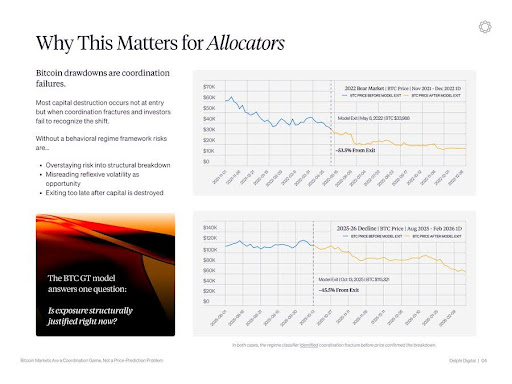
According to a Delphi Digital post on X, in May 2022, the framework detected early signs of coordination fracturing and signaled a move to cash at $33,988. In the following months, BTC declined by an additional 54%. Meanwhile, a similar pattern emerged in October 2025, with the model exiting at $115,321, preceding a 45.5% drawdown.
In both instances, the regime classifier identified the shift in breakdown before the price confirmed the move. These downturns were characterized by speculative capital overwhelming patient capital, leading to a collapse in coordination. Delphi Digital stated that for allocators, the key question now is whether current market conditions justify continued structural exposure.
Source: Chart from Delphi Digital on X
The current phase of the Bitcoin market reflects a transition between different groups of large holders, often referred to as whales. An analyst known as CW on X noted that long-term or old whales completed their accumulation phase last October and have finished positioning themselves well ahead of a potential rally. In contrast, a newer wave of whales is still in the process of building positions.
This ongoing accumulation may be one of the key reasons behind the delay of the start of the rally. What makes this cycle unique is the expected shift in leadership. Historically, BTC bull runs have been driven primarily by a single dominant group of whales. However, this cycle is expected to be led by both old and new whales.
While the current market conditions may appear slow and uneventful, this accumulation dynamic suggests that underlying pressure is building. If both groups converge on their positions, the resulting rally could be significantly stronger than in previous cycles.
Why Bitcoin Revisiting Old Prices Is Not Bearish
Crypto analyst Stockmoney Lizards has pointed out that the current timeline is obsessed with Bitcoin being at the same price it was in 2021. The key observation is that BTC should see a continuous growth, higher bases, and explosive bull markets.
If this trend continues, projections suggest that BTC could reach around $200,000 in 2027 and 2030, with potential expansion toward $500,000 in 2033 and 2035.
BTC trading at $66,311 on the 1D chart | Source: BTCUSDT on Tradingview.com
Featured image from Pixabay, chart from Tradingview.com
Editorial Process for bitcoinist is centered on delivering thoroughly researched, accurate, and unbiased content. We uphold strict sourcing standards, and each page undergoes diligent review by our team of top technology experts and seasoned editors. This process ensures the integrity, relevance, and value of our content for our readers.
World Foundation, the non-profit entity behind the biometric identity verification protocol formerly known as Worldcoin, disclosed today that its subsidiary completed the sale of around $65 million in WLD tokens through a series of over-the-counter deals with four counterparties over the past week.
Based on the disclosed average price, World Assets, Ltd., the unit responsible for token issuance and distribution, sold approximately 239 million WLD tokens.
1/ World Assets, Ltd. has now closed a series of OTC sales for a total of $65,000,000 with four counterparties over the past week, the first of which settled on March 20, 2026.
Of the $65 million raised, $25 million in tokens are locked up for six months to prevent immediate selling by buyers, as noted by the team.
The first settlement was completed on March 20, with the remaining transfers conducted from a designated World Assets multisig wallet. Funds are earmarked for core operations, R&D, manufacturing of the project’s iris-scanning Orb devices, and expansion of the ecosystem.
The disclosure comes after blockchain analytics firm Lookonchain reported last week that World offloaded 117 million WLD tokens valued at $39 million via OTC trades.
WLD traded at around $0.27 at press time, down 13.5% in the past week, CoinGecko data shows. The token once peaked at $11.7 in March 2024.
Tom Lee-backed Eightco Holdings is the largest publicly traded holder of WLD, controlling 277 million tokens as of March 20.
Founded in 2019 by Sam Altman, Alex Blania, and Max Novendstern, Worldcoin combines biometric identity verification with crypto to pioneer a global proof-of-personhood system.
Its ecosystem features the Orb-based World ID, the WLD token, the World App wallet, and the World Chain layer 2 network.
World ID has verified nearly 18 million unique humans, with close to 39 million World App users. The network spans 160-plus countries, supported by 948 active Orbs, and continues to grow with over 60,000 new accounts and 16,000 verifications in the past week.
Disclosure: This article was edited by Vivian Nguyen. For more information on how we create and review content, see our Editorial Policy.
Benin, once considered a peripheral player in the region’s financial ecosystem, is quietly redefining its position through a combination of digital ambition and practical innovation.
Over the past decade, the country has quietly pursued an ambitious digital transformation agenda, positioning itself as an emerging technology hub within the West African Economic and Monetary Union (WAEMU).
Much of its economic development is anchored around “Vision Benin 2060 Alafia” and the National Development Plan 2018–2025, which focuses on structural transformation through innovation in digital, industrialisation via special economic zones (SEZs), as well as agricultural modernisation. It remains a poor nations where, as of 2024, only had a GDP per capita of $1,485.
While Benin’s fintech ecosystem remains relatively small, the convergence of mobile connectivity, regulatory reform and digital economic development is beginning to reshape how financial services are delivered. Benin’s fintech sector is no longer simply nascent but rather evolving.
Digital Transformation as a Foundation for Fintech
The foundation of Benin’s fintech ecosystem lies in its broader digital economic transformation.
Over the past several years, the government has prioritised digitalisation as a central pillar of economic development. Investments in fibre-optic infrastructure, broadband expansion and digital public services have significantly improved connectivity across the country. Via the World Bank’s Digital Economy for Africa programme, Benin has made notable progress in digital infrastructure development, regulatory frameworks and innovation ecosystems, which include implementing various initiatives such as Sèmè City.
More recently, the government has continued to expand its ambitions. Despite a reduced budget, Benin allocated CFA27.2 billion (+$47million) to digital transformation initiatives in 2026, with investments targeting nationwide connectivity, AI integration and digital skills development.
These efforts are expected to have a significant economic impact. Industry projections suggest that Benin’s digital economy could contribute up to CFA1,200 billion (+$1.2billion) to GDP and create over 300,000 jobs by 2028; such developments are critical for fintech, according to the GSMA.
As highlighted in broader industry commentary from The Fintech Times, the next phase of digital economies is no longer about access alone, but about enabling meaningful participation and inclusion within digital ecosystems. In Benin, this shift is increasingly visible.
Financial Inclusion and the Expansion of Digital Payments
Bohicon, Benin – September 8, 2012: People crossing the street in busiest market junction in town, lot of motorbikes in background SOURCE ISTOCK
Fintech growth in Benin is closely tied to the country’s progress in financial inclusion.
Recent regulatory reforms have played a significant role. The introduction of a new banking law in 2024 expanded the regulatory framework to include payment institutions, electronic money providers and fintech companies, strengthening the ecosystem for digital financial services.
As a result, financial inclusion levels have risen sharply. Estimates suggest that financial inclusion in Benin has now reached close to 90 per cent within the WAEMU zone, driven largely by the adoption of mobile money and digital payment solutions.
Mobile network operators such as MTN and Moov Africa have been central to this transformation, introducing mobile money platforms that allow users to send funds, pay bills and access financial services without traditional bank accounts. This model has proven particularly effective in extending financial services to underserved populations.
Across Africa, mobile money has become the primary driver of financial inclusion. In Benin, it is increasingly embedded in everyday economic activity. This is from peer-to-peer transfers to merchant payments and public service transactions.
Fintech Startups and the Emerging Ecosystem
Alongside telecommunications providers and banks, a growing number of fintech startups are shaping Benin’s digital finance landscape.
Industry data suggests that around 20 to 21 fintech startups are currently active in Benin, focusing primarily on digital payments, financial infrastructure and remittance solutions.
Whist infant, there are companies that illustrate the diversity of this emerging ecosystem. One of the most prominent is FedaPay, a fintech platform specialising in merchant payments, bulk payments and international transfers, which has expanded its services beyond Benin into regional markets. Another key player is KKiaPay, a payment aggregator that enables businesses to accept mobile money, card payments and digital transactions across multiple platforms. Also, FeexPay, founded by Beninese entrepreneur Jean-Hugues Houinsou, provides online payment solutions and has become one of the first fintech companies in the region to obtain regulatory approval from the Banque Centrale des Etats de l’Afrique de l’Ouest (BCEAO).
These platforms are complemented by regional and international players focusing on mobile payments, micro-loans and also digital marketplaces.
Combined, these companies highlight a key characteristic of Benin’s fintech ecosystem: innovation is concentrated around payments and financial infrastructure. This focus reflects both the needs of the domestic market and the opportunities presented by regional integration.
Regional Integration and Digital Opportunity
Benin’s fintech ecosystem is also shaped by its position within the WAEMU region, an advantage they have due to French being a lingua franca in West Africa
For startups operating in relatively small domestic markets, regional scalability is essential. Fintech companies in Benin increasingly design solutions that can expand across West Africa, aligning with regional payment systems and regulatory frameworks. This regional approach is particularly important for attracting investment.
Investors often prioritise fintech startups that can scale beyond national borders. In this context, Benin’s integration within a larger monetary and regulatory framework provides a strategic advantage.
In addition, local innovation ecosystems continue to develop. Events such as the Salon de l’Entrepreneuriat Numérique et de l’Intelligence Artificielle (SENIA) bring together technology entrepreneurs, policymakers and investors, fostering collaboration within the country’s digital economy.
These initiatives contribute to a growing culture of digital entrepreneurship.
The Future in Benin
If the past decade was about building digital foundations, the next may be about scale.
Benin’s fintech ecosystem still operates below the radar of global investors, yet the direction of travel is becoming clearer. The combination of rising connectivity, a supportive regulatory environment and an increasingly entrepreneurial digital economy suggests a market that is beginning to find its footing.
Progress may be incremental rather than exponential. Benin is not yet leading the region’s fintech conversation But it is no longer absent from it. It at least has demonstrated it has joined the circle with regards to digital economic development.
Trusted Editorial content, reviewed by leading industry experts and seasoned editors. Ad Disclosure
Morgan Stanley’s 16,000 financial advisors manage $6.2 trillion in client assets. That number has been sitting in the background of a major filing — and it explains a lot about why the bank set its proposed Bitcoin ETF fee where it did.
A Fee Built For Advisors, Not Just Investors
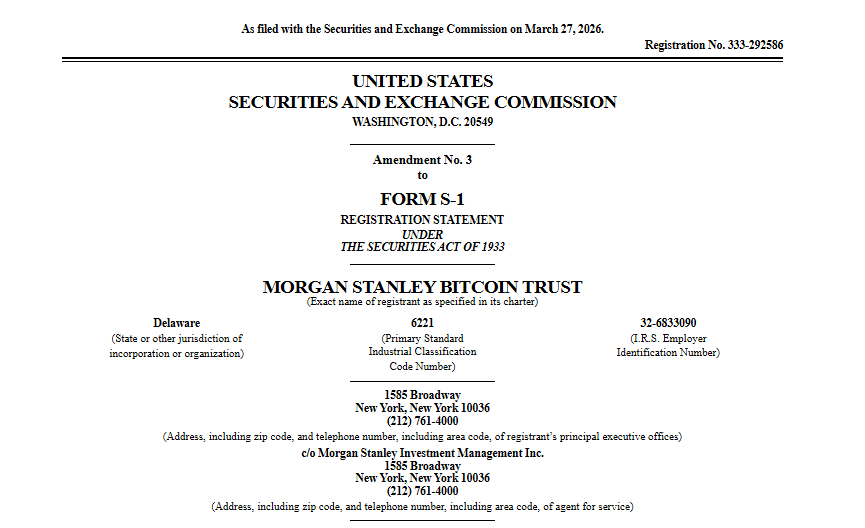
The bank filed an updated S-1 registration statement with the SEC on Friday, setting the fee for its proposed Morgan Stanley Bitcoin Trust at 0.14%.
If approved, that would make it the lowest fee of any spot Bitcoin ETF currently trading in the US market. Bloomberg ETF analyst Eric Balchunas said the fee was set with advisors in mind — at that price point, no one on the firm’s sales floor would feel awkward recommending the product to clients.
Morgan Stanley disclosed the 0.14% fee in its latest S-1 filing on Friday.
That is a practical calculation. Advisors who push high-fee products into client portfolios face questions. At 0.14%, those questions go away.
BlackRock’s iShares Bitcoin Trust charges 0.25%. The Grayscale Bitcoin Mini Trust sits at 0.15%. Morgan Stanley is going in one basis point below both of its nearest rivals.
Bloomberg ETF analyst James Seyffart called it a big move and said an early April launch is likely, pending regulatory approval.
WOW. We have the fee on Morgan Stanley’s spot bitcoin ETF $MSBT. Will charge just 0.14% !!! Big move here. They are not messing around. Likely to launch in early April. https://t.co/R0iA3wMB5N
Approval would put Morgan Stanley in a category of one. No major bank has yet issued a spot Bitcoin ETF in the US. That distinction, combined with a rock-bottom fee and a distribution network of thousands of advisors, gives the product a strong early position if it clears the SEC.
Bitcoin is now trading at $66,180. Chart: TradingView
The bank named Coinbase and Bank of New York Mellon as custodians for the fund. Those are two of the most established names in digital asset custody, and the pairing signals that Morgan Stanley is building this to last — not testing the waters.
Rivals will now face a decision. The $83 billion spot ETF market has operated with fees clustered around 0.20% to 0.25%. A new entrant coming in below all of them puts pressure on existing providers to respond or accept the risk of losing assets over time.
More Than Just Bitcoin
The Bitcoin ETF is one piece of a larger push. In January, Morgan Stanley also filed for a Solana ETF and a staked Ether ETF. Weeks later, it applied for a national trust banking charter that would allow it to custody digital assets, carry out trades, and offer staking services directly to clients.
Featured image from Unsplash, chart from TradingView
Editorial Process for bitcoinist is centered on delivering thoroughly researched, accurate, and unbiased content. We uphold strict sourcing standards, and each page undergoes diligent review by our team of top technology experts and seasoned editors. This process ensures the integrity, relevance, and value of our content for our readers.