The latest version of the crypto bill Clarity Act is in the spotlight mostly because of its stablecoin rules. In practice, it may land hardest on decentralized finance (DeFi) and tokens tied to it, according to a report by 10x Research.
At the center of the proposal is a ban on offering yield — or anything resembling it like rewards — on stablecoin balances. That effectively ends the idea of stablecoins as onchain savings products and redefines them as pure payment rails.
“This represents a clear re-centralization of yield,” wrote Markus Thielen, founder of 10xResearch. This is because the proposal pulls back yield into banks, money market funds and regulated wrappers, leaving crypto-native platforms with less room to compete on returns.
That shift could also hit DeFi, despite early hopes it might benefit.
The logic was that if centralized platforms can’t offer yield, users would move onchain, Thielen said.
But that assumes DeFi escapes the same rules. In practice, the Clarity framework is likely to extend into front-end interfaces and token models, especially where fee generation or governance starts to resemble equity, he said.
That puts a wide swath of the sector in focus. Decentralized exchanges like Uniswap (UNI), SUSHI$0.1896 and dYdX (DYDX), as well as lending protocols like Aave AAVE$95.69 and COMP$18.29, could face tighter constraints around how they operate and distribute value, the report argued. The result could be lower volumes, reduced liquidity and weaker token demand.
On the other hand, the proposed regulation is “structurally bullish” for infrastructure players like Circle (CRCL) as it embeds stablecoins deeper into payment rails, Thielen said.
Trusted Editorial content, reviewed by leading industry experts and seasoned editors. Ad Disclosure
The global macro environment has been one of the major defining factors in Bitcoin and the broader crypto market so far this year. From the brewing geopolitical tensions in the Middle East to the rising inflation expectations in the United States, the global financial markets have barely caught a break in 2026. A prominent market expert has come forward with interesting US labor data, breaking down how the rising macroeconomic pressure could impact Bitcoin and the broader financial markets.
Macro Shock Could Trigger Risk-Off Behavior Among BTC Investors
In a March 28th post on the X platform, Alphractal founder and CEO shared that the participation of the United States labor force has been in a steep decline over the past few weeks. According to the crypto pundit, the Labor Force Participation is one of the most underrated macroeconomic signals in the current market landscape.
Wedson highlighted the major trends of the Labor Force Participation over the last two decades and its impact on the S&P 500 index. According to the highlighted data, participation reached its peak around 2000, before collapsing during 2008 financial crisis, briefly recovering, and then falling to historic lows during the COVID-19 pandemic.
Source: @joao_wedson on X
As the labor force participation rate dwindled, the S&P 500 soon followed despite its initial show of resilience. The same can be seen for Bitcoin in the chart below, which seemed to succumb to the macro stress each time the LFP suffered a nosedive.
Source: @joao_wedson on X
Wedson noted that, before the “liquidity” flood sent the Bitcoin price to new highs, the market leader initially fell to cycle lows as the labor participation crashed during the COVID lockdown in 2020. What’s different now is that there’s no obvious liquidity fuel to take advantage in the current labor participation plunge.
Wedson wrote in his post:
A falling participation rate means fewer people working, less consumption, weaker real economic output. The stock market can diverge from that reality for a while but not forever.
According to the Alphractal founder, the specific risk for Bitcoin is a macro shock that triggers a risk-off behavior among investors, with most market participants fleeing to safety before the next accumulation phase begins. And, as rightly baked in the steadily-declining Coinbase Premium, the demand for BTC among US investors seems to be in a steady downturn.
Bitcoin Price Overview
As of this writing, the flagship cryptocurrency is valued at around $66,750, reflecting a roughly 1% jump in the past 24 hours. The single-day action has not been enough to wipe out losses from the past week, which still stand at more than 5%.
The price of BTC on the daily timeframe | Source: BTCUSDT chart on TradingView
Featured image created by DALL.E, chart from TradingView
Editorial Process for bitcoinist is centered on delivering thoroughly researched, accurate, and unbiased content. We uphold strict sourcing standards, and each page undergoes diligent review by our team of top technology experts and seasoned editors. This process ensures the integrity, relevance, and value of our content for our readers.
Xiaomi’s MiMo-V2-Pro—a trillion-parameter model that briefly passed as “DeepSeek V4”—quietly lands as a top-tier AI contender.
It excels at coding, creative writing, and agentic tasks while dramatically undercutting rivals like Claude on price.
Strong reasoning and output quality come with trade-offs, including math missteps and high token consumption at times.
Most Americans know Xiaomi—if they know it at all—as that cheap phone brand from China.
That’s a significant misread. Xiaomi is the third-largest smartphone manufacturer on the planet, behind only Apple and Samsung, shipping roughly 170 million phones in 2025. It makes televisions, air purifiers, fitness trackers, electric scooters, clothing, and now cars.
Xiaomi’s SU7 Ultra set the Nürburgring record for fastest mass-produced electric vehicle last year, beating out Rimac and Porsche. It recently partnered with the Sei blockchain to preinstall crypto wallets on its devices across Europe, Latin America, and Southeast Asia. The company’s market cap sits around $137 billion.
So when Xiaomi drops an AI model, maybe we should pay attention.
On March 18, the company’s dedicated AI research arm quietly released three models at once: MiMo-V2-Pro, MiMo-V2-Omni, and a text-to-speech model. The first model of the new MiMo generation appeared in December 2025 when the company quietly dropped MiMo-V2-Flash—a capable 309B mixture-of-experts model—and almost no one outside the Chinese AI community paid attention. The Western tech press mostly shrugged.
Then, on March 11, an anonymous 1-trillion-parameter model called “Hunter Alpha” appeared on OpenRouter with no developer attribution. The model climbed to the top of OpenRouter’s leaderboard, surpassed one trillion tokens in total usage, and immediately triggered widespread speculation that it was DeepSeek’s unreleased V4.
The anticipation for that model had been building for weeks, with insiders claiming it would outperform both Claude and ChatGPT on coding tasks.
It wasn’t DeepSeek.
On March 18, Luo Fuli, head of Xiaomi’s MiMo division and a former DeepSeek researcher, revealed Hunter Alpha was an early internal test build of MiMo-V2-Pro. Xiaomi’s stock jumped 5.8%. “I call this a quiet ambush,” Luo wrote on X.
MiMo-V2-Pro & Omni & TTS is out. Our first full-stack model family built truly for the Agent era.
I call this a quiet ambush — not because we planned it, but because the shift from Chat to Agent paradigm happened so fast, even we barely believed it. Somewhere in between was a…
MiMo boasts over one trillion total parameters, 42 billion active per request via a mixture-of-experts setup. A hybrid attention mechanism running at a 7:1 ratio handles a context window up to one million tokens. A built-in multi-token prediction layer speeds up generation by predicting multiple tokens per step, rather than one at a time. It is currently closed source, though Xiaomi has left the door open on a potential future release.
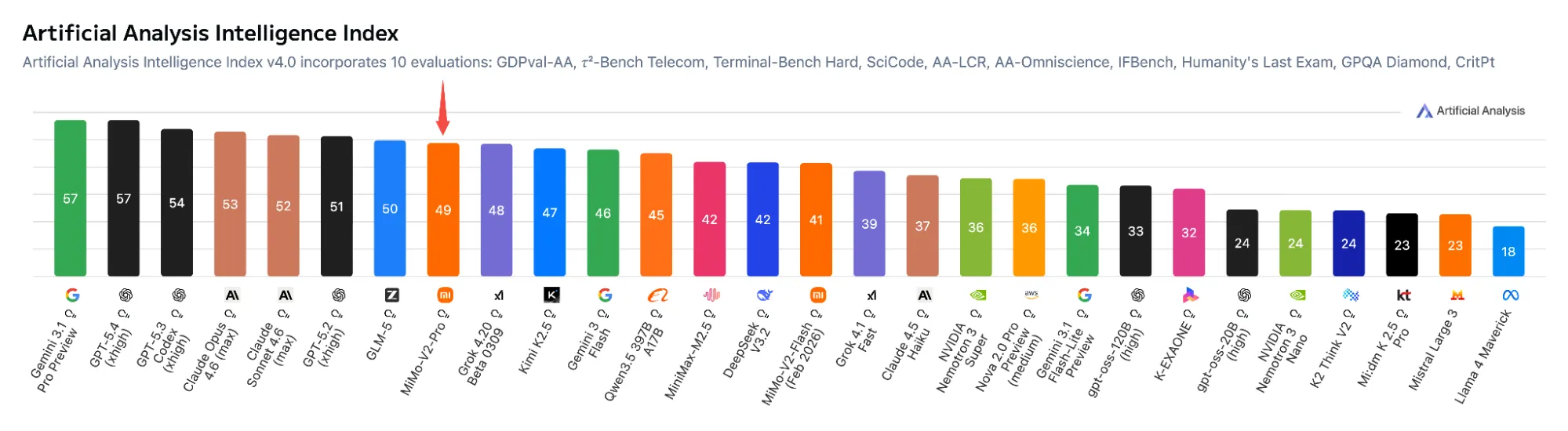
On the Artificial Analysis Intelligence Index, MiMo-V2-Pro ranks eighth worldwide and second among Chinese models, trailing only GLM-5. On SWE-bench Verified—real-world software engineering tasks—it scores 78%, against Claude Opus 4.6’s 80.8% and Claude Sonnet 4.6’s 79.6%.
On ClawEval, the agentic benchmark tied to the OpenClaw framework, it hits 61.5, approaching Opus 4.6’s 66.3. On PinchBench, it sits third globally at 81.0, just behind Opus 4.6 (81.5) and its sibling MiMo-V2-Omni (81.2).
MiMo-V2-Pro costs $1 per million input tokens and $3 per million output tokens, up to 256K context. Claude Sonnet 4.6 runs $3 per million input and $15 per million output (Opus 4.6 is $5/$25). For developers building agentic systems at scale, those numbers are not a footnote.
The Omni sibling handles vision, audio, and video natively—not as bolted-on modules, but trained end-to-end as a unified perceptual system. The demo showing it analyzing dashcam footage as a real-time autonomous driving brain was, frankly, impressive. It’s genuinely multimodal in a way that most “omni” models only claim to be.
Testing the model
Of course, we tested MiMo-V2-Pro to find out how good it is. Here’s what actually happened. The outputs will be available in our Github repository.
Creative writing
We gave MiMo-V2-Pro a single creative writing prompt: a time travel story anchored to Mesoamerican history, with a specific protagonist, a cultural identity to honor, and a philosophical paradox about how time cannot be changed.
The model returned over 3,000 words: a proper title, five full chapters and the structural discipline you’d expect from a draft that had been through an editor. It even wrote an epilogue.
It is, without question, the longest and richest piece of creative prose we have gotten from any model, with the sole exception of Longwriter—a specialized, but now old model built from the ground up specifically for long-form generation, which is a very different category of competition.
The writing itself was rich, descriptive, and vivid. The opening paragraph starts building the image of the entire scene. MiMo v2 Pro embeds realism to make the story believable.
Unlike other models such as Grok, it didn’t just set a scene in a place—in this case, ancient Mexico. It understood what ancient Mesoamerica smelled like, and built the mood from the ground up using native words, realistic descriptions, and good contextual cues.
Dialogue sits inside the narrative exactly how it does in literary fiction, instead of embedding it into paragraphs like most current models do.
Another thing worth noticing is that the paradox—arguably the core element of the story—wasn’t purely intellectual, but emotional. The whole arc is resolved without a lecture. The final lines stick the landing the way good fiction is supposed to: not by explaining the theme, but by making you feel it.
“Outside, the rain began. It fell on the spiraling towers and the restored lakes and the ancient ground of Tlachinollan, where, buried in volcanic soil under the weight of a thousand years, a black rectangle waited with the patience of something that already knew how the story ended.”
The cultural specificity—mentions of cara de luna, maguey fiber, the temazcal tradition, and the Nahuatl names used in the story—is consistent and never decorative. The time travel paradox is actually argued, not just nodded at. For creative writing use cases, MiMo-V2-Pro just put itself on a very short list, and in our opinion is by far the best and richest model available, beating Claude 4.6 Opus easily.
The full story is available here.
Coding
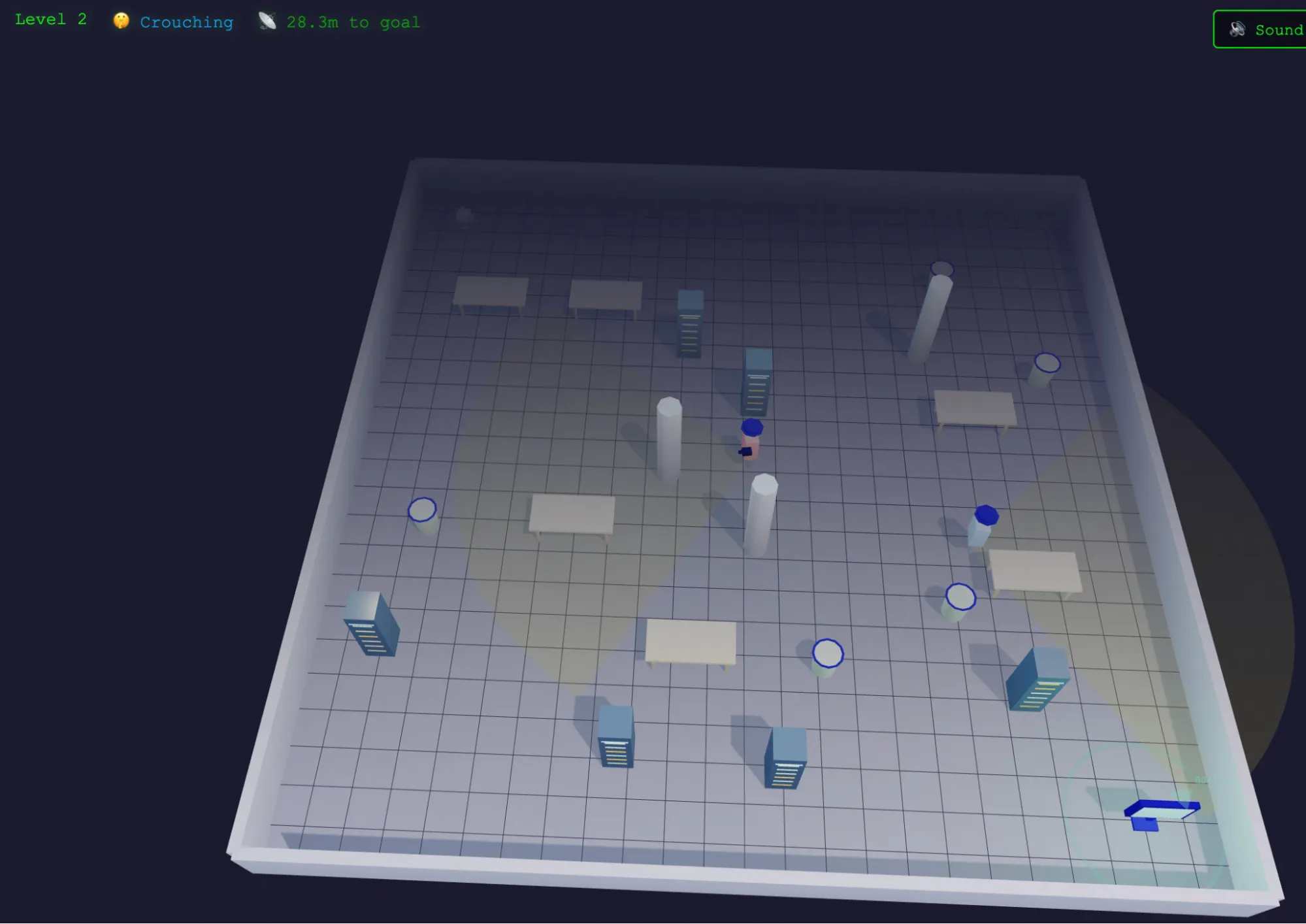
The benchmark numbers point to coding as MiMo-V2-Pro’s strongest suit, and the hands-on experience backs that up. We asked it to build our usual stealth game from a single prompt, and it shipped a working game on the first try.
Not “working” simply in the sense of technically running, but working in the sense that the logic held, the screens made sense, and the visual design was actually good. That combination—correctness and aesthetics—is where most models fall apart. They get one or the other, but usually not both.
It also chose a 2.5 D aesthetic instead of the usual 2D style that other models went with. This design choice made the program more aesthetically pleasing without altering its core proposition.
We followed up with small improvements. Adding sound and MIDI music to a running 3D game has broken previous models mid-generation: the code base gets too large, the context loses the thread, and models either end up in a loop or freeze. MiMo-V2-Pro added both and kept the whole thing coherent. The music matched the game’s tone, while the screens matched the game’s visual identity.
We enjoyed playing it, though if we’re honest, more for how it looked than how it challenged us. The difficulty scaled with the number of opponents rather than level design—the robot and the PC spawned in the same positions every round. That’s a design choice, not a bug.
Still, for a single-prompt, zero-iteration output, it will do the job.
You can play the game by clicking on this link.
Logic and common sense
We asked MiMo-V2-Pro to act as a legal expert and answer whether it’s lawful for a man to marry his widow’s sister under Falkland Islands law. This is a tricky question that aims to evaluate the model’s reasoning.
The final answer was wrong, but the reason why is the interesting part. The model’s chain of thought correctly caught the linguistic trap in the prompt: “if a man has a widow, that means he’s deceased” it said—so the question is technically nonsensical.
It identified the flaw, and decided that the most logical thing was that the user was referring to his “deceased wife’s sister.” It then proceeded to answer that reframed question rather than flagging the original as unanswerable.
“Based on my analysis of the legal framework governing the Falkland Islands, the answer to your question is yes, it is legal for a man to marry the sister of his deceased wife,” the model wrote. “The phrasing ‘marry his widow’s sister’ contains a logical contradiction. If a man has a ‘widow,’ he is deceased and cannot remarry. The correct legal question is whether a man may marry the sister of his deceased wife (i.e., his late wife’s sister). This relationship is one of affinity (created by marriage) rather than consanguinity (blood relation),” it concluded
The reasoning was sound. The decision to quietly swap the premise instead of surfacing the contradiction was not.
This is why transparency in reasoning outputs is important. We only know this because Xiaomi exposes the full chain of thought (OpenAI doesn’t). When a model reasons incorrectly in a hidden chain of thought and confidently delivers a wrong answer, then you have no visibility into where it went sideways or how to correct it.
Math
Math is where MiMo-V2-Pro showed its ceiling.
We asked our usual benchmark question from FrontierMath: “Construct a degree 19 polynomial p(x) ∈ C[x] such that X := {p(x) = p(y)} ⊂ P1 × P1 has at least 3 (but not all linear) irreducible components over C. Choose p(x) to be odd, monic, have real coefficients and linear coefficient -19 and calculate p(19)”
The model hit two full freezes and burned through a significant token budget without producing a reply.
When it did eventually answer on the third attempt, it reasoned through the problem step by step… and still got it wrong. The correct answer was 1876572071974094803391179; it answered p(19)=164,079,552,964,661 and 2,012,379,925,093,098,998 on a follo- up question asking it to correct itself.
In genera,l it is fine for normal and even harder math problems, but frontier math is not its strong suit—at least not yet. Using the Agentic feature instead of the pure LLM may yield better results.
Agentic features
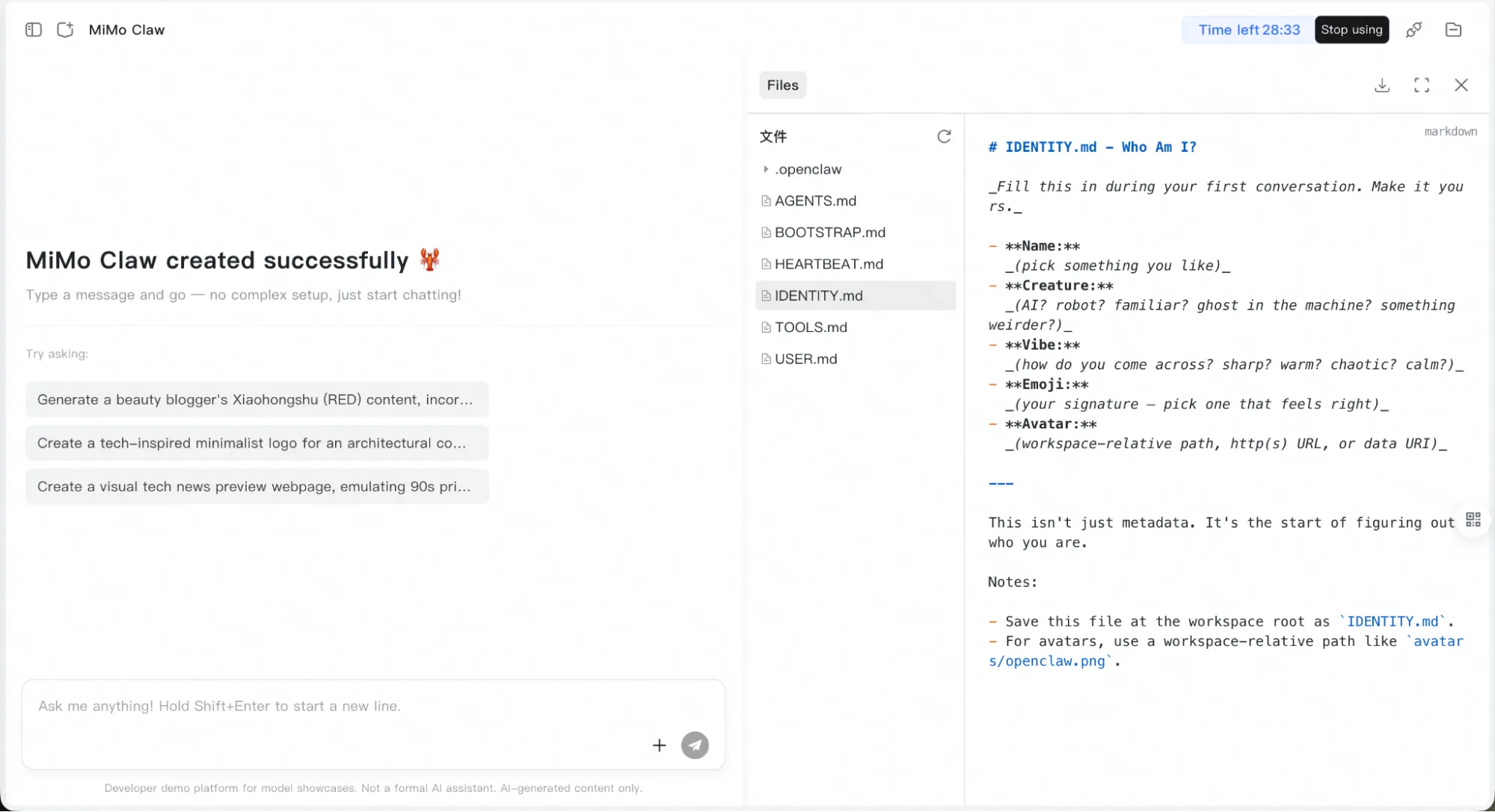
Xiaomi is following the same playbook as MiniMax and Kimi, and provides a one-click OpenClaw integration that spins up a preconfigured cloud instance with MiMo-V2-Pro as the underlying model. No API setup, no VPS, no skill configuration, no hour-long troubleshooting session before you even run your first task. You click, it works.
The demo environment runs for 30 minutes and then destroys itself—which is a real limitation, but also an honest one. For developers already comfortable with agentic infrastructure, this adds nothing. For everyone else, it’s the most frictionless on-ramp to agentic AI you could ask for.
Conclusion
All things considered, MiMo-V2-Pro is a serious model, and we really enjoyed tinkering around with it. It’s not perfect—the math ceiling is real, the chain of thought transparency surfaced a reasoning flaw that a less open model would have buried, and the token consumption during hard reasoning tasks adds up fast.
If you care about costs, then Xiaomi’s pricing is aggressive—a fraction of what Claude Opus or the latest OpenAI and Google models cost, and more capable than GLM or MiniMax in the areas that matter most for creative and agentic work.
Creative professionals in particular stand to gain a lot here—possibly more than they would from Anthropic right now.
This model thinks expensively, and it may be a trade-off. If you’re running high-volume agentic pipelines, watch the token burn, even though you may end up spending less than you would with Claude. If you’re doing rich, open-ended work where output quality is the metric, then MiMo-V2-Pro earns its place on the shortlist.
Daily Debrief Newsletter
Start every day with the top news stories right now, plus original features, a podcast, videos and more.
The following is an economic development and fintech overview in 2026 of the only Spanish speaking nation in the African continent – Equatorial Guinea.
In Central Africa, fintech conversations are often dominated by larger economies such as Cameroon or the Democratic Republic of the Congo (DRC). Yet smaller markets are beginning to reveal how digital finance can evolve under very different conditions. Equatorial Guinea, the only Spanish-speaking country in the African country, long defined by its oil-driven economy, is now exploring a different trajectory. This is one where digital transformation and financial inclusion begin to intersect.
For decades, the country’s economic model has relied heavily on hydrocarbons, with limited diversification into other sectors. But as policymakers increasingly look beyond oil, digital technologies are starting to play a more prominent role in shaping the country’s economic future; fintech has both direct and indirect impact on this.
Pertaining to fintech, at present, Equatorial Guinea’s fintech ecosystem remains small and underdeveloped. Yet the direction of travel is becoming clearer: digital infrastructure, mobile connectivity and policy reform are beginning to lay the groundwork for a more inclusive financial system.
Financial Inclusion Challenges and the Case for Fintech
Financial inclusion remains one of the most significant challenges facing Equatorial Guinea. Like many countries in the Central African Economic and Monetary Community (CEMAC), access to formal financial services is limited. Across the region, financial inclusion rates remain around 32 per cent, meaning that a majority of the population remains outside the formal banking system. In Equatorial Guinea, this translates into a heavy reliance on cash transactions and informal financial systems.
Low banking penetration is driven by several factors: limited branch networks, high service costs and relatively low levels of financial literacy. For many individuals and small businesses, traditional banking services remain either inaccessible or impractical.
This contradicts statistics as, based on GDP per capita, Equatorial Guinea, thanks to its oil, is one of the richest countries in Africa.
However, this is where fintech has the potential to make a difference.
Across Africa, mobile money and digital financial services have demonstrated their ability to expand access to financial tools such as payments, savings and remittances without requiring extensive banking infrastructure. As highlighted in broader fintech analyses, mobile-based financial services have become a critical driver of financial inclusion in underserved markets, according to the International Monetary Fund (IMF).
For Equatorial Guinea, similar models could help bridge the gap between formal financial systems and the everyday needs of individuals and businesses.
Digital Economic Transformation and Policy Direction
Fintech development in Equatorial Guinea is closely tied to the country’s broader digital transformation agenda.
Recognising the need to diversify away from oil dependency, the government has placed digitalisation at the centre of its long-term development strategy. There is the National Development Plan 2035. In addition, and in synergy, is the Digital Agenda for Equatorial Guinea (ADIGE – or Agenda Digital Guinea Ecuatorial in Spanish), which is a World Bank-supported strategic plan to diversify the country’s oil-dependent economy. It focuses on enhancing ICT infrastructure, digitising administration, and building digital skills.
Digital transformation is expected to play a key role in job creation, poverty reduction and financial inclusion, particularly as new digital services expand across the economy.
Recent reforms have focused on several key areas: expanding telecommunications infrastructure, digitising public services, strengthening digital skills and literacy and supporting the development of digital businesses
At the same time, policy frameworks are evolving to support digital finance.
According to Organisation for Economic Co-operation and Development (OECD) assessments, Equatorial Guinea’s digital strategy prioritises data governance, cybersecurity and digital infrastructure as foundational elements for enabling innovation, which includes fintech.
These developments suggest that fintech growth in the country is unlikely to be driven solely by startups, but rather by a broader digital transformation process.
Fintech Ecosystem and Emerging Players
Equatorial Guinea’s fintech ecosystem remains in its early stages.
Industry estimates suggest that the country currently hosts fewer than 5 to 10 fintech and digital financial service providers, reflecting the limited scale of the domestic startup ecosystem. Most activity is concentrated around mobile payments, remittances and basic digital financial services.
The market is still largely dominated by traditional banks and telecommunications operators.
Mobile money services, often provided by regional telecom players, represent the primary entry point into digital finance. Platforms such as Orange Money, which operates across several Central African markets, provide basic services including money transfers, bill payments and airtime purchases.
These services are particularly important in environments where banking infrastructure is limited.
At the same time, small and medium-sized enterprises (SMEs) are driving demand for digital financial solutions. Many businesses require accessible payment systems, working capital financing and cross-border transaction capabilities; these are areas where fintech solutions can play a transformative role.
However, several challenges remain.
Trust in digital financial services, limited digital literacy and infrastructure constraints continue to affect adoption rates. User trust, usability and accessibility remain key barriers to fintech adoption in Equatorial Guinea.
Despite these constraints, opportunities exist in areas such as in digital payments, micro-lending, remittances (many work overseas notably in neighbouring Gabon as well as in Spain) and SME financial services.
In conclusion
Equatorial Guinea’s fintech ecosystem in 2026 does not yet command the same attention as larger African markets.
But it is not standing still. The country is at a point where digital transformation, economic diversification and financial inclusion are beginning to converge. The building blocks of connectivity, policy reform and mobile financial services are gradually falling into place.
A group of Ethereum projects have announced a new effort aimed at fixing a growing problem in Ethereum: its ecosystem is becoming too fragmented.
Revealed at the EthCC conference in Cannes, the project — called the “Ethereum Economic Zone” (EEZ) — is designed to make Ethereum’s many add-on networks (known as layer 2s, or L2s) work together more seamlessly.
The framework is being developed by Gnosis, Zisk and the Ethereum Foundation. Gnosis is a longtime Ethereum infrastructure developer, while Zisk focuses on zero-knowledge proving technology.
It comes as Ethereum for years relied on L2 networks to scale, though these networks often operate like separate islands. Users have to move assets between them using bridges, which can be slow, costly and risky, while developers often have to rebuild the same tools on each network.
The EEZ aims to change that by making all these networks feel like one unified system. In simple terms, it would allow apps and transactions on different Ethereum networks to interact instantly — without needing bridges — while still relying on Ethereum’s core security.
The announcement comes as Ethereum’s long-term reliance on L2 scaling has faced renewed debate. Ethereum co-founder Vitalik Buterin has recently suggested the ecosystem may need to rethink parts of its L2-heavy roadmap, particularly as fragmentation and user experience issues persist. The EEZ appears to directly address those concerns by trying to unify liquidity, infrastructure and user flows across networks, rather than adding more isolated chains
The idea is to create shared liquidity (so funds can move freely), simpler infrastructure for developers, and a smoother experience for users. The system would also continue to use ETH as its main token for fees, rather than introducing new ones.
The project is being developed openly with input from the wider Ethereum community.
“Ethereum doesn’t have a scaling problem. It has a fragmentation problem. Every new L2 is a silo that makes it harder to seamlessly extend and drive value back to the Ethereum mainnet,” said Friederike Ernst, co-founder of Gnosis, in a press release shared with CoinDesk. “The EEZ is designed to do the opposite.”
Read more: From ‘Ethereum’s sidekick’ to standalone stars: How Vitalik Buterin’s latest pivot is forcing Layer 2s to grow up
Trusted Editorial content, reviewed by leading industry experts and seasoned editors. Ad Disclosure
A man identifying himself only as “Red” allegedly ran the whole operation from somewhere far away — and police still don’t know who he is.
Bitcoin Robbery Mastermind Still At Large
That detail emerged during a March 17 court hearing in Maricopa County, where prosecutors revealed that an unidentified third party was on a phone call with two California teenagers throughout a violent home invasion in Scottsdale, Arizona, directing their every move in real time.
The teenagers – Jackson Sullivan, 17, and Skylar LaPaille, 16 – told investigators that “Red” and another individual known as “8” had been communicating with them through the encrypted app Signal — and had handed them $1,000 to buy supplies before the job.
The target was a couple believed to hold $66 million in bitcoin.
According to court records, Sullivan and LaPaille drove roughly 600 miles from San Luis Obispo, California, arriving at a home near 98th Street on Windrose Drive on the morning of January 30.
Teenage Scottsdale home burglars tried to steal $66 million in crypto, police say https://t.co/vqPtYJEORl pic.twitter.com/gprkdHnjvs
They came dressed in delivery driver uniforms purchased online. They brought a fake package and a dolly. When the homeowner answered the door, the teens forced their way inside.
What followed was brutal. The couple was restrained with duct tape and beaten repeatedly while the intruders demanded access to their cryptocurrency wallets.
The homeowner later addressed the court directly. “I have had a concussion. I’ve had a broken rib,” he said. “They used subterfuge to enter our house, and then he personally beat me repeatedly in my own home.”
The couple’s adult son was also in the house. He hid and called 911.
BTCUSD now trading at $66,735. Chart: TradingView
Officers Arrived While The Break-In Was Still Happening
Police reached the home before the teens had left. Sullivan and LaPaille fled, driving a vehicle with stolen plates, at one point going the wrong direction into oncoming traffic during the chase.
They were arrested just after 11:30 a.m. on January 31. Left behind at the scene: duct tape, zip ties, a 3D-printed unloaded gun, and a burner phone.
Both teenagers now face nine felony charges, including aggravated assault, kidnapping, and second-degree burglary.
Image: Da-kuk via Getty Images
Sullivan was released on a $50,000 cash-only bond and is wearing an electronic monitor. LaPaille’s bond was also set at $50,000, though it was unclear whether he had posted it.
Their attorneys have argued the teens were manipulated. Sullivan’s lawyer told the court his client was targeted online and that his parents had no knowledge of what was happening.
The teens themselves told investigators they had been extorted into carrying out the crime.
An FBI spokesperson confirmed the agency is aware of the investigation but said it is not currently involved.
The mystery figure known as “Red” has not been charged and remains unidentified. Prosecutors acknowledged in open court they do not know his current whereabouts.
Featured image from Unsplash, chart from TradingView
Editorial Process for bitcoinist is centered on delivering thoroughly researched, accurate, and unbiased content. We uphold strict sourcing standards, and each page undergoes diligent review by our team of top technology experts and seasoned editors. This process ensures the integrity, relevance, and value of our content for our readers.
On the daily timeframe, bitcoin showed a weakening structure following a rejection near the $76,000 region and a subsequent sequence of lower highs. Price stabilized in the $66,000–$67,000 zone, sitting just above a soft support band.
Elevated volume during the decline suggested distribution rather than a shallow pullback, reinforcing a bearish-neutral bias. A move back toward $70,000 would be required to shift the structure meaningfully, while downside exposure remains toward $65,000 and potentially $62,500.
BTC/USD 1-day chart via Bitstamp on March 29, 2026.
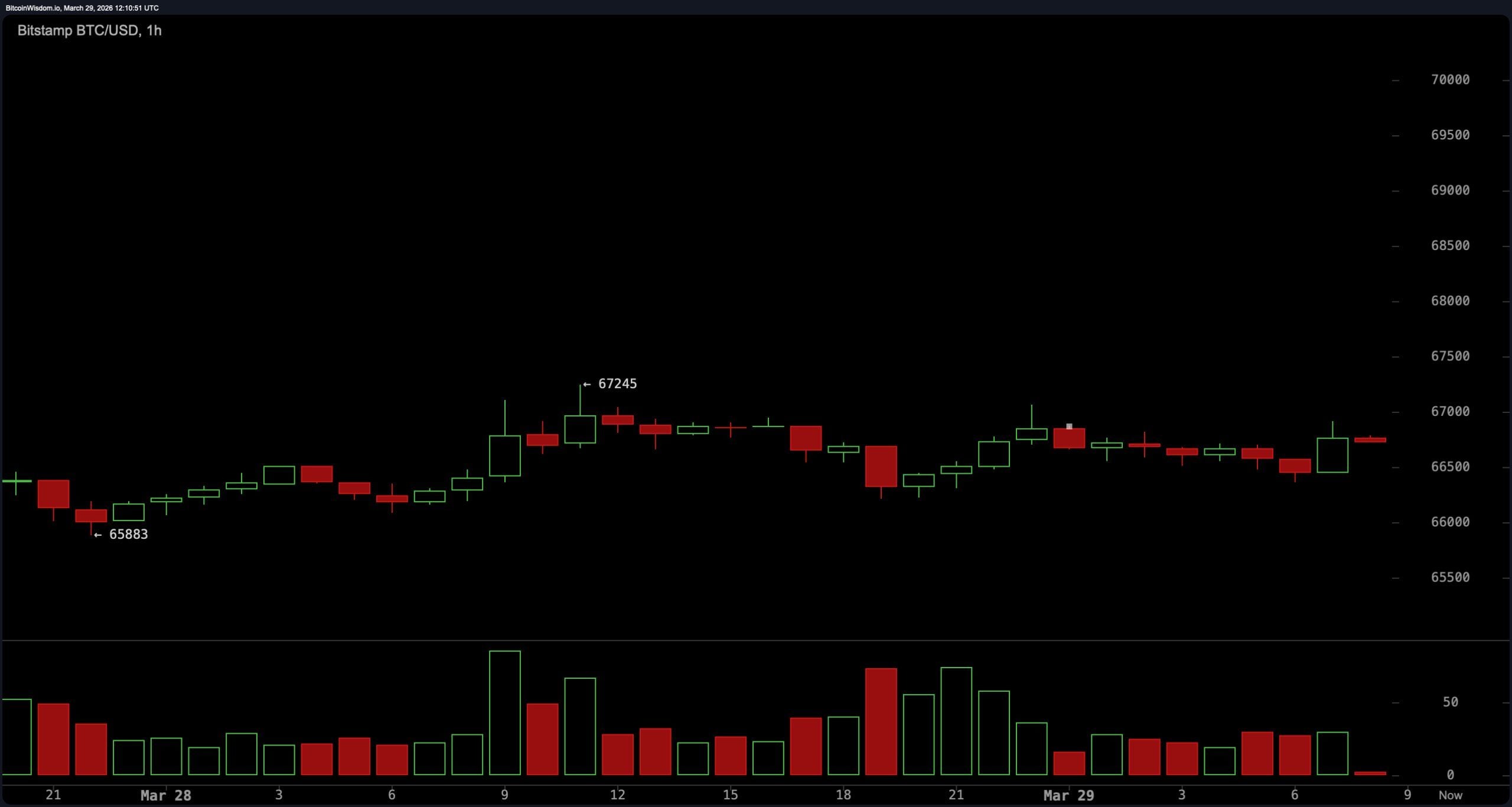
On the 1-hour bitcoin chart, price action tightened into a narrow consolidation range, characterized by smaller candles and declining volume. This compression reflected short-term indecision, though a slight upward drift produced marginally higher lows. Immediate intraday support formed around $65,800 to $66,000, while resistance capped the price between $67,000 and $67,500. The structure suggested a breakout setup, though direction remained unclear given the broader context.
BTC/USD 1-hour chart via Bitstamp on March 29, 2026.
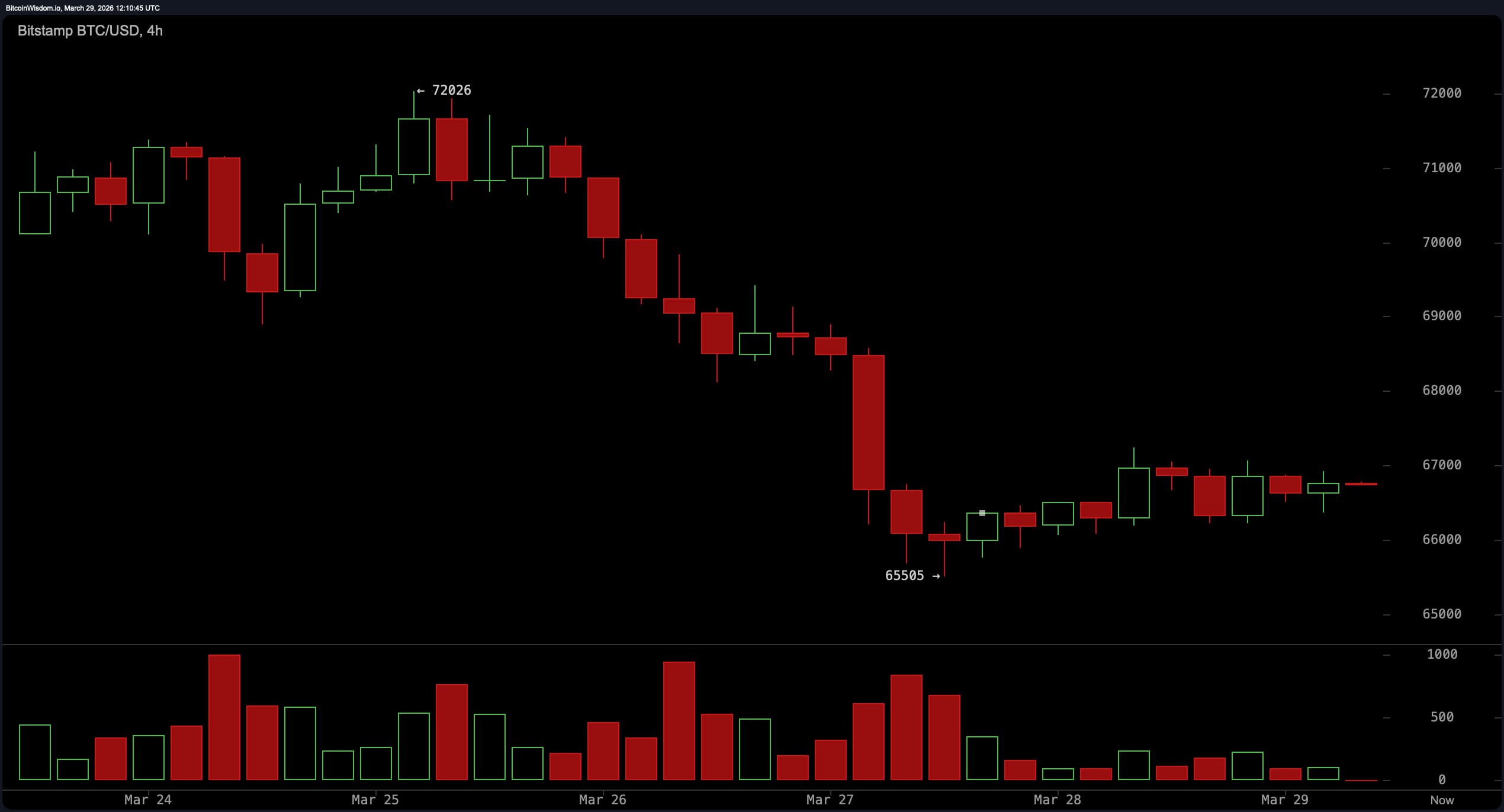
On the 4-hour timeframe, bitcoin transitioned from a sharp selloff into early-stage consolidation. Price established a range between approximately $65,500 as support and $67,500 to $68,000 as resistance. Momentum appeared to be stabilizing, with selling pressure easing but not fully reversing. The range-bound behavior indicated a pause rather than a confirmed reversal, with market participants awaiting a decisive move beyond established boundaries.
BTC/USD 4-hour chart via Bitstamp on March 29, 2026.
Oscillators reflected a market lacking alignment. The relative strength index ( RSI) at 42 remained neutral, while the Stochastic oscillator at 9 approached oversold territory without confirmation. The commodity channel index (CCI) at −158 indicated statistically stretched downside conditions, and momentum at −3,157 suggested potential stabilization.
However, the average directional index (ADX) at 16 pointed to weak trend strength, the Awesome oscillator at −923 remained negative, and the moving average convergence divergence ( MACD) at −721 continued to signal bearish pressure.
Moving averages (MAs) reinforced the broader weakness. The exponential moving average (EMA) and simple moving average (SMA) readings across all major periods remained above price, indicating sustained downside pressure. Short-term levels included the 10 EMA at $68,534 and 10 SMA at $68,817, both above the current price.
Medium-term resistance appeared at the 20 EMA at $69,230 and 20 SMA at $70,192, while longer-term indicators such as the 100 EMA at $77,137 and 200 SMA at $91,072 highlighted the extent of the broader trend gap. Collectively, the EMA and SMA structures reflected a market trading below key trend benchmarks with no immediate reclaim in sight.
Bull Verdict:
Bitcoin remains compressed near support with multiple oscillators, including the commodity channel index (CCI) and momentum (10), signaling stretched downside conditions that could support a short-term rebound. If price stabilizes above the $65,000–$66,000 zone and pushes through near-term resistance around $67,500 to $70,000, the structure could shift toward recovery, particularly given the weakening trend strength indicated by the average directional index (ADX).
Bear Verdict:
Bitcoin continues to trade below all major exponential moving averages (EMA) and simple moving averages (SMA), reinforcing a firmly negative trend backdrop despite short-term consolidation. With the moving average convergence divergence ( MACD) remaining negative and the price unable to reclaim key resistance levels, the broader structure favors continued downside pressure, with risk skewed toward a breakdown below $65,000 and extension toward lower support zones.
FAQ 🔎
What was bitcoin’s price on March 29, 2026? Bitcoin traded at $66,759.93, within a 24-hour range of $66,266.04 to $67,185.75.
Is bitcoin in an uptrend or downtrend right now? Bitcoin remains in a broader downtrend, trading below all major moving averages.
What do bitcoin’s technical indicators show? Indicators are mixed, with weak momentum and limited trend strength despite oversold signals.
What are the key bitcoin price levels to watch? Support sits near $65,000, while resistance is clustered between $67,500 and $70,000.
Representative Stephen Lynch voiced concerns about the direction of the SEC under Donald Trump, citing dropped investigations and enforcement actions on crypto companies.
France’s largest lender BNP Paribas is bringing six new crypto exchange-traded notes (ETNs) tied to Bitcoin and Ethereum to its exchange platform in France, starting tomorrow March 30, according to a recent announcement.
Exchange-traded notes (ETNs) are tradeable debt products that give investors exposure to the underlying markets through index tracking. They provide liquid and diversified exposure without direct ownership, though investors face issuer credit risk and potential market losses.
Offered under MiFID II, which is designed to boost transparency standardize market operations, and protect investors, the ETNs let millions of individual investors and private banking clients get indirect exposure to crypto assets without purchasing or holding the underlying coins directly.
At launch, the products, issued by vetted asset managers, will be available to various client segments, with a phased international rollout to follow.
As one of the early movers of blockchain and crypto, BNP Paribas has tested blockchain use cases in areas such as trade finance and securities settlement, formed partnerships with fintech and blockchain firms, and shown interest in developing digital asset services for institutional clients.
The group has also supported ongoing research into how these innovations could reshape financial markets.
BNP Paribas is part of Qivalis, a consortium of major European banks working to develop a euro-pegged stablecoin for institutional and crypto use. The initiative is targeting a late-2026 launch under MiCA rules.
BNP Paribas pilots tokenized money market fund on Ethereum
BNP Paribas recently piloted the tokenization of a money market fund share class on public Ethereum infrastructure.
Built on a permissioned model, the initiative restricts access to eligible participants while remaining compliant with regulatory standards. The intra-group experiment aims to evaluate new operational workflows and explore how tokenisation could improve fund issuance and distribution.
French retail investment
France’s retail investment base has grown meaningfully in recent years. Roughly 2.5 million French retail investors participated in stock-market trading during 2025, with an estimated 1.6 million new entrants joining the country’s equity markets over the preceding three years.
If even a fraction of the roughly €2 trillion in liquid savings held by French households rotates toward these newinstruments, the capital implications for Bitcoin and Ethereum order books could be significant.
Disclosure: This article was edited by Vivian Nguyen. For more information on how we create and review content, see our Editorial Policy.
For years, the visibility of a private clinic was quite simple: to appear on Google. First in organic results and then in Google Maps.
That is still the case. But it is no longer the only thing.
More and more patients do not start by searching on Google. They also go to ChatGPT, Gemini, Perplexity or other AIs and directly ask which clinic they should go to.
And this changes the rules.
Because we are not talking about the same scenario. They do not work in the same way. And, looking at the data, a clinic can perform very well in one… and practically not exist in the other.
If you work with clinics or have one, this already affects you and it is worth taking into account.
And there are several points that break what many take for granted.
The first: more reviews does not mean better ranking.
The clinic with the most reviews in the entire study (more than 2,200) does not even appear among the first 30. On the other hand, another with fewer than 100 reviews does appear in the top 10.
There is no clear relationship between the volume of reviews and position.
With the average rating something similar happens. The difference between the top 10 and the lower positions is barely 0.05 points. Moving from 4.7 to 4.9 stars, by itself, does not change much.
So, what does make the difference?
This is where the pattern appears.
The best positioned clinics are not those that accumulate the most, but those that work their profile better:
They respond to reviews consistently
They publish recent updates
And they use more secondary categories
This last point is key.
Each additional category allows appearing in more types of searches. However, many clinics still use only the main category.
The result? They lose visibility in more specific searches such as implants, orthodontics or cosmetic dentistry.
In the end, Google Maps does not reward volume so much as consistency and how well structured the profile is.
How AIs Respond When You Ask for a Recommendation
Here the question is different: how do ChatGPT, Gemini or Perplexity build their response when someone asks them to recommend a clinic?
And here it is better not to overcomplicate it.
The analysis does not go into which clinics they recommend or why. It focuses on how the response text is built: whether they use lists, whether they include warnings, whether they add mentions to sources or whether they speak in the first person.
If you want to see the full study on how generative AI systems recommend clinics, centered on the question “What clinics [type of clinic] would you recommend in [city]?”, you can download it directly.
What can be seen is that each system has a fairly marked way of responding. Some tend to longer and more developed texts, others go more straight to the point. They also change in how they structure the information or in whether they include certain nuances.
But there is something that influences more than anything else: how you ask the question. It is what really changes the form of the response.
The type of clinic influences, but much less.
In the end, more than what they recommend, what is repeated is how they say it.
Two Different Systems, One Underlying Idea
Although Google Maps and AI systems work differently, there is something that repeats in both.
Visibility is not for whoever invests the most or whoever accumulates the most reviews.
It is for whoever has the information clear, organized and consistent.
And this changes the approach.
Because it is no longer enough to work only on local SEO or manage reviews. You have to look at the whole: how the digital presence of the clinic is built and what information is available.
Google interprets it in its own way. AIs, in theirs.
But patients increasingly use both before making a decision.
And that is where the change is.
Author bio: José Francisco Ouviña (Frenchy) is a consultant specialized in Google Maps visibility and local SEO for clinics in Spain. His work focuses on how clinics appear in local search results and how AI systems recommend local businesses.