Share
Share
Share
Share
Email
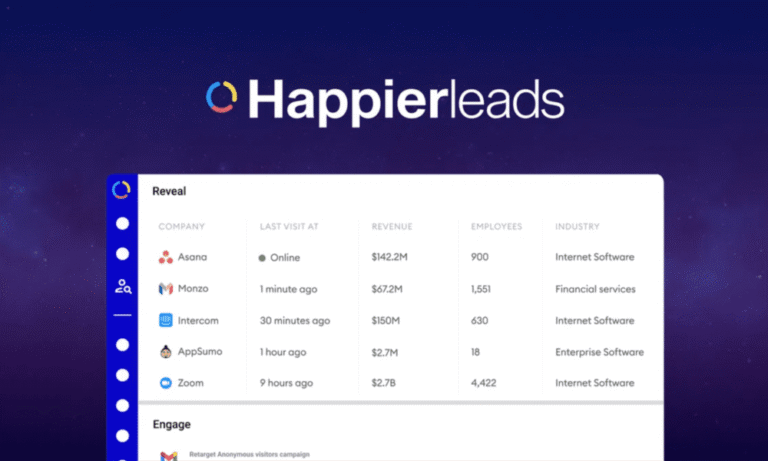
Most website visitors leave without filling out a form. You never know who they are. That is lost money. Happierleads fixes this problem. It tells you exactly who visited your website, name, email, company, and job title. You can then reach out to them directly. No guessing. No wasted ad spend. It works in 173+ countries and connects with your CRM tools. Sales and marketing teams use it to turn silent traffic into real leads.
Key Benefits:
– See exactly who visits your website — not just the company
– Save time on manual research and prospecting
– Automate follow-up emails without extra tools
– Keep CRM data clean and up to date
– Reduce ad spend waste by targeting warm visitors
Who Gets the Most Value:
– B2B SaaS companies
– Sales development reps (SDRs)
– Marketing managers running demand generation
– Small business owners doing their own outreach
– Digital agencies managing client pipelines
Happierleads Pros and Cons:
Pros
- Person-level visitor identification
- All-in-one sales platform
- Built-in AI email writing
- Unlimited team users
- 60-day money-back guarantee
Cons
Happierleads Pricing:
Happierleads offers three distinct monthly pricing tiers designed to identify anonymous website visitors at a personal level . The Business plan currently costs $99 per month and includes visitor qualification, CRM integrations, email campaigns, and AI summaries for a single website . The Reseller tier is $949 monthly,offering growing agencies unlimited websites, full whitelabeling, and full API access . Finally, the Custom plan provides fully tailored pricing, featuring custom integrations, personalized training, and priority customer support.
10 Key Features of Happierleads
01. Visitor Identity Reveal
To be honest, this is the feature most people buy Happierleads for. Most tools only show you the company name. This one shows you the actual person. You get the visitor’s name, email address, job title, and LinkedIn profile. That is person-level identification, not just company-level.
Here’s the thing: most B2B companies spend thousands on ads to bring people to their website. But 96% of those visitors leave without a trace. That is a huge waste.
Happierleads uses a fully-permissioned, proprietary publisher network. This is different from old-school reverse IP lookup. The result is much more accurate data.
The tool works across 173+ countries. For GDPR-restricted EU countries, it uses reverse IP lookup and shows only company data. For the US, UK, Canada, Australia, and many others, you get full person-level details.
Sales reps can now reach out to warm leads. These are people who already visited your site. That changes the conversation completely. No cold outreach from scratch. You already know they are interested.
02. Anonymous Traffic Identification
Guess what up to 98% of your website visitors never identify themselves. They read your pages, check your pricing, and leave. You get nothing.
Anonymous traffic identification solves this. Happierleads tracks every visitor session. It matches that session to a real person or company in its database. You see who came, what they looked at, and how long they stayed.
This data is gold for sales teams. You can see if a decision-maker from a target company visited your pricing page three times this week. That is a buying signal. You can act on it right away.
The platform filters out bots, ISPs, and non-qualifying traffic automatically. So your lead list stays clean. You do not waste time on fake or irrelevant visitors.
Come to think of it, this feature alone can save hours every week. No more manual research. No more guessing who to contact. The tool does the work for you.
This is one area where Happierleads stands apart from basic analytics tools like Google Analytics. GA tells you traffic numbers. This tells you people.
03. Decision-Maker Database
Let’s face it, finding the right contact at a company is slow work. You might know the company visited your site. But who do you email? The intern or the VP of Sales?
Happierleads connects visitor data with a decision-maker database. You get contact details for the people who matter. Job titles, emails, LinkedIn profiles all in one place.
This cuts research time dramatically. Your sales rep does not need to spend an hour on LinkedIn finding the right person. The tool surfaces them automatically.
The database covers multiple industries and company sizes. Startups to large enterprises. The way I see it, this makes prospecting much faster and more targeted.
You can filter contacts by job title, company size, or industry. That means you only reach out to people who match your ideal customer profile. No wasted emails. No wrong contacts.
04. Cold Email Outreach
I often see B2B teams struggling with cold email. They have a list. They have a product. But the emails feel generic and get ignored.
Happierleads has a built-in email outreach tool. You do not need a separate platform. You write your email, set your sequence, and send it directly from the platform.
The outreach tool connects to your mailboxes. You can set follow-up emails on a schedule. If someone does not reply, the tool sends the next email automatically. You stay top of mind without doing it manually.
Speaking of which, the tool also supports mailbox rotation. More on that in a separate section. But the key point here is that outreach is built into the same platform as your visitor data.
That means the whole workflow lives in one place. See a visitor. Identify them. Find their email. Send a message. All without switching tools.
05. Automated Email Campaigns
Okay, let me share with you how automated campaigns work here. You set up a sequence of emails. Each email goes out on a schedule you choose. The system handles everything after that.
You can create multi-step campaigns.
Day 1 — introduction email.
Day 3 — follow-up.
Day 7 — final check-in.
Each step runs on its own. Your sales team focuses on replies, not sending.
The automation also supports triggers. A visitor who hits your pricing page can enter a specific campaign. A visitor who reads your case studies can enter a different one. You match the message to the behavior.
The thing is, personalized, behavior-based emails get much higher open rates. Generic blasts do not work anymore. This system gives you the targeting without the manual work.
You can also pause or stop campaigns for specific leads. If someone replies or books a call, the automation stops for them. Clean and professional.
06. Lead Segmentation
Not every visitor is the same. A CEO from a 500-person company is a different lead than a freelancer. Lead segmentation lets you sort and group your leads based on set rules.
You can segment by job title, company size, industry, country, or pages visited. Each segment can get a different email sequence. Different messages for different audience types.
This matters a lot for conversion rates. The right message to the right person at the right time, that is the goal. Segmentation makes it possible without manual sorting.
I was wondering how small teams could manage this without extra staff. The answer is automation plus segmentation. You set the rules once. The platform handles the rest.
You can also use segments to filter out leads you do not want. Remove ISPs, students, or irrelevant industries. Keep only the leads that match your target profile.
07. CRM Data Enrichment
Your CRM is only as good as the data in it. Old, incomplete, or wrong data means wasted effort. CRM data enrichment keeps your records fresh and complete.
Happierleads pulls visitor data and pushes it into your CRM automatically. Name, email, company, job title, LinkedIn URL , all added without manual entry.
This saves your team from copy-pasting between tools. The data flows in on its own. Your CRM stays updated with real, verified information.
No offense, but most sales teams have messy CRM data. Duplicate contacts, missing emails, outdated job titles. Enrichment fixes this over time.
The platform supports native CRM integrations. More on those later. But the enrichment itself is automatic. You do not need to do anything extra once it is set up.
08. AI Session Summary
Here’s the thing about visitor sessions, they carry a lot of data. Pages visited. Time on site. Scroll depth. Click patterns. Reading all of that manually takes too long.
AI Session Summary solves this. The tool uses AI to read each visitor session and write a short summary. You get a quick overview of what that person did on your site.
Did they check your pricing page twice? The summary tells you. Did they read three blog posts and then visit your contact page? You see that too.
This helps sales reps prioritize. A visitor with high intent gets contacted first. Someone who just hit the homepage once can wait. You focus energy where it counts.
I couldn’t help but notice how much time this saves during daily prospecting. Instead of reviewing raw session data, you read a two-sentence summary and move on.
09. AI Email Personalization
Generic emails get ignored. Personalized emails get replies. The challenge is writing personalized emails at scale. That used to require a big team or a lot of time.
AI Email Personalization changes this. The tool uses AI to write unique, personalized email lines for each lead. Based on their job title, company, and session behavior.
You also get AI Spintax support. This means the AI creates variations of your email text. Each version sounds different, but says the same thing. This helps with email deliverability and avoids spam filters.
The way I see it, this feature is what separates modern outreach from old-school mass email blasts. Every recipient gets a message that feels written just for them.
You can review and edit the AI suggestions before sending. You stay in control. The AI just speeds up the writing process.
10. Native CRM Integrations
Your team already uses tools. Switching platforms is painful. Native CRM integrations mean Happierleads connects directly to the tools you already use.
The platform integrates with Slack, email, and popular CRM tools. Leads flow directly into your existing workflow. No complex setup. No third-party connectors needed in most cases.
You can push new leads to your CRM the moment they are identified. Set rules for which leads get pushed. Filter by score, segment, or behavior. Only the right leads reach your sales team.
Slack integration means your team gets notified in real time. A target company visits your site — your sales rep gets a Slack message instantly. They can act while the lead is still warm.
That being said, some users have noted that CRM integration flexibility could be broader. More integrations would make the tool even more useful for enterprise teams.
Let’s put it this way , most B2B teams spend a lot of money driving traffic. But they have no idea who that traffic is. That is the core problem Happierleads solves.
You get person-level visitor identification. You get built-in email outreach. You get AI personalization. You get CRM enrichment. All in one platform.
No offense, but if you are running B2B sales and still relying only on inbound form fills, you are leaving money on the table. Most buyers research before they ever contact you. Happierleads catches them during that research phase.
The one limitation worth noting is EU data. If most of your target market is in Europe, you will get company-level data only. That is a GDPR requirement, not a product flaw. But it is worth knowing before you buy.