The proposal includes a startup exemption, a fundraising exemption and an investment contract safe harbor for issuers.
US Securities and Exchange Commission Chair Paul Atkins has revealed that a key crypto market safe harbor proposal has landed at the White House for review.
Speaking at the Digital Assets and Emerging Technology Policy Summit on Monday, Atkins said the Regulation Crypto Assets proposal — outlined by the SEC in mid-March — has now been submitted to the Office of Information and Regulatory Affairs.
“We will have reg crypto that we will be proposing here shortly. It’s in fact at OIRA right now, which is the next step before being published,” he said.
Regulation Crypto Assets covers three main ideas: a startup exemption, a fundraising exemption and an investment contract safe harbor for issuers.
If the proposal does end up becoming official rules as part of the SEC’s oversight, it could drive more crypto innovation in the US while providing further regulatory clarity for the industry.
Atkins emphasized that the SEC wants to “hear from the marketplace” to make the whole package “workable.” He did not go into many specifics but said there were a few things the SEC is “building into it” alongside measures such as crypto safe harbors and exemptive relief.
Source: Paul Atkins
SEC proposal is taking shape
Generally, the SEC first votes to approve a formal proposal, which is then sent to OIRA for review. OIRA then completes the review and it is published in the Federal Register and put up for public feedback.
Cointelegraph reached out to the SEC for comment on the matter.
Related: CFTC chief launches innovation task force focused on crypto framework
The startup exemption would enable projects to raise up to a defined amount over a four-year period with softer disclosure requirements, while the fundraising exemption would enable issuers to raise a defined amount over 12 months while “retaining the ability to rely on other exemptions from registration under the federal securities laws.”
The investment contract safe harbor would protect certain assets from the definition of a security once the project team has ceased all of its managerial efforts “represented or promised” as part of the investment contract.
Magazine: Your guide to surviving this mini-crypto winter
Cointelegraph is committed to independent, transparent journalism. This news article is produced in accordance with Cointelegraph’s Editorial Policy and aims to provide accurate and timely information. Readers are encouraged to verify information independently. Read our Editorial Policy https://cointelegraph.com/editorial-policy
Trusted Editorial content, reviewed by leading industry experts and seasoned editors. Ad Disclosure
Bitcoin treasury firm Strategy has resumed its buying spree after a two-week gap with a new $329.9 million acquisition of the cryptocurrency.
Strategy Has Added 4,871 Tokens To Its Bitcoin Treasury
In a new post on X, Strategy co-founder and chairman Michael Saylor has shared details related to the company’s latest Bitcoin acquisition. In total, the firm has added 4,871 BTC for $329.9 million or $67,718 per token with this purchase.
Strategy has had a consistent routine of announcing acquisitions on Monday, but the firm had a rare skip last week. Saylor’s post from Sunday foreshadowed the return to buying ways this week, as the chairman shared the company’s BTC portfolio tracker with the caption: “₿ack to Work.”
According to the filing with US Securities and Exchange Commission (SEC), Strategy bought its latest tokens between April 1st and 5th. The firm funded the purchase using sales of its STRC and MSTR at-the-market (ATM) stock offerings.
In the past, Strategy has often shown a tendency to buy local price tops, with its tokens already dipping into losses by the time it reveals the purchase. This time around, however, the latest Bitcoin spot price is still trading above the buy’s cost basis, meaning that the tokens are in the green.
Though, the firm’s holdings as a whole have continued to be underwater recently. Following the new purchase, Strategy’s cost basis is sitting at $75,644, putting its Bitcoin reserves in a loss of about 8.1% at the current spot price. The company first fell underwater with the price crash at the start of February and with the market staying down since then amid uncertainty like the Iran war, BTC hasn’t been able to reclaim its break-even level.
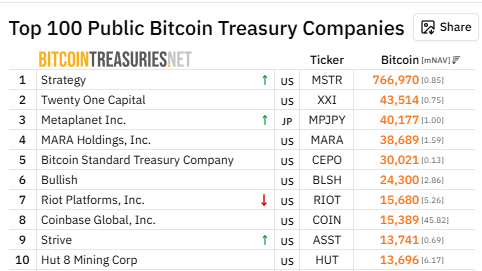
A milestone that Strategy has cleared with the latest acquisition is that its total investment into the asset has broken past the $58 billion mark. With a total of 766,970 tokens in its wallets, Saylor’s firm occupies a network supply share of 3.83%, by far the highest among corporate treasury holders of Bitcoin.
The top 10 corporate holders of BTC today | Source: BitcoinTreasuries.net
Just like how Strategy regularly announces purchases on Monday, Ethereum’s largest treasury company, Bitmine, has made a habit of doing the same. This Monday has been no different, with Bitmine’s regular press release going up with information related to the firm’s latest ETH accumulation.
Over the past week, Bitmine added 71,252 ETH to its wallets, the largest weekly buying spree since December 2025. Thomas “Tom” Lee, the company’s chariman, said:
Bitmine has maintained the increased pace of ETH buys in each of the past four weeks, as our base case ETH is in the final stages of the ‘mini-crypto winter.’
The Ethereum treasury firm now holds a total of 4,803,334 ETH, equivalent to 3.98% of the cryptocurrency’s total supply in circulation.
BTC Price
At the time of writing, Bitcoin is trading around $69,200, up 3.5% over the last 24 hours.
Looks like the price of the coin has surged over the past day | Source: BTCUSDT on TradingView
Featured image from Dall-E, chart from TradingView.com
Editorial Process for bitcoinist is centered on delivering thoroughly researched, accurate, and unbiased content. We uphold strict sourcing standards, and each page undergoes diligent review by our team of top technology experts and seasoned editors. This process ensures the integrity, relevance, and value of our content for our readers.
Investors poured $471 million into US spot Bitcoin ETFs on April 6, the largest single-day gain since late February, according to Farside Investors.
BlackRock’s IBIT and Fidelity’s FBTC topped the inflows, followed by ARK Invest and 21Shares’ ARKB. Other competing funds posted smaller gains.
IBIT pulled in roughly $182 million, and FBTC added approximately $147 million. Together, the two products made up about $329 million of the day’s total inflows, a ratio consistent with their dominance of the spot Bitcoin ETF category since these funds launched in January 2024.
The inflows came during a period of sharp price swings. Bitcoin declined as much as 45% from its October 2025 peak. At press time, the digital asset was trading at $68,714, per CoinGecko.
US spot Bitcoin ETFs now hold approximately $90 billion in total assets, led by IBIT with $54.5 billion, or nearly 60% of the market. Cumulative net inflows have reached an estimated $56 billion.
The first quarter of 2026 was uneven. January and February saw roughly $1.8 billion in net outflows as concerns about Federal Reserve policy and sticky inflation prints weighed on risk sentiment. March brought a partial turnaround, with $1.3 billion flowing back into Bitcoin ETFs as prices stabilized.
Despite renewed interest in Bitcoin ETFs, experts caution that the trend could shift rapidly if inflation surprises to the upside. Market attention is focused on Friday’s March CPI release, along with February’s core PCE report released Thursday, April 9.
Disclosure: This article was edited by Vivian Nguyen. For more information on how we create and review content, see our Editorial Policy.
Polymarket USD replaces bridged USDC as part of an exchange-wide upgrade.
Polymarket on Monday unveiled Polymarket USD, a proprietary collateral token backed 1:1 by USDC that will replace bridged USDC.e as the settlement asset across the on-chain prediction market.
The new token is the centerpiece of what Polymarket called its most significant infrastructure change to date — a full exchange upgrade spanning new smart contracts, a rebuilt central limit order book, and updated developer SDKs, all rolling out over the next two to three weeks.
For most users, the frontend will handle wrapping automatically with a one-time approval prompt, Polymarket said. Power users and API traders will need to wrap their USDC or USDC.e into the new token via a Collateral Onramp contract.
Exchange Upgrade
Alongside the collateral migration, Polymarket is deploying CTF Exchange V2, an upgraded version of its core smart contract. The new contracts optimize trade matching, add support for EIP-1271 signatures, introduce builder codes for on-chain order attribution, and streamline fee collection and distribution, according to a developer breakdown shared alongside the announcement.
All existing order books will be cleared during a short maintenance window, with the exact date and time to be announced at least one week in advance.
Scaling for Growth
The overhaul arrives as Polymarket processes record volumes. The platform crossed $10 billion in monthly volume in March, its highest ever, according to Artemis. Weekly notional volume has consistently exceeded $1 billion through the first quarter.
Polymarket Monthly Volume
The infrastructure push follows a series of milestones, including NYSE parent ICE’s $600 million follow-on investment and the launch of traditional asset markets via Pyth Network.
This article was written with the assistance of AI workflows. All our stories are curated, edited and fact-checked by a human.
The Dubai Virtual Assets Regulatory Authority (VARA) has officially introduced a purpose-built regulatory framework governing the trading of Exchange Traded Derivatives (ETD) in virtual assets.
The new framework, set out in Version 2.1 of VARA’s Exchange Services Rulebook, makes Dubai one of the world’s first jurisdictions to bring virtual asset derivatives under a comprehensive, enforceable rulebook. Effective immediately, the rules apply to all Virtual Asset Service Providers (VASPs) licensed by VARA to carry out exchange services within the Emirate.
Governing complex financial products
The move arrives as global demand for derivatives exposure in virtual asset markets continues to surge. Concurrently, regulators worldwide are grappling with how to effectively govern these increasingly complex financial products within the digital asset space.
VARA’s updated framework enables licensed VASPs to offer derivative products within a clearly defined regulatory perimeter. However, this permission is subject to explicit authorisation and strict compliance with rigorous operational, prudential, and conduct requirements.
Five pillars of the new framework
To protect market participants and ensure the integrity of the broader market, the new VARA framework establishes binding requirements across five critical areas:
Client suitability and classification: Implementing strict requirements, particularly for higher-risk products.
Margin, leverage, and liquidation controls: Establishing mechanisms to proactively manage market exposure.
Asset segregation: Mandating the segregation of client assets and accounts to mitigate systemic and counterparty risks.
Enhanced disclosures: Enforcing communication obligations that strictly align with VARA’s existing Marketing Regulations.
Regulatory intervention powers: Granting VARA the authority to act decisively in response to severe market stress or identified misconduct.
A maturing regulatory landscape
Ruben Bombardi, general counsel at VARA
As the market continues to mature, VARA has rapidly evolved from a start-up regulator into a full-scale supervisory authority overseeing one of the world’s most active virtual asset markets.
Ruben Bombardi, general counsel at VARA, emphasized the necessity of the new rules.
“Derivatives are a natural next step in the evolution of virtual asset markets, but they demand a higher standard of governance,” Bombardi explained. “VARA’s framework gives licensed providers a clear path to offering these products responsibly, while giving market participants confidence that Dubai’s virtual asset ecosystem operates under rules that are rigorous, enforceable, and designed to protect them.”
He concluded: “This is the best way to build a market that will stand the test of time.”
VARA noted that the Rulebook is part of its ongoing commitment to ensure that innovation within the ecosystem is consistently underpinned by robust governance and transparent market practices.
Michael Saylor’s Strategy, the world’s largest publicly listed holder of Bitcoin, resumed buying BTC last week after reporting no purchases in the final week of March.
Strategy acquired 4,871 Bitcoin (BTC) for $329.9 million last week, according to an 8-K filing with the US Securities and Exchange Commission on Monday.
The purchases were made at an average price of $67,718 per coin, below the company’s overall average acquisition price of $75,644. The new acquisitions bring Strategy’s holdings to 766,970 BTC, acquired for a total cost of around $58 billion.
Source: SEC
In addition to the purchase update, Strategy also reported its first-quarter financial results, including a $14.46 billion unrealized loss on digital assets and a $2.42 billion deferred tax benefit.
Deferred tax asset offset by valuation allowance as bitcoin trades below cost basis
Strategy said its Bitcoin holdings continue to trade below their cost basis, resulting in the recognition of a deferred tax asset tied to unrealized losses on its digital assets.
As of March 31, the company recorded a $1.73 billion deferred tax asset related to those unrealized losses, which was offset by a corresponding $1.73 billion valuation allowance against the amount.
Source: SEC
“Because the fair value of Strategy’s Bitcoin holdings is below its cost basis, Strategy expects to establish an additional valuation allowance of $0.5 billion against these deferred tax assets,” the company said.
Strategy saw Bitcoin fall below its average purchase price in early February, marking the first time since late 2023 that BTC traded below its cost basis.
Related: 80% of Strategy’s ‘Stretch’ buyers are mom-and-pop investors
Despite the decline, the company has continued accumulating Bitcoin, buying roughly 54,000 BTC since Feb. 2. Strategy was especially aggressive in March, making some of its largest weekly purchases on record during the month, with monthly acquisitions netting 41,362 BTC.
Strategy’s total Bitcoin purchases in the first quarter of 2026 reached 89,316 BTC, with an aggregate spend of approximately $6.3 billion.
$21 billion offering of STRC and a new $21 billion MSTR offering
Strategy mentioned that the company is updating its at-the-market (ATM) program, including a new $21 billion offering of Stretch (STRC) stock and a new $21 billion offering of Common A (MSTR) stock. The company also terminated its prior Strike (STRK) stock offering and launched a new $2.1 billion STRK stock offering.
The amounts available for STRC and MSTR stock reflect the total remaining capacity under both the existing programs and the newly added offerings. Sales under the STRC and MSTR increases may begin once the existing capacity is substantially used, the company said.
Source: SEC
During March 30–31, Strategy sold approximately 2.28 million shares of STRC and 582,550 shares of MSTR, generating about $299.3 million in net proceeds. From April 1–5, the company sold an additional 1 million shares of STRC and 593,294 shares of MSTR, raising roughly $174.6 million.
Magazine: Your guide to surviving this mini-crypto winter
Cointelegraph is committed to independent, transparent journalism. This news article is produced in accordance with Cointelegraph’s Editorial Policy and aims to provide accurate and timely information. Readers are encouraged to verify information independently. Read our Editorial Policy https://cointelegraph.com/editorial-policy
Japan’s Payment Services Act, revised in June 2023 and updated through 2026, created the world’s strictest stablecoin issuer rules.
Project Pax, backed by MUFG, SMBC, and Mizuho, targets 1 trillion yen in B2B stablecoin issuance by 2028.
JPYC became the world’s first fully regulated yen-pegged stablecoin under a Type II license in October 2025.
The Most Important Crypto Standards Nobody Is Talking About
While U.S. regulators spend years sorting out jurisdictional authority and European regulators iron out MiCA compliance, Japan moved. The country revised its Payment Services Act (PSA) in June 2023, classifying fiat-pegged stablecoins as Electronic Payment Instruments, and spent the next three years building an institutional-grade ecosystem around that decision. As of April 2026, stablecoins in Japan are not a retail product. They are national financial infrastructure.
The three-tiered issuer model the PSA created is what separates Japan’s approach from everyone else’s. Commercial banks, trust companies, and licensed fund transfer providers can each issue stablecoins, but each category carries strict reserve requirements. Trust issuers hold ring-fenced assets in bankruptcy-remote structures. Fund transfer providers hold 100% liquid reserves. Commercial banks issue deposit-backed tokens covered by deposit insurance.
A 2025 amendment allowed trust issuers to place up to 50% of backing assets in short-term instruments like Japanese Government Bonds, improving capital efficiency without loosening consumer protections. October 2025 marked a practical milestone: JPYC Inc. became the world’s first issuer of a fully regulated yen-pegged stablecoin after graduating from a prepaid payment instrument to a licensed Electronic Payment Instrument under a Type II funds transfer license.
The company has set a target of 10 trillion yen in circulation over three years. SBI Holdings and Startale Group followed with JPYSC, a trust bank-backed yen stablecoin managed by SBI Shinsei Trust Bank, announced in late 2025 and targeting a Q2 2026 launch. Institutional players get bankruptcy-remote asset protection. The corporate treasury teams responsible for those decisions get to sleep at night.
The B2B settlement story is where the numbers start to matter. Traditional international wire transfers carry 2 to 7% all-in costs, including fees and foreign exchange spreads, and take three to five business days to clear. Stablecoin settlement compresses that to under 0.5% in costs and settles in under three minutes, 24 hours a day.
Project Pax, the joint initiative between Mitsubishi UFJ (MUFG), Sumitomo Mitsui (SMBC), Mizuho, and blockchain middleware firm Datachain, is targeting 1 trillion yen (roughly $6.5 billion) in stablecoin issuance by 2028. The platform connects more than 300,000 corporate clients across the combined megabank customer base. Mitsubishi Corporation is already using Progmat-issued stablecoins for settlements between its domestic headquarters and overseas subsidiaries.
The architecture behind Project Pax is deliberate. Corporate clients do not touch a crypto wallet. They initiate payments through existing banking dashboards via SWIFT’s API framework. On the backend, the megabanks intercept that call and settle the value instantly using stablecoinsmart contracts routed across Ethereum, Polygon, Avalanche, and Cosmos.
The SWIFT system remains in place as the client-facing interface. The stablecoin does the actual moving of value. Banks eliminate the cost of maintaining nostro and vostro accounts. The client’s accounting software never changes.
Overcoming Trade Bottlenecks in Emerging Markets
For companies trading with emerging markets, the PSA framework also created a practical workaround for a persistent problem. STANDAGE Inc. partnered with Progmat to build a B2B trade settlement wallet designed for Japanese firms dealing with regions where letters of credit face geopolitical or banking constraints. Atomic, real-time settlement replaces the legacy trade finance bottleneck.
The foreign stablecoin story adds another layer. USDC was the first foreign stablecoin approved for Japanese exchanges, after Circle established a regulated joint venture with SBI Holdings, Circle SBI Japan KK, operating through SBI VC Trade. Japanese companies can now execute cross-border vendor payments in digital dollars without maintaining multiple foreign fiat accounts. The U.S. dollar remains the language of global trade. Circle and SBI Holdings gave Japanese enterprises a compliant pipeline into it.
Remittances follow the same pattern. Japan‘s growing foreign workforce, particularly from Southeast Asia, creates consistent outbound money flows. Traditional retail remittance operators charge spread fees that can consume 5 to 10% of a paycheck. Licensed intermediary wallets built under the relaxed 2025 Amendment Act licensing allow workers to use yen stablecoins, convert to dollar-pegged stablecoins on liquid decentralized exchanges, and route payments home for local fiat conversion at a fraction of a cent.
SBI Holdings‘ decade-long relationship with Ripple through SBI Ripple Asia has extended this infrastructure across corridors to South Korea, India, and the Philippines. The Korea-Japan corridor test in late 2025 is worth noting. K Bank, Shinhan Bank, and Nonghyup Bank completed verification for Project Pax’s cross-border remittance capabilities. Korean blockchain entities signed agreements with JPYC Corporation.
The pilot tested B2B and B2C remittances using JPYC across that corridor, and the goal is explicit: regional Asian economies routing trade and remittances without the U.S. dollar as an intermediary. SBI Holdings President Yoshitaka Kitao framed it plainly in December 2025. He described the move to a token economy as “an irreversible societal trend.”
The infrastructure Japan has built between 2023 and 2026 makes that statement less like corporate optimism and more like an accurate read of what has already happened.
On-chain researcher Andrey Sergeenkov found that only 2% of the 2.5 million wallets analyzed have ever made over $1,000.
84.1% of all Polymarket traders are in the red, according to new research published today, April 6, by independent on-chain analyst Andrey Sergeenkov.
The report looked at 2.5 million wallet addresses, analyzing data from on-chain transactions on Polygon, via Dune Analytics. Sergeenkov found that over the past year, only 2% of traders have ever made more than $1,000 in their entire history on the platform, and just 0.033%— or 840 addresses — have earned $100,000 trading on Polymarket.
Sergeenkov also took on the claim that traders can earn a living on Polymarket, analyzing the odds of consistently earning $5,000 per month — just below the average monthly salary in the U.S. — and found that those odds are less than 1% in any single month.
Sustaining profits is even rarer. “Most traders show up, trade for a short period, and leave,” the report summarizes. The odds of earning $5,000 a month drop with each consecutive month, the research found. Among the 6,600 traders who earned an average profit above $5,000 per month, just 2.6% stayed active for more than a year.
A separate study from December 2025 analyzing 124 million trades on Polymarket found that 70% were unprofitable.
The findings land as Polymarket continues its mainstream commercial momentum, earlier this month becoming MLB’s exclusive prediction market partner, as The Defiant reported.
Polymarket is currently the largest on-chain prediction market platform, and the second-largest more broadly, with $9.8 billion in notional trading volume over the past 30 days, following Kalshi with $12.5 billion, per Token Terminal.
Meanwhile, a new referral program as of this month is set to drive another wave of retail signups via influencers — a dynamic Sergeenkov warns could deepen the loss problem without better user education.
Prediction market volumes grew 130x from 2024 through 2025, and the sector has received increasing regulatory attention, especially in the United States. In recent months, the Trump administration’s CFTC has taken a clear stance in favor of federal oversight of prediction market platforms via the agency, recently launching a sweeping review of the sector.
Adding another layer to Polymarket’s ambitions, the platform has also just today unveiled Polymarket USD, a new proprietary stablecoin set to replace bridged USDC.e as the platform’s collateral token, as part of what the platform is calling a significant infrastructure upgrade.
As The Defiant has reported, Polymarket’s crowd-sourced odds are increasingly cited as among the most accurate forecasting tools available, a reputation that sits uneasily alongside these numbers for individual traders.
This article was written with the assistance of AI workflows. All our stories are curated, edited and fact-checked by a human.
Bitcoin rose above the $70,000 level on Monday, but analysts remain skeptical, expecting a drop below the $60,000 support.
Several major altcoins have bounced off their supports, indicating demand at lower levels.
Buyers pushed Bitcoin (BTC) above the $70,000 level, but failed to sustain the breakout. That suggests the bears have not given up and are trying to retain control. Select analysts believe that BTC is likely to dip below its $60,000 low before bottoming out.
Another negative view came from Glassnode, which said in its recent report that its Long-Term Holder Realized Loss metric, which tracks losses locked in by investors who held coins for more than six months before selling, suggests the selling pressure may not have exhausted. The 30-day simple moving average of the indicator at $200 million per day needs to drop to levels below $25 million for the base formation to begin.
Crypto market data daily view. Source: TradingView
Among all the bearishness, there is a silver lining for the bulls. According to crypto sentiment platform Santiment, social media platforms recorded five bearish BTC comments for every four BTC bullish comments, the most since Feb. 28.
That is a good sign as markets typically move in the opposite direction of the crowd’s expectation, suggesting “things can turn positive sooner rather than later,” Santiment added.
Could buyers extend the recovery in BTC and the major altcoins? Let’s analyze the charts.
S&P 500 Index price prediction
The S&P 500 Index (SPX) has pulled back to the 20-day exponential moving average (6,601), indicating solid buying at lower levels.
Sellers will attempt to halt the recovery at the 20-day EMA, but if the bulls prevail, the index may rise to the 50-day simple moving average (6,777). Sellers are expected to pose a strong challenge at the 50-day SMA.
On the downside, the bears will have to yank the price below the 6,316 level to signal the resumption of the corrective phase. The next support to watch out for on the downside is the 6,147 level.
US Dollar Index price prediction
The US Dollar Index (DXY) is stuck between the 20-day EMA ($99.59) and the 100.54 overhead resistance.
Sellers are attempting to pull the price below the 20-day EMA. If they can pull it off, the index may decline to the 50-day SMA (98.44). That suggests the index may trade inside the large range between 95.55 and 100.54 for a while longer.
Buyers will have to maintain the price above the 20-day EMA to retain control. If they do that, the possibility of a break above the 100.54 level increases. The index may then start a new up move to the 102 level and subsequently to the 103.54 level.
Bitcoin price prediction
BTC closed above the moving averages on Sunday, indicating that the bulls are attempting a comeback.
The flattish moving averages and the relative strength index (RSI) near the midpoint do not give a clear advantage either to the bulls or the bears. If the price sustains above the moving averages, the bulls will attempt to drive the BTC/USDT pair above the $72,000 resistance. If they succeed, the BTC price may reach the $74,508 to $76,000 resistance zone.
Sellers are likely to have other plans. They will strive to pull the pair below the support line, invalidating the bullish setup. That opens the doors for a decline to the $62,500 to $60,000 support zone.
Ether price prediction
Ether (ETH) closed above the moving averages on Sunday, clearing the path for a rally to the $2,200 resistance.
Sellers will attempt to halt the recovery at the $2,200 level, but if the buyers pierce the resistance, the ETH/USDT pair may march to the $2,400 resistance. The bulls will have to propel the ETH price above the $2,400 level to start a sustained recovery to $2,800 and then to $3,050.
Alternatively, if the ETH price turns down sharply from the $2,200 level and breaks below the moving averages, it suggests that the pair may consolidate for some time. The support of the range is at the $1,916 level.
BNB price prediction
BNB’s (BNB) bounce off the $570 level has reached the moving averages, where the bears are expected to step in.
If the price turns down sharply from the moving averages, the BNB/USDT pair risks breaking below the $570 level. If that happens, the BNB price may resume the downtrend and plummet to the $500 level.
Instead, if buyers drive the price above the moving averages, it suggests that the pair may extend its stay inside the $570 to $687 range for a few more days. Buyers will be back in the driver’s seat on a close above the $687 level.
XRP price prediction
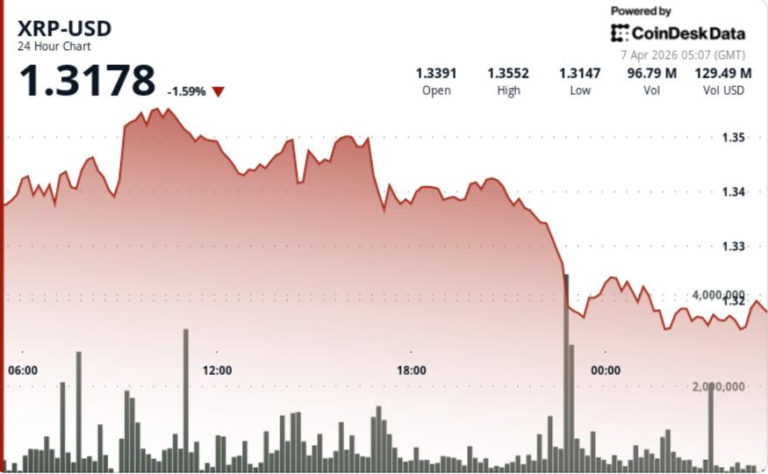
XRP (XRP) turned up from the crucial $1.27 support on Sunday, indicating that the bulls are aggressively defending the level.
The bulls will have to secure a close above the 50-day SMA ($1.39) to improve the prospects of a rally to the $1.61 level and later to the downtrend line of the descending channel pattern.
On the contrary, if the XRP price turns down sharply from the moving averages and breaks below $1.27, it suggests that the bears remain in control. The XRP/USDT pair may plunge to the $1.11 level and eventually to the support line near the $1 level.
Solana price prediction
Solana (SOL) has been oscillating inside the $76 to $98 range for several days, indicating a tough battle between the bulls and the bears.
If buyers push the price above the moving averages, the SOL/USDT pair may ascend to the $98 resistance. Sellers are expected to fiercely defend the $98 level in an attempt to keep the SOL price inside the range.
The next trending move is expected to begin on a close above $98 or below $76. If buyers thrust the price above the $98 resistance, the pair may surge to the $117 level. Conversely, a close below the $76 support might sink the pair to the $67 level.
Related: First real bull signal since 2025? Five things to know in Bitcoin this week
Dogecoin price prediction
Dogecoin (DOGE) remains stuck inside a tight range between the 50-day SMA ($0.09) and the $0.09 level, signaling a balance between supply and demand.
Buyers will gain the upper hand on a close above the moving averages. The DOGE/USDT pair may rally to the $0.11 level and subsequently to the $0.12 resistance. If the price turns down from the overhead resistance, the pair may swing between $0.12 and $0.09 for a while.
If the DOGE price turns down from the moving averages and breaks below the $0.09 level, it signals that the bears have seized control. The pair may slump to the $0.08 level and thereafter to the $0.06 level.
Hyperliquid price prediction
Buyers are attempting to maintain the Hyperliquid (HYPE) price above the 20-day EMA ($37.03) but are facing strong resistance from the bears.
If the HYPE price closes above the 20-day EMA, it suggests that the lower levels continue to attract buyers. The HYPE/USDT pair may then rally to $41.59 and, after that, to the $44 level.
This positive view will be negated in the near term if the price turns down and breaks below the 50-day SMA ($34.48). The pair may then witness a deeper correction to the $30 level.
Cardano price prediction
Cardano (ADA) closed above the $0.25 level on Sunday, signaling that the bears are losing their grip.
There is resistance at the 50-day SMA ($0.26), but if the bulls overcome it, the ADA/USDT pair may reach the downtrend line of the descending channel pattern. Sellers are expected to defend the downtrend line, as a close above it signals a potential short-term trend change.
The $0.22 level is the crucial level to watch out for on the downside. If the support breaks down, the ADA price may start the next leg of the downtrend to the support line near the $0.16 level.
This article does not contain investment advice or recommendations. Every investment and trading move involves risk, and readers should conduct their own research when making a decision. While we strive to provide accurate and timely information, Cointelegraph does not guarantee the accuracy, completeness, or reliability of any information in this article. This article may contain forward-looking statements that are subject to risks and uncertainties. Cointelegraph will not be liable for any loss or damage arising from your reliance on this information.