Home Blog Page 568

Bitcoin (BTC) price touches $70,000 as ETF inflows signal institutional interest: Crypto Daybook Americas

0

By Francisco Rodrigues (All times ET unless indicated otherwise)

Bitcoin and the wider crypto market showed mixed signals on Tuesday, with the largest cryptocurrency briefly touching $70,000 on reports a ceasefire in Iran was proposed.

The hesitation comes a day after bitcoin exchange-traded funds (ETFs) recorded their largest inflows since late February, even as the market pays close attention to the harsh macro backdrop. Bitcoin ETF investors’ demand suggests they see the current price action as an accumulation opportunity.

Binance Research found earlier this month that bitcoin’s correlation with its Global Easing Breadth Index, which tracks 41 central banks, turned strongly negative after the launch of spot bitcoin ETFs. ETF-driven institutional flows tend to be more forward-looking, positioning themselves for expected policy moves. That is, institutional capital may be accumulating ahead of expected easing of monetary policy.

Bitfinex Alpha described the market as range-bound but fragile, with weak organic demand, slower corporate treasury buying and options positioning that turns more unstable below $68,000 as downside protection grows.

Macro pressure remains relevant too. Brent crude remains above $110 a barrel as the looming deadline U.S. President Donald Trump imposed on Iran for a deal to open the Strait of Hormuz keeps investors on edge.

The market currently sees little room for the Federal Reserve to lower rates in the near future given the expected inflation rise caused by higher energy costs. U.S. inflation data coming in later this week will be critical. Stay alert!

Read more: For analysis of today’s activity in altcoins and derivatives, see Crypto Markets Today

What to Watch

For a more comprehensive list of events this week, see CoinDesk’s “Crypto Week Ahead”.

  • Crypto
  • Macro
    • April 7, 07:15 a.m.: U.S. ADP Employment Change Weekly (est. 10K)
    • April 7, 7:30 a.m.: U.S. Durable Goods Orders MoM for February est 04% (Prev. 0%)
    • April 7, 11:35 a.m.: Chicago Fed President and CEO Austan Goolsbee to participate in a conversation on economic and monetary policy.
  • Earnings (Estimates based on FactSet data)

Token Events

For a more comprehensive list of events this week, see CoinDesk’s “Crypto Week Ahead”.

  • Governance votes & calls
    • April 7: Kamino and xStocks to host an X Spaces session on tokenization.
    • Balancer DAO is voting across two linked proposals to restructure operations with a reduced team and budget, and to revamp tokenomics by halting BAL emissions, discontinuing veBAL, routing all fees to the treasury, and offering a token buyback. Voting ends April 7.
    • CoW DAO is voting to fix its solver rewards budget at 50% of protocol revenue, splitting it between performance and new consistency rewards. The proposal has overwhelming support and ends April 7.
  • Unlocks
  • Token Launches

Conferences

For a more comprehensive list of events this week, see CoinDesk’s “Crypto Week Ahead”.

Market Movements

  • BTC is down 0.98% from 4 p.m. ET Monday at $69,149.83 (24hrs: -1.05%)
  • ETH is down 0.98% at $2,128.41(24hrs: -1.31%)
  • CoinDesk 20 is down 1.13% at 1,946.75 (24hrs: -1.59%)
  • Ether CESR Composite Staking Rate is up 4 bps at 2.74%
  • BTC funding rate is at 0.0049% (5.3327% annualized) on Binance
  • DXY is down 0.15% at 99.83
  • Gold futures are unchanged at $4,688.40
  • Silver futures are down 0.3% at $72.63
  • Nikkei 225 closed unchanged at 53,429.56
  • Hang Seng closed down 0.70% at 25,116.53
  • FTSE is up 0.33% at 10,470.51
  • Euro Stoxx 50 is up 0.98% at 5,748.35
  • DJIA closed on Monday up 0.36% at 46,669.88
  • S&P 500 closed up 0.44% at 6,611.83
  • Nasdaq Composite closed up 0.54% at 21,996.34
  • S&P/TSX Composite closed up 0.22% at 33,181.97
  • S&P 40 Latin America closed up 0.12% at 3,656.10
  • U.S. 10-Year Treasury rate is down 1 bps at 4.325%
  • E-mini S&P 500 futures are unchanged at 6,657.25
  • E-mini Nasdaq-100 futures are unchanged at 24,373.50
  • E-mini Dow Jones Industrial Average Index futures are up 0.16% at 46,976.00

Bitcoin Stats

  • BTC Dominance: 59.04% (-0.08%)
  • Ether-bitcoin ratio: 0.03077 (0.54%)
  • Hashrate (seven-day moving average): 951 EH/s
  • Hashprice (spot): $31.40
  • Total fees: 2.18 BTC / $151,084
  • CME Futures Open Interest: 117,120 BTC
  • BTC priced in gold: 14.8 oz.
  • BTC vs gold market cap: 4.6%

Technical Analysis

Ta for April 7
  • The chart shows bitcoin’s dollar price in weekly candle for the past several years.
  • The measure is still trading around the 200-week exponential moving average of $68,317 while the RSI continues to grind up after bottoming out at 27 a few weeks ago.
  • With no clear bearish RSI divergences, the next core level to monitor is $73,000 for any confirmed upward momentum

Crypto Equities

  • Coinbase Global (COIN): closed on Monday at $174.79 (+1.94%), -0.56% at $173.82 in pre-market
  • Circle Internet (CRCL): closed at $92.15 (+2.09%), +0.18% at $92.32
  • Galaxy Digital (GLXY): closed at $18.28 (+3.63%), +0.11% at $18.30
  • Bullish (BLSH): closed at $37.35 (+2.69%), unchanged in pre-market
  • MARA Holdings (MARA): closed at $8.85 (+1.61%), -0.55% at $8.80
  • Riot Platforms (RIOT): closed at $13.52 (+5.13%), -0.52% at $13.45
  • Core Scientific (CORZ): closed at $16.29 (+0.37%), -0.18% at $16.26
  • CleanSpark (CLSK): closed at $9.10 (+3.53%), -0.33% at $9.07
  • CoinShares Valkyrie Bitcoin Miners ETF (WGMI): closed at $36.70 (+2.63%)
  • Exodus Movement (EXOD): closed at $6.33 (+3.77%), +0.63% at $6.37

Crypto Treasury Companies

  • Strategy (MSTR): closed at $127.69 (+6.56%), -0.71% at $126.79
  • Strive (ASST): closed at $10.12 (+3.79%), +0.30% at $10.15
  • SharpLink Gaming (SBET): closed at $6.38 (+3.07%), +0.12% at $6.39
  • Upexi (UPXI): closed at $1.01 (+3.59%), -0.99% at $1.00
  • Lite Strategy (LITS): closed at $1.14 (+1.79%)

ETF Flows

Spot BTC ETFs

  • Daily net flows: $471.4 million
  • Cumulative net flows: $56.41 billion
  • Total BTC holdings ~1.29 million

Spot ETH ETFs

  • Daily net flows: $120.2 million
  • Cumulative net flows: $11.63 billion
  • Total ETH holdings ~5.68 million

Source: Farside Investors

While You Were Sleeping

Two Heavyweights Join the Genasys Board

0

Genasys are pleased to announce that Hugh Hessing and Gavin Routledge have joined Genasys as Non-Executive Directors.

Between them, they bring over 60 years of experience across insurance operations, technology transformation, corporate finance and strategic investment. Both appointments come as they establish ourselves as a genuine mid-market alternative to the enterprise policy administration incumbents.

Hugh Hessing spent 14 years at Aviva in a series of senior executive roles, rising to UK Chief Operating Officer with responsibility for data, operations, IT, CISO and first-line governance. Before Aviva, he spent a decade at KPMG delivering transformation projects for Swiss Re, Barclays Insurance and Norwich Union Life. His most recent corporate role was Group Chief Operating Officer at Direct Line Group. He now advises start-ups and scale-ups delivering new technology to the insurance industry.

“Having spent my career working with and around legacy insurance technology, I know first-hand how much the industry needs modern, flexible alternatives,” Hugh said. “Genasys has built something genuinely different. The platform’s ability to deliver rapid product launches and streamlined operations is exactly what the mid-market has been waiting for.”

Gavin Routledge is a qualified lawyer who began his career at Webber Wentzel (now in alliance with Linklaters), specialising in international financial law, structured finance and M&A. In 1995 he co-founded Capricorn Ventures International (now Yellowwoods International), the investment arm of the Enthoven insurance group, which encompasses Hollard Insurance, Auto & General and Budget Insurance. He is Chairman of JSE-listed Clientele Limited and holds chairmanships at Clientele Life Assurance, Clientele General Insurance, 1Life Insurance and Emerald Life. He is also a former board member of Genasys Holdings.

“I have watched Genasys’s evolution closely over a number of years and have been consistently impressed by the calibre of the team and the trajectory of the business,” Gavin said. “The insurance industry globally is at an inflection point, and Genasys is exceptionally well positioned to capture significant market share.”

Genasys CEO Andre Symes said: “Hugh’s operational experience at the very highest levels of UK insurance, combined with his passion for technology-led transformation, makes him an invaluable addition. Gavin’s strategic acumen and long-standing involvement in the insurance investment sector bring a perspective that will be instrumental as we scale. These appointments reflect our ambition and our confidence in the path ahead.”

Michael Saylor’s Strategy (MSTR) keeps buying bitcoin, so why isn’t the price moving?

0

Strategy (MSTR), the world’s largest publicly traded holder of bitcoin, announced on Monday that it purchased 4,871 BTC for $330 million, marking one of its largest acquisitions of 2026.

Yet a recurring question remains, why do these sizable purchases fail to move the market? In fact, bitcoin’s price often declines around the time these announcements are made.

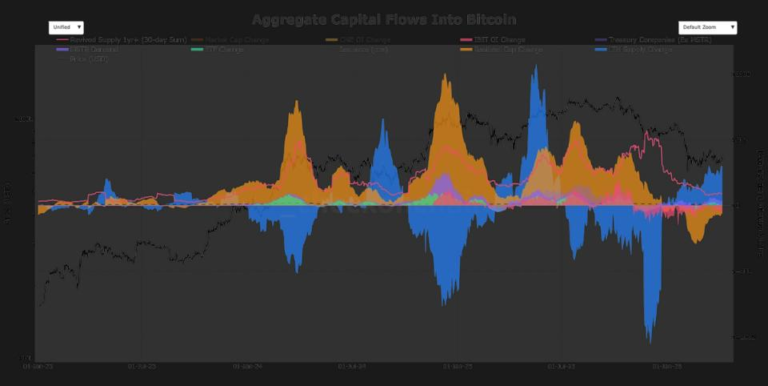
The answer lies in understanding market flows. MSTR demand currently accounts for roughly 7% of total gross inflows, rising to about 9% of net flows, according to checkonchain data. Gross flows reflect only positive demand entering the market, while net flows account for both buying and selling, giving a clearer picture of overall pressure. While Strategy remains a consistent buyer, its impact is relatively small compared to broader market forces.

Historically, its influence was larger. MSTR demand peaked above $15 billion in November 2024, coinciding with its all-time high stock price high and bitcoin over $100,000. Since then, activity has normalized to a range of $1 billion to $4 billion, with current demand around $2.8 billion over the past 30 days.

The dominant force is long-term holders (LTHs), coins held for more than 155 days, which are driving roughly $28.5 billion in supply change. A key subsection is revived 1+ year supply — older coins moving on chain over the past 30 days — which represents roughly $9 billion in change.

Elsewhere, U.S. spot exchange-traded funds (ETFs) have added roughly $1 billion of inflows over the past 30 days, while miner issuance, at 450 BTC per day, contributes around $880 million of monthly supply pressure.

More importantly, capital continues to leave. Bitcoin’s realized cap saw a $29 billion drawdown since February over a 30-day window, while BlackRock’s IBIT open interest is down over $4 billion. Together, these outflows dwarf MSTR’s demand.

Strategy may be buying aggressively, but it is being overwhelmed by larger forces distributing supply and capital being pulled out of the system.

Analysts eye potential breakdown as BTC price repeats familiar pattern: Crypto Markets Today

0

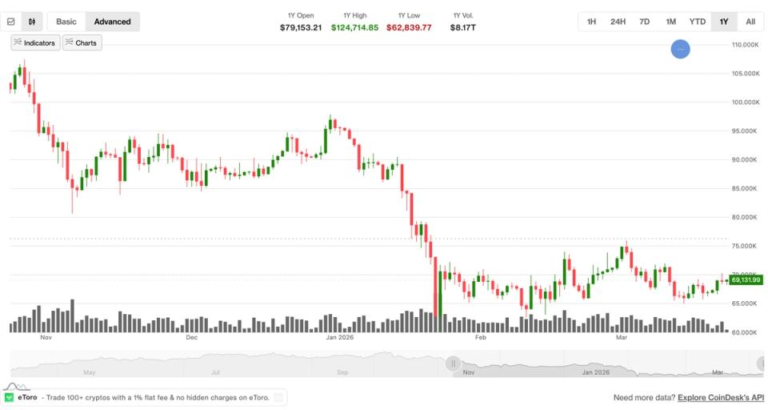
The crypto market is trading sluggishly within the range it has held for two months, with bitcoin changing hands at $69,000 and ether (ETH) at $2,130.

The range-bound pricing dates back to Feb. 6, with several peaks between $72,000 and $75,000 and troughs between $62,000 and $65,000.

A similar two-month pattern occurred between November and January before a price breakdown, leading analysts to suggest a similar scenario may play out this time around.

Much still depends on the conflict in Iran, with U.S. President Donald Trump’s threats of “obliteration” falling on deaf ears thus far. Brent crude oil remains at $107 per barrel, which will have a knock-on effect on inflation over the course of the year unless it declines.

Derivatives positioning

  • The market continues to consolidate as bitcoin open interest (OI) stabilizes at $16.7 billion, little changed from last week and indicating that speculative activity remains flat.
  • Funding rates have moved into a neutral 0%-6% range, following a period of negative funding that likely fueled the initial relief rally through short covering.
  • With the three-month annualized basis also little changed over the week, institutional conviction remains cautious, suggesting that while the immediate downside pressure has eased, the big players are not yet positioning for a major breakout.
  • Options sentiment is stabilizing as call dominance reaches 47% and one-week skew drops to 16% from 19% last week. However, the implied volatility term structure’s front-end backwardation confirms that traders are still prioritizing immediate downside protection over long-term growth expectations.
  • CoinGlass data shows $163 million in 24-hour liquidations, with a 60-40 split between longs and shorts. BTC (64 million), ETH ($35 million) and others ($16 million) were the leaders in terms of notional liquidations.
  • The Binance liquidation heatmap indicates $69,500 as a core level to monitor in case of a price rise.

Token talk

  • The altcoin market has been surprisingly buoyant recently, despite broader market apathy. Since midnight UTC privacy tokens zcash (ZEC) and dash (DASH) rose by 6.7% and 3.1%, respectively, and there were also notable gains for FET, PUMP and RENDER.
  • The bitcoin-dominant CoinDesk 20 (CD20) index gained 0.3% on Tuesday, while being outpaced by the CoinDesk Memecoin Index (CDMEME) and CoinDesk Computing Select Index (CPUS), a sign of the relative strength of altcoins compared with crypto majors.
  • The recent bounce in altcoins has not been uniform, however. AI tokens, privacy tokens and the likes of HYPE and ALGO have performed well, while other market segments have tumbled. Over the past 90 days ethena (ENA) has lost 66% of its value, while TIA, LDO, SUI and ARB have all fallen by more than 50%.
  • That’s a divergence from previous cycles, when altcoins moved in unison. It now appears the market is maturing to a point where assets may be moving based on real-world impact, as opposed to hype and overzealous roadmaps.

OpenAI Calls for Global Shift in Taxation, Labor Policy as AI Takes Over

0

In brief

  • OpenAI released a policy paper arguing that governments must prepare for economic disruption from advanced AI.
  • The document proposes ideas such as broader AI access, tax changes tied to automation, and stronger safety oversight.
  • The release comes as The New Yorker reported separate allegations involving CEO Sam Altman, questioning his motivations and leadership.

ChatGPT developer OpenAI is calling for world leaders to plan now for a world dominated by advanced artificial intelligence.

In the paper “Industrial Policy for the Intelligence Age: Ideas to Keep People First,” released on Monday, OpenAI argues that rapid advances in AI could reshape economies and may require new approaches to taxation, labor policy, and social protections as society prepares for the possibility of superintelligence.

“No one knows exactly how this transition will unfold,” the company wrote. “At OpenAI, we believe we should navigate it through a democratic process that gives people real power to shape the AI future they want, and prepare for a range of possible outcomes while building the capacity to adapt.”

While OpenAI claims AI could significantly increase productivity and accelerate scientific discovery, it also warns that the technology could disrupt labor markets and concentrate wealth if policies do not adapt. The paper says governments should begin preparing now for possible changes in work, income, and economic growth.

The document outlines several policy ideas, including treating access to AI as a foundational economic resource for “participation in the modern economy, similar to mass efforts to increase global literacy,” modernizing tax systems to account for automation, and creating mechanisms that allow citizens to share in the economic gains produced by AI-driven industries.

“The promise of advanced AI is not just technological progress, but a higher quality of life for all. Everyone should have the opportunity to participate in the new opportunities AI creates,” OpenAI wrote. “Living standards should rise, and people should see material improvements through lower costs, better health and education, and more security and opportunity.”

It also proposes strengthening worker protections and expanding social support if technological change leads to sudden job losses, while calling for oversight tools, including auditing for frontier models, incident reporting systems, and “model-containment playbooks” for scenarios in which dangerous AI systems cannot easily be recalled once deployed.

“If AI winds up controlled by, and benefiting only a few, while most people lack agency and access to AI-driven opportunity, we will have failed to deliver on its promise,” the company wrote.

This policy push comes at a difficult time for OpenAI CEO Sam Altman, who is facing fresh scrutiny following an extensive investigation by The New Yorker. The report reveals that in 2023, OpenAI’s co-founder and then-chief scientist, Ilya Sutskever, wrote internal memos accusing Altman of being deceptive about the company’s safety protocols and other key operations.

According to the magazine, these trust issues led the OpenAI board to fire Altman, concluding that he hadn’t been “consistently candid” with them. The firing set off a firestorm in the company, with employees threatening to leave the company in protest, while powerful investors like Josh Kushner threatened to withhold funding unless Altman was reinstated.

The report underscored the deep internal divisions over governance and safety, with some former insiders—including Sutskever and Anthropic co-founder Dario Amodei—arguing that Altman prioritized growth and product expansion over the company’s original safety-focused mission.

OpenAI did not immediately respond to a request for comment by Decrypt.

Daily Debrief Newsletter

Start every day with the top news stories right now, plus original features, a podcast, videos and more.

Ethena Strikes Lending Deals With Anchorage and Maple amid USDe Reserve Overhaul

0

The synthetic dollar protocol is moving beyond its crypto basis trade roots into institutional lending, real-world credit, and equity and commodity perpetuals.

Ethena Labs is finalizing its first direct lending agreements with Anchorage Digital, Maple Institutional, and Coinbase Asset Management as part of a sweeping plan to diversify the assets backing its USDe synthetic dollar.

Under the agreements, Ethena would lend stablecoins from USDe’s reserves to facilitate overcollateralized loans originated by those entities, with borrower collateral held in secured triparty custody. Each loan will operate within parameters set by the Ethena Risk Committee, including minimum overcollateralization ratios, concentration limits, automatic liquidation thresholds, and tenors designed to minimize liquidity risk during large USDe redemption events.

Ethena framed the move as a natural extension of the stablecoin lending it already does on DeFi protocols like Aave and Morpho, but for institutional counterparties with only high-quality, immediately liquid collateral such as BTC and ETH.

Beyond the Basis Trade

The institutional lending push is one piece of a broader four-part diversification strategy Ethena outlined Monday, which also includes expanding real-world asset (RWA) exposure beyond tokenized Treasury bills, extending its delta-neutral framework into equity and commodity perpetuals, and exploring prime lending to trading firms.

The shift reflects how far USDe’s reserve composition has already moved. Perpetual futures positions, once the mainstay of USDe’s backing, now make up just 11% of the stablecoin’s reserves, with the rest allocated to stablecoin reserves and DeFi lending positions. Ethena recently proposed replacing its static 7-day unstaking cooldown with a dynamic model, arguing the fixed period no longer reflects the liquidity available to meet redemptions.

USDe’s circulating supply has contracted to approximately $5.9 billion from a peak above $14.6 billion before the October 10 crash that wiped more than $5 billion from its market cap.

Meanwhile, the protocol’s ENA token is up 9% over the past 24 hours, but has dropped 94% from its peak two years ago.

ENA Chart

Equity and Commodity Perps

Perhaps the most novel element is Ethena’s plan to apply its basis trade methodology to equity and commodity perpetual futures — a market that has grown rapidly since Hyperliquid launched its HIP-3 framework in October 2025.

TradeXYZ Open Interest chart
TradeXYZ Open Interest

HIP-3 open interest has surged from $70 million at launch to over $2 billion, driven by non-crypto pairs such as equities, commodities, and indices. Ethena noted that gold perpetual funding rates on Binance averaged 24.6% in March, presenting a clear basis opportunity for delta-neutral operators.

On the RWA side, Ethena said initial allocations will likely be limited to AAA-rated CLOs, which have no history of defaults, with potential expansion into investment-grade corporate bond funds and short-duration credit products.

This article was written with the assistance of AI workflows. All our stories are curated, edited and fact-checked by a human.

SoFi launches big business banking to power fiat and crypto banking on a single regulated platform

0


Regulated banking infrastructure enables companies to hold deposits, move money, and operate 24/7 through fiat or stablecoins. Initial participants will include Cumberland, Bullish, BitGo, B2C2, Fireblocks, Wintermute, Galaxy, Jupiter, Mesh Payments, and Mastercard. The platform is expected to leverage Solana, alongside other blockchain networks.

SoFi Technologies, Inc. (NASDAQ: SOFI), the one-stop shop for digital financial services, today announced the launch of SoFi Big Business Banking, a new offering that gives enterprise partners the ability to manage both fiat and crypto banking from a single, nationally chartered bank.

This launch builds on SoFi’s integration of blockchain into its core platform. Over the last year, SoFi has enabled members to buy, sell and hold crypto, launched SoFiUSD, and built the regulated infrastructure connecting traditional and on-chain finance. Big Business Banking brings it all together, enabling any company operating across both traditional and digital finance to hold deposits, move money and settle transactions 24/7 within SoFi’s regulated banking platform.

“To be competitive businesses today must operate in a global, always-on environment 24 hours a day, 7 days a week, while legacy banks typically still operate 9 to 5, Monday to Friday,” said Anthony Noto, CEO of SoFi. “SoFi Big Business Banking is changing that by combining the strength and regulatory foundation of a nationally chartered bank with the speed, scale, and flexibility companies need to move and manage money or digital assets in real time.”

Introducing SoFi Big Business Banking

SoFi Big Business Banking combines the strength of a nationally chartered bank and direct access to the Federal Reserve with modern, API-driven capabilities. The result is a simpler, faster way for companies to make payments, access liquidity, and operate in real time at scale.

Key capabilities of SoFi Big Business Banking will include:

  • Regulated Business Deposit Accounts: High-capacity accounts that allow companies to hold funds directly within SoFi’s regulated bank, providing transparency and institutional-grade safeguards.
  • Real-Time, API-Driven Payments: 24/7/365 money movement and settlement, including payments in fiat or SoFiUSD or selected crypto currencies, enabling businesses to operate at the speed of global markets without the limitations of traditional banking hours.
  • Digital Asset Enablement: Foundational support for the “mint and burn” of SoFiUSD, allowing for the instant conversion between fiat and digital assets while maintaining reserves within SoFi’s regulated environment.
  • Unified Financial Operations: A single, integrated interface for managing both traditional banking and digital asset activity, reducing complexity and reliance on multiple intermediaries.

SoFi gives businesses one regulated partner to hold funds, move money or crypto coins, and operate in real time, instead of having to rely on multiple providers of fiat and crypto currencies. As companies increasingly operate across both fiat and digital assets, SoFi is built to support those needs at scale.

The launch of SoFi’s Big Business Banking is supported by a foundational ecosystem of industry-leading firms who are leveraging the platform and supporting the institutional launch of SoFiUSD. Participants will be able to utilize SoFi’s regulated infrastructure to build the next generation of scalable financial services. Initial firms will include Cumberland, Bullish, BitGo, B2C2, Fireblocks, Wintermute, Galaxy, Jupiter, Mesh Payments and Mastercard. The platform is expected to leverage Solana, alongside other blockchain networks.

US Spot Bitcoin ETFs Hit Strongest Gains Since February

0

US-listed spot Bitcoin exchange-traded funds (ETFs) have renewed the pace of inflows, recording their largest daily flows in weeks.

Spot Bitcoin (BTC) ETFs posted $471 million in inflows on Monday, the largest daily inflow since Feb. 25, when the funds attracted $507 million, according to SoSoValue.

The inflows came as the Bitcoin price briefly approached $70,000 before retreating below $69,000, according to CoinGecko data.

The volatility occurred amid ongoing geopolitical pressure as well as renewed concerns over Bitcoin’s quantum resistance, while the Crypto Fear & Greed Index remained in “Extreme Fear” at 13.

BlackRock’s IBIT leads the inflows at $182 million

BlackRock’s iShares Bitcoin Trust ETF (IBIT) led the inflows with about $182 million, followed by the Fidelity Wise Origin Bitcoin Fund (FBTC) with $147 million, according to Farside data.

The ARK 21Shares Bitcoin ETF (ARKB) ranked third with nearly $119 million, marking its largest daily inflow since July 10, 2025.

On Monday, the blockchain analytics platform Arkham observed that ETF outflows slowed to a halt last week, with major issuers selling just about $16.6 million in Bitcoin. ARK Invest’s ARKB ETF purchased the most BTC, or $34 million in a week, it said.

Source: Arkham

Following the three trading sessions in April so far, US spot Bitcoin ETFs recorded about $307 million in net inflows, bringing total assets under management (AUM) back above $90 billion.

Related: Strategy adds $330M BTC as paper losses top $14.5B in Q1

In March, Bitcoin ETFs posted $1.3 billion in inflows, marking the first monthly gain after outflows of $1.61 billion in January and $207 million in February.

Ether ETFs record $120 million in inflows

US spot Ether (ETH) ETFs followed the recovery in sentiment on Monday, recording $120 million in inflows and offsetting $78 million in outflows from the prior two trading sessions.

Ether ETFs posted three consecutive months of losses, bringing total outflows for the period to about $770 million.

Other altcoin ETFs saw muted activity, with XRP (XRP) recording zero inflows on Monday, while Solana (SOL) ETFs posted about $247,000 in inflows.

Magazine: Your guide to surviving this mini-crypto winter