Home Blog Page 557

Italy fines Revolut €11.5m

0

The Italian competition authority has fined Revolut €11.5 million for spreading misleading information about investment services and deceptive practices in the management of its banking offering.

Editorial

This content has been selected, created and edited by the Finextra editorial team based upon its relevance and interest to our community.

Revolut says it will appeal the decision in court, with the firm telling Reuters in a statement: “We remain confident that our communications are clear and transparent. Protecting our millions of customers is our absolute priority.”

The regulator fined Revolut Securities Europe UAB and Revolut Group Holdings €5 million for failing “to clearly disclose, from the very first point of contact with clients, the additional costs and limitations involved in commission-free investments”.

The two unite were hit with another €5 million penalty for “aggressive practices in managing the suspension, limitation and blocking of payment accounts, while omitting (or failing to clearly provide) key information on the relevant terms and procedures”.

Finally, the $75 billion fintech giant faces a €1.5 million fine for not providing “clear and exhaustive” information on the requirements and timeframe for obtaining an Italian IBAN instead of a Lithuanian IBAN.

Says a Revolut spokesperson: “The transition to Italian IBANs followed rigorous local banking protocols. We are required by law to verify customer documentation and eligibility to ensure a secure, compliant, and orderly transition to the local entity.”

Last month Revolut finally secured a full banking licence in the UK after a years-long process that saw it face intense regulatory scrutiny about the firm’s ability to keep pace with compliance issues as it scaled its operations in other markets.

The fintech has had previous brushes with regulators, including last year when it was fined €3.5 million by the central bank of Lithuania for deficiencies in its anti-money laundering controls.

MARA Conducts Ongoing Layoffs Following $1.1B Bitcoin Sale And Debt Reduction Push

0

Bitcoin miner MARA Holdings has begun a series of company-wide layoffs affecting multiple departments, according to reporting from Blockspace Media, marking the latest shift in the firm’s broader restructuring strategy.

Sources familiar with the matter said the layoffs have been “ongoing” and executed in a piecemeal fashion, with at least two rounds taking place this week on Wednesday and Thursday. The total number of employees impacted — as well as the percentage of the workforce affected — has not been disclosed, and the company has not publicly commented on the cuts.

The workforce reduction comes just days after MARA completed a major balance sheet restructuring that involved selling 15,133 bitcoin for approximately $1.1 billion between March 4 and March 25. The proceeds were used to repurchase portions of its outstanding 0.00% convertible senior notes due in 2030 and 2031, allowing the company to retire debt at an average discount of roughly 9% to par.

In total, MARA repurchased $367.5 million of its 2030 notes for $322.9 million and $633.4 million of its 2031 notes for $589.9 million. The transactions are expected to generate approximately $88.1 million in cash savings and reduce the company’s total convertible debt by about 30%, from roughly $3.3 billion to $2.3 billion.

Following the repurchases, MARA now has $632.5 million in 2030 notes and $291.6 million in 2031 notes remaining outstanding. Other tranches of convertible debt — including $48.1 million due in 2026, $300 million due in 2031, and $1.025 billion due in 2032 — remain unchanged.

CEO Fred Thiel previously framed the bitcoin sale as part of a deliberate capital allocation strategy aimed at strengthening the company’s balance sheet while preserving long-term shareholder value. He said the move would improve financial flexibility and position the firm for expansion beyond traditional bitcoin mining.

Bitcoin miners are pivoting to AI 

That expansion includes a growing focus on artificial intelligence and high-performance computing (HPC), areas where MARA is seeking to leverage its expertise in energy infrastructure and data center operations. The company has increasingly positioned itself as a digital energy and compute provider, rather than a pure-play bitcoin miner.

As part of this shift, MARA has also signaled that selling bitcoin could become a recurring element of its treasury strategy. The company stated it plans to sell BTC “from time to time” throughout 2026 to support liquidity needs and fund corporate initiatives.

The developments come amid a challenging environment for bitcoin miners, who are navigating tighter margins, rising competition, and increasing pressure to diversify revenue streams beyond block rewards. 

For MARA, the combination of debt reduction, bitcoin sales, and workforce cuts signals a company in transition — prioritizing balance sheet strength and strategic repositioning as it moves deeper into AI and energy infrastructure.

Oil shock, war risk keep crypto investors on sidelines: Grayscale

0

Crypto markets are stuck in a holding pattern as geopolitical tensions in the Middle East cloud an otherwise improving macro backdrop, according to crypto asset manager Grayscale.

“The war in Iran overshadowed virtually all other market developments in March,” the Grayscale research team said in a Wednesday report.

Before the conflict escalated, global growth appeared to be strengthening and central banks were leaning toward rate cuts. That outlook has been disrupted by a sharp rise in oil prices, which has fueled inflation concerns and pushed interest rate expectations higher, weighing on risk assets and keeping investors on the sidelines, the report said.

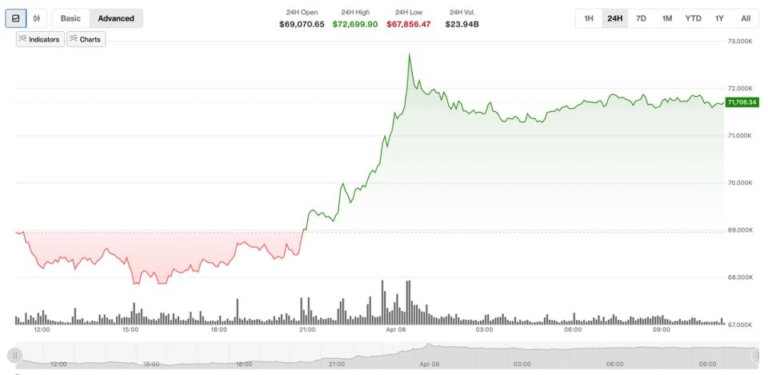
Since the outbreak of the Middle East conflict, crypto markets have been volatile but broadly rangebound, with sharp headline-driven swings tied to oil prices and shifting risk sentiment. Bitcoin initially dropped into the mid-$60,000s on the first escalation, then rebounded toward the low-$70,000s before slipping back again as the conflict dragged on and macro conditions tightened.

More recently, renewed escalation has pushed bitcoin down roughly 10% from March highs, alongside declines in ether (ETH) and other tokens, as investors pulled back from risk assets. Despite the turbulence, performance has held up better than some traditional markets, with bitcoin roughly flat since the start of the war and even outperforming equities at times, underscoring both its sensitivity to macro shocks and its relative resilience.

For now, Grayscale expects many market participants to wait for greater clarity. If the conflict eases and energy prices retreat, markets could quickly reprice toward a more supportive macro environment. If not, persistently high oil prices may continue to pressure growth and delay a broader recovery.

Even so, crypto has shown notable resilience. Prices have held relatively steady through the volatility, suggesting a more durable bottom may be forming. The research team also pointed to continued inflows into spot crypto investment products and a pickup in futures positioning as signs that risk appetite is stabilizing beneath the surface.

Looking ahead, the report argued that the key catalyst for a sustained rebound will be a reduction in macro uncertainty. But it maintains that the long-term drivers of the asset class, including growing adoption of stablecoins and tokenized assets, remain intact.

The stablecoin market has expanded rapidly in recent years, with total supply rising from about $20 billion in 2020 to more than $300 billion by 2025, and sitting around $315 billion, according to industry data.

The sector added roughly $100 billion in 2025 alone, reflecting renewed growth after a brief contraction, as demand for dollar-pegged digital assets surged across trading, payments and onchain finance.

Periods of heightened uncertainty like the current one have historically presented attractive opportunities for long-term investors positioning for the next phase of growth, the report added.

Read more: Bitcoin holds ground as gold, silver slide on ETF outflows and liquidity strains: JPMorgan

Crypto startups raised $5 billion in Q1 — here are the top 10 funding rounds

0

Crypto startups raised nearly $5 billion from venture investors in the first-quarter of 2026, DefiLlama data shows.

That’s a 16% decrease year-on-year when compared to the first three months of 2025 when the market saw closer to $6 billion in funding amid the crypto industry’s euphoria after Donald Trump took office.

Yet investment momentum is not lost — the fundraising data highlights a rapidly evolving startup ecosystem.

The prediction market sector emerged as the dominant force, securing over $1.7 billion in capital. This was followed by payments at $735 million and trading infrastructure at $423 million, underscoring a shift from speculative crypto token bets to real-world tools and institutional utility.

And more and more marquee investors — not just crypto VCs — are piling in. They include the likes of Sequoia Capital, Founders Fund, Bain Capital, and Alibaba Group.

Here are the top 10 raises in the first-quarter this year.

CHART HERE

Kalshi, $1 billion 

Kalshi, the CFTC-regulated event derivatives exchange, raised $1 billion at a $22 billion valuation, reinforcing its leadership in regulated prediction markets, according to people familiar with the situation speaking with Bloomberg and the Wall Street Journal.

Investment firm Coatue Management led the raise, according to the publications’ sources.

Kalshi has not yet officially confirmed the deal.

This capital injection underscores the growing institutional appetite for prediction platforms.

Polymarket, $600 million  

Polymarket secured $600 million, maintaining its dominance in decentralised betting markets.

Intercontinental Exchange, the fintech firm, said it had poured the fresh capital into the prediction market platform. and that it may acquire up to $40 million of Polymarket securities from existing holders.

Rain, $250 million 

Rain raised $250 million in a Series C round at nearly $2 billion valuation.

Iconiq Capital led the raise into the stablecoin payments infrastructure provider. Other investors include Sapphire Ventures, Dragonfly Capital, Bessemer Venture Partners and Galaxy Digital.

The platform combines card issuance with stablecoin payment rails, enabling crypto-native organisations to transact with the traditional economy.

BitGo, $213 million

In January, crypto custodian BitGo raised more than $213 million in an initial public offering at over $2 billion valuation.

The firm listed on the New York Stock Exchange, pricing shares at $18, with strong institutional demand.

Flying Tulip, $206 million 

Flying Tulip raised $206 million via a public token sale at a $1 billion fully diluted valuation, with development led by decentralised finance architect Andre Cronje. The sale funded a protocol integrating trading, lending and insurance functions.

The platform focuses on automated yield strategies and risk management, reflecting a broader shift towards simplified, vertically integrated DeFi products designed for institutional and advanced retail users.

Whop, $200 million 

Whop secured $200 million in a strategic round valuing the company at $1.6 billion.

The investment was made entirely by Tether, the stablecoin issuer behind USDT.

Whop operates as a digital marketplace for creators, enabling the sale of software, courses and memberships with native stablecoin payments.

LMAX Group, $150 million

In January, LMAX Group raised $150 million in a strategic financing round at an undisclosed valuation.

The investment was made entirely by Ripple, the fintech company.

The partnership will integrate Ripple’s RLUSD stablecoin as collateral across LMAX’s trading venues. The deal aims to improve margin efficiency and enable around-the-clock settlement for institutional clients, highlighting increasing convergence between traditional financial infrastructure and digital asset rails.

Alpaca, $150 million

In January, Alpaca raised $150 million in a Series D round valuing the firm at over $1 billion.

The raise was led by Drive Capital with backing from Citadel Securities, MUFG Innovation Partners, Kraken Ventures and BNP Paribas’ venture arm.

The API-driven brokerage platform provides infrastructure for fintech firms to offer trading in equities and crypto. The funding will support international expansion and enhanced security capabilities, the firm says.

Bluesky, $100 million

In March, Bluesky secured $100 million in a Series B round.

The raise was led by Bain Capital’s crypto arm, with participation from Anthos Capital, early-stage venture firm Bloomberg Beta and the Knight Foundation.

The platform aims to give users control over data and identity. Its growth to more than 43 million users reflects rising demand for decentralised social infrastructure.

Anchorage Digital, $100 million 

In February, Anchorage Digital raised $100 million in a strategic round at over $4 billion valuation.

The investment was made by Tether and deepens ties with the platform and reinforces the role of regulated infrastructure in the digital asset ecosystem.

As the first crypto firm to receive a US national trust charter, Anchorage provides custody, trading and financing services to institutional clients.

You’re reading the latest instalment of The Weekly Raise, our column covering fundraising deals across the crypto and DeFi spaces, powered by DefiLlama.

Lance Datskoluo is DL News’ Europe-based markets correspondent. Got a tip? Email him at lance@dlnews.com.

Elliptic flags $285 million Drift exploit as a likely North Korea-linked operation

0

Elliptic said Thursday the $285 million Drift Protocol exploit, the largest this year, carries “multiple indicators” of North Korea’s state-sponsored DPRK hacker group involvement.

The research firm pointed specifically to onchain behavior, laundering methodologies and network-level signals, all of which align with previous state-linked attacks.

Drift Protocol, whose token has dropped over 40% to roughly $0.06 since the hack, is the largest decentralized perpetual futures exchange on the Solana blockchain.

“If confirmed, this incident would represent the eighteenth DPRK act Elliptic has tracked this year, with over $300 million stolen so far,” the report said.

“It is a continuation of the DPRK’s sustained campaign of large-scale cryptoasset theft, which the U.S. government has linked to the funding of its weapons programs. DPRK-linked actors are believed to be responsible for billions of dollars in cryptoasset theft in recent years,” Elliptic added.

Hours earlier, Arkham data showed that over $250 million had been moved from Drift to an interim wallet, then to various other addresses.

In December, a Chainalysis report revealed DPRK hackers stole a record $2 billion of crypto in 2025, including the $1.4 billion Bybit breach, representing a 51% increase from the previous year. The U.S. Treasury Department last month said North Korea uses the stolen assets to fund the country’s weapons of mass destruction program.

Rather than focusing on the exploit itself, Elliptic’s analysis highlights a familiar operational pattern. The activity appears “premeditated and carefully staged,” with early test transactions and pre-positioned wallets preceding the main event.

The report explains that once executed, funds were rapidly consolidated and swapped, bridged across chains, and converted into more liquid assets, reflecting a structured, repeatable laundering flow designed to obscure origin while maintaining control.

A central challenge, Elliptic notes, is Solana’s account model. Because each asset is held in a separate token account, activity tied to a single actor can appear fragmented across multiple addresses. Without linking these, investigators risk seeing “fragments of the attacker’s activity, not the complete picture.”

This is where Elliptic’s report highlights the clustering approach, which connects token accounts back to a single entity, allowing exposure to be identified regardless of which address is screened. In an incident involving more than a dozen asset types, that entity-level view becomes critical.

The case also emphasizes, Elliptic adds in its report, how laundering has become inherently cross-chain. Funds moved from Solana to Ethereum and beyond, demonstrating the need for what Elliptic described as “holistic cross-chain tracing capabilities.”

Bitcoin Treasury Companies Are Dumping Their Bitcoin

0

A wave of bitcoin selling from public companies and sovereign entities is adding pressure to the bitcoin market, as firms that once called themselves long-term holders sit on long-term losses and move to shore up balance sheets, repay debt, and fund strategic pivots.

Companies including Riot Platforms, Genius Group, and Nakamoto Holdings have all reduced their bitcoin holdings this week, citing liquidity needs and operational priorities. 

The shift marks a drastic change from the accumulation trend that defined the past two years, when firms raced to build BTC treasuries during a period of rising prices.

Bitcoin HODL-ish

Empery Digital (EMPD) said it sold 370 BTC at an average price of $66,632, generating $24.7 million in proceeds. The company used part of the funds to repay its term loan and released about 1,800 BTC that had been held as collateral. 

Following the sale, Empery holds 2,989 BTC, down from a peak position of about 4,000 BTC built after it began accumulating in July 2025. Its shares have fallen 75% from a 2025 high of $15.80.

Genius Group (GNS), an AI-focused education company that once held as much as 440 BTC, has exited its BTC position. The firm sold its remaining 84 BTC to repay $8.5 million in debt, completing a series of reductions that began earlier this year. 

The company said it may rebuild its bitcoin treasury when market conditions improve.

Riot Platforms (RIOT), one of the largest publicly traded bitcoin miners in the U.S., has also been selling. Blockchain data tracked by Lookonchain indicates the company moved 500 BTC, worth about $34 million, to an exchange-linked address, suggesting a sale. This movement took place on April 1. 

The transaction follows roughly $200 million in bitcoin sales in the final months of 2025, as Riot shifts capital toward artificial intelligence and high-performance computing infrastructure.

Other firms are merely tapping their holdings. Nakamoto Holdings (NAKA) sold 284 BTC for about $20 million in March, representing around 5% of its reserves. 

The company said the proceeds will support working capital and operations following acquisitions tied to its bitcoin-focused strategy. Nakamoto reported a pre-tax loss of $52.2 million for 2025, driven in part by a decline in the value of its digital assets.

Marathon Digital (MARA) has taken one of the largest steps. The miner sold 15,133 BTC between March 4 and March 25 for about $1.1 billion. It used the proceeds to repurchase $1 billion in convertible notes due in 2030 and 2031, reducing outstanding debt by about 30%. The move lowered its holdings to 38,689 BTC from 53,822 BTC at the start of the year.

The trend extends beyond corporate treasuries. Bhutan has continued to reduce its BTC holdings, selling a total of 3,103 BTC. A single transaction on March 30 accounted for 375 BTC, according to Glassnode data. 

The country had built its position through state-backed mining operations, reaching more than 13,000 BTC at its peak in October 2024.

Despite the recent selling, public companies still hold about 1.16 million BTC, or more than 5% of bitcoin’s fixed supply of 21 million, according to BitcoinTreasuries.net.

Bitcoin traded near $66,000 at the time of writing, down about 3% on the day.

Bitcoin Magazine is published by BTC Inc, a subsidiary of Nakamoto Inc. (NASDAQ: NAKA)

Coinbase Receives Conditional Approval for US Trust Charter

0

The US Office of the Comptroller of the Currency (OCC) has approved cryptocurrency exchange Coinbase’s application for a national bank trust charter after six months of consideration.

In a Thursday X post, Coinbase chief legal officer Paul Grewal said the company received conditional approval for the OCC application, following December approvals for Ripple Labs, BitGo, Circle, Fidelity Digital Assets and Paxos.

Although the company said in October it had “no intention of becoming a bank” if approved, the move by US regulators marks one of the most significant forays into bridging crypto and traditional finance.

Source: Paul Grewal

“Coinbase is not becoming a commercial bank,” said vice president of institutional product Greg Tusar in a Thursday blog post.We will not be taking retail deposits. We will not be engaging in fractional reserve banking. This charter is about bringing federal regulatory uniformity to the custody and market infrastructure business we have been building for years.”

Tusar said that the company would continue to operate under the Department of Financial Services in New York, where it holds a BitLicense and a state charter as a limited-purpose trust company.

The OCC approval, coupled with Coinbase’s state-level efforts, came as the company is in the middle of a debate on issues stalling a digital asset market structure bill in Congress, including over stablecoin yield.

CEO Brian Armstrong said in January that the exchange could not support the legislation as written. Lawmakers on the Senate Banking Committee later postponed a markup, which is necessary before a potential floor vote on the bill.

Related: Coinbase exec says Senate CLARITY compromise is close, but no markup date set

At the time of publication, the OCC website showed no change to Coinbase’s application, which it marked as received by the banking regulator. Cointelegraph reached out to the exchange for comment but did not receive an immediate response.

Coinbase faces legal pushback over prediction markets

The crypto platform rolled out prediction market bets for US-based users in January as part of a partnership with Kalshi.

In lawsuits filed preemptively against state gaming authorities in Connecticut, Illinois and Michigan, Coinbase argued that the US Commodity Futures Trading Commission, as a federal regulator, had the authority to oversee prediction markets. Many of the cases were ongoing as of Thursday.

Magazine: AI agents will kill the web as we know it: Animoca’s Yat Siu