Michael Saylor, executive chairman of Strategy (MSTR), believes bitcoin likely bottomed in early February at $60,000.
Speaking at a recent Mizuho event, Saylor reiterated his long-held view that bottoms aren’t necessarily about valuations but are driven by seller exhaustion, analysts Dan Dolev and Alexander Jenkins wrote.
Trend reversals, he added, are driven more by capital structure and liquidity than by investor sentiment.
Saylor now sees limited selling pressure amid growing demand from ETF inflows, which are absorbing daily supply, and companies shifting treasury assets into bitcoin.
Bitcoin and Strategy’s next drivers
As for the catalyst for the next bull market, Saylor believes it will be the formation of banking credit and digital credit on top of bitcoin. This will have bitcoin supporting more lending and credit activity beyond simple buy-and-hold demand.
Digital credit already exists, said Saylor, in the form of Strategy’s STRC preferred stock, whose beefy 11.5% yield remains well below the company’s expectation of BTC’s long-term appreciation. Strategy is “stretching” bitcoin “from a nonyielding asset into a capital markets engine,” he said.
On the recently hotly-debated topic of quantum computing, Saylor said the risks are overblown. The threat, he argued, is theoretical, likely decades away, and even then solvable.
Mizuho retained its outperform rating on Stategy and $320 price target, suggesting about 150% upside from the current $127.
Bitcoin is showing signs of bottoming out, but some analysts believe a final shakeout below $60,000 is still possible over the next few months.
Several major altcoins are showing early signs of buying, but the bulls have a lot of work to do before a trend change is signalled.
Bitcoin (BTC) rose above the $72,000 level on Tuesday following the announcement of a ceasefire agreement between the US and Iran. Although the bulls could not achieve a close above $72,000, a positive sign is that the buyers have not ceded much ground to the bears. That suggests the bulls are holding on to their positions as they anticipate the recovery to continue.
Several analysts believe that BTC is showing signs of bottoming out. Crypto trader Quantum Ascend said in a post on X that BTC’s stochastic relative strength index (RSI) indicator is at the “exact same point on the daily as it was in 2022” before the price sprinted higher.
Crypto market data daily view. Source: TradingView
A slightly different view was put forth by Alphractal founder and CEO Joao Wedson, who said in a post on X that the bear trend may be ending but BTC may witness “a sharp move like a –$15K shakeout” over the next six months.
Could BTC and select major altcoins extend their relief rally? Let’s analyze the charts of the top 10 cryptocurrencies to find out.
Bitcoin price prediction
BTC cleared the moving averages and the $72,000 resistance on Tuesday, indicating solid buying by the bulls.
Sellers are expected to defend the $72,000 to $76,000 zone with all their might, as a close above it will complete a bullish ascending triangle pattern. If that happens, the BTC/USDT pair may skyrocket to $84,000.
The first sign of weakness will be a close below the moving averages, suggesting that the bears remain sellers on rallies. A close below the support line will invalidate the positive setup, increasing the risk of a fall to the crucial $62,500 to $60,000 support zone.
Ether price prediction
Ether (ETH) turned up from the 50-day simple moving average ($2,059) on Tuesday and surged above the $2,200 resistance.
The 20-day exponential moving average ($2,110) has started to turn up, and the RSI is in the positive territory, indicating that the path of least resistance is to the upside. There is resistance at the $2,400 level, but if the bulls overcome it, the up move may extend to $2,800.
Time is running out for the bears. They will have to swiftly yank the ETH price below the moving averages to signal a comeback. The ETH/USDT pair may fall to $1,918 and potentially to the $1,750 support.
XRP price prediction
XRP’s (XRP) bounce off the $1.27 level reached the moving averages, which is a crucial resistance to watch out for.
If buyers thrust the XRP/USDT pair above the moving average, it clears the path for a rally to the breakdown level of $1.61 and then to the downtrend line of the descending channel pattern. Sellers will attempt to halt the up move at the downtrend line, as a close above it points to a potential trend change.
On the downside, a close below the $1.27 level signals that the bears remain in control. That increases the risk of a drop to the $1.11 level and eventually to the support line of the descending channel pattern near $1.
BNB price prediction
BNB (BNB) has been consolidating between $570 and $687 for several days, indicating buying near the support and selling close to the resistance.
The flattish moving averages and the RSI near the midpoint suggest that the range-bound action may continue for a few more days. If bulls pierce the moving averages, the BNB/USDT pair may reach the $687 level, where the bears are expected to step in.
The next trending move is expected to begin on a close above the $687 resistance or below the $570 support. If the $687 level is taken out, the pair may soar to $730 and later to $790. On the other hand, a close below $570 may sink the pair to $500.
Solana price prediction
Solana (SOL) is attempting to rise above the moving averages, but the bears have held their ground.
The flattish moving averages and the RSI just below the midpoint do not give a clear advantage either to the bulls or the bears. If the SOL price rises above the moving averages, the next stop may be the $98 level. Buyers will have to secure a close above the $98 resistance to gain the upper hand.
On the downside, a break and close below the $76 support tilts the advantage in favor of the bears. That increases the risk of a drop to $67 and subsequently to $50.
Dogecoin price prediction
Dogecoin (DOGE) rose above the moving averages on Tuesday, but the recovery is facing resistance at the downtrend line.
Sellers will attempt to strengthen their position by pulling the DOGE price below the $0.09 level. If they manage to do that, the DOGE/USDT pair will complete a descending triangle pattern. The pattern target of this bearish setup is $0.06.
On the contrary, a close above the downtrend line invalidates the negative setup. That suggests the bears have given up, opening the gates for a rally to $0.11 and then to the $0.12 level.
Hyperliquid price prediction
Hyperliquid (HYPE) closed above the 20-day EMA ($37.28) on Tuesday, signaling that the correction may be over.
The bulls will attempt to push the HYPE price to the $41.59 to $43.76 zone, where the sellers are expected to mount a solid defense. If buyers clear the overhead barrier, the HYPE/USDT pair may rally to $50.
This positive view will be negated in the near term if the price turns down and breaks below the 50-day SMA ($34.80). Such a move indicates that higher levels continue to attract sellers. The pair may then tumble to the $29.42 level.
Related: Oil falls, Bitcoin jumps to $72K, but is this BTC price breakout for real?
Cardano price prediction
Buyers pushed Cardano (ADA) to the 50-day SMA ($0.26) on Tuesday, indicating that the bulls are attempting a comeback.
If buyers pierce the 50-day SMA, the ADA/USDT pair may reach the downtrend line of the descending channel pattern. Sellers are expected to fiercely defend the downtrend line as a close above it signals a potential trend change.
Sellers are likely to have other plans. They will attempt to aggressively defend the downtrend line and pull the ADA price below the moving averages. If they do that, the pair may extend its stay inside the channel for a few more days.
Bitcoin Cash price prediction
Buyers are attempting to sustain Bitcoin Cash (BCH) above the breakdown level of $443 but are expected to face significant resistance from the bears.
If the BCH price turns down from the moving averages and breaks below the $420 level, it signals the resumption of the downward move. That may sink the BCH/USDT pair to the $375 level.
The first sign of strength will be a close above the moving averages. That suggests the market has rejected the break below the $443 level. The pair may then rally to the $520 to $540 zone.
Chainlink price prediction
Chainlink (LINK) closed above the moving averages on Tuesday, opening the doors for a rally to the resistance of the $8 to $10 range.
Sellers are expected to defend the $10 level, keeping the LINK price inside the range for some more time.
Buyers will have to propel and maintain the price above the $10 resistance to gain the upper hand. That may drive the LINK/USDT pair to $10.94 and thereafter to the $11.61 level. On the downside, a break and close below the $8 level signals an advantage to bears. The pair risks falling to $7.15 and then to the pattern target of $6.
This article does not contain investment advice or recommendations. Every investment and trading move involves risk, and readers should conduct their own research when making a decision. While we strive to provide accurate and timely information, Cointelegraph does not guarantee the accuracy, completeness, or reliability of any information in this article. This article may contain forward-looking statements that are subject to risks and uncertainties. Cointelegraph will not be liable for any loss or damage arising from your reliance on this information.
The New York Times published an investigation Tuesday arguing that Adam Back, a British cryptographer and longtime figure in the Bitcoin community, is the most credible candidate yet for Satoshi Nakamoto — the pseudonymous inventor of Bitcoin.
Back denied the claim before the story ran, denied it inside the story, and denied it again in a public post on X after publication.
“I’m not satoshi, but I was early in laser focus on the positive societal implications of cryptography, online privacy and electronic cash, hence my ~1992 onwards active interest in applied research on ecash, privacy tech on cypherpunks list which led to hashcash and other ideas,” Back wrote on X.
The Times investigation leans on textual analysis of old emails and forum posts. The methodology focuses on writing patterns, including the use of double hyphens and British spelling conventions. The Times noted that early researchers had explored concepts such as peer-to-peer systems, proof-of-work, and routing models that looked like prototypes for Bitcoin, and that Back’s archived writing contained a high density of those overlaps.
Back, who developed Hashcash in 1997 — a proof-of-work system later incorporated into Bitcoin’s design — acknowledged the surface-level similarities but offered a structural counter.
Because he wrote at length on the cypherpunks mailing list about electronic cash and privacy from around 1992 onward, he argued, his old writing is simply easier to match against Satoshi’s than the writing of contributors who posted far less.
“The rest is a combination of coincidence and similar phrases from people with similar experience and interests,” Back wrote on X.
He also addressed a specific passage in the Times story that treated one of his remarks in a reporter interview as a possible slip. Back said the comment was about confirmation bias in the research process, not an accidental self-disclosure.
Adam Back, Satoshi identity claim faces skepticism
The report did not produce documentary proof — no private key demonstration, no verified direct communication from Satoshi’s wallet address, and no corroborating witness on the record. The case rests on stylometric analysis and pattern matching, tools that carry real analytical weight but have not, in prior Satoshi investigations, produced conclusions that the broader Bitcoin community has accepted.
Several credible voices expressed skepticism. Joe Weisenthal, a Bloomberg columnist and co-host of the Odd Lots podcast, said he was “not 100% convinced by the evidence or the conclusion.” He noted that shared political views on privacy and internet architecture were common across the cypherpunk cohort and do not single out any one person. He also pointed out that hyphenation habits vary and are a fragile basis for attribution.
Nicholas Gregory, an early Bitcoin participant in the U.K., said he did not believe Back was Satoshi based on personal interactions, according to CoinDesk reporting. He also raised a practical concern: public identification of the person behind the pseudonym, whoever that is, could put that individual and their family in physical danger. According to crypto exchange Arkham, Satoshi’s Bitcoin holdings are worth roughly $73 billion.
This is not the first time a major outlet has believed it solved the mystery. A 2024 documentary pointed to developer Peter Todd, who also denied the claim and whose case ultimately failed to persuade.
Advances in quantum computing could eventually pose a threat to Bitcoin’s cryptographic security, but the risk remains manageable and unlikely to cause existential disruption, according to a new research report by Bernstein.
In the report, the Bernstein team — Gautam Chhugani, Mahika Sapra, Sanskar Chindalia and Harsh Misra — described quantum computing as a “manageable upgrade cycle” rather than an “existential risk.”
Recent breakthroughs, including research from Google showing a significant reduction in the resources required to break modern encryption, have accelerated the timeline for potential threats. However, building quantum computers powerful enough to compromise Bitcoin (BTC) remains years away due to major technical hurdles and high costs.
Bernstein estimates the crypto industry has roughly three to five years to prepare for post-quantum security upgrades, allowing time to transition toward quantum-resistant cryptographic standards.
The transition would likely be handled by Bitcoin’s open-source developer community and core contributors, who are responsible for proposing and implementing protocol upgrades through consensus.
Quantum experts generally give a 10-year timeline for cryptographically relevant quantum computers (CRQCs), or machines capable of breaking today’s encryption. Source: Bernstein
Related: Researchers say quantum computers could, in theory, be ready by 2030
Quantifying the quantum risk for Bitcoin
Quantum computing differs from classical computing in that it uses “qubits,” which can encode multiple states simultaneously. This enables algorithms that, in principle, could break widely used encryption methods, including those used to secure Bitcoin wallets.
Still, the risk is not uniform across the network.
According to Bernstein, vulnerabilities are primarily concentrated in older Bitcoin wallets and addresses that reuse public keys, which are more exposed to potential attacks. Newer wallet formats and best practices, such as avoiding address reuse, significantly reduce this risk.
Bitcoin’s mining process, which relies on SHA-256 hashing, is not considered meaningfully vulnerable to quantum attacks or AI quantum computing breakthroughs.
Bernstein believes certain Bitcoin address types — specifically pay-to-public-key (P2PK), pay-to-multisig (P2MS) and pay-to-Taproot (P2TR) — are among the most vulnerable to quantum risks.
Bernstein identifies P2PK, P2MS and P2TR address types as the most vulnerable to quantum risks. Source: Bernstein
The risk is particularly pronounced for older “legacy” wallets. Roughly 1.7 million Bitcoin, including an estimated 1.1 million BTC attributed to Satoshi Nakamoto, are held in early P2PK addresses, where public keys are permanently exposed.
Related: Is $450B in Bitcoin vulnerable to the quantum threat? Analysts weigh in
Cointelegraph is committed to independent, transparent journalism. This news article is produced in accordance with Cointelegraph’s Editorial Policy and aims to provide accurate and timely information. Readers are encouraged to verify information independently. Read our Editorial Policy https://cointelegraph.com/editorial-policy
Polymarket has acquired Brahma to enhance its DeFi infrastructure and trading performance capabilities.
Polymarket has acquired Brahma, a DeFi infrastructure provider, to strengthen its platform’s trading performance and underlying infrastructure. The acquisition was announced on April 8, 2026, and aims to bolster Polymarket’s capabilities in the decentralized finance ecosystem.
Brahma’s integration into Polymarket is expected to enhance the prediction market platform’s technical infrastructure and user experience. The deal represents continued consolidation in the DeFi sector as platforms seek to improve their competitive positioning.
Source: Polymarket
This article was generated automatically by The Defiant’s AI news system from publicly available sources.
Nunchuk has released two open-source repositories aimed at reshaping how AI agents interact with Bitcoin wallets, introducing a model that limits agent control while preserving human oversight.
The release includes Nunchuk CLI, a command-line interface for managing Bitcoin wallets, and a companion “Agent Skills” repository designed to help AI systems operate the CLI across common workflows. Both tools are licensed under MIT and target developers building automated financial systems on Bitcoin, Nunchuk said.
The core premise challenges a growing trend in AI wallet design. Rather than granting agents full control over funds with basic safeguards, Nunchuk proposes a shared custody model where agents operate within strict policy limits. Human users retain final authority over transactions that exceed predefined thresholds.
Under this structure, wallets are configured as group wallets with multiple keys. A user key, an agent key, and a policy co-signer work together to authorize transactions. The agent can initiate actions such as creating wallets, inviting participants, and constructing transactions, but spending authority remains constrained by rules set at the policy level.
AI-driven bitcoin use
These policies define limits such as daily spending caps, approval requirements, and signing delays. Transactions that fall within allowed parameters can proceed without intervention, while larger or sensitive actions require explicit user approval.
Nunchuk separates custody from automation. The wallet structure governs ownership and control of funds, while policy layers define what an agent can execute. This distinction ensures that funding a wallet does not grant broader authority to the agent managing it.
The CLI supports a range of functions including key generation, wallet creation, transaction workflows, and policy configuration. It also allows users to export wallet descriptors and backups using standard formats, which supports portability and recovery outside the Nunchuk ecosystem.
The Agent Skills repository serves as an interface layer for AI systems. It provides predefined commands and prompts that guide agents through tasks such as setting up wallets, managing participants, and executing transactions. This reduces the need for custom integrations and lowers the barrier for developers experimenting with Bitcoin-based automation.
Nunchuk positions the dual-repository approach as a response to two distinct challenges: execution and usability. The CLI acts as the execution layer tied to the Nunchuk API, while the skills layer focuses on how AI systems interact with that infrastructure.
The release reflects a broader effort to define safe design patterns for AI in financial contexts. By enforcing bounded authority, Nunchuk aims to enable practical automation without introducing full custodial risk.
Potential use cases include shared human-agent wallets, automated bill payment systems, treasury management tools, and multi-agent coordination. While these applications remain in early stages, the underlying model provides a framework for controlled experimentation.
As AI systems gain access to financial tools, the question of control becomes central. Nunchuk’s approach suggests that the path forward may depend less on restricting capability and more on structuring authority.
Editorial Disclaimer: We leverage AI as part of our editorial workflow, including to support research, image generation, and quality assurance processes. All content is directed, reviewed, and approved by our editorial team, who are accountable for accuracy and integrity. AI-generated images use only tools trained on properly license material. In Bitcoin, as in media: Don’t trust. Verify.
South Korea’s financial regulator said it will tighten the exception rules under crypto exchanges’ withdrawal-delay system after finding that scam-linked accounts granted exemptions accounted for most voice-phishing-related losses.
The Financial Services Commission (FSC) said Wednesday that the strengthened framework, developed with the Financial Supervisory Service (FSS) and the Digital Asset eXchange Alliance (DAXA), will impose unified standards on when users can bypass withdrawal delays.
The regulator said exchanges had been applying their own exception criteria with no clear minimum standard, creating loopholes that let bad actors quickly move funds if they meet easy requirements such as account age or trading history.
From June to September 2025, accounts granted withdrawal-delay exemptions made up 59% of fraudulent accounts and 75.5% of related losses at crypto exchanges, the FSC said.
The move follows a wider South Korean push to tighten crypto exchange controls after voice-phishing abuse and operational-control failures, including fresh reforms announced this week after Bithumb’s Bitcoin (BTC) payout error.
Transfer route and protection device for voice phishing damage through virtual assets, translated to English. Source: FSC
Unified rules aim to curb misuse of withdrawal-delay exemptions
The FSC said that under the new rules, exchanges must assess factors like trading frequency, account history and deposit and withdrawal amounts when determining whether a user qualifies for a withdrawal-delay exemption.
The regulator said the change is expected to reduce the number of users eligible for exemptions sharply. The FSC said a simulation showed the share of users eligible for exemptions would fall to around 1% under the new rules, but did not provide a baseline for comparison.
Related: South Korean brokerage Korea Investment & Securities eyes Coinone stake: Report
The FSC said it will also strengthen oversight of users granted exemptions through periodic checks, including verification of the source of funds, and by building systems to monitor suspicious withdrawal activity.
The regulator added that they will continue reviewing the rules to prevent new circumvention methods and adjust as needed.
The move adds to a broader push by South Korean regulators to tighten oversight of crypto exchanges following recent incidents.
On Tuesday, the FSC ordered exchanges to reconcile internal ledgers with actual asset holdings every five minutes after an inspection linked to the Bithumb payout error found gaps in internal controls and risk management systems.
On Jan. 29, South Korea expanded crypto licensing scrutiny to cover exchanges and major shareholders.
Magazine: ‘Phantom Bitcoin’ checks, Drift hack linked to North Korea: Asia Express
Cointelegraph is committed to independent, transparent journalism. This news article is produced in accordance with Cointelegraph’s Editorial Policy and aims to provide accurate and timely information. Readers are encouraged to verify information independently. Read our Editorial Policy https://cointelegraph.com/editorial-policy
Trusted Editorial content, reviewed by leading industry experts and seasoned editors. Ad Disclosure
Bitcoin surged above $72,000 yesterday and is holding above $70,000 today. The narrative of a bottom is building. And an XWIN Research Japan analysis is asking the more important question: not whether Bitcoin has bounced, but whether anyone understands why it fell.
The report from XWIN Research Japan reframes the past six months in a way that changes how the current recovery should be read. Bitcoin is not, in their framework, a standard risk asset that rises and falls with market sentiment. It is a terminal liquidity asset — the last recipient in a hierarchical financial system where capital flows from central banks to government bonds to equities and finally, at the very end of the chain, to crypto. When the upstream flow weakens, Bitcoin does not experience demand destruction. It receives nothing. The capital simply never arrives.
That is what happened over the past six months. Elevated US interest rates, a strengthening dollar, and rising Japanese bond yields simultaneously tightened global liquidity from multiple directions. Japan — one of the largest external investors in global markets — reduced its capital exports as domestic bond yields made home markets more attractive. The result was not investors selling Bitcoin. It was investors who never bought it.
The bounce above $72,000 is visible. Whether the conditions that prevented the capital from arriving have changed is the question the price chart cannot answer.
The Sell-Off Was Not Spot. It Was Credit
The analysis adds the second layer that completes the structural picture. As global liquidity tightened and capital stopped reaching Bitcoin, the derivatives market compounded the damage through a mechanism separate from — and more destructive than — simple selling.
Excess leverage accumulated during the bull run began unwinding in cascading liquidations. Each forced exit consumed demand that would have entered the market in future sessions. The downside was not just the selling that happened. It was the buying that was destroyed before it could occur.
The on-chain data confirms this interpretation without contradicting it. STH-SOPR holding below 1.0 for sustained periods reflected short-term holders realizing losses — an outcome of the liquidity squeeze, not its cause. The Coinbase Premium Gap staying negative reflected weak US spot demand — again, an outcome. These indicators describe what was happening to participants at the retail level while the structural cause operated several layers above them in the global capital hierarchy.
Bitcoin Coinbase Premium Index | Source: CryptoQuant
The forward conditions are equally structural and equally precise. A new all-time high requires capital to flow back through the system — from central banks, through bonds, through equities, and finally to the terminal edge where Bitcoin waits. Two catalysts could accelerate that flow specifically: US midterm elections influencing fiscal expansion and rate expectations, and a potential Japan Bitcoin ETF that would open access to one of the largest pools of household savings in the world.
The past six months were not a verdict on Bitcoin. They were a consequence of where it sits in the financial system. The next major move will arrive when the system above it changes — not when the narrative does.
Bitcoin Reclaims $70K but Trend Structure Remains Unresolved
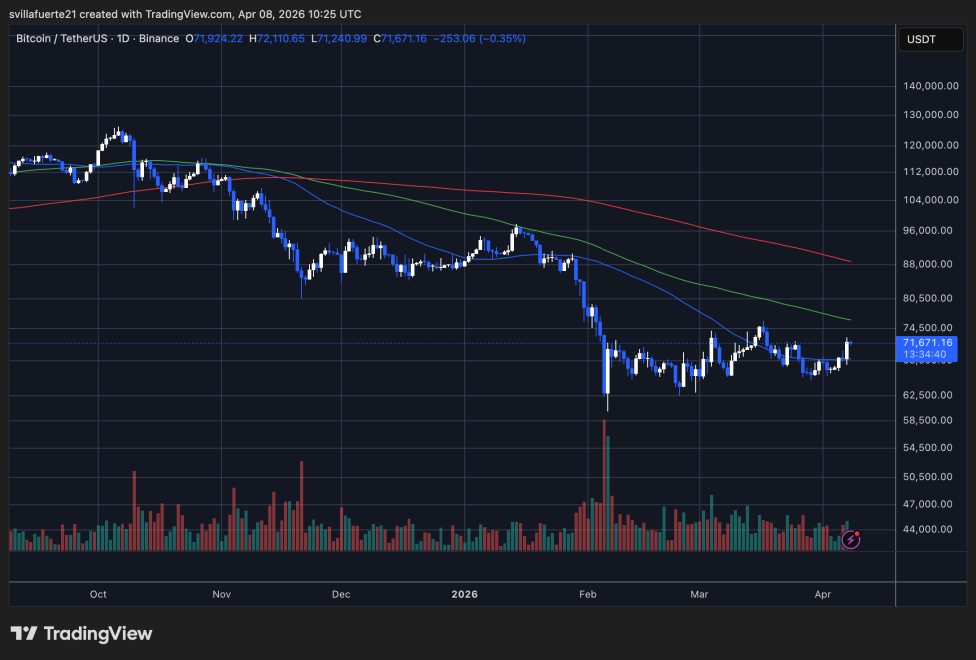
Bitcoin has pushed back above the $70,000 level after a sharp recovery from its February lows, but the broader structure remains technically fragile. The chart still reflects a clear downtrend sequence from late 2025, with price consistently trading below the 100-day (green) and 200-day (red) moving averages. Both remain downward sloping, indicating that the macro trend has not yet shifted despite the recent bounce.
BTC testing $72K level | Source: BTCUSDT chart on TradingView
The February capitulation event marked a local exhaustion point, with a spike in volume and a rapid wick below $60,000, followed by stabilization. Since then, the price has formed a range between roughly $62,000 and $72,000, with multiple failed attempts to sustain a breakout above resistance. The recent move above $70,000 is notable, but it has not yet been accompanied by a decisive expansion in volume or follow-through.
Short-term momentum has improved, as Bitcoin is now testing the 50-day moving average (blue), but this level has acted as dynamic resistance throughout the downtrend. A confirmed reclaim of this zone would be the first structural signal of strength. Until then, the current move appears corrective within a broader bearish framework, not a confirmed trend reversal.
Featured image from ChatGPT, chart from TradingView.com
Editorial Process for bitcoinist is centered on delivering thoroughly researched, accurate, and unbiased content. We uphold strict sourcing standards, and each page undergoes diligent review by our team of top technology experts and seasoned editors. This process ensures the integrity, relevance, and value of our content for our readers.
Market analysts say Bitcoin’s (BTC) is building up after its 7% rally above $72,000 on Tuesday, with bulls eyeing further gains to $90,000 amid improving macro sentiment.
Key takeaways:
BTC price builds a bullish structure after reclaiming $72,000, as a symmetrical triangle breakout targets $90,000.
Binance taker buy volume exploded by $2.7 billion in two hours after the US-Iran ceasefire, signaling strong aggressive buying by bulls.
BTC price “builds a bullish structure”
Bitcoin’s latest rally saw it reclaim key support areas, including the $68,000 zone where the 200-week exponential moving average and the 50-day simple moving average converge.
Related: Bitcoin wallets absorb 4.37M BTC as network activity flips to ‘bull phase’
“Bitcoin breaks through the crucial $71K level and builds a bullish structure,” MN Capital founder Michael van de Poppe said in a post on Wednesday.
The analyst further pointed out that the next crucial resistance zone is $80,000 and that holding the support at $70,000 was required to secure the recovery toward $90,000, as shown in the chart below.
“That would strengthen the entire theory of higher lows, higher highs, and continue the momentum upwards.”
BTC/USD daily chart. Source: X/Michael van de Poppe
From a technical perspective, BTC/USD is validating a symmetrical triangle after breaking above its upper trend line at $70,000 on Tuesday.
A daily candlestick close above this level would confirm the breakout, with the next line of resistance being the $76,000 range high.
Above that, bulls will have to contend with resistance at $80,000 before pushing Bitcoin price toward the measured target of the triangle at $90,000, 25% above the current price.
The daily relative strength index, or RSI, has increased to 56 from oversold conditions at 15 reached on Feb. 6, suggesting increasing bullish momentum.
As Cointelegraph reported, maintaining above $69,500 in the near term is crucial for the bulls to sustain the recovery.
Bitcoin bulls are “buying aggressively”
Bullish sentiment could be returning to Bitcoin as a key metric from Binance, the largest crypto exchange by trading volume, shows that buyers are starting to dominate the platform’s volumes.
The Binance taker buy volume, which measures the total dollar amount of aggressive buy orders (market buys) placed by traders on Binance futures, increased by $2.7 billion within two hours following the US and Iran ceasefire agreement on Tuesday.
“Within just two hours, during and after the announcement, $1.2B and $1.5B ($2.7B) in taker buy volume appeared on derivatives markets,” CryptoQuant contributor DarkFost said in an April 8 note, adding:
“This sudden improvement in visibility allows investors to reposition in the short term, and sends a constructive signal for Bitcoin.”
Bitcoin taker buy volume on Binance. Source: CryptoQuant
This increased flow of liquidity into Binance was also reinforced by net taker volume, which measures the imbalance between aggressive buyers and sellers in derivatives markets.
The Binance Bitcoin cumulative test taker volume has “climbed to $1.02 billion, its highest level since March 17, signaling a sharp return of aggressive buying in Bitcoin,” CryptoQuant analyst Amr Taha said, adding:
“This suggests Binance traders were buying aggressively into improving macro sentiment, not just reacting to a crypto-specific headline.”
Bitcoin Binance net taker volume. Source: CryptoQuant
Meanwhile, Bitcoin’s Coinbase premium index has flipped positive, pointing to a return in demand from US investors, following a long stretch of negative readings.
Coinbase Bitcoin Premium Index
This article is produced in accordance with Cointelegraph’s Editorial Policy and is intended for informational purposes only. It does not constitute investment advice or recommendations. All investments and trades carry risk; readers are encouraged to conduct independent research before making any decisions. Cointelegraph makes no guarantees regarding the accuracy or completeness of the information presented, including forward-looking statements, and will not be liable for any loss or damage arising from reliance on this content.
Circle Payments Network (CPN) Managed Payments let financial institutions operate in fiat, while using crypto rails behind the scenes via Circle.
Circle today launched Circle Payments Network (CPN) Managed Payments, a stablecoin settlement solution designed to simplify stablecoin transactions for traditional financial institutions, according to a press release from the firm.
The new managed solution is aimed at mainstream TradFi firms, including payment service providers, fintechs, banks, and global enterprises, per the release. The product’s core pitch is simplicity: participating firms interact solely in fiat, while Circle handles the the crypto rails in the background, namely USDC minting and burning, payment orchestration, compliance, and blockchain infrastructure.
Use cases include cross-border settlement, merchant stablecoin acceptance, high-volume payouts, and FX cost reduction, according to the releae. At launch, partners include Thunes and Worldline, alongside payments company Veem.
In recent months, UDSC has overtaken Tether’s USDT, the largest stablecoin by market cap, in terms of monthly transaction volume, per data from Visa and Allium.
Stablecoin transaction volume by asset. Source: Visa, Allium
The launch comes as stablecoins cement their role as mainstream financial infrastructure. Total stablecoin supply surged 50% in 2025 as enterprise adoption accelerated, with the GENIUS Act creating the first federal U.S. regulatory framework for the sector.
Major institutions have moved quickly: Visa launched USDC settlement on Solana in December, and the same month, Intuit struck a multi-year deal with Circle to embed stablecoin capabilities across TurboTax, QuickBooks, and Credit Karma.
Meanwhile, last month, Mastercard acquired stablecoin infrastructure firm BVNK with aims to bridge on-chain and fiat rails within the network.
This article was written with the assistance of AI workflows. All our stories are curated, edited and fact-checked by a human.