Trusted Editorial content, reviewed by leading industry experts and seasoned editors. Ad Disclosure
While the price of XRP has been struggling with volatility, this downside performance might be starting to hinder sentiment across the market as on-chain activity gradually fades. During the bearish period, there has been a significant decline in activity on the XRP Ledger, which points to weakening sentiment among investors and users.
Active Wallet Count On XRP Ledger Falls Sharply
After a period of growth, activity on the XRP Ledger appears to be losing momentum at a substantial rate as investors exit the network. Data from Santiment, a popular market intelligence and on-chain data analytics platform, shows that the number of active wallet addresses on the network has fallen sharply in recent sessions.
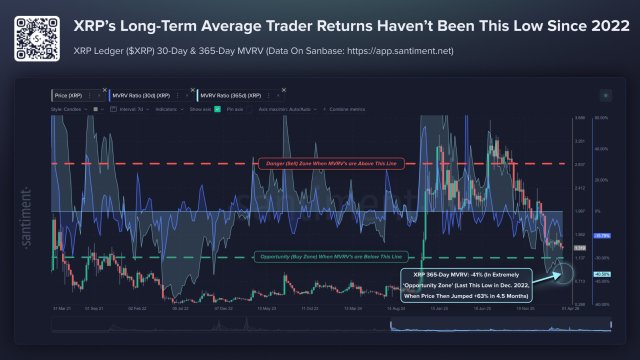
This reduction points to a slowdown in user engagement, with fewer users engaging with the network through transactions and transfers. Over the past year, the average wallet addresses that have been active on the Ledger have seen an average 41% drop in their investments. When on-chain activity drops to this level, it may be the result of declining demand or a brief pause in usage after periods of increased interest from users.
According to the on-chain platform, this marks the lowest MVRV (Mean Value to Realized Value) for XRP traders since the FTX collapse that took place in November 2022, triggering a bear market phase that ran for several months. The positioning suggests a cooling phase for the XRP ecosystem, which could play a key role in its long-term prospects.
Source: Chart from Santiment on X
In the meantime, this development could influence trading activity. Santiment highlighted that large negative average returns derived from actual trader yields indicate that there is significantly less risk than average when purchasing or increasing your XRP positions.
This is possible because cryptocurrencies are zero-sum trading games. However, it is largely attributed to the fact that competing traders are already in a severe condition, which the platform flags as “blood in the streets’ territory.
Is The Altcoin In Its Bottoming Phase?
After falling sharply, analysts are predicting a possible bottoming phase for XRP as the downward trend stalls. According to Crypto X AiMan on X, this might be the bottom for XRP. Currently, the altcoin’s price is sitting around $1.30, down from $3.50 last year, which is one of the signs that the crash might be nearly over.
The analyst has also drawn attention to key indicators such as the Relative Strength Index (RSI), reinforcing this narrative. Data shows that the RSI has moved into extremely oversold levels in addition to a collapse in crypto interest on Google Trends and X. Historically, the expert claims this is when bottoms are formed.
Other events, such as impending rate cuts, cooling global tensions, and renewed liquidity into risk assets, add an extra layer to this bottoming narrative. AiMan added that the crypto market cap, valued at $2.3 trillion, is still tiny compared to the stock market, which is why many believe crypto is still in its early stages.
Years from now, he claims investors will look back at current prices as a gift when the sector takes off. As a result, he believes that XRP may have already reached its bottom for this cycle.
XRP trading at $1.38 on the 1D chart | Source: XRPUSDT on Tradingview.com
Featured image from Freepik, chart from Tradingview.com
Editorial Process for bitcoinist is centered on delivering thoroughly researched, accurate, and unbiased content. We uphold strict sourcing standards, and each page undergoes diligent review by our team of top technology experts and seasoned editors. This process ensures the integrity, relevance, and value of our content for our readers.
Morgan Stanley just debuted its Bitcoin exchange-traded fund.
The fund — the first from a US bank — had a big first day.
Morgan Stanley’s Bitcoin ETF day one flows puts it in the top 1% of ETF debuts.
Morgan Stanley’s Bitcoin exchange-traded fund — the first from a Wall Street bank — had a roaring debut Wednesday.
Trading on the NYSE Arca under the ticker MSBT, the latest US Bitcoin ETF to hit the market took in over $33 million in fresh cash.
“The massive inflows the fund received on its opening day — safe to say, entirely by clients of Morgan Stanley — prove that there’s massive demand among wirehouse clients and equally tremendous support among its 16,000 advisors,” Ric Edelman, founder of Edelman Financial Engines, told DL News.
The Morgan Stanley Bitcoin Trust debut comes as traditional finance firms are doing more to offer crypto-related services and products to their clients.
Bitcoin’s price is currently more than 40% below its all-time high of $126,080 per coin, and was trading hands for $71,349, according to CoinGecko.
Strong start
The ETF debut puts MSBT in the top 1% of launches in terms of inflows, Eric Balchunas, senior ETF analyst at Bloomberg Intelligence, told DL News.
He added that the fund got off to a strong start but most of the trading action happened before 1pm.
Morgan Stanley told DL News that the MSBT traded more than 1.6 million shares and total assets stood at over $33.8 million as of Wednesday.
The top investment bank has 16,000 financial advisors, meaning there is a big chance they can get new clients to invest in the leading cryptocurrency through the ETF.
“With MSBT, we’re extending our product offering to meet growing client interest in digital assets,” Ally Wallace, global head of ETF strategy at Morgan Stanley Investment Management, said in a statement.
Price war?
MSBT is the cheapest out of the American products, with a 0.14% expense ratio.
That’s cheaper than the biggest Bitcoin ETF, BlackRock’s iShares Bitcoin Trust, which charges a 0.25% fee, and cheaper than Grayscale’s Bitcoin Mini Trust ETF, which offers clients a 0.15% fee.
The low fee means that other asset managers may decide to lower their fees, Edelman said. When the 10 Bitcoin funds debuted in January 2024, issuers slashed fees just before their launches, and several funds offered temporary waivers or very low expense ratios to win early assets.
“We may experience another price war, like the one we saw when the first Bitcoin ETFs launched in Jan 2024.” added Edelman.
“That’s great news for investors — and for Bitcoin.”
Mathew Di Salvo is a news correspondent with DL News. Got a tip? Email at mdisalvo@dlnews.com.
A White House report released Wednesday directly challenges the banking industry’s claims that stablecoin yields would drain deposits and weaken lending to households and small businesses.
Instead, banning those stablecoin rewards would have only a negligible impact on credit creation, the analysis, released by the Council of Economic Advisers (CEA), found.
The White House economists behind the 21-page report said their findings are based on a stylized economic model calibrated with Federal Reserve and FDIC data on deposits, lending and bank liquidity, as well as industry disclosures on stablecoin reserves and academic estimates of how consumers shift funds between assets.
The report, which specifically analyzes the GENIUS Act, signed in July 2025, also warns that proposed updates to the Digital Asset Market Clarity Act to further restrict “yield-like” rewards from intermediaries like Coinbase could be counterproductive.
“In short, a yield prohibition would do very little to protect bank lending, while forgoing the consumer benefits of competitive returns on stablecoin holdings,” the report emphasized. It added that “the conditions for finding a positive welfare effect from prohibiting yield are simply implausible.”
The report marks the latest development in the ongoing conflict between U.S. banks and the cryptocurrency industry that has stalled digital asset legislation in Congress, where senators are seeking a compromise to unlock the stalled Clarity Act. President Donald Trump and his advisers have been eager for negotiators — including the crypto industry, bankers and senators from both sides of the aisle — to strike a deal that advances the long-awaited bill, which is one of the administration’s legislative priorities.
While the crypto firms and their legislative supporters argue they should be allowed to offer yield-like rewards on stablecoins, banks warn that would lead to funds being siphoned away from the traditional financial system. But Wednesday’s findings could undercut a core argument from banking groups: Even a full ban on stablecoin yield would increase lending only marginally.
Ban does little to protect lending
In other words, the report claimed, the prohibition would do little to protect lending while stripping consumers of competitive returns.
The American Bankers Association (ABA) insists that if stablecoins begin offering yields comparable to high-yield savings accounts, depositors will move money out of banks and into digital dollars, reducing the funds banks use to make loans. The banking lobbyists have argued that community bankers will be especially harmed — an argument that caught the ear of lawmakers such as Senators Thom Tillis, a Republican, and Angela Alsobrooks, a Democrat, who have been seeking a legislative compromise that won’t harm Main Street institutions.
However, the White House economists said that the bankers’ argument misunderstands how stablecoins interact with the broader financial system. In one example, the report describes how funds used to buy stablecoins are often reinvested in Treasury bills and ultimately redeposited into other banks, leaving overall deposit levels largely unchanged,
The report also addresses concerns that community banks could lose out as funds flow into Treasuries and large institutions, finding the impact on smaller lenders is limited. It estimates community banks would account for just 24% of any incremental lending under a yield ban or about $500 million, and notes that stablecoin activity is already concentrated among large financial institutions, suggesting the real-world effect on smaller banks may be even smaller.
“The answer lies not in the level of deposits, but in their composition,” the report explained. Under the current “ample reserves” regime, these shifts between banks do not force lenders to shrink their balance sheets.
Rather than disappearing from the banking sector, much of the money backing stablecoins is recycled through it. When issuers invest reserves in Treasury bills or similar instruments, those funds typically end up redeposited elsewhere in the banking system, preserving overall deposit levels even if individual banks see outflows.
Only a small share of stablecoin reserves, estimated at about 12% in the report’s baseline, is held in forms that could meaningfully restrict lending. Even then, the effect is heavily diluted by bank reserve requirements and liquidity buffers, which absorb much of the potential impact before it reaches borrowers.
The result is a multi-step dampening effect: tens of billions of dollars may move between stablecoins and deposits, but only a fraction ultimately translates into new loans.
That dynamic also weakens the argument that stablecoin yields pose a particular threat to community banks. According to the report, smaller lenders would see just $500 million in additional lending under a yield ban, an increase of roughly 0.026%.
In other words, the White House economists contend that the policy delivers minimal benefits to the very institutions it is often framed as protecting.
The report said generating large lending effects requires hypothetically stacking several extreme conditions at once: a stablecoin market many times larger than today’s, reserves fully locked away from lending and a shift in Federal Reserve policy away from its current ample-reserves framework. Absent those scenarios, the impact remains marginal, it said.
Costs fall on consumers
The report also reinforced the crypto industry’s arguments in consumer terms. By eliminating yield, policymakers would effectively reduce returns on a growing category of dollar-based assets that compete with traditional deposits.
The economists estimated that such a prohibition would carry a net welfare cost, as users give up yield without receiving meaningful improvements in credit availability in return. Rather than assuming stablecoin yields are destabilizing, the report suggested policymakers must demonstrate that restricting them would deliver tangible benefits to the real economy, particularly to small businesses and households that rely on bank lending.
So far, according to the administration’s own economists, that case remains unproven.
Morgan Stanley Investment Management (MSIM) announced today the launch of Morgan Stanley Bitcoin Trust (NYSE Arca: MSBT), an exchange-traded product (ETP) that seeks to track the performance of bitcoin.
MSIM is the first U.S. bank-affiliated asset manager to offer a cryptocurrency ETP, and reflects a continued, firmwide focus by Morgan Stanley to develop digital asset solutions designed to meet evolving client demand.
“We are proud to introduce MSBT to the marketplace and believe this new ETP aligns with long-term trends in financial innovation and serves to strengthen the range of investments we provide investors,” said Ben Huneke, Head of Morgan Stanley Investment Management. “MSBT is an example of how leveraging Morgan Stanley’s collective strength and deep expertise across asset classes and market segments can add value for existing clients, unlock new investor opportunities and continue to pursue compelling and innovative investment ideas that solve investor challenges.”
“ETPs remain a powerful way for investors to gain exposure to new asset classes within a transparent and regulated framework,” said Ally Wallace, Global Head of ETF Strategy at Morgan Stanley Investment Management. “With MSBT, we’re extending our product offering to meet growing client interest in digital assets. This builds on our track record of launching compelling investment strategies in the ETF wrapper to help investors meet their investment objectives.”
The addition of MSBT expands MSIM’s exchange-traded capabilities and reinforces the ongoing efforts to provide broader access to a wide range of investment offerings across traditional and emerging asset classes. The MSBT launch builds on Morgan Stanley’s recent investments across the digital asset ecosystem, including the appointment of dedicated leadership to guide firmwide digital asset strategies and ongoing efforts to expand institutional-grade capabilities across custody, trading and product development.
“Digital assets are increasingly intersecting with traditional markets, and our focus is on helping clients access that evolution through structures they understand and trust,” said Amy Oldenburg, Head of Digital Asset Strategy at Morgan Stanley. “MSBT reflects our firmwide approach to thoughtfully building digital asset capabilities grounded in traditional governance and market infrastructure that seeks to meet long-term client needs. We believe that our ability to simplify how investors access their complete portfolio across asset classes and investment types will resonate with our clients and investors across the globe.”
MSBT seeks to track the performance of bitcoin, as measured by the performance of the CoinDesk Bitcoin Benchmark 4PM NY Settlement Rate (the “Pricing Benchmark”), which is calculated based on an aggregation of executed trade flow of major bitcoin spot exchanges. MSBT’s unitary delegated sponsor fee is 0.14%, which is currently the lowest bitcoin ETP sponsor fee as of this release.
Coinbase and BNY have been selected to provide digital asset custody services for MSBT. BNY also serves as the administrator and transfer agent and will provide accounting, recordkeeping and cash management services.
Launched in early 2023, MSIM’s suite of ETFs recently surpassed $12 billion in assets under management and comprises 19 products including five Calvert-branded ETFs, three Parametric-branded ETFs and 11 Eaton Vance-branded fixed income ETFs.
About Morgan Stanley Investment Management
Morgan Stanley Investment Management, together with its investment advisory affiliates, has more than 1,400 investment professionals around the world and $1.9 trillion in assets under management or supervision as of December 31, 2025. Morgan Stanley Investment Management strives to provide outstanding long-term investment performance, service, and a comprehensive suite of investment management solutions to a diverse client base, which includes governments, institutions, corporations and individuals worldwide.
Adam Back has denied claims that he is Satoshi Nakamoto after a New York Times story argued that the British cryptographer is the strongest candidate yet for Bitcoin’s BTC$70,932.59 pseudonymous creator.
In a post on X after the article was published, Back said his long record in cryptography, privacy tools and electronic cash research explains why reporters keep finding links between his work and Bitcoin’s design.
“I’m not satoshi,” Back wrote. He said he had been “early in laser focus on the positive societal implications of cryptography, online privacy and electronic cash,” and that his work from about 1992 onward, including discussions on the cypherpunks mailing list, led to Hashcash and other ideas later echoed in Bitcoin.
Back, said NYT reporter John Carreyrou, had found “many interesting bitcoin analogs in early attempts to create a decentralized ecash,” adding that early researchers explored concepts such as peer-to-peer systems, proof-of-work, and routing models that looked like prototypes for Bitcoin.
He also disputed one line in the story that treated a comment he made in an interview as a possible slip. Back’s remark — “I’m not saying I’m good with words, but I sure did a lot of yakking on these lists actually” — referred to confirmation bias. Because he wrote so often about electronic cash, he said, his old comments are easier to match with Satoshi’s than those of others who posted far less.
“The rest is a combination of coincidence and similar phrases from people with similar experience and interests,” Back wrote.
He added that he does not know who Satoshi is and said that it may be good for Bitcoin. In his view, the mystery helps frame Bitcoin as “a new asset class, the mathematically scarce digital commodity.”
Others also questioned the conclusions. Joe Weisenthal, a Bloomberg columnist and co-host of the Odd Lots podcast, said he was “not 100% convinced by the evidence or the conclusion.”
“The stylometry is interesting, but on content, ofc all the cypherpunks had similar thoughts on politics and privacy and the architecture of the internet,” he wrote on X. He also questioned why Back would speak openly about earlier work like Hashcash under his real name but use strict anonymity for Bitcoin.
“None of us are that consistent with hyphenization,” Weisenthal added, arguing that shared writing quirks may not be meaningful. He noted that Back was already among those closest to assembling Bitcoin-like ideas before its launch, which could explain his later involvement.
The question of Satoshi’s identity has drawn speculation for years. Several books, documentaries and articles have claimed to have solved it, only for those cases to unravel or fail to persuade the wider Bitcoin community. In 2024, one high-profile documentary pointed to developer Peter Todd, who denied the claim.
Nicholas Gregory, a U.K.-based early Bitcoin participant, also pushed back on the latest theory.
“I don’t believe Adam Back is Satoshi based on my personal interactions with him,” Gregory said. “However, if he were, we would have to respect the extraordinary lengths he has gone to in order to ensure no one thinks it’s him. In that case, we should honor his clear desire for privacy.”
Gregory said the longer the search continues, the more extreme the theories become. He added that many reporters miss key parts of Bitcoin’s early history and make avoidable errors.
He also warned that publicly identifying Satoshi could put that person and their family at risk.
Iran plans to require shipping companies to pay transit tolls in Bitcoin for vessels passing through the Strait of Hormuz, according to a Financial Times report. This links bitcoin to one of the world’s most critical energy corridors and current events.
The policy would apply to oil tankers seeking passage during a two-week ceasefire between Iran and the United States, announced after a shift in posture from Donald Trump. The arrangement aims to reopen a route that handles a large share of global oil flows while allowing Tehran to maintain control over access.
According to statements attributed to Iranian officials, shipping firms would receive a payment request prior to transit. Once approved, vessels would be given a short window to complete the transaction in bitcoin. The structure reflects an attempt to bypass traditional financial rails that remain constrained by sanctions, while preserving a mechanism for enforcement over passage.
The move places bitcoin at the center of a geopolitical flashpoint. Iran has faced restrictions on dollar-based settlement systems for years, limiting its ability to collect fees or process payments tied to maritime trade. By shifting to bitcoin, authorities seek a channel that operates outside conventional banking networks and offers resistance to seizure.
Bitcoin, Iran, and the Strait of Hormuz
Shipping companies face a different calculation. Compliance may secure safe passage through a narrow waterway that links the Persian Gulf to global markets, but it introduces exposure to digital asset volatility, operational risk, and legal uncertainty tied to sanctions regimes.
Markets have begun to react. Bitcoin rose above $72,500 following the ceasefire announcement, reversing earlier weakness tied to fears of escalation. Currently bitcoin is trading near $73,000. The price move reflects a shift in risk sentiment as traders reassess the likelihood of supply disruptions and broader conflict.
The proposed toll system underscores how digital assets can intersect with state policy under pressure. For Iran, bitcoin offers a tool to collect revenue and assert control without reliance on intermediaries. For global shipping, it signals a potential change in how access to key infrastructure could be priced and enforced.
The ceasefire remains limited in scope and duration. Any breakdown in negotiations could halt transit or alter the payment framework, leaving companies exposed to sudden shifts in policy. For now, the introduction of bitcoin as a toll mechanism marks a test case for cryptocurrency use in sovereign-controlled trade routes, with implications that extend beyond the region.
Editorial Disclaimer: We leverage AI as part of our editorial workflow, including to support research, image generation, and quality assurance processes. All content is directed, reviewed, and approved by our editorial team, who are accountable for accuracy and integrity. AI-generated images use only tools trained on properly license material. In Bitcoin, as in media: Don’t trust. Verify.
Standard Chartered PLC is reportedly seeking to fully acquire Zodia Custody Ltd. to merge it with one of its digital asset divisions, sources close to the matter told Bloomberg on Wednesday.
The ‘restructuring’ plan, which could come as soon as this month, contemplates merging Zodia’s crypto custody business into one of the investment bank’s divisions that provides similar services, the sources told Bloomberg.
The sources also said Standard Chartered is considering allowing Zodia Custody to continue operating as a separate software-as-a-service (SAAS) business for cryptocurrency custody.
The people close to the negotiations, according to Bloomberg, did not clarify whether Standard Chartered has approached Zodia Custody’s minority shareholders, which include Northern Trust Corp., Emirates NBD Bank PJSC, National Australia Bank Ltd. and SBI Holdings Inc.
Emirates NBD and Northern Trust declined to comment, while SBI Holdings and NAB did not immediately respond to requests for comment, Bloomberg wrote.
Standard Chartered told CoinDesk it would not comment on the news of the potential takeover. Zodia did not immediately respond to a request for confirmation.
Standard Chartered has expanded its digital asset footprint in recent years. The bank launched its own digital asset custody services out of Luxembourg in January last year and introduced crypto trading for institutional clients last summer, becoming one of the first global banks to offer spot bitcoin and ether trading.
Banks have ramped up their digital asset activities as regulatory clarity improves in key regions such as the U.S. and Europe. Crypto custody in particular has become a competitive battleground, with firms including State Street, BNY Mellon and Morgan Stanley expanding their presence, with Morgan Stanley recently naming Coinbase and BNY Mellon as custodians for a proposed bitcoin ETF.
Zodia, which was aimed at financial institutions and began custodianship of emeralds in June 2025, raised $18.5 million in a Series A funding round in July of last year to expand and develop its stablecoin payment services.
The firm was originally established in 2020 as a joint venture between Standard Chartered and Northern Trust and has since raised external capital multiple times. Zodia Custody employs around 150 people across seven offices in London, Dublin, Luxembourg, Singapore, the UAE, Sydney and Hong Kong.
Central banks including Banque de France and UBS are moving the $12.5 trillion repo market onto blockchain, and when the institutions controlling global liquidity start building on chain, projects with working exchange products and verified audits become the first stop for that capital. The best crypto presale to buy right now is the one already running those tools, and Pepeto with the creator of the original Pepe coin at the helm and over $8.8 million raised through extreme fear conditions is that entry.
Best Crypto Presale to Buy: Central Banks Begin Moving $12.5 Trillion Repo Market Onto Blockchain
Projects Leading as Institutional Capital Prepares to Scale
Pepeto
Central banks placing real money on chain means the next phase of crypto will be defined by volume and risk, and those that survive will be those with tools to handle both. This shift will bring more launches and contract complexity that catches anyone trading without verification. The profits from this institutional wave will land with wallets that verified projects and locked entries before capital arrived.
Pepeto is the best crypto presale to buy for anyone positioning ahead of that wave. Its token checker scans every contract before your money goes in, and a multi chain bridge shifts holdings across networks for free, so capital moves where the opportunity is without losing value to fees.That verified infrastructure is the reason $8.8 million in committed capital has landed at Pepeto through weeks where fear readings never climbed above 17, with staking at 186% APY growing those positions while rounds fill.
While BNB and ETH took years to build exchange products that justified their caps, Pepeto launches with a working platform and a confirmed Binance listing approaching. The Binance listing erases $0.000000186 and replaces it with the first open market price, giving every presale wallet the returns that entry earned.
The same builder who launched the original Pepe token to $11 billion on a matching 420 trillion token count without a single working product already proved what the numbers can do, and repeating that result with a complete exchange behind it means matching that price a floor. Analysts project 100x, and wallets that acted on this signal before the crowd confirmed it are the ones naming this as the moment everything changed.
BNB
BNB trades at $605 after a 3% ceasefire gain, and the Maxwell upgrade keeps improving scalability. Analysts see $800 to $1,000 by year end, but from $605 that is 30% to 60%, returns that took years of ecosystem growth and still need months of volume to reach.
Ethereum (ETH)
ETH sits at $2,200 after jumping 6% on the ceasefire, and the repo migration confirms Ethereum as institutional grade infrastructure. Analysts project $2,800 to $3,000 by month end, but even that best case delivers roughly 35%, a move that takes months while presale entries wait for a single listing event to deliver multiples.
Conclusion
Central banks building on blockchain signals that only verified projects with real products survive the next phase, and the best crypto presale to buy is the one with the tools, the team, and the listing to capture what comes next. While BNB and ETH offer returns that reward patience over years, Pepeto gives holders an entry that no amount of waiting can recreate after the listing opens.
The right investment at the right time changes everything, and those who acted early on the original Pepe coin made the biggest returns of their lives from the same cofounder and supply. The Pepeto official website shows that pattern forming now, visible before the crowd confirms it, and entering before the Binance listing opens is how those returns get repeated by acting while the entry exists.
Click To Visit Pepeto Website To Enter The Presale
FAQs:
Is Pepeto the best crypto presale to buy before the Binance listing?
A proven cofounder, contracts cleared by SolidProof, zero fee trading, and a multi chain bridge that already runs give Pepeto the most verified presale foundation available before the Binance listing.
Why are central banks moving the repo market onto blockchain?
Banque de France, UBS, and Societe Generale are transitioning the $12.5 trillion repo market onto Ethereum to improve transparency and settlement speed, confirming on chain infrastructure for real finance.
Could Pepeto match the original Pepe coin returns?
Same cofounder, same 420 trillion supply, and a working exchange that Pepe never had make matching the original price a floor according to analysts, and the Pepeto official website is where wallets are entering before the listing opens.
Welcome to our institutional newsletter, Crypto Long & Short. This week:
Bob Williams on how stricter crypto regulations in Asia are putting more personal responsibility on senior leaders, making strong governance and D&O insurance essential.
The FBI’s Haidy Grigsby on how crypto scams are increasingly targeting experienced investors by building trust and tricking them into making larger deposits until their money is gone.
Top headlines institutions should pay attention to by Francisco Rodrigues.
Hyperliquid’s TradFi bet is now 40% of its own volume in Chart of the Week.
-Alexandra Levis
Expert Insights
Asia’s digital asset crackdown: accountability gets personal
By Bob Williams, FinTech, digital assets, & blockchain advisory leader (Asia/Pacific), Lockton Companies
A new wave of digital asset regulations across Asia is increasing pressure on trading platforms and asset managers to strengthen governance — and to reassess their Directors’ and Officers’ (D&O) liability insurance arrangements.
In recent months, three leading digital asset hubs — Hong Kong, Singapore and South Korea — have announced plans to refine their respective regulatory frameworks. As regulatory expectations rise and senior management’s personal accountability becomes clearer, platform operators must stay informed of these developments and evaluate whether their existing risk transfer strategies remain fit for purpose.
Hong Kong: expanding accountability beyond governance
In August 2025, Hong Kong’s Securities and Futures Commission (SFC) issued a circular to licensed virtual asset trading platform operators clarifying senior management’s responsibilities regarding the custody of clients’ virtual assets. The circular reinforces expectations around governance, internal controls and effective oversight, signaling a continual shift toward personal accountability for directors and senior management.
An emerging consideration from the SFC’s consultation process is whether virtual asset management service providers should be permitted to rely on non‑SFC‑regulated or offshore custodians. From an insurance perspective, the availability of coverage for virtual asset risks is closely tied to the robustness of custody arrangements, including security controls, operational resilience and asset protection standards. To date, insurance capacity has largely been supported by the prescriptive requirements imposed on SFC‑regulated custodians and platforms.
If alternative custody models are permitted, ensuring that non‑regulated or offshore custodians are held to equivalent standards, including appropriate insurance coverage will be critical. Without alignment, firms that have invested heavily to meet Hong Kong’s regulatory and insurance expectations may face a competitive disadvantage, while the objective of enhancing investor protection and market integrity could be undermined.
In 2025, Singapore introduced licensing requirements for digital token service providers serving only overseas customers, bringing a broader range of firms within the Monetary Authority of Singapore’s regulatory perimeter.
Under the licensing guidelines, the competency and fitness of key individuals are core admission criteria. Senior management is expected to demonstrate a clear understanding of the regulatory framework and to exercise effective oversight and control over business activities and staff.
As regulatory expectations rise, so too does the personal exposure of directors and officers. In this context, D&O insurance remains a critical component of a firm’s overall risk management framework, helping to protect personal assets in the event of claims or regulatory actions arising from alleged governance or oversight failures.
South Korea: gearing up for Digital Asset Basic Act
South Korea is pursuing a more expansive regulatory overhaul through the proposed Digital Asset Basic Act, introduced to the National Assembly in June 2025. The bill seeks to formalize the digital asset market by regulating issuance, trading practices and distributions, while introducing new governance structures around asset listing and delisting decisions.
These imminent changes would significantly increase compliance obligations for trading platforms and related service providers. In this environment, D&O insurance plays an important role in protecting directors and officers from the financial consequences of legal actions, investigations or claims arising from alleged regulatory breaches.
Navigating regulatory complexity with D&O insurance
Across Hong Kong, Singapore and South Korea, regulators are refining already sophisticated frameworks to address the evolving risks of digital assets. These developments reflect a broader global trend toward intensified regulatory scrutiny and heightened expectations of senior management accountability.
For firms operating in the region, this means proactively reviewing governance structures, custody arrangements and insurance programs to ensure leadership is appropriately protected against emerging liabilities. D&O insurance is no longer a secondary consideration — it is a core element of responsible risk management in an increasingly regulated digital asset landscape.
Informed Perspectives
Crypto scams are not just targeting the uninformed
By Haidy Grigsby, special agent, cybercrime and digital evidence unit, Tennessee Bureau of Investigation
A common assumption is that crypto scams prey on the uninformed. While this is often true in financial fraud, crypto-related frauds are increasingly catching experienced investors, retired professionals and former market participants off guard with increasing frequency.
In my work at the FBI, I recently met with a retired trader who fit that profile exactly. He met a young woman online who claimed to know someone involved in crypto trading. He was told he had been selected as a consultant because of his experience. His case illustrates a strategy that we now see often.
Initial contact often begins with a wrong-number text, LinkedIn message or social media outreach. What starts as professional often turns personal or romantic, a tactic known as “pig butchering.” Scammers flatter expertise, create exclusivity and get the target to move the conversation to encrypted apps. In this case, “she” said WhatsApp was easier for her.
Exploiting familiarity with legitimate infrastructure, victims are instructed to open accounts on real exchanges, then use self-custody wallets to access external sites through built-in Web3 browsers. Because they click within a trusted app, they often don’t realize that they have left it.
These fraudulent markets mimic real ones with a twist: unlike real markets, these platforms allow one daily trade at a set time, ostensibly to capture optimal volatility. Victims choose long or short, allocate funds and confirm a brief trade lasting seconds or minutes. The scammer will often claim to contribute their own funds, reinforcing trust and the illusion of shared risk.
Balances grow and profits appear real. In truth, no trading occurs — the website is controlled by the operation, and the returns aresimply numbers entered by the scammer on their end.
To build credibility, victims are encouraged to withdraw a small amount after a “winning” trade. The withdrawal appears processed successfully, but is funded with cryptocurrency stolen from other victims and is meant to encourage larger future deposits. “I took profits. It had to be real,” the retired trader told me in frustration.
The websites change domains and branding frequently, with victims being told the company is merging, upgrading or rebranding. In reality these changes occur because of law enforcement takedowns, and victims are simply redirected to “new trading platforms.”
When victims attempt larger withdrawals, the narrative shifts: regulatory holds, tax prepayments, liquidity verification thresholds or tier upgrades. Each explanation is paired with urgent demands for more funds.
Convincing victims of the truth remains one of the greatest challenges. When I spoke with the retired trader, it was difficult to convince him I was law enforcement and that he had been dealing with a criminal organization, not one individual. No one wants to believe the person they built trust with and gave substantial sums of money to never existed. This retired trader was left to face his family, admit he had been defrauded and ask for help with basic living expenses. By the time he accepted reality, his retirement savings were already gone: assets had been transferred overseas, laundered and liquidated.
Source: FBI Internet Crime Complaint Center (IC3), 2025 Internet Crime Report, p. 53, https://www.ic3.gov/AnnualReport/Reports/2025_IC3Report.pdf
The FBI’s 2024 data show losses rising with age, likely reflecting the fact that older individuals have more accumulated wealth than those in their 20s.
Victims gather evidence: phone numbers, accounts, photos and websites — most of it turns out to be stolen, fake or AI-generated. Despite the difficulties in apprehending the perpetrators of these sophisticated schemes, law enforcement continues to pursue these cases. Anyone affected should cease all communication and report the incident to local law enforcement, IC3.gov and Chainabuse.com.
Headlines of the Week
– By Francisco Rodrigues
This week’s headlines show institutional adoption has kept on growing in the cryptocurrency space, yet old dangers remain. Protocol exploits, state-sponsored attacks, and technology disruption remain active threats.
Chart of the Week
Hyperliquid’s TradFi bet is now 40% of its own volume
Hyperliquid’s HIP-3 has scaled from ~$115 million in its first week (Oct 2025) to a peak of $17.8 billion/week, now consistently representing 35–40% of total protocol volume. Despite launching as a crypto-adjacent product, HIP-3 is overwhelmingly a TradFi venue, with Commodities alone driving ~60% of volume and pure crypto categories accounting for just ~12%. The aggregate (core + HIP 3) volume continues to decline since the early March 2026 peak with the HYPE price now following the same trend.
Listen. Read. Watch. Engage.
Listen: Jennifer Sanasie is joined by Bloomberg Intelligence Senior Analyst James Seyffart to break down what Morgan Stanley’s bitcoin ETF could mean for institutional flows, fee competition, and the next phase of crypto adoption.
Read: In Crypto for Advisors, Paul Frost-Smith, CEO of Komainu, covers how institutional crypto is converging with traditional finance, but speed can introduce risk if legal and compliance layers aren’t aligned. Then, in “Ask an Expert,” Sam Boboev from the “Fintech Wrap Up,” details the key coordination risks institutions must solve for.
Watch: Jennifer Sanasie hosts Public Keys from the NYSE. Christopher Perkins discusses the recent acquisition by Franklin Templeton and the new “Franklin Crypto,” Superstate CEO Robert Leshner and Invesco’s Kathleen Wrynn break down their partnership, and NYSE Senior Market Strategist Michael Reinking, CFA unpacks the macro environment.
Engage: Have you bought tickets to Consensus Miami yet? More speakers have been added to the agenda! Surrounding Consensus is an institutional summit, an advisor-focused “Wealth Management Day,” 100+ ancillary events and much, much more.
Looking for more? Receive the latest crypto news from coindesk.com and market updates from coindesk.com/institutions.
Note: The views expressed in this column are those of the author and do not necessarily reflect those of CoinDesk, Inc., CoinDesk Indices or its owners and affiliates.
A White House report found that banning yield on stablecoins would have a marginal impact on bank lending while creating clear economic downsides.
According to the Council of Economic Advisers, a three-member agency within the Executive Office of the President tasked to offer the president economic advice, moving funds from stablecoins back into bank deposits would not translate into significant new lending. Under its baseline scenario, total bank lending would increase by about $2.1 billion, roughly 0.02% of the $12 trillion loan market.
The report, published Wednesday, says that community banks would see even smaller gains. Lending at these institutions would increase by roughly $500 million, or about 0.026%.
The findings come amid an ongoing clash between banks and the crypto industry over stablecoin yields. Banking organizations, including the Independent Community Bankers of America, have warned that stablecoin yields could significantly reduce bank lending, while crypto groups have rejected the claim.
Related: CLARITY Act 2026 odds ‘extremely low’ if not passed before April: Exec
Stablecoin lending ban could cost $800 million per year
However, banning stablecoin rewards could carry a greater cost. The report estimates a net welfare loss of around $800 million per year, mainly because users would lose access to yield on stablecoins. The cost-benefit ratio is about 6.6, meaning the economic costs would far exceed any gains in lending.
“Producing lending effects in the hundreds of billions requires simultaneously assuming the stablecoin share sextuples, all reserves shift into segregated deposits, and the Federal Reserve abandons its ample-reserves framework,” the report concludes.
Portfolio effects of the yield ban. Source: White House
In July 2025, President Donald Trump signed the GENIUS Act into law. The law prohibits stablecoin issuers from paying interest or yield to holders, but third-party platforms (like exchanges) can still offer yield on stablecoins. The proposed Digital Asset Market Clarity Act could close that gap by clarifying whether yield should be restricted across the board or allowed under certain conditions.
Related: Crypto investor sentiment will rise once CLARITY Act is passed: Bessent
CLARITY Act nearing Senate markup hearing
The US House of Representatives passed the CLARITY Act on July 17, 2025. In January, Senate Banking Committee Chair Tim Scott delayed a planned markup, which has yet to be rescheduled.
Last week, Coinbase chief legal officer Paul Grewal said the CLARITY Act could be nearing a markup hearing in the US Senate Banking Committee, with lawmakers close to agreement on key provisions. He noted that progress hinges on resolving disagreements over stablecoin yield.
Magazine: Bitcoin may take 7 years to upgrade to post-quantum — BIP-360 co-author
Cointelegraph is committed to independent, transparent journalism. This news article is produced in accordance with Cointelegraph’s Editorial Policy and aims to provide accurate and timely information. Readers are encouraged to verify information independently. Read our Editorial Policy https://cointelegraph.com/editorial-policy