Share
Share
Share
Share
Email
In the rapidly evolving landscape of regenerative medicine, few molecules have garnered as much attention as Nicotinamide Adenine Dinucleotide (NAD+). Often referred to as the “miracle molecule” or the “cellular fuel” of the body, NAD+ is a coenzyme found in every living cell. While the public often focuses on its anti-aging potential, the scientific community remains fascinated by its intricate chemical architecture and the complex biosynthetic pathways that maintain its levels.
For researchers seeking high-quality materials, finding reliable Peptides for Sale is only the first step. Understanding the “how” and “why” of NAD+ at a molecular level is essential for unlocking its full therapeutic potential.
The Chemical Architecture of NAD+
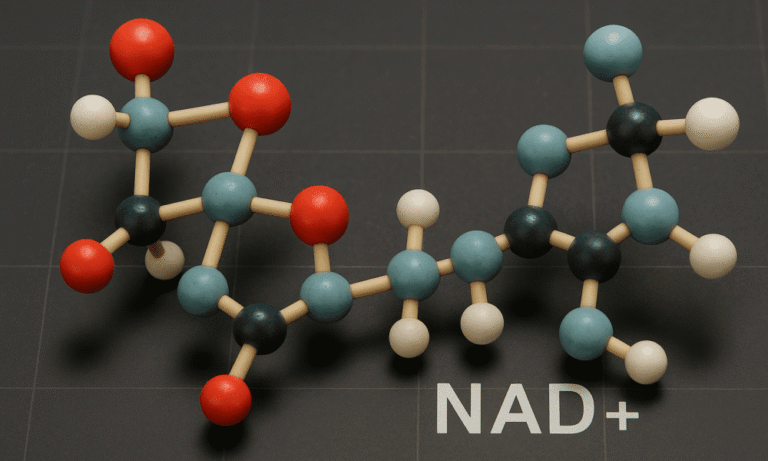
To understand how NAD+ works, one must first look at its structural blueprint. Chemically, NAD+ is a dinucleotide. In biochemistry, a “nucleotide” is a building block composed of a nitrogenous base, a sugar, and a phosphate group. NAD+ is formed by joining two of these building blocks together.
The Two Pillars of the NAD+ Structure
- Adenosine Monophosphate (AMP): This part of the molecule consists of the adenine base the same base found in DNA attached to a ribose sugar and a phosphate group.
- Nicotinamide Monophosphate (NMN): This is the functional “business end” of the molecule. It contains the nicotinamide ring (derived from Vitamin B3), a ribose sugar, and a phosphate group.
These two nucleotides are linked by a pyrophosphate bond (two phosphate groups joined together). This unique arrangement allows the molecule to act as a versatile electron carrier. The nicotinamide ring is particularly special because it can exist in two states: the oxidized form (NAD+) and the reduced form (NADH).
The Redox Powerhouse
The “+” in NAD+ signifies its oxidized state, meaning it is “hungry” for electrons. When it participates in metabolic reactions like glycolysis or the Krebs cycle, it accepts a hydride ion (one proton and two electrons) to become NADH.
This ability to flip-flop between states is the fundamental mechanism of cellular respiration. Without this chemical flexibility, our cells would be unable to convert the food we eat into Adenosine Triphosphate (ATP), the energy currency of life.
The Pathways of Synthesis: How the Body Builds NAD+
Unlike some molecules that have a single point of origin, the body employs multiple “redundant” pathways to ensure NAD+ levels remain stable. These pathways are of particular interest to those looking to buy NAD+ Peptide Online for research, as they illustrate how external precursors can influence internal levels.
- The De Novo Biosynthesis Pathway
This is the “from scratch” route. It begins with the essential amino acid Tryptophan. Through a complex series of enzymatic steps known as the Kynurenine Pathway, tryptophan is eventually converted into quinolinic acid, which then enters the NAD+ production cycle. While effective, this pathway is energetically expensive and relatively inefficient compared to other routes.
- The Preiss-Handler Pathway
Named after the scientists who discovered it, this pathway utilizes Nicotinic Acid (Niacin). It involves three distinct enzymatic steps to convert Niacin into Nicotinic Acid Mononucleotide (NAMN), then into Nicotinic Acid Adenine Dinucleotide (NAAD), and finally into NAD+.
- The Salvage Pathway: Nature’s Recycling Program
This is perhaps the most important pathway for maintaining daily NAD+ levels. Our cells are constantly “consuming” NAD+ through the activity of enzymes like Sirtuins and PARPs (which are involved in DNA repair). When NAD+ is used, it breaks down into Nicotinamide (NAM).
The salvage pathway recycles this NAM back into Nicotinamide Mononucleotide (NMN) and eventually back into NAD+. This “closed loop” system is highly efficient and is the primary target for modern research regarding NAD+ precursors like NR (Nicotinamide Riboside) and NMN.
NAD+ in the Context of Longevity Research
The chemical stability and synthesis of NAD+ are inextricably linked to the aging process. As we age, our NAD+ levels naturally decline, partly because we produce less and partly because we consume more due to chronic inflammation and accumulated DNA damage.
This decline is why researchers are exploring a variety of synergistic compounds. For instance, many studies that focus on the “cellular clock” often look at the interaction between NAD+ and telomere maintenance. In these experimental frameworks, researchers might Epitalon Buy Online to study how telomerase activation interacts with the improved metabolic signaling provided by optimized NAD+ levels.
Furthermore, the relationship between NAD+ and the endocrine system is a burgeoning field. Because NAD+ is essential for the healthy function of the pituitary gland, its levels can indirectly influence the secretion of Human Growth Hormone. Maintaining a robust NAD+ pool ensures that the metabolic signaling required for hormone production remains intact.
Synthesis Insights for the Modern Laboratory
When conducting experiments with Research Peptide, scientists must be aware of the purity and stability of the compound. NAD+ is a relatively stable molecule in its powdered form, but it is highly sensitive to moisture and light when in solution.
Synthesis Challenges
In a laboratory setting, the chemical synthesis of NAD+ analogs often involves:
- Phosphorylation: Attaching the phosphate groups to the ribose sugars.
- Condensation: Linking the two nucleotides via the pyrophosphate bridge.
- Purification: Using High-Performance Liquid Chromatography (HPLC) to ensure the final product is free from precursors like excess nicotinamide, which can actually inhibit certain NAD+-dependent enzymes.
For researchers, the goal is often to find the most “bioavailable” form. This is why the debate between providing pure NAD+ versus precursors like NMN or NR remains one of the most active topics in biochemistry today.
The Broader Landscape of Peptide Science
The study of NAD+ does not happen in isolation. It is part of a larger movement toward “biologically intelligent” interventions. Whether a researcher is looking for Peptides for Sale to study tissue repair or metabolic optimization, the underlying theme is the same: restoring the body’s natural signaling pathways.
From the DNA-protective effects of sirtuins to the energy-producing power of the electron transport chain, NAD+ is the linchpin that holds the system together. As our ability to synthesize and stabilize this molecule improves, so too does our understanding of how to mitigate the decline of the human body.
Comparison of Key NAD+ Precursors
| Precursor |
Pathway |
Key Enzyme |
| Tryptophan |
De Novo |
IDO / TDO |
| Nicotinic Acid |
Preiss-Handler |
NAPRT |
| Nicotinamide |
Salvage |
NAMPT |
| NMN / NR |
Salvage |
NMNAT / NRK |
Conclusion: A Foundation for Future Vitality
The chemical structure of NAD+ is a masterpiece of biological engineering. By combining the stability of adenine with the reactive potential of nicotinamide, nature has created a molecule capable of powering every breath, thought, and movement we make.
Understanding the nuances of its synthesis from the tryptophan-based de novo pathway to the highly efficient salvage cycle provides researchers with the “maps” they need to navigate the complexities of human health. As we continue to explore NAD+ Peptide Online and its related compounds, we are not just studying a molecule; we are studying the fundamental blueprint of life itself.
Through the careful application of peptide science, the goal of “adding life to years” becomes more than a possibility it becomes a scientific reality.