Accumulation reached multiple times new supply, tightening liquidity and strengthening long-term bullish pressure.
Michael Saylor Signals Bitcoin Expansion Amid Market Volatility
Strategy (Nasdaq: MSTR) is drawing renewed market attention after executive chairman Michael Saylor signaled potential accumulation activity on April 12. The development highlights how social media cues from corporate leaders can influence cryptomarket sentiment. Traders increasingly monitor such signals as indicators of institutional demand cycles.
Saylor, a long-time bitcoin advocate, hinted at expansion without explicitly confirming new purchases. He stated on social media platform X: “Think Bigger.” The post aligns with Strategy’s existing holdings of 766,970 BTC, valued at approximately $54.47 billion. Market participants often interpret such messaging as a precursor to additional acquisitions.
The timing of the message coincides with heightened geopolitical tension impacting crypto markets. Bitcoin fell 2.5% as the U.S. Navy entered the Strait of Hormuz to address Iranian naval mines. Such developments often trigger risk-off sentiment across global markets, including digital assets. The pullback near $71,000 reflects how macro instability can influence short-term BTC pricing dynamics.
Strategy’s internal metrics illustrate how the firm may be positioned to respond during market weakness. The company reported a 3-month return of negative 18% and a one-year return of negative 53% for MSTR. Despite equity pressure, enterprise value reached $60.9 billion, exceeding its $44.6 billion market capitalization. The dashboard indicated BTC reserves of $54.46 billion alongside 766,970 bitcoin holdings.
Balance sheet positioning and acquisition velocity indicate Strategy is executing a high-conviction accumulation strategy amid constrained bitcoin issuance. The firm disclosed last week that purchases reached 2.2 times newly mined supply, delivering a year-to-date increase of 24,675 BTC. Liquidity buffers remain notable, with $2.25 billion in USD reserves against $8.25 billion in debt, while net leverage holds at 11%. This pace of accumulation suggests Strategy is absorbing a significant share of incremental bitcoin supply entering the market. Such sustained demand can compress available liquidity over time, reinforcing supply-side pressure. Market participants suggest continued institutional inflows at this scale could accelerate price discovery to the upside.
Jurrien Timmer, director of global macro at Fidelity Investments, characterizes the current market environment as “another wild ride,” where each week seems to deliver headlines stranger than the last.
Yet despite the volatility, his overarching message is that conditions are not nearly as dire as they might appear, and he remains relatively constructive on the outlook for markets.
Timmer argues that markets, broadly speaking, are “pricing in some form of resolution” to the current geopolitical tensions, particularly around Iran, “sooner rather than later,” he told CoinDesk in an interview.
Oil ‘backwardation’
While crude prices surged above $100 a barrel, the futures curve remains in backwardation, with contracts further out trading roughly $40 below the front month. That structure signals that markets view the current supply disruption as a short-term bottleneck rather than a prolonged crisis, according to Timmer.
Elsewhere, market behavior reinforces this cautiously optimistic view. The S&P 500, which at one point was down about 9%, has recovered to a drawdown closer to 1%.
Credit spreads remain contained, suggesting that systemic stress is limited. Even in traditionally defensive assets, the signals are nuanced. Gold and bonds, which are typically less correlated, have been moving together more closely, a dynamic Timmer attributes in part to global capital flows.
Countries facing constraints in moving energy through the Strait of Hormuz, he notes, may be raising liquidity by selling highly liquid assets such as gold and U.S. Treasuries, creating unusual correlations.
The crypto market got a much-needed lift Tuesday after U.S. President Donald Trump announced a two-week ceasefire with Iran. Oil prices plunged more than 17% on the news and equity markets also gained. WTI has since bounced back to trade around $100.
Bitcoin’s $65,000 support
Bitcoin BTC$70,779.17 adds another layer to this shifting landscape, behaving more like gold, while gold has, at times, traded with characteristics more akin to BTC.
When bitcoin reached $126,000 last October, fast-moving capital rotated out of crypto and into gold, a shift visible in exchange-traded fund (ETF) flows. Now, however, with bitcoin already down 50–60% from its peak, Timmer sees fewer “paper hands” left in the market.
Selling pressure has largely been absorbed, while gold, after a strong run, appears more vulnerable to a pullback. Despite this, he remains bullish on both assets. Bitcoin, in particular, looks technically interesting to him, with the $65,000 level acting as solid support.
He sees the potential for a base to form, though he emphasizes that a catalyst will be needed to drive the next leg higher.
The world’s largest cryptocurrency was trading in the low $70,000s at the time of publication.
‘Priced for success’
Timmer believes equities are effectively priced for success, with only single-digit drawdowns despite significant geopolitical uncertainty. A key reason, he argues, is the strength of corporate earnings.
Importantly, Timmer points out that the broader backdrop before the Iran conflict was already constructive. The U.S. Supreme Court’s rollback of tariffs had improved the policy environment, and fears of an AI-driven market bubble had not materialized. In fact, he sees investor skepticism, particularly toward AI and software valuations, as a healthy sign. In a true bubble, investors stop asking hard questions; today, they are doing the opposite. That scrutiny, in his view, has helped prevent the market from overshooting.
Still, the situation in the Middle East remains fluid, and the range of possible outcomes is wide. A worst-case scenario, in which Iran escalates by targeting energy infrastructure across the Gulf, could be highly destabilizing. With roughly 20% of global oil supply passing through the Strait of Hormuz, a prolonged disruption could lead to a stagflationary shock, combining elevated inflation with weaker growth.
Timmer nevertheless believes markets have developed a more measured response to geopolitical shocks. After a series of “false alarms,” including last year’s tariff-related selloff, which saw the S&P 500 drop 21% from its highs, investors are less prone to panic. There is now a “show-me” attitude, where weak hands are less easily shaken out.
This backdrop remains constructive, Timmer argues, supported by what he describes as a strong mid-cycle economic expansion. However, he highlights several risks that investors should actively manage.
One is concentration risk, particularly in the so-called “Magnificent Seven” technology stocks. Interest rate risk is another key concern. The 10-year Treasury yield is approaching 4.5% and could move toward 5%, a development that has occurred even amid geopolitical uncertainty. Rising yields, rather than falling, are an important signal that investors should monitor closely.
The real risk
Ultimately, Timmer frames periods of volatility not just as challenges but as opportunities. He encourages investors to act as providers of liquidity rather than takers. Those who panic during turbulent periods become price takers, while disciplined investors with long-term perspectives can step in as price makers. At Fidelity, he notes, this means leaning into volatility, providing liquidity, and rebalancing portfolios when others are retreating.
While acknowledging that geopolitical events are inherently unpredictable, Timmer emphasizes that remaining on the sidelines out of fear is not a viable strategy. Instead, a well-diversified portfolio, combined with a willingness to engage during periods of stress, can offer the best path forward.
Read more: Oil shock, Iran war risk keep crypto investors on sidelines: Grayscale
At the SuiteConnect London event , Oracle NetSuite introduced major new additions to its AI Connector Service. The updates are specifically designed to help corporate finance teams apply artificial intelligence more effectively while simultaneously maintaining strict governance and control over sensitive financial data and workflows.
Evan Goldberg, founder and executive vice president at Oracle NetSuite
The expansion introduces new capabilities that allow customers to connect their preferred, third-party AI models directly to NetSuite data in a secure, governed manner.
Evan Goldberg, founder and executive vice president at Oracle NetSuite, emphasised the importance of flexibility for modern businesses.
“We are committed to providing the most intelligent, extensible, and AI-ready system,” Goldberg stated. “A strong data foundation is critical, but we also have to meet our customers where they are. Many are already working with AI assistants, and these extensions of the NetSuite AI Connector Service make it even easier and more intuitive to securely connect their own AI to their data and workflows.”
Introducing the AI Connector Service Companion
A key feature of the rollout is the new NetSuite AI Connector Service Companion. This tool essentially helps external AI assistants understand complex financial data, permissions, and specific NetSuite workflows, allowing customers to use AI more reliably across operations.
Key capabilities include:
No prompt engineering required: Customers gain access to a curated Prompt Library containing more than 100 finance-specific prompt templates that are already aligned to NetSuite’s data structures and terminology.
Standardised AI usage: ‘Skills’ provide supported AI models with reusable, NetSuite-specific instructions to ensure consistent outputs across different teams and workflows.
Role-based governance: Preconfigured access patterns map AI capabilities directly to specific NetSuite roles—such as CFO, Controller, or Accounts Payable Analyst—helping to reduce risk and ensure that sensitive data remains restricted.
Additionally, the update includes expanded access to the NetSuite Analytics Warehouse, enabling users to run broader forecasting and cross-system analysis using historical and third-party data.
Yoto scales globally with NetSuite
Alongside the product news, NetSuite highlighted its ongoing collaboration with Yoto, the London-founded children’s audio platform. Yoto, which recently surpassed £100million in annual revenue in 2025, is using NetSuite’s AI-powered ERP system to consolidate its financial and operational data.
Founded in 2017, the company has expanded rapidly across the UK, US, Canada, Australia, and France. As it scaled, Yoto found that its disconnected legacy systems made it difficult to manage growing operations or maintain visibility across the business.
Ben Averis, chief financial officer at Yoto, explained the decision to upgrade.
“As a fast-growing global business, we needed systems that could keep pace with our growth and support increasingly complex operations,” Averis said. “We chose NetSuite because it is a system capable of scaling and supporting the ambitions we have as a company. NetSuite has helped us operate more efficiently, plan more effectively, and make faster, more confident decisions by giving us a single source of truth for all financial and operational data.”
Yoto is now utilising the NetSuite AI Connector Service to securely connect its unified data to a third-party large language model. By defining exactly what the AI can see and do via role-based access, the company can safely automate financial tasks and drive global business outcomes.
Revolutions leave behind artifacts — not always weapons or flags, but the quieter objects that carried a message before anyone knew how far it would travel. A wheat-pasted broadside on a Los Angeles overpass. A hand-lettered cardboard sign held up in the snow outside a Tokyo office building. A newspaper headline, pulled from the front page of The Times of London and encoded permanently into a piece of software that would go on to challenge the architecture of global finance.
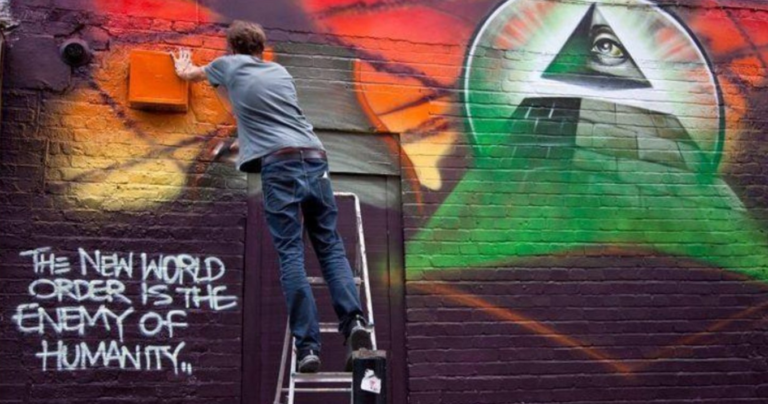
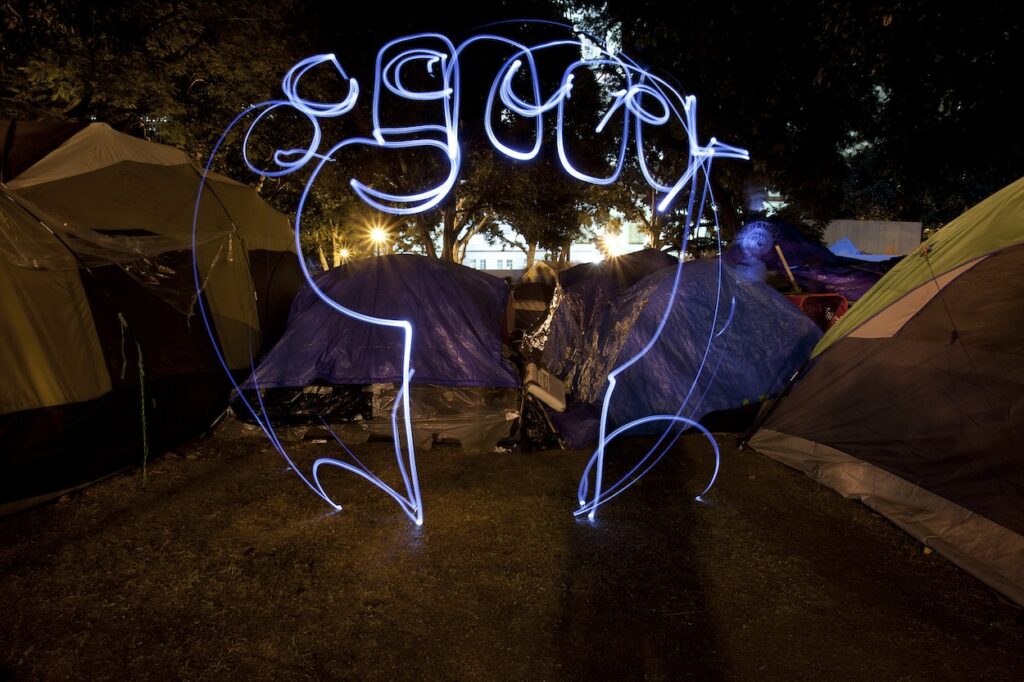
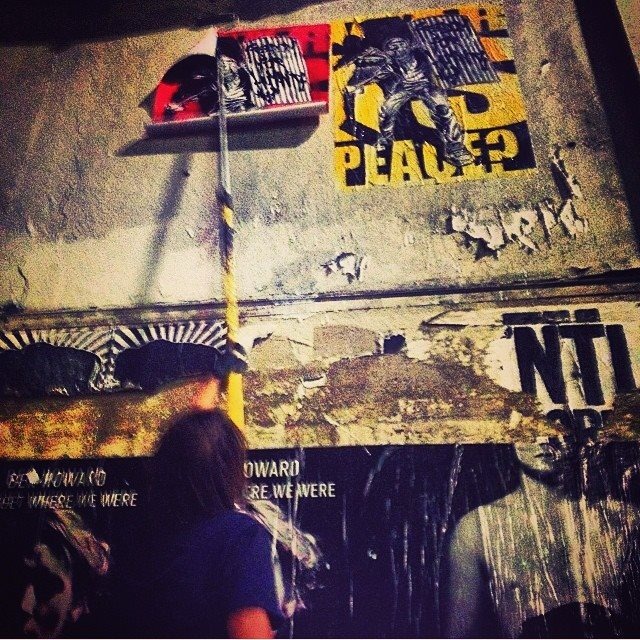
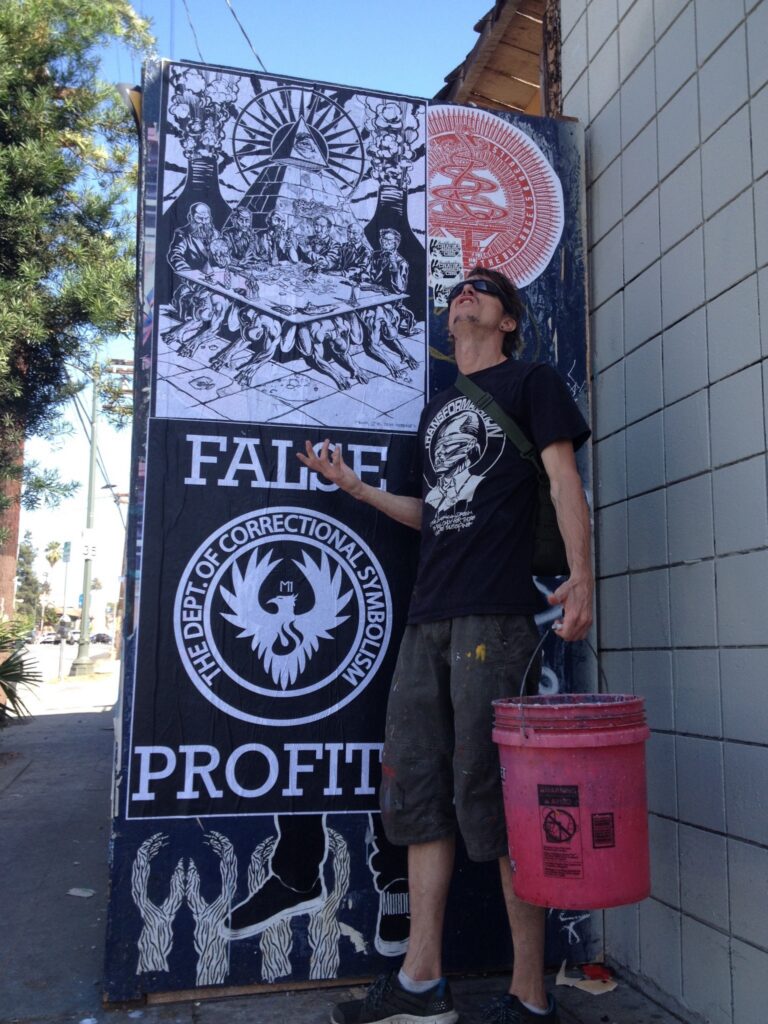
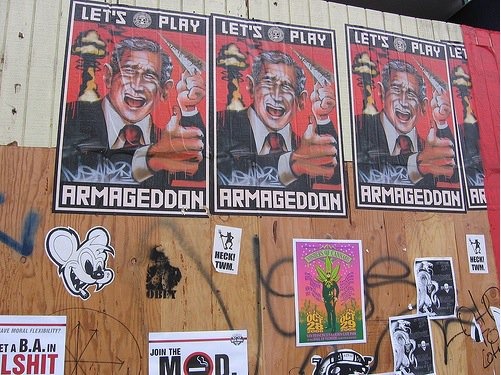
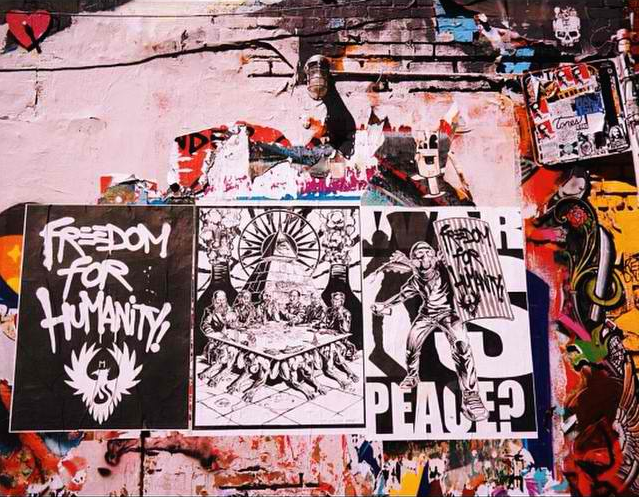
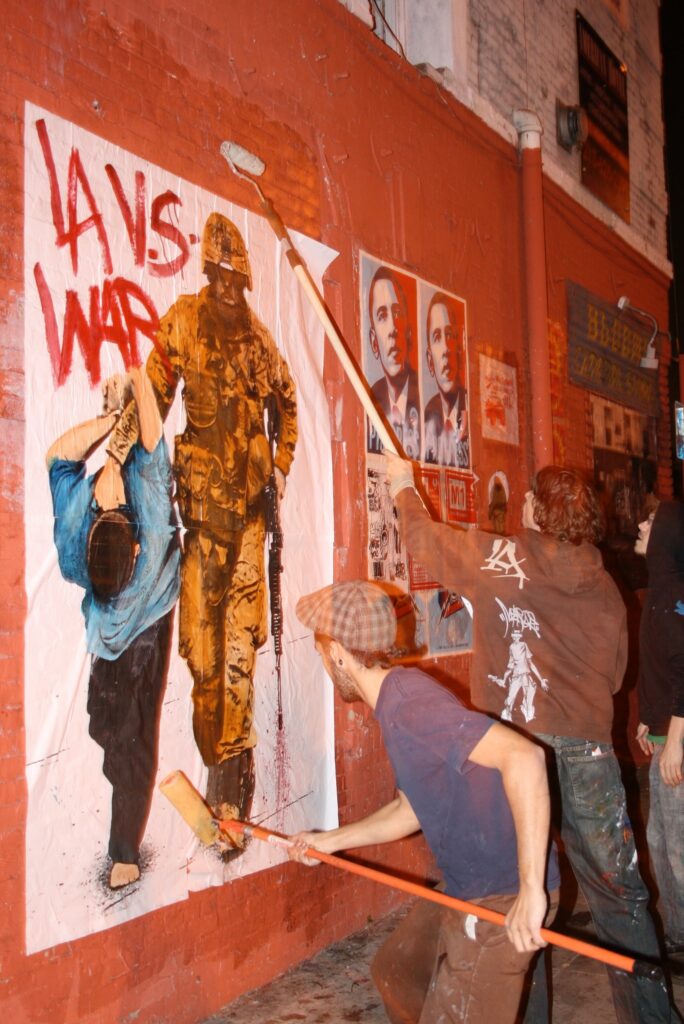
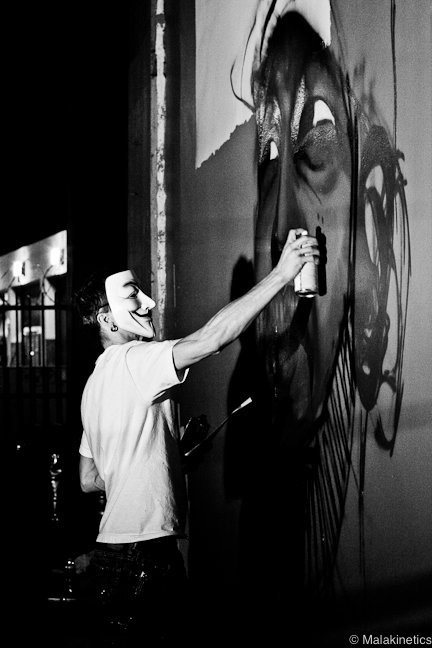
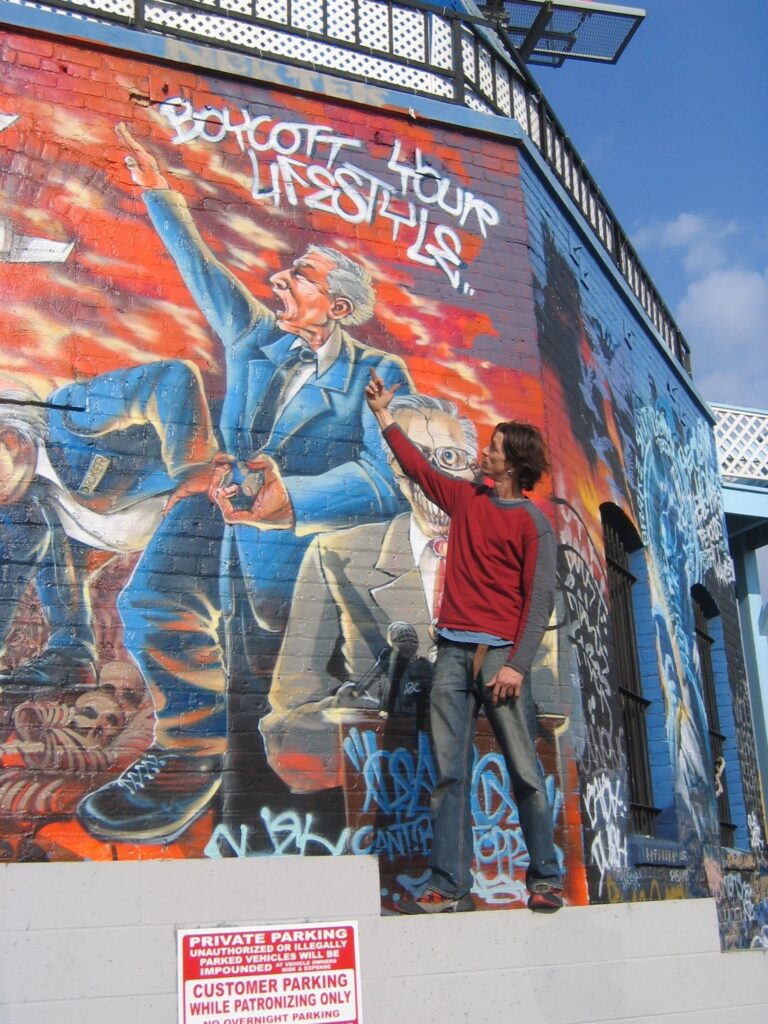
The works gathered in Relics of a Revolution at the Bitcoin 2026 Conference in Las Vegas trace a specific lineage of dissent — one that connects street-level protest to the birth of Bitcoin itself. Mear One (b. 1971, Santa Cruz, CA) has spent nearly four decades using the walls of Los Angeles as a medium for political and economic confrontation. He pioneered the Melrose graffiti art movement in the late 1980s, was the first graffiti artist to exhibit at the 01 Gallery on Melrose and at 33 1/3 Gallery in Silverlake — where Banksy would later debut his first North American show — and in 2004 joined Shepard Fairey and Robbie Conal on the Be the Revolution tour, a nationwide series of anti-war street art interventions during the Bush administration. His work was part of the landmark Art in the Streets exhibition at the Los Angeles Museum of Contemporary Art in 2011 and resides in the permanent collections of the Laguna Art Museum among others. From anti-Gulf War broadsides in the early 1990s through the Occupy Wall Street encampments of 2011, Mear One has been making work that insists the root problem is the system itself — not the politicians or the policies, but the underlying architecture of money and power.
I sat down with Mear One ahead of his panel at Bitcoin 2026 to talk about protest, art, broken systems, and why the revolution is not over, or how to exit a loop.
BMAG: Mear One, you started writing on walls in Los Angeles in the mid-1980s, at a moment when graffiti was still broadly criminalized and the idea of it entering museum collections would have seemed far-off. By the early 1990s, you were making large-scale political work — anti-Gulf War broadsides, pieces confronting economic power structures head-on. What was driving you to use the street as a political medium at that point, and who were you trying to reach?
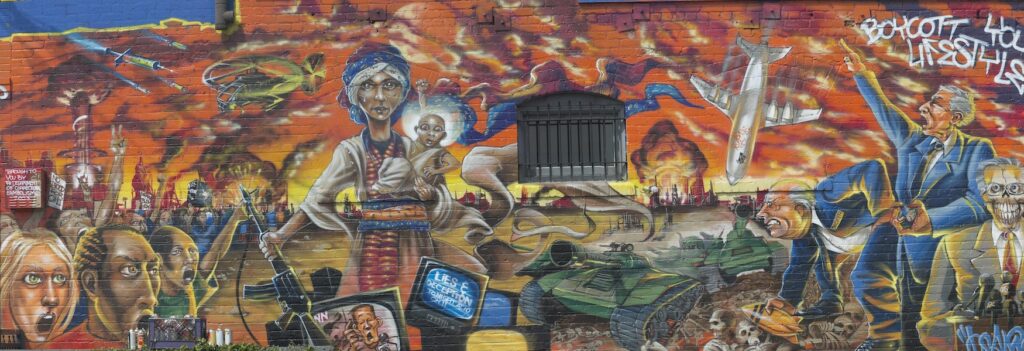
Mear One: Graffiti is the voice of the dissatisfied soul, and back then it was a vehicle to reach the masses before the internet took off & social media ever existed. When you illegally spray paint your ideas in the public realm it resonates with the urbanite caught in traffic, angers the city officials whose dilapidated walls we scribe like a big middle finger to their failed policies. Conscious art speaks to conscious people, and the act of vandalism carries with it an energy that helped instigate a movement which was lacking. The streets were our meeting ground, and getting away with it kept us all anonymous, permissionless.
BMAG: There’s a phrase that circulates in bitcoin culture — “all wars are banker’s wars.” The Genesis Block itself contains a newspaper headline about a bank bailout. When you look back at the work you were making during the Gulf War era and later during Occupy Wall Street, how much of it feels like it was pointing toward the same structural critique that bitcoin would eventually encode into its protocol?
Mear One: Quite honestly, when I discovered bitcoin it immediately reminded me of the graffiti, hip hop, and punk rock culture I grew up in, it mirrored the revolutionary necessities I was communicating through my art. I think we all desire an ideology or movement that speaks to and offers a solution to the endless new world order slave trap that so many have become accustomed to. And it turns out the architects who created this current economic matrix are the same builders of our prison schools, creators of our bankers’ wars. Satoshi knew this. Humans don’t really have world war issues with one another, these issues stem from economic and political power struggles outside of our fundamental human desires like freedom, love, a spiritual connection to a higher purpose. My goal as an artist is to always experience freedom, to set myself free from the system, this is the basis of my art, philosophy and resistance.
BMAG: In 2004, you joined Shepard Fairey and Robbie Conal on the Be the Revolution tour — taking anti-war, anti-corporate street art across the country during the Bush administration. That was four years before the financial collapse, and three years after 9/11 had already been used to justify unprecedented expansions of surveillance, military spending, and executive power. What did that experience teach you about using art as a tool for economic and political resistance, and how did it shape your thinking when the crash actually arrived?
Mear One: Be the Revolution with Robbie and Shepard was more so an outlet to express my angst and dismay of American politics at the time. Fighting wars for foreign resources to sell for profit exacerbating this hierarchy of haves and have nots still weighs heavy on my philosophical heart.
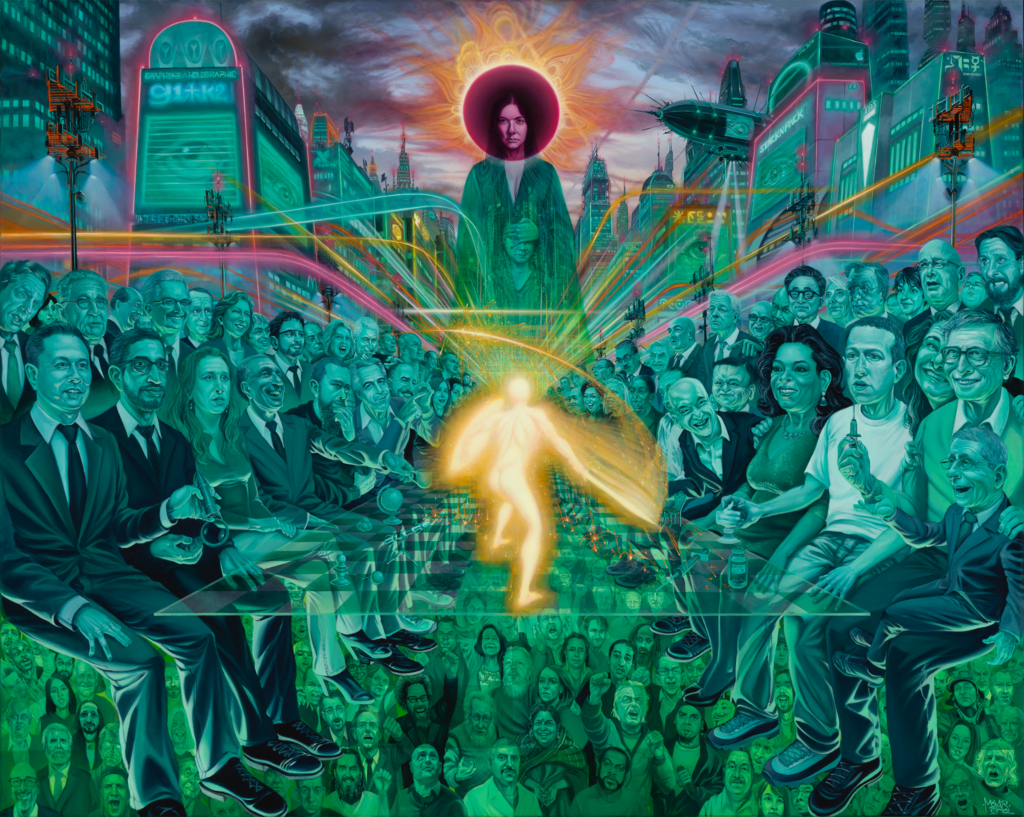
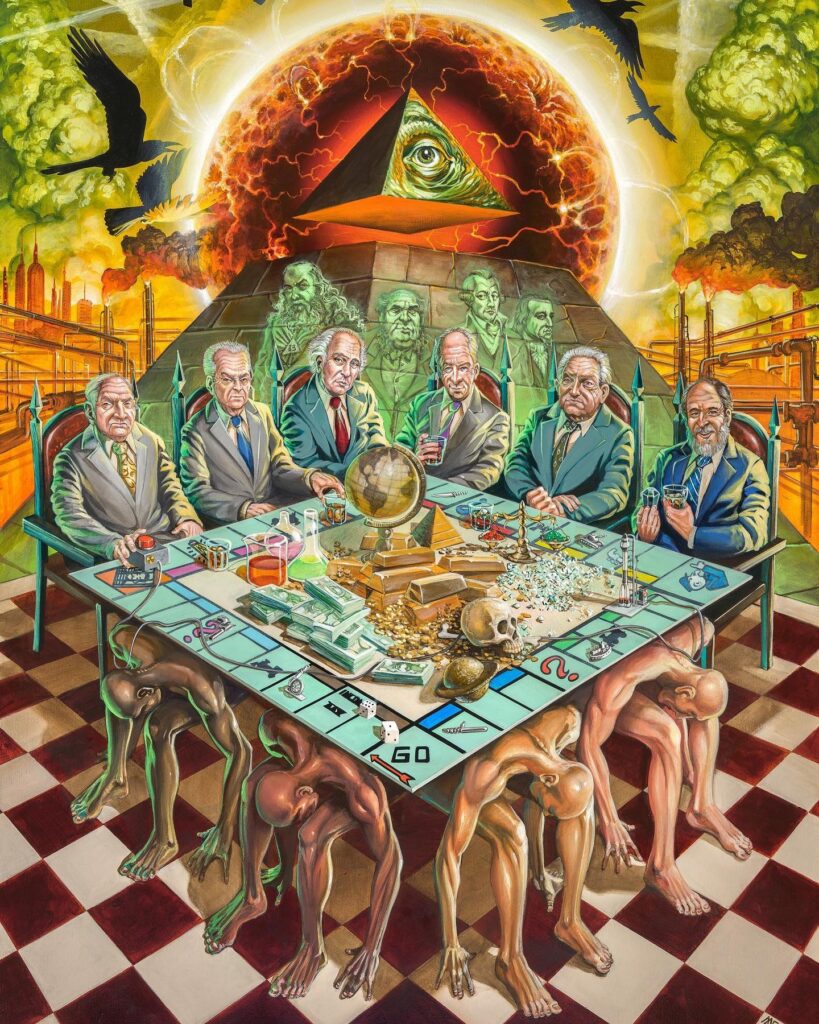
But when the financial crash hit in 2008 my revolutionary lens shifted drastically, and for the first time in my life I became interested in learning how the system of money actually operates, what money is, and seeking to articulate through my art a more accurate definition of the new world order culminating in my most controversial work to date False Profits.
“You cannot dismantle the master’s house with the master’s tools.” Subversive art, subliminal art, illegal art, art that punches you in the gut with facts and satire using a spray can, paint brush, wheat pastes, music, comedy, film, whatever tools are in your creative kit, art is the most effective way to create change. I think great art stands the test of time for its quality of being somewhat psychic, narrating the cause before the effect is widely understood by the masses, before it’s too late.
BMAG: Street art is ephemeral by nature — it gets buffed, painted over, torn down, rained on. Some of your protest works from the Occupy era and earlier have survived. What does it mean to you that objects made in that spirit of urgency — work created to be temporary — are now being shown in a gallery context as historical artifacts?
Mear One: They’re still relevant, ironically, because nothing’s changed! Same circumstance, different puppets. These works point out a condition that is ongoing within our human story, and it’s important as Bitcoiners to pay memory to our past struggles and the remedies which we choose to solve them. In this spirit of urgency these Relics of Revolution are calling out for exactly that – the time for change is always now!
BMAG: You were making anti-war street art during the first Gulf War. Now, more than thirty years later, we’re watching another military escalation in the Middle East — this time with Iran. The machinery looks different, the justifications sound different, but the economic architecture underneath it is remarkably similar. For a generation that came of age watching 9/11 become the justification for two decades of war and then watched the 2008 crash reveal that the financial system underwriting it all was itself a fraud — when you see this cycle repeating, does it feel like confirmation of something you’ve been saying on walls for decades, or does it feel like failure — that the message didn’t land?
Mear One: Like you said, all wars are bankers wars. And for hundreds of years we’ve been fed a false narrative about who our enemy is. There’s a lot of truths I’ve tried to point out through my art and it has made my life much harder for it. I’ve been criticized, censored, nearly cancelled, had my life threatened, labelled all sorts of heinous things. But I resisted, I was unapologetic, and I continue to do my work unfazed. Sometimes it feels like I’m standing on the street corner pointing up in the sky, screaming at the top of my lungs about the chemtrails, and everyone just thinks I’m crazy – it’s always like that in the beginning – but people are waking up. It’s not easy to do art that points out what’s wrong with the system. But it’s also not easy to be honest with yourself and accept the mediocre mundane pointless reality that is the social norm. The reward in doing this is to see a movement like bitcoin spawning and like-minded people sharing the joy and vigor for revolution.
BMAG: There’s an argument — and it runs deep in Bitcoin thinking — that wars are not really fought over ideology or territory but over monetary control. That every major conflict is ultimately about protecting or resetting an economic order that benefits the people waging it. Your work has been making that case visually since the 1990s. How do you articulate that connection between war and money to someone who hasn’t thought about it that way?
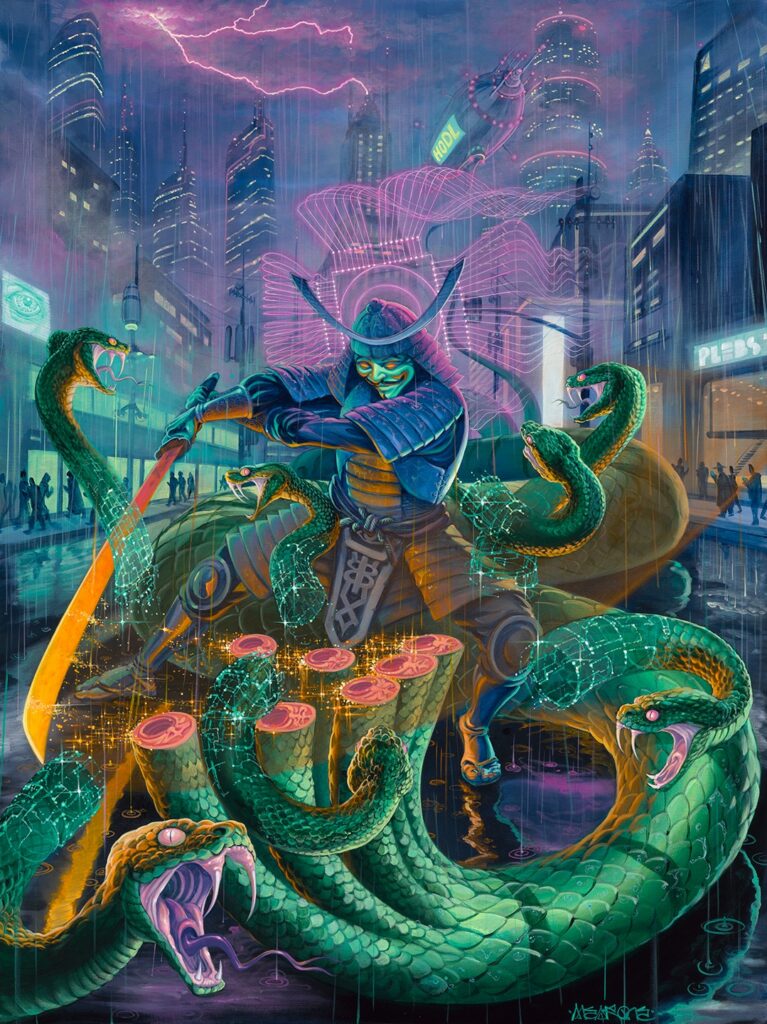
Mear One: I create an allegory that consists of the main factors, I am challenged to present it in its most digestible form; yet this is complicated subject matter so this challenge causes me to include subliminal psychedelic mythological archetypes and symbolism all coming together to assist in this complicated narrative, not only to create something visually compelling, but to give the subject matter a focus and a place to become a discussion amongst people. Through narrative art you can introduce ideas that people struggle with in the abstract.
BMAG: The 2008 crash, the bailouts, Occupy, and now what looks like another cycle of inflation, debt, and military spending — do you see Bitcoin as the first real exit from that loop, or just the latest attempt to build something outside a system that keeps absorbing its opposition?
Mear One: I’m a non-dogmatic being by nature. Bitcoin to me is the first wave in new technology that might steer us away from the fiat slave system. But I’m not convinced that it is the be-all and end-all for our current predicament. As we observe Wall Street attempting to hijack bitcoin all the while in-fighting amongst internal ideologues rages on, all that noise obscures bitcoin’s original ethos. These are its problems that are being worked out. I’m much more a believer in innovation and I welcome many more new inventions to enter our realm. I think that the monetary reality needs to run its course though, and what eventually follows I hope is a spiritual revolution. I see bitcoin as a crowbar in an emergency break the glass situation where it is necessary for the next iteration of where we’re heading into the 2030s. I do believe that is towards a state of ultimate freedom where the concept of money itself will become obsolete as we migrate closer to rebuilding a new world.
BMAG: How did you first encounter Bitcoin, and was there a specific moment where it clicked for you as connected to the same values and frustrations that had driven your street practice for decades?
Mear One: Back in 2009 I ran into a mathematician at a coffee shop in my neighborhood, we struck up conversation over my art and he hipped me to bitcoin for the first time. I never saw myself as one who would invest money into money, so it was just an interesting idea in the back of my mind. As I deepened my education into what money is through Occupy and to the creation/fallout of my London mural in 2012, my path eventually led my lady and I to our first bitcoin conference down in Mexico at Anarchapulco. We were introduced to a tribe of anarchists who shared similar sentiments on politics and lifestyle. I had millions of questions, everyone had answers, and like a sponge I absorbed this knowledge. I rocked two live art pieces for the community, which I auctioned off. Those collectors helped me set up my first wallet (shout out EDGE) as well as the transactions in exchange for my proof-of-work. That’s when it clicked for me, when I earned my first coins.
BMAG: Your work is in a show called Relics of a Revolution. Do you think the revolution it’s referencing is over, still happening, or something that hasn’t fully begun yet?
Mear One: Revolution is a daily occurrence, it is one of the inevitable aspects of life that you either take part in or it’s gonna take a part of you. Revolution literally means a cycle that we experience in different seasons across different cultures, time and space. There’s a variety of revolutions currently taking place. What’s great about bitcoin is it somehow is able to connect and bridge to them all at once because ultimately it seeks what we all desire – freedom from the system.
BMAG: This exhibition is called Relics of a Revolution, and it includes your protest works alongside an original copy of The Times from January 3, 2009 — the newspaper whose headline Satoshi embedded in the Genesis Block. That newspaper is the moment a diagnosis became a protocol — the moment the frustration that Mear One had been painting on walls and that Kolin would later carry on a sign in Tokyo was encoded into something that could not be buffed, censored, or bailed out. When you see your work displayed alongside that artifact, what do you want someone walking through this exhibition to take away — someone who may know Bitcoin as a price ticker but doesn’t know the history of why it exists?
Mear One: Collect these works of art! And I don’t mean that facetiously. Every great art movement had their Medicis, those whose power and influence defined the style & ideas of a generation. All the works you see here in the gallery is art denominated in bitcoin, created by artists whose works are inspired by the philosophical principles underlying the greatest bitcoin artwork of them all, the Genesis Block. Like bitcoin, art is the greatest store of value. But cultural preservation of these fine art assets of freedom by accomplished artists requires the patronage of those with passion for these aesthetic visions. Currently we face WW3, economic destruction, trade & agriculture collapse. Bitcoin cuts that circuit of suffering & punishment. Our ultimate fight is with the controllers of money and their bullshit fiat institutions, rendering their scheme obsolete and irrelevant.
This is Part II of a three-part interview series accompanying the Relics of a Revolution exhibition. Part I features Kolin Burges. Part III, featuring Afroman, is forthcoming.
Fix the money. Fix the world.
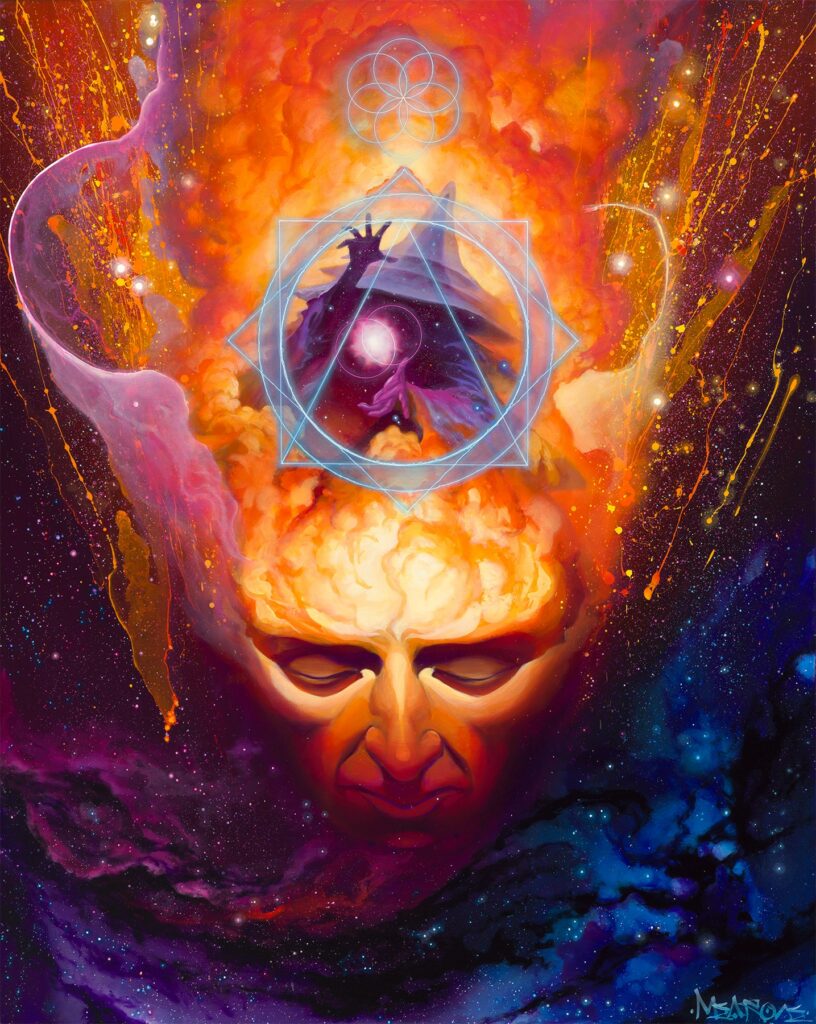
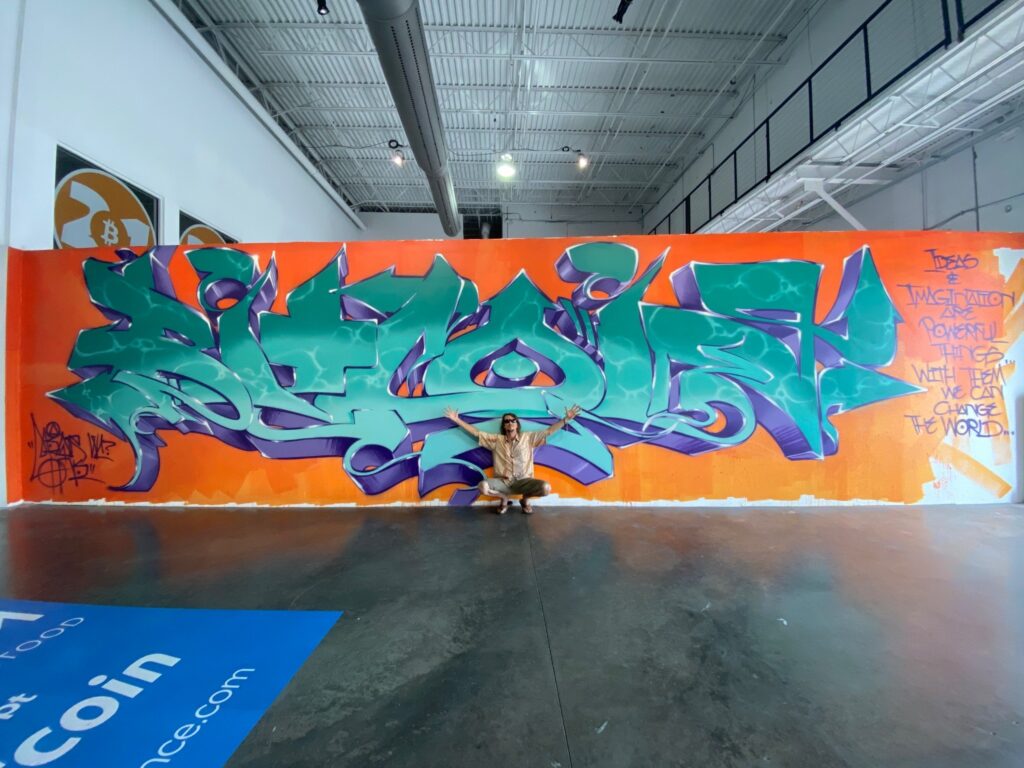
Mear One will be painting live in the BMAG art gallery throughout Bitcoin 2026, April 27–29, at The Venetian Resort, Las Vegas, and will appear on a speaking panel moderated by Dennis Koch titled “Looking at Bitcoin Art Through a Protest Lens.” A unique print by Mear One entitled The Magician is available exclusively through BMAG. Preview Mear One’s historic protest works included in the Relics of a Revolution exhibition in the BMAG B26 auction HERE.
The Bitcoin Museum & Art Gallery (BMAG) is the curatorial and cultural programming division of BTC Inc and the Bitcoin Conference. Since 2019, the BMAG conference art gallery has facilitated more than 120 BTC in art and collectible sales. Learn more about BMAG at museum.b.tc. Follow BMAG on twitter @BMAG_HQ. Bundle your Bitcoin 2026 pass with a stay at The Venetian and get your fourth night free. Use code AFTERS for a free After Hours Pass, or get your pass alone here.
The token for World Liberty Financial hit an all-time low on Friday.
The company has used that token to borrow its stablecoin, USD1, from DeFi protocol Dolomite — a circular arrangement that has raised eyebrows.
An upcoming unlock has also weighed on the token’s price.
The token for World Liberty Financial plummeted to an all-time low on Friday amid plans to unlock new tokens and reports that suggest the company engaged in a dubious transaction using the DeFi protocol Dolomite.
World Liberty Financial’s token was trading around $0.93 on Thursday when CoinDeskreported the company used 5 billion WLFI as collateral to borrow $75 million in stablecoins, including its own USD1 stablecoin.
The company used a protocol called Dolomite, which was founded by Corey Caplan, a World Liberty Financial adviser. The series of transactions left Dolomite vulnerable to a sharp decrease in WLFI’s price and left some USD1 lenders unable to withdraw until World Liberty Financial closes its position, CoinDesk reported.
Come Friday afternoon New York time, the token had fallen 13% to about $0.79, an all-time low. The asset is now over 75% below its all-time high.
World Liberty Financial did not immediately return DL News’ request for comment.
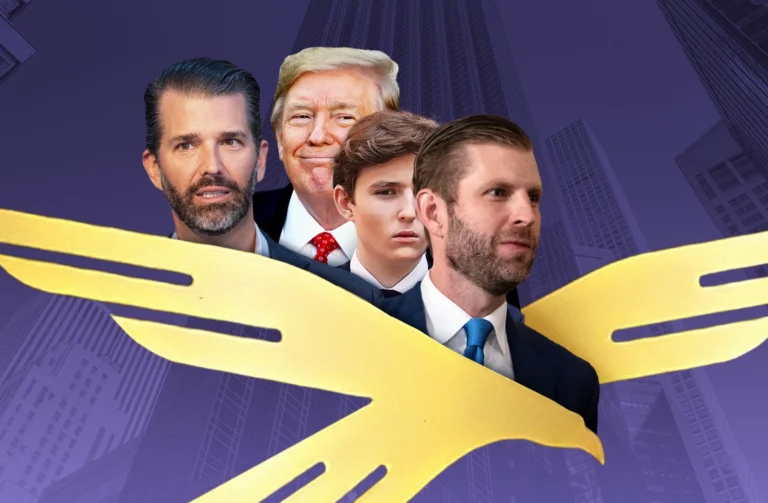
Backed by the family of US President Donald Trump, World Liberty Financial slammed criticism of its Dolomite transactions as “FUD.”
“Yes, we supplied WLFI as collateral and borrowed stablecoins,” World Liberty said in a statement on X. “No, we are nowhere near liquidation — and frankly, even if markets moved dramatically against us, we’d simply supply more collateral.”
But it failed to address the fact that investors who had lent USD1 to Dolomite’s USD1-WLFI market were functionally stuck there until World Liberty Financial closes its position.
That’s because World Liberty Financial borrowed USD1 in such quantity that it functionally drained the pool, CoinDesk reported.
World Liberty Financial also attempted to quell fear that it would allow early investors to sell all their tokens.
World Liberty Financial will allow WLFI holders to vote to unlock their tokens in the coming weeks, the company said Thursday. Shortly thereafter, it returned to social media to clarify the scope of the upcoming vote.
“This is not a proposal to unlock all tokens at once,” it said on X. “The vote will be on a long-term vesting and unlock schedule for retail early purchasers — a structured, phased approach designed with the long-term health of the ecosystem in mind.”
Aleks Gilbert is DL News’ New York-based DeFi correspondent. Have a tip? You can reach him at aleks@dlnews.com.
The largest traders have a problem: how to keep their activity quiet enough to not influence market prices or reveal any long-term strategies.
In traditional markets like equities, they’ve had that ability for decades through so-called dark pools and off-exchange venues. Even as far back as January 2025, more than half of all U.S. equities trading took place off public exchanges, according to Bloomberg data.
Crypto has never had an equivalent, and the absence is increasingly difficult to ignore. Every trade on Hyperliquid, every order on a decentralized exchange, is visible to anyone paying attention, and companies like DeFiLlama and Arkham exist to collect and present that data in a digestible way.
The crypto market, which prides itself on disrupting traditional finance, has replicated one of TradFi’s most persistent structural problems: If you’re big enough to move markets, everyone can see you coming. As a result, firms providing liquidity on public decentralized exchanges say their strategies get reverse-engineered quickly
“On Hyperliquid, one of the top market makers told us they have to rotate their trading strategies every three weeks because they get copied,” Denis Dariotis, co-founder of GoQuant, a crypto trading infrastructure firm backed by GSR, said in an interview. “That’s the alpha problem.”
There are other consequences, too. Market makers — the firms providing the liquidity that keeps crypto markets functioning — operate in full public view, and the industry has developed a habit of making them the villain whenever something goes wrong. Recent scrutiny of Jane Street’s involvement in the Terra/Luna collapse is only the latest example. A large firm’s onchain activity gets traced, a narrative forms and the company spends weeks managing a PR crisis over trades that, on a traditional venue, would have been entirely unremarkable.
GoQuant’s answer is GoDark, a decentralized exchange (DEX) set to start up on Solana in May. That platform uses zero-knowledge proofs to conceal trade details not just from other market participants, but also from the node operators running the order book. The ambition is radical: a matching engine where nobody in the system can see what they’re matching.
The immediate question is whether that’s technically achievable at any useful speed. Zero-knowledge proofs are computationally expensive, and the architecture adds latency that privacy-agnostic systems don’t have to absorb. Internal testing puts order matching at 25 to 50 milliseconds — Dariotis frames this as fast relative to most decentralized exchanges, where execution often runs into the hundreds of milliseconds, and he’s right. But it’s also an order of magnitude slower than what’s available to firms co-located with a centralized exchange. For retail traders that gap probably doesn’t matter. For the market makers GoDark is banking on to provide liquidity, it might.
Which brings up the harder problem. A private exchange with no volume is just a dark room. GoDark’s plan to seed liquidity mirrors what Hyperliquid did with its HLP vault — users deposit funds, the funds get deployed as market-making liquidity, participants take a cut of fees and first access to liquidations.
It worked for Hyperliquid. But it has not worked for most of the DEXes that have tried to replicate the model since, which have generally seen volume collapse once the incentive period ends.
Then there is the regulatory question, which the team has so far avoided having to answer directly. Traditional dark pools are private in the narrow sense that they conceal pre-trade order information, but they operate under post-trade reporting requirements and regulatory oversight.
GoDark’s privacy is more absolute by design, it’s structurally incapable of producing a full audit trail. The inclusion of automated OFAC screening is a gesture toward compliance, but it is unlikely to satisfy regulators who have spent the past three years pushing crypto toward more transparency, not less. How that tension resolves — and whether it limits institutional participation to jurisdictions with lighter oversight — remains to be seen.
GoDark is separate from GoQuant’s existing institutional product of the same name, a spot DEX built with Copper and GSR that enters production next month and targets a different, narrower client base. The May launch is the retail-facing version.
Ether Machine has called off its planned public debut after the Ethereum treasury-focused firm and Dynamix Corporation agreed to terminate their merger, citing deteriorating market conditions.
In a Saturday post on X, Ether Machine said the decision to end the deal was mutual and effective immediately. The transaction had aimed to take the firm public through a merger with the Nasdaq-listed special purpose acquisition company (SPAC), alongside involvement from The Ether Reserve LLC.
“The Ether Reserve LLC, together with certain other parties thereto, announced today that they have mutually agreed to terminate their previously announced Business Combination Agreement, effective immediately, as a result of unfavorable market conditions,” the firm wrote.
According to a filing with the US Securities and Exchange Commission, an unnamed “Payor,” identified in Annex A of the agreement but not disclosed publicly, must pay $50 million to Dynamix within 15 days of the termination taking effect.
Related: Bitmine uplists to NYSE as share buyback is increased to $4B
Ether Machine’s $1.5 billion Ethereum treasury plan collapses
Ether Machine first announced plans to launch what it described as the largest yield-bearing Ether (ETH) fund aimed at institutional investors in July last year. At the time, the company, co-founded by former Consensys executives Andrew Keys and David Merin, said it would list on Nasdaq under the ticker “ETHM,” launching with more than 400,000 ETH, worth over $1.5 billion at the time, under management.
In September, Ether Machine secured $654 million in a private financing round, including 150,000 ETH from Ethereum advocate Jeffrey Berns, who also joined the company’s board. The raise was part of its broader plan to build a large Ether treasury ahead of the planned Nasdaq debut, which has now been canceled.
Top Ether treasury firms. Source: EthereumTreasuries.NET
Meanwhile, Dynamix retains a limited window to secure a new deal. The company has until November 22, 2026, to complete another business combination. If it fails to do so, it will be required to liquidate and return funds held in trust to shareholders, in line with its corporate charter.
Related: Peter Thiel’s Founders Fund dumps ETHZilla stake as ETH treasuries face pressure
Ethereum treasury exits deepen
Ether funds exit amid mounting pressure on Ethereum treasury strategies. Trend Research has fully unwound its Ethereum position, selling 651,757 ETH worth about $1.34 billion while locking in an estimated $747 million loss.
Separately, ETHZilla, formerly a biotech firm that pivoted into an Ethereum treasury strategy during the 2025 hype, has also moved away from Ether accumulation, updating its corporate name and brand to Forum Markets.
Magazine: Bitcoin’s ‘biggest bull catalyst’ would be Saylor’s liquidation — Santiment founder
Cointelegraph is committed to independent, transparent journalism. This news article is produced in accordance with Cointelegraph’s Editorial Policy and aims to provide accurate and timely information. Readers are encouraged to verify information independently. Read our Editorial Policy https://cointelegraph.com/editorial-policy
Crypto prices are under further pressure during U.S. morning hours on Sunday after President Trump announced a blockade of the Strait of Hormuz.
“Effective immediately, the United States Navy … will begin the process of blockading any and all ships trying to enter, or leave, the Strait of Hormuz,” said the president in a social media post.
The president’s move came hours after Vice President J.D. Vance late Saturday announced that U.S. and Iranian negotiators had failed to agree to an extended ceasefire after long weekend meetings in Pakistan.
Trading above $73,000 for most of Saturday, bitcoin quickly pulled back to the $71,500 area following the Vance comments. In the minutes since President Trump announced the blockade, BTC has slid further to $70,900, now lower by 2.5% over the past 24 hours.
Bitcoin and Ether aren’t far from levels that could signal a trend reversal this year, despite a growing consensus across the industry calling for a bear market, according to macro analyst Jordi Visser.
“If we trade above $76,000 and at the same time we see Ethereum above $2,400, I believe that is the beginning of a move that will be sustainable this year because I don’t think we’re going to have a recession,” Visser said on the Anthony Pompliano podcast published on YouTube on Friday.
A move to $76,000 would represent an increase of 6.1% from Bitcoin’s (BTC) price of $71,646 at the time of publication, according to CoinMarketCap data. Ether’s (ETH) move to $2,400 would represent an increase of around 8%.
Inflation is going to remain high, says Visser
Traders on the prediction market Kalshi are leaning toward a similar macro outlook to Visser, pricing a 24% chance of a recession in 2026, down 10% over the past 30 days.
“I think inflation is going to stay elevated, and I think people are going to need to find something that is making money in a world where the S&P is not moving anywhere,” Visser said.
Jordi Visser spoke to Anthony Pompliano on Friday. Source: Anthony Pompliano
The United States Bureau of Labor Statistics (BLS) revealed in a report published on Friday that the Consumer Price Index (CPI) in April rose 3.3% year-over-year.
Visser’s recent comments challenge the growing view across the crypto industry that 2026 still has more downside ahead, with some even calling for a move below the Feb. 6 yearly low of $60,000.
Bitcoin may fall below $60,000 yearly low
On March 31, veteran trader Peter Brandt said that this may not be the lowest level for 2026, forecasting that Bitcoin could retest or even move “slightly lower” than the price level in September or October this year.
“That would then be the bear cycle low,” Brandt said.
Related: Bitcoin charts point to $80K in April: Here’s how it may happen
Visser explained that he has never been a “big fan” of labeling Bitcoin price trends as bull or bear markets.
“Especially when we’re at all-time highs. Like, at some point in there, it just seems like okay, they go up and then the normal course is at some point people don’t invest as much as they have,” he said.
Magazine: Should users be allowed to bet on war and death in prediction markets
Cointelegraph is committed to independent, transparent journalism. This news article is produced in accordance with Cointelegraph’s Editorial Policy and aims to provide accurate and timely information. Readers are encouraged to verify information independently. Read our Editorial Policy https://cointelegraph.com/editorial-policy
A new proposal outlines a way to create quantum-resistant Bitcoin transactions without changing the network protocol.
The design replaces elliptic-curve assumptions with hash-based puzzles and Lamport signatures.
The approach shifts computational work to transaction creators and is presented as a temporary workaround rather than a permanent fix.
Bitcoin transactions could be made resistant to future quantum attacks without changing the network’s core protocol, according to a proposal from StarkWare researcher Avihu Mordechai Levy.
In a recent paper, Levy describes a “Quantum-Safe Bitcoin” transaction scheme designed to remain secure even if quantum computers break the elliptic-curve cryptography used today. The method works within Bitcoin’s existing scripting rules and would not require a soft fork or other network upgrade.
“We present QSB, a Quantum Safe Bitcoin transaction scheme that requires no changes to the Bitcoin protocol and remains secure even in the presence of Shor’s algorithm,” Levy wrote.
The proposal replaces elliptic-curve signatures with hash-based cryptography and Lamport signatures, an early signature scheme considered resistant to quantum attacks.
“Since Lamport signatures are post-quantum secure, and they sign a cryptographically strong identifier of the transaction, it is not possible to modify the transaction without producing a new Lamport signature—which the attacker cannot forge, even with quantum computing capabilities,” Levy wrote.
At the center of the design is a cryptographic puzzle that must be solved before a transaction is broadcast. The paper estimates that finding a valid solution would require about 70 trillion attempts.
Unlike Bitcoin mining, the computation happens before the transaction reaches the network. Users perform the work off-chain and submit a transaction that already includes proof that the puzzle was solved.
Levy estimates the puzzle could be solved using commodity hardware such as GPUs at a cost of a few hundred dollars per transaction.
The scheme is designed to operate within Bitcoin’s scripting limits of 201 opcodes and 10,000 bytes. The paper notes these limits are extremely restrictive because every opcode counts toward the total, even if it appears in an unused script branch.
To fit within those limits, the system combines Lamport signatures with hash-based puzzles in a layered transaction structure. It also introduces “transaction pinning,” which requires anyone attempting to modify the transaction to solve the puzzle again.
Levy describes the system as a “last-resort” measure rather than a scalable fix. The paper says both the off-chain computational cost and the on-chain transaction size would not scale to Bitcoin’s target throughput or the needs of most users.
Transaction creation is also more complex than standard Bitcoin usage, and may be considered non-standard under current relay policies, meaning they could face propagation issues and may need to be submitted directly to mining pools rather than broadcast through the public mempool.
The proposal also carries security trade-offs. While it avoids attacks based on Shor’s algorithm that threaten elliptic-curve signatures, Grover’s algorithm could still provide a quadratic speedup for quantum attackers.
“To the extent that the quantum threat is believed to be real, it remains necessary to continue the ongoing effort to research and implement the best possible solution for Bitcoin–one that is maximally efficient, user-friendly, and answers Bitcoin’s needs, through protocol-level changes,” Levy wrote.
Levy’s paper joins several proposals that have emerged outlining how Bitcoin could transition to quantum-resistant cryptography, including BIP-360, which introduces a Pay-to-Merkle-Root address format designed to support quantum-safe signatures.
While the quantum threat to Bitcoin remains theoretical, companies including Google and Cloudflare are already preparing for it, setting a 2029 deadline to transition their systems to post-quantum.
Daily Debrief Newsletter
Start every day with the top news stories right now, plus original features, a podcast, videos and more.