Leadership isn’t just about moving the needle on ROI; it’s about leveraging corporate platforms to solve real-world crises. As Fintech leaders increasingly pivot toward social impact, inclusivity and community, the recent Street Child Gala proves that the industry’s greatest asset isn’t just its capital – its community.
Beyond the Boardroom: The Marketing Pivot
In the high-velocity world of fintech, the transition from execution to strategy is often seen through the lens of product launches and market share. However, for Jodie Anne Taylor, VP of Marketing at Moorwand, stepping into a senior leadership role necessitated a broader vision.
“One of the most pivotal points in my career was stepping into the VP of Marketing role,” Taylor explains. “For me, it represented much more than a new title-it marked a shift in how I contribute to the business and how I lead others. Stepping into this role allowed me to deepen my leadership of marketing strategy, scaling the vision. In the high-velocity world of fintech, the transition from execution to strategy is often seen through the lens of product launches and market share. However, for Jodie Anne Taylor, VP of Marketing at Moorwand, stepping into a senior leadership role necessitated a broader vision.
This strategic shift goes beyond internal KPIs. Taylor champions an ‘outside-in’ approach to leadership, where contributing to social impact – through organisations like Street Child – helps maintain perspective and purpose.
The ROI of Radical Allyship in Fintech
The fintech sector has long wrestled with diversity, but the conversation is moving past “performative tea and cakes.” Jodie’s collaboration with the international charity Street Child highlights how industry leaders are putting their ‘network capital’ to work. 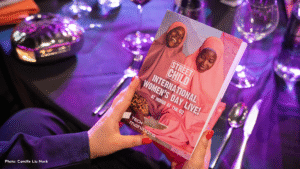
Joanne Dewar, Street Child Trustee and a titan in the payments space, is known for bridging the gap between the City and the social sector. “I’ve developed a reputation for encouraging people across the fintech industry to join in with rewarding side projects, and this is how I first connected with Jodie in November,” Dewar notes. “Getting any new event off the ground is so much harder than a repeating format, especially when there is next to zero budget… Unfazed by the challenge, Jodie jumped at the opportunity with her infamous zeal.”
The results were tangible. While 272 million children remain out of school globally, Street Child’s targeted approach-focusing on the 90% of caregivers who are women-is breaking the cycle of poverty through micro-loans and education.
Kate Bushell, Global Communications Officer at Street Child, highlights the urgency: “In early 2025, major donors, including the US and UK, announced significant cuts to international aid, putting programmes that help girls access education in some of the world’s most fragile places at risk. The gala grew out of that urgency.”
The Power of the Platform
By leveraging her network, Taylor secured celebrity hosts like Priscilla Anyabu and Claira Hermet, transforming a standard fundraiser into a high-profile gala at the O2’s Indigo Rooms.
 “She introduced us to the fabulous Priscilla Anyabu, a TV presenter who hosted the whole evening incredibly with such warmth and authority,” says Bushell. “The evening was really successful. We raised £166,000, which goes directly towards Street Child’s work in supporting the marginalised women and girls around the world.”
International Women’s Day
International Women’s Day has often suffered from a “pink-washing” problem, where corporate box-ticking is swapped for genuine progress. But the tide is turning. For the modern fintech leader, IWD is no longer about a LinkedIn post and a morning tea; it is a high-stakes audit of meaningful allyship. As Jodie Anne Taylor, VP of Marketing at Moorwand, notes, the focus has shifted toward “actively supporting other women in tangible ways – mentoring, advocating for opportunities, and ensuring women’s voices are heard and valued.” In a sector actively working to close the gender gap, the focus is evolving from celebrating achievements to creating pathways for the next generation of leaders – ensuring inclusivity extends from the boardroom to the grassroots.
The FF Perspective: Why This Matters for Fintech This isn’t just a “feel-good” story; it’s a blueprint for ESG (Environmental, Social, and Governance) integration. In an era where Gen Z and Millennial talent demand purposeful employment, fintech firms that fail to engage with social impact risk losing their most valuable assets: their people.
The synergy between fintech and micro-finance is obvious, but the “Big Picture” here is the mobilisation of the Fintech Network. When industry leaders move beyond siloed competition to support initiatives like the Women and Girls Impact Committee, they create a more resilient and inclusive ecosystem. As Dewar puts it: “In a world where IWD events can seem so performative … this event really delivered on the #GivetoGain theme.”