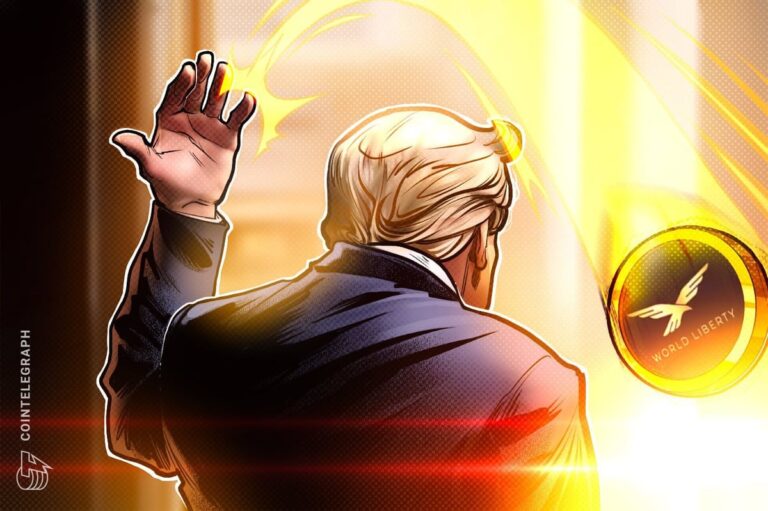
World Liberty Financial’s WLFI token risks dipping 20% in April, according to a mix of convincing technical and fundamental indicators.
Key takeaways:
Bear pennant hints at WLFI dip in April
As of Tuesday, WLFI was consolidating inside a classic bear flag, a continuation pattern that typically forms after a sharp decline.
In technical analysis, a bear flag typically resolves when the price breaks below the lower trendline alongside rising trading volumes and falls by as much as the structure’s maximum height.
WLFI/USDT four-hour chart. Source: TradingView
Applying this classic rule to WLFI’s chart brings its measured downside target to around $0.066 in April, down about 20% from the current price levels.
Conversely, a break below the upper trendline risks invalidating the bear flag setup, with the 20-day (green) and 50-day (red) exponential moving averages (EMAs) at around $0.081 and $0.085 serving as primary upside targets.
Insider activity, token unlock fears add pressure
Beyond technicals, WLFI faces mounting scrutiny that continues to weigh on sentiment.
On-chain data from Arkham Intelligence show wallets linked to the project deposited roughly 3–5 billion WLFI tokens—largely illiquid—as collateral on Dolomite to borrow about $75 million in stablecoins, including USD1 and USDC.
Source: X
Over $40 million was later moved to Coinbase Prime. The position pushed pool utilization to ~93%, restricting withdrawals and drawing criticism for “circular” liquidity extraction.
The structure is risky because it uses thinly traded internal tokens to borrow real liquidity, meaning any sharp WLFI price drop could trap depositors, trigger bad debt, and deepen selling pressure.
Source: X
At the same time, markets are bracing for a proposed unlock of over 16 billion WLFI tied to still-locked public allocations, raising dilution risks.
Adding to the pressure, Tron founder Justin Sun, who reportedly invested ~$75 million and became an adviser, again accused WLFI of embedding a hidden backdoor blacklisting function in the smart contract.
Related: US President Trump faces renewed backlash as Trump-linked tokens crash
This allegedly allowed the team to unilaterally freeze his wallet/assets without notice or recourse, violating “decentralization” promises.
He called it a trap, denounced “token scandals,” claimed governance votes were rigged/non-transparent and demanded unlocks/transparency.
This article is produced in accordance with Cointelegraph’s Editorial Policy and is intended for informational purposes only. It does not constitute investment advice or recommendations. All investments and trades carry risk; readers are encouraged to conduct independent research before making any decisions. Cointelegraph makes no guarantees regarding the accuracy or completeness of the information presented, including forward-looking statements, and will not be liable for any loss or damage arising from reliance on this content.
The XRP Ledger added native support for zero-knowledge (ZK) proof verification by integrating with Boundless, a ZK proving network, in what the company claims is the first deployment of its kind on the ledger.
The move is designed to let financial institutions transact privately on the public blockchain while meeting regulatory requirements.
It addresses a specific barrier to institutional adoption that has persisted across every public blockchain. Transaction flows, treasury positions, and counterparty relationships are visible by default on public ledgers. For a bank settling cross-border payments or a fund managing OTC positions, that transparency creates competitive risk.
Zero-knowledge proofs solve this by allowing one party to prove a statement is true without revealing the underlying data. It’s like passing a credit check, where the bank confirms an individual qualifies for a loan without telling the lender specifics about income, debts or account balance.
In practice on XRPL, this means a payment can be verified as valid, correctly funded, and compliant without exposing the amount, the sender, or the receiver to the public ledger.
XRPL already has institutional traction that most layer-1 blockchains do not. SBI Holdings in Japan, Zand Bank in the UAE, Archax in the U.K. and Guggenheim Treasury Services in the U.S. all use the network.
More than $550 million has been deployed into XRPL ecosystem initiatives. The connection to Boundless gives those institutional users a path to privacy they did not previously have on the ledger.
The timing is notable given the broader conversation around blockchain cryptography this month.
Google’s quantum computing paper forced every major chain to evaluate its cryptographic assumptions. ZK proofs are built on different mathematical foundations than the elliptic curve cryptography that quantum threatens, and several ZK proof systems are already considered quantum-resistant or can be upgraded to post-quantum constructions more easily than traditional signature schemes.
Adding ZK infrastructure now positions XRPL to build on cryptographic foundations that may age better than the ones the quantum debate is focused on.
At InsurTech NY, Vincent Defour from Trendtracker addressed the core problem of how insurers can plan long-term strategies in a world that is moving faster than ever.
Defour highlighted the myriad of external factors, including geopolitics, economics, technology, and AI, that constantly impact insurers and because insurance is a long-term business, often requiring a focus five or ten years into the future, the rapid pace of change makes sustainable planning incredibly challenging.
Trendtracker’s platform is designed to help insurance carriers look into the world to see what is shifting and asDefour emphasized that success isn’t about tracking one specific movement but rather understanding the convergence; its about how multiple trends combine to create disruption for the insurance industry.
Trendtracker is well-positioned to tackle this, as it originated directly from the insurance industry and initially built its AI models and collected data specifically for incumbent carriers.
Defour explained that these AI models can spot those convergent patterns and signals earlier which allows insurers and insurance carriers to anticipate the future and stay ahead in a fast-changing world. Defour noted that they are focused on expansion toward the US market and are using the InsurTech NY conference to connect with the community and build personal relationships, stressing that insurance remains fundamentally a relationship business.
Avalanche is moving beyond finance and into outer space, with a new network designed to verify telescope data in real time.
SkyMapper has introduced a dedicated Avalanche-based network that cryptographically records observations from telescopes around the world, turning each data point into a secure, verifiable digital record.
The new network, SkyMapper L1, collects data from a wide range of telescopes and sensors around the world and turns each observation into a secure digital record. The company calls this a “Proof of Space Observation” (POSO) — essentially a way to prove that a specific event in the sky was actually seen, when it happened, and that the data hasn’t been altered. These verified records can then be used by scientists, businesses or government agencies that need reliable space data.
The SETI Institute, known for its search for extraterrestrial intelligence, is contributing live observational data, marking one of the first production-scale integrations of institutional science into a blockchain-based verification system.
SkyMapper’s pitch centers on a growing problem: the explosion of data from satellites, drones and space missions, and the difficulty of verifying that data hasn’t been altered or misattributed. The team argues that blockchain can help solve this by creating a permanent, tamper-resistant record of each observation that anyone can independently verify.
The system works by validating observations at the moment they are captured. When a telescope in the network records an event — such as a satellite pass or deep-space signal — the data is immediately cryptographically signed, effectively creating a unique fingerprint tied to that device. The observation is then time-stamped and transmitted through SkyMapper’s infrastructure.
Instead of keeping all the data in one central database, SkyMapper spreads it across a decentralized storage network. At the same time, it saves a kind of digital fingerprint of that data on the Avalanche blockchain. This fingerprint means anyone can later check it to confirm the data is real and hasn’t been changed.
The network uses smart contracts to check incoming data, organize it, and control who can access it. Some information — like sensitive government or defense data — can be kept private, while other data, such as scientific research, can be shared openly.
The result is a system where each observation can be independently verified: users can check when and where it was recorded, confirm it hasn’t been tampered with, and trace it back to its source.
“We’re building blockchain infrastructure for real-world impact,” said Emin Gün Sirer, founder and CEO of Ava Labs. “SkyMapper’s work anchoring observatory data on Avalanche shows how this technology can transform science, providing tamper-proof, verifiable telescope records.”
Read more: FIFA Teams Up With Avalanche to Build Its Own Blockchain, Expanding Web3 Ambition
A new panel has officially been announced for Bitcoin 2026 titled “Is Bitcoin Still A Sovereign Tool?” featuring Matt Odell, Bruce Fenton, Luke Rudkowski, and BTC Sessions. The conversation will bring together these four voices who have spent years examining the intersection of Bitcoin, individual freedom, institutional adoption, and whether Bitcoin is staying true to its original ethos as adoption accelerates.
Matt Odell is an entrepreneur, podcaster, and venture capitalist best known for his Bitcoin privacy advocacy and working in freedom technology education for over a decade with guides, workshops, and even training activists on how to use Bitcoin. He is a managing partner at Ten31, the largest Bitcoin technology investor in the world, and co-founder of OpenSats, Bitcoin Park, and the Bitcoin Policy Institute.
Bruce Fenton has been involved in Bitcoin since 2012 and is the founder and host of the Satoshi Roundtable, now in its 12th year — an invitation-only annual retreat for leading CEOs, developers, founders, and academics in the Bitcoin ecosystem. He previously served as Executive Director of the Bitcoin Foundation and organized the first Dubai Bitcoin Conference in 2014.
Luke Rudkowski is an independent journalist and founder of We Are Change, a grassroots media outlet who has covered Bitcoin through the lens of government overreach, financial freedom, and decentralization for over a decade.
BTC Sessions, the online handle of Ben Perrin, runs the world’s longest-running and most-watched Bitcoin-only educational YouTube channel, focused on self-custody, privacy, and making Bitcoin accessible to everyday users.
The panel will cover whether Bitcoin’s core promise of individual sovereignty has been preserved as institutional adoption, government reserves, and corporate treasuries have entered the space, and what it means for the everyday Bitcoiner. It takes place April 28 at 5:30 PM on the Nakamoto Stage at Bitcoin 2026, The Venetian Resort, Las Vegas.
Bitcoin 2026 is Returning to Las Vegas
Bitcoin 2026 will take place April 27–29 at The Venetian, Las Vegas, and is expected to be the biggest Bitcoin event of the year.
Focused on the future of money, Bitcoin 2026 will bring together Bitcoin builders, investors, miners, policymakers, technologists, and newcomers from around the world. The event will feature a wide range of pass types, including general admission passes designed specifically for those new to Bitcoin, alongside premium passes for professionals, enterprises, and institutions.
With multiple stages, immersive experiences, technical workshops, and headline keynotes, Bitcoin 2026 is designed to serve both first-time attendees and long-time Bitcoiners shaping the next era of global adoption.
Past Bitcoin Conferences in the U.S.
Bitcoin’s flagship conference has scaled dramatically over the past five years:
2021 – Miami: 11,000 attendees
2022 – Miami: 26,000 attendees
2023 – Miami: 15,000 attendees
2024 – Nashville: 22,000 attendees
2025 – Las Vegas: 35,000 attendees
🎟️ Get Your Bitcoin 2026 Pass
Bitcoin Magazine readers can save 10% on Bitcoin 2026 tickets using code ‘ARTICLE10‘ at checkout.
Stay at The official hotel of Bitcoin 2026, The Venetian, and get a guaranteed low rate plus 15% off your pass. Be in the middle of where the fun is all happening, and where the networking never ends.
And don’t forget:
Volunteer at Bitcoin 2026 and get Pro Pass access plus exclusive perks.
All students ages 13+ can apply for a Student Pass and get free general admission access to Bitcoin 2026.
📍 Location: The Venetian, Las Vegas 📅 Dates: April 27–29, 2026
For more information and exclusive offers, visit the Bitcoin Conference on X here.
Why Attend Bitcoin 2026?
Bitcoin 2026 is the definitive gathering for anyone serious about the future of money. With 500+ speakers, multiple world-class stages, and programming spanning Bitcoin fundamentals, open-source development, enterprise adoption, mining, energy, AI, policy, and culture, the conference brings every corner of the Bitcoin ecosystem together under one roof.
From headline keynotes on the Nakamoto Stage to deep technical sessions for builders, institutional strategy discussions for enterprises, and beginner-friendly Bitcoin 101 education, Bitcoin 2026 is designed for everyone—from first-time attendees to the leaders shaping Bitcoin’s global adoption.
Whether you’re looking to learn, build, invest, network, or influence, Bitcoin 2026 is where Bitcoin’s next chapter is written.
Bitcoin 2026 Pass Types: Something for Everyone
Bitcoin 2026 offers a range of pass options designed to meet the needs of newcomers, professionals, enterprises, and high-net-worth Bitcoiners alike.
🎟️ Bitcoin 2026 General Admission Pass
Ideal for newcomers and those looking to experience the heart of the conference.
Limited access on Days 2 & 3
Entry to Main Stage
Access to Genesis Stage
Full access to the Expo Hall
🎟️ Bitcoin 2026 Pro Pass
Designed for professionals, operators, and serious Bitcoin participants.
Includes all General Admission features, plus:
Full 3-day access, including Pro Day
Entry to the Pro Pass Reception
Access to Enterprise Hall, Enterprise Stage, and Networking Lounge
Conference App networking features
Access to the Bitcoin For Corporations Symposium
Entry to Compute Village and Energy Stage
Complimentary lunch, coffee, tea, and snacks
Dedicated registration and check-in
Reserved seating at Main Stage
Huge savings when you bundle your hotel and Pro Pass
🐋 Bitcoin 2026 Whale Pass
The all-inclusive, premium Bitcoin 2026 experience.
Includes all Pro Pass features, plus:
Reserved seating at Main Stage
All-inclusive gourmet food and beverages
Entry to Whale Night and Whale Reception
Access to all official after-parties
Networking app access to connect with other Whales
Premium access to The Deep — an exclusive networking lounge with intimate speaker sessions
Complimentary stay at The Venetian when you bundle your whale pass and hotel (use promo code ‘WHALEHOTEL’ here)
This is the most immersive way to experience Bitcoin 2026.
🎉 Bitcoin 2026 After Hours Pass
Your ticket to the night.
Most deals are done with a drink in your hand. Get exclusive access to 3 official Bitcoin 2026 after-parties across Las Vegas — each with a 2-hour open bar — where the real conversations happen and the best connections are made.
Access to 3 official Bitcoin 2026 after-parties
2-hour open bar at each event
Evening events across Las Vegas, April 27–29
Network with Bitcoiners, builders, and industry leaders after hours
More headline speaker announcements are coming soon.
Human error during a planned system update led to the leaking of protected address data of Danske bank customers to outsiders.
Editorial
This content has been selected, created and edited by the Finextra editorial team based upon its relevance and interest to our community.
During a period of three months in 2025, the coding error led to protected addresses being visible to recipients of domestic payment transactions as part of the payment details in Denmark.
The bank says: “The issue occurred despite multilayered technical and organisational controls being in place. When the issue was identified in October 2025, a correction was deployed immediately, and we initiated an investigation to determine the scope and root cause of the issue.”
All told some 20,600 customers had their personal addresses leaked.
Says the bank: “Since identifying the issue, we have performed several reconciliation exercises and implemented controls to ensure our processes are operating correctly and further integrated regular controls, alongside organisational and technical measures to further reduce the risk of similar incidents occurring in the future.”
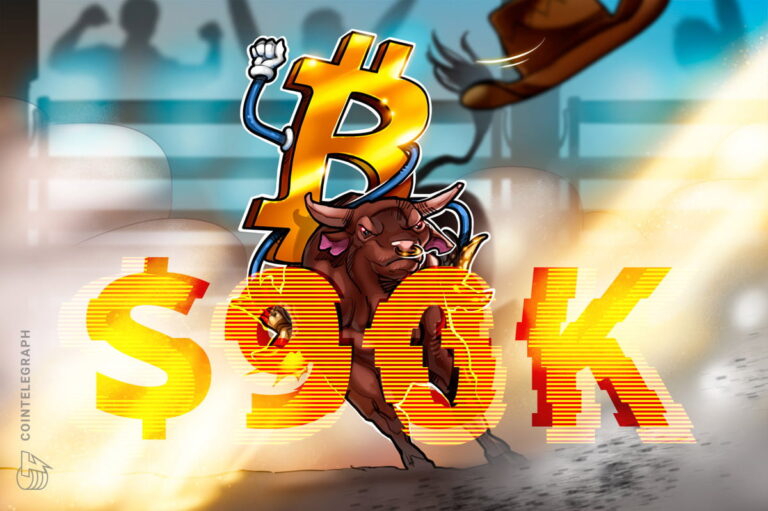
Market analysts say Bitcoin (BTC) is showing “renewed bullish momentum” after its 5% rally above $76,000 on Tuesday, with bulls eyeing further gains to $90,000 amid improving network activity.
Bitcoin price hits a 70-day high
Data from TradingView shows the BTC/USD pair rose over 5% on Tuesday to an intraday high of $76,120, levels last seen on Feb. 6.
The surge saw Bitcoin’s price reclaim key support levels, including the $75,000 zone where the 100-day exponential and simple moving averages converge.
“#Bitcoin surged above the $76,000 level, breaking above its March highs and signaling renewed bullish momentum,” analyst CryptoBlockto said in an X post on Tuesday.
The analyst pointed out that the next crucial resistance zone is $76,000 and that clearing it would confirm “a trend reversal and sustained upside momentum.”
BTC/USD four-hour chart. Source: X/CryptoBlockto
From a technical perspective, Bitcoin is validating an ascending triangle after breaking above its upper trend line at $73,000 on Monday.
A daily candlestick close above the moving averages at $75,000 would confirm the breakout, with the next line of resistance being the psychological level at $80,000.
Above that, bulls could push the BTC price toward the triangle’s measured target of $89,050, 18% above the current price.
The daily relative strength index has increased to 63 from oversold conditions at 15 reached on Feb. 6, suggesting increasing bullish momentum.
“#Bitcoin is #trading within the horizontal supply zone of an ascending triangle pattern. The 100MA is also acting as a resistance barrier above the current price action,” analyst CryptOpus said in a recent X post, adding:
“A strong breakout above both the #pattern and the 100MA would confirm a #bullish rally in the market.”
As Cointelegraph reported, a close above $76,000 would complete a bullish ascending triangle pattern, clearing the path for a potential rally to $84,000.
The strength in BTC price is reflected in onchain activity, with Bitcoin’s daily transaction count rising by 62% in 2026 to 765,130 million on April 5.
This metric was last at these levels in November 2024, when the hype around the 2024 US Presidential Election pushed Bitcoin price above $100,000 for the first time in history.
“$BTC daily transaction count is higher than when $BTC was $120K,” analyst CW8900 said in an X post on Tuesday, adding:
Bitcoin’s total fee volume has also climbed, increasing by 4% over the last week to $153,700, indicating “heightened onchain demand,” Glassnode said in its latest Market Pulse report, adding:
“This increase implies an uptick in network activity, potentially signalling a shift in user willingness to pay for transaction priority.”
Bitcoin total transaction fee volume. Source: Glassnode
Bitcoin’s increasing transaction count and fees mean that more users are interacting with the network. It suggests high network activity, which is often correlated with increased interest and market confidence.
This article is produced in accordance with Cointelegraph’s Editorial Policy and is intended for informational purposes only. It does not constitute investment advice or recommendations. All investments and trades carry risk; readers are encouraged to conduct independent research before making any decisions. Cointelegraph makes no guarantees regarding the accuracy or completeness of the information presented, including forward-looking statements, and will not be liable for any loss or damage arising from reliance on this content.
Trusted Editorial content, reviewed by leading industry experts and seasoned editors. Ad Disclosure
While Bitcoin’s price has been struggling with fresh volatility following news of the US-Iran war, investor activity, especially on cryptocurrency exchanges, is beginning to undergo a crucial shift. During the waning period, BTC transfer activity to trading platforms has experienced one of its steepest drops recently.
Binance Records Historically Low Bitcoin Deposits
As Monday drew to a close, the Bitcoin price saw a brief rebound back above the $73,000 mark, flipping sentiment bullish once again across the market. This new bounce may be attributed to several factors underneath the surface, such as the BTC transfer activity to cryptocurrency exchanges.
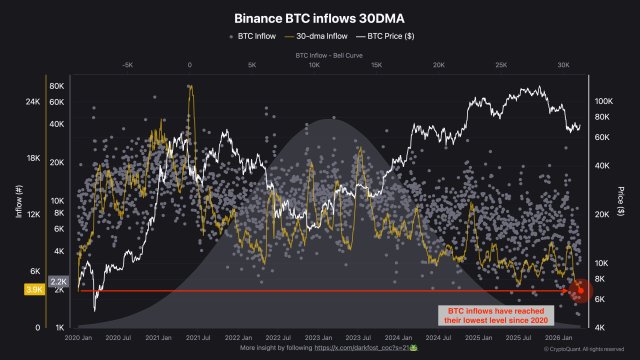
Currently, inflows to Binance, the world’s largest trading platform, have fallen to record low levels, indicating a significant change in the dynamics of Bitcoin flow. Darkfost, a market expert and data analyst, announced that BTC inflows have now reached levels last seen in 2022 as the market stays on hold.
The decline collides with growing uncertainty in the market, fueled by global events, making the current environment particularly difficult to interpret. Such a lack of visibility prevents investors from making conviction-driven positioning, mainly in risk assets such as Bitcoin.
Source: Chart from Darkfost on X
Despite these unfavorable conditions, panic is not appearing among BTC investors. According to data from the chart, the 30-day moving average now stands around 3,998 BTC, marking a more than 6-year low when compared to levels observed in the 2020 cycle.
This dramatic drop implies that fewer holders are transferring their BTC to crypto exchanges, a pattern sometimes linked to a decrease in the desire to sell right away. Furthermore, this trend can lead to the tightening of the available supply of BTC on these platforms, which could change the short-term behavior of the market.
A Massive Distinction From Periods Of Stress Or Euphoria
Even in periods of stress or euphoria, the aforementioned figure is far from those seen then. In July 2023, there was an average of 19,000 BTC sent to exchanges per day. Also, in May 2023, over 25,000 BTC were moved daily to exchanges on average.
With a historical average of approximately 11,000 BTC, the present levels are about three times lower than that. Thus, a clear dynamic is being reflected by this sharp contraction in inflows. Investors are not exhibiting any desire to move their BTC onto exchanges to sell.
However, they seem to be adopting a holding strategy, which mechanically reduces short-term selling pressure. As inflow activity dries up, this situation could be a sign of renewed confidence or a cooling phase before the next wave of volatility hits the market, as evidenced on Sunday.
Darkfost argues that a structural shift may also be at play here, with some flows currently being moved through alternative mediums such as ETFs (Exchange-Traded Funds). Using the vehicles ultimately reduces visible BTC movements toward crypto exchanges.
In the end, this kind of signal indicates a market that is more in a waiting period than a capitulation. At the same time, BTC holders remain largely passive rather than panicked, even in an uncertain situation.
BTC trading at $74,474 on the 1D chart | Source: BTCUSDT on Tradingview.com
Featured image from Pixabay, chart from Tradingview.com
Editorial Process for bitcoinist is centered on delivering thoroughly researched, accurate, and unbiased content. We uphold strict sourcing standards, and each page undergoes diligent review by our team of top technology experts and seasoned editors. This process ensures the integrity, relevance, and value of our content for our readers.
Elon Musk’s X launched interactive Cashtags on April 14, 2026, giving iPhone users in the U.S. and Canada real-time stock and crypto data.
X’s Wealthsimple pilot in Canada lets users trade directly from the timeline, marking the platform’s first brokerage integration.
Nikita Bier confirmed Web and Android rollouts are coming soon, signaling X’s push to become a full finance destination.
X Rolls Out Cashtags Feature
The feature activates when a user types or taps a $ticker symbol such as $ BTC or $TSLA, or pastes a crypto contract address. X automatically suggests the matching asset to eliminate ambiguity between similarly named tokens or tickers, then displays current price data, an interactive chart with timeframes spanning one day to one year, and a feed of posts tied to that specific asset.
Nikita Bier, X’s head of product, announced the rollout on the platform Tuesday. “X has always been the best source of financial news for traders and investors,” Bier wrote. “Billions of dollars are allocated every day based on what people read on Timeline.”
The company has supported basic $cashtag linking for years. The updated version, described internally as Smart Cashtags, adds chart overlays, live market data, and inline post aggregation. Users stay inside the app throughout.
Bier said the goal is to close the gap between financial information and action. “Our vision is more than just charts,” he wrote. “The content on X is valuable and actionable, so trading should be frictionless.”
As part of Tuesday’s launch, X announced a pilot trading integration in Canada through Wealthsimple, the country’s largest online brokerage. Canadian users see a trade button on each Cashtag page that routes directly to Wealthsimple for stock and crypto execution. X does not act as the broker in this arrangement.
“Today we’re also announcing a pilot integration with Wealthsimple, Canada’s leading brokerage,” Bier wrote. “Users in Canada will see a button on Cashtags so they can trade seamlessly from X.”
Bier first teased the feature in January 2026, describing plans for real-time prices and asset-specific matching inside cashtag searches. In mid-February 2026, he told users a rollout was weeks away and would eventually include direct trading linked to X Money, the platform’s peer-to-peer payments product currently in beta.
Tuesday’s release delivers the data and charting layer first. Trading access remains limited to the Canada pilot. Web and Android versions are described as coming soon.
The launch is limited to the iOS app for users in the United States and Canada. Supported assets include major equities, cryptocurrencies, and memecoins reachable through contract addresses on networks such as Solana and Base.
Bier credited the X product team in his announcement, singling out team member @k3shen for contributing to the feature on his first launch at the company.
“Cashtags are just the first step in our commitment to be the best destination for the finance and crypto community,” Bier wrote. “This is just a small preview of what’s to come.”
Today Presidio Bitcoin, a Bitcoin hub located in the Bay Area in California, has launched a knowledge repository/living report on Github to track the current state of research related to Bitcoin’s quantum vulnerability.
Our Quantum Bitcoin Summit last July helped push bitcoin’s quantum discussion forward.
Today we’re publishing Bitcoin’s Quantum Readiness, a living paper on bitcoin’s exposure, mitigation menu, upgrade paths, and plausible transition scenarios. 🧵👇 pic.twitter.com/XHdiSJFrlB
The report aims to be a central location where people in the ecosystem can easily keep track of and analyze the current state of research around the issue.
It currently takes a comprehensive look through the state of:
The current state of quantum computing, as well as research into different quantum computing technologies that could lead to material engineering progress towards a viable device.
The level of exposure, i.e. how many coins and how much overall value is currently vulnerable to long-range attacks by a capable quantum computer.
Post-quantum cryptographic schemes, as well as the current state of research in developing variants of such schemes more heavily optimized for Bitcoin’s unique architecture and way of functioning.
Different ways of implementing post-quantum cryptography in Bitcoin, and the trade-offs between these different paths.
Different mechanisms for safely migrating vulnerable coins to quantum-safe addresses in the event that a powerful enough quantum computer is created before users migrate to post-quantum cryptography.
An analysis of different ways that the actual migration could play out under different circumstances.
They plan to regularly update the repository/report as new research comes out, and solutions and plans are further refined and updated.
The announcement comes after growing claims that Bitcoin developers are not doing anything to acknowledge or address the issue, and aims to highlight the on-going research and development into solutions to the issue conducted by developers.