At MPE 2026, Ashley Paulus, Head of UK and Europe for Checkout.com, spoke about the company’s laser focus on driving merchant profitability and expansion into new markets. As one of the world’s leading PSPs, independently rated among the top three PSPs alongside Stripe and Adyen.
Checkout.com operates on a revenue-share, partnership model with their merchants and Paulus emphasized that their singular goal is to increase merchant revenue by improving payment acceptance rates, lowering the cost of funds, and helping with internal reconciliation.
This performance-driven approach yielded significant results in 2025, which marked the company’s first full year of profitability withCheckout.com processing over $300 billion in transactions and achieved 30% year-on-year growth for the second year in a row. For 2026, the strategy is built around expansion and innovation, including doubling down on the U.S. market, securing their own domestic processing license while also committing to Agentic Commerce. This Agentic push involves internal KPIs for every employee to use AI and preparing merchant solutions for agentic processing as the technology matures.
Finally, reflecting on her first time at the MPE conference, Paulus praised the event for attracting payments experts who are “deep in the weeds” and appreciated the opportunity to meet directly with merchants and offer utility as they develop their payments strategies for 2026.
In today’s newsletter, Marcin Kazmierczak from Redstone takes us through the evolution of tokenization as it moves from “concept to allocation.”
Then, in “Ask an Expert,” Kieran Mitha answers investor questions about tokenized investments.
– Sarah Morton
Where Tokenized Assets Are Today
Tokenization is moving from concept to allocation. What matters now is how these assets fit into portfolios and what they actually enable.
Your clients are already hearing and asking about tokenized assets, and that trend will only accelerate.
In the last 18 months, companies like BlackRock, Franklin Templeton, and Fidelity Investments have launched real products on the blockchain, including Treasury funds and private credit strategies. Investors are taking notice. The numbers are rising, the news is easy to track, and the basic idea is simple: bonds, private credit, and money market funds are now available on-chain, without traditional intermediaries, and settlement becomes orders of magnitude faster.
That summary is mostly accurate, but it does not tell the whole story.
The technology to create tokens has never been the main challenge. The real test comes later, with decisions on compliance, identity, transfer rules, sanctions, and lifecycle management. These are the areas where most projects slow down, and where the market is evolving now.
Last month, RedStone’s research team released the Tokenization & RWA Standards Report 2026, which examines how these systems are actually being built.
The compliance question is an architecture question
For issuers, the most important choice is not which blockchain to use, but where to place the compliance rules.
Compliance can be built right into the token and enforced by smart contracts with every transfer. It can also be managed outside the token using tools such as whitelisting. Another option is to enforce compliance at the network level, where the blockchain itself decides which transactions are allowed.
Each method fixes one issue but creates another.
Identity verification structures for tokenized assets, source: Tokenization Standards Report
Putting compliance rules inside the token gives you exact control, but it makes the system less flexible. For example, updating a sanctions list or rule might require upgrading the contract, turning a simple policy change into a technical task. Managing compliance outside the token makes things more flexible, but it means relying on middlemen and can expose assets if they leave their original environment. Enforcing rules at the network level makes token design easier, but it limits how easily the asset can move to other chains and systems.
For advisors, this is not an abstract design choice. It directly affects how an asset behaves. It determines whether it can move across chains, integrate with blue-chip decentralized finance (DeFi) protocols, like Morpho or Aave, and serve as collateral in a lending strategy. Two tokenized funds with identical underlying assets can behave very differently depending on this single architectural decision.
Institutional capital is already moving on-chain
The transition from theory to practice is most evident in how tokenized assets are used in lending markets.
Deposits of tokenized real-world assets in DeFi lending protocols have surpassed $840 million. A large share of this activity follows a familiar structure: an investor posts a tokenized asset as collateral, borrows against it, and redeploys the borrowed capital, often back into the same asset. The mechanics are new, but the logic is not. It is a programmatic version of the same capital efficiency strategies long used in traditional finance, now executed without a prime broker — faster, cheaper, and with less friction.
How investors allocate these assets is increasingly reflecting broader market trends.
On one major protocol, tokenized Treasury exposure declined sharply, while tokenized gold allocations expanded severalfold over the same period, tracking changes in rate expectations with notable precision. It is the best showcase of how professional capital responds to macro signals through on-chain infrastructure.
For advisors, this reframes the role of tokenized assets. They are not simply wrappers around existing products. In the right structure, they become productive collateral, capable of generating additional yield and participating in broader strategies while remaining in the portfolio.
Credit risk is becoming explicit
As these assets move into lending and structured strategies, credit risk is evolving alongside specific DeFi strategies, such as looping. Emerging DeFi risk ratings frameworks like Credora introduce continuous, on-chain risk assessment, bringing a level of transparency that traditional markets rarely offer.
For advisors, that shifts the question from what the asset represents to how it behaves under stress, and what risks it entails. Simple-to-understand ratings on a familiar A+ to D scale facilitate the creation of a risk-adjusted portfolio, attracting more and more interested parties.
What remains unresolved
Some structural gaps remain. Corporate actions still rely heavily on off-chain processes, and illiquid assets such as private credit and real estate are not yet fully compatible with DeFi standards.
Until those pieces are solved, tokenization will continue to scale unevenly, with the most complex assets lagging behind the simplest ones. The bright side? Creators of tokenization frameworks are well aware of that limitation, and soon enough, we should see solutions addressing that gap.
Sanctions screening approaches in tokenized assets, source: Tokenization Standards Report
– Marcin Kazmierczak, co-founder, Redstone
Ask an Expert
Q:As tokenization moves from pilot programs into live financial infrastructure, what needs to happen for it to become a standard layer in global capital markets?
Tokenization becomes standard when it integrates into existing financial systems rather than competing with them. The priority is interoperability between blockchains, custodians, and traditional market infrastructure so assets can move seamlessly across platforms.
Regulatory clarity is equally critical. Institutions need confidence in ownership rights, settlement finality, and compliance frameworks before allocating significant capital. We are already seeing early traction, but scale will come when tokenized assets match or exceed the efficiency, liquidity, and reliability of traditional securities. At that point, tokenization will not be viewed as innovation. It will simply be the infrastructure underpinning modern markets.
Q:What are the most overlooked risks or misconceptions surrounding tokenized assets today?
One of the biggest misconceptions is that tokenization automatically creates liquidity. It does not. It simply makes assets easier to access. Take real estate as an example. You can tokenize a property and divide it into thousands of shares, but if there are no active buyers and sellers, those shares will still be difficult to trade.
Another challenge is how early the market still is. Different platforms are building their own ecosystems, which can lead to fragmented liquidity rather than one unified market.
The technology is moving quickly, but infrastructure, regulation, and investor participation are still catching up. That gap between what is possible and what is practical is where most of the risk exists today.
Q:For retail investors, does tokenization open the door to new types of investments, and could that be a catalyst for bringing younger generations into the market?
Tokenization is emerging as younger generations move into higher earning careers and take a more active role in managing their wealth. Having grown up through rapid technological change myself, this group naturally expects financial systems to evolve in the same way as everything else in their lives.
That mindset is driving a greater willingness to explore asset classes beyond traditional stocks and bonds. Tokenization can open access to areas like private markets and real estate, while offering a more digital and flexible investment experience.
It is not just about new opportunities, it is about alignment. As the financial industry modernizes, it begins to reflect the speed, transparency, and accessibility younger investors are used to. That shift is likely to play a meaningful role in attracting a new generation into investing.
Crypto’s newest arms race is not just about faster models or better prompts.
It is about whether autonomous agents can handle capital as well as they handle information.
Early evidence suggests they cannot. At least not yet.
In its latest research, DWF Labs found that when several leading AI models were tested in trading settings against human participants, the top human outperformed the best model by roughly five times. Only a small subset of models made money at all.
The standout lesson was not that machines lacked speed. It was that most lacked discipline, while the better-performing systems used lower leverage, held positions longer and focused more on loss containment than on maximizing upside.
It’s crucial because the commercial infrastructure around AI agents is now moving from concept to deployment.
In recent months, Coinbase’s x402 protocol was contributed to the newly launched x402 Foundation at the Linux Foundation, which described the standard as a way to embed payments directly into web interactions for AI agents, APIs and apps.
Google has been pushing its Agent Payments Protocol, or AP2, as an open framework for secure agent-led payments.
Stripe, meanwhile, has rolled out an Agentic Commerce Suite to help merchants publish products to AI agents and accept agent-initiated payments.
Visa has also expanded its Intelligent Commerce push, saying this month that its new Intelligent Commerce Connect will help merchants and developers plug into AI-powered commerce flows.
The pace of buildout is striking.
But the gap between payment automation and investment judgment is still wide.
That distinction sits at the heart of the current agent debate in crypto. Buying, routing and settling a transaction is a structured problem. Trading volatile assets in real time is not. One rewards reliability and rules. The other punishes weak judgment, poor sizing and undisciplined risk-taking.
Crypto has always been fertile ground for automation because markets run around the clock, transaction rails are programmable and data is public. That is one reason why agentic activity is accelerating. According to DWF Labs report, agent-led behavior is already becoming a meaningful part of on-chain activity, especially in stablecoin flows and strategy execution, even if the fully autonomous end state remains out of reach.
Public market data points support the broader direction of travel.
Stablecoin Insider said in its Q1 2026 report that bots accounted for about 76% of all stablecoin transaction volume, the highest share in two years, while total stablecoin transaction volume reached $28 trillion in the quarter.
That does not prove agentic intelligence is outperforming humans. It does show that automated systems are already deeply embedded in crypto market infrastructure.
That makes the DWF findings even more important.
If more capital is moving through machine-run systems, the key question is no longer whether agents can participate. It is whether they can protect capital when conditions turn unstable.
So far, the answer appears mixed.
The research points to a pattern traders would recognize immediately.
Models that flipped positions too frequently tended to underperform. Models that pushed leverage beyond roughly moderate levels lost faster. And the strongest setup was the one optimized to avoid major losses rather than chase every possible gain.
In other words, the best AI trader did not look like a hyperactive speculator. It looked more like a cautious risk officer with an execution engine.
That conclusion also lines up with where agent technology is working best today.
Coinbase says its AgentKit and agentic wallet tooling are designed to let AI systems perform on-chain actions such as transfers, swaps and contract interactions. Those are powerful capabilities, but they are still closer to execution infrastructure than to autonomous portfolio judgment.
Google and Stripe are making similar bets on the payments and coordination layer, where trust, authorization and merchant connectivity matter more than speculative alpha generation.
That may end up being the real near-term investment story.
The first durable winners in agentic finance may not be the agents that promise to beat markets. They may be the companies building the rails that let agents transact safely, prove authorization and operate under tighter controls.
There is a reason that identity, validation and reputation systems are getting attention alongside trading models. Ethereum’s ERC-8004 proposal describes a trustless framework for discovering and interacting with agents across organizational boundaries. The goal is to let agents establish verifiable identities and reputations on-chain. That could help with coordination. It does not solve for strategy quality, capital crowding or malicious behavior on its own.
Those structural tensions are starting to show up in academic research too.
A January 2026 paper from researchers at Cornell and IC3 described what it called the “CoinAlg Bind,” a profitability-fairness tradeoff in collective investment algorithms.
In simple terms, transparent systems can become easier to arbitrage, while opaque ones can expose users to insider advantage and hidden extraction.
For crypto-native agent strategies, that is a serious warning. The more successful an approach becomes, the greater the pressure from copycats, frontrunners and information asymmetry.
That points to a more sober reading of the current moment.
Agentic finance is not failing. It is maturing into its real use cases.
Those use cases look strongest where the environment is structured, permissions are clear and risk limits are hard-coded. They look far weaker where success depends on adapting to unstable conditions, avoiding crowding and knowing when not to trade.
The DWF results capture that shift clearly. Human traders still appear better at balancing conviction with restraint in open-ended markets. Agents, by contrast, still perform best when their mandate is narrower and their behavior is constrained.
That is not a disappointment.
It is a useful signal.
In crypto, autonomy may arrive first not as a machine that outthinks the market, but as a system that loses less, routes better and knows its limits.
The article “AI Trading Agents Are Moving Faster Across Crypto; They Still Struggle to Beat Humans” was first published on AlexaBlockchain. Read the complete article here: https://alexablockchain.com/ai-trading-agents-moving-faster-across-crypto-struggle-to-beat-humans/
Read Also: MoneyGram, Pairpoint and eToro Back Midnight’s Privacy Blockchain Before Mainnet
Disclaimer: The information provided on AlexaBlockchain is for informational purposes only and does not constitute financial advice. Read complete disclaimer here.
Bitcoin BTC$74,011.67 quickly pulled back in U.S. morning trade on Thursday, slipping 2% in a matter of minutes after once again failing to push through what’s becoming stiff resistance.
The largest cryptocurrency fell to around $73,500 during the U.S. morning session, now lower by more than 1% over the past 24 hours. The move came after the crypto was turned back yet again after rising past $75,000.
Alongside, the breathtaking stock market rally — which yesterday sent the Nasdaq and S&P 500 to record highs — took a pause. A bit more than an hour into the session, both of those indices were lower by about 0.1%.
Crypto-linked stocks also pulled back across the board. Coinbase (COIN), Strategy (MSTR), Robinhood (HOOD) and Circle (CRCL) were all down roughly 2%-3% in morning trading.
Meanwhile, crude oil prices rose about 2%, reclaiming the $90 level, as ongoing geopolitical tensions continued to underpin supply concerns.
The $75,000-$76,000 range is key for bitcoin, as that was the level it traded at prior to the Feb. 5 market crash that took BTC down to $60,000. A rise past that level might suggest a larger move that could bring prices back to around the $90,000 mark at which bitcoin started the year.
Software catching up to bitcoin
Bitcoin and software stocks were moving almost in lockstep prior to the Middle East conflict at the end of February, with a near 1:1 correlation. During this period, bitcoin has been outperforming IGV, the software ETF.
Since the conflict began at the end of February, bitcoin has gained more than 11%, while IGV has risen by roughly 2%, prompting a narrative that bitcoin was beginning to decouple from software equities. However, over the past five days, IGV is catching up and is up by as much as 11%, while bitcoin has been flat. This suggests that rather than a clean decoupling, software may have simply been lagging bitcoin and is now catching up. IGV is up 1% on Thursday, while bitcoin is down 1.5%.
Charles Schwab announced further details and plans in their attempt to launch direct spot bitcoin trading through its new platform, Schwab Crypto™, signaling a major step by one of the country’s largest brokerage firms into the digital asset market.
The feature will roll out in phases over the coming weeks and will allow retail clients to buy and sell bitcoin and ethereum through existing Schwab platforms, the bank said.
The move gives millions of Schwab clients the ability to trade bitcoin alongside traditional holdings such as stocks, ETFs, and mutual funds. Clients will access Schwab Crypto through Charles Schwab Premier Bank, SSB, which will act as custodian for the digital assets.
Blockchain infrastructure provider Paxos will handle sub-custody and trade execution under a federally regulated trust structure.
“Clients want to conduct more of their financial lives at Schwab,” said Jonathan Craig, Head of Retail Investing. “With Schwab Crypto, they can trade digital assets within their existing accounts while drawing on the service, research, and tools they rely on.”
At launch, Schwab Crypto will enable direct trading in bitcoin and ethereum, which together represent about three-quarters of global crypto market capitalization.
Schwab will charge a transaction fee of 75 basis points on the dollar value of each trade, placing its pricing at the low end of the brokerage industry. Over time, the firm plans to add more cryptocurrencies and enable transfer capabilities for deposits and withdrawals.
Schwab said its platform will integrate digital assets across Schwab.com, the Schwab Mobile App, and the thinkorswim® trading suite. Clients will retain access to Schwab’s 24/7 customer service network, digital asset education through Schwab Coaching®, and research from the Schwab Center for Financial Research.
Charles Schwab is jumping into bitcoin
Joe Vietri, Head of Digital Assets at Schwab, described the launch as an extension of the firm’s broader digital strategy. “Our goal is to be the destination of choice for retail investors who want to integrate digital assets into their portfolios with confidence,” Vietri said.
Paxos, a New York–based blockchain provider overseen by the Office of the Comptroller of the Currency, will supply the infrastructure that underpins the new trading offering. Its custody platform is already used by several global financial institutions seeking regulated access to digital assets.
Schwab already holds a strong presence in the digital asset ecosystem, with clients owning roughly 20 percent of spot crypto exchange-traded products. The new feature expands Schwab’s reach beyond indirect crypto exposure through ETFs, mutual funds, and futures tied to cryptocurrency benchmarks.
The company’s entry into spot trading will position it alongside firms such as Coinbase, Robinhood, and Webull, which have long provided retail access to major digital currencies.
Lawmakers in Washington are closing in on a final agreement for the Digital Asset Market Clarity Act, a bill that would establish a comprehensive framework for crypto regulation in the United States, according to reporting from CoinDesk citing JPMorgan sources.
The bank said negotiations have entered a late stage, with most disputes resolved and only a small set of issues still under discussion. One senior policy official said that the list of contentious topics has narrowed from about a dozen to just two or three, signaling a shift toward consensus after years of debate.
At the center of the legislation is a long-standing question over how to divide oversight of digital assets between federal regulators. The bill would formalize jurisdictional boundaries between the Securities and Exchange Commission and the Commodity Futures Trading Commission, while also defining how tokens, stablecoins and decentralized finance platforms fit within existing financial law.
Lawmakers and industry participants have framed the measure as a critical step toward bringing regulatory certainty to a sector that has operated in a patchwork environment. Treasury Secretary Scott Bessent and other officials have urged Congress to act, warning that delays risk pushing innovation and capital to foreign markets with clearer rules.
One of the most sensitive issues in negotiations has been whether stablecoin issuers should be allowed to offer crypto yield or yield-like rewards to users. That debate has exposed a divide between crypto firms and traditional banks, which argue that such features could replicate deposit-taking without the same safeguards as insured accounts.
Recent negotiations have produced a compromise that would prohibit passive yield while allowing activity-based rewards tied to payments and platform usage. Policymakers involved in the talks said the framework balances concerns from banks with demands from the digital asset sector for product flexibility.
Crypto yield disputes might be near a resolution
The stablecoin debate has unfolded alongside a broader policy clash. A White House economic analysis found that banning yield would have limited impact on bank lending, while reducing returns for consumers. In response, the American Bankers Association argued the analysis failed to capture long-term risks, warning that yield-bearing stablecoins could draw deposits away from community banks and raise funding costs for local lenders.
Despite these tensions, JPMorgan said the emerging compromise could attract support from both sides. The bank pointed to growing alignment on key provisions, including anti-money laundering standards, custody requirements and operational rules for exchanges and brokers.
Momentum has also been reinforced by earlier legislative progress. The House of Representatives passed a version of the bill in 2025 with bipartisan support, and Senate negotiators are now working to finalize language ahead of a potential committee markup.
The final text has not been released, and no vote has been scheduled. Timing may prove critical as the 2026 midterm elections approach. A shift in control of Congress could alter legislative priorities and slow progress on crypto policy.
The governance proposal would give early token buyers the ability to start unlocking their tokens in two years — notably, after Trump’s second presidential term ends.
World Liberty Financial (WLFI), the DeFi project tied to the Trump family, has posted a governance proposal restructuring token unlocks for all major holder categories, covering over 62 billion WLFI tokens in total.
Under the proposal, early supporters — presale buyers who purchased WLFI at either $0.015 or $0.05 per token — would see their more than 17 billion locked tokens placed on a 2-year cliff followed by a 2-year linear vest, with tokens beginning to unlock at year two and fully distributed by year four. Per the proposal, the unlock takes effect from the date that the proposal passes.
The initial WLFI presale began a year and a half ago, in mid-October, 2024, as The Defiant reported at the time. The proposed unlock and vesting schedule would mean early buyers will have to wait a total of five and a half years before their tokens are fully unlocked and distributed.
That timeline would notably extend well past January 2029, when Donald Trump’s second term as U.S. president ends.
Founders, team members, and partners, which hold a collective 45.2 billion WLFI, face a stricter schedule: a 2-year cliff with a 3-year linear vest, plus an immediate 10% burn of their allocation upon passage, per the proposal.
The proposed schedule does not replace a previous one, as the World Liberty team noted in the proposal and an X announcement today. WLFI’s original sale terms gave early buyers no guaranteed unlock date, and tokens could remain locked indefinitely, with any release contingent on a governance vote.
Holders who decline the new schedule remain under those original indefinite terms, per the proposal.
WLFI is currently trading around $0.08, down over 75% from its all-time high near $0.33, which it reached soon after launch.
Mounting Controversy
Earlier this week, WLFI’s largest investor, Justin Sun, publicly clashed with the project, alleging a hidden blacklisting function in the token contract gives WLFI unilateral power to freeze holder assets. WLFI responded by threatening legal action and calling Sun’s claims baseless.
The conflict follows reporting that WLFI borrowed roughly $75 million in stablecoins using its own WLFI tokens as collateral on Dolomite — a lending protocol co-founded by WLFI’s own CTO — drawing comparisons to prior DeFi blow-ups involving founder self-collateralization.
The latest governance vote runs for seven days with a 1 billion WLFI quorum threshold.
This article was written with the assistance of AI workflows. All our stories are curated, edited and fact-checked by a human.
At FTT Lending 2026, we asked the attendees…”First Lending Product?
Many attendees at FTT Lending cited predictable early financial products as one response pointed to an initial bank overdraft, while another referenced the ever-present student loan, jokingly noting that it “will continue to hold me for 30 years”. Moving into major purchases, one speaker recalled taking out a car loan at age 18 and these responses highlight the traditional milestones where individuals first engage with formal lending institutions.
However, the conversation also touched on the roots of borrowing, the informal, everyday exchanges as one attendee remembered being the one who habitually forgot money, relying on friends to “chip in” for school purchases. Another anecdote involved lending money to a sibling for sweets, an early lesson in providing credit, or being the lender.
Perhaps the most resonant modern story focused on the friction of building a financial identity while another attendee at FTT Lending 2025 said that after moving to the UK, they were initially unable to get a credit card due to having “no credit history”.
Their solution? They had to finance a mattress just “in order to build my credit history” and this anecdote offers a sharp reminder to the financial services audience that while lending products have evolved, the process of establishing trust and credit eligibility remains a significant hurdle for many, forcing them into unusual purchasing decisions.
Bitcoin BTC$74,622.84 is still hovering near $75,000 as it hits a wall of supply while institutional demand remains steady, with traders weighing progress in U.S.-Iran peace talks during a two-week ceasefire.
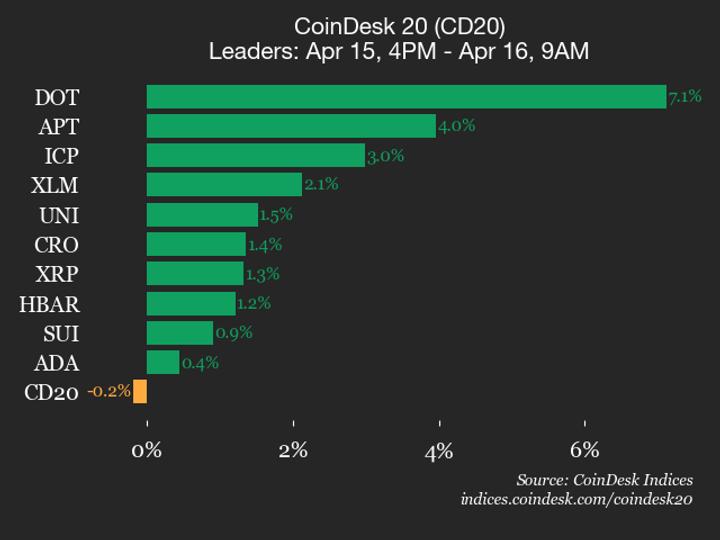
The CoinDesk 20 (CD20) index rose around 1.9% in the past 24 hours, compared with bitcoin’s 1%, amid reports of a ceasefire extension, improving risk sentiment.
The increases come alongside a softer U.S. dollar, which slipped to a near six-week low, and easing Treasury yields, conditions that often support crypto prices by lowering the relative appeal of holding cash. Gold also gained, pointing to a market balancing risk appetite with hedging demand.
Still, the backdrop remains tense. The U.S. blockade of Iranian ports and Iran’s threats to disrupt shipping routes in the Persian Gulf and nearby waterways continue to cloud the outlook for the global economy.
Energy supply shocks have already begun feeding into inflation expectations, a factor that could shift central bank policy and ripple into crypto markets.
Onchain data also show bitcoin supply tends to appear when prices reach key cost-basis levels for short-term holders. That’s around $76,800, a level that could act as resistance as investors cash out when breaking even.
Derivatives positioning
Crypto futures open interest (OI) has risen 2.5% in the past 24 hours even as trading volume dropped 16% and liquidations fell 48% to $220 million.
The divergence suggests traders are adding or holding positions despite a slowdown in activity, pointing to a buildup of exposure without strong conviction. The sharp decline in liquidations indicates reduced volatility and fewer forced exits.
Among the biggest tokens, XRP and DOGE stand out with OI increases of at least 3%, showcasing a bullish combination of positive perpetual funding rates and OI-adjusted cumulative volume delta (CVD).
DOGE has the most positive 24-hour CVD, indicating that buyers have been more aggressive in lifting offers and driving trades.
On decentralized exchange Hyperliquid, perpetuals tied to commodities continue to do solid business and now account for 30% of the platform’s total notional open interest.
Bitcoin and ether’s 30-day implied volatility indexes, BVIV and EVIV, continue to hover below their 200-day averages, indicating market calm.
In the BTC options market, the one-week implied volatility is now trading cheaper relative to realized or actual volatility. In other words, short-dated options are now cheap. This kind of setup often has traders taking bullish volatility bets via straddle/strangle strategies that involve buying both call and put options.
The Deribit-listed bitcoin and ether options continue to show a bias for puts. The persistent demand for downside hedges indicates that the sustainability of recent rally is still being questioned.
Token talk
CoW Swap, a decentralized exchange aggregator tied to CoW Protocol, on Tuesday suffered a domain name system (DNS) hijacking attack that redirected users to a malicious site and drained funds from connected wallets.
The breach did not touch the protocol’s smart contracts or back-end systems. Instead, attackers used social engineering to gain control of the project’s domain registrar, allowing them to reroute traffic from cow.fi to a cloned interface designed to capture wallet approvals.
Losses appear limited to affected users rather than the protocol itself. Onchain data points to at least $1 million drained, including a single wallet that lost 219 ETH.
The COW token fell about 2.6% that day, with trading volume spiking as news spread. Prices continued to drift lower in the following sessions, and are now 11% lower.
CoW DAO reclaimed control of the cow.fi domain little over half a day ago, but sentiment for the protocol doesn’t appear to have improved. The token is down another 6% since then.