Home Blog Page 434

Wall Street tech is coming to crypto as DoubleZero rolls out high-speed data for blockchain

0

DoubleZero Foundation, a project building high-speed data infrastructure for blockchains like Solana, has rolled out a new platform to speed up how trading firms access crypto market data — a sign of growing demand for Wall Street-style systems in digital asset markets.

The project, called DoubleZero Edge, went live on Thursday. Its first offering is a real-time feed of raw data from the Solana blockchain, giving traders faster access to information that can influence prices.

Solana, a high-speed blockchain popular with traders, produces large amounts of real-time data as transactions are processed. DoubleZero plugs into that system by working with validators to distribute it more quickly to market players.

Unlike traditional finance, where exchanges rely on specialized networks to deliver data at high speed, crypto markets still largely depend on the public internet: a setup that can introduce delays and inconsistencies. DoubleZero is trying to change that by building a dedicated system designed specifically for onchain data.

According to the company, the new network can shave tens of milliseconds off data delivery times, with bigger gains during periods of heavy network activity. For high-frequency trading firms, even small speed improvements can translate into a competitive edge.

The platform works by sending data over a private fiber network using multicast, a method commonly used in traditional financial markets to simultaneously distribute data to multiple participants.

Beyond speed, DoubleZero is also pitching a new economic model. Validators on the Solana network can earn additional revenue by supplying data to the platform, while traders pay to subscribe to the feeds using USDC.

The launch comes as crypto trading firms increasingly seek more reliable, predictable infrastructure, particularly as competition intensifies and margins tighten. DoubleZero says its system could help level the playing field by reducing uncertainty in how quickly market data reaches participants.

“Traditional finance has spent decades building infrastructure where speed and deterministic performance are a real competitive advantage,” said Andrew McConnell, a co-founder of DoubleZero, in a press release shared with CoinDesk. “On-chain markets didn’t get that foundation, which left even sophisticated trading firms working on uneven ground. Deterministic infrastructure removes a risk market makers have to price in, which leads to tighter spreads and better execution.”

Read more: A former Solana exec is taking a page out of Wall Street playbook to make global crypto trades faster

Massive XRP Adoption Trend Paints The Most Bullish Picture Yet

0

Trusted Editorial content, reviewed by leading industry experts and seasoned editors. Ad Disclosure

Most investors tracking XRP are watching the wrong screen. XRP’s price action has struggled to show the scale of what has been building around Ripple, RLUSD, and the XRP Ledger. The price action is full of red monthly candles while a much broader institutional foundation is being assembled underneath it.

That disconnect is what enthusiast X Finance Bull leaned on in a recent post on X. Recent developments from Ripple itself suggest that the claim is not as easy to dismiss as it once was.

Ripple’s Story Is Growing Past Payments

Many XRP community members are looking at ultra-bullish pictures for the cryptocurrency. One of such community members is X Finance Bull, who recently took to the social media platform X to highlight reasons as to why the mass adoption of Ripple, XRP, XRP Ledger, and RLUSD is already here.

One of the key points the analyst highlighted is Ripple’s strategy to build a full end-to-end treasury ecosystem setup. The setup functions as a financial operating layer that integrates with a company’s existing banks, ERP systems, and internal workflows, linking them to digital asset rails without requiring any overhaul of existing infrastructure.

Enterprise platforms such as SAP, Oracle, NetSuite, and Workday are all connected through a single API layer referred to as ClearConnect. The same API layer bridges traditional rails (ACH, wire transfers, and SWIFT) with XRP settlement, RLUSD, and Ripple’s brokerage and custody infrastructure. 

The most important thing in this treasury ecosystem is that Ripple is growing and no longer pitching itself only as a cross-border payments company. On April 1, Ripple announced native digital asset capabilities inside Ripple Treasury, describing it as the first treasury management system with built-in support for digital assets. 

RLUSD And Ripple Prime Are Making The Institutional Case Clearer

Another sector where Ripple is gaining adoption is through its RLUSD stablecoin. Ripple says RLUSD is issued on both the XRP Ledger and Ethereum, backed one-to-one by cash, cash equivalents, and US Treasuries, and issued under NYDFS oversight.

Ripple Prime, also highlighted by X Finance Bull, is another factor for Ripple and XRP’s adoption. Ripple Prime was created following Ripple’s acquisition of Hidden Road, and data from its website shows that the business clears over $3 trillion annually while serving more than 300 institutional clients. 

Notable examples are Deutsche Bank, AMINA Bank, and SBI Holdings. Interestingly, Ripple also indicated during the acquisition that RLUSD would be positioned for use as collateral for brokerage products.

Institutional adoption extends into custody as well. As noted by X Finance Bull, Ripple’s custody solutions are already being used by financial players, including BBVA Switzerland, Societe Generale-FORGE, and DBS. 

The overall picture is even more bullish when developments and updates on the Ledger itself are considered alongside these ecosystem developments. As noted by X Finance Bull, all these didn’t appear overnight. They are the products of a decade of building acquisitions, licenses, integrations, and compliance frameworks. It is all now coming together in 2026.

XRP
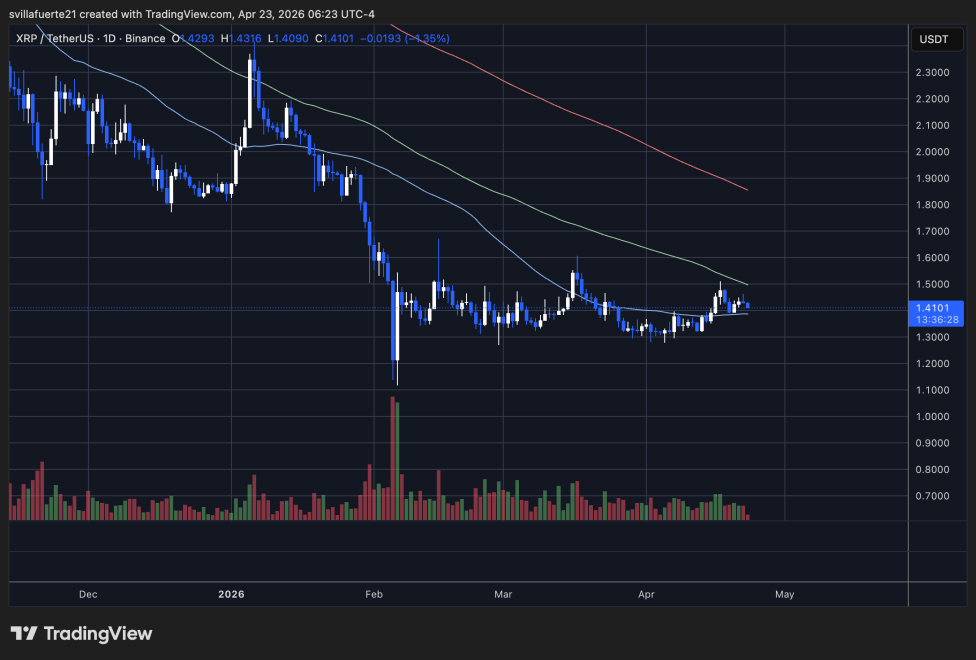
XRP trading at $1.40 on the 1D chart | Source: XRPUSDT on Tradingview.com

Featured image from Getty Images, chart from Tradingview.com

Editorial Process for bitcoinist is centered on delivering thoroughly researched, accurate, and unbiased content. We uphold strict sourcing standards, and each page undergoes diligent review by our team of top technology experts and seasoned editors. This process ensures the integrity, relevance, and value of our content for our readers.

LDO Bucks DeFi Downturn With 30% Monthly Rally After DAO Passes Buyback Scheme

0

Lido’s token is the only top DeFi token in the green over the past 30 days, fueled by a $20 million treasury repurchase program.

Top Ethereum liquid staking protocol Lido’s governance token has emerged as a rare bright spot in a battered DeFi sector, gaining 30% over the past 30 days while every other major token slid into the red.

LDO is trading at $0.42, up 12% in the past 24 hours, according to CoinGecko.

LDO Chart

The contrast with its DeFi peers is stark. Over the same 30-day window, AAVE fell 7%, Uniswap (UNI) dropped 15%, Curve’s CRV slipped 9%, and Etherfi’s ETHFI shed 16%. MORPHO was the closest to breakeven among top DeFi tokens, losing just 0.5%.

The catalyst behind LDO’s outperformance is a $20 million buyback program. The Lido DAO voted to spend up to 10,000 stETH ($23 million) to repurchase LDO tokens from the open market, routing purchases through centralized exchanges and market makers in 1,000 stETH batches due to thin on-chain liquidity. Each batch requires a separate Easy Track governance motion to execute. At current prices, the full program could retire roughly 8% of LDO’s circulating supply, according to the proposal.

The buyback coincides with a broader strategic pivot. In December, the DAO approved a $60 million budget to push Lido beyond its core liquid staking business. That plan began taking shape in March when the protocol launched EarnUSD, its first stablecoin vault, which allocates USDC and USDT deposits across lending markets, real-world asset integrations and structured positions.

But despite the rally, LDO remains down more than 94% from its November 2021 peak of $7.30, and Lido’s share of staked ETH has slipped to a year-to-date low of roughly 23%, according to a Dune dashboard.

The buyback proposal itself acknowledged the token’s distressed valuation, calling the gap between LDO’s price and Lido’s revenue “one of the most significant dislocations” in the project’s history.

Drift gets $148 million rescue fund and Tether will replace Circle’s USDC for settlement after massive exploit

0

Drift Protocol, the victim of a recent North Korean exploit, plans to relaunch with Tether’s USDT as its settlement layer after securing a proposed funding package of up to $147.5 million from the stablecoin issuer and partners, the companies said on Thursday.

The deal includes up to $127.5 million from Tether and $20 million from the other partners, structured to support user recovery following Drift’s April 1 exploit and to reboot the platform as a USDT-based perpetual futures exchange on Solana. Previously, the platform used Circle’s stablecoin USDC as its settlement layer.

The rescue package combines a revenue-linked credit facility, ecosystem grants and loans to market makers. A portion of trading revenue, alongside committed capital, will be directed to a recovery pool aimed at covering roughly $295 million in user losses over time.

The funding comes after a North Korea-linked group infiltrated Drift Protocol, posing as a quantitative trading firm for about six months before carrying out an exploit that was more than $270 million on April 1. Drift’s governance token, DRIFT, has lost about 70% of its value since the exploit.

Circle came under fire from the crypto community for its seeming unwillingness to halt the money transfer after the exploit. The attacker moved about $232 million in USDC from Solana to Ethereum using Circle’s cross-chain transfer protocol. Some critics, including blockchain investigator ZachXBT, said Circle could have moved faster to blacklist wallets and freeze funds to prevent (or at least slow down) the attacker from moving the assets.

However, Circle’s didn’t take any such actions due to legal risks.

Its CEO, Jeremy Allaire, later said that his company freezes USDC wallets only when directed by law enforcement or courts, not in real time during hacks. The approach reflects Circle’s broader strategy to align closely with regulators and institutions.

Its rival, USDT, meanwhile, is more nimble at freezing funds. The stablecoin issuer has repeatedly frozen assets linked to hacks or other illicit activities previously.

Drift is the largest decentralized perpetual futures exchange on Solana, with more than 175,000 users and roughly $150 billion in cumulative trading volume. Founded in 2021, it offers perpetuals, spot trading, lending, borrowing and cross-margin trading.

Stablecoin war

Competition in stablecoins is intensifying as exchanges, fintechs, and traditional financial institutions race to control the on-ramps, liquidity, and settlement layers that underpin digital asset markets.

Circle’s USDC has been steadily chipping away at Tether’s long-standing dominance of the stablecoin market, gaining share on the back of regulatory alignment and growing institutional use.

While USDT still leads by a wide margin, according to CoinDesk data, with roughly $185.5 billion in supply versus about $78.6 billion for USDC, Circle’s transaction volume outpaced Tether’s in recent months as its market share expanded.

With the new funding package, Tether also plans to fund fee reductions and user incentives tied to Drift’s transition to USDT, while extending liquidity support to designated market makers to bolster trading depth at relaunch.

Drift said the move positions USDT at the center of its trading infrastructure while providing a pathway to restore user funds and resume operations.

Read more: How a Solana feature designed for convenience let attackers drain more than $270 million from Drift

Un nuevo informe de MHI y Deloitte concluye que la IA es la mayor fuerza disruptiva de las cadenas de suministro durante la próxima década

0

El 71 % de los encuestados afirma que la IA está transformando las cadenas de suministro; y un 24 % considera que la disrupción será transformacional

Un nuevo informe publicado hoy por MHI y Deloitte concluye que la inteligencia artificial (IA) es considerada la tecnología más disruptiva para las cadenas de suministro durante la próxima década.

El informe anual de la industria MHI 2026, “Rewiring the Future: A Supply Chain Playbook for Innovation” (“Reescribiendo el futuro: una guía para la innovación en la cadena de suministro”), señala que la aparición de la IA está llevando a los líderes del sector a replantear todos los aspectos de sus operaciones, invirtiendo no solo en las tecnologías digitales avanzadas como la IA, la robótica y la analítica en tiempo real, sino también en su fuerza laboral.

La publicación, basada en una encuesta a líderes de la cadena de suministro, indica que una cuarta parte de los encuestados (24 %) considera la IA como transformacional, y casi la mitad (48 %) estima que su impacto disruptivo es significativo o superior, lo que supone un aumento de 25 puntos porcentuales desde 2025. La robótica y la automatización ocupan el segundo lugar entre las tecnologías más disruptivas, con un 39 % que califica su impacto como significativo o superior, un aumento de 16 puntos porcentuales.

Al centrarse en la intersección entre los negocios y tecnología, el informe va más allá de las tendencias tecnológicas y analiza cómo las evaluaciones operativas, la automatización inteligente, la toma de decisiones basada en datos y los nuevos enfoques de desarrollo de talento pueden integrarse para “reconfigurar” el rendimiento de la cadena de suministro.

Planes de inversión en innovación

Según el informe, el 56 % de las organizaciones espera aumentar su inversión en innovación en la cadena de suministro, y el 52 % afirma que planea invertir más de 1 millón de dólares. El 17 % prevé invertir más de 10 millones de dólares. Este gasto refleja un enfoque de inversión más disciplinado, ya que las empresas están revisando qué problema intentan resolver, seleccionando la gestión y realizando planificación de escenarios para justificar, controlar y escalar mejor las inversiones tecnológicas.

Las organizaciones de la cadena de suministro operan hoy en un entorno definido por disrupción constante, volatilidad y cambios rápidos en la demanda del mercado. La incertidumbre geopolítica, la escasez de mano de obra, la aceleración de los ciclos tecnológicos y el aumento de las expectativas de los clientes han convergido para hacer que la previsibilidad sea cosa del pasado. Las prioridades estratégicas incluyen ahora el fortalecimiento de la gestión de riesgos, la mejora de la transparencia, la habilitación de la entrega rápida y la integración de la sostenibilidad en toda la cadena de suministro.

“Las cadenas de suministro ya no pueden optimizarse de forma parcial”, afirmó John Paxton, director ejecutivo de MHI. “Deben reconfigurarse integralmente. Solo las redes conectadas, inteligentes y automatizadas en tiempo real podrán soportar la volatilidad y responder a las futuras demandas de velocidad y eficiencia de los clientes”.

La IA es el futuro de la cadena de suministro, y el futuro es ahora

La IA ya está aportando valor en una amplia gama de procesos de la cadena de suministro, desde la gestión de inventarios hasta la planificación de la demanda y la logística. En el futuro, las organizaciones del sector aprovecharán cada vez más la IA para mejorar todas sus operaciones. En particular, la IA agéntica tiene el potencial de eliminar rápidamente tareas repetitivas de alto volumen, abordar proactivamente las disrupciones, mejorar la precisión de las previsiones y aumentar la visibilidad general de la cadena de suministro.

Aunque los líderes están entusiasmados con el potencial de la IA, el informe señala que muchos encuentran dificultades para determinar por dónde empezar y qué se necesita para ascender. Las barreras son reales y prácticas: casos de uso poco claros y costes de automatización, junto con una comprensión limitada; dificultades para construir casos de negocio; escasez de talento; y restricciones presupuestarias.

“Aquellos que conecten la excelencia operativa, la orquestación impulsada por IA y la preparación de la fuerza laboral en una sola estrategia no solo resistirán la disrupción, sino que la convertirán en crecimiento y rendimiento sostenido”, afirmó Wanda Johnson,experta en tecnología de la cadena de suministro de Deloitte Consulting LLP.

La integración de la IA generativa, la IA agéntica, la IA física y la IA en el borde (edge AI) en las operaciones está dando lugar a un futuro en el que la ejecución de la cadena de suministro se defina por software, se adapte continuamente y esté respaldada por motores de orquestación inteligentes. Esta transformación no solo mejora lo existente, sino que cambia fundamentalmente cómo se resuelven los problemas, cómo se invierte el capital y cómo se gestiona la capacidad de la fuerza laboral.

La incertidumbre encabeza la lista de las principales tendencias que impactarán las cadenas de suministro en 2026

Según los encuestados de este año, estas son las principales tendencias que afectan a las cadenas de suministro:

  1. Incertidumbre económica, inflación y riesgos geopolíticos
  2. Fuerza laboral, escasez de talento y cambios en las habilidades requeridas
  3. Ritmo de adopción tecnológica, digitalización y necesidad de datos en tiempo real
  4. Visibilidad, agilidad y resiliencia de la cadena de suministro
  5. Ciberseguridad y seguridad de datos
  6. Aumento del costo del capital
  7. Desafíos de inventario
  8. Crecimiento del comercio electrónico
  9. Enfoque centrado en el cliente
  10. Reubicación de la producción

“El mayor riesgo no es la disrupción, sino la falta de innovación y el peligro de operar en el futuro con equipos y tecnología del pasado”, afirmó John Paxton, director ejecutivo de MHI.

El informe también incluye estudios de caso reales sobre tecnologías digitales aplicadas a la cadena de suministro y recomendaciones para que los líderes desarrollen estrategias de implementación de estas innovaciones.

What Will Restart The Rally?

0

Bitcoin (BTC) struggles to reclaim price highs above $76,000, but analysts say that the uptrend may continue if key conditions are met.

Bitcoin’s 8% climb over the last three days saw it reclaim key levels, including the 50-day exponential moving average (EMA) at $71,000.

“$76K is the level that decides everything,” analyst Crypto Patel said in a Wednesday post on X, adding:

“We need a proper HTF candle close above this zone to trust the move.”

Related: Bitcoin falls to lower support as analysts say markets are ignoring key Iran issue

The analyst further explained that a high-time frame close above $76,000 would open the path toward the $84,000-$96,000 zone, where investors acquired more than 2 million BTC over the last six months, according to Glassnode’s cost basis distribution heatmap.

BTC/USD daily chart. Source: X/Crypto Patel

Echoing this view, trading resource Material Indicators said that “there are multiple levels of technical resistance stacked” between the spot price and a “bonafide $BTC bull market breakout.”

These include the yearly open at $87,500 and the 50-week moving average at $97,000, which must be reclaimed to confirm that the “$BTC bull market has returned,” Material Indicators said in a follow-up post.

BTC/USD daily chart. Source: Material Indicators

The trading resource further pointed out that the relative strength index must close and hold above the 41 level in the weekly time frame. 

Previous occurrences in 2023, 2020 and 2019 have led to 660%, 1,600% and 316% BTC price rallies, respectively.

“Obviously, we are not there yet,” Materials indicators said in a video posted on X, adding:

“Those are the macro things that need to happen to say a validated bull market is on.”

For analyst Rekt Capital, the BTC/USD pair needs to achieve a weekly close above $72,800 to “confirm a breakout.”

BTC/USD weekly chart. Source: X/Rekt Capital

As Cointelegraph reported, the bulls must decisively break above the $76,000-$80,000 range to confirm a trend change.

Optimism needs to return to the BTC market

The bull score index, a measure of Bitcoin’s overall market health that combines fundamental and technical metrics, indicates a significant improvement in market conditions following BTC’s latest move to $76,000. 

The metric increased to 40 on April 15, the highest since late October 2025. This reading remains within neutral territory, reflecting a gradual recovery after a period of relatively weak momentum.

While the bull score index improvement to 40 “reflects relative stability in the market,” it must rise to an area of “strong optimism (above 60), which typically indicates strong bullish conditions,”  CryptoQuant analyst Arab Chain said in a Quicktake post, adding:

“If the indicator continues to improve gradually, it may signal a potential return of upward momentum, especially if higher levels are reclaimed in the coming period.”

Bitcoin bull score index. Source: CryptoQuant

Meanwhile, demand for spot Bitcoin ETFs remains intermittent, with these investment products recording alternating inflows and outflows after every few days. 

Although the $451 million in net inflows recorded on Tuesday pointed to a return in demand from US investors, persistent positive flows are required to propel BTC price higher.

Spot Bitcoin ETF flows chart. Source: SoSoValue

As Cointelegraph reported, onchain activity is showing “bull market behavior,” with Bitcoin’s daily transaction count reaching 17-month highs, further reinforcing BTC’s upside potential.