Home Blog Page 370

Ripple CEO Garlinghouse Named Harvard Business Leader Of The Year

0

Trusted Editorial content, reviewed by leading industry experts and seasoned editors. Ad Disclosure

Ripple CEO Brad Garlinghouse has been honored as the 2026 Business Leader of the Year by the Harvard Business School Association of Northern California, giving one of crypto’s most prominent executives a high-profile recognition from the Bay Area business establishment. The award places Ripple’s payments and digital-asset strategy in a broader conversation about financial infrastructure, regulation and institutional adoption.

The event was held Tuesday, April 21, at the Julia Morgan Ballroom in San Francisco, with more than 250 entrepreneurs, investors, business leaders and HBS alumni in attendance, according to the association’s post shared on LinkedIn. Ripple said the evening included a fireside conversation between Garlinghouse and Ripple co-founder and executive chairman Chris Larsen, focused on more than a decade of building the company and what comes next.

Harvard Honors Ripple CEO

HBSANC framed the recognition around Garlinghouse’s role in payments infrastructure, digital assets and Bay Area business leadership. The association said it was “proud to honor Brad Garlinghouse” and described Ripple’s mission as enabling “faster, more efficient global money movement.” In its event materials, the group highlighted Ripple’s push to move, store, exchange and manage value across borders in seconds rather than days, while reducing costs and improving transparency.

Garlinghouse’s tenure at Ripple has been defined not only by product expansion, but also by the company’s long-running fight for regulatory clarity in the United States.

HBSANC described him as a central voice in the debate over digital-asset regulation and pointed to Ripple’s legal victory against the Securities and Exchange Commission as part of the backdrop for the award. The association said his leadership during that period reflected “resilience” and “steadfast conviction,” language that tracks closely with how Ripple and XRP supporters have viewed the company’s posture through the SEC case.

The award also ties Garlinghouse’s current profile back to a longer Silicon Valley career. Before joining Ripple, he held senior roles at Yahoo, where he worked on products including Yahoo Mail and Messenger, later served as president of consumer applications at AOL and was CEO of Hightail. HBSANC also referenced his widely circulated “Peanut Butter Manifesto,” the Yahoo strategy memo that became shorthand in Silicon Valley for focus and product discipline.

Notably, Harvard’s own investment arm has also disclosed crypto exposure through SEC 13F filings: Harvard Management Company cut its iShares Bitcoin Trust position by roughly 21% in the fourth quarter of 2025, but still held more than $265 million in IBIT, its largest publicly disclosed holding, while opening a new Ethereum ETF position of nearly 4 million shares valued at about $86.8 million.

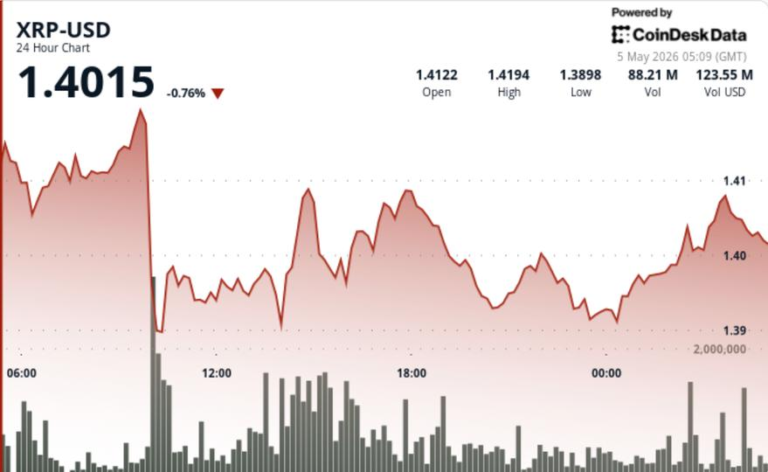
At press time, XRP traded at $1.4151.

XRP price chart
XRP closed above the 200-week EMA, 1-week chart | Source: XRPUSDT on TradingView.com

Featured image created with DALL.E, chart from TradingView.com

Editorial Process for bitcoinist is centered on delivering thoroughly researched, accurate, and unbiased content. We uphold strict sourcing standards, and each page undergoes diligent review by our team of top technology experts and seasoned editors. This process ensures the integrity, relevance, and value of our content for our readers.

Taranis Capital and Emaar Executive Company Partner to Build Next-Gen Data Centres in Saudi Arabia

0

Taranis Capital Limited, an investment firm regulated by the DFSA and based in the Dubai International Financial Centre (DIFC), has officially signed a Memorandum of Understanding (MOU) with Emaar Executive Company (EEC). Together, the firms plan to develop, construct, and operate a portfolio of next-generation, carrier-neutral data centre facilities across the Kingdom of Saudi Arabia.

The collaboration unites Taranis Capital’s fund management and investor network with EEC’s vertically integrated engineering, procurement, and construction (EPC) capabilities, alongside its design and operations expertise. This combination creates a fully integrated platform aimed at delivering world-class digital infrastructure within the Kingdom.

Addressing the Kingdom’s infrastructure gap

Saudi Arabia’s data centre market is currently experiencing unprecedented demand, primarily driven by the rapid adoption of artificial intelligence (AI), cloud computing, and various digital transformation initiatives under Vision 2030. However, despite substantial investments from global hyperscalers, the Kingdom currently lacks sufficient carrier-neutral, multi-tenant facilities capable of providing the connectivity ecosystems that enterprises, content providers, and cloud platforms require.

To bridge this gap, the new partnership will focus on developing strategically located data centre campuses. Key features of these planned facilities include:

  • A line of sight to a 40–50 MW capacity per site.

  • Integration of the latest cooling technologies.

  • Flexible designs specifically capable of supporting evolving AI workloads, which includes NVIDIA’s next-generation GPU architectures.

Leadership perspectives

Nicholas Bingham, founding partner and CEO of Taranis Capital, highlighted the strong market demand driving the project.

“This partnership brings together exactly the right combination of capabilities to deliver on the enormous data centre opportunity in Saudi Arabia,” Bingham stated. “EEC has an unmatched track record of building and operating hyperscaler-grade facilities in the Kingdom, and with SIPA’s support, we are positioned to move rapidly from planning to execution.”

Bingham added that investors are currently viewing digital infrastructure in Saudi Arabia as one of the most compelling investment themes globally.

Milan Radia, partner of data centre strategy at Taranis Capital, pointed out the need for a specific ecosystem model within the region.

“What is missing in the Saudi market is the connectivity ecosystem model that made companies like Equinix, Telecity, and Interxion so successful in Europe,” Radia explained. “No one in the region has yet built a true community-of-interest environment.”

Karthik Ramaswamy, COO of Emaar Executive Company, emphasized the operational strength behind the joint venture.

“EEC brings over a decade of experience delivering complex technology infrastructure projects in Saudi Arabia, with our own certified workforce on the ground,” Ramaswamy said. “This partnership will allow us to scale our capabilities and contribute to the Kingdom’s ambition of becoming a global hub for digital infrastructure and artificial intelligence.”

Strategic support from SIPA

The Saudi Investment Promotion Authority (SIPA) has demonstrated a proactive commitment to the partnership, playing a central role in its progress. SIPA will actively facilitate the necessary regulatory and licensing processes for the data centres to ensure a seamless and efficient investor journey.

According to the press release, SIPA’s involvement reinforces its position as a key driver in advancing Saudi Arabia’s ambitions to become a global hub for digital infrastructure. The initiative strongly aligns with Vision 2030, particularly in its goals to accelerate digital capacity, foster innovation, support economic diversification, and achieve technological leadership across the Kingdom.

Pudgy Penguins, BAYC rally masks a shrinking NFT market as volumes and users fall

0

Non-fungible tokens (NFTs) are rallying, and to those fixated on rising prices, the market may seem to be booming. Overall activity, however, tells a different story.

Leading the rally are Bored Ape Yacht Club and Pudgy Penguins. Their floor prices, the lowest possible acquisition cost, have climbed double digits in recent weeks, and their tokens have posted double-digit gains. Still, the comeback is unfolding with far fewer buyers.

Pudgy Penguins’ floor has climbed above 5 ETH, up more than 20% on the week, with 201 sales and nearly 1,000 ETH in volume over the past seven days supporting the move. BAYC’s floor is up 81% over the past 30 days, rebounding sharply from depressed levels.

Floor prices are an important metric to follow. In an NFT collection, the floor price is the lowest-priced item currently for sale. If the lowest-priced Pudgy Penguin on the market is listed at 5.38 ether (ETH), that becomes the collection’s floor. A rising floor generally means buyers are willing to pay up to get in. A falling floor usually means holders are rushing for the exit.

But beneath the headline price gains, the market’s structure tells a different story, as broad participation is shrinking.

According to CryptoSlam, global NFT sales fell to roughly $175 million in April from $304 million in February, while total transactions and active users both dropped by nearly half.

Average sale prices, meanwhile, more than doubled month over month, climbing from $30.60 in March to $67.38 in April. Those two data points describe the same phenomenon from opposite ends. A smaller pool of capital is concentrating in high-value trades in blue-chip collections, rather than a broad-based demand returning to the market.

Even within blue chips, demand quality varies. Pudgy Penguins is seeing relatively high transaction counts alongside rising prices, a sign of sustained activity. By contrast, collections like CryptoPunks have recorded similar weekly volume with far fewer trades, implying that a small number of large transactions are having an outsized impact on price.

Broader market signals remain mixed. Wash trading still accounts for roughly 50% of total volume, according to CryptoSlam, and aggregate trading profits remain negative, indicating that many participants are still underwater despite the recent rebound.

Taken together, the data points to a market that is stabilizing but not yet expanding. Prices are rising, but participation is falling, and activity is concentrated in a handful of collections.

At the same time, ETH is up roughly 18% over the past month, and BTC is up nearly as much. Some portion of what looks like an NFT-specific rally is simply beta to a crypto-wide risk-on move, with blue-chip collections priced in ETH catching the updraft alongside everything else.

What is Paul Sztorc’s Bitcoin hard fork ‘eCash’ and how it affects BTC?

0

Long-time Bitcoin developer Paul Sztorc has been trying to overhaul Bitcoin’s architecture since 2015, but the broader community hasn’t budged.

So now he has proposed a dramatic step, called eCash hardfork, that involves copying Bitcoin’s code to launch a separate version in August, while giving existing bitcoin holders equivalent tokens in the new network for free.

The community, however, is criticizing the funding part, which involves reassigning coins linked to Bitcoin’s missing founder, Satoshi Nakamoto.

What is a hard fork?

Think of a hard fork like a railway line splitting into two. Trains start from the same station, but at some point the line splits, helping trains reach completely different destinations.

When a group of developers cannot reach consensus on a proposed change to Bitcoin’s code, they copy the existing blockchain and launch it as a separate chain, which shares Bitcoin’s entire history up to the point of the split, but diverges after the split, moving forward with its own rules, features, token and direction.

That’s precisely what happened in 2017 when the debate over Bitcoin’s block size reached a tipping point, culminating in a chain split and the creation of the Bitcoin Cash blockchain with its native token, BCH.

The technical dispute centered on Bitcoin’s 1MB block size limit, which caps the number of transactions that can be processed every 10 minutes when new blocks are added to the blockchain. Hence, some favoured increasing the block size, but the community remained divided, eventually leading to a chain split.

Sztorc’s eCash hard fork

The proposed hard fork will create a new chain called eCash with native eCash tokens. “Hold 4.19 BTC at the time of the fork, get 4.19 eCash. You can sell it, keep it, or ignore it entirely,” he said on X.

The fork is scheduled for Bitcoin block height 964,000 in August 2026. A coin-splitter tool will be released to help holders cleanly separate their BTC from their new eCash.

The new chain will be a near-copy of Bitcoin’s existing blockchain, with one critical addition called Drivechains, a scaling architecture Sztorc first proposed in 2015 and formally submitted to Bitcoin developers as BIP300 and BIP301 in 2017 and 2019, respectively.

Drivechains are sidechains tethered to the Bitcoin blockchain, allowing seamless movement of BTC between the main chain and sidechains without changing Bitcoin’s base layer. Each sidechain can operate under its own rules and features, essentially allowing developers to build new capabilities on top of Bitcoin without requiring the entire network to adopt those changes.

Think of Drivechains as service roads attached to the main highway. When the highway is congested, drivers can exit the highway and travel on the service road at different speed limits, then re-enter the highway when it’s clear. This way, the highway never changes, yet more traffic is handled more efficiently, and the journey becomes more flexible for everyone.

Seven Drivechains are already in development, Sztorc said on X, including a privacy chain modelled on Zcash, a prediction market called Truthcoin, a decentralised exchange called CoinShift, and a quantum-resistant chain called Photon.

The controversial part linked to Satoshi coins

Sztorc wants to use coins that would have gone to Satoshi Nakamoto’s equivalent addresses on the new eCash chain to bring investors on board before the fork goes live, a decision he calls necessary but which has riled the community, with some calling it outright theft.

A potential hard fork would bring Bitcoin’s entire transaction history to the new chain. So every bitcoin balance, including Satoshi’s 1.1 million bitcoin, sitting untouched in wallets that have noved moved these coins, would show up as an equivalent eCash balance on the new chain.

As per the plan, fewer than half of the Satoshi-equivalent eCash coins will be assigned to investors today. The precise mechanism of how it’s being done remains unclear. But since eCash doesn’t yet exist, the pre-hard fork assign seems to be a promised credit following a successful hard fork.

The plan, he argues, will ensure collaborators have a tangible incentive to get involved early, building momentum and completing work ahead of launch. Without this mechanism, the project can turn into a “zombie project” that ships unfinished. Worse, it could become a centralized project, where a small group of developers gains outsized control over the chain’s direction.

The industry response, however, has been negative.

“Taking Satoshi coins is theft and disrespectful, and eCash is already used for Lightning payments with Cashu and Fedi. Those are poor choices,” Bitcoin advocate Peter McCormack said.

Josh Ellithorpe, chief technology officer at Pixelated Ink, expressed concerns about the precedent it sets and how it could eventually be a risk to everyone’s BTC holdings.

“eCash, setting the precedent that they can and will steal coins. Now it’s Satoshi, but it could be anyone later. Also misrepresenting the BCH fork, stealing another project’s name, and not having replay protection,” Ellithorpe said.

Key US Crypto Bill Nears May Approval: CEO

0

Trusted Editorial content, reviewed by leading industry experts and seasoned editors. Ad Disclosure

The odds of a landmark US crypto bill passing this year stand at 50-50, according to one of the industry’s own analysts — even as his CEO boss says the deal is all but done.

A Bill With Big Promises

Galaxy Digital CEO Mike Novogratz says the CLARITY Act — legislation designed to bring regulatory order to the US crypto market — will clear Congress in May and land on US President Donald Trump’s desk in June.

Novogratz made the prediction during a podcast appearance with SkyBridge Capital founder Anthony Scaramucci published Friday, where he framed the bill in sweeping terms.

Around 5.5 billion people worldwide currently have no access to US financial products, he said. With a crypto wallet on a smartphone, a teenager in Bhutan or Bolivia could one day tap into the American economy directly.

The bill would also allow major corporations like SpaceX and Google to be tokenized and sold to investors across the globe, Novogratz added. Its passage is widely seen as a signal that the US is open for crypto business again, after several firms relocated abroad during the Biden administration over what they described as a hostile regulatory climate.

Divided Views Within The Same Firm

Not everyone at Galaxy Digital shares Novogratz’s confidence. Alex Thorn, the firm’s head of research, published a separate assessment Wednesday putting the bill’s chances of passing in 2026 at 50%.

BTCUSD now trading at $77,972. Chart: TradingView

He warned that if committee markup does not happen by mid-May, those odds will fall sharply. The Senate Banking Committee had been expected to schedule a markup hearing by this past Friday. It did not. That miss rattled some in the industry who had been counting on a faster timeline.

Based on reports, Thorn now expects the committee to announce a markup hearing this week, likely for the final days of April. Progress has been slowed partly by a standoff between traditional banks and crypto firms over stablecoin yields.

Banks argue that if stablecoins pay returns, they could pull deposits away from conventional lenders, putting them at a disadvantage.

The CLARITY Act passed the House in July 2025 with support from both parties. Since then, progress in the Senate has stalled.

Novogratz acknowledged the bumpy week but insisted bipartisan backing would carry the bill through. “It’s wildly important for it to get done for both Democrats and Republicans,” he said.

Featured image from MetaAI, chart from TradingView

Editorial Process for bitcoinist is centered on delivering thoroughly researched, accurate, and unbiased content. We uphold strict sourcing standards, and each page undergoes diligent review by our team of top technology experts and seasoned editors. This process ensures the integrity, relevance, and value of our content for our readers.

BTC pulls back from 12-week high as Iran rally hits seller wall at $79,400

0

Bitcoin tagged a 12-week high of $79,399 overnight before sellers stepped in Asian morning hours on Monday, dousing a rally that setup the asset for a run to $80,000 for the first time since January.

Bitcoin traded at $77,705 on Monday morning, down 0.4% over 24 hours after climbing to $79,399 around 09:00 IST and reversing sharply through the Asia session. Ether slipped 2.4% to $2,329, Solana fell 1.9% to $86, and BNB declined 1.2% to $630. The rally that lifted bitcoin to its highest level since January 31 unwound by mid-morning Singapore time.

The push higher came on a report from Axios that Iran offered a new proposal to the US to reopen the Strait of Hormuz, with nuclear talks delayed until after the US naval blockade is lifted.

Asian equities ran with it. The MSCI Asia Pacific Index rose 1.7%, the emerging markets index hit a record, and Taiwan Semiconductor Manufacturing surged 6% to its own record. Brent crude pared earlier 2.5% gains to up 1% at $106.50 a barrel.

Bitcoin briefly traded along with the risk-on move and then peeled away. The rejection at $79,399 has a clean technical explanation. Rachael Lucas, an analyst at BTC Markets, said $80,000 is where many recent buyers are approaching breakeven, which historically produces selling pressure as those traders rotate out of positions they were underwater on for weeks.

Bitcoin is up 16% in April, on pace for its first double-digit monthly gain since May 2025. Strategy bought $3.9 billion of bitcoin this month according to Bloomberg, the firm’s largest monthly accumulation in a year.

Funding rates on perpetual futures across major exchanges remain negative on a 7-day basis at -0.13% per Coinglass, meaning shorts are still paying longs to hold positions, which is the structural setup that produces a squeeze if spot can hold above the recent breakeven cluster.

The Federal Reserve and European Central Bank both have policy decisions this week, and megacap tech earnings include the four largest US companies by market cap.

Either the Fed or a single earnings beat could provide the catalyst the bitcoin tape has been missing. Without one, the third rejection from $79,000 in eight sessions starts to define the range rather than precede the breakout.

Litecoin Suffers Denial-of-Service Attack Due To Network Bug — Details

0

Trusted Editorial content, reviewed by leading industry experts and seasoned editors. Ad Disclosure

According to the latest report, major Litecoin mining pools were hit by a Denial-of-Service (DOS) attack this weekend due to a zero-day vulnerability in the network. The Litecoin Foundation confirmed that the bug has been patched and the network is fully operational.

Litecoin Attacker Attempts Double-Spend Exploits On Cross-Chain Protocols

On Saturday, April 25, the Litecoin Foundation reported in a post on the X platform that a Denial-of-Service attack occurred on its network. According to the foundation, this exploit, enabled by a zero-day bug in the network’s MimbleWimble Extension Block (MWEB) privacy layer, allowed the bad actor to attempt double-spends against cross-chain swap protocols.

The foundation explained that the vulnerability allowed non-updated mining nodes to facilitate an invalid MWEB transaction, which enabled individuals to peg out coins to third-party decentralized exchanges. This DOS attack caused a disruption to the normal operations of major mining pools, the post-mortem report read.

The Litecoin Foundation noted that the attack was mitigated through a 13-block reorganization (reorg), which reversed the invalid transactions and prevented them from being added to the blockchain. “All valid transactions during that period remain unaffected,” the foundation further clarified.

It is worth noting that the Litecoin Foundation didn’t identify any affected pools and didn’t specify the value of the invalid MWEB transactions created. Meanwhile, this incident comes at a time when blockchain insecurity has been rife, with the industry still reeling from the recent Kelp DAO attack.

Aurora Labs CEO: Zero-Day Or Inside Job?

Aurora Labs CEO Alex Shevchenko, who caught the Litecoin attack early, suggested that the DOS exploit had the markings of an inside job. According to the crypto founder, the attacker planned to swap LTC into ETH on a recently funded address, suggesting the exploiter knew about the bug from the outset.

Hence, the Aurora Labs CEO thinks prior knowledge defeats the whole idea of a “zero-day buy,” which means a software vulnerability unknown to the creator or the public. Shevchenko explained that the DOS attack involved putting nodes down to decrease the hashrate and was a way to exploit the buy.

Shevchenko wrote on X:

The fact that protocol automatically handled the reorg once DoS stopped (which is great) means that some portion of the hashrate was actually running an updated code. Thus, this bug was known and it’s not a zero-day.

As of this writing, the price of LTC is around $55.92, with no significant change over the past 24 hours. Despite the FUD (fear, uncertainty, and doubt) surrounding news of this DOS attack, the altcoin dropped by about 1.2% on the day.

Litecoin

The price of LTC on the daily timeframe | Source: LTCUSDT chart on TradingView

Featured image from PayPal, chart from TradingView

Editorial Process for bitcoinist is centered on delivering thoroughly researched, accurate, and unbiased content. We uphold strict sourcing standards, and each page undergoes diligent review by our team of top technology experts and seasoned editors. This process ensures the integrity, relevance, and value of our content for our readers.

XRP Flashes Rare On-Chain Signal As Massive Exchange Outflow Spike Emerges

0

Trusted Editorial content, reviewed by leading industry experts and seasoned editors. Ad Disclosure

XRP has entered the final stretch of April with one of its strongest on-chain accumulation signals of the year. Data from Santiment shows that 34.94 million XRP left exchanges in a single 24-hour period on April 24, making it the sixth-largest exchange outflow day recorded so far in 2026.

The move comes as XRP is trading around $1.43, having clawed back from the $1.30 levels that defined much of early April. 

Millions Of XRP Leave Exchanges In Major On-Chain Signal

Exchange outflows measure the volume of tokens being withdrawn from trading platforms into private wallets, and this is a bullish move that shows holder intent to accumulate their tokens.

According to data from on-chain analytics platform Santiment, XRP investors recently went through one of their highest 24-hour accumulations from crypto exchanges so far this year. Notably, Santiment’s data shows that XRP’s latest outflow spike reached 34.94 million tokens in one day. These 34.94 million XRP tokens that flowed off exchanges rank as the sixth-largest such event within 2026 alone. 

Santiment’s XRP exchange outflow chart shows that each of the largest outflow spikes this year, occurring in early January, late January, early February, late February, and late March, was subsequently accompanied by bullish price action. In each instance, the drawdown in exchange-held supply gave way to a price recovery within days.

XRP Exchange Outflows. Source: @santimentfeed On X

XRP Entering Wave 3 Expansion Setup

While on-chain data is pointing to accumulation, technical analysis from crypto analyst EGRAG CRYPTO laid out a macro-level Elliott Wave framework on the monthly chart that could guide XRP’s price trajectory through 2026 and into 2027.

The guide is based on the monthly 50 EMA, which XRP is currently holding as support. According to EGRAG, price wicked down to the 100 EMA on the monthly timeframe in the previous market cycle  before recovering. However, this cycle is unlikely to repeat that depth. 

XRPUSD now trading at $1.42. Chart: TradingView

As it stands, the 50 EMA is the primary accumulation zone, while any wick to the 100 EMA would represent what the analyst describes as a rare, once-in-a-cycle entry opportunity. The 100 EMA is currently around the $0.96 price level. 

The analyst’s bigger contention is that XRP may be moving from Wave 2 correction into Wave 3 expansion. Wave 1 constituted XRP’s initial breakout to new all-time highs in 2025, Wave 2 is the correction that the price is completing now, and Wave 3 is the expansion phase that’s about to kick off.

XRP Price Chart. Source: @egragcrypto On X

In Elliott Wave analysis, Wave 3 is often treated as the strongest part of a trend. The monthly chart maps Wave 3 targets using the 1.618 Fibonacci extension of Wave 1, with a projected range between $15 and $31 if the price action plays out this way.

Featured image from Unsplash, chart from TradingView

Editorial Process for bitcoinist is centered on delivering thoroughly researched, accurate, and unbiased content. We uphold strict sourcing standards, and each page undergoes diligent review by our team of top technology experts and seasoned editors. This process ensures the integrity, relevance, and value of our content for our readers.

UTXO Management Launches Dual-Class Digital Credit Income Fund

0

UTXO Management, a subsidiary of Nakamoto Inc. (NASDAQ: NAKA), announced the formation of UTXO Preferred Income Strategies LP, a Delaware limited partnership structured to provide access to income from preferred digital credit securities. 

The fund introduces a dual-class structure designed to serve different allocator objectives within a single vehicle.

The structure includes a Senior Income Class and a Total Return Class. The Senior Income Class targets a fixed annual coupon paid monthly as return of capital sourced from preferred dividend streams, according to a company release.

Distributions flow first to this class, ahead of fees and junior allocations. The structure seeks to deliver yield above short-term U.S. Treasury bills, supported by a junior equity cushion. This class carries no management or performance fees.

The Total Return Class targets return through residual income after senior distributions. The strategy includes disciplined leverage, relative value positioning across the preferred digital credit stack, and participation in new issuance. This class absorbs first loss and captures upside tied to spread compression and income growth.

The fund’s initial portfolio is expected to include digital credit instruments such as the Strategy Variable Rate Perpetual Stretch Preferred Security (STRC). These instruments form part of a growing segment within capital markets that blends features of fixed income with digital asset exposure.

Chief Investment Officer Tyler Evans said the digital credit market has reached a stage of development that supports structured products, though access remains limited across institutional channels. 

“We designed our first structured credit product, UTXO Preferred Income Strategies LP, to give allocators access to these dividend-paying securities, with the capital structure enhancements, institutional servicing, and operational transparency they require,” Evans said. 

UTXO’s expansion into credit

Since 2019, UTXO Management and its affiliates have launched and managed several investment vehicles across the Bitcoin ecosystem. These include the Bitcoin Ecosystem Fund, focused on venture investments, and 210k Capital, LP, a hedge fund strategy centered on Bitcoin and related instruments. The launch of UTXO Preferred Income Strategies LP marks the firm’s entry into structured credit, extending its platform into income-oriented strategies.

UTXO Management operates as a Bitcoin-native asset manager across public and private markets. The firm allocates capital across liquid securities, venture investments, and strategic partnerships tied to Bitcoin infrastructure and adoption. Nakamoto Inc., its parent company, holds and operates a portfolio of Bitcoin-native businesses.

The fund will be offered to accredited investors who also meet the definition of qualified purchasers under applicable securities laws. Interests will be sold through private placement and will not be registered under the Securities Act of 1933. Investment decisions must rely on the fund’s offering documents, which contain full details on terms, risks, and structure.

The strategy involves a high degree of risk. Digital credit securities face regulatory uncertainty, liquidity constraints, and valuation challenges. The fund may employ leverage, which can increase losses. The dual-class structure depends on the performance of underlying assets and the sufficiency of the junior equity layer to protect senior distributions.

No capital has been deployed under the strategy at the time of announcement. Target yield and return figures represent internal objectives based on modeled scenarios and do not constitute forecasts or guarantees. Actual performance may differ based on market conditions, issuer credit quality, and broader economic factors.

Disclaimer: Bitcoin Magazine is published by BTC Inc, a subsidiary of Nakamoto Inc. UTXO Management is also a subsidiary of Nakamoto Inc. (NASDAQ: NAKA)

Bitcoin Community Questions US Military’s Role In The Network

0

Trusted Editorial content, reviewed by leading industry experts and seasoned editors. Ad Disclosure

Iran’s decision to accept Bitcoin as payment for oil shipping tolls through the Strait of Hormuz gave fresh weight to a question already circulating in Washington: does the US military actually understand crypto well enough to use it as a tool of national power?

A Waterway And A Currency

About 20% of the world’s oil supply moves through the Strait of Hormuz. Iran announced it would accept Chinese yuan, dollar-pegged stablecoins, and Bitcoin for tolls on ships passing through.

Officials at the Bitcoin Policy Institute told reporters that Iran leans toward stablecoins — but Bitcoin has a quality stablecoins don’t. Stablecoins can be frozen by their issuers at the contract level. Bitcoin cannot. No single entity controls the network, which means no one can shut it down or block a transaction.

“This is one of the most significant situations where Bitcoin is very clearly a strategic asset,” said Sam Lyman, head of research at the BPI. He added that Iran’s preference for BTC in certain transactions comes down to one thing: no one can freeze it.

That backdrop made what happened in a Senate hearing room on Tuesday all the more pointed.

BTCUSD trading at $78,030 on the 24-hour chart: TradingView

What The Admiral Said

US Navy Admiral Samuel Paparo appeared before the Senate Armed Services Committee to discuss the posture of US Indo-Pacific Command.

During testimony, he told the committee that the US government operates a Bitcoin node and described the cryptocurrency as “the combination of cryptography, a blockchain, and a proof of work” — framing it as a computer science tool and an instrument of power projection.

Crypto educator Matthew Kratter was unimpressed. He said online that the admiral sounded like he was reading off a Wikipedia page. Kratter said neither Paparo nor Senator Tommy Tuberville, who was also part of the exchange, appeared to grasp what they were actually talking about.

“These two guys are talking about something they don’t understand,” Kratter wrote. “All I could think is they’re saying absolutely nothing.”

Journalist Lola Leetz called the testimony “babbling.”

Substance Behind The Criticism

The Bitcoin community’s reaction zeroed in on a basic concern: if the US military is positioning the crypto as a strategic asset, vague language about “computer science tools” and “power projection” doesn’t inspire confidence that decision-makers understand the network’s actual properties — particularly the ones that make it useful in high-stakes geopolitical situations.

Iran’s move at the Strait of Hormuz made that gap harder to ignore. Data from the Bitcoin Policy Institute shows that transactions linked to the Iranian Revolutionary Guard Corps account for nearly half of total crypto market volume inside Iran.

That’s not a fringe use case. It’s a government and its military apparatus actively using the network — and doing so with apparent purpose.

Featured image from MetaAI, chart from TradingView

Editorial Process for bitcoinist is centered on delivering thoroughly researched, accurate, and unbiased content. We uphold strict sourcing standards, and each page undergoes diligent review by our team of top technology experts and seasoned editors. This process ensures the integrity, relevance, and value of our content for our readers.